

Barry Lyndon

Encyclopedia
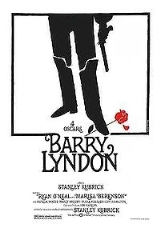
Barry Lyndon is a 1975 British-American period romantic
war film
produced, written, and directed by Stanley Kubrick
based on the 1844 novel The Luck of Barry Lyndon
by William Makepeace Thackeray
which recounts the exploits of an 18th century Irish adventurer. Ryan O'Neal
stars as Barry Lyndon.
The film had a modest commercial success and a mixed critical reception; now it is seen as one of Kubrick's finest films. It was part of Time magazine
's poll of the 100 best films as well as the Village Voice poll conducted in 1999 and was ranked #27 in Sight and Sounds 2002 film critics poll. Director Martin Scorsese
has cited Barry Lyndon as his favorite Kubrick film. Quotations from it appeared in such disparate works as Ridley Scott
's The Duellists
, Martin Scorsese
's The Age of Innocence
, Wes Anderson
's Rushmore
and Lars von Trier
's Dogville
.
An omniscient narrator (voice of Michael Horton
)informs us that in 1750s Ireland, the father of Redmond Barry (Ryan O'Neal
) is killed in a duel over a disputed horse sale. The widow (Marie Kean
), disdaining offers of marriage, devotes herself to her only son.
At a teenager, Barry falls in love with his older cousin, Nora Brady (Gay Hamilton
). She seduces him, but when the well-off English Captain John Quin (Leonard Rossiter
) appears, Barry, who has no money, is dropped. Nora and her family plan to relieve their poverty with an advantageous marriage. Barry refuses to accept the situation and shoots Quin in a duel
.
Barry flees to Dublin, but en route is robbed of purse and equipment by a famous highwayman
, Captain Feeney (Arthur O'Sullivan
). Broke, he joins the British army where a family friend, Captain Grogan (Godfrey Quigley
), informs him that he did not kill Quin. His pistol was loaded with tow. The duel was stage-managed to get rid of Barry so Quin could marry Nora and repair her family's fortune.
Barry's regiment is sent to France fight in the Seven Years' War
. Grogan is fatally wounded in a skirmish with the French. Barry steals an officer courier's uniform, horse and identity and deserts. En route to Holland, then neutral, he encounters the Prussian, Captain Potzdorf (Hardy Krüger
), who, seeing through his disguise, offers him the choice of being turned back over to the British where he will be shot as a deserter, or enlisting in the Prussian army. Barry enlists in his second army and saves Potzdorf's life in a battle.
After the war ends in 1763, Barry is employed by the Potzdorf's Prussian Police uncle to become the servant of the Chevalier de Balibari (Patrick Magee
), a professional gambler. The Prussians suspect he is a spy and Barry is to verify this. Barry discovers the Chevalier is Irish and they become confederates cheating at cards. When Potzdorf figures this out, he orders the Chevalier to be expelled from the country, but Barry is also able to escape with the help of the Chevalier and they both leave Prussia secretly. For the next few years, Barry and the Chevalier travel the spas and parlors of Europe, profiting from their gambling with Barry enforcing reluctant debtors with a duel.
Seeing that his life is going nowhere, Barry decides to marry into wealth. At a gambing table in Belguim, he encounters the beautiful and wealthy Countess of Lyndon (Marisa Berenson
), has little difficulty seducing her, and after her elderly husband, Sir Charles Lyndon (Frank Middlemass
), dies, marries her.
On marriage (in 1773), Barry takes the Countess' last name and settles in England to enjoy her wealth, still with no money of his own. Lord Bullingdon (Dominic Savage
), Lady Lyndon's 10-year-old son by Sir Charles, does not approve of the marriage and quickly comes to hate Barry, aware that Barry is merely a lower-class adventurer and is not in love with his mother. The Countess bears Barry a son, Bryan Patrick, but the marriage is unhappy: Barry is openly unfaithful and enjoys spending his wife's money while keeping his wife in dull seclusion. He later comes to his senses and apologizes to her.
Some years later, Barry's mother comes to live with him at the Lyndon estate. She warns her son that his position is precarious: If Lady Lyndon were to die, all her wealth would go to Lord Bullingdon (now a young man, played by Leon Vitali
), leaving Barry penniless. Barry's mother advises him to obtain a noble title to protect himself. He cultivates the acquaintance of the influential Lord Wendover (André Morell
) with this goal in mind, spending much money to ingratiate himself to high society. All this effort is wasted, however, for one day during a birthday party for Lady Lyndon, Lord Bullingdon announces his hatred of his stepfather and his intention to leave the family estate for as long as his mother remains married to Barry. Angered, Barry immediately attacks and beats up Bullingdon before the parties' audience. This public display of cruelty loses Barry all the powerful friends he has worked so hard to make and he is shunned socially. Bullingdon makes good on his announcement and leaves the estate and England itself for parts unknown.
In contrast to as badly as he has treated his stepson, Barry proves a compassionate and doting father to Bryan with whom, after Bullingdon's departure, he spends all his time. He cannot refuse his son anything, and even buys Bryan a horse although the boy is too young to ride alone. Concerned, Lady Lyndon makes Bryan promise to ride the horse only when with his father, but the day before his ninth birthday Bryan steals away to ride the horse alone. The horse has not yet been broken and throws Bryan to the ground; he dies a few days later from his injuries. The grief-stricken Barry turns to drink, while Lady Lyndon seeks solace in religion assisted by the Reverend Samuel Runt (Murray Melvin
), tutor first to Lord Bullingdon and then to Bryan. Left in charge of the families' affairs while Barry and Lady Lyndon grieve, Barry's mother dismisses the Reverend, both because the family no longer needs (nor can afford, due to Barry's debts) a tutor and for fear that his influence is making Lady Lyndon worse. Plunging even deeper into grief, Lady Lyndon later attempts suicide by taking pills; the Reverend and the family's accountant and emissary Graham (Philip Stone
) seek out Lord Bullingdon. Upon hearing of these events, Lord Bullingdon returns to England and after fining Barry in a local tavern and getting drunk instead of being with Lady Lyondon, challenges Barry to a duel.
Inside a barn where the duel is held, a coin flip gives Bullingdon the privilege of first fire, but his pistol misfires. Barry, reluntant to shoot Bullington, magnanimously fires into the ground
, but the unmoved Bullingdon refuses to let the duel end; He is allowed a second shot and this time he hits Barry in his right leg. A surgeon later informs Barry that the leg will need to be amputated below the knee if he is to survive.
While Barry is recovering, Bullingdon takes control of the estate. He sends a very nervous Graham to the cottage where Barry is recovering to offer him a deal: Bullingdon will grant Barry an annuity
of 500 guineas for life on the conditions that he leave England forever and end his marriage to Lady Lyndon. Otherwise, with his credit and bank accounts exhausted, Barry's creditors and bill collectors will see to it that he is jailed. Wounded in spirit and body, Barry accepts. He goes first to Ireland with his mother, then to the European continent to resume his former profession of gambler, though without his former success. He never sees Lady Lyndon again. The final scene (set in 1789) shows the middle-aged Lady Lyndon signing Barry's annuity cheque as Bullingdon looks on.
One last title card closes the film:
Critic Tim Robey suggests, that the film "makes you realise that the most undervalued aspect of Kubrick's genius could well be his way with actors." He adds that the supporting cast
is a "glittering procession of cameo
s, not from star names but from vital character players."
The cast featured Leon Vitali as the older Lord Bullingdon, who would then become Kubrick's personal assistant
, working as the casting director on his following films, and supervising film-to-video transfers for Kubrick. Their relationship lasted until Kubrick's death. The film's cinematographer, John Alcott
, appears at the men's club in the non-speaking role of the man asleep in a chair near the title character when Lord Bullingdon challenges Barry to a duel. Kubrick's daughter Vivian
also appears (in an uncredited role) as a guest at Bryan's birthday party.
Kubrick stalwarts Patrick Magee
(who had played the handicapped writer in A Clockwork Orange
) and Philip Stone
(who had played Alex's father in A Clockwork Orange, and would go on to play the dead caretaker Grady in The Shining
) also featured as the Chevalier du Balibari and the Lyndon family lawyer respectively.
, Kubrick made plans for a film about Napoleon Bonaparte
. During pre-production, however, Sergei Bondarchuk
and Dino De Laurentiis
' Waterloo was released and subsequently failed at the box office. As a result, Kubrick's financiers pulled their funding for the film. He was furious, having put considerable time and effort into the development of the Napoleon project. Left with no alternative, he turned his attention to his next film, A Clockwork Orange
. Subsequently, Kubrick showed an interest in Thackeray's Vanity Fair but dropped the project when a serialised version for television was produced. He told an interviewer, "At one time, Vanity Fair interested me as a possible film but, in the end, I decided the story could not be successfully compressed into the relatively short time-span of a feature film...as soon as I read Barry Lyndon I became very excited about it."
Having garnered Oscar nominations for Dr Strangelove, 2001: A Space Odyssey and A Clockwork Orange, Kubrick's reputation in the early 1970s was that of "a perfectionist auteur who loomed larger over his movies than any concept or star." His studio—Warner Bros.—was therefore "eager to bankroll" his next project, which Kubrick kept "shrouded in secrecy" from the press partly due to the furor surrounding the controversially violent A Clockwork Orange (particularly in the UK) and partly due to his "long-standing paranoia
about the tabloid press."
Having felt compelled to set aside his plans for a film about Napoleon Bonaparte, Kubrick set his sights on Thackeray's 1844 "satirical
picaresque about the fortune-hunting of an Irish rogue," Barry Lyndon, the setting of which allowed Kubrick to take advantage of the copious period research Kubrick had done for the now-aborted Napoleon. At the time, Kubrick merely announced only that his next film would star Ryan O'Neal
(deemed "a seemingly un-Kubricky choice of leading man") and Marisa Berenson
, a former Vogue
and Time
magazine cover model, and be shot largely in Ireland. So heightened was the secrecy surrounding the film that "Even Berenson, when Kubrick first approached her, was told only that it was to be an 18th-century costume piece [and] she was instructed to keep out of the sun in the months before production, to achieve the period-specific pallor he required."
Many of the film's exteriors were shot in Ireland, playing "itself, England, and Prussia
during the Seven Years' War
." Drawing inspiration from "the landscapes of Watteau and Gainsborough
," Kubrick and cinematographer Alcott also relied on the "scrupulously researched art direction
" of Ken Adam
and Roy Walker
. Alcott, Adam and Walker would be among those who would win Oscars for their "amazing work" on the film.
Several of the interior scenes were filmed in Powerscourt House, a famous 18th century mansion in County Wicklow
, Republic of Ireland
. The house was destroyed in an accidental fire several months after filming (November 1974), so the film serves as a record of the lost interiors, particularly the "Saloon" which was used for more than one scene. The Wicklow Mountains
are visible, for example, through the window of the Saloon during a scene set in Berlin. Other locations included Blenheim Palace
, Castle Howard
(exteriors of the Lyndon estate), Corsham Court
(various interiors and the music room scene), Petworth House
(chapel, and so on.), Stourhead
(lake and temple), Longleat
, and Wilton House
(interior and exterior) in England, Dunrobin Castle
(exterior and garden as Spa
) in Scotland, Dublin Castle
in Ireland (the chevalier's home), Ludwigsburg Palace
near Stuttgart
and Frederick the Great's Neues Palais
at Potsdam
near Berlin
(suggesting Berlin's main street Unter den Linden
as construction in Potsdam had just begun in 1763). Some exterior shots were also filmed at Waterford Castle (now a luxury hotel and golf course) and Island
. Moorstown Castle
in Tipperary
also featured.
, Barry Lyndon saw a considerable number of sequences shot "without recourse to electric light." Cinematography
was overseen by director of photography John Alcott
(who won an Oscar for his work), and is particularly noted for the technical innovations that made some of its most spectacular images possible. To achieve photography without electric lighting "[f]or the many densely furnished interior scenes... meant shooting by candle
light," which is known to be difficult in still photography
, "let alone with moving images."
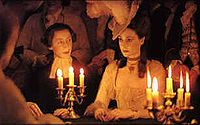 Kubrick was "determined not to reproduce the set-bound, artificially lit look of other costume drama
s from that time." After "tinker[ing] with different combinations of lenses
and film stock
," the production got hold of three "super-fast 50mm" lenses "developed by Zeiss for use by NASA
in the Apollo moon landings," which Kubrick had discovered in his search for low-light solutions. These super-fast lenses "with their huge aperture (the film actually features the lowest f/stop in film history) and fixed focal length
" were problematic to mount, and were extensively modified into three versions by Cinema Products Corp. for Kubrick so to gain a wider angle of view, with input from optics expert Richard Vetter of Todd-AO
. This allowed Kubrick and Alcott to shoot scenes lit with actual candles to an average lighting volume of only three candela
, "recreating the huddle and glow of a pre-electrical age."
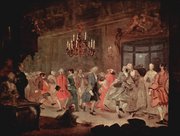
Although Kubrick's express desire was to avoid electric lighting where possible, most shots were achieved with conventional lenses and lighting, but were lit to deliberately mimic natural light rather than for compositional reasons. In addition to potentially seeming more realistic, these methods also gave a particular period look to the film which has often been likened to 18th century paintings (which were, of course, depicting a world devoid of electric lighting), in particular owing "a lot to William Hogarth
, with whom Thackeray had always been fascinated."
 According to critic Tim Robey, the film has a "stately, painterly, often determinedly static quality." For example, to help light some interior scenes, lights were placed outside and aimed through the windows, which were covered in a diffuse material to scatter the light evenly through the room rather than being placed inside for maximum use as most conventional films do. A sign of this method occurs in the scene where Barry duels Lord Bullingdon. Though it appears to be lit entirely with natural light, one can see that the light coming in through the cross-shaped windows in the barn appears blue in color, while the main lighting of the scene coming in from the side is not. This is because the light through the cross-shaped windows is daylight from the sun, which when recorded on the film stock used by Kubrick showed up as blue-tinted compared to the incandescent electric light coming in from the side.
Despite such slight tinting effects, this method of lighting not only gave the look of natural daylight coming in through the windows, but it also protected the historic locations from the damage caused by mounting the lights on walls or ceilings and the heat from the lights. This helped the film "fit... perfectly with Kubrick's gilded-cage aesthetic - the film is consciously a museum piece, its characters pinned to the frame like butterflies."
(an arrangement of the Concerto for violin and oboe in C minor), Frederick the Great (Hohenfriedberger Marsch), Antonio Vivaldi
(Cello Concerto in E-Minor, a transcription of the Cello Sonata in E Minor RV 40), Giovanni Paisiello
, Wolfgang Amadeus Mozart
, and Franz Schubert
(German Dance No. 1 in C major, Piano Trio in E-Flat, Opus 100
and Impromptu No. 1 in C minor). The piece most associated with the film, however, is the main title music: George Frideric Handel
's stately Sarabande
from the Suite in D minor HWV 437
. Originally for solo harpsichord
, the versions for the main and end titles are performed very romantically
with orchestral strings, harpsichord, and timpani
. It is used at various points in the film, in various arrangements, to indicate the implacable working of impersonal fate.
The score also includes Irish folk music
arranged by Paddy Moloney
and performed by The Chieftains
. Another very famous piece in the soundtrack is called Women of Ireland
, by Seán Ó Riada
, played by The Chieftains.
had been hoping for" within the United States, although it fared better in Europe. This mixed reaction saw the film (in the words of one retrospective review) "greeted, on its release, with dutiful admiration – but not love. Critics... rail[ed] against the perceived coldness of Kubrick's style, the film's self-conscious artistry and slow pace. Audiences, on the whole, rather agreed..." This "air of disappointment" factored into Kubrick's decision to next film Stephen King
's The Shining
– a project that would not only please him artistically, but also be more likely to succeed financially. Still, several other critics, including Gene Siskel
, praised the film's technical quality and strong narrative, and Siskel himself counted it as one of the five best films of the year.
Roger Ebert
added this film to his 'Great Movies' list on September 9, 2009, writing, "It defies us to care, it asks us to remain only observers of its stately elegance", and it "must be one of the most beautiful films ever made."
Actor Alec Baldwin
has described Barry Lyndon as "Kubrick's most colorful film", adding, “With its stunning imagery, you almost forget that it’s three hours long.”
for Best Art Direction
(Ken Adam
, Roy Walker
, Vernon Dixon
), Best Cinematography
(John Alcott
), Best Costume Design
(Milena Canonero
, Ulla-Britt Söderlund) and Best Musical Score
(Leonard Rosenman
, "for his arrangements of Schubert and Handel
".) Kubrick was nominated three times, for Best Director, Best Picture
, and Best Adapted Screenplay
.
Kubrick won the British Academy of Film and Television Arts
Award for Best Direction
. John Alcott won for Best Cinematography
. Barry Lyndon was also nominated for Best Film
, Art Direction, and Costume Design
.
's The Luck of Barry Lyndon
(republished as the novel Memoirs of Barry Lyndon, Esq.), a picaresque tale written and published in serial form in 1844. The serial, which is told in the first person and "edited" by the fictional George Savage FitzBoodle, concerns a member of the Irish gentry
trying to become a member of the English aristocracy.
The source novel is written by Lyndon while imprisoned looking back on his life. Lyndon is a notable example of the literary device of the unreliable narrator
– throughout the novel the reader is constantly asked to question the veracity of the events described by him. Although later editions dropped the frame device of FitzBoodle's (Thackeray's pseudonym) editions, it is crucial in unmasking Lyndon's narcissism
through occasional notes inserted at the bottom of the page noting information that is contradictory or inconsistent in relation to what Lyndon writes elsewhere. As Andrew Sanders argues in his introduction for the Oxford Classics edition, these annotations were relevant to the novel as an ingenious narrative device as Thackeray constantly invites the reader to question Lyndon's version of the events.
Kubrick however felt that using a first-person narrative would not be useful in a film adaptation:
As in the case of most literary adaptations, Kubrick shortens or in some cases omits characters who were significant in the novel. The time period constituting his escape from the Prussian army to his marriage is given greater detail in the novel than the film.
It is also interesting to note that the film ends much before the novel's ending. At the end of the film, Barry Lyndon survives with an amputated leg from a duel (an incident absent in the novel) and returns to his gambling lifestyle with lesser success while Lady Lyndon pays the debts accumulated during her marriage to Barry, including the sum promised to Redmond in return for leaving the country. Though these events occur in the novel as well, Thackeray also writes that upon Lady Lyndon's death, the sum promised to Barry is cancelled and he becomes destitute eventually winding up in prison for his confidence schemes. It is at this place where Barry writes his memoirs, which end noting that he has to 'eke out a miserable existence, quite unworthy of the famous and fashionable Barry Lyndon'.
At this point Fitz-Boodle writes an epilogue of sorts about Barry's final days, where his only visitor is his mother. He dies after spending 19 years in prison.
Thackeray based the novel on the life and exploits of the Irish rakehell
and fortunehunter Andrew Robinson Stoney
, who married (and subsequently was divorced by) Mary Eleanor Bowes
, the Countess of Strathmore, who became known as "The Unhappy Countess" due to the tempestuous liaison.
The revised version, which is the novel that the world generally knows as Barry Lyndon, was shorter and tighter than the original serialization, and dropped the FitzBoodle, Ed. device. It generally is considered the first "novel without a hero" or novel with an antihero in the English language. Upon its publication in 1856, it was entitled by Thackeray's publisher The Memoirs of Barry Lyndon, Esq. Of The Kingdom Of Ireland Containing An Account of His Extraordinary Adventures; Misfortunes; His Sufferings In The Service Of His Late Prussian Majesty; His Visits To Many Courts of Europe; His Marriage and Splendid Establishments in England And Ireland; And The Many Cruel Persecutions, Conspiracies And Slanders Of Which He Has Been A Victim.
Barry Lyndon departs from its source novel in several ways. In Thackeray's writings, events are related in the first person by Barry himself. A comic tone pervades the work, as Barry proves both a raconteur and an unreliable narrator. Kubrick's film, by contrast, presents the story objectively. Though the film contains voice-over (by actor Michael Hordern
), the comments expressed are not Barry's, but those of an omniscient, although not entirely impartial, narrator. This change in perspective alters the tone of the story; Thackeray tells a jaunty, humorous tale, but Kubrick's telling is essentially tragic
, with many subtle humorous jabs toward 18th century society, such as how Barry tries to learn the correct behavior for a gentleman, and pays a huge price when he does so.
Kubrick also changed the plot. The novel does not include a final duel. By adding this episode, Kubrick establishes dueling as the film's central motif: the film begins with a duel where Barry's father is shot dead, and duels recur throughout the film. Also, in Thackeray's novel, the Chevalier de Balibari (played by Patrick Magee in the film) is Barry's long-lost uncle ("Balibari" being a gentrified version of "Bally Barry," the family's home), and by marrying into the Lyndons, Barry intends to regain his family fortune (his ancestors were dispossessed by the Lyndons). In the film, Kubrick eliminated these familial connections from the story.
Romance film
Romance films are love stories that focus on passion, emotion, and the affectionate involvement of the main characters and the journey that their love takes through courtship or marriage. Romance films make the love story or the search for love the main plot focus...
war film
War film
War films are a film genre concerned with warfare, usually about naval, air or land battles, sometimes focusing instead on prisoners of war, covert operations, military training or other related subjects. At times war films focus on daily military or civilian life in wartime without depicting battles...
produced, written, and directed by Stanley Kubrick
Stanley Kubrick
Stanley Kubrick was an American film director, writer, producer, and photographer who lived in England during most of the last four decades of his career...
based on the 1844 novel The Luck of Barry Lyndon
The Luck of Barry Lyndon
The Luck of Barry Lyndon is a picaresque novel by William Makepeace Thackeray, first published in serial form in 1844, about a member of the Irish gentry trying to become a member of the English aristocracy...
by William Makepeace Thackeray
William Makepeace Thackeray
William Makepeace Thackeray was an English novelist of the 19th century. He was famous for his satirical works, particularly Vanity Fair, a panoramic portrait of English society.-Biography:...
which recounts the exploits of an 18th century Irish adventurer. Ryan O'Neal
Ryan O'Neal
Charles Patrick Ryan O'Neal , better known as Ryan O'Neal, is an American actor best known for his appearances in the ABC nighttime soap opera Peyton Place and for his roles in such films as Paper Moon , Stanley Kubrick's Barry Lyndon , A Bridge Too Far , and Love Story , for which he received...
stars as Barry Lyndon.
The film had a modest commercial success and a mixed critical reception; now it is seen as one of Kubrick's finest films. It was part of Time magazine
Time (magazine)
Time is an American news magazine. A European edition is published from London. Time Europe covers the Middle East, Africa and, since 2003, Latin America. An Asian edition is based in Hong Kong...
's poll of the 100 best films as well as the Village Voice poll conducted in 1999 and was ranked #27 in Sight and Sounds 2002 film critics poll. Director Martin Scorsese
Martin Scorsese
Martin Charles Scorsese is an American film director, screenwriter, producer, actor, and film historian. In 1990 he founded The Film Foundation, a nonprofit organization dedicated to film preservation, and in 2007 he founded the World Cinema Foundation...
has cited Barry Lyndon as his favorite Kubrick film. Quotations from it appeared in such disparate works as Ridley Scott
Ridley Scott
Sir Ridley Scott is an English film director and producer. His most famous films include The Duellists , Alien , Blade Runner , Legend , Thelma & Louise , G. I...
's The Duellists
The Duellists
The Duellists is a 1977 historical drama film that was Ridley Scott's first feature film as a director. It won the Best Debut Film award at the 1977 Cannes Film Festival...
, Martin Scorsese
Martin Scorsese
Martin Charles Scorsese is an American film director, screenwriter, producer, actor, and film historian. In 1990 he founded The Film Foundation, a nonprofit organization dedicated to film preservation, and in 2007 he founded the World Cinema Foundation...
's The Age of Innocence
The Age of Innocence (film)
The Age of Innocence is a 1993 American film adaptation of Edith Wharton's 1920 novel of the same name. The film was released by Columbia Pictures, directed by Martin Scorsese, and stars Daniel Day-Lewis, Michelle Pfeiffer, and Winona Ryder....
, Wes Anderson
Wes Anderson
Wesley Wales Anderson is an American film director, screenwriter, actor, and producer of features, short films and commercials....
's Rushmore
Rushmore (film)
Rushmore is a 1998 comedy-drama film directed by Wes Anderson about an eccentric teenager named Max Fischer , his friendship with rich industrialist Herman Blume , and their mutual love for elementary school teacher Rosemary Cross . The film was co-written by Anderson and Owen Wilson...
and Lars von Trier
Lars von Trier
Lars von Trier is a Danish film director and screenwriter. He is closely associated with the Dogme 95 collective, although his own films have taken a variety of different approaches, and have frequently received strongly divided critical opinion....
's Dogville
Dogville
Dogville is a 2003 drama written and directed by Lars von Trier, and starring Nicole Kidman, Lauren Bacall, Chloë Sevigny, Paul Bettany, Stellan Skarsgård, Udo Kier, and James Caan...
.
Act I
- By What Means Redmond Barry Acquired the Style and Title of Barry Lyndon
An omniscient narrator (voice of Michael Horton
Michael Horton
Michael Scott Horton is Professor of Theology and Apologetics at Westminster Seminary California, editor-in-chief of Modern Reformation magazine, and host of the nationally syndicated radio broadcast, The White Horse Inn. He was formerly the president of Christians United for Reformation , which...
)informs us that in 1750s Ireland, the father of Redmond Barry (Ryan O'Neal
Ryan O'Neal
Charles Patrick Ryan O'Neal , better known as Ryan O'Neal, is an American actor best known for his appearances in the ABC nighttime soap opera Peyton Place and for his roles in such films as Paper Moon , Stanley Kubrick's Barry Lyndon , A Bridge Too Far , and Love Story , for which he received...
) is killed in a duel over a disputed horse sale. The widow (Marie Kean
Marie Kean
Marie Kean was an Irish actress of stage and screen whose career spanned over 40 years.Kean grew up in the village of Rush, County Dublin and was educated at Loreto College, North Great George's Street, Dublin...
), disdaining offers of marriage, devotes herself to her only son.
At a teenager, Barry falls in love with his older cousin, Nora Brady (Gay Hamilton
Gay Hamilton
Gay Hamilton is a Scottish actress. Her filmography notably includes Stanley Kubrick's Barry Lyndon and Ridley Scott's The Duellists. In the late 1960s/early 1970s, she was love interest and later wife of Detective Chief Superintendent John Watt in the TV series Softly, Softly and its Taskforce...
). She seduces him, but when the well-off English Captain John Quin (Leonard Rossiter
Leonard Rossiter
Leonard Rossiter was an English actor known for his roles as Rupert Rigsby, in the British comedy television series Rising Damp , and Reginald Iolanthe Perrin, in The Fall and Rise of Reginald Perrin...
) appears, Barry, who has no money, is dropped. Nora and her family plan to relieve their poverty with an advantageous marriage. Barry refuses to accept the situation and shoots Quin in a duel
Duel
A duel is an arranged engagement in combat between two individuals, with matched weapons in accordance with agreed-upon rules.Duels in this form were chiefly practised in Early Modern Europe, with precedents in the medieval code of chivalry, and continued into the modern period especially among...
.
Barry flees to Dublin, but en route is robbed of purse and equipment by a famous highwayman
Highwayman
A highwayman was a thief and brigand who preyed on travellers. This type of outlaw, usually, travelled and robbed by horse, as compared to a footpad who traveled and robbed on foot. Mounted robbers were widely considered to be socially superior to footpads...
, Captain Feeney (Arthur O'Sullivan
Arthur O'Sullivan
Arthur O'Sullivan , also known as Archie O'Sullivan, was an Irish actor who appeared on stage, screen and radio.- Radio career:...
). Broke, he joins the British army where a family friend, Captain Grogan (Godfrey Quigley
Godfrey Quigley
Godfrey Quigley was an Irish stage, film and television actor.Quigley was born in Jerusalem where his father served as an officer in the British Army...
), informs him that he did not kill Quin. His pistol was loaded with tow. The duel was stage-managed to get rid of Barry so Quin could marry Nora and repair her family's fortune.
Barry's regiment is sent to France fight in the Seven Years' War
Seven Years' War
The Seven Years' War was a global military war between 1756 and 1763, involving most of the great powers of the time and affecting Europe, North America, Central America, the West African coast, India, and the Philippines...
. Grogan is fatally wounded in a skirmish with the French. Barry steals an officer courier's uniform, horse and identity and deserts. En route to Holland, then neutral, he encounters the Prussian, Captain Potzdorf (Hardy Krüger
Hardy Krüger
Hardy Krüger is a German actor. He is thought of as one of the greatest German actors of the 1960s. He was born in Wedding, Berlin, German Reich...
), who, seeing through his disguise, offers him the choice of being turned back over to the British where he will be shot as a deserter, or enlisting in the Prussian army. Barry enlists in his second army and saves Potzdorf's life in a battle.
After the war ends in 1763, Barry is employed by the Potzdorf's Prussian Police uncle to become the servant of the Chevalier de Balibari (Patrick Magee
Patrick Magee (actor)
Patrick Magee was a Northern Irish actor best known for his collaborations with Samuel Beckett and Harold Pinter, as well as his appearances in horror films and in Stanley Kubrick's films A Clockwork Orange and Barry Lyndon.-Early life:He was born Patrick McGee in Armagh, County Armagh, Northern...
), a professional gambler. The Prussians suspect he is a spy and Barry is to verify this. Barry discovers the Chevalier is Irish and they become confederates cheating at cards. When Potzdorf figures this out, he orders the Chevalier to be expelled from the country, but Barry is also able to escape with the help of the Chevalier and they both leave Prussia secretly. For the next few years, Barry and the Chevalier travel the spas and parlors of Europe, profiting from their gambling with Barry enforcing reluctant debtors with a duel.
Seeing that his life is going nowhere, Barry decides to marry into wealth. At a gambing table in Belguim, he encounters the beautiful and wealthy Countess of Lyndon (Marisa Berenson
Marisa Berenson
Vittoria Marisa Schiaparelli Berenson is an American actress and model.-Early life:She is the elder daughter of Robert L. Berenson, an American diplomat turned shipping executive, who was of Lithuanian Jewish descent; his family's original surname was Valvrojenski...
), has little difficulty seducing her, and after her elderly husband, Sir Charles Lyndon (Frank Middlemass
Frank Middlemass
Francis George Middlemass was an English actor, who even in his early career played older roles. He is best remembered for his television roles as Rocky Hardcastle in As Time Goes By, Algy Herries in To Serve Them All My Days and Dr. Alex Ferrenby in Heartbeat...
), dies, marries her.
Act II
- Containing an Account of the Misfortunes and Disasters Which Befell Barry Lyndon
On marriage (in 1773), Barry takes the Countess' last name and settles in England to enjoy her wealth, still with no money of his own. Lord Bullingdon (Dominic Savage
Dominic Savage
Dominic Savage is a BAFTA-award-winning director, writer and actor who was born in 1962 in Margate.Originally a child actor — making several television appearances and featuring in Stanley Kubrick's Barry Lyndon — Savage moved into writing and directing in his mid-thirties, going on to win BAFTAs...
), Lady Lyndon's 10-year-old son by Sir Charles, does not approve of the marriage and quickly comes to hate Barry, aware that Barry is merely a lower-class adventurer and is not in love with his mother. The Countess bears Barry a son, Bryan Patrick, but the marriage is unhappy: Barry is openly unfaithful and enjoys spending his wife's money while keeping his wife in dull seclusion. He later comes to his senses and apologizes to her.
Some years later, Barry's mother comes to live with him at the Lyndon estate. She warns her son that his position is precarious: If Lady Lyndon were to die, all her wealth would go to Lord Bullingdon (now a young man, played by Leon Vitali
Leon Vitali
Leon Vitali is an English actor, best known for his collaborations with filmmaker Stanley Kubrick, most notably as Lord Bullingdon in Barry Lyndon.- Biography :...
), leaving Barry penniless. Barry's mother advises him to obtain a noble title to protect himself. He cultivates the acquaintance of the influential Lord Wendover (André Morell
André Morell
André Morell was a British actor. He appeared frequently in theatre, film and on television from the 1930s to the 1970s...
) with this goal in mind, spending much money to ingratiate himself to high society. All this effort is wasted, however, for one day during a birthday party for Lady Lyndon, Lord Bullingdon announces his hatred of his stepfather and his intention to leave the family estate for as long as his mother remains married to Barry. Angered, Barry immediately attacks and beats up Bullingdon before the parties' audience. This public display of cruelty loses Barry all the powerful friends he has worked so hard to make and he is shunned socially. Bullingdon makes good on his announcement and leaves the estate and England itself for parts unknown.
In contrast to as badly as he has treated his stepson, Barry proves a compassionate and doting father to Bryan with whom, after Bullingdon's departure, he spends all his time. He cannot refuse his son anything, and even buys Bryan a horse although the boy is too young to ride alone. Concerned, Lady Lyndon makes Bryan promise to ride the horse only when with his father, but the day before his ninth birthday Bryan steals away to ride the horse alone. The horse has not yet been broken and throws Bryan to the ground; he dies a few days later from his injuries. The grief-stricken Barry turns to drink, while Lady Lyndon seeks solace in religion assisted by the Reverend Samuel Runt (Murray Melvin
Murray Melvin
Murray Melvin is an English stage and film actor.The son of Hugh Victor Melvin and Maisie Winifred Driscoll, he is best known for having created the role of Geoffrey in the Shelagh Delaney play, A Taste of Honey, a role which he recreated opposite Rita Tushingham in the 1961 film of the same name...
), tutor first to Lord Bullingdon and then to Bryan. Left in charge of the families' affairs while Barry and Lady Lyndon grieve, Barry's mother dismisses the Reverend, both because the family no longer needs (nor can afford, due to Barry's debts) a tutor and for fear that his influence is making Lady Lyndon worse. Plunging even deeper into grief, Lady Lyndon later attempts suicide by taking pills; the Reverend and the family's accountant and emissary Graham (Philip Stone
Philip Stone
Philip Stone was an English actor.He was born Philip Stones in Leeds, West Yorkshire. Stone appeared in three successive Stanley Kubrick films: playing the central character's "Dad" in A Clockwork Orange , "Graham" in Barry Lyndon and as "Delbert Grady," the original caretaker in The Shining...
) seek out Lord Bullingdon. Upon hearing of these events, Lord Bullingdon returns to England and after fining Barry in a local tavern and getting drunk instead of being with Lady Lyondon, challenges Barry to a duel.
Inside a barn where the duel is held, a coin flip gives Bullingdon the privilege of first fire, but his pistol misfires. Barry, reluntant to shoot Bullington, magnanimously fires into the ground
Delope
Delope is the practice of throwing away one's first fire in a duel, in an attempt to abort the conflict. According to most traditions the deloper must first allow his opponent the opportunity to fire after the command is issued by the secondary, without hinting at his intentions...
, but the unmoved Bullingdon refuses to let the duel end; He is allowed a second shot and this time he hits Barry in his right leg. A surgeon later informs Barry that the leg will need to be amputated below the knee if he is to survive.
While Barry is recovering, Bullingdon takes control of the estate. He sends a very nervous Graham to the cottage where Barry is recovering to offer him a deal: Bullingdon will grant Barry an annuity
Life annuity
A life annuity is a financial contract in the form of an insurance product according to which a seller — typically a financial institution such as a life insurance company — makes a series of future payments to a buyer in exchange for the immediate payment of a lump sum or a series...
of 500 guineas for life on the conditions that he leave England forever and end his marriage to Lady Lyndon. Otherwise, with his credit and bank accounts exhausted, Barry's creditors and bill collectors will see to it that he is jailed. Wounded in spirit and body, Barry accepts. He goes first to Ireland with his mother, then to the European continent to resume his former profession of gambler, though without his former success. He never sees Lady Lyndon again. The final scene (set in 1789) shows the middle-aged Lady Lyndon signing Barry's annuity cheque as Bullingdon looks on.
One last title card closes the film:
- EpilogueEpilogueAn epilogue, epilog or afterword is a piece of writing at the end of a work of literature or drama, usually used to bring closure to the work...
...It was in the reign of King George III that the aforesaid personages lived and quarreled; good or bad, handsome or ugly, rich or poor, they are all equal now.
Cast
- Ryan O'NealRyan O'NealCharles Patrick Ryan O'Neal , better known as Ryan O'Neal, is an American actor best known for his appearances in the ABC nighttime soap opera Peyton Place and for his roles in such films as Paper Moon , Stanley Kubrick's Barry Lyndon , A Bridge Too Far , and Love Story , for which he received...
as Redmond Barry/Barry Lyndon - Marisa BerensonMarisa BerensonVittoria Marisa Schiaparelli Berenson is an American actress and model.-Early life:She is the elder daughter of Robert L. Berenson, an American diplomat turned shipping executive, who was of Lithuanian Jewish descent; his family's original surname was Valvrojenski...
as Lady Lyndon - Patrick MageePatrick Magee (actor)Patrick Magee was a Northern Irish actor best known for his collaborations with Samuel Beckett and Harold Pinter, as well as his appearances in horror films and in Stanley Kubrick's films A Clockwork Orange and Barry Lyndon.-Early life:He was born Patrick McGee in Armagh, County Armagh, Northern...
as The Chevalier de Balibari - Hardy KrügerHardy KrügerHardy Krüger is a German actor. He is thought of as one of the greatest German actors of the 1960s. He was born in Wedding, Berlin, German Reich...
as Captain Potzdorf - Gay HamiltonGay HamiltonGay Hamilton is a Scottish actress. Her filmography notably includes Stanley Kubrick's Barry Lyndon and Ridley Scott's The Duellists. In the late 1960s/early 1970s, she was love interest and later wife of Detective Chief Superintendent John Watt in the TV series Softly, Softly and its Taskforce...
as Nora Brady - Godfrey QuigleyGodfrey QuigleyGodfrey Quigley was an Irish stage, film and television actor.Quigley was born in Jerusalem where his father served as an officer in the British Army...
as Captain Grogan - Steven BerkoffSteven BerkoffSteven Berkoff is an English actor, writer and director. Best known for his performance as General Orlov in the James Bond film Octopussy, he is typically cast in villanous roles, such as Lt...
as Lord Ludd - Marie KeanMarie KeanMarie Kean was an Irish actress of stage and screen whose career spanned over 40 years.Kean grew up in the village of Rush, County Dublin and was educated at Loreto College, North Great George's Street, Dublin...
as Belle, Barry's mother - Murray MelvinMurray MelvinMurray Melvin is an English stage and film actor.The son of Hugh Victor Melvin and Maisie Winifred Driscoll, he is best known for having created the role of Geoffrey in the Shelagh Delaney play, A Taste of Honey, a role which he recreated opposite Rita Tushingham in the 1961 film of the same name...
as Reverend Samuel Runt - Frank MiddlemassFrank MiddlemassFrancis George Middlemass was an English actor, who even in his early career played older roles. He is best remembered for his television roles as Rocky Hardcastle in As Time Goes By, Algy Herries in To Serve Them All My Days and Dr. Alex Ferrenby in Heartbeat...
as Sir Charles Reginald Lyndon - Leon VitaliLeon VitaliLeon Vitali is an English actor, best known for his collaborations with filmmaker Stanley Kubrick, most notably as Lord Bullingdon in Barry Lyndon.- Biography :...
as Lord Bullingdon- Dominic SavageDominic SavageDominic Savage is a BAFTA-award-winning director, writer and actor who was born in 1962 in Margate.Originally a child actor — making several television appearances and featuring in Stanley Kubrick's Barry Lyndon — Savage moved into writing and directing in his mid-thirties, going on to win BAFTAs...
as young Bullingdon
- Dominic Savage
- Leonard RossiterLeonard RossiterLeonard Rossiter was an English actor known for his roles as Rupert Rigsby, in the British comedy television series Rising Damp , and Reginald Iolanthe Perrin, in The Fall and Rise of Reginald Perrin...
as Captain John Quin - André MorellAndré MorellAndré Morell was a British actor. He appeared frequently in theatre, film and on television from the 1930s to the 1970s...
as Lord Wendover - David Morley as Bryan Patrick Lyndon
- Michael HordernMichael HordernSir Michael Murray Hordern was an English actor, knighted in 1983 for his services to the theatre, which stretched back to before the Second World War.-Personal life:...
as Narrator - Diana KörnerDiana KörnerDiana Körner is a German actress. She is probably best known outside Germany for her brief character in Stanley Kubrick's period film Barry Lyndon.-Selected filmography:...
as Lieschen (German Girl) - Arthur O'SullivanArthur O'SullivanArthur O'Sullivan , also known as Archie O'Sullivan, was an Irish actor who appeared on stage, screen and radio.- Radio career:...
as Captain Feeny - Billy BoyleBilly BoyleBilly Boyle is an Irish actor on British film, television and stage. He is a veteran of the West-End stage having played leading roles in over 15 hit shows. In his first West-End musical "Maggie May" he was nominated as best newcomer. Gower Champion then chose him to play Barnaby in "Hello Dolly"...
as Seamus Feeny - Anthony SharpAnthony SharpAnthony Sharp was an English actor cast for roles on television and film principally from the 1950s onwards....
as Lord Hallam
Critic Tim Robey suggests, that the film "makes you realise that the most undervalued aspect of Kubrick's genius could well be his way with actors." He adds that the supporting cast
Supporting character
A supporting character is a character of a book, play, video game, movie, television or radio show or other form of storytelling usually used to give added dimension to a main character, by adding a relationship with this character...
is a "glittering procession of cameo
Cameo appearance
A cameo role or cameo appearance is a brief appearance of a known person in a work of the performing arts, such as plays, films, video games and television...
s, not from star names but from vital character players."
The cast featured Leon Vitali as the older Lord Bullingdon, who would then become Kubrick's personal assistant
Personal assistant
A personal assistant or personal aide is someone who assists in daily business or personal tasks. It is common in design to have a PDA, or personal design assistant....
, working as the casting director on his following films, and supervising film-to-video transfers for Kubrick. Their relationship lasted until Kubrick's death. The film's cinematographer, John Alcott
John Alcott
John Alcott, B.S.C. was an English cinematographer best known for his four collaborations with director Stanley Kubrick; these are 2001: A Space Odyssey , for which he took over as lighting cameraman from Geoffrey Unsworth in mid-shoot, A Clockwork Orange , Barry Lyndon , the film for which he won...
, appears at the men's club in the non-speaking role of the man asleep in a chair near the title character when Lord Bullingdon challenges Barry to a duel. Kubrick's daughter Vivian
Vivian Kubrick
Vivian Vanessa Kubrick is an American-born English filmmaker and composer, known for her work with her father, filmmaker Stanley Kubrick...
also appears (in an uncredited role) as a guest at Bryan's birthday party.
Kubrick stalwarts Patrick Magee
Patrick Magee (actor)
Patrick Magee was a Northern Irish actor best known for his collaborations with Samuel Beckett and Harold Pinter, as well as his appearances in horror films and in Stanley Kubrick's films A Clockwork Orange and Barry Lyndon.-Early life:He was born Patrick McGee in Armagh, County Armagh, Northern...
(who had played the handicapped writer in A Clockwork Orange
A Clockwork Orange (film)
A Clockwork Orange is a 1971 film adaptation of Anthony Burgess's 1962 novel of the same name. It was written, directed and produced by Stanley Kubrick...
) and Philip Stone
Philip Stone
Philip Stone was an English actor.He was born Philip Stones in Leeds, West Yorkshire. Stone appeared in three successive Stanley Kubrick films: playing the central character's "Dad" in A Clockwork Orange , "Graham" in Barry Lyndon and as "Delbert Grady," the original caretaker in The Shining...
(who had played Alex's father in A Clockwork Orange, and would go on to play the dead caretaker Grady in The Shining
The Shining (film)
The Shining is a 1980 psychological horror film produced and directed by Stanley Kubrick, co-written with novelist Diane Johnson, and starring Jack Nicholson, Shelley Duvall, and Danny Lloyd. The film is based on the novel of the same name by Stephen King. A writer, Jack Torrance, takes a job as an...
) also featured as the Chevalier du Balibari and the Lyndon family lawyer respectively.
Development
After 2001: A Space Odyssey2001: A Space Odyssey (film)
2001: A Space Odyssey is a 1968 epic science fiction film produced and directed by Stanley Kubrick, and co-written by Kubrick and Arthur C. Clarke, partially inspired by Clarke's short story The Sentinel...
, Kubrick made plans for a film about Napoleon Bonaparte
Napoleon I of France
Napoleon Bonaparte was a French military and political leader during the latter stages of the French Revolution.As Napoleon I, he was Emperor of the French from 1804 to 1815...
. During pre-production, however, Sergei Bondarchuk
Sergei Bondarchuk
Sergei Fedorovich Bondarchuk was a Soviet film director, screenwriter, and actor.- Biography :Born in Belozerka, in the Kherson Governorate, Sergei Bondarchuk spent his childhood in the cities of Yeysk and Taganrog, graduating from the Taganrog School Number 4 in 1938. His first performance as an...
and Dino De Laurentiis
Dino De Laurentiis
Agostino "Dino" De Laurentiis was an Italian film producer.-Early life:He was born at Torre Annunziata in the province of Naples, and grew up selling spaghetti produced by his father...
' Waterloo was released and subsequently failed at the box office. As a result, Kubrick's financiers pulled their funding for the film. He was furious, having put considerable time and effort into the development of the Napoleon project. Left with no alternative, he turned his attention to his next film, A Clockwork Orange
A Clockwork Orange (film)
A Clockwork Orange is a 1971 film adaptation of Anthony Burgess's 1962 novel of the same name. It was written, directed and produced by Stanley Kubrick...
. Subsequently, Kubrick showed an interest in Thackeray's Vanity Fair but dropped the project when a serialised version for television was produced. He told an interviewer, "At one time, Vanity Fair interested me as a possible film but, in the end, I decided the story could not be successfully compressed into the relatively short time-span of a feature film...as soon as I read Barry Lyndon I became very excited about it."
Having garnered Oscar nominations for Dr Strangelove, 2001: A Space Odyssey and A Clockwork Orange, Kubrick's reputation in the early 1970s was that of "a perfectionist auteur who loomed larger over his movies than any concept or star." His studio—Warner Bros.—was therefore "eager to bankroll" his next project, which Kubrick kept "shrouded in secrecy" from the press partly due to the furor surrounding the controversially violent A Clockwork Orange (particularly in the UK) and partly due to his "long-standing paranoia
Paranoia
Paranoia [] is a thought process believed to be heavily influenced by anxiety or fear, often to the point of irrationality and delusion. Paranoid thinking typically includes persecutory beliefs, or beliefs of conspiracy concerning a perceived threat towards oneself...
about the tabloid press."
Having felt compelled to set aside his plans for a film about Napoleon Bonaparte, Kubrick set his sights on Thackeray's 1844 "satirical
Satire
Satire is primarily a literary genre or form, although in practice it can also be found in the graphic and performing arts. In satire, vices, follies, abuses, and shortcomings are held up to ridicule, ideally with the intent of shaming individuals, and society itself, into improvement...
picaresque about the fortune-hunting of an Irish rogue," Barry Lyndon, the setting of which allowed Kubrick to take advantage of the copious period research Kubrick had done for the now-aborted Napoleon. At the time, Kubrick merely announced only that his next film would star Ryan O'Neal
Ryan O'Neal
Charles Patrick Ryan O'Neal , better known as Ryan O'Neal, is an American actor best known for his appearances in the ABC nighttime soap opera Peyton Place and for his roles in such films as Paper Moon , Stanley Kubrick's Barry Lyndon , A Bridge Too Far , and Love Story , for which he received...
(deemed "a seemingly un-Kubricky choice of leading man") and Marisa Berenson
Marisa Berenson
Vittoria Marisa Schiaparelli Berenson is an American actress and model.-Early life:She is the elder daughter of Robert L. Berenson, an American diplomat turned shipping executive, who was of Lithuanian Jewish descent; his family's original surname was Valvrojenski...
, a former Vogue
Vogue (magazine)
Vogue is a fashion and lifestyle magazine that is published monthly in 18 national and one regional edition by Condé Nast.-History:In 1892 Arthur Turnure founded Vogue as a weekly publication in the United States. When he died in 1909, Condé Montrose Nast picked up the magazine and slowly began...
and Time
Time (magazine)
Time is an American news magazine. A European edition is published from London. Time Europe covers the Middle East, Africa and, since 2003, Latin America. An Asian edition is based in Hong Kong...
magazine cover model, and be shot largely in Ireland. So heightened was the secrecy surrounding the film that "Even Berenson, when Kubrick first approached her, was told only that it was to be an 18th-century costume piece [and] she was instructed to keep out of the sun in the months before production, to achieve the period-specific pallor he required."
Principal photography
Principal photography took 300 days, from spring 1973 through early 1974, with a break for Christmas.Many of the film's exteriors were shot in Ireland, playing "itself, England, and Prussia
Prussia
Prussia was a German kingdom and historic state originating out of the Duchy of Prussia and the Margraviate of Brandenburg. For centuries, the House of Hohenzollern ruled Prussia, successfully expanding its size by way of an unusually well-organized and effective army. Prussia shaped the history...
during the Seven Years' War
Seven Years' War
The Seven Years' War was a global military war between 1756 and 1763, involving most of the great powers of the time and affecting Europe, North America, Central America, the West African coast, India, and the Philippines...
." Drawing inspiration from "the landscapes of Watteau and Gainsborough
Thomas Gainsborough
Thomas Gainsborough was an English portrait and landscape painter.-Suffolk:Thomas Gainsborough was born in Sudbury, Suffolk. He was the youngest son of John Gainsborough, a weaver and maker of woolen goods. At the age of thirteen he impressed his father with his penciling skills so that he let...
," Kubrick and cinematographer Alcott also relied on the "scrupulously researched art direction
Art director
The art director is a person who supervise the creative process of a design.The term 'art director' is a blanket title for a variety of similar job functions in advertising, publishing, film and television, the Internet, and video games....
" of Ken Adam
Ken Adam
Sir Kenneth Adam, OBE, born Klaus Hugo Adam , is a motion picture production designer most famous for his set designs for the James Bond films of the 1960s and 1970s.-Childhood in Germany:...
and Roy Walker
Roy Walker (production designer)
Roy Walker is a production designer. He won an Academy Award and was nominated for two more in the category Best Art Direction.-Selected filmography:Walker won an Academy Award for Best Art Direction and was nominated for two more:Won...
. Alcott, Adam and Walker would be among those who would win Oscars for their "amazing work" on the film.
Several of the interior scenes were filmed in Powerscourt House, a famous 18th century mansion in County Wicklow
County Wicklow
County Wicklow is a county in Ireland. It is part of the Mid-East Region and is also located in the province of Leinster. It is named after the town of Wicklow, which derives from the Old Norse name Víkingalág or Wykynlo. Wicklow County Council is the local authority for the county...
, Republic of Ireland
Republic of Ireland
Ireland , described as the Republic of Ireland , is a sovereign state in Europe occupying approximately five-sixths of the island of the same name. Its capital is Dublin. Ireland, which had a population of 4.58 million in 2011, is a constitutional republic governed as a parliamentary democracy,...
. The house was destroyed in an accidental fire several months after filming (November 1974), so the film serves as a record of the lost interiors, particularly the "Saloon" which was used for more than one scene. The Wicklow Mountains
Wicklow Mountains
The Wicklow Mountains form the largest continuous upland area in Ireland. They occupy the whole centre of County Wicklow and stretch outside its borders into Counties Carlow, Wexford and Dublin. Where the mountains extend into County Dublin, they are known locally as the Dublin Mountains...
are visible, for example, through the window of the Saloon during a scene set in Berlin. Other locations included Blenheim Palace
Blenheim Palace
Blenheim Palace is a monumental country house situated in Woodstock, Oxfordshire, England, residence of the dukes of Marlborough. It is the only non-royal non-episcopal country house in England to hold the title of palace. The palace, one of England's largest houses, was built between...
, Castle Howard
Castle Howard
Castle Howard is a stately home in North Yorkshire, England, north of York. One of the grandest private residences in Britain, most of it was built between 1699 and 1712 for the 3rd Earl of Carlisle, to a design by Sir John Vanbrugh...
(exteriors of the Lyndon estate), Corsham Court
Corsham Court
Corsham Court is an English country house in a park designed by Capability Brown. It is in the town of Corsham, 3 miles west of Chippenham, Wiltshire and is notable for its fine art collection, based on the nucleus of paintings inherited in 1757 by Paul Methuen from his uncle, Sir Paul...
(various interiors and the music room scene), Petworth House
Petworth House
Petworth House in Petworth, West Sussex, England, is a late 17th-century mansion, rebuilt in 1688 by Charles Seymour, 6th Duke of Somerset, and altered in the 1870s by Anthony Salvin...
(chapel, and so on.), Stourhead
Stourhead
Stourhead is a 2,650 acre estate at the source of the River Stour near Mere, Wiltshire, England. The estate includes a Palladian mansion, the village of Stourton, gardens, farmland, and woodland...
(lake and temple), Longleat
Longleat
Longleat is an English stately home, currently the seat of the Marquesses of Bath, adjacent to the village of Horningsham and near the towns of Warminster in Wiltshire and Frome in Somerset. It is noted for its Elizabethan country house, maze, landscaped parkland and safari park. The house is set...
, and Wilton House
Wilton House
Wilton House is an English country house situated at Wilton near Salisbury in Wiltshire. It has been the country seat of the Earls of Pembroke for over 400 years....
(interior and exterior) in England, Dunrobin Castle
Dunrobin Castle
Dunrobin Castle is a stately home in Sutherland, in the Highland area of Scotland. It is the seat of the Countess of Sutherland and the Clan Sutherland. It is located north of Golspie, and approximately south of Brora, on the Dornoch Firth close to the A9 road. Nearby Dunrobin Castle railway...
(exterior and garden as Spa
Spa, Belgium
Spa is a municipality of Belgium. It lies in the country's Walloon Region and Province of Liège. It is situated in a valley in the Ardennes mountain chain, some southeast of Liège, and southwest of Aachen. As of 1 January 2006, Spa had a total population of 10,543...
) in Scotland, Dublin Castle
Dublin Castle
Dublin Castle off Dame Street, Dublin, Ireland, was until 1922 the fortified seat of British rule in Ireland, and is now a major Irish government complex. Most of it dates from the 18th century, though a castle has stood on the site since the days of King John, the first Lord of Ireland...
in Ireland (the chevalier's home), Ludwigsburg Palace
Ludwigsburg Palace
Ludwigsburg Palace is a historical building in the city of Ludwigsburg , Germany. It is one of the country's largest Baroque palaces and features an enormous garden in that style....
near Stuttgart
Stuttgart
Stuttgart is the capital of the state of Baden-Württemberg in southern Germany. The sixth-largest city in Germany, Stuttgart has a population of 600,038 while the metropolitan area has a population of 5.3 million ....
and Frederick the Great's Neues Palais
New Palace (Potsdam)
The New Palace is a palace situated on the western side of the Sanssouci royal park in Potsdam, Germany. The building was begun in 1763, after the end of the Seven Years' War, under Frederick the Great and was completed in 1769...
at Potsdam
Potsdam
Potsdam is the capital city of the German federal state of Brandenburg and part of the Berlin/Brandenburg Metropolitan Region. It is situated on the River Havel, southwest of Berlin city centre....
near Berlin
Berlin
Berlin is the capital city of Germany and is one of the 16 states of Germany. With a population of 3.45 million people, Berlin is Germany's largest city. It is the second most populous city proper and the seventh most populous urban area in the European Union...
(suggesting Berlin's main street Unter den Linden
Unter den Linden
Unter den Linden is a boulevard in the Mitte district of Berlin, the capital of Germany. It is named for its linden trees that line the grassed pedestrian mall between two carriageways....
as construction in Potsdam had just begun in 1763). Some exterior shots were also filmed at Waterford Castle (now a luxury hotel and golf course) and Island
Little Island, Waterford
Little Island is an island on the eastern outskirts of Waterford City in Ireland. Islands are rare within the city and county of Waterford, although it is encircled by the River Suir and Kings Channel rather than the Atlantic Ocean...
. Moorstown Castle
Moorstown Castle
Moorstown Castle is a late 15th century stone structure consisting of a circular keep and walled courtyard or bawn. The circular tower house is unusual in Irish architecture, most such structures being square in plan. It was built by James Keating, an ally of the Earl of Ormond. The castle and...
in Tipperary
County Tipperary
County Tipperary is a county of Ireland. It is located in the province of Munster and is named after the town of Tipperary. The area of the county does not have a single local authority; local government is split between two authorities. In North Tipperary, part of the Mid-West Region, local...
also featured.
Cinematography
The film—as with "almost every Kubrick film"—is a "showcase for [a] major innovation in technique." While 2001: A Space Odyssey had featured "revolutionary effects," and The Shining would later feature heavy use of the SteadicamSteadicam
A Steadicam is a stabilizing mount for a motion picture camera that mechanically isolates it from the operator's movement, allowing a smooth shot even when moving quickly over an uneven surface...
, Barry Lyndon saw a considerable number of sequences shot "without recourse to electric light." Cinematography
Cinematography
Cinematography is the making of lighting and camera choices when recording photographic images for cinema. It is closely related to the art of still photography...
was overseen by director of photography John Alcott
John Alcott
John Alcott, B.S.C. was an English cinematographer best known for his four collaborations with director Stanley Kubrick; these are 2001: A Space Odyssey , for which he took over as lighting cameraman from Geoffrey Unsworth in mid-shoot, A Clockwork Orange , Barry Lyndon , the film for which he won...
(who won an Oscar for his work), and is particularly noted for the technical innovations that made some of its most spectacular images possible. To achieve photography without electric lighting "[f]or the many densely furnished interior scenes... meant shooting by candle
Candle
A candle is a solid block or cylinder of wax with an embedded wick, which is lit to provide light, and sometimes heat.Today, most candles are made from paraffin. Candles can also be made from beeswax, soy, other plant waxes, and tallow...
light," which is known to be difficult in still photography
Photography
Photography is the art, science and practice of creating durable images by recording light or other electromagnetic radiation, either electronically by means of an image sensor or chemically by means of a light-sensitive material such as photographic film...
, "let alone with moving images."
Costume drama
A costume drama or period drama is a period piece in which elaborate costumes, sets and properties are featured in order to capture the ambiance of a particular era.The term is usually used in the context of film and television...
s from that time." After "tinker[ing] with different combinations of lenses
Photographic lens
A camera lens is an optical lens or assembly of lenses used in conjunction with a camera body and mechanism to make images of objects either on photographic film or on other media capable of storing an image chemically or electronically.While in principle a simple convex lens will suffice, in...
and film stock
Film stock
Film stock is photographic film on which filmmaking of motion pictures are shot and reproduced. The equivalent in television production is video tape.-1889–1899:...
," the production got hold of three "super-fast 50mm" lenses "developed by Zeiss for use by NASA
NASA
The National Aeronautics and Space Administration is the agency of the United States government that is responsible for the nation's civilian space program and for aeronautics and aerospace research...
in the Apollo moon landings," which Kubrick had discovered in his search for low-light solutions. These super-fast lenses "with their huge aperture (the film actually features the lowest f/stop in film history) and fixed focal length
Focal length
The focal length of an optical system is a measure of how strongly the system converges or diverges light. For an optical system in air, it is the distance over which initially collimated rays are brought to a focus...
" were problematic to mount, and were extensively modified into three versions by Cinema Products Corp. for Kubrick so to gain a wider angle of view, with input from optics expert Richard Vetter of Todd-AO
Todd-AO
Todd-AO is a post-production company founded in 1953, providing sound-related services to the motion picture and television industries. The company operates three facilities in the Los Angeles area.-History:...
. This allowed Kubrick and Alcott to shoot scenes lit with actual candles to an average lighting volume of only three candela
Candela
The candela is the SI base unit of luminous intensity; that is, power emitted by a light source in a particular direction, weighted by the luminosity function . A common candle emits light with a luminous intensity of roughly one candela...
, "recreating the huddle and glow of a pre-electrical age."
Although Kubrick's express desire was to avoid electric lighting where possible, most shots were achieved with conventional lenses and lighting, but were lit to deliberately mimic natural light rather than for compositional reasons. In addition to potentially seeming more realistic, these methods also gave a particular period look to the film which has often been likened to 18th century paintings (which were, of course, depicting a world devoid of electric lighting), in particular owing "a lot to William Hogarth
William Hogarth
William Hogarth was an English painter, printmaker, pictorial satirist, social critic and editorial cartoonist who has been credited with pioneering western sequential art. His work ranged from realistic portraiture to comic strip-like series of pictures called "modern moral subjects"...
, with whom Thackeray had always been fascinated."
Despite such slight tinting effects, this method of lighting not only gave the look of natural daylight coming in through the windows, but it also protected the historic locations from the damage caused by mounting the lights on walls or ceilings and the heat from the lights. This helped the film "fit... perfectly with Kubrick's gilded-cage aesthetic - the film is consciously a museum piece, its characters pinned to the frame like butterflies."
Music
The film's period setting allowed Kubrick to indulge his penchant for classical music, and the film score uses pieces by Johann Sebastian BachJohann Sebastian Bach
Johann Sebastian Bach was a German composer, organist, harpsichordist, violist, and violinist whose sacred and secular works for choir, orchestra, and solo instruments drew together the strands of the Baroque period and brought it to its ultimate maturity...
(an arrangement of the Concerto for violin and oboe in C minor), Frederick the Great (Hohenfriedberger Marsch), Antonio Vivaldi
Antonio Vivaldi
Antonio Lucio Vivaldi , nicknamed because of his red hair, was an Italian Baroque composer, priest, and virtuoso violinist, born in Venice. Vivaldi is recognized as one of the greatest Baroque composers, and his influence during his lifetime was widespread over Europe...
(Cello Concerto in E-Minor, a transcription of the Cello Sonata in E Minor RV 40), Giovanni Paisiello
Giovanni Paisiello
Giovanni Paisiello was an Italian composer of the Classical era.-Life:Paisiello was born at Taranto and educated by the Jesuits there. He became known for his beautiful singing voice and in 1754 was sent to the Conservatorio di S. Onofrio at Naples, where he studied under Francesco Durante, and...
, Wolfgang Amadeus Mozart
Wolfgang Amadeus Mozart
Wolfgang Amadeus Mozart , baptismal name Johannes Chrysostomus Wolfgangus Theophilus Mozart , was a prolific and influential composer of the Classical era. He composed over 600 works, many acknowledged as pinnacles of symphonic, concertante, chamber, piano, operatic, and choral music...
, and Franz Schubert
Franz Schubert
Franz Peter Schubert was an Austrian composer.Although he died at an early age, Schubert was tremendously prolific. He wrote some 600 Lieder, nine symphonies , liturgical music, operas, some incidental music, and a large body of chamber and solo piano music...
(German Dance No. 1 in C major, Piano Trio in E-Flat, Opus 100
Piano Trio No. 2 (Schubert)
The Trio No. 2 in E-flat major for piano, violin, and violoncello, D. 929, was one of the last compositions completed by Franz Schubert, dated November 1827. It was published by Probst as opus 100 in late 1828, shortly before the composer's death and first performed at a private party in January...
and Impromptu No. 1 in C minor). The piece most associated with the film, however, is the main title music: George Frideric Handel
George Frideric Handel
George Frideric Handel was a German-British Baroque composer, famous for his operas, oratorios, anthems and organ concertos. Handel was born in 1685, in a family indifferent to music...
's stately Sarabande
Sarabande
In music, the sarabande is a dance in triple metre. The second and third beats of each measure are often tied, giving the dance a distinctive rhythm of quarter notes and eighth notes in alternation...
from the Suite in D minor HWV 437
Keyboard suite in D minor (HWV 437)
The Keyboard suite in D minor was composed by George Frideric Handel, for solo keyboard , between 1703 and 1706. It is also referred to as Suite de pièce Vol. 2 No. 4. It was first published in 1733.-Movements:...
. Originally for solo harpsichord
Harpsichord
A harpsichord is a musical instrument played by means of a keyboard. It produces sound by plucking a string when a key is pressed.In the narrow sense, "harpsichord" designates only the large wing-shaped instruments in which the strings are perpendicular to the keyboard...
, the versions for the main and end titles are performed very romantically
Romantic music
Romantic music or music in the Romantic Period is a musicological and artistic term referring to a particular period, theory, compositional practice, and canon in Western music history, from 1810 to 1900....
with orchestral strings, harpsichord, and timpani
Timpani
Timpani, or kettledrums, are musical instruments in the percussion family. A type of drum, they consist of a skin called a head stretched over a large bowl traditionally made of copper. They are played by striking the head with a specialized drum stick called a timpani stick or timpani mallet...
. It is used at various points in the film, in various arrangements, to indicate the implacable working of impersonal fate.
The score also includes Irish folk music
Folk music of Ireland
The folk music of Ireland is the generic term for music that has been created in various genres in Ireland.-History:...
arranged by Paddy Moloney
Paddy Moloney
Paddy Moloney is one of the founders of the Irish musical group The Chieftains and has played on every one of their albums.He was born in Donnycarney in Dublin. His mother bought him a tin whistle when he was six and at the age of eight he started to learn the Uilleann pipes. He also plays button...
and performed by The Chieftains
The Chieftains
The Chieftains are a Grammy-winning Irish musical group founded in 1962, best known for being one of the first bands to make Irish traditional music popular around the world.-Name:...
. Another very famous piece in the soundtrack is called Women of Ireland
Women of Ireland
"Women of Ireland", or "Mná na hÉireann" in Irish, is a song composed by Seán Ó Riada . The poem, on which the music is based, was written by Peadar Ó Dornín . Usually it falls under the category of Irish rebel music...
, by Seán Ó Riada
Seán Ó Riada
Seán Ó Riada , was a composer and perhaps the single most influential figure in the revival of Irish traditional music during the 1960s...
, played by The Chieftains.
Reception
The film "was not the commercial success Warner Bros.Warner Bros.
Warner Bros. Entertainment, Inc., also known as Warner Bros. Pictures or simply Warner Bros. , is an American producer of film and television entertainment.One of the major film studios, it is a subsidiary of Time Warner, with its headquarters in Burbank,...
had been hoping for" within the United States, although it fared better in Europe. This mixed reaction saw the film (in the words of one retrospective review) "greeted, on its release, with dutiful admiration – but not love. Critics... rail[ed] against the perceived coldness of Kubrick's style, the film's self-conscious artistry and slow pace. Audiences, on the whole, rather agreed..." This "air of disappointment" factored into Kubrick's decision to next film Stephen King
Stephen King
Stephen Edwin King is an American author of contemporary horror, suspense, science fiction and fantasy fiction. His books have sold more than 350 million copies and have been adapted into a number of feature films, television movies and comic books...
's The Shining
The Shining (film)
The Shining is a 1980 psychological horror film produced and directed by Stanley Kubrick, co-written with novelist Diane Johnson, and starring Jack Nicholson, Shelley Duvall, and Danny Lloyd. The film is based on the novel of the same name by Stephen King. A writer, Jack Torrance, takes a job as an...
– a project that would not only please him artistically, but also be more likely to succeed financially. Still, several other critics, including Gene Siskel
Gene Siskel
Eugene Kal "Gene" Siskel was an American film critic and journalist for the Chicago Tribune. Along with colleague Roger Ebert, he hosted the popular review show Siskel & Ebert At the Movies from 1975 until his death....
, praised the film's technical quality and strong narrative, and Siskel himself counted it as one of the five best films of the year.
Roger Ebert
Roger Ebert
Roger Joseph Ebert is an American film critic and screenwriter. He is the first film critic to win a Pulitzer Prize for Criticism.Ebert is known for his film review column and for the television programs Sneak Previews, At the Movies with Gene Siskel and Roger Ebert, and Siskel and Ebert and The...
added this film to his 'Great Movies' list on September 9, 2009, writing, "It defies us to care, it asks us to remain only observers of its stately elegance", and it "must be one of the most beautiful films ever made."
Actor Alec Baldwin
Alec Baldwin
Alexander Rae "Alec" Baldwin III is an American actor who has appeared on film, stage, and television.Baldwin first gained recognition through television for his work in the soap opera Knots Landing in the role of Joshua Rush. He was a cast member for two seasons before his character was killed off...
has described Barry Lyndon as "Kubrick's most colorful film", adding, “With its stunning imagery, you almost forget that it’s three hours long.”
Awards
The film received Academy AwardsAcademy Awards
An Academy Award, also known as an Oscar, is an accolade bestowed by the American Academy of Motion Picture Arts and Sciences to recognize excellence of professionals in the film industry, including directors, actors, and writers...
for Best Art Direction
Academy Award for Best Art Direction
The Academy Awards are the oldest awards ceremony for achievements in motion pictures. The Academy Award for Best Art Direction recognizes achievement in art direction on a film. The films below are listed with their production year, so the Oscar 2000 for best art direction went to a film from 1999...
(Ken Adam
Ken Adam
Sir Kenneth Adam, OBE, born Klaus Hugo Adam , is a motion picture production designer most famous for his set designs for the James Bond films of the 1960s and 1970s.-Childhood in Germany:...
, Roy Walker
Roy Walker (production designer)
Roy Walker is a production designer. He won an Academy Award and was nominated for two more in the category Best Art Direction.-Selected filmography:Walker won an Academy Award for Best Art Direction and was nominated for two more:Won...
, Vernon Dixon
Vernon Dixon
Vernon Dixon was a British set decorator. He won three Academy Awards in the category Best Art Direction.-Selected filmography:Dixon won three Academy Awards for Best Art Direction:* Oliver! * Nicholas and Alexandra...
), Best Cinematography
Academy Award for Best Cinematography
The Academy Award for Best Cinematography is an Academy Award awarded each year to a cinematographer for work in one particular motion picture.-History:...
(John Alcott
John Alcott
John Alcott, B.S.C. was an English cinematographer best known for his four collaborations with director Stanley Kubrick; these are 2001: A Space Odyssey , for which he took over as lighting cameraman from Geoffrey Unsworth in mid-shoot, A Clockwork Orange , Barry Lyndon , the film for which he won...
), Best Costume Design
Academy Award for Costume Design
The Academy Award for Best Costume Design is one of the Academy Awards of Merit presented annually by the Academy of Motion Picture Arts and Sciences for achievement in film costume design....
(Milena Canonero
Milena Canonero
Milena Canonero is an Italian costume designer, working both for films and stage productions. She has won three Academy Awards for Best Costume design, and been nominated for it eight times.-Career:...
, Ulla-Britt Söderlund) and Best Musical Score
Academy Award for Original Music Score
The Academy Award for Original Score is presented to the best substantial body of music in the form of dramatic underscoring written specifically for the film by the submitting composer.-Superlatives:...
(Leonard Rosenman
Leonard Rosenman
Leonard Rosenman was an American film, television and concert composer.-Life and career:Leonard Rosenman was born in Brooklyn, New York. After service in the Pacific with the Army Air Forces in World War II, he earned a bachelor's degree in music from the University of California, Berkeley...
, "for his arrangements of Schubert and Handel
HANDEL
HANDEL was the code-name for the UK's National Attack Warning System in the Cold War. It consisted of a small console consisting of two microphones, lights and gauges. The reason behind this was to provide a back-up if anything failed....
".) Kubrick was nominated three times, for Best Director, Best Picture
Academy Award for Best Picture
The Academy Award for Best Picture is one of the Academy Awards of Merit presented annually by the Academy of Motion Picture Arts and Sciences to artists working in the motion picture industry. The Best Picture category is the only category in which every member of the Academy is eligible not only...
, and Best Adapted Screenplay
Academy Award for Writing Adapted Screenplay
The Academy Award for Writing Adapted Screenplay is one of the Academy Awards, the most prominent film awards in the United States. It is awarded each year to the writer of a screenplay adapted from another source...
.
Kubrick won the British Academy of Film and Television Arts
British Academy of Film and Television Arts
The British Academy of Film and Television Arts is a charity in the United Kingdom that hosts annual awards shows for excellence in film, television, television craft, video games and forms of animation.-Introduction:...
Award for Best Direction
BAFTA Award for Best Direction
Winners of the BAFTA Award for Best Direction presented by the British Academy of Film and Television Arts.-2010s:* 2010 - David Fincher – The Social Network** Tom Hooper – The King's Speech** Danny Boyle – 127 Hours...
. John Alcott won for Best Cinematography
BAFTA Award for Best Cinematography
-Best Cinematography - Colour:* 1963 - From Russia with Love - Ted Moore** Nine Hours to Rama – Arthur Ibbetson** The Running Man – Robert Krasker** Sammy Going South – Erwin Hillier** The Scarlet Blade – Jack Asher...
. Barry Lyndon was also nominated for Best Film
BAFTA Award for Best Film
This page lists the winners and nominees for the BAFTA Award for Best Film, BAFTA Award for Best Film not in the English Language and Alexander Korda Award for Best British Film for each year, in addition to the retired earlier versions of those awards...
, Art Direction, and Costume Design
BAFTA Award for Best Costume Design
The British Academy Film Award for Best Costume Design is one of the annual film awards given by the British Academy of Film and Television Arts.-1960s:* 1969 - Oh! What a Lovely War - Anthony Mendleson** Funny Girl – Irene Sharaff...
.
Source novel
Stanley Kubrick based his original screenplay on William Makepeace ThackerayWilliam Makepeace Thackeray
William Makepeace Thackeray was an English novelist of the 19th century. He was famous for his satirical works, particularly Vanity Fair, a panoramic portrait of English society.-Biography:...
's The Luck of Barry Lyndon
The Luck of Barry Lyndon
The Luck of Barry Lyndon is a picaresque novel by William Makepeace Thackeray, first published in serial form in 1844, about a member of the Irish gentry trying to become a member of the English aristocracy...
(republished as the novel Memoirs of Barry Lyndon, Esq.), a picaresque tale written and published in serial form in 1844. The serial, which is told in the first person and "edited" by the fictional George Savage FitzBoodle, concerns a member of the Irish gentry
Gentry
Gentry denotes "well-born and well-bred people" of high social class, especially in the past....
trying to become a member of the English aristocracy.
The source novel is written by Lyndon while imprisoned looking back on his life. Lyndon is a notable example of the literary device of the unreliable narrator
Unreliable narrator
An unreliable narrator is a narrator, whether in literature, film, or theatre, whose credibility has been seriously compromised. The term was coined in 1961 by Wayne C. Booth in The Rhetoric of Fiction. This narrative mode is one that can be developed by an author for a number of reasons, usually...
– throughout the novel the reader is constantly asked to question the veracity of the events described by him. Although later editions dropped the frame device of FitzBoodle's (Thackeray's pseudonym) editions, it is crucial in unmasking Lyndon's narcissism
Narcissism
Narcissism is a term with a wide range of meanings, depending on whether it is used to describe a central concept of psychoanalytic theory, a mental illness, a social or cultural problem, or simply a personality trait...
through occasional notes inserted at the bottom of the page noting information that is contradictory or inconsistent in relation to what Lyndon writes elsewhere. As Andrew Sanders argues in his introduction for the Oxford Classics edition, these annotations were relevant to the novel as an ingenious narrative device as Thackeray constantly invites the reader to question Lyndon's version of the events.
Kubrick however felt that using a first-person narrative would not be useful in a film adaptation:
"I believe Thackeray used Redmond Barry to tell his own story in a deliberately distorted way because it made it more interesting. Instead of the omniscient author, Thackeray used the imperfect observer, or perhaps it would be more accurate to say the dishonest observer, thus allowing the reader to judge for himself, with little difficulty, the probable truth in Redmond Barry's view of his life. This technique worked extremely well in the novel but, of course, in a film you have objective reality in front of you all of the time, so the effect of Thackeray's first-person story-teller could not be repeated on the screen. It might have worked as comedy by the juxtaposition of Barry's version of the truth with the reality on the screen, but I don't think that Barry Lyndon should have been done as a comedy."
As in the case of most literary adaptations, Kubrick shortens or in some cases omits characters who were significant in the novel. The time period constituting his escape from the Prussian army to his marriage is given greater detail in the novel than the film.
It is also interesting to note that the film ends much before the novel's ending. At the end of the film, Barry Lyndon survives with an amputated leg from a duel (an incident absent in the novel) and returns to his gambling lifestyle with lesser success while Lady Lyndon pays the debts accumulated during her marriage to Barry, including the sum promised to Redmond in return for leaving the country. Though these events occur in the novel as well, Thackeray also writes that upon Lady Lyndon's death, the sum promised to Barry is cancelled and he becomes destitute eventually winding up in prison for his confidence schemes. It is at this place where Barry writes his memoirs, which end noting that he has to 'eke out a miserable existence, quite unworthy of the famous and fashionable Barry Lyndon'.
At this point Fitz-Boodle writes an epilogue of sorts about Barry's final days, where his only visitor is his mother. He dies after spending 19 years in prison.
Thackeray based the novel on the life and exploits of the Irish rakehell
Rake (character)
A rake, short for rakehell, is a historic term applied to a man who is habituated to immoral conduct, frequently a heartless womanizer. Often a rake was a man who wasted his fortune on gambling, wine, women and song, incurring lavish debts in the process...
and fortunehunter Andrew Robinson Stoney
Andrew Robinson Stoney
Andrew Robinson Stoney, later renamed Andrew Robinson Stoney Bowes was an Anglo-Irish adventurer who married Mary Eleanor Bowes, the Countess of Strathmore. She became known as "The Unhappy Countess" due to their tempestuous relationship, which ended in scandal...
, who married (and subsequently was divorced by) Mary Eleanor Bowes
Mary Eleanor Bowes
Mary Eleanor Bowes, Countess of Strathmore and Kinghorne , known as "The Unhappy Countess", was the daughter and heiress of George Bowes...
, the Countess of Strathmore, who became known as "The Unhappy Countess" due to the tempestuous liaison.
The revised version, which is the novel that the world generally knows as Barry Lyndon, was shorter and tighter than the original serialization, and dropped the FitzBoodle, Ed. device. It generally is considered the first "novel without a hero" or novel with an antihero in the English language. Upon its publication in 1856, it was entitled by Thackeray's publisher The Memoirs of Barry Lyndon, Esq. Of The Kingdom Of Ireland Containing An Account of His Extraordinary Adventures; Misfortunes; His Sufferings In The Service Of His Late Prussian Majesty; His Visits To Many Courts of Europe; His Marriage and Splendid Establishments in England And Ireland; And The Many Cruel Persecutions, Conspiracies And Slanders Of Which He Has Been A Victim.
Barry Lyndon departs from its source novel in several ways. In Thackeray's writings, events are related in the first person by Barry himself. A comic tone pervades the work, as Barry proves both a raconteur and an unreliable narrator. Kubrick's film, by contrast, presents the story objectively. Though the film contains voice-over (by actor Michael Hordern
Michael Hordern
Sir Michael Murray Hordern was an English actor, knighted in 1983 for his services to the theatre, which stretched back to before the Second World War.-Personal life:...
), the comments expressed are not Barry's, but those of an omniscient, although not entirely impartial, narrator. This change in perspective alters the tone of the story; Thackeray tells a jaunty, humorous tale, but Kubrick's telling is essentially tragic
Tragedy
Tragedy is a form of art based on human suffering that offers its audience pleasure. While most cultures have developed forms that provoke this paradoxical response, tragedy refers to a specific tradition of drama that has played a unique and important role historically in the self-definition of...
, with many subtle humorous jabs toward 18th century society, such as how Barry tries to learn the correct behavior for a gentleman, and pays a huge price when he does so.
Kubrick also changed the plot. The novel does not include a final duel. By adding this episode, Kubrick establishes dueling as the film's central motif: the film begins with a duel where Barry's father is shot dead, and duels recur throughout the film. Also, in Thackeray's novel, the Chevalier de Balibari (played by Patrick Magee in the film) is Barry's long-lost uncle ("Balibari" being a gentrified version of "Bally Barry," the family's home), and by marrying into the Lyndons, Barry intends to regain his family fortune (his ancestors were dispossessed by the Lyndons). In the film, Kubrick eliminated these familial connections from the story.
External links
- Movie trailer
- Barry Lyndon Press Kit
- "Two Special Lenses for Barry Lyndon, Superfast lenses employed in the filming of Barry Lyndon article from American CinematographerAmerican CinematographerAmerican Cinematographer is a monthly magazine published by the American Society of Cinematographers.American Cinematographer focuses on the art and craft of cinematography, going behind the scenes on domestic and international productions of all shapes and sizes...
- "Barry Lyndon Reconsidered" essay by Mark Crispin Miller
- "Kubrick's Anti-Reading Of The Luck Of Barry Lyndon" essay by Mark Crispin Miller
- "Barry Lyndon: The Shape of Things to Come" essay by Bilge EbiriBilge EbiriBilge Ebiri is a Turkish American journalist and filmmaker. He was born in 1973 in York, England. Currently, Ebiri is a film critic for New York Magazine and Nerve.com...
- "Narrative and Discourse in Kubrick's Modern Tragedy" essay by Michael Klein
- "Photographing Stanley Kubrick's Barry Lyndon", interview with John Alcott first published in American CinematographerAmerican CinematographerAmerican Cinematographer is a monthly magazine published by the American Society of Cinematographers.American Cinematographer focuses on the art and craft of cinematography, going behind the scenes on domestic and international productions of all shapes and sizes...
- Stanley Kubrick's letter to projectionists on Barry Lyndon at Some Came Running