

Camelford

Encyclopedia
Camelford is a town and civil parish in north Cornwall
, United Kingdom
, situated in the River Camel
valley northwest of Bodmin Moor
. The town is approximately ten miles (16 km) north of Bodmin
and is governed by Camelford Town Council.
Lanteglos-by-Camelford is the ecclesiastical parish in which the town is situated (not to be confused with Lanteglos-by-Fowey
).
Camelford is in the North Cornwall parliamentary constituency
. Until 1974, the town was the administrative headquarters of Camelford Rural District
.
The two main industrial enterprises in the area are the slate quarry at Delabole
and the cheese factory at Davidstow
but there is a small industrial estate at Highfield.
The A39 road (dubbed 'Atlantic Highway') passes directly through the town centre: a bypass
has been discussed for many years. Camelford Station was some distance from the town and closed in 1966; the site was subsequently used as a cycling
museum.
, and even Camlann, but historians have been quick to refute these suggestions. (Also sometimes to Gafulford the site of a battle which is more likely to have been at Galford
in Devon
.) Nearby Slaughterbridge is supposed to be the site of a battle. The origin of the name is probably from the original name of the river (Allen) in combination with cam- = crooked and the English 'ford', though this is not accepted by all.
The town elected two members to the Unreformed House of Commons
: the first MPs sat in the Parliament of 1552. It was later considered a rotten borough
and its franchise was abolished in 1832: the article Camelford (UK Parliament constituency)
provides more information.
The seal of the borough shows: Arg. a camel passing through a ford of water all proper with legend "Sigillum Vill: de Camelford".
on Bodmin Moor
. An independent inquiry into the incident
(the worst of its kind in British history) was started in 2002, and a draft report issued in January 2005, but questions still remain as to the long-term effects on the health of local residents. Michael Meacher
, who visited Camelford in his post as environment minister, called the incident and its aftermath, "A most unbelievable scandal."
(it is recorded in 1312). The Rector of Lanteglos is also responsible for the adjacent parish of Advent
.
In Market Place is the Methodist Church (originally a Wesleyan Methodist Chapel). The founder of Methodism
, John Wesley
, visited Camelford on several occasions during his journeys in Cornwall. In the 1830s and 1840s the Camelford Wesleyan Methodist circuit underwent a secession by more than half the members to the Wesleyan Methodist Association
. There is an older Methodist chapel (now disused) in Chapel Street.
Soul's Harbour Pentecostal Church is situated on the Clease adjacent to the car park. It is affiliated with The Assemblies of God of Great Britain
and was founded in 1987. The building the Church occupies was built as the Church School in 1846.
Sir James Smith's School
provides secondary education to the town and surrounding area and there is also a primary school.
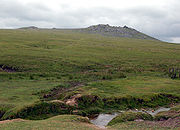
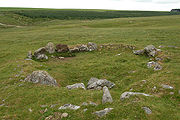
 Its position near the highest land in Cornwall makes the climate rather wet. On 8 June 1957, 203 millimetres (8 in) of rain fell at Camelford. Roughtor is the nearest of the hills of Bodmin Moor to the town and numerous prehistoric remains can be found nearby as well as a china clay works. The Town Hall was built in 1806, but is now used as a branch public library. By the riverside is Enfield Park; hamlets in the parish include Helstone, Tregoodwell
and Valley Truckle
. The economy depends largely on agriculture and tourism; there is a china clay works at Stannon.
(or Helston in Trigg) was in the Middle Ages one of the chief manors of the Hundred of Trigg and perhaps in Celtic times the seat of a chieftain. In the Domesday Book
this manor was held by Earl Robert of Mortain
: there were 2 hides, land for 15 ploughs; the lord had 4 ploughs & 18 serfs; 20 villagers & 18 smallholders had 8 ploughs; 10 acres (40,468.6 m²) of woodland; 6 square leagues of pasture; five kinds of livestock, in total 195 beasts. The manor of Penmayne was a dependency of this manor. It was one of the 17 Antiqua maneria
of the Duchy of Cornwall
.
 Camelford is the home of the North Cornwall Museum and Gallery which contains paintings and objects of local historical interest. To the northwest at Slaughterbridge
is an Arthurian Centre and at nearby Camelford Station is the Cycling Museum (temporarily closed 2010). To the east are the hills of Roughtor and Brown Willy
and to the south the old parish churches at Lanteglos and Advent.
. The main road through Camelford is the A39
(Atlantic Highway) and there are infrequent bus services to Plymouth
and parts of North Cornwall. Traffic problems have never been relieved by a planned bypass.
was born near Camelford (among his achievements was the circumnavigation of the world). Francis Hurdon
, the Canadian politician was also born at Camelford. Two members of the Pitt family held the title of Baron Camelford: Thomas Pitt, 1st Baron Camelford
(1737–1793) and Thomas Pitt, 2nd Baron Camelford
(1775–1804). Samuel Pollard
, missionary to China was also born in Camelford.
For the patrons of the parliamentary borough see the separate article.
Cornwall
Cornwall is a unitary authority and ceremonial county of England, within the United Kingdom. It is bordered to the north and west by the Celtic Sea, to the south by the English Channel, and to the east by the county of Devon, over the River Tamar. Cornwall has a population of , and covers an area of...
, United Kingdom
United Kingdom
The United Kingdom of Great Britain and Northern IrelandIn the United Kingdom and Dependencies, other languages have been officially recognised as legitimate autochthonous languages under the European Charter for Regional or Minority Languages...
, situated in the River Camel
River Camel
The River Camel is a river in Cornwall, UK. It rises on the edge of Bodmin Moor and together with its tributaries drains a considerable part of North Cornwall. The river issues into the Celtic Sea area of the Atlantic Ocean between Stepper Point and Pentire Point having covered a distance of...
valley northwest of Bodmin Moor
Bodmin Moor
Bodmin Moor is a granite moorland in northeastern Cornwall, England, United Kingdom. It is in size, and originally dates from the Carboniferous period of geological history....
. The town is approximately ten miles (16 km) north of Bodmin
Bodmin
Bodmin is a civil parish and major town in Cornwall, England, United Kingdom. It is situated in the centre of the county southwest of Bodmin Moor.The extent of the civil parish corresponds fairly closely to that of the town so is mostly urban in character...
and is governed by Camelford Town Council.
Lanteglos-by-Camelford is the ecclesiastical parish in which the town is situated (not to be confused with Lanteglos-by-Fowey
Lanteglos-by-Fowey
Lanteglos-by-Fowey is a coastal civil parish in south Cornwall, United Kingdom. It is situated on the east side of the tidal estuary of the River Fowey which separates it from the town and civil parish of Fowey....
).
Camelford is in the North Cornwall parliamentary constituency
North Cornwall (UK Parliament constituency)
North Cornwall is a county constituency represented in the House of Commons of the Parliament of the United Kingdom. It elects one Member of Parliament by the first past the post system of election.- Boundaries :...
. Until 1974, the town was the administrative headquarters of Camelford Rural District
Camelford Rural District
Camelford Rural District was a local government division of north Cornwall between 1894 and 1974. The district council offices were at Camelford, Cornwall, England, UK, latterly in the former grammar school...
.
The two main industrial enterprises in the area are the slate quarry at Delabole
Delabole
Delabole is a large village in north Cornwall, England, UK. It is situated approximately two miles west of Camelford.The village of Delabole came into existence in the 20th century; it is named after the Delabole Quarry. There were three hamlets: Pengelly, Medrose and Rockhead...
and the cheese factory at Davidstow
Davidstow
Davidstow is a civil parish and village in north Cornwall, United Kingdom. The village is north of Bodmin Moor straddling the A395 road about 3 miles north of Camelford....
but there is a small industrial estate at Highfield.
The A39 road (dubbed 'Atlantic Highway') passes directly through the town centre: a bypass
Bypass (road)
A bypass is a road or highway that avoids or "bypasses" a built-up area, town, or village, to let through traffic flow without interference from local traffic, to reduce congestion in the built-up area, and to improve road safety....
has been discussed for many years. Camelford Station was some distance from the town and closed in 1966; the site was subsequently used as a cycling
Cycling
Cycling, also called bicycling or biking, is the use of bicycles for transport, recreation, or for sport. Persons engaged in cycling are cyclists or bicyclists...
museum.
History
Due to its name, it has been linked to the legendary CamelotCamelot
Camelot is a castle and court associated with the legendary King Arthur. Absent in the early Arthurian material, Camelot first appeared in 12th-century French romances and eventually came to be described as the fantastic capital of Arthur's realm and a symbol of the Arthurian world...
, and even Camlann, but historians have been quick to refute these suggestions. (Also sometimes to Gafulford the site of a battle which is more likely to have been at Galford
Lew Trenchard
Lew Trenchard is a parish and village in west Devon, England. Most of the larger village of Lewdown is in the parish. In Domesday Book a manor of Lew is recorded in this area and two rivers have the same name: see River Lew. Trenchard comes from the lords of the manor in the 13th century...
in Devon
Devon
Devon is a large county in southwestern England. The county is sometimes referred to as Devonshire, although the term is rarely used inside the county itself as the county has never been officially "shired", it often indicates a traditional or historical context.The county shares borders with...
.) Nearby Slaughterbridge is supposed to be the site of a battle. The origin of the name is probably from the original name of the river (Allen) in combination with cam- = crooked and the English 'ford', though this is not accepted by all.
The town elected two members to the Unreformed House of Commons
Unreformed House of Commons
The unreformed House of Commons is the name generally given to the British House of Commons as it existed before the Reform Act 1832.Until the Act of Union of 1707 joining the Kingdoms of Scotland and England , Scotland had its own Parliament, and the term refers to the House of Commons of England...
: the first MPs sat in the Parliament of 1552. It was later considered a rotten borough
Rotten borough
A "rotten", "decayed" or pocket borough was a parliamentary borough or constituency in the United Kingdom that had a very small electorate and could be used by a patron to gain undue and unrepresentative influence within Parliament....
and its franchise was abolished in 1832: the article Camelford (UK Parliament constituency)
Camelford (UK Parliament constituency)
Camelford was a rotten borough in Cornwall which returned two Members of Parliament to the House of Commons in the English and later British Parliament from 1552 to 1832, when it was abolished by the Great Reform Act.-History:...
provides more information.
The seal of the borough shows: Arg. a camel passing through a ford of water all proper with legend "Sigillum Vill: de Camelford".
Water pollution incident
In July 1988, the water supply to the town and the surrounding area was contaminated when 20 tons of aluminium sulphate was poured into the wrong tank at the nearby Lowermoor Water Treatment WorksLowermoor Water Treatment Works
The Lowermoor Water Treatment Works supplies drinking water to the north Cornwall water distribution network. Raw water is obtained from the Crowdy Reservoir, which is 3/4 mile to the north east, and which is filled predominantly by run-off and drainage from surrounding moorland...
on Bodmin Moor
Bodmin Moor
Bodmin Moor is a granite moorland in northeastern Cornwall, England, United Kingdom. It is in size, and originally dates from the Carboniferous period of geological history....
. An independent inquiry into the incident
Camelford water pollution incident
The Camelford water pollution incident involved the accidental contamination of the drinking water supply to the town of Camelford, Cornwall, England with 20 tonnes of aluminium sulphate in July 1988...
(the worst of its kind in British history) was started in 2002, and a draft report issued in January 2005, but questions still remain as to the long-term effects on the health of local residents. Michael Meacher
Michael Meacher
Michael Hugh Meacher is a British Labour politician, who has been the Member of Parliament for Oldham West and Royton since 1997. Previously he had been the MP for Oldham West, first elected in 1970. On 22 February 2007 he declared that he would be standing for the Labour Leadership, challenging...
, who visited Camelford in his post as environment minister, called the incident and its aftermath, "A most unbelievable scandal."
Churches and schools
The parish church of Camelford is at Lanteglos by Camelford though there is also a Church of St Thomas of Canterbury (opened in 1938) in the town. Langdon (1896) recorded the existence of seven stone crosses in the parish, including three at the rectory (Lanteglos Rectory was converted into a guesthouse in the mid-20th century). There was in medieval times a chapel of St Thomas which probably fell into disuse after the ReformationEnglish Reformation
The English Reformation was the series of events in 16th-century England by which the Church of England broke away from the authority of the Pope and the Roman Catholic Church....
(it is recorded in 1312). The Rector of Lanteglos is also responsible for the adjacent parish of Advent
Advent, Cornwall
Advent is a civil parish on the north-western edge of Bodmin Moor in north Cornwall, England, United Kingdom. It is named after St Adwenna and lies in the Registration District of Camelford....
.
In Market Place is the Methodist Church (originally a Wesleyan Methodist Chapel). The founder of Methodism
Methodism
Methodism is a movement of Protestant Christianity represented by a number of denominations and organizations, claiming a total of approximately seventy million adherents worldwide. The movement traces its roots to John Wesley's evangelistic revival movement within Anglicanism. His younger brother...
, John Wesley
John Wesley
John Wesley was a Church of England cleric and Christian theologian. Wesley is largely credited, along with his brother Charles Wesley, as founding the Methodist movement which began when he took to open-air preaching in a similar manner to George Whitefield...
, visited Camelford on several occasions during his journeys in Cornwall. In the 1830s and 1840s the Camelford Wesleyan Methodist circuit underwent a secession by more than half the members to the Wesleyan Methodist Association
Wesleyan Association
The Wesleyan Association, or the Wesleyan Methodist Association, was a Christian denomination in the United Kingdom that was formed in 1836, largely by Protestant Methodists. Their place of worship was the Wesleyan Association Chapel. They sent several missionaries to Jamaica and Australia.Robert...
. There is an older Methodist chapel (now disused) in Chapel Street.
Soul's Harbour Pentecostal Church is situated on the Clease adjacent to the car park. It is affiliated with The Assemblies of God of Great Britain
Assemblies of God in the United Kingdom
Assemblies of God in Great Britain is a Pentecostal denomination and a part of the World Assemblies of God Fellowship, the world's largest Pentecostal denomination with a global adherence of 52.5 million people....
and was founded in 1987. The building the Church occupies was built as the Church School in 1846.
Sir James Smith's School
Sir James Smith's School
Sir James Smith's School is a small humanities college in the town of Camelford, North Cornwall, United Kingdom, providing education at secondary level. The headteacher is Jon Lawrence, who succeeded Angela Perlmutter in January 2007.-History:...
provides secondary education to the town and surrounding area and there is also a primary school.
Geography
Tregoodwell
Tregoodwell is a hamlet half a mile east of Camelford in Cornwall, England, UK. It is on the road towards Rough Tor....
and Valley Truckle
Valley Truckle
Valley Truckle is a hamlet on the A39 road south of Camelford in Cornwall, England, UK. Its name probably derives from a corruption of Cornish "Vellan draeth" . This was suggested by Charles Henderson....
. The economy depends largely on agriculture and tourism; there is a china clay works at Stannon.
Manor of Helston in Trigg
HelstoneHelstone
Helstone is a settlement in north Cornwall, United Kingdom. It is situated two miles southwest of Camelford on the A39 road.-History:...
(or Helston in Trigg) was in the Middle Ages one of the chief manors of the Hundred of Trigg and perhaps in Celtic times the seat of a chieftain. In the Domesday Book
Domesday Book
Domesday Book , now held at The National Archives, Kew, Richmond upon Thames in South West London, is the record of the great survey of much of England and parts of Wales completed in 1086...
this manor was held by Earl Robert of Mortain
Robert, Count of Mortain
Robert, Count of Mortain, 1st Earl of Cornwall was a Norman nobleman and the half-brother of William I of England. Robert was the son of Herluin de Conteville and Herleva of Falaise and was full brother to Odo of Bayeux. The exact year of Robert's birth is unknown Robert, Count of Mortain, 1st...
: there were 2 hides, land for 15 ploughs; the lord had 4 ploughs & 18 serfs; 20 villagers & 18 smallholders had 8 ploughs; 10 acres (40,468.6 m²) of woodland; 6 square leagues of pasture; five kinds of livestock, in total 195 beasts. The manor of Penmayne was a dependency of this manor. It was one of the 17 Antiqua maneria
Antiqua maneria
The Antiqua maneria were the original 17 manors belonging to the Earldom of Cornwall.After March 1337 these manors passed to the new Duchy of Cornwall which was created by King Edward III to give financial support to his son Edward, the Black Prince .The table below shows the 17 Antiqua maneria...
of the Duchy of Cornwall
Duchy of Cornwall
The Duchy of Cornwall is one of two royal duchies in England, the other being the Duchy of Lancaster. The eldest son of the reigning British monarch inherits the duchy and title of Duke of Cornwall at the time of his birth, or of his parent's succession to the throne. If the monarch has no son, the...
.
Places of interest
Slaughterbridge
Slaughterbridge, Treague and Camelford Station are three adjoining settlements in north Cornwall, United Kingdom. They straddle the boundary of Forrabury and Minster and Lanteglos by Camelford civil parishes just over a mile north-west of the market town of CamelfordThe settlements are on the...
is an Arthurian Centre and at nearby Camelford Station is the Cycling Museum (temporarily closed 2010). To the east are the hills of Roughtor and Brown Willy
Brown Willy
Brown Willy is a hill in Cornwall, United Kingdom. The summit is the highest point of Bodmin Moor and of Cornwall as a whole....
and to the south the old parish churches at Lanteglos and Advent.
Transport
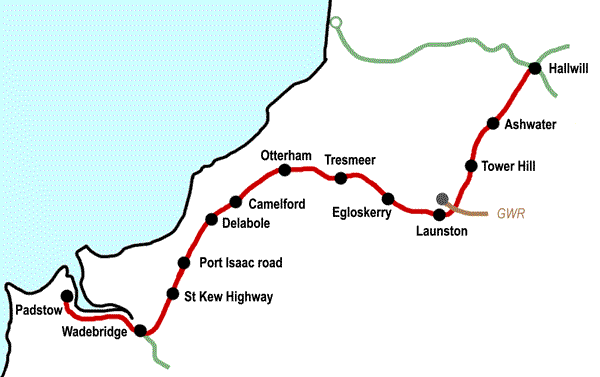
For 70 years the town had a station on the North Cornwall RailwayNorth Cornwall Railway
The North Cornwall Railway was a railway line running from Halwill in Devon to Padstow in Cornwall via Launceston, Camelford and Wadebridge, a distance of 49 miles 67 chains. Opened in the last decade of the nineteenth century, it was part of a drive by the London and South Western Railway to...
. The main road through Camelford is the A39
A39 road
The A39 is an A road in south west England. It runs south-west from Bath in Somerset through Wells, Glastonbury, Street and Bridgwater. It then follows the north coast of Somerset and Devon through Williton, Minehead, Porlock, Lynmouth, Barnstaple, Bideford, Stratton, Camelford, Wadebridge and St...
(Atlantic Highway) and there are infrequent bus services to Plymouth
Plymouth
Plymouth is a city and unitary authority area on the coast of Devon, England, about south-west of London. It is built between the mouths of the rivers Plym to the east and Tamar to the west, where they join Plymouth Sound...
and parts of North Cornwall. Traffic problems have never been relieved by a planned bypass.
Notable people associated with Camelford
The naval officer Samuel WallisSamuel Wallis
Samuel Wallis was a Cornish navigator who circumnavigated the world.Wallis was born near Camelford, Cornwall. In 1766 he was given the command of HMS Dolphin to circumnavigate the world, accompanied by the Swallow under the command of Philip Carteret...
was born near Camelford (among his achievements was the circumnavigation of the world). Francis Hurdon
Francis Hurdon
Francis Hurdon was an Ontario businessman and political figure. He represented Bruce South in the 1st Canadian Parliament as a Conservative member....
, the Canadian politician was also born at Camelford. Two members of the Pitt family held the title of Baron Camelford: Thomas Pitt, 1st Baron Camelford
Thomas Pitt, 1st Baron Camelford
Thomas Pitt, 1st Baron Camelford was a British politician and connoisseur of art.-Early life:He was the son of Thomas Pitt of Boconnoc , a brother of William Pitt the Elder, and was born and baptised at Boconnoc in Cornwall on 3 March 1737. His mother was Christian, eldest daughter of Sir Thomas...
(1737–1793) and Thomas Pitt, 2nd Baron Camelford
Thomas Pitt, 2nd Baron Camelford
Thomas Pitt, 2nd Baron Camelford was a British peer, naval officer and wastrel, best known for bedevilling George Vancouver during and after the latter's great voyage of exploration.-Early life:...
(1775–1804). Samuel Pollard
Sam Pollard
- Sources used : — Dingle describes how Sam Pollard used positioning of vowel marks relative to consonants to indicate tones — Morrison recounts meeting Sam Pollard and his wife at the Bible Christian Mission in 1894 — reports on an article in The Sunday Times describing the...
, missionary to China was also born in Camelford.
For the patrons of the parliamentary borough see the separate article.