


Tandem bicycle

Encyclopedia

Bicycle
A bicycle, also known as a bike, pushbike or cycle, is a human-powered, pedal-driven, single-track vehicle, having two wheels attached to a frame, one behind the other. A person who rides a bicycle is called a cyclist, or bicyclist....
(occasionally, a tricycle
Tricycle
A tricycle is a three-wheeled vehicle. While tricycles are often associated with the small three-wheeled vehicles used by pre-school-age children, they are also used by adults for a variety of purposes. In the United States and Canada, adult-sized tricycles are used primarily by older persons for...
) designed to be ridden by more than one person. The term tandem
Tandem
Tandem is an arrangement where a team of machines, animals or people are lined up one behind another, all facing in the same direction....
refers to the seating arrangement (fore to aft, not side-by-side), not the number of riders. A bike with two riders side-by-side is called a sociable
Sociable
The Sociable or Buddy Bike or Side By Side Bicycle is a bicycle that supports two riders who sit side by side.This type of bicycle should not be referred to as a tandem bicycle as "tandem" is defined as: "a group of two or more arranged one behind the other ..."-History:The Sociable is said by some...
.
History
Patents related to tandem bicycles date from the late 19th century. In approximately 1898, Mikael PedersenMikael Pedersen
Mikael Pedersen was a Danish inventor much associated with the English town of Dursley. He is chiefly known today for the highly distinctive Pedersen bicycle...
developed a two-rider tandem version of his Pedersen bicycle
Pedersen bicycle
The Pedersen bicycle, also called the Dursley Pedersen bicycle is a bicycle that was developed by Danish inventor Mikael Pedersen and produced in the English town of Dursley. Though never hugely popular, they enjoy a devoted following and are still produced today...
that weighed 24 pounds, and a four-rider, or "quad", that weighed 64 pounds. They were also used in the Second Anglo-Boer War. Tandem popularity began to decline after WWII until a revival started in the late sixties. In the UK The Tandem Club
The Tandem Club
The Tandem Cycling Club of the United Kingdom, generally known as The Tandem Club, is a British cycling club for riders of tandem bicycles....
was founded in 1971, new tandems came on to the market from the French companies Lejeune and Gitane
Gitane
Gitane is a French manufacturer of bicycles based in Machecoul, France; the name "Gitane" means gypsy woman. The brand was synonymous with French bicycle racing from the 1960s through the mid-1980s, sponsoring riders such as Jacques Anquetil , Lucien Van Impe , Bernard Hinault , Laurent Fignon ,...
, and in the USA Bill McReady founded Santana Cycles
Santana Cycles
Santana Cycles is the world's leading manufacturer of tandem bicycles. Santana was founded in 1976 by Bill McCready, an Associate Editor at Bicycling Magazine, and is located in La Verne, California...
in 1976. Modern technology has improved component and frame designs, and many tandems are as well-built as modern high-end road and off-road bikes.
Performance
Compared to a conventional bicycle, a tandem has double the pedalBicycle pedal
A bicycle pedal is the part of a bicycle that the rider pushes with their foot to propel the bicycle. It provides the connection between the cyclist's foot or shoe and the crank allowing the leg to turn the bottom bracket spindle and propel the bicycle's wheels...
ling power
Power (physics)
In physics, power is the rate at which energy is transferred, used, or transformed. For example, the rate at which a light bulb transforms electrical energy into heat and light is measured in watts—the more wattage, the more power, or equivalently the more electrical energy is used per unit...
with only slightly more frictional loss in the drivetrain. It has about the same wind resistance as a conventional bicycle. High-performance tandems may weigh less than twice as much as a single bike, so the power-to-weight ratio
Power-to-weight ratio
Power-to-weight ratio is a calculation commonly applied to engines and mobile power sources to enable the comparison of one unit or design to another. Power-to-weight ratio is a measurement of actual performance of any engine or power sources...
may be slightly better than that of a single bike and rider. On flat terrain and downhill, most of the power produced by cyclists is used to overcome wind resistance, so tandems can reach higher speeds than the same riders on single bicycles. They are not necessarily slower on climbs, but are perceived as such, in part due to the need for a high level of coordination between the riders, especially if the physical abilities of the two riders are very different, requiring a compromise on cadence
Cadence (cycling)
In cycling, cadence is the number of revolutions of the crank per minute; roughly speaking, this is the rate at which a cyclist is pedalling/turning the pedals...
.
Terminology
On conventional tandems, the front rider steers as well as pedals the bicycle and is known as the captain, pilot, or steersman; the rear rider only pedals and is known as the stoker, navigator, or rear admiral. On most tandems the two sets of cranks are mechanically linked by a timing chainTiming belt
A timing belt, or cam belt , is a part of an internal combustion engine that controls the timing of the engine's valves. Some engines, such as the flat-4 Volkswagen air-cooled engine, and the straight-6 Toyota F engine use timing gears...
and turn at the same rate. As time has moved on so has the use of 'Captain' and 'Stoker' as terms for riders of a tandem. As both are seen as riders the use of the words 'front rider' and 'rear rider' are far more descriptive to modern Tandem riders.
Uses
Tandem bicycles are used in competitions such as the ParalympicsParalympic Games
The Paralympic Games are a major international multi-sport event where athletes with a physical disability compete; this includes athletes with mobility disabilities, amputations, blindness, and Cerebral Palsy. There are Winter and Summer Paralympic Games, which are held immediately following their...
with blind
Blindness
Blindness is the condition of lacking visual perception due to physiological or neurological factors.Various scales have been developed to describe the extent of vision loss and define blindness...
and visually impaired
Low vision
Low vision is a subspecialty within the professions of optometry and ophthalmology dealing with individuals who have reduced vision even when using the best possible spectacle or contact lens correction available. It can be a result of either congenital disease Low vision is a subspecialty within...
cyclists riding as stokers with fully sighted captains
Sighted guide
A sighted guide is a person who guides a person with blindness or vision impairment.-Paralympic Games:At the Paralympic Games there are various classifications of athletes with a visual impairment....
.
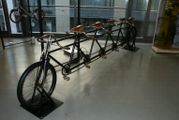
More than two riders
Tandems can have more than 2 riders — tandemTandem
Tandem is an arrangement where a team of machines, animals or people are lined up one behind another, all facing in the same direction....
refers to the arrangement of the riders one behind the other rather than the number of riders. Bicycles for three, four, or five riders are referred to as "triples" or "triplets", "quads" or "quadruplets", and "quints" or "quintuplets" respectively. One such familiar to UK TV viewers was the "trandem" ridden by The Goodies
The Goodies
The Goodies are a trio of British comedians who created, wrote, and starred in a surreal British television comedy series called The Goodies during the 1970s and early 1980s combining sketches and situation comedy.-Honours:All three Goodies now have OBEs...
. Originally a 2-man tandem with an extra "dummy" seat attached, a full 3-man version was built for them by Raleigh
Raleigh Bicycle Company
The Raleigh Bicycle Company is a bicycle manufacturer originally based in Nottingham, UK. It is one of the oldest bicycle companies in the world. From 1921 to 1935 Raleigh also produced motorcycles and three-wheel cars, leading to the formation of the Reliant Company.-Early years:Raleigh's history...
.
Independent pedaling
Some designs such as the DaVinci can allow independent pedaling through the use of multiple freewheels. In another design, the rear rider steers and propels the rear wheel with pedals, and the front rider propels the front wheel with both hands and feet.Seating arrangements
Tandems come with both upright and recumbentRecumbent bicycle
A recumbent bicycle is a bicycle that places the rider in a laid-back reclining position. Most recumbent riders choose this type of design for ergonomic reasons; the rider's weight is distributed comfortably over a larger area, supported by back and buttocks...
seating.
The Bilenky
Bilenky Cycle Works
Bilenky Cycle Works is an American handmade bicycle manufacturer formed in 1983. It is in Philadelphia, Pennsylvania. It makes both frames and complete bicycles and restores and repairs bikes. The company is owned by Stephen Bilenky, a member of the musical group The Notekillers. It makes tandem...
ViewPoint (originally the Opus Counterpoint) is a semi-recumbent tandem steered by the captain who sits upright in the rear, while the stoker rides in a recumbent position in the front. The Angletech Harmony is another semi-recumbent tandem. (Both also feature independent stoker pedaling.)
The "Buddy Bike" is designed to allow a child to sit on the front saddle with an adult on the rear saddle and steering with extra long handlebars.
Double steering
Both riders, in the case of just two, may be able to steer. The Star Cycle Company, of Woverhampton, England, marketed its "Combination Roadster tandem" in 1896. It had a link from the second set of handlebars to the front fork.Tricycles
Tandems are also available as tricycleTricycle
A tricycle is a three-wheeled vehicle. While tricycles are often associated with the small three-wheeled vehicles used by pre-school-age children, they are also used by adults for a variety of purposes. In the United States and Canada, adult-sized tricycles are used primarily by older persons for...
s; the conventional tandem trike has a small but devoted following in the United Kingdom
United Kingdom
The United Kingdom of Great Britain and Northern IrelandIn the United Kingdom and Dependencies, other languages have been officially recognised as legitimate autochthonous languages under the European Charter for Regional or Minority Languages...
, and is available in one-wheel and two-wheel drive designs. Recumbent tandem tricycles are also gaining popularity throughout the world http://www.skywheel.kr/.
Short wheelbase
There are short wheelbase models, with the rear rider sitting over the rear wheel, either just in front of or even behind the rear axle.Folding
Several manufacturers offer foldingFolding bicycle
A folding bicycle is a bicycle designed to fold into a compact form, facilitating transport and storage. When folded, the bikes can be more easily carried into buildings and workplaces or onto public transportation or more easily stored in compact living quarters or aboard a car, boat or plane...
tandems, either with small wheels
Small wheel bicycle
Small wheel bicycles are adult bicycles which have wheels of 20 inch nominal diameter or less, which is smaller than the 26" or 700c sizes common on most full-sized adult bikes. While many folding bicycles are small wheel bicycles, not all small wheel bicycles can fold...
or not, to facilitate packing and travelling.
Couplers
It is possible to add couplersBicycle Torque Coupling
An S and S Coupling also known as a Bicycle Torque Coupling or BTC is a coupling which enables bicycle frames to be separated into smaller pieces, usually to facilitate packing and transporting. They can be built into the frame by the frame manufacturer when the frame is originally assembled or...
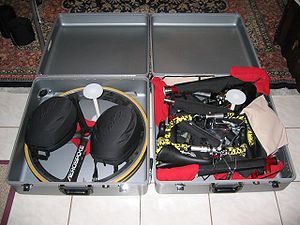
either during manufacturing or as a retrofit so that the frame can be disassembled into smaller pieces to facilitate packing and travel. Santana manufactures a "triplet (or quad) that can be transformed into a tandem by simply removing the center section of the frame."
Tandem specific components
Tandems are subjected to unique stresses caused by additional riders and weight requiring solutions specific to tandem construction. The phrase "Tandem Specific" was popularized by its use in Santana tandem catalogs during the 1990s.Drive train
To transfer power from all pedals to the rear wheel requires a drive train. Typically, the frontmost crankset turns a timing chain, which in turn connects to the rear crankset, which transfers this power to the drive chain that connects to the rear wheel. This configuration is called crossover rear drive, and requires both of the rear riders crank arms to have chainrings mounted.The second most popular solution, due to being able to convert a singles bike into a tandem is called single side rear drive. The front crankset drives a timing chain which connects to the rear crankset. The rear crankset has another chain ring that connects a second chain, the drive chain to the rear wheel.
The least popular solution is to run a drive chain from the front crankset, to the rear wheel, then a timing chain from the front crankset to the rear crankset. This is less popular because it requires considerably more chain then either setup. Such a setup is called a crossover front drive.
A rare solution to the requirement of coordinated pedaling is the use of a jackshaft
Jackshaft
A jackshaft is a device for turning the wheels of a locomotive. It is essentially an axle with no wheels. Each end of the jackshaft has a crank pin and a counterweight. The driving wheels are then connected by side rods. The name may come from a combination of "jack," a slang term for a locomotive,...
plus two freehubs, thus allowing one rider to coast while the other continues to pedal. This also allows riders to select different crank positions, such as inphase (IP), or Out-Of-Phase (OOP), while pedaling together. Davinci Tandems use a unique "Independent Drive" whereby the intermediate shaft transfers the power from the stoker and captain cranks into a converter which allows up to for chainrings. This variant also allows stoker and captain cranks to freewheel (coast) independently.
Crankset
The front cranksetCrankset
The crankset or chainset , is the component of a bicycle drivetrain that converts the reciprocating motion of the rider's legs into rotational motion used to drive the chain, which in turn drives the rear wheel...
typically has only one chain ring. The rear crankset typically has many chain rings, sometimes on both sides. On a tandem where the pedaling is designed to be in sync
Synchronization
Synchronization is timekeeping which requires the coordination of events to operate a system in unison. The familiar conductor of an orchestra serves to keep the orchestra in time....
, both cranksets will use a chain ring for the timing chain of the same size. The drive chain chain rings can be single gear or use a derailleur
Derailleur gears
Derailleur gears are a variable-ratio transmission system commonly used on bicycles, consisting of a chain, multiple sprockets of different sizes, and a mechanism to move the chain from one sprocket to another...
.
To maintain the necessary tension on the timing chain, many tandems use an eccentric
Eccentric (mechanism)
In mechanical engineering, an eccentric is a circular disk solidly fixed to a rotating axle with its centre offset from that of the axle ....
that is placed in the front rider's bottom bracket
Bottom bracket
The bottom bracket on a bicycle connects the crankset to the bicycle and allows the crankset to rotate freely. It contains a spindle that the crankset attaches to, and the bearings that allow the spindle and cranks to rotate. The chainrings and pedals attach to the cranks...
shell. An alternate solution is to implement a pulley, or idler, on the bottom of the timing chain to take up slack. Idlers add friction and a potential point of failure to the drive train.
Handle bars and stem
Stoker handlebarsBicycle handlebar
Bicycle handlebar or often bicycle handlebars refers to the steering mechanism for bicycles; the equivalent of a steering wheel. Besides steering, handlebars also often support a portion of the rider's weight, depending on their riding position, and provide a convenient mounting place for brake...
are typically connected to a stoker stem
Stem (bicycle part)
The stem is the component on a bicycle that connects the handlebars to the steerer tube of the bicycle fork. Sometimes called a goose neck, a stem's design belongs to either a quill or threadless system, and each system is compatible with respective headset and fork designs:-Quill vs...
that is clamped around the captain's seatpost
Seatpost
A bicycle seatpost, seatpin, saddlepole, saddle pillar, or saddle pin is a tube that extends upwards from the bicycle frame to the saddle. The amount that it extends out of the frame can usually be adjusted, and there is usually a mark that indicates the minimum insertion...
. The stoker handlebars are typically bull horns or very wide drop bars with "stoker pegs" instead of brake levers.
Wheels
Because of the extra weight and stresses, tandem wheelsBicycle wheel
A bicycle wheel is a wheel, most commonly a wire wheel, designed for bicycle. A pair is often called a wheelset, especially in the context of ready built "off the shelf" performance-oriented wheels....
may use a higher spoke
Spoke
A spoke is one of some number of rods radiating from the center of a wheel , connecting the hub with the round traction surface....
count, sturdier rims, higher pressure tires
Bicycle tire
A bicycle tire is a tire that fits on the wheel of a bicycle, unicycle, tricycle, quadracycle, bicycle trailer, or trailer bike. They may also be used on wheelchairs and handcycles, especially for racing...
, a stronger freewheel, dishless spoke configuration, or asymmetric wheels. Tandems wear out rear wheels faster than front wheels; therefore, they may use non-symmetrical wheel setups, such as more spokes or a sturdier rim on the rear wheel.
The dish of a wheel measures the amount of asymmetry between the rim and the hub flanges. To accommodate a large cassette, more space is needed on the drive side of the axle; this increases the complexity of manufacturing and truing the wheel. Tandem rear wheels tend to run a wider hub/axle to allow the right-side hub flange to be further right of wheel center and thus reduce the total dish of the wheel. Some modern tandems use a 160mm wide axle which allows a wheel that is completely "dishless" (i.e. symmetric). The disadvantage is this may increase the Q-factor
Q Factor (Bicycles)
The Q Factor of a bicycle is the distance between the pedal attachment points on the crank arms, when measured parallel to the bottom bracket axle. It may also be referred to as the "tread" of the crankset. The term was coined by Grant Petersen during his time at Bridgestone Bicycles.Q Factor is...
of the stoker's cranks and may also cause "heel-strike" of the stoker's shoes on the chain stays. Others use shorter axles (often 145mm wide) thereby trading a little decrease in the strength of the wheel for the advantage of a similar decrease in the bending moment of the axle spindle. Rear hubs may also be threaded on the left side to allow the use of a drum brake.
Specialty wheels such as Aerospoke or Shimano
Shimano
Shimano, Inc. is a Japanese multinational manufacturer of cycling components, fishing tackle, and rowing equipment.In 2005, the company had net sales of US $1.4 billion. Bicycle components provided 75% of its sales income...
"Sweet-16" may build "tandem certified" racing wheelsets. The Aerospoke tandem wheelset is built up more than their roadset with special tandem hubs that can be removed and which facilitates stacking the rims flat into a travel case.
Brakes
The Arai drum brake is used during long downhill descents where a rim brake might overheat the tire and possibly cause it to fail. The drum of the brake screws onto the left side of the tandem hub, which must be threaded for the drum. The shoe plate slips over the axle and a small reaction arm from the shoe plate engages with the bicycle frame to prevent the plate from turning. The drum brake is typically controlled by a friction shift lever like a BARCON or similar. The brake is designed to be engaged continuously during a descent to maintain a steady speed. The standard brakes can be used in addition as necessary.Some modern tandems use disc brakes with 6 or 8 inch rotors. These brakes, modeled after motorcycle style brakes, offer increased stopping power with better modulation, heat dissipation, and weight savings. Tandems must be manufactured specifically to handle disc brake setups including rear caliper mounts and additional frame gussets to support the stresses created by the disc brake system.
Riding techniques
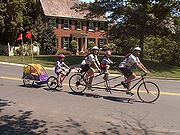
For those who can get accustomed to the rear rider always being clipped in, the distinct advantage to this technique will become obvious when trying to start at the foot of a bridge or on a hill. If the tandem team does not practice this, then they often reserve this type of start for when they are faced with a bridge or hill. This technique allows the rear rider to apply continuous power as the front rider steadies the tandem during the initial take-off. This reduces the risk of the tandem toppling over due to starting on an incline. The rear rider will continue to pedal as the front rider attempts to get the foot used for steadying the tandem clipped into the pedal.
Crank phase
Riders may choose to synchronise their pedalling through in-phasePhase (waves)
Phase in waves is the fraction of a wave cycle which has elapsed relative to an arbitrary point.-Formula:The phase of an oscillation or wave refers to a sinusoidal function such as the following:...
(IP) or out-of-phase (OOP) pedalling. In in-phase pedalling, each rider's cranks are the same or opposite clock positions at any point in time. In out-of-phase pedalling, both riders have their cranks in differing non-opposite positions. This has the potential for a wide range of variation. Some tandem riders arrange their cranks so that they are 90° out of phase to produce what is called the "4 banger arrangement". In practice, OOP setups range from a mere two-tooth phase difference between cranks to a full 90° phase difference. Generally, OOP provides the greatest benefits to the tandem team that has disparate leg-strength. When the tandem is pedalled IP it is possible, and often happens, that the stronger rider literally drops the pedals out from beneath the feet of the weaker rider and cause the latter to be unable to contribute meaningfully. Using OOP makes a significant difference in gearing choice as each rider has the full mass of the tandem in their power stroke, so lower gears are preferred. However, using OOP can help develop leg strength for the very same reason. Some argue that this produces a smoother power stroke, or that it reduces stress on the drive train because the point of maximum power is reduced to roughly half and distributed over the chain rings.
Tandem bicycle manufacturers
Since the market for tandem bicycles is significantly smaller than the market for single bikes, there are far fewer tandem bicycle manufacturers than single-bicycle manufacturers. There are a few builders who specialize in tandems, as well as single-bike makers who offer tandem models. Current notable tandem bicycle manufacturers include:- Bilenky Cycle WorksBilenky Cycle WorksBilenky Cycle Works is an American handmade bicycle manufacturer formed in 1983. It is in Philadelphia, Pennsylvania. It makes both frames and complete bicycles and restores and repairs bikes. The company is owned by Stephen Bilenky, a member of the musical group The Notekillers. It makes tandem...
- Bohemian BicyclesBohemian BicyclesBohemian Bicycles is a bicycle manufacturer in Tucson, Arizona, USA . It makes handmade steel lugged frames. David Bohm, owner of Bohemian Bicycles, started the business in 1994....
- Cannondale Bicycle CorporationCannondale Bicycle CorporationThe Cannondale Bicycle Corporation, is an American bicycle manufacturer, headquartered in Bethel, Connecticut with manufacturing and assembly facilities in Taichung, Taiwan...
- Co-Motion CyclesCo-Motion CyclesCo-Motion Cycles is an American bicycle manufacturer located in Eugene, Oregon. The company was formed in 1988. It is owned by Dwan Shepard and Dan Vrijmoet. The company makes high-end tandem and single bicycles. Co-Motion offers both custom frames and ready-made frames in standard dimensions...
- Dawes Cycles
- KHS Bicycles
- Santana CyclesSantana CyclesSantana Cycles is the world's leading manufacturer of tandem bicycles. Santana was founded in 1976 by Bill McCready, an Associate Editor at Bicycling Magazine, and is located in La Verne, California...
- TorkerTorkerTorker is a brand of bicycles and unicycles currently owned by Seattle Bike Supply, headquartered in Kent, Washington.-History:The Torker name was created by Johnson Engineering in Fullerton, CA in 1977 for a BMX bike frame....
- Trek BicyclesTrek Bicycle CorporationTrek Bicycle Corporation is a major bicycle and cycling product manufacturer and distributor under brand names Trek, Gary Fisher, Bontrager, Klein and until recently, LeMond Racing Cycles...
See also
- Cycle rickshawCycle rickshawThe cycle rickshaw is a small-scale local means of transport; it is also known by a variety of other names such as velotaxi, pedicab, bikecab, cyclo, becak, trisikad, or trishaw or, simply, rickshaw which also refers to auto rickshaws, and the, now uncommon, rickshaws pulled by a person on foot...
- Bicycle trailerBicycle trailerA bicycle trailer is a motorless wheeled frame with a hitch system for transporting cargo by bicycle. It can greatly increase a bike's cargo capacity, allowing point-to-point haulage of objects up to 4 cubic yards in volume that weigh as much as half-a-ton.-Types:Different types of trailer are...
- SociableSociableThe Sociable or Buddy Bike or Side By Side Bicycle is a bicycle that supports two riders who sit side by side.This type of bicycle should not be referred to as a tandem bicycle as "tandem" is defined as: "a group of two or more arranged one behind the other ..."-History:The Sociable is said by some...
- Quadracycle (human-powered vehicle)
- Trailer bikeTrailer bikeTrailer bike is a one-wheeled bicycle trailer designed to carry one or more small riders in positions that closely resemble that of a bicycle rider...
- TricycleTricycleA tricycle is a three-wheeled vehicle. While tricycles are often associated with the small three-wheeled vehicles used by pre-school-age children, they are also used by adults for a variety of purposes. In the United States and Canada, adult-sized tricycles are used primarily by older persons for...
- Bicycle Built for Two
External links
- The Tandem Experience - the original try before you buy and training company
- The Tandem Club — the original tandem club, UK-based with Dutch, other European and international members
- The Tandem Club of America — a U.S.-based club
- The Bishops Castle Tandem Triathlon
- Tandem Bike News and Info — an interactive community for tandem bike fanatics. Includes information on road tandems, mountain tandems, and tandem specific routes. US centric