

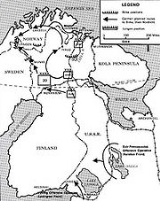
Lapland War

Encyclopedia
The Lapland War were the hostilities between Finland
and Nazi Germany
between September 1944 and April 1945, fought in Finland's northernmost Lapland Province. While the Finns saw this as a separate conflict much like the Continuation War
, German forces considered their actions to be part of the Second World War. A peculiarity of the war was that the Finnish army was forced to demobilise their forces while at the same time fighting to force the German army to leave Finland. The German forces retreated to Norway
, and Finland managed to uphold its promises made under the Moscow Armistice
, although it remained formally still at war with the two Allied powers
that were the Soviet Union
and the United Kingdom
, one government in exile
in London
and the British Dominions until the formal conclusion of the Continuation War was ratified by the 1947 Paris peace treaty
.
. As early as the summer of 1943, the German High Command began making plans for the eventuality that Finland might make a separate peace
agreement with the Soviet Union. The Germans planned to withdraw their forces northward in order to shield the nickel mines
near Petsamo
.
During the winter of 1943–1944, the Germans improved the roads from northern Norway to northern Finland by extensive use of prisoner of war
(POW) labour. Casualties among these POWs were high, in part because many of them had been captured in southern Europe
and were still in summer uniform. In addition, the Germans surveyed defensive positions and accumulated stores in the region. Thus, when Finland signed the Moscow Armistice
with the Soviet Union in September 1944, the Germans were ready.
The Soviets demanded that all German troops be expelled from Finland. The Finns were thus placed in a situation of having to fight to free their lands of German forces. The Finns' task was complicated by the Soviet demand that the major part of Finnish armed forces be demobilized at the same time, even while conducting a military campaign against the Germans. General Hjalmar Siilasvuo
, the victor of Suomussalmi
, led the Finns against the Germans, who were commanded by General Lothar Rendulic
.
on the border with Sweden. Heavy combat lasted for a week, and the Germans were forced to withdraw.
At the onset of the Tornio invasion, Finnish troops took about 100 Germans as prisoners of war. In an effort to free them, Rendulic ordered Finnish civilians to be captured as hostage. Starting on 1 October 1944, Germans imprisoned 132 persons in the town of Kemi
and 130 in Rovaniemi
, 24 of them women. General Rendulic sent Major General Mathias Kräutler to the headquarters of the Finnish attack troops in Tornio, to deliver a letter to Lieutenant Colonel Wolf Halsti. He demanded that the Germans POWs to be freed, or the Finnish hostages would be shot and the Kemi pulp mill
burned down.
Halsti conveyed this message to Lieutenant General Hjalmar Siilasvuo
, commander of the Finnish III Army, who refused all bargains or deals with the Germans. Halsti delivered this reply, adding that should anything happen to the civilian hostages or to the mill, he would personally order all the German POWs held by his troops to be shot, together with all German staff and patients of the German military hospital in Tornio.
With this Finnish threat to respond to the threat of German atrocities by reciprocal action against German POWs and wounded patients, the Germans dropped their threats, and released the Finnish hostages unharmed on 11 October, near Rovaniemi
. During the intervening ten days, the situation was carefully followed in the Finnish press, helping to turn the general attitude of the Finns against their former German allies. A popular anti-German attitude intensified when Rendulic ordered scorched-earth tactics, including lesser atrocities of burning most of the villages and destroying Lapland's civilian infrastructure.
Finnish forces advancing from Kemi
towards Rovaniemi
did not see any true action as the Finnish troops on foot were not able to keep up with withdrawing motorized German units, however on the road leading from Ranua
towards Rovaniemi there were several small battles, first one at Ylimaa and second at Kivitaival before meeting Germans again at Rovaniemi
. North from Rovaniemi Finns encountered heavily fortified German Schutzwall positions at Tankavaara. On the road that runs along the Torne
and Muonio
rivers Germans timetable for the withdrawal was swiftly that they were not required to fight until at village of Muonio
.
At Ylimaa Finns were lucky enough to capture documents detailing German positions and Germans were forced to fight delaying action due their pre-set timetable. However as the forces were numerically roughly identical the Finnish lack of heavy weapons and exhaustion from long marches prevented them from trapping the defending German regiment before Germans received permission to withdraw. At Kivitaival however tables were turned and only fortuitous German withdrawal saved Finnish regiment from being mauled. The German withdrawal allowed Finns to surround one of the delaying battalions however with full regiment coming to its rescue Germans managed to rescue the stranded battalion.
Finnish demobilization and difficult supply routes started to show and already at Tankavaara barely 4 Finnish battalions attempted unsuccessfully to beat German division entrenched in prepared fortifications. At Muonio Germans had again numerical and material superiority over the Finns which prevented Finns from gaining upper hand regardless of initially fairly successful flanking operations.
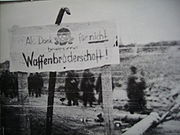 Siilasvuo pursued the Germans, who consistently fought back so as to cover their retreat towards Norway. Motorized German troops were left behind to secure the main forces, defending their positions with heavy firepower. When the Finns arrived, they tried to bypass German posts with time-consuming and back-breaking marches through marshland and forests. Knowing this, the Germans quickly pulled out, destroying bridges and moving to the next defensive post that they had planned and equipped beforehand.
Most of the civilian population of Lapland, totaling 168,000 persons, was evacuated to Sweden and Southern Finland, with the exception of the inhabitants of Tornio area. The civilian evacuation had been carried out as a cooperative effort of German military and Finnish authorities prior to the start of the hostilities. Hundreds of Finnish women who had been engaged to German soldiers or working for the German military left with the German troops, meeting diverse fates.
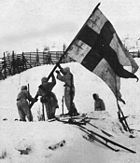
devastated large areas of northern Finland with scorched earth tactics. As a result, some 40–47% of the dwellings in the area were destroyed, and the provincial capital of Rovaniemi was burned to the ground
, as were the villages of Savukoski and Enontekiö. Two-thirds of the buildings in the main villages of Sodankylä, Muonio, Kolari, Salla and Pello were demolished, 675 bridges were blown up, all main roads were mined, and 3,700 km of telephone lines were destroyed.
In addition to the property losses, estimated as equivalent to about US $300 million in 1945 dollars (US$ billion in ), about 100,000 inhabitants became refugees, a situation that added to the problems of postwar reconstruction. After the war the Allies convicted Rendulic of war crimes, and he was sentenced to 20 years in prison, although charges concerning the devastation of Lapland were dropped. He was released after six years.
The last German troops were expelled in April 1945. By that time, as a result of the Soviet demand for the demobilisation of the Finnish army, only 600 Finnish troops, mostly fresh recruits
, were left facing them. Because of this, the latter half of the Lapland War is known in Finland as the Children's Crusade.
The military casualties of the conflict were relatively limited: 774 killed in action (KIA), 262 missing in action and about 3,000 wounded in action (WIA) for the Finnish troops, and 1,200 KIA and about 2,000 WIA for the Germans. 1,300 German soldiers became prisoners of war, and were handed over to the Soviet Union according to the terms of the armistice with the Soviets. The extensive German land mines caused civilian casualties for decades after the war, and almost 100 personnel were killed during demining
operations.
Finland
Finland , officially the Republic of Finland, is a Nordic country situated in the Fennoscandian region of Northern Europe. It is bordered by Sweden in the west, Norway in the north and Russia in the east, while Estonia lies to its south across the Gulf of Finland.Around 5.4 million people reside...
and Nazi Germany
Nazi Germany
Nazi Germany , also known as the Third Reich , but officially called German Reich from 1933 to 1943 and Greater German Reich from 26 June 1943 onward, is the name commonly used to refer to the state of Germany from 1933 to 1945, when it was a totalitarian dictatorship ruled by...
between September 1944 and April 1945, fought in Finland's northernmost Lapland Province. While the Finns saw this as a separate conflict much like the Continuation War
Continuation War
The Continuation War was the second of two wars fought between Finland and the Soviet Union during World War II.At the time of the war, the Finnish side used the name to make clear its perceived relationship to the preceding Winter War...
, German forces considered their actions to be part of the Second World War. A peculiarity of the war was that the Finnish army was forced to demobilise their forces while at the same time fighting to force the German army to leave Finland. The German forces retreated to Norway
Norway
Norway , officially the Kingdom of Norway, is a Nordic unitary constitutional monarchy whose territory comprises the western portion of the Scandinavian Peninsula, Jan Mayen, and the Arctic archipelago of Svalbard and Bouvet Island. Norway has a total area of and a population of about 4.9 million...
, and Finland managed to uphold its promises made under the Moscow Armistice
Moscow Armistice
The Moscow Armistice was signed between Finland on one side and the Soviet Union and United Kingdom on the other side on September 19, 1944, ending the Continuation War...
, although it remained formally still at war with the two Allied powers
Allies of World War II
The Allies of World War II were the countries that opposed the Axis powers during the Second World War . Former Axis states contributing to the Allied victory are not considered Allied states...
that were the Soviet Union
Soviet Union
The Soviet Union , officially the Union of Soviet Socialist Republics , was a constitutionally socialist state that existed in Eurasia between 1922 and 1991....
and the United Kingdom
United Kingdom
The United Kingdom of Great Britain and Northern IrelandIn the United Kingdom and Dependencies, other languages have been officially recognised as legitimate autochthonous languages under the European Charter for Regional or Minority Languages...
, one government in exile
Government in exile
A government in exile is a political group that claims to be a country's legitimate government, but for various reasons is unable to exercise its legal power, and instead resides in a foreign country. Governments in exile usually operate under the assumption that they will one day return to their...
in London
London
London is the capital city of :England and the :United Kingdom, the largest metropolitan area in the United Kingdom, and the largest urban zone in the European Union by most measures. Located on the River Thames, London has been a major settlement for two millennia, its history going back to its...
and the British Dominions until the formal conclusion of the Continuation War was ratified by the 1947 Paris peace treaty
Paris Peace Treaties, 1947
The Paris Peace Conference resulted in the Paris Peace Treaties signed on February 10, 1947. The victorious wartime Allied powers negotiated the details of treaties with Italy, Romania, Hungary, Bulgaria, and Finland .The...
.
Prelude
Since June 1941, Germany and Finland had been at war with the Soviet Union, co-operating closely in the Continuation WarContinuation War
The Continuation War was the second of two wars fought between Finland and the Soviet Union during World War II.At the time of the war, the Finnish side used the name to make clear its perceived relationship to the preceding Winter War...
. As early as the summer of 1943, the German High Command began making plans for the eventuality that Finland might make a separate peace
Separate peace
The phrase "separate peace" refers to a nation's agreement to cease military hostilities with another, even though the former country had previously entered into a military alliance with other states that remain at war with the latter country...
agreement with the Soviet Union. The Germans planned to withdraw their forces northward in order to shield the nickel mines
Nickel deposits of Finland
The Finnish nickel deposits were found in the Petsamo area near the Barents Sea. Until the Paris Peace Treaties, 1947, this was the northernmost part of Finland. In 1934 it was estimated that the deposits contained over five million tons of nickel...
near Petsamo
Pechengsky District
Pechengsky District is an administrative and municipal district , one of the five in Murmansk Oblast, Russia. It is located to the northwest of the Kola Peninsula on the coast of the Barents Sea and borders with Finland in the south and southwest and with Norway in the west, northwest, and north...
.
During the winter of 1943–1944, the Germans improved the roads from northern Norway to northern Finland by extensive use of prisoner of war
Prisoner of war
A prisoner of war or enemy prisoner of war is a person, whether civilian or combatant, who is held in custody by an enemy power during or immediately after an armed conflict...
(POW) labour. Casualties among these POWs were high, in part because many of them had been captured in southern Europe
Europe
Europe is, by convention, one of the world's seven continents. Comprising the westernmost peninsula of Eurasia, Europe is generally 'divided' from Asia to its east by the watershed divides of the Ural and Caucasus Mountains, the Ural River, the Caspian and Black Seas, and the waterways connecting...
and were still in summer uniform. In addition, the Germans surveyed defensive positions and accumulated stores in the region. Thus, when Finland signed the Moscow Armistice
Moscow Armistice
The Moscow Armistice was signed between Finland on one side and the Soviet Union and United Kingdom on the other side on September 19, 1944, ending the Continuation War...
with the Soviet Union in September 1944, the Germans were ready.
Events
While German ground troops were reorganised for withdrawal to the north, the German navy mined the seaward approaches to Finland and attempted to seize the island of Gogland in Operation Tanne Ost. Sailors on Finnish ships in German-held ports, including Norway, were interned, and German submarines sank several Finnish civilian vessels.The Soviets demanded that all German troops be expelled from Finland. The Finns were thus placed in a situation of having to fight to free their lands of German forces. The Finns' task was complicated by the Soviet demand that the major part of Finnish armed forces be demobilized at the same time, even while conducting a military campaign against the Germans. General Hjalmar Siilasvuo
Hjalmar Siilasvuo
Hjalmar Fridolf Siilasvuo was a Finnish general who led troops in the Winter War, Continuation War and Lapland War...
, the victor of Suomussalmi
Battle of Suomussalmi
The Battle of Suomussalmi [suo.mus.sal.mi] was fought between Finnish and Soviet forces in the Winter War. The action took place from around December 7, 1939 to January 8, 1940.The outcome was a major Finnish victory against vastly superior forces...
, led the Finns against the Germans, who were commanded by General Lothar Rendulic
Lothar Rendulic
Generaloberst Lothar Rendulic was an Austro-Hungarian and Austrian Army officer of Croatian origin who served as a German general during World War II. He commanded the 14. Infanterie-Division, 52. Infanterie-Division, XXXV Armeekorps, 2. Panzer-Armee, 20...
.
Autumn manoeuvres
During the first few weeks the withdrawal of Germans and advance of Finnish troops was organised jointly by the headquarters of both armies, a fact that was kept secret from the Soviets. The Germans fell back according to a common timetable, and the Finns attacked and fired at the empty trenches. After two weeks, the Soviets realised the deception and demanded the Finns to conduct immediate heavy action against the Germans.Invasion of Tornio
Fighting intensified when the Finns made a risky invasion from the sea on 1 October 1944 near TornioTornio
Tornio is a town and municipality in Lapland, Finland. The municipality covers an area of of which is water. The population density is , with a total population of . It borders to the Swedish municipality of Haparanda...
on the border with Sweden. Heavy combat lasted for a week, and the Germans were forced to withdraw.
At the onset of the Tornio invasion, Finnish troops took about 100 Germans as prisoners of war. In an effort to free them, Rendulic ordered Finnish civilians to be captured as hostage. Starting on 1 October 1944, Germans imprisoned 132 persons in the town of Kemi
Kemi
Kemi is a town and municipality of Finland. It is located very near the city of Tornio. It was founded in 1869 by royal decree, because of its proximity to a deep water harbour....
and 130 in Rovaniemi
Rovaniemi
Rovaniemi is a city and municipality of Finland. It is the administrative capital and commercial centre of Finland's northernmost province, Lapland. It is situated close to the Arctic Circle and is between the hills of Ounasvaara and Korkalovaara, at the confluence of the Kemijoki River and its...
, 24 of them women. General Rendulic sent Major General Mathias Kräutler to the headquarters of the Finnish attack troops in Tornio, to deliver a letter to Lieutenant Colonel Wolf Halsti. He demanded that the Germans POWs to be freed, or the Finnish hostages would be shot and the Kemi pulp mill
Pulp mill
A pulp mill is a manufacturing facility that converts wood chips or other plant fibre source into a thick fibre board which can be shipped to a paper mill for further processing. Pulp can be manufactured using mechanical, semi-chemical or fully chemical methods...
burned down.
Halsti conveyed this message to Lieutenant General Hjalmar Siilasvuo
Hjalmar Siilasvuo
Hjalmar Fridolf Siilasvuo was a Finnish general who led troops in the Winter War, Continuation War and Lapland War...
, commander of the Finnish III Army, who refused all bargains or deals with the Germans. Halsti delivered this reply, adding that should anything happen to the civilian hostages or to the mill, he would personally order all the German POWs held by his troops to be shot, together with all German staff and patients of the German military hospital in Tornio.
With this Finnish threat to respond to the threat of German atrocities by reciprocal action against German POWs and wounded patients, the Germans dropped their threats, and released the Finnish hostages unharmed on 11 October, near Rovaniemi
Rovaniemi
Rovaniemi is a city and municipality of Finland. It is the administrative capital and commercial centre of Finland's northernmost province, Lapland. It is situated close to the Arctic Circle and is between the hills of Ounasvaara and Korkalovaara, at the confluence of the Kemijoki River and its...
. During the intervening ten days, the situation was carefully followed in the Finnish press, helping to turn the general attitude of the Finns against their former German allies. A popular anti-German attitude intensified when Rendulic ordered scorched-earth tactics, including lesser atrocities of burning most of the villages and destroying Lapland's civilian infrastructure.
Further action in Lapland War
Some other action were also seen in the Lapland War. These were mainly limited to the immediate vicinity of the three main roads which constricted military activities considerably. In general the actions followed nearly identical setup where advance Finnish units would encounter German rear guard and attempt flanking them, as the destroyed road network prevented Finns from having artillery or other heavy weapons in their support, during which the delaying motorized German units would simply drive away and take up positions further down the road.Finnish forces advancing from Kemi
Kemi
Kemi is a town and municipality of Finland. It is located very near the city of Tornio. It was founded in 1869 by royal decree, because of its proximity to a deep water harbour....
towards Rovaniemi
Rovaniemi
Rovaniemi is a city and municipality of Finland. It is the administrative capital and commercial centre of Finland's northernmost province, Lapland. It is situated close to the Arctic Circle and is between the hills of Ounasvaara and Korkalovaara, at the confluence of the Kemijoki River and its...
did not see any true action as the Finnish troops on foot were not able to keep up with withdrawing motorized German units, however on the road leading from Ranua
Ranua
Ranua is a municipality of Finland.It is located in the province of Lapland. The municipality has a population of and covers an area of of which is water. The population density is .The municipality is unilingually Finnish...
towards Rovaniemi there were several small battles, first one at Ylimaa and second at Kivitaival before meeting Germans again at Rovaniemi
Battle of Rovaniemi
The Battle of Rovaniemi was an event during the 1944 Lapland War. The actual fighting between the Finnish Armoured Division and the troops of the German Twentieth Mountain Army took place to the south of the town of Rovaniemi...
. North from Rovaniemi Finns encountered heavily fortified German Schutzwall positions at Tankavaara. On the road that runs along the Torne
Torne River
The Torne River , is a river in northern Sweden and Finland. Approximately half of the river's length is a part of the border between these two countries. It rises at Lake Torne near the border with Norway and flows generally southeast for a distance of into the Gulf of Bothnia...
and Muonio
Muonio River
The Muonio River is a river of northern Finland and Sweden. It is a tributary of the Torne River. Together the two rivers form the national border between Finland and Sweden. The river is 230 kilometres long....
rivers Germans timetable for the withdrawal was swiftly that they were not required to fight until at village of Muonio
Muonio
Muonio is a municipality of Finland.It is located in the province of Lapland. The municipality has a population of and covers an area of of which is water. The population density is...
.
At Ylimaa Finns were lucky enough to capture documents detailing German positions and Germans were forced to fight delaying action due their pre-set timetable. However as the forces were numerically roughly identical the Finnish lack of heavy weapons and exhaustion from long marches prevented them from trapping the defending German regiment before Germans received permission to withdraw. At Kivitaival however tables were turned and only fortuitous German withdrawal saved Finnish regiment from being mauled. The German withdrawal allowed Finns to surround one of the delaying battalions however with full regiment coming to its rescue Germans managed to rescue the stranded battalion.
Finnish demobilization and difficult supply routes started to show and already at Tankavaara barely 4 Finnish battalions attempted unsuccessfully to beat German division entrenched in prepared fortifications. At Muonio Germans had again numerical and material superiority over the Finns which prevented Finns from gaining upper hand regardless of initially fairly successful flanking operations.
German retreat to Norway
Most of the civilian population of Lapland, totaling 168,000 persons, was evacuated to Sweden and Southern Finland, with the exception of the inhabitants of Tornio area. The civilian evacuation had been carried out as a cooperative effort of German military and Finnish authorities prior to the start of the hostilities. Hundreds of Finnish women who had been engaged to German soldiers or working for the German military left with the German troops, meeting diverse fates.
Consequences
In their retreat the German forces under General Lothar RendulicLothar Rendulic
Generaloberst Lothar Rendulic was an Austro-Hungarian and Austrian Army officer of Croatian origin who served as a German general during World War II. He commanded the 14. Infanterie-Division, 52. Infanterie-Division, XXXV Armeekorps, 2. Panzer-Armee, 20...
devastated large areas of northern Finland with scorched earth tactics. As a result, some 40–47% of the dwellings in the area were destroyed, and the provincial capital of Rovaniemi was burned to the ground
Battle of Rovaniemi
The Battle of Rovaniemi was an event during the 1944 Lapland War. The actual fighting between the Finnish Armoured Division and the troops of the German Twentieth Mountain Army took place to the south of the town of Rovaniemi...
, as were the villages of Savukoski and Enontekiö. Two-thirds of the buildings in the main villages of Sodankylä, Muonio, Kolari, Salla and Pello were demolished, 675 bridges were blown up, all main roads were mined, and 3,700 km of telephone lines were destroyed.
In addition to the property losses, estimated as equivalent to about US $300 million in 1945 dollars (US$ billion in ), about 100,000 inhabitants became refugees, a situation that added to the problems of postwar reconstruction. After the war the Allies convicted Rendulic of war crimes, and he was sentenced to 20 years in prison, although charges concerning the devastation of Lapland were dropped. He was released after six years.
The last German troops were expelled in April 1945. By that time, as a result of the Soviet demand for the demobilisation of the Finnish army, only 600 Finnish troops, mostly fresh recruits
Army recruit
Recruit or army recruit is a term often colloquially used to refer to the lowest military rank in various armed services. It usually implies that the soldier so labeled has not yet completed basic training....
, were left facing them. Because of this, the latter half of the Lapland War is known in Finland as the Children's Crusade.
The military casualties of the conflict were relatively limited: 774 killed in action (KIA), 262 missing in action and about 3,000 wounded in action (WIA) for the Finnish troops, and 1,200 KIA and about 2,000 WIA for the Germans. 1,300 German soldiers became prisoners of war, and were handed over to the Soviet Union according to the terms of the armistice with the Soviets. The extensive German land mines caused civilian casualties for decades after the war, and almost 100 personnel were killed during demining
Demining
Demining or mine clearance is the process of removing either land mines, or naval mines, from an area, while minesweeping describes the act of detecting of mines. There are two distinct types of mine detection and removal: military and humanitarian.Minesweepers use many tools in order to accomplish...
operations.
See also
- History of GermanyHistory of GermanyThe concept of Germany as a distinct region in central Europe can be traced to Roman commander Julius Caesar, who referred to the unconquered area east of the Rhine as Germania, thus distinguishing it from Gaul , which he had conquered. The victory of the Germanic tribes in the Battle of the...
- History of FinlandHistory of FinlandThe land area that now makes up Finland was settled immediately after the Ice Age, beginning from around 8500 BCE. Most of the region was part of the Kingdom of Sweden from the 13th century to 1809, when it was ceded to the Russian Empire, becoming the autonomous Grand Duchy of Finland. The...
- Operation Tanne OstTanne OstOperation Tanne Ost was a German operation during World War II to capture the island Suursaari in the Gulf of Finland before it could fall into Soviet hands...
- World War IIWorld War IIWorld War II, or the Second World War , was a global conflict lasting from 1939 to 1945, involving most of the world's nations—including all of the great powers—eventually forming two opposing military alliances: the Allies and the Axis...
- LapplandsenderLapplandsenderLapplandsender was during the World War II a military radio station for Nazi German forces in Northern Finland and Northern Norway. The transmitter was situated in the German garrison area outside the provincial capital of Rovaniemi in the Arctic Circle...
External links
- Pictures from Wars during Finland´s independence: The War of Lapland (maps, photos from front, songs and radio speeches)