

Bethlem Royal Hospital

Encyclopedia
The Bethlem Royal Hospital is a psychiatric hospital
located in London
, United Kingdom
and part of the South London and Maudsley NHS Foundation Trust
. Although no longer based at its original location, it is recognised as the world's first and oldest institution to specialise in mental illnesses. It has been variously known as St. Mary Bethlehem, Bethlem Hospital, Bethlehem Hospital and Bedlam.
The Hospital is closely associated with King's College London
and in partnership with the King's College London Institute of Psychiatry
is a major centre for psychiatric research. It is part of both the King's Health Partners
academic health science centre
and the NIHR Biomedical Research Centre for Mental Health.
The word bedlam, meaning uproar and confusion, is derived from the hospital's prior name. Although the hospital is now at the forefront of humane psychiatric treatment, for much of its history it was notorious for cruelty and inhumane treatment – the epitome of what the term "madhouse" or "insane asylum" might connote to the modern reader.
for the sisters and brethren of the Order of the Star of Bethlehem , from where the building took its name. Its first site was in Bishopsgate
(where Liverpool Street station
now stands). In 1337 it became a hospital, and it admitted some mentally ill patients from 1357, but did not become a dedicated psychiatric hospital until later. Early sixteenth century maps show Bedlam, next to Bishopsgate, as a courtyard with a few stone buildings, a church and a garden. Conditions were consistently dreadful, and the care amounted to little more than restraint. There were 31 patients and the noise was "so hideous, so great; that they are more able to drive a man that hath his wits rather out of them." Violent or dangerous patients were manacled and chained to the floor or wall. Some were allowed to leave, and licensed to beg. It was a Royal hospital, but controlled by the City of London
after 1557, and managed by the Governors of Bridewell. Day to day management was in the hands of a Keeper, who received payment for each patient from their parish, livery company, or relatives. In 1598 an inspection showed neglect; the "Great Vault" (cesspit
) badly needed emptying, and the kitchen drains needed replacing. There were 20 patients there, one of whom had been there over 25 years.
Many sources assert that, in 1620, patients of Bethlem banded together and sent a "Petition of the Poor Distracted People in the House of Bedlam (concerned with conditions for inmates)" to the House of Lords
. However, the absence of a primary document suggests that this may well be a 'phantom reference'.
The Hospital became famous and notorious for the brutal ill-treatment meted out to the mentally ill. In 1675 Bedlam moved to new buildings in Moorfields
designed by Robert Hooke
, outside the City boundary. The playwright
Nathaniel Lee
was incarcerated there for five years, reporting that: "They called me mad, and I called them mad, and damn them, they outvoted me."
The inmates were first called "patients" in 1700, and "curable" and "incurable" wards were opened in 1725-34. In the 18th century people used to go to Bedlam to stare at the lunatics. For a penny one could peer into their cells, view the freaks of the "show of Bethlehem" and laugh at their antics. Entry was free on the first Tuesday of the month. In 1814 alone, there were 96,000 such visits.
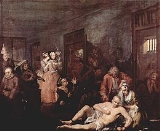
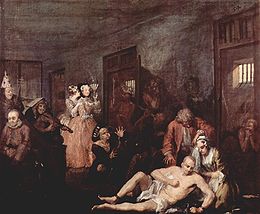 Eighteenth century Bethlem was most notably portrayed in a scene from William Hogarth
's A Rake's Progress (1735), the story of a rich merchant's son whose immoral living causes him to end up in a ward at Bethlem. This reflects the view of the time that madness was a result of moral weakness, leading to "moral insanity
" being used as a common diagnosis.
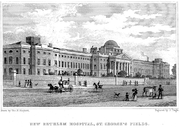
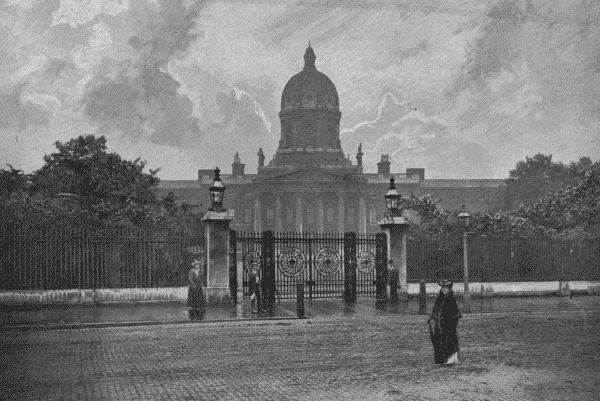 In 1815, Bedlam was moved to St George's Fields
, Southwark
, into buildings designed by James Lewis (a cupola was added later by Sydney Smirke
). The inmates were referred to as "unfortunates" and must have had an uncomfortable time in their first winter there; no glass was initially provided for the windows, because of "the disagreable effluvias peculiar to all madhouses". In June 1816 Thomas Monro
, Principal Physician resigned as a result of scandal when he was accused of ‘wanting in humanity’ towards his patients.
The new building had a remarkable library as an annex which was well frequented. Although the sexes were separated, in the evenings, those capable of appreciating music could dance together in the great ballroom. In the chapel the sexes were separated by a curtain. Finally, in 1930, the hospital was moved to an outer suburb of London, on the site of Monks Orchard House between Eden Park
, Beckenham
and Shirley
. The old hospital and its grounds were bought by Lord Rothermere and presented to the London County Council
for use as a park; the central part of the building was retained and became home to the Imperial War Museum
in 1936.
In the early modern period it was widely believed that patients discharged from Bethlem Hospital were licensed to beg, though in 1675 the Governors denied this. They were known as Abraham-men
or Tom o' Bedlam
. They usually wore a tin plate on their arm as a badge and were also known as Bedlamers, Bedlamites, or Bedlam Beggars. In William Shakespeare's King Lear
, the Earl of Gloucester's son Edgar takes the role of a Bedlam Beggar in order to remain in England unnoticed after banishment. Whether any were ever licensed is uncertain. There were probably far more who claimed falsely to have been inmates than were ever admitted to the hospital.
In 1997 the Bethlem hospital started planning celebrations of its history on the occasion of its 750th anniversary. The service user perspective was not to be included, however, and members of the Psychiatric survivors movement
saw nothing to celebrate in either the original Bedlam or in current mental health care. A campaign called "Reclaim Bedlam" was launched by Pete Shaugnessey, which was supported by hundreds of patients and ex-patients and widely reported in the media. A sit-in was held outside the earlier Bedlam site at the Imperial War Museum. The historian Roy Porter
called the Bethlem Hospital "a symbol for man's inhumanity to man, for callousness and cruelty."
Until the 1990s, the hospital and its grounds were in the London Borough of Croydon, but were swapped with the London Borough of Bromley
for South Norwood Country Park
. This has meant that the hospital is now located in a community which it does not primarily serve (although as many of its services meet the needs of people from across England and Wales and even Gibraltar, to judge its location by its ability to serve a local population conveniently may not be entirely appropriate).
("SLaM"), along with the Maudsley Hospital
in Camberwell
.
In 2001 SLaM sought planning permission for an expanded Medium Secure Unit in 2001 and extensive further works to improve security, much of which would be on Metropolitan Open Land. Local residents groups organised mass meetings to oppose the application, with accusations that it was unfair most patients could be from inner London areas and therefore not locals and that drug use was rife in and around the Hospital. Bromley Council eventually refused the application, with Croydon Council
also objecting. However the Office of the Deputy Prime Minister overturned the decision to refuse in 2003, and development started.
The new 89-bed, £33.5m unit (River House) opened in February 2008. It is the most significant development on the site since the hospital was formally opened at Monks Orchard in 1930. River House represents a major improvement in the quality of local NHS care for people with mental health problems. The unit provides care for people who were previously being treated in hospitals as far as 200 miles away from their families because of the historic shortage of medium secure beds in South-east London. This, in turn, was intended to help the NHS to manage people's progress through care and treatment more effectively.
The Hospital Trust still owns land throughout England, often left to it as a bequest. It owns a lease in Piccadilly for which it has paid the same peppercorn rent
for over 200 years. This property is let out to shops and a hotel, which contributes to funding.
Other services on the hospital include the Bethlem Adolescent Unit which provides care and treatment for young people aged 12 - 18 from across the UK. A virtual tour of the unit is available on the SLaM website.
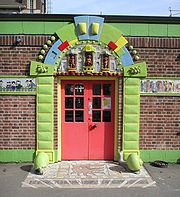 The hospital also has an occupational therapy
department, which has its own art gallery displaying work of current patients, and a number of noted artists have been past patients at the hospital over the years. Several examples of their work can be found in the Bethlem museum.
, Richard Dadd
and Louis Wain
.
Other exhibits include a pair of statues by Caius Gabriel Cibber
known as Raving and Melancholy Madness, from the gates of the 17th century Bethlem Hospital, 18th and 19th century furniture, and documents from the archives. Due to the size of the museum only a small fraction of the collections can be displayed at one time, and the exhibits are rotated periodically.
Bethlem Royal Hospital possesses extensive archives from Bethlem Hospital, the Maudsley Hospital and Warlingham Park Hospital
, and some of the archives of Bridewell Hospital. There are documents dating back to the 16th century, as well as full modern patient records. The archives are open for inspection by appointment, subject to the laws of confidentiality governing recent patient records.
The Bethlem Royal Hospital Archives and Museum is governed by a registered charity called the Bethlem Art and History Collections Trust. The museum is a member of the London Museums of Health & Medicine
.
Psychiatric hospital
Psychiatric hospitals, also known as mental hospitals, are hospitals specializing in the treatment of serious mental disorders. Psychiatric hospitals vary widely in their size and grading. Some hospitals may specialise only in short-term or outpatient therapy for low-risk patients...
located in London
London
London is the capital city of :England and the :United Kingdom, the largest metropolitan area in the United Kingdom, and the largest urban zone in the European Union by most measures. Located on the River Thames, London has been a major settlement for two millennia, its history going back to its...
, United Kingdom
United Kingdom
The United Kingdom of Great Britain and Northern IrelandIn the United Kingdom and Dependencies, other languages have been officially recognised as legitimate autochthonous languages under the European Charter for Regional or Minority Languages...
and part of the South London and Maudsley NHS Foundation Trust
South London and Maudsley NHS Foundation Trust
The South London and Maudsley NHS Foundation Trust is an NHS foundation trust based in London, United Kingdom. It comprises three psychiatric hospitals The South London and Maudsley NHS Foundation Trust is an NHS foundation trust based in London, United Kingdom. It comprises three psychiatric...
. Although no longer based at its original location, it is recognised as the world's first and oldest institution to specialise in mental illnesses. It has been variously known as St. Mary Bethlehem, Bethlem Hospital, Bethlehem Hospital and Bedlam.
The Hospital is closely associated with King's College London
King's College London
King's College London is a public research university located in London, United Kingdom and a constituent college of the federal University of London. King's has a claim to being the third oldest university in England, having been founded by King George IV and the Duke of Wellington in 1829, and...
and in partnership with the King's College London Institute of Psychiatry
Institute of Psychiatry
The Institute of Psychiatry is a research institution dedicated to discovering what causes mental illness and diseases of the brain. In addition, its aim is to help identify new treatments for them and ways to prevent them in the first place...
is a major centre for psychiatric research. It is part of both the King's Health Partners
King's Health Partners
-External links:* * * * *...
academic health science centre
Academic health science centre
An academic health science centre is a partnership between one or more universities and healthcare providers focusing on research, clinical services, education and training...
and the NIHR Biomedical Research Centre for Mental Health.
The word bedlam, meaning uproar and confusion, is derived from the hospital's prior name. Although the hospital is now at the forefront of humane psychiatric treatment, for much of its history it was notorious for cruelty and inhumane treatment – the epitome of what the term "madhouse" or "insane asylum" might connote to the modern reader.
History
Bethlem has been a part of London since 1247, first as a prioryPriory
A priory is a house of men or women under religious vows that is headed by a prior or prioress. Priories may be houses of mendicant friars or religious sisters , or monasteries of monks or nuns .The Benedictines and their offshoots , the Premonstratensians, and the...
for the sisters and brethren of the Order of the Star of Bethlehem , from where the building took its name. Its first site was in Bishopsgate
Bishopsgate
Bishopsgate is a road and ward in the northeast part of the City of London, extending north from Gracechurch Street to Norton Folgate. It is named after one of the original seven gates in London Wall...
(where Liverpool Street station
Liverpool Street station
Liverpool Street railway station, also known as London Liverpool Street or simply Liverpool Street, is both a central London railway terminus and a connected London Underground station in the north-eastern corner of the City of London, England...
now stands). In 1337 it became a hospital, and it admitted some mentally ill patients from 1357, but did not become a dedicated psychiatric hospital until later. Early sixteenth century maps show Bedlam, next to Bishopsgate, as a courtyard with a few stone buildings, a church and a garden. Conditions were consistently dreadful, and the care amounted to little more than restraint. There were 31 patients and the noise was "so hideous, so great; that they are more able to drive a man that hath his wits rather out of them." Violent or dangerous patients were manacled and chained to the floor or wall. Some were allowed to leave, and licensed to beg. It was a Royal hospital, but controlled by the City of London
City of London
The City of London is a small area within Greater London, England. It is the historic core of London around which the modern conurbation grew and has held city status since time immemorial. The City’s boundaries have remained almost unchanged since the Middle Ages, and it is now only a tiny part of...
after 1557, and managed by the Governors of Bridewell. Day to day management was in the hands of a Keeper, who received payment for each patient from their parish, livery company, or relatives. In 1598 an inspection showed neglect; the "Great Vault" (cesspit
Cesspit
A cesspit, or cesspool is a pit, conservancy tank, or covered cistern, which can be used to dispose of urine and feces, and more generally of all sewage and refuse. It is a more antiquated solution than a sewer system. Traditionally, it was a deep cylindrical chamber dug into the earth, having...
) badly needed emptying, and the kitchen drains needed replacing. There were 20 patients there, one of whom had been there over 25 years.
Many sources assert that, in 1620, patients of Bethlem banded together and sent a "Petition of the Poor Distracted People in the House of Bedlam (concerned with conditions for inmates)" to the House of Lords
House of Lords
The House of Lords is the upper house of the Parliament of the United Kingdom. Like the House of Commons, it meets in the Palace of Westminster....
. However, the absence of a primary document suggests that this may well be a 'phantom reference'.
The Hospital became famous and notorious for the brutal ill-treatment meted out to the mentally ill. In 1675 Bedlam moved to new buildings in Moorfields
Moorfields
In London, the Moorfields were one of the last pieces of open land in the City of London, near the Moorgate. The fields were divided into three areas, the Moorfields proper, just north of Bethlem Hospital, and inside the City boundaries, and Middle and Upper Moorfields to the north.After the Great...
designed by Robert Hooke
Robert Hooke
Robert Hooke FRS was an English natural philosopher, architect and polymath.His adult life comprised three distinct periods: as a scientific inquirer lacking money; achieving great wealth and standing through his reputation for hard work and scrupulous honesty following the great fire of 1666, but...
, outside the City boundary. The playwright
Playwright
A playwright, also called a dramatist, is a person who writes plays.The term is not a variant spelling of "playwrite", but something quite distinct: the word wright is an archaic English term for a craftsman or builder...
Nathaniel Lee
Nathaniel Lee
Nathaniel Lee was an English dramatist.He was the son of Dr Richard Lee, a Presbyterian clergyman who was rector of Hatfield and held many preferments under the Commonwealth...
was incarcerated there for five years, reporting that: "They called me mad, and I called them mad, and damn them, they outvoted me."
The inmates were first called "patients" in 1700, and "curable" and "incurable" wards were opened in 1725-34. In the 18th century people used to go to Bedlam to stare at the lunatics. For a penny one could peer into their cells, view the freaks of the "show of Bethlehem" and laugh at their antics. Entry was free on the first Tuesday of the month. In 1814 alone, there were 96,000 such visits.
William Hogarth
William Hogarth was an English painter, printmaker, pictorial satirist, social critic and editorial cartoonist who has been credited with pioneering western sequential art. His work ranged from realistic portraiture to comic strip-like series of pictures called "modern moral subjects"...
's A Rake's Progress (1735), the story of a rich merchant's son whose immoral living causes him to end up in a ward at Bethlem. This reflects the view of the time that madness was a result of moral weakness, leading to "moral insanity
Moral insanity
Moral insanity is a medical diagnosis first described by the French humanitarian and psychiatrist Philippe Pinel in 1806...
" being used as a common diagnosis.
St George's Fields
St George's Fields was an area of Southwark in South London, England.Originally the area was an undifferentiated part of the south-side of the Thames, which was low lying marshland unsuitable for even agricultural purposes. As such it was part of the extensive holdings of the king, it is difficult...
, Southwark
Southwark
Southwark is a district of south London, England, and the administrative headquarters of the London Borough of Southwark. Situated east of Charing Cross, it forms one of the oldest parts of London and fronts the River Thames to the north...
, into buildings designed by James Lewis (a cupola was added later by Sydney Smirke
Sydney Smirke
Sydney Smirke, architect, was born in London, England, the younger brother of Sir Robert Smirke, also an architect. Their father, also Robert Smirke, had been a well-known 18th Century painter.Sydney Smirke's works include:...
). The inmates were referred to as "unfortunates" and must have had an uncomfortable time in their first winter there; no glass was initially provided for the windows, because of "the disagreable effluvias peculiar to all madhouses". In June 1816 Thomas Monro
Thomas Monro
Thomas Monro was a British art collector and patron as well as Physician to George III. He was Principal Physician of the Bethlem Royal Hospital in London but resigned in June 1816 as a result of scandal when he was accused of ‘wanting in humanity’ towards his patients.Monro was best known as a...
, Principal Physician resigned as a result of scandal when he was accused of ‘wanting in humanity’ towards his patients.
The new building had a remarkable library as an annex which was well frequented. Although the sexes were separated, in the evenings, those capable of appreciating music could dance together in the great ballroom. In the chapel the sexes were separated by a curtain. Finally, in 1930, the hospital was moved to an outer suburb of London, on the site of Monks Orchard House between Eden Park
Eden Park, London
Eden Park is a place in the London Borough of Bromley, England. It is a suburban area between West Wickham, Elmers End and Shirley.The Bethlem Royal Hospital is found nearby.-Recent developments:...
, Beckenham
Beckenham
Beckenham is a town in the London Borough of Bromley, England. It is located 8.4 miles south east of Charing Cross and 1.75 miles west of Bromley town...
and Shirley
Shirley, London
Shirley is a place in the London Borough of Croydon, England. It is a suburban development situated 10 miles south south-east of Charing Cross.-Description:...
. The old hospital and its grounds were bought by Lord Rothermere and presented to the London County Council
London County Council
London County Council was the principal local government body for the County of London, throughout its 1889–1965 existence, and the first London-wide general municipal authority to be directly elected. It covered the area today known as Inner London and was replaced by the Greater London Council...
for use as a park; the central part of the building was retained and became home to the Imperial War Museum
Imperial War Museum
Imperial War Museum is a British national museum organisation with branches at five locations in England, three of which are in London. The museum was founded during the First World War in 1917 and intended as a record of the war effort and sacrifice of Britain and her Empire...
in 1936.
In the early modern period it was widely believed that patients discharged from Bethlem Hospital were licensed to beg, though in 1675 the Governors denied this. They were known as Abraham-men
Abraham-men
The Abraham-men were a class of beggars claiming to be lunatics allowed out of restraint, in the Tudor and Stuart periods in England....
or Tom o' Bedlam
Tom o' Bedlam
"Tom O' Bedlam" is the name of a critically acclaimed anonymous poem written circa 1600 about a Bedlamite....
. They usually wore a tin plate on their arm as a badge and were also known as Bedlamers, Bedlamites, or Bedlam Beggars. In William Shakespeare's King Lear
King Lear
King Lear is a tragedy by William Shakespeare. The title character descends into madness after foolishly disposing of his estate between two of his three daughters based on their flattery, bringing tragic consequences for all. The play is based on the legend of Leir of Britain, a mythological...
, the Earl of Gloucester's son Edgar takes the role of a Bedlam Beggar in order to remain in England unnoticed after banishment. Whether any were ever licensed is uncertain. There were probably far more who claimed falsely to have been inmates than were ever admitted to the hospital.
In 1997 the Bethlem hospital started planning celebrations of its history on the occasion of its 750th anniversary. The service user perspective was not to be included, however, and members of the Psychiatric survivors movement
Psychiatric survivors movement
The psychiatric survivors movement is a diverse association of individuals who are either currently clients of mental health services , or who consider themselves survivors of interventions by psychiatry, or who identify themselves as ex-patients of mental health services...
saw nothing to celebrate in either the original Bedlam or in current mental health care. A campaign called "Reclaim Bedlam" was launched by Pete Shaugnessey, which was supported by hundreds of patients and ex-patients and widely reported in the media. A sit-in was held outside the earlier Bedlam site at the Imperial War Museum. The historian Roy Porter
Roy Porter
Roy Sydney Porter was a British historian noted for his prolific work on the history of medicine.-Life:...
called the Bethlem Hospital "a symbol for man's inhumanity to man, for callousness and cruelty."
Until the 1990s, the hospital and its grounds were in the London Borough of Croydon, but were swapped with the London Borough of Bromley
London Borough of Bromley
The London Borough of Bromley is a London borough of south east London, England and forms part of Outer London. The principal town in the borough is Bromley.-Geography:...
for South Norwood Country Park
South Norwood Country Park
South Norwood Country Park is a park in South Norwood, close to Elmers End station, mainly in the London Borough of Croydon. It is a 47 hectare green space which opened in 1989...
. This has meant that the hospital is now located in a community which it does not primarily serve (although as many of its services meet the needs of people from across England and Wales and even Gibraltar, to judge its location by its ability to serve a local population conveniently may not be entirely appropriate).
21st century
In 1999, Bethlem Royal Hospital became part of the South London and Maudsley NHS Foundation TrustSouth London and Maudsley NHS Foundation Trust
The South London and Maudsley NHS Foundation Trust is an NHS foundation trust based in London, United Kingdom. It comprises three psychiatric hospitals The South London and Maudsley NHS Foundation Trust is an NHS foundation trust based in London, United Kingdom. It comprises three psychiatric...
("SLaM"), along with the Maudsley Hospital
Maudsley Hospital
The Maudsley Hospital is a British psychiatric hospital in South London. The Maudsley is the largest mental health training institution in the country...
in Camberwell
Camberwell
Camberwell is a district of south London, England, and forms part of the London Borough of Southwark. It is a built-up inner city district located southeast of Charing Cross. To the west it has a boundary with the London Borough of Lambeth.-Toponymy:...
.
In 2001 SLaM sought planning permission for an expanded Medium Secure Unit in 2001 and extensive further works to improve security, much of which would be on Metropolitan Open Land. Local residents groups organised mass meetings to oppose the application, with accusations that it was unfair most patients could be from inner London areas and therefore not locals and that drug use was rife in and around the Hospital. Bromley Council eventually refused the application, with Croydon Council
London Borough of Croydon
The London Borough of Croydon is a London borough in South London, England and is part of Outer London. It covers an area of and is the largest London borough by population. It is the southernmost borough of London. At its centre is the historic town of Croydon from which the borough takes its name...
also objecting. However the Office of the Deputy Prime Minister overturned the decision to refuse in 2003, and development started.
The new 89-bed, £33.5m unit (River House) opened in February 2008. It is the most significant development on the site since the hospital was formally opened at Monks Orchard in 1930. River House represents a major improvement in the quality of local NHS care for people with mental health problems. The unit provides care for people who were previously being treated in hospitals as far as 200 miles away from their families because of the historic shortage of medium secure beds in South-east London. This, in turn, was intended to help the NHS to manage people's progress through care and treatment more effectively.
The Hospital Trust still owns land throughout England, often left to it as a bequest. It owns a lease in Piccadilly for which it has paid the same peppercorn rent
Peppercorn (legal)
A peppercorn in legal parlance is a metaphor for a very small payment, a nominal consideration, used to satisfy the requirements for the creation of a legal contract. "A peppercorn does not cease to be good consideration if it is established that the promisee does not like pepper and will throw...
for over 200 years. This property is let out to shops and a hotel, which contributes to funding.
Services
The hospital includes a range of specialist services such as the National Psychosis Unit.Other services on the hospital include the Bethlem Adolescent Unit which provides care and treatment for young people aged 12 - 18 from across the UK. A virtual tour of the unit is available on the SLaM website.
Occupational therapy
Occupational therapy is a discipline that aims to promote health by enabling people to perform meaningful and purposeful activities. Occupational therapists work with individuals who suffer from a mentally, physically, developmentally, and/or emotionally disabling condition by utilizing treatments...
department, which has its own art gallery displaying work of current patients, and a number of noted artists have been past patients at the hospital over the years. Several examples of their work can be found in the Bethlem museum.
Museum and archives
Since 1970, there has been a small museum at Bethlem Royal Hospital. It is open to the public on weekdays. The museum is mainly used to display items from the hospital's art collection, which specialises in work by artists who have suffered from mental health problems, such as former Bethlem patients William KurelekWilliam Kurelek
William Kurelek, CM was a Canadian artist and writer. His work was influenced by his childhood on the prairies, his Ukrainian-Canadian roots and his Roman Catholicism.- Life :...
, Richard Dadd
Richard Dadd
Richard Dadd was an English painter of the Victorian era, noted for his depictions of fairies and other supernatural subjects, Orientalist scenes, and enigmatic genre scenes, rendered with obsessively minuscule detail...
and Louis Wain
Louis Wain
Louis Wain was an English artist best known for his drawings, which consistently featured anthropomorphised large-eyed cats and kittens. In his later years he suffered from schizophrenia, which, according to some psychologists, can be seen in his works.- Life and work :Louis William Wain was...
.
Other exhibits include a pair of statues by Caius Gabriel Cibber
Caius Gabriel Cibber
Caius Gabriel Cibber was a Danish sculptor, who enjoyed great success in England, and was the father of the actor, author and poet laureate Colley Cibber. He was appointed "carver to the king's closet" by William III....
known as Raving and Melancholy Madness, from the gates of the 17th century Bethlem Hospital, 18th and 19th century furniture, and documents from the archives. Due to the size of the museum only a small fraction of the collections can be displayed at one time, and the exhibits are rotated periodically.
Bethlem Royal Hospital possesses extensive archives from Bethlem Hospital, the Maudsley Hospital and Warlingham Park Hospital
Warlingham Park Hospital
Warlingham Park Hospital was a psychiatric hospital in Warlingham, Surrey. It was located at in Chelsham.It opened on 26 June 1903 as the Croydon Mental Hospital ....
, and some of the archives of Bridewell Hospital. There are documents dating back to the 16th century, as well as full modern patient records. The archives are open for inspection by appointment, subject to the laws of confidentiality governing recent patient records.
The Bethlem Royal Hospital Archives and Museum is governed by a registered charity called the Bethlem Art and History Collections Trust. The museum is a member of the London Museums of Health & Medicine
The London Museums of Health & Medicine
The London Museums of Health & Medicine is an organization that brings together some of the activities of some of the museums in London related to health and medicine...
.
Notable patients
- Lemuel Francis AbbottLemuel Francis AbbottLemuel "Francis" Abbot was an English portrait painter, famous for his likeness of Horatio Nelson, 1st Viscount Nelson and for those of other naval officers and literary figures of the 18th century.-Life and work:He was born Lemuel Abbott in Leicestershire in 1760 or 1761,...
, portrait painter - Richard DaddRichard DaddRichard Dadd was an English painter of the Victorian era, noted for his depictions of fairies and other supernatural subjects, Orientalist scenes, and enigmatic genre scenes, rendered with obsessively minuscule detail...
, artist - John FrithJohn Frith (assailant)John Frith was an Englishman who believed himself to be St Paul.On 21 January 1790, Frith threw a stone at King George III's coach as it travelled to the State Opening of Parliament. As in an earlier case of assault against the King, that of Margaret Nicholson, Frith had sent multiple petitions to...
, would-be assailant of King George IIIGeorge III of the United KingdomGeorge III was King of Great Britain and King of Ireland from 25 October 1760 until the union of these two countries on 1 January 1801, after which he was King of the United Kingdom of Great Britain and Ireland until his death... - James HadfieldJames HadfieldJames Hadfield or Hatfield attempted to assassinate George III of the United Kingdom in 1800 but was acquitted of attempted murder by reason of insanity....
, would-be assassinAssassinationTo carry out an assassination is "to murder by a sudden and/or secret attack, often for political reasons." Alternatively, assassination may be defined as "the act of deliberately killing someone, especially a public figure, usually for hire or for political reasons."An assassination may be...
of King George III - Daniel M'NaghtenDaniel M'NaghtenDaniel M'Naghten was a Scottish woodturner who assassinated English civil servant Edward Drummond while suffering from paranoid delusions...
, catalyst for the creation of the M'Naghten RulesM'Naghten RulesThe M'Naghten rules were a reaction to the acquittal of Daniel McNaughton. They arise from the attempted assassination of the British Prime Minister, Robert Peel, in 1843 by Daniel M'Naghten. In fact, M'Naghten fired a pistol at the back of Peel's secretary, Edward Drummond, who died five days later...
(criteria for the defence of insanity in the British legal system) after the shootingShootingShooting is the act or process of firing rifles, shotguns or other projectile weapons such as bows or crossbows. Even the firing of artillery, rockets and missiles can be called shooting. A person who specializes in shooting is a marksman...
of Edward Drummond - Jonathan Martin, the man who set fire to York MinsterYork MinsterYork Minster is a Gothic cathedral in York, England and is one of the largest of its kind in Northern Europe alongside Cologne Cathedral. The minster is the seat of the Archbishop of York, the second-highest office of the Church of England, and is the cathedral for the Diocese of York; it is run by...
- James Tilly MatthewsJames Tilly MatthewsJames Tilly Matthews was a London tea broker, originally from Wales, who was committed to the Bethlem psychiatric hospital in 1797, and is considered to be the first fully documented case of paranoid schizophrenia....
, one time tea merchant and subject of the first book-length psychiatric case study - Moll Cutpurse, also known as Mary Frith or "The Roaring Girl", released from Bedlam in 1644 according to Bridewell records
- Margaret NicholsonMargaret NicholsonMargaret Nicholson was an Englishwoman who assaulted King George III. Her futile and somewhat half-hearted attempt on the King's life became famous and was featured in one of Shelley's first works: Posthumous Fragments of Margaret Nicholson, published in 1810.-Life:Nicholson was born in...
, would-be assassin of King George IIIGeorge III of the United KingdomGeorge III was King of Great Britain and King of Ireland from 25 October 1760 until the union of these two countries on 1 January 1801, after which he was King of the United Kingdom of Great Britain and Ireland until his death... - Edward OxfordEdward OxfordEdward Oxford was tried for high treason for attempting to assassinate Queen Victoria in 1840.The Queen was out riding on Constitution Hill with her husband, Prince Albert, on 10 June, when Oxford shot twice at the couple, missing both times. He was seized by onlookers, arrested and tried at the...
, tried for high treason after the attempted assassination of Queen Victoria and Prince Albert - Martha ThompsonMartha ThompsonMartha Thompson was an English Methodist. She was a housemaid in London, and was converted to Methodism after hearing John Wesley preach in Moorfields. Martha was declared insane and sent to Bedlam, but Wesley later freed her and rode with her back to her hometown of Preston...
, Methodist convert - Louis WainLouis WainLouis Wain was an English artist best known for his drawings, which consistently featured anthropomorphised large-eyed cats and kittens. In his later years he suffered from schizophrenia, which, according to some psychologists, can be seen in his works.- Life and work :Louis William Wain was...
, artist
See also
- Abraham-menAbraham-menThe Abraham-men were a class of beggars claiming to be lunatics allowed out of restraint, in the Tudor and Stuart periods in England....
- John Cutting (psychiatrist)John Cutting (psychiatrist)Dr. John Charles Cutting, who writes as Dr. John Cutting , is a British psychiatrist specializing in schizophrenia research...
- The Monro familyMonro Family (Physicians)The Monro of Fyrish family were a Scottish family and branch of the ancient highland Clan Munro. The family produced a notable dynasty of doctors to London in the 18th and 19th century where they were involved in early work on curing 'insanity'. Four generations occupied successively the position...
provided several generations of doctors who were principal physicians of the Hospital in the 18th and 19th centuries. - Augustus Welby Northmore Pugin (1812–1852) English architect, best known for his work on the Houses of Parliament as well as many churches.