

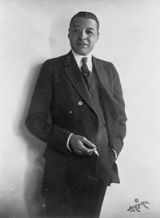
Bert Williams

Encyclopedia
- This is about the Broadway performer Bert Williams. For the English footballer, see Bert Williams (footballer)Bert Williams (footballer)Bert Frederick Williams MBE is a former English international football goalkeeper. Nicknamed The Cat, he spent the majority of his playing career at Wolverhampton Wanderers where he won the League Championship and FA Cup....
Egbert Austin "Bert" Williams (November 12, 1874 – March 4, 1922) was one of the preeminent entertainers of the Vaudeville
Vaudeville
Vaudeville was a theatrical genre of variety entertainment in the United States and Canada from the early 1880s until the early 1930s. Each performance was made up of a series of separate, unrelated acts grouped together on a common bill...
era and one of the most popular comedian
Comedian
A comedian or comic is a person who seeks to entertain an audience, primarily by making them laugh. This might be through jokes or amusing situations, or acting a fool, as in slapstick, or employing prop comedy...
s for all audiences of his time. He was by far the best-selling black recording artist before 1920. In 1918, the New York Dramatic Mirror called Williams "one of the great comedians of the world."
Williams was a key figure in the development of African-American entertainment. In an age when racial inequality and stereotyping were commonplace, he became the first black American to take a lead role on the Broadway
Broadway theatre
Broadway theatre, commonly called simply Broadway, refers to theatrical performances presented in one of the 40 professional theatres with 500 or more seats located in the Theatre District centered along Broadway, and in Lincoln Center, in Manhattan in New York City...
stage, and did much to push back racial barriers during his career. Fellow vaudevillian W.C. Fields, who appeared in productions with Williams, described him as "the funniest man I ever saw – and the saddest man I ever knew."
Early life
Williams was born in NassauNassau, Bahamas
Nassau is the capital, largest city, and commercial centre of the Commonwealth of the Bahamas. The city has a population of 248,948 , 70 percent of the entire population of The Bahamas...
, Bahamas, and at the age of 10 he was brought to New York City
New York City
New York is the most populous city in the United States and the center of the New York Metropolitan Area, one of the most populous metropolitan areas in the world. New York exerts a significant impact upon global commerce, finance, media, art, fashion, research, technology, education, and...
by his parents. From New York City the family moved to Riverside, California
Riverside, California
Riverside is a city in Riverside County, California, United States, and the county seat of the eponymous county. Named for its location beside the Santa Ana River, it is the largest city in the Riverside-San Bernardino-Ontario metropolitan area of Southern California, 4th largest inland California...
, where Williams graduated from Riverside High School. He later went to San Francisco, intending to study to be a civil engineer
Civil engineer
A civil engineer is a person who practices civil engineering; the application of planning, designing, constructing, maintaining, and operating infrastructures while protecting the public and environmental health, as well as improving existing infrastructures that have been neglected.Originally, a...
, but instead joined a minstrel company known as "The Mastoden Minstrels", which played the lumber and mining camps of California. In 1893, in San Francisco he formed the team of Williams and Walker, his partner being equally celebrated straight man George Walker
George Walker (vaudeville)
George Walker was an African American vaudevillian. In 1893, in San Francisco, Walker met Bert Williams, who became his performing partner. Walker and Williams appeared in The Gold Bug , Clorindy , The Policy Player , Sons of Ham , In Dahomey , Abyssinia , and Bandanna Land...
.
Williams became one of Vaudeville
Vaudeville
Vaudeville was a theatrical genre of variety entertainment in the United States and Canada from the early 1880s until the early 1930s. Each performance was made up of a series of separate, unrelated acts grouped together on a common bill...
's top solo artists, but he first gained notice as half of the successful double-act "Williams & Walker." He and George Walker
George Walker (vaudeville)
George Walker was an African American vaudevillian. In 1893, in San Francisco, Walker met Bert Williams, who became his performing partner. Walker and Williams appeared in The Gold Bug , Clorindy , The Policy Player , Sons of Ham , In Dahomey , Abyssinia , and Bandanna Land...
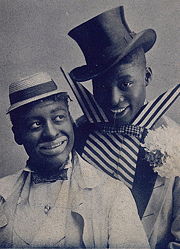
performed song-and-dance numbers, comic dialogues and skits, and humorous songs. They fell into stereotypical vaudevillian roles: originally Williams portrayed a slick conniver, while Walker played the "dumb coon" victim of Williams' schemes. However, they soon discovered that they got a better reaction by switching roles. The sharp-featured and slender Walker eventually developed a persona as a strutting dandy, while the stocky Williams played the languorous oaf. Despite his thickset physique, Williams was a master of body language and physical "stage business."
In late 1896, the pair were added to The Gold Bug, a struggling musical. The show did not survive, but Williams & Walker got good reviews, and were able to secure higher profile bookings. They headlined the Koster and Bial's vaudeville house for 36 weeks in 1896-97, where their spirited version of the cakewalk
Cakewalk
The Cakewalk dance was developed from a "Prize Walk" done in the days of slavery, generally at get-togethers on plantations in the Southern United States. Alternative names for the original form of the dance were "chalkline-walk", and the "walk-around"...
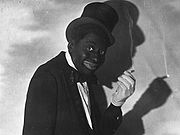
helped popularize the dance. The pair performed in burnt-cork blackface
Blackface
Blackface is a form of theatrical makeup used in minstrel shows, and later vaudeville, in which performers create a stereotyped caricature of a black person. The practice gained popularity during the 19th century and contributed to the proliferation of stereotypes such as the "happy-go-lucky darky...
, as was customary at the time, billing themselves as "Two Real Coons" to distinguish their act from the many white minstrels also performing in blackface. Williams also made his first recordings in 1896, but none are known to survive.
In 1899 Bert surprised his partner George Walker and his family when he announced he had recently married Charlotte ("Lottie") Thompson, a singer with whom he had worked professionally, in a very private ceremony. Lottie was a widow 8 years Bert's senior and a homebody, thus the match seemed odd to some who knew the gregarious and constantly traveling Williams, but all who knew them considered them a uniquely happy couple and the union lasted until his death. The Williamses never had children biologically but they adopted three of Lottie's nieces and frequently sheltered orphans and foster children in their homes.
Williams & Walker appeared in a succession of shows, including A Senegambian Carnival, A Lucky Coon, and The Policy Players. Their stars were on the ascent, but they still faced vivid reminders of the limits placed on them by white society. In August 1900, in New York City, hysterical rumors of a white detective having been shot by a black man erupted into an uncontained riot. Unaware of the street violence, Williams & Walker left their theater after a performance and parted ways. Williams headed off in a fortunate direction, but Walker was yanked from a streetcar by a white mob and was beaten.
Sons of Ham and In Dahomey
Victor Talking Machine Company
The Victor Talking Machine Company was an American corporation, the leading American producer of phonographs and phonograph records and one of the leading phonograph companies in the world at the time. It was headquartered in Camden, New Jersey....
. Some of these, like "The Phrenologist Coon," were standard blackface material, but the financial lament "When It's All Going Out and Nothing Coming In" was race-blind, and became one of Williams' best-known songs. Another Williams composition, "Good Morning Carrie", was covered by many artists, becoming one of the biggest hits of 1901. These discs existed only in pressings of fewer than 1,000, and were not heard by very many listeners. Sons of Ham ran for two years.
In September 1902, Williams & Walker debuted their next vehicle, In Dahomey
In Dahomey
In Dahomey was a landmark American musical comedy, in that it was "the first full-length musical written and played by blacks to be performed at a major Broadway house." It featured music by Will Marion Cook, book by Jesse A. Shipp, and lyrics by Paul Laurence Dunbar...
, which was an even bigger hit. In 1903 the production, with music by Will Marion Cook
Will Marion Cook
William Mercer Cook , better known as Will Marion Cook, was an African American composer and violinist from the United States. Cook was a student of Antonín Dvořák and performed for King George V among others...
and lyrics by Paul Laurence Dunbar
Paul Laurence Dunbar
Paul Laurence Dunbar was a seminal African American poet of the late 19th and early 20th centuries. Dunbar gained national recognition for his 1896 "Ode to Ethiopia", one poem in the collection Lyrics of Lowly Life....
moved to New York City, where it became the first black musical to open on Broadway. This was a landmark event, but seating inside the theater was segregated. One of the musical's songs, "I'm a Jonah Man," helped codify Williams' hard-luck persona and tales of woe. In Dahomey then traveled to London
London
London is the capital city of :England and the :United Kingdom, the largest metropolitan area in the United Kingdom, and the largest urban zone in the European Union by most measures. Located on the River Thames, London has been a major settlement for two millennia, its history going back to its...
, where it was enthusiastically received. A command performance was given at Buckingham Palace
Buckingham Palace
Buckingham Palace, in London, is the principal residence and office of the British monarch. Located in the City of Westminster, the palace is a setting for state occasions and royal hospitality...
in June 1903.
In February 1906, Abyssinia, with a score co-written by Williams, premiered at the Majestic Theater. The show, which included live camels, was another smash. Williams committed many of its songs to disc and cylinder. One of them, "Nobody
Nobody (1905 song)
"Nobody" is a popular song with music by Bert Williams and lyrics by Alex Rogers, published in 1905.The song premiered in February 1906, in the Broadway production "Abyssinia." The show, which included live camels, premiered at the Majestic Theater and continued the string of hits for the...
", became his signature theme, and the song he is best remembered for today. It is a doleful and ironic composition, replete with his dry observational wit, and is perfectly complemented by Williams' intimate, half-spoken singing style.
- When life seems full of clouds and rain,
- And I am filled with naught but pain,
- Who soothes my thumping, bumping brain?
- [pause] Nobody.
- When winter comes with snow and sleet,
- And me with hunger and cold feet,
- Who says, "Here's two bits, go and eat"?
- [pause] Nobody.
- I ain't never done nothin' to Nobody.
- I ain't never got nothin' from Nobody, no time.
- And, until I get somethin' from somebody sometime,
- I don't intend to do nothin' for Nobody, no time.
Williams became so identified with the song that he was obliged to sing it in almost every appearance for the rest of his life. He considered its success both blessing and curse: "Before I got through with 'Nobody,' I could have wished that both the author of the words and the assembler of the tune had been strangled or drowned... 'Nobody' was a particularly hard song to replace." "Nobody" remained active in Columbia's sales catalogue into the 1930s, and the musicologist Tim Brooks
Tim Brooks (television historian)
Tim Brooks is an American television and radio historian, author and retired television executive. He is credited with having helped launch the Sci Fi Channel in 1992 as well as other USA Network projects and channels....
estimates that it sold between 100,000 and 150,000 copies, a phenomenally high amount for the era.
Williams' langorous, drawling delivery was the primary selling point of several similarly-structured Williams recordings, such as "Constantly" and "I'm Neutral." Williams even recorded two compositions titled "Somebody" and "Everybody." His style was inimitable. In an era when the most popular songs were simultaneously promoted by several artists (for example, "Over There
Over There
"Over There" is a 1917 song popular with United States soldiers in both world wars.It was written by George M. Cohan during World War I. Notable early recordings include versions by Nora Bayes, Enrico Caruso, Billy Murray, and Charles King....
" was a top ten hit for six different acts in 1917-18), Williams' repertoire was left comparatively untouched by competing singers.
Williams & Walker were prominent success stories for the black community, and they received both extensive press coverage and frequent admonitions to properly "represent the race." Leading black newspapers mounted campaigns against demeaning stereotypes such as the word "coon." Williams & Walker were sympathetic, but also had their careers to consider, where they performed before many white audiences. The balancing act between their audience's expectations and their artistic impulses was tricky.
In his only known essay, Williams wrote:
- "People sometimes ask me if I would not give anything to be white. I answer . . . most emphatically, "No." How do I know what I might be if I were a white man? I might be a sandhog, burrowing away and losing my health for $8 a day. I might be a streetcar conductor at $12 or $15 a week. There is many a white man less fortunate and less well-equipped than I am. In fact, I have never been able to discover that there was anything disgraceful in being a colored man. But I have often found it inconvenient . . . in America."
Bandanna Land
In 1908, while starring in the successful Broadway production Bandanna Land, Williams & Walker were asked to appear at a charity benefit by George M. CohanGeorge M. Cohan
George Michael Cohan , known professionally as George M. Cohan, was a major American entertainer, playwright, composer, lyricist, actor, singer, dancer, and producer....
. Walter C. Kelly, a prominent monologist, protested and encouraged the other acts to withdraw from the show rather than appear alongside black performers. But only two of the acts joined Kelly's boycott.
Bandanna Land continued the duo's series of hits, and introduced a sketch that Williams made famous: his pantomime poker game. In total silence, Williams acted out a hand of poker, with only his facial expressions and body language conveying the dealer's up-and-down emotions. It became a standard routine in his stage act, and was recorded on film by Biograph Studios
Biograph Studios
Biograph Studios was a studio facility and film laboratory complex built in 1912 by the Biograph Company, formerly American Mutoscope and Biograph Company, at 807 E. 175th Street, in the Bronx, New York....
in 1916.
Solo career
Walker was in ill health by this point, apparently due to syphilis, and was forced to drop out of Bandanna Land in early 1909. The famous pair never performed in public again, and Walker died less than two years later. Walker had been the businessman and public spokesman for the duo. His absence left Williams professionally adrift. His next moves in show business were cautious and tentative. He did a short solo act for the high-class vaudeville circuit, consisting of four songs and a dance. Williams next starred as Mr. Lode of Koal, a farce about a kidnapped king that was well-received by critics, but which played a secondary string of theaters and was a box office flop.After Mr. Lode skidded to a halt, Williams accepted an unprecedented offer to join Flo Ziegfeld's Follies
Ziegfeld Follies
The Ziegfeld Follies were a series of elaborate theatrical productions on Broadway in New York City from 1907 through 1931. They became a radio program in 1932 and 1936 as The Ziegfeld Follies of the Air....
. The idea of a black featured performer amid an otherwise all-white show was a shock in 1910. Williams' initial reception was cool, and several cast members delivered an ultimatum to Ziegfeld that Williams be fired. Ziegfeld held firm, saying, "I can replace every one of you, except [Williams]." The show's writers were slow to devise material for him to perform. But by the time the show finally debuted in June, Williams was a sensation. Reviews were uniformly positive for Williams, and also for Fanny Brice
Fanny Brice
Fanny Brice was a popular and influential American illustrated song "model," comedienne, singer, theatre and film actress, who made many stage, radio and film appearances and is known as the creator and star of the top-rated radio comedy series, The Baby Snooks Show...
, who was making her Broadway debut.
Following his success, Williams signed an exclusive contract with Columbia Records
Columbia Records
Columbia Records is an American record label, owned by Japan's Sony Music Entertainment, operating under the Columbia Music Group with Aware Records. It was founded in 1888, evolving from an earlier enterprise, the American Graphophone Company — successor to the Volta Graphophone Company...
, and recorded four of the show's songs. His elevated status was signaled not just by the generous terms of the contract, but by the tenor of Columbia's promotion, which dropped much of the previous "coon harmony"-type sales patter and began touting Williams' "inimitable art" and "direct appeal to the intelligence." Tim Brooks wrote,
"Williams had become a star who transcended race, to the extent that was possible in 1910." All four songs sold well, and one of them, "Play That Barbershop Chord," became a substantial hit.
Few stage performers were recording regularly in 1910, in some cases because their onstage styles did not translate to the limited technical media. But Williams' low-key natural delivery was ideal for discs of the time, and his personality was warm and funny.
Leon Errol
Leon Errol , was an Australian-born American comedian and actor, popular in the first half of the 20th century.-Biography:...
to ecstatic effect. Williams also reprised his poker routine, and popularized a song called "Woodman, Spare That Tree." In January 1913, he recorded several more sides for Columbia, including a new version of "Nobody," the 1906 copies having long since become scarce. All of the releases remained in Columbia's catalog for years. Williams continued as a featured star of the Follies, and made several more recording dates for Columbia, though he stopped writing his own songs by 1915. He also began making film appearances, though most have been lost. One of them, A Natural Born Gambler, shows his pantomime poker sketch, and is the best-known footage of Williams available.
The 1917 installment of Ziegfeld's Follies featured a rich array of talent, including W.C. Fields, Will Rogers
Will Rogers
William "Will" Penn Adair Rogers was an American cowboy, comedian, humorist, social commentator, vaudeville performer, film actor, and one of the world's best-known celebrities in the 1920s and 1930s....
, and Eddie Cantor
Eddie Cantor
Eddie Cantor was an American "illustrated song" performer, comedian, dancer, singer, actor and songwriter...
, as well as Brice and Williams. Williams and Cantor did scenes together, and struck up a close friendship. In 1918-19, Williams went on a hiatus from the Follies. Over the next four years, he recorded several records in the guise of "Elder Eatmore," an unscrupulous preacher, as well as songs dealing with Prohibition
Prohibition
Prohibition of alcohol, often referred to simply as prohibition, is the practice of prohibiting the manufacture, transportation, import, export, sale, and consumption of alcohol and alcoholic beverages. The term can also apply to the periods in the histories of the countries during which the...
, such as "Everybody Wants a Key to My Cellar," "Save a Little Dram for Me," "Ten Little Bottles," and the smash hit, "The Moon Shines on the Moonshine." By this point, Williams' records were taking up a full page in Columbia's catalog, and they were among the strongest-selling songs of the age. At a time when 10,000 sales was considered a very successful major label release, Williams had four songs that shipped between 180,000 and 250,000 copies in 1920 alone. Williams, along with Al Jolson
Al Jolson
Al Jolson was an American singer, comedian and actor. In his heyday, he was dubbed "The World's Greatest Entertainer"....
and Nora Bayes
Nora Bayes
Nora Bayes was a popular American singer, comedienne and actress of the early 20th century.-Early life and career:...
, was one of the three most highly paid recording artists in the world.
Williams continued to face racism. On one occasion, when he attempted to buy a drink at the bar of New York's elegant Hotel Astor, the white bartender tried to chase Williams away by telling him that he would be charged $50. Williams' response was to produce a thick roll of hundred dollar bills out of his pocket; placing the wad on the bar, he ordered a round for everyone in the room.
Late career and death
Williams' stage career lagged after his final Follies appearance in 1919. His name was enough to open a show, but they had shorter, less profitable runs. In December 1921, Under the Bamboo Tree opened, to middling results. Williams still got good reviews, but the show did not. Williams developed pneumoniaPneumonia
Pneumonia is an inflammatory condition of the lung—especially affecting the microscopic air sacs —associated with fever, chest symptoms, and a lack of air space on a chest X-ray. Pneumonia is typically caused by an infection but there are a number of other causes...
, but did not want to miss performances, knowing that he was the only thing keeping an otherwise moribund musical alive at the box office.
On February 27, 1922 Williams collapsed during a performance in Detroit, Michigan, which the audience initially thought was a comic bit. Helped to his dressing room, Williams quipped, "That's a nice way to die. They was laughing when I made my last exit." He returned to New York, but his health worsened. He died on March 4, at the age of forty-seven. Few had suspected that he was sick, and news of his death came as a public shock. More than 5,000 fans filed past his casket, and thousands more were turned away. Williams was buried in Woodlawn Cemetery, Bronx
Woodlawn Cemetery, Bronx
Woodlawn Cemetery is one of the largest cemeteries in New York City and is a designated National Historic Landmark.A rural cemetery located in the Bronx, it opened in 1863, in what was then southern Westchester County, in an area that was annexed to New York City in 1874.The cemetery covers more...
, New York
New York
New York is a state in the Northeastern region of the United States. It is the nation's third most populous state. New York is bordered by New Jersey and Pennsylvania to the south, and by Connecticut, Massachusetts and Vermont to the east...
.
Legacy
In 1910, Booker T. WashingtonBooker T. Washington
Booker Taliaferro Washington was an American educator, author, orator, and political leader. He was the dominant figure in the African-American community in the United States from 1890 to 1915...
had written of Williams, "He has done more for our race than I have. He has smiled his way into people's hearts; I have been obliged to fight my way." Gene Buck, who had discovered W.C. Fields in vaudeville and hired him for the Follies, wrote to a friend on the occasion of Fields' death, "Next to Bert Williams, Bill [Fields] was the greatest comic that ever lived."
In 1940, Duke Ellington
Duke Ellington
Edward Kennedy "Duke" Ellington was an American composer, pianist, and big band leader. Ellington wrote over 1,000 compositions...
composed and recorded "A Portrait of Bert Williams," a subtly crafted tribute. In a memorable turn on a Boston Pops TV special, Ben Vereen
Ben Vereen
Ben Vereen is an American actor, dancer, and singer who has appeared in numerous Broadway theatre shows. Vereen graduated from Manhattan's High School of Performing Arts.- Early years :...
performed a tribute to Williams, complete with appropriate makeup and attire, and reprising Williams' high-kick dance steps, to such classic vaudeville standards as "Waitin' for the Robert E. Lee".
The 1980 Broadway musical Tintypes
Tintypes
Tintypes is a musical revue conceived by Mary Kyte with Mel Marvin and Gary Pearle.With its time frame set between the turn of the 20th century and the onset of World War I, this chamber piece with a cast of five provides a musical history lesson focusing on an exciting and tumultuous period in...
featured I'm a Jonah Man, a song first popularized by Williams in 1903. In 1996, Bert Williams was inducted into the International Clown Hall of Fame
International Clown Hall of Fame
The International Clown Hall of Fame and Research Center , located in Baraboo, Wisconsin, USA, is dedicated to the preservation and advancement of clown art and achievement...
.
The Archeophone
Archeophone Records
Archeophone Records, LLC, based in Champaign, Illinois, specializes in preserving recordings of the acoustic era of the recording industry by remastering phonograph cylinders and gramophone records from the late 19th and early 20th centuries and releasing them on compact disc...
label has collected and released all of Williams' extant recordings on three CDs.
Further reading
- Charters, Ann, Nobody: The Story of Bert Williams. Macmillan, 1970.
- Chude-Sokei, Louis, The Last 'Darky': Bert Williams, Black-on-Black Minstrelsy, and the African Diaspora. Duke UP, 2005.
- Forbes, Camille F. Introducing Bert Williams: Burnt Cork, Broadway, and the Story of America's First Black Star. Basic Civitas, 2008.
- Phillips, Caryl, Dancing in the Dark, a novel about Bert Williams. Knopf, 2005. ISBN 1-4000-4396-4.
External links
- "Natural Born Gambler," one of the few surviving film records of Williams' act
- Songwriters Hall of Fame, biography of Bert Williams
- DuBois Learning Center, biography
- Bert Williams and George Walker
- Williams and Walker
- Bert Williams cylinder recordings, from the Cylinder Preservation and Digitization ProjectCylinder Preservation and Digitization ProjectThe Cylinder Preservation and Digitization Project is a free digital collection maintained by the University of California, Santa Barbara Libraries with streaming and downloadable versions of over 10,000 phonograph cylinders manufactured between 1893 and the mid 1920s.- History :The project began...
at the University of California, Santa BarbaraUniversity of California, Santa BarbaraThe University of California, Santa Barbara, commonly known as UCSB or UC Santa Barbara, is a public research university and one of the 10 general campuses of the University of California system. The main campus is located on a site in Goleta, California, from Santa Barbara and northwest of Los...
Library. - Philip Sterling research materials on Bert Williams, 1899-1981 (bulk 1959-1962)
- http://web.archive.org/web/20080829221916/http://beinecke.library.yale.edu/LetItResound/art_rmt_williams_b.htmlBert Williams at Yale UniversityYale UniversityYale University is a private, Ivy League university located in New Haven, Connecticut, United States. Founded in 1701 in the Colony of Connecticut, the university is the third-oldest institution of higher education in the United States...
's Beinecke Rare Book and Manuscript LibraryBeinecke Rare Book and Manuscript LibraryYale University's Beinecke Rare Book and Manuscript Library was a 1963 gift of the Beinecke family. The building was designed by architect Gordon Bunshaft of the firm of Skidmore, Owings, and Merrill, and is the largest building in the world reserved exclusively for the preservation of rare books...
]