
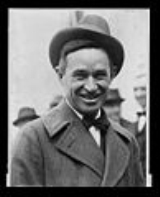
William "Will" Penn Adair Rogers (November 4, 1879 – August 15, 1935) was an American cowboy, comedian, humorist, social commentator, vaudeville performer, film actor, and one of the world's best-known celebrities in the 1920s and 1930s.
Known as
OklahomaOklahoma is a state located in the South Central region of the United States of America. With an estimated 3,751,351 residents as of the 2010 census and a land area of 68,667 square miles , Oklahoma is the 28th most populous and 20th-largest state...
's favorite son, Rogers was born to a prominent
Cherokee NationThe Cherokee Nation of the 19th century —an historic entity —was a legal, autonomous, tribal government in North America existing from 1794–1906. Often referred to simply as The Nation by its inhabitants, it should not be confused with what is known today as the "modern" Cherokee Nation...
family in
Indian TerritoryThe Indian Territory, also known as the Indian Territories and the Indian Country, was land set aside within the United States for the settlement of American Indians...
(now part of
OklahomaOklahoma is a state located in the South Central region of the United States of America. With an estimated 3,751,351 residents as of the 2010 census and a land area of 68,667 square miles , Oklahoma is the 28th most populous and 20th-largest state...
). He traveled around the world three times, made 71
moviesThe cinema of the United States, also known as Hollywood, has had a profound effect on cinema across the world since the early 20th century. Its history is sometimes separated into four main periods: the silent film era, classical Hollywood cinema, New Hollywood, and the contemporary period...
(50
silent filmA silent film is a film with no synchronized recorded sound, especially with no spoken dialogue. In silent films for entertainment the dialogue is transmitted through muted gestures, pantomime and title cards...
s and 21 "talkies"), wrote more than 4,000
nationally-syndicatedPrint syndication distributes news articles, columns, comic strips and other features to newspapers, magazines and websites. They offer reprint rights and grant permissions to other parties for republishing content of which they own/represent copyrights....
newspaper columns, and became a world-famous figure. By the mid-1930s, Rogers was adored by the American people. He was the leading political wit of the
Progressive EraThe Progressive Era in the United States was a period of social activism and political reform that flourished from the 1890s to the 1920s. One main goal of the Progressive movement was purification of government, as Progressives tried to eliminate corruption by exposing and undercutting political...
, and was the top-paid
Hollywood movie starClassical Hollywood cinema or the classical Hollywood narrative, are terms used in film history which designates both a visual and sound style for making motion pictures and a mode of production used in the American film industry between roughly the 1910s and the early 1960s.Classical style is...
at the time. Rogers died in 1935 with aviator
Wiley PostWiley Hardeman Post was a famed American aviator, the first pilot to fly solo around the world. Also known for his work in high altitude flying, Post helped develop one of the first pressure suits. His Lockheed Vega aircraft, the Winnie Mae, was on display at the National Air and Space Museum's...
, when their small airplane crashed in Alaska.
His vaudeville rope act led to success in the Ziegfeld Follies, which in turn led to the first of his many movie contracts. His 1920s syndicated newspaper column and his radio appearances increased his visibility and popularity. Rogers crusaded for aviation expansion, and provided Americans with first-hand accounts of his world travels. His earthy anecdotes and folksy style allowed him to poke fun at gangsters, prohibition, politicians, government programs, and a host of other controversial topics in a way that was readily appreciated by a national audience, with no one offended. His aphorisms, couched in humorous terms, were widely quoted: "I am not a member of an organized political party. I am a Democrat."
Rogers even provided an epigram on his most famous epigram:
- When I die, my epitaph, or whatever you call those signs on gravestones, is going to read: "I joked about every prominent man of my time, but I never met a man I dident like." I am so proud of that, I can hardly wait to die so it can be carved.
Early years
Will Rogers was born on the
Dog Iron RanchThe Dog Iron Ranch, located about two miles east of Oologah, Oklahoma, United States, is the historic ranch of humorist Will Rogers. The ranch was donated to the state of Oklahoma by the Rogers family...
in
Indian TerritoryThe Indian Territory, also known as the Indian Territories and the Indian Country, was land set aside within the United States for the settlement of American Indians...
, near present-day
OologahOologah is a town in Rogers County, Oklahoma, United States. Renowned humorist Will Rogers was born on a ranch two miles east of Oologah, though he usually claimed Claremore as his birthplace, "because nobody but an Indian can pronounce 'Oologah.'"...
,
OklahomaOklahoma is a state located in the South Central region of the United States of America. With an estimated 3,751,351 residents as of the 2010 census and a land area of 68,667 square miles , Oklahoma is the 28th most populous and 20th-largest state...
. The house he was born in had been built in 1875 and was known as the "White House on the
Verdigris RiverThe Verdigris River is a tributary of the Arkansas River in southeastern Kansas and northeastern Oklahoma in the United States. It is about long...
." His parents,
Clement Vann RogersClement Vann Rogers was a Cherokee senator and judge in Indian Territory. Rogers was a Confederate veteran and served as a delegate to the Oklahoma Constitutional Convention...
(1839–1911) and Mary America Schrimsher (1838–1890), were both
CherokeeThe Cherokee are a Native American people historically settled in the Southeastern United States . Linguistically, they are part of the Iroquoian language family...
, and Rogers himself was 9/32 (just over 1/4) Cherokee. Rogers quipped that his ancestors didn't come over on the
MayflowerThe Mayflower was the ship that transported the English Separatists, better known as the Pilgrims, from a site near the Mayflower Steps in Plymouth, England, to Plymouth, Massachusetts, , in 1620...
but they "met the boat." Mary Rogers was quarter-Cherokee and a hereditary member of the Paint Clan. She died when Will was 11, and his father remarried less than two years after her death.
Rogers was the youngest of eight children. He was named for the Cherokee leader Col.
William Penn AdairWilliam Penn Adair was a Cherokee leader and Confederate colonel.-Background:William Penn Adair was born on April 15, 1830 in the old Cherokee Nation in New Echota, Georgia. His parents were George Washington Adair and Martha Adair. He attended Cherokee schools in Indian Territory, studying law....
. Only three of his siblings, sisters Sallie Clementine, Maude Ethel, and May (Mary), survived into adulthood.
His father, Clement, was a leader within Cherokee society. A Cherokee judge, he was a
ConfederateThe Confederate States of America was a government set up from 1861 to 1865 by 11 Southern slave states of the United States of America that had declared their secession from the U.S...
veteran and served as a delegate to the
Oklahoma Constitutional ConventionThe Constitution of the State of Oklahoma is the governing document of the U.S. State of Oklahoma. Adopted in 1907, Oklahoma ratified the United States Constitution on November 16, 1907, as the 46th US State. At its ratification, the Oklahoma Constitution was the longest governing document of any...
.
Rogers County, OklahomaRogers County is a county located in the U.S. state of Oklahoma. As of 2010, the population was 86,905. Its county seat is Claremore. The county was originally created in 1906 and named Cooweescoowee...
is named in honor of Clement Rogers. He served several terms on the Cherokee Senate. Clement Rogers achieved financial success as a rancher and used his influence to help soften the negative effects of white acculturation on the tribe. Roach (1980) presents a sociological-psychological assessment of the relationship between Will and his father during the formative boyhood and teenage years. Clement had high expectations for his son and desired him to be more responsible and business-minded. Will was more easygoing and oriented toward the loving affection offered by his mother, Mary, rather than the harshness of his father. The personality clash increased after his mother's death, and young Will went from one venture to another with little success. Only after Will won acclaim in vaudeville did the rift begin to heal, but Clement's untimely death in 1911 precluded a full reconciliation.
Rogers was a good student and an avid reader of
The New York TimesThe New York Times is an American daily newspaper founded and continuously published in New York City since 1851. The New York Times has won 106 Pulitzer Prizes, the most of any news organization...
, but he dropped out after the 10th grade. He later claimed he was a poor student, saying that he "studied the Fourth Reader for ten years." He was much more interested in
cowboyA cowboy is an animal herder who tends cattle on ranches in North America, traditionally on horseback, and often performs a multitude of other ranch-related tasks. The historic American cowboy of the late 19th century arose from the vaquero traditions of northern Mexico and became a figure of...
s and horses, and learned to rope and use a
lariatLariat can refer to:*A rope in the form of a lasso*Lariat chain, a science demonstration*A professional wrestling move, a variation of a clothesline*A genetic structure in Splicing *Double Lariat, a popular song sung by Luka Megurine...
.
First jobs
Rogers worked the Dog Iron Ranch for a few years. Near the end of 1901, he and a friend left home with aspirations to work as
gauchoGaucho is a term commonly used to describe residents of the South American pampas, chacos, or Patagonian grasslands, found principally in parts of Argentina, Uruguay, Southern Chile, and Southern Brazil...
s in
ArgentinaArgentina , officially the Argentine Republic , is the second largest country in South America by land area, after Brazil. It is constituted as a federation of 23 provinces and an autonomous city, Buenos Aires...
. They arrived in Argentina in May 1902, and spent five months trying to make it as ranch owners in the pampas. Rogers and his partner lost all their money, and in his words, "I was ashamed to send home for more," so the two friends separated and Rogers sailed for
South AfricaThe South African Republic , often informally known as the Transvaal Republic, was an independent Boer-ruled country in Southern Africa during the second half of the 19th century. Not to be confused with the present-day Republic of South Africa, it occupied the area later known as the South African...
. It is often claimed he took a job breaking in horses for the
British ArmyThe British Army is the land warfare branch of Her Majesty's Armed Forces in the United Kingdom. It came into being with the unification of the Kingdom of England and Scotland into the Kingdom of Great Britain in 1707. The new British Army incorporated Regiments that had already existed in England...
, but the
Boer WarThe Second Boer War was fought from 11 October 1899 until 31 May 1902 between the British Empire and the Afrikaans-speaking Dutch settlers of two independent Boer republics, the South African Republic and the Orange Free State...
had ended three months earlier. Rogers actually got work at Piccione's ranch in Mooi River Station.
He began his show business career as a trick roper in "Texas Jack's Wild West Circus":
He (Texas JackTexas Jack Jr., , adopted son of Texas Jack Omohundro, is best known for running a Wild West show and circus where he gave Will Rogers his start as an entertainer....
) had a little Wild West aggregation that visited the camps and did a tremendous business. I did some roping and riding, and Jack, who was one of the smartest showmen I ever knew, took a great interest in me. It was he who gave me the idea for my original stage act with my pony. I learned a lot about the show business from him. He could do a bum act with a rope that an ordinary man couldn't get away with, and make the audience think it was great, so I used to study him by the hour, and from him I learned the great secret of the show business—knowing when to get off. It's the fellow who knows when to quit that the audience wants more of.
Grateful for the guidance but anxious to move on, Rogers quit the circus and went to
AustraliaAustralia , officially the Commonwealth of Australia, is a country in the Southern Hemisphere comprising the mainland of the Australian continent, the island of Tasmania, and numerous smaller islands in the Indian and Pacific Oceans. It is the world's sixth-largest country by total area...
. Texas Jack gave him a reference letter for the Wirth Brothers Circus there, and Rogers continued to perform as a rider and trick roper, and worked on his pony act. He returned to the United States in 1904, and began to try his roping skills on the American vaudeville circuits.
Vaudeville
On a trip to
New York CityNew York is the most populous city in the United States and the center of the New York Metropolitan Area, one of the most populous metropolitan areas in the world. New York exerts a significant impact upon global commerce, finance, media, art, fashion, research, technology, education, and...
, Rogers was at
Madison Square GardenMadison Square Garden, often abbreviated as MSG and known colloquially as The Garden, is a multi-purpose indoor arena in the New York City borough of Manhattan and located at 8th Avenue, between 31st and 33rd Streets, situated on top of Pennsylvania Station.Opened on February 11, 1968, it is the...
when a wild steer broke out of the arena and began to climb into the viewing stands. Rogers quickly roped the steer to the delight of the crowd. The feat got front page attention from the newspapers, giving him valuable publicity and an audience eager to see more. William Hammerstein came to see his vaudeville act, and quickly signed Rogers to appear on the Victoria Roof—which was literally on a rooftop—with his pony. For the next decade, Rogers estimated he worked for fifty weeks a year at the Roof and at the city's myriad vaudeville theaters.
Rogers described these early years at the Fifteenth Anniversary of the Columbia Theater in New York City. "I got a job on Hammerstein's Roof at $140 a week for myself, my horse, and the man who looked after it. I remained on the roof for eight weeks, always getting another two week extension when Willie Hammerstein would say to me after the Monday matinee, 'you're good for two weeks more'.. . Marty Shea, the booking agent for the Columbia, came to me and asked if I wanted to play
burlesqueAmerican Burlesque is a genre of variety show. Derived from elements of Victorian burlesque, music hall and minstrel shows, burlesque shows in America became popular in the 1860s and evolved to feature ribald comedy and female striptease...
. They could use an extra attraction... I told him I would think about it, but 'Burlesque' sounded to me then as something funny." Shea and
Sam A. ScribnerSam A. Scribner was an American circus and burlesque impresario of the late Nineteenth and early Twentieth Century. He operated the Columbia Amusement Company, presenting forty or more family-entertainment burlesque shows simultaneous in theaters throughout the Northeast and Midwest of the United...
, the general manager of the Columbia Amusement Company, approached Rogers a few days later; Shea told Scribner Rogers was getting $150 and would take $175. "'What's he carrying?' Scribner asked Shea. 'Himself, a horse, and a man'. answered Shea." Scribner replied "'Give him eight weeks at $250'".
In 1908, Rogers married Betty Blake, and the couple had four children:
Will Rogers, Jr.William Vann Rogers, generally known as Will Rogers, Jr. , was a son of legendary humorist Will Rogers and his wife, the former Betty Blake . He was a Democratic U. S. Representative from California from January 3, 1943 until May 23, 1944, when he resigned to return to the United States Army...
(Bill), Mary Amelia (Mary), James Blake (Jim), and Fred Stone. Bill became a
World War IIWorld War II, or the Second World War , was a global conflict lasting from 1939 to 1945, involving most of the world's nations—including all of the great powers—eventually forming two opposing military alliances: the Allies and the Axis...
hero, played his father in two films, and became a member of
CongressThe United States Congress is the bicameral legislature of the federal government of the United States, consisting of the Senate and the House of Representatives. The Congress meets in the United States Capitol in Washington, D.C....
. Mary became a
BroadwayBroadway theatre, commonly called simply Broadway, refers to theatrical performances presented in one of the 40 professional theatres with 500 or more seats located in the Theatre District centered along Broadway, and in Lincoln Center, in Manhattan in New York City...
actress, and Jim was a newspaperman and rancher; Fred died of
diphtheriaDiphtheria is an upper respiratory tract illness caused by Corynebacterium diphtheriae, a facultative anaerobic, Gram-positive bacterium. It is characterized by sore throat, low fever, and an adherent membrane on the tonsils, pharynx, and/or nasal cavity...
at age two. The family lived in New York, but they managed to make it home to Oklahoma during the summers. In 1911, Rogers bought a 20 acres (8.1 ha) ranch near
Claremore, OklahomaClaremore is a city and the county seat of Rogers County, Oklahoma, United States. The population was 18,581 at the 2010 census, a 17.1 percent increase from 15,873 at the 2000 census. It is part of the Tulsa Metropolitan Area and home to Rogers State University...
, which he intended to use as his retirement home, for
US$The United States dollar , also referred to as the American dollar, is the official currency of the United States of America. It is divided into 100 smaller units called cents or pennies....
500 per acre.
In the fall of 1915, Rogers began to appear in
Florenz ZiegfeldFlorenz Ziegfeld, Jr. , , was an American Broadway impresario, notable for his series of theatrical revues, the Ziegfeld Follies , inspired by the Folies Bergère of Paris. He also produced the musical Show Boat...
's Midnight Frolic. The
variety revueA variety show, also known as variety arts or variety entertainment, is an entertainment made up of a variety of acts, especially musical performances and sketch comedy, and normally introduced by a compère or host. Other types of acts include magic, animal and circus acts, acrobatics, juggling...
began at midnight in the top-floor night club of Ziegfeld's
New Amsterdam TheatreThe New Amsterdam Theatre is a Broadway theater located at 214 West 42nd Street between Seventh and Eighth Avenues in the Theatre District of Manhattan, New York City, off of Times Square...
, and drew many influential—and regular—customers. By this time, Rogers had refined his act to a science. His monologues on the news of the day followed a similar routine every night. He appeared on stage in his cowboy outfit, nonchalantly twirling his lasso, and said, "Well, what shall I talk about? I ain't got anything funny to say. All I know is what I read in the papers." He then made jokes about what he had read in that day's newspapers. The line "All I know is what I read in the papers" is often incorrectly described as Rogers's most famous
punch lineA punch line is the final part of a joke, comedy sketch, or profound statement, usually the word, sentence or exchange of sentences which is intended to be funny or to provoke laughter or thought from listeners...
, when it was in fact his opening line.
His run at the New Amsterdam ran on into 1916, and Rogers's obvious popularity led to an engagement on the more famous
Ziegfeld FolliesThe Ziegfeld Follies were a series of elaborate theatrical productions on Broadway in New York City from 1907 through 1931. They became a radio program in 1932 and 1936 as The Ziegfeld Follies of the Air....
. At this stage Rogers' act was strictly physical, a display of daring riding and clever tricks with his lariat. He discovered that audiences identified the cowboy as the archetypical American — doubtless aided by
Theodore RooseveltTheodore "Teddy" Roosevelt was the 26th President of the United States . He is noted for his exuberant personality, range of interests and achievements, and his leadership of the Progressive Movement, as well as his "cowboy" persona and robust masculinity...
's image as a cowboy. Rogers' cowboy showed an unfettered man free of institutional restraints, with no bureaucrats to order his life. When he came back to the United States and worked in Wild West shows, he noticed that audiences were just as fascinated by his frontier, Oklahoma twang. By 1916, a featured star in Ziegfeld's Follies on Broadway, he moved into satire by transforming the "Ropin' Fool" to the "Talkin' Fool". At one performance, with President
Woodrow WilsonThomas Woodrow Wilson was the 28th President of the United States, from 1913 to 1921. A leader of the Progressive Movement, he served as President of Princeton University from 1902 to 1910, and then as the Governor of New Jersey from 1911 to 1913...
in the audience, he improvised a "roast" of presidential policies that had Wilson, and the entire audience, in stitches and proved his remarkable skill at off-the-cuff, witty commentary on current events. The rest of his career he built around that skill.
An editorial in
The New York TimesThe New York Times is an American daily newspaper founded and continuously published in New York City since 1851. The New York Times has won 106 Pulitzer Prizes, the most of any news organization...
said that "Will Rogers in the Follies is carrying on the tradition of
AristophanesAristophanes , son of Philippus, of the deme Cydathenaus, was a comic playwright of ancient Athens. Eleven of his forty plays survive virtually complete...
, and not unworthily." Rogers branched into silent films too, for
Samuel GoldwynSamuel Goldwyn was an American film producer, and founding contributor executive of several motion picture studios.-Biography:...
's company
Goldwyn PicturesGoldwyn Pictures Corporation was an American motion picture production company founded in 1916 by Samuel Goldfish in partnership with Broadway producers Edgar and Archibald Selwyn using an amalgamation of both last names to create the name...
. He made his first silent movie, Laughing Bill Hyde, filmed in
Fort LeeFort Lee is a borough in Bergen County, New Jersey, United States. As of the 2010 United States Census, the borough population was 35,345. Located atop the Hudson Palisades, the borough is the western terminus of the George Washington Bridge...
,
New JerseyNew Jersey is a state in the Northeastern and Middle Atlantic regions of the United States. , its population was 8,791,894. It is bordered on the north and east by the state of New York, on the southeast and south by the Atlantic Ocean, on the west by Pennsylvania and on the southwest by Delaware...
, in 1918. Many early films were made near the major New York performing market, so Rogers could make the film, yet still rehearse and perform in the Follies. He eventually appeared in most of the Follies, from 1916 to 1925.
Movies
Hollywood discovered Rogers in 1918, as Samuel Goldwyn gave him the title role in Laughing Bill Hyde. A three-year contract with Goldwyn, at triple the Broadway salary, moved Rogers west. He bought a ranch in Santa Monica and set up his own production company. While Rogers enjoyed film acting, his appearances in silent movies suffered from the obvious restrictions of silence—not the strongest medium for him, having gained his fame as a commentator on stage. It helped somewhat that he wrote a good many of the
title cardsIn motion pictures, an intertitle is a piece of filmed, printed text edited into the midst of the photographed action, at various points, generally to convey character dialogue, or descriptive narrative material related to, but not necessarily covered by, the material photographed.Intertitles...
appearing in his films. In 1923, he began a one-year stint for
Hal RoachHarold Eugene "Hal" Roach, Sr. was an American film and television producer and director, and from the 1910s to the 1990s.- Early life and career :Hal Roach was born in Elmira, New York...
and made 12 pictures. Among the films he made for Roach in 1924 were three directed by Rob Wagner: Two Wagons Both Covered, Going to Congress and Our Congressman. He made two other feature silents and a travelogue series in 1927, and did not return to the screen until his time in the '
talkiesA sound film is a motion picture with synchronized sound, or sound technologically coupled to image, as opposed to a silent film. The first known public exhibition of projected sound films took place in Paris in 1900, but decades would pass before sound motion pictures were made commercially...
' began in 1929.
He made 48 silent movies, but with the arrival of sound in 1929 he became a top star in that medium. His first sound film, They Had to See Paris (1929), finally gave him the chance to exercise his verbal magic. He played a homespun farmer (State Fair) in 1933, an old-fashioned doctor (Dr. Bull) in 1933, a small town banker (David Harum ) in 1934, and a rustic politician (Judge Priest) in 1934. He was also in County Chairman (1935), Steamboat 'Round the Bend (1935), and In Old Kentucky (1935). His favorite director was
John FordJohn Ford was an American film director. He was famous for both his westerns such as Stagecoach, The Searchers, and The Man Who Shot Liberty Valance, and adaptations of such classic 20th-century American novels as The Grapes of Wrath...
.
Rogers appeared in 21 feature films alongside such noted performers as
Lew AyresLew Ayres was an American actor, best known for starring as Paul in All Quiet on the Western Front and for playing Dr...
,
Billie BurkeMary William Ethelbert Appleton "Billie" Burke was an American actress. She is primarily known to modern audiences as Glinda the Good Witch of the North in the musical film The Wizard of Oz. She was nominated for an Academy Award for her performance as Emily Kilbourne in Merrily We Live...
,
Richard CromwellRichard Cromwell, born LeRoy Melvin Radabaugh , was an American actor. His family and friends called him Roy, though he was also professionally known and signed autographs as Dick Cromwell. Cromwell's career was at its pinnacle with his work in Jezebel with Bette Davis and Henry Fonda and again...
,
Jane Darwell,
Andy DevineAndrew Vabre "Andy" Devine was an American character actor and comic cowboy sidekick known for his distinctive raspy voice.-Early life:...
,
Janet GaynorJanet Gaynor was an American actress and painter.One of the most popular actresses of the silent film era, in 1928 Gaynor became the first winner of the Academy Award for Best Actress for her performances in three films: Seventh Heaven , Sunrise: A Song of Two Humans and Street Angel...
,
Rochelle HudsonRochelle Hudson was an American film actress from the 1930s through the 1960s. Hudson was a WAMPAS Baby Star in 1931.-Career:...
,
Boris KarloffWilliam Henry Pratt , better known by his stage name Boris Karloff, was an English actor.Karloff is best remembered for his roles in horror films and his portrayal of Frankenstein's monster in Frankenstein , Bride of Frankenstein , and Son of Frankenstein...
,
Myrna LoyMyrna Loy was an American actress. Trained as a dancer, she devoted herself fully to an acting career following a few minor roles in silent films. Originally typecast in exotic roles, often as a vamp or a woman of Asian descent, her career prospects improved following her portrayal of Nora Charles...
,
Joel McCreaJoel Albert McCrea was an American actor whose career spanned 50 years and appearances in over 90 films.-Early life:...
,
Hattie McDanielHattie McDaniel was the first African-American actress to win an Academy Award. She won the award for Best Supporting Actress for her role of Mammy in Gone with the Wind ....
,
Ray MillandRay Milland was a Welsh actor and director. His screen career ran from 1929 to 1985, and he is best remembered for his Academy Award–winning portrayal of an alcoholic writer in The Lost Weekend , a sophisticated leading man opposite a corrupt John Wayne in Reap the Wild Wind , the murder-plotting...
,
Maureen O'SullivanMaureen Paula O’Sullivan was an Irish actress.-Early life:O'Sullivan was born in Boyle, County Roscommon, Ireland, the daughter of Roman Catholic parents Mary Lovatt and Charles Joseph O'Sullivan, an officer in The Connaught Rangers who served in The Great War...
,
ZaSu PittsZaSu Pitts was an American actress who starred in many silent dramas and comedies, transitioning to comedy sound films.-Early life:ZaSu Pitts was born in Parsons, Kansas to Rulandus and Nellie Pitts; she was the third of four children...
,
Dick PowellRichard Ewing "Dick" Powell was an American singer, actor, producer, director and studio boss.Despite the same last name he was not related to William Powell, Eleanor Powell or Jane Powell.-Biography:...
, Bill "Bojangles" Robinson,
Mickey RooneyMickey Rooney is an American film actor and entertainer whose film, television, and stage appearances span nearly his entire lifetime. He has won multiple awards, including an Honorary Academy Award, a Golden Globe and an Emmy Award...
, and
Peggy WoodPeggy Wood was an American actress of stage, film and television.-Early career:She was born Mary Margaret Wood in Brooklyn, New York, the daughter of Eugene Wood, a journalist, and Mary Gardner, a telegraph operator. She was a direct descendant of Daniel Boone...
. He was directed three times by
John FordJohn Ford was an American film director. He was famous for both his westerns such as Stagecoach, The Searchers, and The Man Who Shot Liberty Valance, and adaptations of such classic 20th-century American novels as The Grapes of Wrath...
. He appeared in three films with his friend
Stepin FetchitStepin Fetchit was the stage name of American comedian and film actor Lincoln Theodore Monroe Andrew Perry....
(aka Lincoln T. Perry):
David HarumDavid Harum; A Story of American Life is a best-selling novel of 1899 whose principal legacy is the colloquial use of the term horse trading.-Literary significance and criticism:...
(1934),
Judge PriestJudge Priest is a 1934 American comedy film. The film was based on humorist Irvin S. Cobb's character Judge Priest. The film was directed by John Ford and produced by Sol M. Wurtzel in association with Fox Film...
(1934) and The County Chairman (1935).
With his voice becoming increasingly familiar to audiences, he was able to basically play himself, without normal makeup, in each film, managing to ad-lib and even work in his familiar commentaries on politics at times. The clean moral tone of his films led to various public schools taking their classes, during the school day, to attend special showings of some of them. His most unusual role may have been in the first talking version of
Mark TwainSamuel Langhorne Clemens , better known by his pen name Mark Twain, was an American author and humorist...
's novel
A Connecticut Yankee in King Arthur's CourtA Connecticut Yankee in King Arthur's Court is an 1889 novel by American humorist and writer Mark Twain. The book was originally titled A Yankee in King Arthur's Court...
. His popularity soared to new heights with films including Young As You Feel, Judge Priest, and Life Begins at 40 with
Richard CromwellRichard Cromwell, born LeRoy Melvin Radabaugh , was an American actor. His family and friends called him Roy, though he was also professionally known and signed autographs as Dick Cromwell. Cromwell's career was at its pinnacle with his work in Jezebel with Bette Davis and Henry Fonda and again...
and
Rochelle HudsonRochelle Hudson was an American film actress from the 1930s through the 1960s. Hudson was a WAMPAS Baby Star in 1931.-Career:...
.
Newspapers and magazines
Rogers demonstrated multiple skills, and was an indefatigable worker. He toured the lecture circuit. The New York Times syndicated his weekly newspaper column, 1922-35. Going daily in 1926 his short "Will Rogers Says" reached forty million newspaper readers. He wrote frequently for the mass-circulation upscale magazine,
The Saturday Evening PostThe Saturday Evening Post is a bimonthly American magazine. It was published weekly under this title from 1897 until 1969, and quarterly and then bimonthly from 1971.-History:...
, where Rogers advised Americans to embrace the frontier values of neighborliness and democracy on the domestic front while remaining clear of foreign entanglements. He took a strong, highly popular stand in favor of aviation, including a military air force of the sort his flying buddy, General Billy Mitchell, advocated.
Rogers began a weekly column, titled "Slipping the Lariat Over," at the end of 1922. He had already published a book of wisecracks and had begun a steady stream of humor books. Through the continuing series of columns for the
McNaught SyndicateThe McNaught Syndicate was an American newspaper syndicate founded in 1922. It was established by Virgil Venice McNitt and Charles V. McAdam. Its best known contents were the columns by Will Rogers and O. O. McIntyre, the Dear Abby letters section and comic strips, including Joe Palooka and...
between 1922 and 1935, as well as in his personal appearances and radio broadcasts, he won the loving admiration of the American people, poking jibes in witty ways at the issues of the day and prominent people—often politicians. He wrote from a non-partisan point of view and became a friend of
presidentsThe President of the United States of America is the head of state and head of government of the United States. The president leads the executive branch of the federal government and is the commander-in-chief of the United States Armed Forces....
and a confidant of the great. Loved for his cool mind and warm heart, he was often considered the successor to such greats as
Artemus WardCharles Farrar Browne was a United States humor writer, better known under his nom de plume, Artemus Ward. At birth, his surname was "Brown." He added the "e" after he became famous.-Biography:...
and
Mark TwainSamuel Langhorne Clemens , better known by his pen name Mark Twain, was an American author and humorist...
. Rogers was not the first entertainer to use political humor before his audience. Others, such as Broadway comedian
Raymond HitchcockRaymond Hitchcock was a silent film actor, stage actor, and stage producer, who appeared in or produced 30 plays on Broadway from 1898 to 1928, and who became famous in silent films of the 1920s.-Biography:...
and Britain's Sir
Harry LauderSir Henry Lauder , known professionally as Harry Lauder, was an international Scottish entertainer, described by Sir Winston Churchill as "Scotland's greatest ever ambassador!"-Early life:...
, preceded him by several years. The legendary
Bob HopeBob Hope, KBE, KCSG, KSS was a British-born American comedian and actor who appeared in vaudeville, on Broadway, and in radio, television and movies. He was also noted for his work with the US Armed Forces and his numerous USO shows entertaining American military personnel...
is the best known political humorist to follow Rogers's example.
Travel
From about 1925 to 1928, Rogers traveled the length and breadth of the United States in a "lecture tour". (He began his lectures by pointing out that "A humorist entertains, and a lecturer annoys.") During this time he became the first civilian to fly from coast to coast with pilots flying the mail in early air mail flights. The National Press Club dubbed him "Ambassador at Large of the United States." He visited
Mexico CityMexico City is the Federal District , capital of Mexico and seat of the federal powers of the Mexican Union. It is a federal entity within Mexico which is not part of any one of the 31 Mexican states but belongs to the federation as a whole...
, along with
Charles LindberghCharles Augustus Lindbergh was an American aviator, author, inventor, explorer, and social activist.Lindbergh, a 25-year-old U.S...
, as a guest of U.S. Ambassador
Dwight MorrowDwight Whitney Morrow was an American businessman, politician, and diplomat.-Life:Born in Huntington, West Virginia, he moved with his parents, James E. and Clara Morrow to Allegheny, Pennsylvania in 1875. His father James, was principal of Marshall College, which is now Marshall University...
. (Morrow's daughter
AnneAnne Morrow Lindbergh was an American author, aviator, and the spouse of fellow aviator Charles Lindbergh.She was an acclaimed author whose books and articles spanned the genres of poetry to non-fiction, touching upon topics as diverse as youth and age; love and marriage; peace, solitude and...
later married Lindbergh.) Rogers gave numerous after-dinner speeches, became a popular convention speaker, and gave dozens of benefits for victims of floods, droughts, or earthquakes.
He made a trip to
the OrientThe Orient means "the East." It is a traditional designation for anything that belongs to the Eastern world or the Far East, in relation to Europe. In English it is a metonym that means various parts of Asia.- Derivation :...
in 1931 and to
CentralCentral America is the central geographic region of the Americas. It is the southernmost, isthmian portion of the North American continent, which connects with South America on the southeast. When considered part of the unified continental model, it is considered a subcontinent...
and
South AmericaSouth America is a continent situated in the Western Hemisphere, mostly in the Southern Hemisphere, with a relatively small portion in the Northern Hemisphere. The continent is also considered a subcontinent of the Americas. It is bordered on the west by the Pacific Ocean and on the north and east...
the following year. In 1934, he made a globe-girdling tour and returned to play the lead in
Eugene O'NeillEugene Gladstone O'Neill was an American playwright and Nobel laureate in Literature. His poetically titled plays were among the first to introduce into American drama techniques of realism earlier associated with Russian playwright Anton Chekhov, Norwegian playwright Henrik Ibsen, and Swedish...
's stage play
Ah, Wilderness!Ah, Wilderness! is a comedy by American playwright Eugene O'Neill that premiered on Broadway at the Guild Theatre on 2 October 1933.-Plot summary:...
He had tentatively agreed to go on loan from Fox to
MGMMetro-Goldwyn-Mayer Inc. is an American media company, involved primarily in the production and distribution of films and television programs. MGM was founded in 1924 when the entertainment entrepreneur Marcus Loew gained control of Metro Pictures, Goldwyn Pictures Corporation and Louis B. Mayer...
to star in the 1935 movie version of the play; however, his concern over a fan's reaction to the 'facts-of-life' talk between his character and its son caused him to decline the role—and that freed up his schedule allowing him to fly with
Wiley PostWiley Hardeman Post was a famed American aviator, the first pilot to fly solo around the world. Also known for his work in high altitude flying, Post helped develop one of the first pressure suits. His Lockheed Vega aircraft, the Winnie Mae, was on display at the National Air and Space Museum's...
that summer.
Radio
Radio was the exciting new medium, and Rogers became a star there as well, recycling his newspaper pieces. From 1930 to 1935, he made radio broadcasts for the
Gulf OilGulf Oil was a major global oil company from the 1900s to the 1980s. The eighth-largest American manufacturing company in 1941 and the ninth-largest in 1979, Gulf Oil was one of the so-called Seven Sisters oil companies...
Company. This weekly Sunday evening show, The Gulf Headliners, ranked among the top radio programs in the country. Since he easily rambled from one subject to another, reacting to his studio audience, he often lost track of the half-hour time limit in his earliest broadcasts, and was cut off in mid-sentence. To correct this, he brought in a wind-up alarm clock, and its on-air buzzing alerted him to begin wrapping up his comments. By 1935, his show was being announced as "Will Rogers and his famous Alarm Clock."
In January 1934, Rogers used a taboo word that led the NAACP to protest. He used the word “nigger” in a radio skit, referring to a song as a “nigger spiritual” Rogers had used the word in print in his syndicated newspaper columns on a few occasions, but this was evidently the first time he used it on the radio.
Politics
Rogers was a staunch
DemocratThe history of the Democratic Party of the United States is an account of the oldest political party in the United States and arguably the oldest democratic party in the world....
, but he also supported Republican
Calvin CoolidgeJohn Calvin Coolidge, Jr. was the 30th President of the United States . A Republican lawyer from Vermont, Coolidge worked his way up the ladder of Massachusetts state politics, eventually becoming governor of that state...
. Democrat
Franklin D. RooseveltFranklin Delano Roosevelt , also known by his initials, FDR, was the 32nd President of the United States and a central figure in world events during the mid-20th century, leading the United States during a time of worldwide economic crisis and world war...
was his favorite. Although he supported Roosevelt's
New DealThe New Deal was a series of economic programs implemented in the United States between 1933 and 1936. They were passed by the U.S. Congress during the first term of President Franklin D. Roosevelt. The programs were Roosevelt's responses to the Great Depression, and focused on what historians call...
, he could just as easily joke about it:
- Lord, the money we do spend on Government and it’s not one bit better than the government we got for one-third the money twenty years ago.
Rogers served as a goodwill ambassador to
MexicoThe United Mexican States , commonly known as Mexico , is a federal constitutional republic in North America. It is bordered on the north by the United States; on the south and west by the Pacific Ocean; on the southeast by Guatemala, Belize, and the Caribbean Sea; and on the east by the Gulf of...
, and a brief stint as mayor of Beverly Hills. During the depths of the Great Depression, angered by Washington's inability to feed the people, he embarked on a cross country fund raising tour for the Red Cross.
Presidential campaign, 1928
Rogers thought all campaigning was bunk. To prove the point he mounted a mock campaign in 1928 for the presidency. His only vehicle was the pages of Life, a weekly humor magazine. Rogers ran as the "bunkless candidate" of the Anti-Bunk Party. His only campaign promise was that, if elected, he would resign. Every week, from Memorial Day through Election Day, Rogers caricatured the farcical humors of grave campaign politics. On election day he declared victory and resigned.
Philosophy and style
After Rogers gained recognition as a humorist-philosopher in vaudeville, he gained a national audience in acting and literary careers from 1915 to 1935. In these years, Rogers increasingly expressed the views of the "common man" in America. He downplayed academic credentials, noting, "Everybody is ignorant, only on different subjects." Americans of all walks admired his individualism, his appreciation for democratic ideas, and his liberal philosophies on most issues. Moreover, Rogers extolled hard work and long hours of toil in order to succeed, and such expressions upheld theories of many Americans on how best to realize their own dreams of success. He symbolized the self-made man, the common man, who believed in America, in progress, in the
American DreamThe American Dream is a national ethos of the United States in which freedom includes a promise of the possibility of prosperity and success. In the definition of the American Dream by James Truslow Adams in 1931, "life should be better and richer and fuller for everyone, with opportunity for each...
of upward mobility, and whose humor never offended even those who were the targets of it.
America in the 1920s was disenchanted and alienated from the outside world. Rogers seemed to many an anchor of stability; his conventional home life and "old fashioned" morality reminded people of an innocent past. His newspaper column, which ran from 1922 to 1935, stressed both "old" morality and the belief that political problems were not as serious as they sounded. In his films, Rogers began by playing a simple cowboy; his characters evolved to explore the meaning of innocence in film. In his last movies, Rogers explores a society fracturing into competing classes from economic pressures. Throughout his career, Will Rogers was a link to a better, more comprehensible past.
In 1926, the high-circulation weekly magazine The Saturday Evening Post financed a European tour for Rogers in return for the publication of his articles. Rogers made whirlwind visits to numerous European capitals and met with both international figures and common people. His articles reflected a fear that Europeans would again go to war, and thus he recommended that the United States should assume an isolationist posture. He reasoned that for the moment American needs could best be served by concentrating on domestic questions and avoiding foreign entanglements. He commented:
- America has a unique record. We never lost a war and we never won a conference in our lives. I believe that we could without any degree of egotism, single-handed lick any nation in the world. But we can’t confer with Costa Rica and come home with our shirts on.
Rogers was famous for his use of language. He effectively utilized up-to-date slang and invented new words to fit his needs. He also made frequent use of puns and terms which closely linked him to the cowboy tradition, as well as speech patterns using a southern dialect.
Brown (1979) argues that Rogers held up a "magic mirror" that reflected iconic American values. Rogers was the archetypical "American Democrat" thanks to his knack of moving freely among all social classes, his stance above political parties, and his passion for fair play. He represented the "American Adam" with his independence and self-made record. Rogers furthermore represented the "American Prometheus" through his commitment to utilitarian methods and his ever-optimistic faith in future progress.
Quotes and one-liners
- One of Will Rogers' most famous lines, "I have never yet met a man that I dident like," was part of a longer quotation and in its original form was in reference to Leon Trotsky
Leon Trotsky , born Lev Davidovich Bronshtein, was a Russian Marxist revolutionary and theorist, Soviet politician, and the founder and first leader of the Red Army....
:
"I bet you if I had met him and had a chat with him, I would have found him a very interesting and human fellow, for I never yet met a man that I dident like. When you meet people, no matter what opinion you might have formed about them beforehand, why, after you meet them and see their angle and their personality, why, you can see a lot of good in all of them. Note that "dident" was a spelling choice that Rogers used repeatedly.
- "The average citizen knows only too well that it makes no difference to him which side wins. He realizes that the Republican elephant and the Democratic donkey have come to resemble each other so closely that it is practically impossible to tell them apart; both of them make the same braying noise, and neither of them ever says anything. The only perceptible difference is that the elephant is somewhat the larger of the two.
- "Every guy just looks in his own pocket and then votes. And the funny part of it is that it's the last year of an administration that counts. [A president] can have three bad ones and then wind up with everybody having money in the fourth, and the incumbent will win so far he needn't even stay up to hear the returns. Conditions win elections, not speeches.
- "I bet any Sunday could be made as popular at church as Easter is, if you made 'em fashion shows too. The audience is so busy looking at each other that the preacher might as well recite "Gunga Din
-Background:The poem is a rhyming narrative from the point of view of a British soldier, about a native water-bearer who saves the soldier's life but dies himself. The last line suggests a deep-down unease of conscience about the prevailing views of natural hierarchies, both in the depicted...
".
- "Be thankful we're not getting all the government we're paying for."
- "Mother's Day, it's beautiful thought, but it's somebody's hurtin' conscience that thought of the idea. It was someone who had neglected their mother for years, and then they figured out: I got to do something about Momma. And knowing Momma was that easy, they figured, “we'll give her a day, and it will be all right with Momma.” Give her a day, and then in return Momma gives you the other 364. See?
- "One sure certainty about our Memorial Days is that as fast as the ranks from one war thin out, the ranks from another take their place. Prominent men may run out of Decoration Day speeches, but the world never runs out of wars. People talk peace, but men give up their life's work to war.
- "Thanksgiving Day! In the days of our founders, they were willing to give thanks for mighty little, for mighty little was all they expected. … Those old boys in the Fall of the year, if they could gather a few pumpkins, potatoes and some corn for the Winter, they was in a thanking mood. But if we can't gather in a new car, a new radio, a new tuxedo and some Government relief, we feel like the world is agin' us.
- "Everything is changing. People are taking the comedians seriously and the politicians as a joke."
- "Americans will feed anyone that's not close to them."
- "Our foreign policy is an open book - a checkbook."
- "I belong to no organized party, I'm a Democrat."
- "Lettin' the cat out of the bag is a lot easier than puttin' it back in."
- "People who fly into a rage always make a bad landing."
- "The income tax has made more liars out of Americans than golf."
- "If stupidity got us in this mess, why can't it get us out?"
- "Everybody says this here thing we're involved in ain't a real war. Congress says it ain't a war. The President says it ain't a war. 'Course the guys over here getting shot at say it's the best damned imitation they ever saw."
- "A senator got up today in Congress and called his fellow senators sons of wild jackasses. Now, if you think the senators were hot, imagine how the jackasses must feel."
- "Even if you are on the right track, you'll get run over if you just sit there."
- 'The only problem with Boy Scouts is, there aren't enough of them."
Aviation and death
Rogers became an advocate for the aviation industry after noticing advancements in Europe and befriending
Charles LindberghCharles Augustus Lindbergh was an American aviator, author, inventor, explorer, and social activist.Lindbergh, a 25-year-old U.S...
, the most famous aviator of the era. During his 1926 European trip he witnessed the European advances in commercial air service and compared them to the almost nonexistent facilities in the United States. Rogers' newspaper columns frequently emphasized the safety record, speed, and convenience of this means of transportation, and he helped shape public opinion on the subject.
In 1935 the famed aviator
Wiley PostWiley Hardeman Post was a famed American aviator, the first pilot to fly solo around the world. Also known for his work in high altitude flying, Post helped develop one of the first pressure suits. His Lockheed Vega aircraft, the Winnie Mae, was on display at the National Air and Space Museum's...
, an Oklahoman, became interested in surveying a mail-and-passenger air route from the West Coast to Russia. He attached a
Lockheed Explorer wing to a Lockheed Orion fuselage, fitting floats for landing in the lakes of Alaska and Siberia. Rogers visited Post often at the airport in Burbank, California while he was modifying the aircraft, and asked Post to fly him through Alaska in search of new material for his newspaper column. When the floats Post had ordered did not arrive at Seattle in time, he used a set that was designed for a larger type, making the already nose-heavy hybrid aircraft still more nose-heavy. However, according to the research of Bryan Sterling, the floats were the correct type for the aircraft.
After making a test flight in July, Post and Rogers left Seattle in the Lockheed Orion-Explorer in early August and then made several stops in Alaska. While Post piloted the aircraft, Rogers wrote his columns on his typewriter. Before they left Fairbanks they signed and mailed a
burgeeA burgee is a distinguishing flag, regardless of its shape, of a recreational boating organization.-Etiquette:Yacht clubs and their members may fly their club's burgee while underway and at anchor, day or night, but not while racing. Sailing vessels may fly the burgee from the main masthead or from...
belonging to the South Coast Corinthian Yacht Club. The signed burgee is on display at South Coast Corinthian Yacht Club in Marina del Rey, California. On August 15, they left Fairbanks, Alaska for Point Barrow. They were a few miles from Point Barrow when they became uncertain of their position in bad weather and landed in a lagoon to ask directions. On takeoff, the engine failed at low altitude, and the aircraft, uncontrollably nose-heavy at low speed, plunged into the lagoon, shearing off the right wing and ending inverted in the shallow water of the lagoon. Both men died instantly.
Oklahoma honors
One of Oklahoma's two statues in the
National Statuary Hall CollectionThe National Statuary Hall Collection in the United States Capitol comprises statues donated by individual states to honor persons notable in their history...
, housed in the
United States CapitolThe United States Capitol is the meeting place of the United States Congress, the legislature of the federal government of the United States. Located in Washington, D.C., it sits atop Capitol Hill at the eastern end of the National Mall...
, is of Rogers. The work was paid for by a state appropriation and was sculpted in clay by
Jo DavidsonJo Davidson was an American sculptor of Russian-Jewish descent. Although he specialized in realistic, intense portrait busts, Davidson did not require his subjects to formally pose for him; rather, he observed and spoke with them...
, a close friend of Rogers whom he nicknamed the "headhunter" because Davidson was always looking for heads to sculpt, then cast in bronze in
BrusselsBrussels , officially the Brussels Region or Brussels-Capital Region , is the capital of Belgium and the de facto capital of the European Union...
,
BelgiumBelgium , officially the Kingdom of Belgium, is a federal state in Western Europe. It is a founding member of the European Union and hosts the EU's headquarters, and those of several other major international organisations such as NATO.Belgium is also a member of, or affiliated to, many...
. Dedicated on June 6, 1939 before a crowd of more than 2,000 people, the statue faces the floor entrance of the House of Representatives Chamber next to
National Statuary HallNational Statuary Hall is a chamber in the United States Capitol devoted to sculptures of prominent Americans. The hall, also known as the Old Hall of the House, is a large, two-story, semicircular room with a second story gallery along the curved perimeter. It is located immediately south of the...
. The
Architect of the CapitolThe Architect of the Capitol is the federal agency responsible for the maintenance, operation, development, and preservation of the United States Capitol Complex, and also the head of that agency. The Architect of the Capitol is in the legislative branch and is responsible to the United States...
, David Lynn, said there had never been such a large ceremony or crowd in the Capitol.
Oklahoma leaders asked Rogers to represent the state as one of their two statues in the Capitol, and Rogers agreed on the condition that his image would be placed facing the House Chamber, supposedly so he could "keep an eye on Congress." Of the statues in this part of the Capitol, the Rogers sculpture is the only one facing the Chamber entrance. According to guides at the Capitol, each President rubs the left shoe of the Rogers statue for good luck before entering the House Chamber to give the
State of the Union AddressThe State of the Union is an annual address presented by the President of the United States to the United States Congress. The address not only reports on the condition of the nation but also allows the president to outline his legislative agenda and his national priorities.The practice arises...
.
Oklahoma has named many places and buildings for Rogers. His
birthplaceThe Dog Iron Ranch, located about two miles east of Oologah, Oklahoma, United States, is the historic ranch of humorist Will Rogers. The ranch was donated to the state of Oklahoma by the Rogers family...
is located two miles east of Oologah, Oklahoma. The house was moved about ¾ mile (1.2 km) to its present location overlooking its original site when the
Verdigris RiverThe Verdigris River is a tributary of the Arkansas River in southeastern Kansas and northeastern Oklahoma in the United States. It is about long...
valley was flooded to create
Oologah LakeLake Oologah is a reservoir in northeastern Oklahoma. It is located near the towns of Oologah, Nowata, and Claremore. The lake has a surface of of water and...
. The family tomb is at the Will Rogers Memorial Museum in nearby Claremore, which stands on the site purchased by Rogers in 1911 for his retirement home. In 1944, Rogers' body was moved from a holding vault in California to the tomb; his wife Betty was interred beside him later that year upon her death. A casting of the Davidson sculpture that stands in National Statuary Hall, paid for by Davidson personally, resides at the museum. Both the birthplace and the museum are open to the public.
Will Rogers World AirportWill Rogers World Airport , also known as Will Rogers Airport or simply Will Rogers, is located in southwestern Oklahoma City, Oklahoma 6 miles from downtown and is the principal commercial airport of the Oklahoma City Metropolitan Area...
in
Oklahoma CityOklahoma City is the capital and the largest city in the state of Oklahoma. The county seat of Oklahoma County, the city ranks 31st among United States cities in population. The city's population, from the 2010 census, was 579,999, with a metro-area population of 1,252,987 . In 2010, the Oklahoma...
was named for him, as was the
Will Rogers TurnpikeThe Will Rogers Turnpike is a toll road in northeast Oklahoma that runs from Tulsa, Oklahoma to the Missouri state line. It is long and costs $4.00 to drive one way...
, also known as the section of
Interstate 44Interstate 44 is a major highway in the central United States. Its western terminus is in Wichita Falls, Texas at a concurrency with US 277, US 281 and US 287; its eastern terminus is at the Illinois state line on the Poplar Street Bridge over the Mississippi River in St...
between Tulsa and
Joplin, MissouriJoplin is a city in southern Jasper County and northern Newton County in the southwestern corner of the US state of Missouri. Joplin is the largest city in Jasper County, though it is not the county seat. As of the 2010 census, the city population was 50,150...
. Near
Vinita, OklahomaVinita is a city in south-central Craig County, Oklahoma. As of 2009, the population estimate was 6,057. It is the county seat of Craig County.-Geography:...
, a statue of Rogers stands outside the west anchor of the McDonald's that spans both lanes of the interstate. A recent expansion and renovation of the Will Rogers World Airport includes a statue of Will Rogers on horseback in front of the terminal.
There are 13 public schools in Oklahoma named Will Rogers, including
Will Rogers High SchoolWill Rogers High School, located on 3909 E. 5th Place in Tulsa, Oklahoma, was built by Tulsa Public Schools in 1939 using WPA workers and designed by Joseph R. Koberling, Jr. and Leon B. Senter. It was named for the humorist Will Rogers, who died in 1935 along with Wiley Post in a plane crash...
in
TulsaTulsa is the second-largest city in the state of Oklahoma and 46th-largest city in the United States. With a population of 391,906 as of the 2010 census, it is the principal municipality of the Tulsa Metropolitan Area, a region with 937,478 residents in the MSA and 988,454 in the CSA. Tulsa's...
. The
University of OklahomaThe University of Oklahoma is a coeducational public research university located in Norman, Oklahoma. Founded in 1890, it existed in Oklahoma Territory near Indian Territory for 17 years before the two became the state of Oklahoma. the university had 29,931 students enrolled, most located at its...
named the large Will Rogers Room in the
student unionCarillon bells play every half hour during the day; selections include "Boomer Sooner" and "Oklahoma!."]]The Oklahoma Memorial Union is the University of Oklahoma's student union, or student activity center...
for him, as did the
Boy Scouts of AmericaThe Boy Scouts of America is one of the largest youth organizations in the United States, with over 4.5 million youth members in its age-related divisions...
with the Will Rogers Council and the Will Rogers Scout Reservation near
ClevelandCleveland is a city in Pawnee County, Oklahoma, United States. The 2009 population estimate was 3,251. It is the hometown of Heisman trophy winner Billy Vessels.-History:...
.
In 1947, a college football
bowl gameThe Will Rogers Bowl was a postseason college football bowl game held in Oklahoma City, Oklahoma on January 1, 1947. It was intended to be an annual event, but was discontinued after the first edition...
was named in his honor, but the event folded after the first year.
California memorials
Rogers's home, stables, and polo fields are preserved today for public enjoyment as
Will Rogers State Historic ParkWill Rogers State Historic Park is the former estate of American humorist Will Rogers. It lies in the Santa Monica mountains in Los Angeles, in the Pacific Palisades area.-Geography:...
in
Pacific PalisadesPacific Palisades is an affluent neighborhood and district within the U.S. city of Los Angeles, California, located among Brentwood to the east, Malibu and Topanga to the west, Santa Monica to the southeast, the Santa Monica Bay to the southwest, and the Santa Monica Mountains to the north. The...
. His widow, Betty, willed the property to the state of California upon her death in 1944, under the condition that polo be played on the field every year. Will Rogers Elementary School in
Santa MonicaSanta Monica is a beachfront city in western Los Angeles County, California, US. Situated on Santa Monica Bay, it is surrounded on three sides by the city of Los Angeles — Pacific Palisades on the northwest, Brentwood on the north, West Los Angeles on the northeast, Mar Vista on the east, and...
is named for Rogers, as is Will Rogers Elementary School in Ventura. There are two Middle Schools named Will Rogers (one in
Long BeachLong Beach is a city situated in Los Angeles County in Southern California, on the Pacific coast of the United States. The city is the 36th-largest city in the nation and the seventh-largest in California. As of 2010, its population was 462,257...
and the other in
Fair OaksFair Oaks is a census-designated place in Sacramento County, California, United States. It is part of the Sacramento–Arden-Arcade–Roseville Metropolitan Statistical Area. The population was 30,912 at the 2010 census, up from 28,008 at the 2000 census. Fair Oaks's zip code is 95628...
). A
United States NavyThe United States Navy is the naval warfare service branch of the United States Armed Forces and one of the seven uniformed services of the United States. The U.S. Navy is the largest in the world; its battle fleet tonnage is greater than that of the next 13 largest navies combined. The U.S...
submarine
USS Will Rogers is also named in his honor. A small park on Sunset Boulevard and Beverly Drive in Beverly Hills was named Will Rogers Memorial Park after him. Also, a beach in Malibu was named Will Rogers Beach.
U.S. Route 66U.S. Route 66 was a highway within the U.S. Highway System. One of the original U.S. highways, Route 66 was established on November 11, 1926 -- with road signs erected the following year...
is known as the Will Rogers Highway; a plaque dedicating the highway to the humorist is located opposite the western terminus of Route 66 in Santa Monica.
The California Theatre in San Bernardino is the site of the humorist's final show. He always performed in front of special jewelled curtains of which he had two.
While he was using one, he would send the other to the site of his next performance. Due to his untimely death, the curtain before which he performed last remained with the California Theatre where the artifact stays to this day, and two memorial murals by Ken Twitchell grace the exterior of the fly loft. The California Theatre also named one of its reception spaces the Will Rogers Room.
Texas memorials
The
Will Rogers Memorial CenterThe Will Rogers Memorial Center is an public entertainment, sports and livestock complex located in Fort Worth, Texas . The complex is named for American humorist and writer Will Rogers. The WRMC is the home of the annual Fort Worth Stock Show and Rodeo...
was built in
Fort Worth, TexasFort Worth is the 16th-largest city in the United States of America and the fifth-largest city in the state of Texas. Located in North Central Texas, just southeast of the Texas Panhandle, the city is a cultural gateway into the American West and covers nearly in Tarrant, Parker, Denton, and...
, in 1936 with a mural, a bust and a life-size statue of Rogers on Soapsuds, titled Into the Sunset and sculpted by Electra Waggoner Biggs.
A casting of Into the Sunset stands in the entrance to the main campus quad at
Texas Tech UniversityTexas Tech University, often referred to as Texas Tech or TTU, is a public research university in Lubbock, Texas, United States. Established on February 10, 1923, and originally known as Texas Technological College, it is the leading institution of the Texas Tech University System and has the...
in
Lubbock, TexasLubbock is a city in and the county seat of Lubbock County, Texas, United States. The city is located in the northwestern part of the state, a region known historically as the Llano Estacado, and the home of Texas Tech University and Lubbock Christian University...
. This memorial was dedicated on February 16, 1950, by Rogers' longtime friend, Amon G. Carter. Another casting resides at the Will Rogers Memorial in Claremore, Oklahoma.
National tributes
In 1936, the NVA Hospital located in
Saranac Lake, New YorkSaranac Lake is a village located in the state of New York, United States. As of the 2010 census, the population was 5,406. The village is named after Upper, Middle, and Lower Saranac Lakes, which are nearby....
was renamed to the
Will Rogers Memorial HospitalWill Rogers Memorial Hospital is a historic tuberculosis sanatorium located at Saranac Lake in Essex County. It was built in 1928 by the National Vaudeville Artists association, who previously sent patients to the Kennedy Cottage. It is a three story, "T" shaped, steel frame and reinforced...
in his honor by the National Vaudeville Artists association.
Rogers's eldest son, Bill, starred as his father in the 1952 biopic
The Story of Will RogersThe Story of Will Rogers is a 1952 movie biography of humorist and movie star Will Rogers, directed by Michael Curtiz and starring Will Rogers, Jr. as his father. The supporting cast features Jane Wyman, Slim Pickens, Noah Beery, Jr., Steve Brodie, and Eddie Cantor...
. Rogers also came to life for modern audiences in the
Tony AwardThe Antoinette Perry Award for Excellence in Theatre, more commonly known as a Tony Award, recognizes achievement in live Broadway theatre. The awards are presented by the American Theatre Wing and The Broadway League at an annual ceremony in New York City. The awards are given for Broadway...
-winning musical The Will Rogers Follies, with
Keith CarradineKeith Ian Carradine is an American actor who has had success on stage, film and television. In addition, he is a Golden Globe and Oscar winning songwriter. As a member of the Carradine family, he is part of an acting "dynasty" that began with his father, John Carradine.-Early life:Keith...
in the lead role, and he was also portrayed by
James WhitmoreJames Allen Whitmore, Jr. was an American film and stage actor.-Early life:Born in White Plains, New York, to Florence Belle and James Allen Whitmore, Sr., a park commission official, Whitmore attended Amherst Central High School in Snyder, New York, before graduating from The Choate School in...
in the one-man show Will Rogers' U.S.A.
On November 4, 1948, the
United States Post OfficeThe Post Office Department was the name of the United States Postal Service when it was a Cabinet department. It was headed by the Postmaster General....
commemorated Rogers with a first day cover of a 3-cent stamp with his image—the inscription reads, "In honor of Will Rogers, Humorist, Claremore, Oklahoma." He was also later honored on the centennial of his birth, in 1979, with the issue of a
United States Postal ServiceThe United States Postal Service is an independent agency of the United States government responsible for providing postal service in the United States...
15-cent stamp as part of the "Performing Arts" series.
The Barrow, Alaska airport (BRW), located about 16 miles (26 km) from the location of their fatal airplane crash, is known as the Wiley Post–Will Rogers Memorial Airport.
The final boat of the Benjamin Franklin class ballistic missile submarines USS Will Rogers is named in his honor.
The Will Rogers Theatre, an
Art DecoArt deco , or deco, is an eclectic artistic and design style that began in Paris in the 1920s and flourished internationally throughout the 1930s, into the World War II era. The style influenced all areas of design, including architecture and interior design, industrial design, fashion and...
movie house designed by
Rapp and RappThe architectural firm Rapp and Rapp was active in Chicago, Illinois during the early 20th century. The brothers Cornelius W. Rapp and George Leslie Rapp of Carbondale, Illinois were the named partners and 1899 alumnus of the University of Illinois School of Architecture...
, opened in
ChicagoChicago is the largest city in the US state of Illinois. With nearly 2.7 million residents, it is the most populous city in the Midwestern United States and the third most populous in the US, after New York City and Los Angeles...
's Belmont-Central shopping district in 1936. It operated until 1986 and was razed in 1987.
The Will Rogers Theater in Charleston, Illinois, also an
Art DecoArt deco , or deco, is an eclectic artistic and design style that began in Paris in the 1920s and flourished internationally throughout the 1930s, into the World War II era. The style influenced all areas of design, including architecture and interior design, industrial design, fashion and...
movie house was opened in 1938 and designed by Roy M. Kennedy. It had 1,000 seats in its single auditorium. The theatre was placed on the Register of Historic Places in 1984. It was later twinned and then closed by AMC in 2010.
Film portrayals
Rogers was portrayed by A.A. Trimble in cameos in both the 1936 film,
The Great ZiegfeldThe Great Ziegfeld is a 1936 musical film produced by MGM. A fictionalized biography of Florenz Ziegfeld from his show business beginnings to his death, it showcases a series of spectacular musical productions. The film includes original music by Walter Donaldson and Irving Berlin...
, and the 1937 film,
You're a SweetheartYou're a Sweetheart is a 1937 Universal musical film directed by David Butler. The movie stars Alice Faye, George Murphy and Ken Murray and was remade in 1943 under the title Cowboy in Manhattan....
.
Rogers was portrayed by his son,
Will Rogers, Jr.William Vann Rogers, generally known as Will Rogers, Jr. , was a son of legendary humorist Will Rogers and his wife, the former Betty Blake . He was a Democratic U. S. Representative from California from January 3, 1943 until May 23, 1944, when he resigned to return to the United States Army...
, in a cameo in the 1949 film,
Look for the Silver LiningLook for the Silver Lining is a 1949 film directed by David Butler. It stars June Haver and Ray Bolger. It was nominated for an Academy Award in 1950.-Cast:*June Haver as Marilyn Miller*Ray Bolger as Jack Donahue*Gordon MacRae as Frank Carter...
, and as the star of the 1952 film,
The Story of Will RogersThe Story of Will Rogers is a 1952 movie biography of humorist and movie star Will Rogers, directed by Michael Curtiz and starring Will Rogers, Jr. as his father. The supporting cast features Jane Wyman, Slim Pickens, Noah Beery, Jr., Steve Brodie, and Eddie Cantor...
.
Rogers was portrayed by actor
Keith CarradineKeith Ian Carradine is an American actor who has had success on stage, film and television. In addition, he is a Golden Globe and Oscar winning songwriter. As a member of the Carradine family, he is part of an acting "dynasty" that began with his father, John Carradine.-Early life:Keith...
in the 1994 film
Mrs. Parker and the Vicious CircleMrs. Parker and the Vicious Circle is a 1994 film scripted by writer/director Alan Rudolph and former Washington Star reporter Randy Sue Coburn...
. Carradine had played Rogers three years earlier on Broadway, in the stage musical, The Will Rogers Follies.
Silent films
- Laughing Bill Hyde (1918)
- Almost A Husband (1919)
- Jubilo (1919)
- Water, Water Everywhere (1919)
- The Strange Boarder (1920)
- Jes' Call Me Jim (1920)
- Cupid The Cowpuncher (1920)
- Honest Hutch (1920)
- Guile Of Women (1920)
- Boys Will Be Boys (1921)
- An Unwilling Hero (1921)
- Doubling For Romeo (1921)
- A Poor Relation (1921)
- The Illiterate Digest (1920)
- One Glorious Day (1922)
- The Headless Horseman (1922)
- The Ropin' Fool (1922)
- Fruits Of Faith (1922)
- One Day in 365 (1922) (unreleased)
- Hollywood
Hollywood was a silent comedy film directed by James Cruze, co-written by Frank Condon and Thomas J. Geraghty, and released by Paramount Pictures.The film has become famous as having featured cameos of more than thirty famous Hollywood stars...
(1923) cameo
- Hustling Hank (1923)
- Two Wagons Both Covered (1923)
- Jus' Passin' Through (1923)
- Uncensored Movies (1923)
- The Cake Eater (1924)
- The Cowboy Sheik (1924)
- Big Moments From Little Pictures (1924)
- High Brow Stuff (1924)
- Going to Congress (1924)
- Don't Park There(1924)
- Jubilo, Jr.
Jubilo, Jr. is a 1924 short silent comedy film directed by Robert F. McGowan. It was the 27th Our Gang short subject released.-Synopsis:...
(1924) (part of the Our GangOur Gang, also known as The Little Rascals or Hal Roach's Rascals, was a series of American comedy short films about a group of poor neighborhood children and the adventures they had together. Created by comedy producer Hal Roach, the series is noted for showing children behaving in a relatively...
series)
- Our Congressman (1924)
- A Truthful Liar (1924)
- Gee Whiz Genevieve (1924)
- Tip Toes
Tip Toes is a 1927 British silent film comedy-drama, directed by Herbert Wilcox and starring Dorothy Gish and Will Rogers. The film is a loose adaptation of the stage musical Tip-Toes, with the action transferred from Florida to London.-Plot:...
(1927)
- A Texas Steer (1927)
Travelog Series
- In Dublin (1927)
- In Paris (1927)
- Hiking Through Holland (1927)
- Roaming The Emerald Isle (1927)
- Through Switzerland And Bavaria (1927)
- In London (1927)
- Hunting For Germans In Berlin (1927)
- Prowling Around France (1927)
- Winging Round Europe (1927)
- Exploring England (1927)
- Reeling Down The Rhine (1927)
- Over The Bounding Blue (1928)
Sound films
- They Had To See Paris
They Had to See Paris is a 1929 American comedy film directed by Frank Borzage and starring Will Rogers, Irene Rich and Marguerite Churchill. A wealthy American oil tycoon travels to Paris with his family at his wife's request, despite the fact he hates the French.Rogers starred in a similar film...
(1929)
- Happy Days
Happy Days is an 80 minute musical film, notable for being the first feature film shown entirely in widescreen anywhere in the world. Happy Days (1929) is an 80 minute musical film, notable for being the first feature film shown entirely in widescreen anywhere in the world. Happy Days (1929) is an...
(1929)
- So This Is London
So This Is London is a 1930 American comedy film directed by John G. Blystone and starring Will Rogers, Irene Rich, Frank Albertson and Lumsden Hare. It was based on a play by Arthur Goodrich, which was adapted again in 1939. An American and an Englishman clash over which country is the greater,...
(1930)
- Lightnin (1930)
- Young As You Feel (1930)
- Ambassador Bill (1930)
- Business and Pleasure
Business and Pleasure is a 1932 comedy film directed by David Butler, starring Will Rogers and featuring Boris Karloff.-Cast:* Will Rogers - Earl Tinker* Jetta Goudal - Madame Momora* Joel McCrea - Lawrence Ogle* Dorothy Peterson - Mrs. Tinker...
(1930)
- A Connecticut Yankee (1931)
- Down To Earth (1932)
- Too Busy To Work (1932)
- State Fair (1933)
- Doctor Bull
Doctor Bull is a comedy film directed by John Ford, based on the James Gould Cozzens novel The Last Adam. Will Rogers portrays a small town doctor who must deal with a typhoid outbreak in the community....
(1933)
- Mr. Skitch (1933)
- David Harum (1934)
- Handy Andy (1934)
- Judge Priest
Judge Priest is a 1934 American comedy film. The film was based on humorist Irvin S. Cobb's character Judge Priest. The film was directed by John Ford and produced by Sol M. Wurtzel in association with Fox Film...
(1934)
- The County Chairman
- Life Begins At Forty
Life Begins at Forty is a 1935 black-and-white film starring Will Rogers and Richard Cromwell. It is based on the non-fiction self-help book Life Begins at 40 by Walter B. Pitkin.-Cast:*Will Rogers as Kenesaw H. Clark*Richard Cromwell as Lee Austin...
(1935)
- Doubting Thomas (1935)
- Steamboat Round the Bend
-Plot:A con man enters his steamboat in a winner-take-all race with a rival while attempting to find a witness that will save his nephew, who has been wrongly convicted of murder, from the gallows.-Cast:* Will Rogers - Doctor John Pearly...
(1935)
- In Old Kentucky (1935)
Biographies
- Anderson, Gary Clayton
Gary Clayton Anderson is a professor of history at the University of Oklahoma at Norman, Oklahoma, known for his specialization in the American Indians of the Great Plains and the Southwest.-Background:...
Will Rogers and "His" America (2010).
- Ketchum, Richard M. Will Rogers: His Life and Times (1973)
- O'Brien, P. J. Will Rogers, Ambassador of Good Will Prince of Wit and Wisdom. (1935) online edition
- Robinson, Ray. American Original: A Life of Will Rogers. (1996). 288 pp. online edition
- Rollins, Peter C. Will Rogers: A Bio-Bibliography. Greenwood, 1984. 282 pp.
- Sterling, Bryan B.
Bryan Sterling was an authority on the life and work of American political commentator, humorist, and entertainer Will Rogers...
, and Frances N. Sterling, Will Rogers' World (1989),
- Yagoda, Ben. Will Rogers: A Biography (1993) excerpt and text search
Scholarly studies
- Brown, William R. "Will Rogers and His Magic Mirror." Chronicles of Oklahoma 1979 57(3): 300-325.
- Coleman, Timothy S. "All We Know of Nation Is What We See in the Pictures: Will Rogers and the National Imaginary in 1920's and 1930's America." PhD dissertation, Wayne State U. 2003. 183 pp. DAI 2004 64(12): 4245-A. DA3116488 Fulltext: ProQuest Dissertations & Theses
- Jenkins, Ronald Scott. "Representative Clowns: Comedy and Democracy in America." PhD dissertation Harvard U. 1984. 208 pp. DAI 1984 45(4): 1187-A. DA8416931 Fulltext: ProQuest Dissertations & Theses
- Johnson, Bobby H. and R. Stanley Mohler. "Wiley Post, His Winnie Mae, and the World's First Pressure Suit." Washington: Smithsonian Institution, 1971.
- Roach, Fred, Jr. "Will Rogers' Youthful Relationship with His Father, Clem Rogers: a Story of Love and Tension." Chronicles of Oklahoma 1980 58(3): 325-342. Issn: 0009-6024
- Roach, Fred, Jr. "Vision of the Future: Will Rogers' Support of Commercial Aviation." Chronicles of Oklahoma 1979 57(3): 340-364.
- Rollins, Peter C. "Will Rogers: Symbolic Man, Journalist, and Film Image." Journal of Popular Culture 1976 9(4): 851-877. Issn: 0022-3840
- Rollins, Peter C. "Will Rogers, Ambassador sans Portfolio: Letters from a Self-made Diplomat to His President." Chronicles of Oklahoma 1979 57(3): 326-339. *Smallwood, James M. "Will Rogers of Oklahoma: Spokesman for the 'Common Man.'" Journal of the West 1988 27(2): 45-49. Issn: 0022-5169
- Southard, Bruce. "Will Rogers and the Language of the Southwest: a Centennial Perspective." Chronicles of Oklahoma 1979 57(3): 365-375.
Books by Rogers
- Rogers, Will. Letters of a Self-Made Diplomat to His President (1926) online edition
- Rogers, Will, and Joseph H. Carter. Never Met a Man I Didn't Like (1991) excerpt and text search
- Rogers, Will. Will Rogers at the Ziegfeld Follies. ed. by Arthur Frank Wertheim, (1992). 288 pp.
- Rogers, Will. Will Rogers' Weekly Articles. Vol. 1, The Harding/Coolidge Years, 1922-1925. ed. by James M. Smallwood, (1980). 431 pp.
- Rogers, Will. Will Rogers' Weekly Articles. Vol. 2: The Coolidge Years, 1925-1927. ed. by Steven K. Gragert, (1980). 368 pp.
- Rogers, Will. Will Rogers' Weekly Articles. Vol. 3: The Coolidge Years, 1927-1929. ed. by Steven K. Gragert, (1981). 304 pp.
- Rogers, Will. Will Rogers' Weekly Articles. Vol. 4: The Hoover Years, 1929-1931. ed. by Steven K. Gragert, (1981). 278 pp.
- Rogers, Will. Will Rogers's Daily Telegrams. Vol. l, The Coolidge Years, 1926-1929. ed. by James M. Smallwood, 1978. 453 pp.
- Rogers, Will. Will Rogers' Daily Telegrams. Vol. 4, The Roosevelt Years, 1933-1935. ed. by James M. Smallwood, (1979). 457 pp.
- Rogers, Will. Convention Articles of Will Rogers. ed. by Joseph A. Stout, 1976. 174 pp.
- Rogers, Will. The Writings of Will Rogers. Volume 3: Illiterate Digest. ed. by Joseph A. Stout, Jr., 1974. 230 pp. online edition
- Rogers, Will. Autobiography (1948), ed. by Donald Day; 410pp; online edition
- Rogers, Will. Rogers-isms: the Cowboy Philosopher on the Peace Conference, (1919). Online at Project Gutenberg
- Sterling, Bryan B., and Frances N. Sterling, eds. Will Rogers Speaks: Over 1,000 Timeless Quotations for Public Speakers (And Writers, Politicians Comedians, Browsers) (1995).
- The Papers of Will Rogers
See also
- Will Rogers phenomenon
The Will Rogers phenomenon is obtained when moving an element from one set to another set raises the average values of both sets. It is based on the following quote, attributed to comedian Will Rogers:...
- Will Rogers Shrine of the Sun
Will Rogers Shrine of the Sun, also known as Will Rogers Shrine or 5EP2175, is the tomb which holds the ashes of Spencer Penrose , a philanthropist who contributed many of the most prominent landmarks in Colorado Springs, including the neighboring Cheyenne Mountain Zoo and the Broadmoor Hotel...
- Will Rogers Memorial
The Will Rogers Memorial is a museum in Claremore, Oklahoma that memorializes entertainer Will Rogers. The museum houses artifacts, memorabilia, photographs, and manuscripts pertaining to Rogers' life, and documentaries, speeches, and movies starring Rogers are shown in a theater...
- List of people on the cover of Time Magazine: 1920s - 19 July 1926
- The Will Rogers Follies
External links