

Battle of Dresden

Encyclopedia
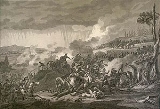
The Battle of Dresden was fought on 26–27 August 1813 around Dresden
, Germany, resulting in a French victory under Napoleon I
against forces of the Sixth Coalition of Austria
ns, Russians and Prussia
ns under Field Marshal
Schwartzenberg. However, Napoleon's victory was not as complete as it could have been. Substantial pursuit was not undertaken after the battle, and the flanking corps was surrounded and forced to surrender a few days later at the Battle of Kulm
.
Saint-Cyr's corps to fortify and hold Dresden in order to hinder allied movements and to serve as a possible base for his own manoeuvres. He planned to strike against the interior lines of his enemies and defeat them in detail, before they could combine their full strength. He had some 300,000 men against allied forces totaling over 450,000. But the Coalition avoided battle with Napoleon himself, choosing to attack his subordinate commanders instead (see the Trachenburg Plan
). On 23 August, at the Battle of Grossbeeren
, south of Berlin, Crown Prince Charles
of Sweden (formerly French Marshal Bernadotte, Napoleon's own Marshal) defeated his old comrade Marshal Oudinot
. And on 26 August, Prussian Marshal Blücher
defeated Marshal MacDonald
at the Katzbach
.
cut the left wing of the Allied army, commanded by Johann von Klenau
and Ignaz Gyulai
, from the main body. Marshal
Joachim Murat
took advantage of this isolation and inflicted heavy losses on the Austrians. A French participant observed, "Murat.... cut off from the Austrian army Klenau's corps, hurling himself upon it at the head of the carabineers
and cuirassier
s. .... Nearly all his [Klenau's] battalions were compelled to lay down their arms, and two other divisions of infantry shared their fate." Of Klenau's force, Lieutenant Field Marshal Joseph, Baron von Mesko de Felsö-Kubiny
's division of five infantry regiments was surrounded and captured by Murat's cavalry, which amounted to approximately 13,000 men, and 15 colours. Gyulai's divisions also suffered serious losses when they were attacked by Murat's cavalry during a rainstorm. With damp flints and powder, their muskets would not fire and many battalions became an easy prey to the French cuirassiers and dragoons.
Then suddenly, Napoleon had to leave the field by virtue of a sudden fit of gastric spasma and the failure to follow up on his success allowed Schwarzenberg to withdraw and narrowly escape encirclement. The Coalition had lost some 38,000 men and 40 guns. French casualties totaled around 10,000. Some of Napoleon's officers noted he was "suffering from a violent cholic, which had been brought on by the cold rain, to which he had been exposed during the whole of the battle."
 On 27 August, General Vandamme
received orders to advance on Pirna and bridge the Elbe there. This was accomplished in a pouring rain, without disturbing the Russians drawn up on the heights of Zehista. This advance by Vandamme resulted in the Battle of Kulm
three days later. Interestingly Napoleon's old rival Jean Victor Marie Moreau
who had only recently returned from his banishment from the United States was talking to the Tsar (who wished to see Napoleon defeated) and was mortally wounded in the battle and died later on September 2 in Louny
.
Dresden
Dresden is the capital city of the Free State of Saxony in Germany. It is situated in a valley on the River Elbe, near the Czech border. The Dresden conurbation is part of the Saxon Triangle metropolitan area....
, Germany, resulting in a French victory under Napoleon I
Napoleon I of France
Napoleon Bonaparte was a French military and political leader during the latter stages of the French Revolution.As Napoleon I, he was Emperor of the French from 1804 to 1815...
against forces of the Sixth Coalition of Austria
Austrian Empire
The Austrian Empire was a modern era successor empire, which was centered on what is today's Austria and which officially lasted from 1804 to 1867. It was followed by the Empire of Austria-Hungary, whose proclamation was a diplomatic move that elevated Hungary's status within the Austrian Empire...
ns, Russians and Prussia
Prussia
Prussia was a German kingdom and historic state originating out of the Duchy of Prussia and the Margraviate of Brandenburg. For centuries, the House of Hohenzollern ruled Prussia, successfully expanding its size by way of an unusually well-organized and effective army. Prussia shaped the history...
ns under Field Marshal
Field Marshal
Field Marshal is a military rank. Traditionally, it is the highest military rank in an army.-Etymology:The origin of the rank of field marshal dates to the early Middle Ages, originally meaning the keeper of the king's horses , from the time of the early Frankish kings.-Usage and hierarchical...
Schwartzenberg. However, Napoleon's victory was not as complete as it could have been. Substantial pursuit was not undertaken after the battle, and the flanking corps was surrounded and forced to surrender a few days later at the Battle of Kulm
Battle of Kulm
The Battle of Kulm was a battle near the town Kulm and the village Přestanov in northern Bohemia. It was fought on 29–30 August 1813, during the War of the Sixth Coalition...
.
Prelude
On 16 August, Napoleon had sent MarshalMarshal of France
The Marshal of France is a military distinction in contemporary France, not a military rank. It is granted to generals for exceptional achievements...
Saint-Cyr's corps to fortify and hold Dresden in order to hinder allied movements and to serve as a possible base for his own manoeuvres. He planned to strike against the interior lines of his enemies and defeat them in detail, before they could combine their full strength. He had some 300,000 men against allied forces totaling over 450,000. But the Coalition avoided battle with Napoleon himself, choosing to attack his subordinate commanders instead (see the Trachenburg Plan
Trachenburg Plan
The Trachenberg Plan was concocted by Allied commanders in the 1813 German Campaign during the War of the Sixth Coalition of the Napoleonic Wars. The plan advocated avoiding direct engagement with the French emperor, Napoleon I. This resulted from fear of the Emperor's now legendary prowess in battle...
). On 23 August, at the Battle of Grossbeeren
Battle of Grossbeeren
In the Battles of Großbeeren and neighboring Blankenfield and Sputendorf an allied Prussian-Swedish army under Crown Prince Charles John - formerly Marshal of France Jean-Baptiste Bernadotte - defeated the French under Marshal Oudinot...
, south of Berlin, Crown Prince Charles
Charles XIV John of Sweden
Charles XIV & III John, also Carl John, Swedish and Norwegian: Karl Johan was King of Sweden and King of Norway from 1818 until his death...
of Sweden (formerly French Marshal Bernadotte, Napoleon's own Marshal) defeated his old comrade Marshal Oudinot
Nicolas Oudinot
Nicolas Charles Oudinot, 1st Comte Oudinot, 1st Duc de Reggio , was a Marshal of France.-Early life:...
. And on 26 August, Prussian Marshal Blücher
Gebhard Leberecht von Blücher
Gebhard Leberecht von Blücher, Fürst von Wahlstatt , Graf , later elevated to Fürst von Wahlstatt, was a Prussian Generalfeldmarschall who led his army against Napoleon I at the Battle of the Nations at Leipzig in 1813 and at the Battle of Waterloo in 1815 with the Duke of Wellington.He is...
defeated Marshal MacDonald
Étienne-Jacques-Joseph-Alexandre MacDonald
Étienne Jacques Joseph Alexandre MacDonald, 1st duke of Taranto was a Marshal of France and military leader during the French Revolutionary and Napoleonic Wars.-Family background:...
at the Katzbach
Battle of Katzbach
The Battle of Katzbach on 26 August 1813, was an accidental engagement of the Napoleonic Wars between the forces of the First French Empire under Marshal MacDonald and a Russo-Prussian army of the Sixth Coalition under Prussian Marshal Graf von Blücher...
.
Battle
On the same day as Katzbach, Karl Philipp Fürst zu Schwarzenberg, the commander of the Austrian force of over 200,000 men of the Austrian Army of Bohemia (and accompanied by the Austrian emperor, the Russian tsar and the Prussian king), attacked Saint-Cyr. Napoleon arrived quickly and unexpectedly with reinforcements to repel this assault. Although outnumbered two to one, Napoleon attacked the following day (27 August), turned the allied left flank, and won an impressive tactical victory. The flooded WeißeritzWeißeritz
The Weißeritz is a river in Saxony. The 12 km short left tributary of the Elbe runs through Freital and Dresden. Its name is derived from west Slavic bystrica . The official name of the river used in documents and hydrographic maps is Vereinigte Weißeritz...
cut the left wing of the Allied army, commanded by Johann von Klenau
Johann von Klenau
Johann von Klenau , also called Johann Josef Cajetan von Klenau und Janowitz, the son of a Bohemian noble, was a field marshal in the Habsburg army...
and Ignaz Gyulai
Ignaz Gyulai
Ignaz Gyulai von Máros-Nemeth und Nádaska, Ignácz Gyulay, Ignác Gyulay, or Ignjat Đulaj born 11 September 1763 – died 11 November 1831, joined the army of Habsburg Austria, fought against Ottoman Turkey, and became a general officer during the French Revolutionary Wars. From 1806 he held the...
, from the main body. Marshal
Marshal of France
The Marshal of France is a military distinction in contemporary France, not a military rank. It is granted to generals for exceptional achievements...
Joachim Murat
Joachim Murat
Joachim-Napoléon Murat , Marshal of France and Grand Admiral or Admiral of France, 1st Prince Murat, was Grand Duke of Berg from 1806 to 1808 and then King of Naples from 1808 to 1815...
took advantage of this isolation and inflicted heavy losses on the Austrians. A French participant observed, "Murat.... cut off from the Austrian army Klenau's corps, hurling himself upon it at the head of the carabineers
Carabinier
A Carabinier was originally a cavalry soldier armed with a carbine...
and cuirassier
Cuirassier
Cuirassiers were mounted cavalry soldiers equipped with armour and firearms, first appearing in late 15th-century Europe. They were the successors of the medieval armoured knights...
s. .... Nearly all his [Klenau's] battalions were compelled to lay down their arms, and two other divisions of infantry shared their fate." Of Klenau's force, Lieutenant Field Marshal Joseph, Baron von Mesko de Felsö-Kubiny
Joseph, Baron von Mesko de Felsö-Kubiny
Joseph de Mesko, Freiherr von Felsö-Kubiny was a cavalry general and field marshal in Austrian service during the French Revolutionary and Napoleonic wars.- Military service :...
's division of five infantry regiments was surrounded and captured by Murat's cavalry, which amounted to approximately 13,000 men, and 15 colours. Gyulai's divisions also suffered serious losses when they were attacked by Murat's cavalry during a rainstorm. With damp flints and powder, their muskets would not fire and many battalions became an easy prey to the French cuirassiers and dragoons.
Then suddenly, Napoleon had to leave the field by virtue of a sudden fit of gastric spasma and the failure to follow up on his success allowed Schwarzenberg to withdraw and narrowly escape encirclement. The Coalition had lost some 38,000 men and 40 guns. French casualties totaled around 10,000. Some of Napoleon's officers noted he was "suffering from a violent cholic, which had been brought on by the cold rain, to which he had been exposed during the whole of the battle."
Aftermath
Dominique Vandamme
General Dominique-Joseph René Vandamme, Count of Unseburg was a French military officer, who fought in the Napoleonic Wars....
received orders to advance on Pirna and bridge the Elbe there. This was accomplished in a pouring rain, without disturbing the Russians drawn up on the heights of Zehista. This advance by Vandamme resulted in the Battle of Kulm
Battle of Kulm
The Battle of Kulm was a battle near the town Kulm and the village Přestanov in northern Bohemia. It was fought on 29–30 August 1813, during the War of the Sixth Coalition...
three days later. Interestingly Napoleon's old rival Jean Victor Marie Moreau
Jean Victor Marie Moreau
Jean Victor Marie Moreau was a French general who helped Napoleon Bonaparte to power, but later became a rival and was banished to the United States.- Early life :Moreau was born at Morlaix in Brittany...
who had only recently returned from his banishment from the United States was talking to the Tsar (who wished to see Napoleon defeated) and was mortally wounded in the battle and died later on September 2 in Louny
Louny
Louny is a town in the Ústí nad Labem Region of the Czech Republic. It is situated on the River Ohře.-History:The city was founded in the 12th century . The Church of St Peter stands on the site of the original fort...
.
External links
- Battle of Dresden animated battle map by Jonathan Webb
- Battle of Dresden 1813 – maps, illustrations
- Memoirs of the Duke RovigoAnne Jean Marie René SavaryAnne Jean Marie René Savary, 1st Duc de Rovigo , French general and diplomat, was born at Marcq in the Ardennes.-Biography:...