


Battle of Jerusalem Plank Road

Encyclopedia
The Battle of Jerusalem Plank Road, also known as the First Battle of the Weldon Railroad
, was fought June 21–23, 1864, near Petersburg, Virginia
. It was the first of a series of battles during the Siege of Petersburg
aimed at extending the Union
siege lines to the west and cutting the rail lines supplying Petersburg. Two infantry corps of the Union Army of the Potomac
attempted to sever the railroad, but were attacked and driven off by the Confederate
Army of Northern Virginia
's Third Corps
, principally the division of Brig. Gen. William Mahone
. The inconclusive battle left the Weldon Railroad temporarily in Confederate hands, but the Union Army began to extend its fortifications to the west, starting to increase the pressure of the siege.
Ulysses S. Grant
reluctantly decided on a siege
of Petersburg, defended by Gen. Robert E. Lee
's Army of Northern Virginia. The Union Army of the Potomac, commanded by Maj. Gen. George G. Meade (although closely supervised by his superior, Grant), entrenched east of the city, running from near the Jerusalem Plank Road (present-day U.S. Route 301
, Crater Road) to the Appomattox River
.
Grant's first objective was secure the three remaining open rail lines that served Petersburg and the Confederate capital of Richmond
: the Richmond and Petersburg Railroad
; the South Side Railroad, which reached to Lynchburg
in the west; and the Weldon Railroad
, also called the Petersburg and Weldon Railroad, which led to Weldon, North Carolina
, and the Confederacy's only remaining major port, Wilmington, North Carolina
. Grant decided on a wide-ranging cavalry raid (the Wilson-Kautz Raid
) against the South Ride and Weldon railroads, but he also directed that a significant infantry force be sent against the Weldon closer to his current position. Meade selected the II Corps, temporarily commanded by Maj. Gen. David B. Birney
while Maj. Gen. Winfield S. Hancock was suffering from his lingering wound incurred at Gettysburg
, and the VI Corps, commanded by Maj. Gen. Horatio G. Wright. The positions in the trench lines occupied by these two corps were to be filled in by units of the Army of the James
that would be moved from Bermuda Hundred.
As the Union troops were rearranging their lines on June 21 in preparation for their mission against the railroad, they received a surprise visitor, President
Abraham Lincoln
, who had traveled by water and landed at City Point
, Grant's newly established headquarters. He told Grant, "I just thought I would jump aboard a boat and come down and see you. I don't expect I can do any good, and in fact I'm afraid I may do some harm, but I'll just put myself under your orders and if you find me doing anything wrong just send me right away." After discussing strategy with Grant, Lincoln visited some of the VI Corps troops who would participate in the upcoming battle.
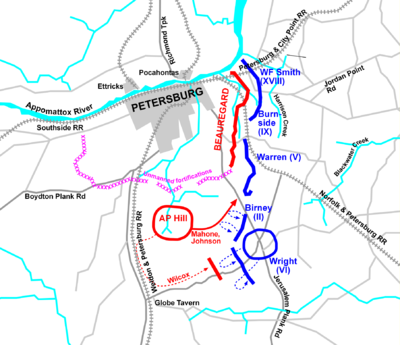 On June 21, elements of the II Corps probed toward the railroad and skirmished with Confederate cavalry. The plan of attack was that both the II and VI Corps would cross the Jerusalem Plank Road and then pivot northwest about 2 miles (3.2 km) to reach the railroad. Difficult terrain—swamps and thickets—slowed their advance and by the morning of June 22, a gap opened up between the two corps. While the II Corps began pivoting as planned, the VI Corps encountered Confederate troops from Maj. Gen. Cadmus Wilcox's division of Lt. Gen. A.P. Hill's corps and they began to entrench rather than advance. Brig. Gen. William Mahone
, another division commander in Hill's corps, observed that the gap between the two Union corps was widening, creating a prime target.
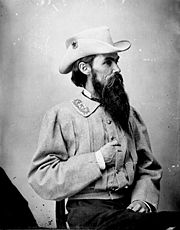 Mahone had been a railroad engineer before the war and had personally surveyed this area south of Petersburg, so he was familiar with a ravine that could be used to hide the approach of a Confederate attack column. Robert E. Lee approved Mahone's plan and at 3 p.m. on June 22, Mahone's men emerged in the rear of the II Corps division of Brig. Gen. Francis C. Barlow
, catching them by surprise. A soldier wrote, "The attack was to the Union troops more than a surprise. It was an astonishment."
Barlow's division quickly collapsed under the surprise assault. The division of Brig. Gen. John Gibbon
, which had erected earthworks, was also surprised by an attack from the rear and many of the regiments ran for safety. Mahone sent an urgent message to his colleague Wilcox, asking him to join in the attack, but Wilcox was concerned about the VI Corps men to his front and the two regiments he sent in support arrived too late to make a difference. The II Corps troops rallied around earthworks that they had constructed on the night of June 21 and stabilized their lines. Darkness ended the fighting.
On June 23, the II Corps advanced to retake its lost ground, but the Confederates had pulled back, abandoning the earthworks they had captured. Under orders from General Meade, the VI Corps sent out a heavy skirmish line after 10 a.m. in a second attempt to reach the Weldon Railroad. Men from Brig. Gen. Lewis A. Grant
's 1st Vermont Brigade
had begun tearing up track when they were attacked by a larger force of Confederate infantry. Numerous Vermonters were taken prisoner and only about 0.5 miles of track had been destroyed when they were chased away. Meade repeatedly urged Horatio G. Wright to move forward and engage the enemy, but Wright refused to move, concerned that his corps would suffer the same reverses as the II Corps the previous day. At 7:35 p.m., Meade gave up and told Wright, "Your delay has been fatal." Meade's aide Theodore Lyman wrote, "On this particular occasion Wright showed himself totally unfit to command a corps."
(or the Second Battle of the Weldon Railroad) in August, although Lee could ship supplies by wagon from the Weldon where it reached Stony Creek Station
. In an expedition of December 7–11, Maj. Gen. Gouverneur K. Warren
destroyed an additional 16 miles (25.7 km) of track, rendering the Weldon Railroad unable to supply Petersburg.
Wilmington and Weldon Railroad
Originally chartered in 1835 as the Wilmington and Raleigh Railroad, the Wilmington and Weldon Railroad name began use in 1855. At the time of its 1840 completion, the line was the longest railroad in the world with 161.5 miles of track...
, was fought June 21–23, 1864, near Petersburg, Virginia
Petersburg, Virginia
Petersburg is an independent city in Virginia, United States located on the Appomattox River and south of the state capital city of Richmond. The city's population was 32,420 as of 2010, predominantly of African-American ethnicity...
. It was the first of a series of battles during the Siege of Petersburg
Siege of Petersburg
The Richmond–Petersburg Campaign was a series of battles around Petersburg, Virginia, fought from June 9, 1864, to March 25, 1865, during the American Civil War...
aimed at extending the Union
Union Army
The Union Army was the land force that fought for the Union during the American Civil War. It was also known as the Federal Army, the U.S. Army, the Northern Army and the National Army...
siege lines to the west and cutting the rail lines supplying Petersburg. Two infantry corps of the Union Army of the Potomac
Army of the Potomac
The Army of the Potomac was the major Union Army in the Eastern Theater of the American Civil War.-History:The Army of the Potomac was created in 1861, but was then only the size of a corps . Its nucleus was called the Army of Northeastern Virginia, under Brig. Gen...
attempted to sever the railroad, but were attacked and driven off by the Confederate
Confederate States Army
The Confederate States Army was the army of the Confederate States of America while the Confederacy existed during the American Civil War. On February 8, 1861, delegates from the seven Deep South states which had already declared their secession from the United States of America adopted the...
Army of Northern Virginia
Army of Northern Virginia
The Army of Northern Virginia was the primary military force of the Confederate States of America in the Eastern Theater of the American Civil War, as well as the primary command structure of the Department of Northern Virginia. It was most often arrayed against the Union Army of the Potomac...
's Third Corps
Third Corps, Army of Northern Virginia
The Third Corps of the Army of Northern Virginia was a military organization within the Confederate Army of Northern Virginia during much of the American Civil War. The corps was formed in mid-1863 and served until Lee's surrender April 9, 1865, near the end of the war.-Formation:After the death of...
, principally the division of Brig. Gen. William Mahone
William Mahone
William Mahone was a civil engineer, teacher, soldier, railroad executive, and a member of the Virginia General Assembly and U.S. Congress. Small of stature, he was nicknamed "Little Billy"....
. The inconclusive battle left the Weldon Railroad temporarily in Confederate hands, but the Union Army began to extend its fortifications to the west, starting to increase the pressure of the siege.
Background
After the assaults on Petersburg the previous week failed to capture the city, Lt. Gen.Lieutenant General (United States)
In the United States Army, the United States Air Force and the United States Marine Corps, lieutenant general is a three-star general officer rank, with the pay grade of O-9. Lieutenant general ranks above major general and below general...
Ulysses S. Grant
Ulysses S. Grant
Ulysses S. Grant was the 18th President of the United States as well as military commander during the Civil War and post-war Reconstruction periods. Under Grant's command, the Union Army defeated the Confederate military and ended the Confederate States of America...
reluctantly decided on a siege
Siege
A siege is a military blockade of a city or fortress with the intent of conquering by attrition or assault. The term derives from sedere, Latin for "to sit". Generally speaking, siege warfare is a form of constant, low intensity conflict characterized by one party holding a strong, static...
of Petersburg, defended by Gen. Robert E. Lee
Robert E. Lee
Robert Edward Lee was a career military officer who is best known for having commanded the Confederate Army of Northern Virginia in the American Civil War....
's Army of Northern Virginia. The Union Army of the Potomac, commanded by Maj. Gen. George G. Meade (although closely supervised by his superior, Grant), entrenched east of the city, running from near the Jerusalem Plank Road (present-day U.S. Route 301
U.S. Route 301
U.S. Route 301 is a spur of U.S. Route 1 running through the South Atlantic States. It currently runs 1,099 miles from Glasgow, Delaware at U.S. Route 40 to Sarasota, Florida. It passes through the states of Delaware, Maryland, Virginia, North Carolina, South Carolina, Georgia, and Florida...
, Crater Road) to the Appomattox River
Appomattox River
The Appomattox River is a tributary of the James River, approximately long, in central and eastern Virginia in the United States, named for the Appomattocs Indian tribe who lived along its lower banks in the 17th century...
.
Grant's first objective was secure the three remaining open rail lines that served Petersburg and the Confederate capital of Richmond
Richmond, Virginia
Richmond is the capital of the Commonwealth of Virginia, in the United States. It is an independent city and not part of any county. Richmond is the center of the Richmond Metropolitan Statistical Area and the Greater Richmond area...
: the Richmond and Petersburg Railroad
Richmond and Petersburg Railroad
Richmond and Petersburg Railroad was a regional railroad serving east-central Virginia. It was strategically important to the Confederacy during the American Civil War, when it provided a vital supply and transportation route in late 1864 and early 1865 for Robert E...
; the South Side Railroad, which reached to Lynchburg
Lynchburg, Virginia
Lynchburg is an independent city in the Commonwealth of Virginia. The population was 75,568 as of 2010. Located in the foothills of the Blue Ridge Mountains along the banks of the James River, Lynchburg is known as the "City of Seven Hills" or "The Hill City." Lynchburg was the only major city in...
in the west; and the Weldon Railroad
Wilmington and Weldon Railroad
Originally chartered in 1835 as the Wilmington and Raleigh Railroad, the Wilmington and Weldon Railroad name began use in 1855. At the time of its 1840 completion, the line was the longest railroad in the world with 161.5 miles of track...
, also called the Petersburg and Weldon Railroad, which led to Weldon, North Carolina
Weldon, North Carolina
Weldon is a town in Halifax County, North Carolina, United States. The population was 1,374 at the 2000 census. It is part of the Roanoke Rapids, North Carolina Micropolitan Statistical Area.-Geography:Weldon is located at ....
, and the Confederacy's only remaining major port, Wilmington, North Carolina
Wilmington, North Carolina
Wilmington is a port city in and is the county seat of New Hanover County, North Carolina, United States. The population is 106,476 according to the 2010 Census, making it the eighth most populous city in the state of North Carolina...
. Grant decided on a wide-ranging cavalry raid (the Wilson-Kautz Raid
Wilson-Kautz Raid
The Wilson-Kautz Raid was a cavalry operation in south central Virginia in late June 1864, during the American Civil War. Occurring early in the Richmond-Petersburg Campaign, the raid was conducted by Union cavalry under Brigadier Generals James Wilson and August Kautz, who were ordered to cut...
) against the South Ride and Weldon railroads, but he also directed that a significant infantry force be sent against the Weldon closer to his current position. Meade selected the II Corps, temporarily commanded by Maj. Gen. David B. Birney
David B. Birney
David Bell Birney was a businessman, lawyer, and a Union General in the American Civil War.-Early life:Birney was born in Huntsville, Alabama, the son of an abolitionist from Kentucky, James G. Birney. The Birney family returned to Kentucky in 1833, and James Birney freed his slaves...
while Maj. Gen. Winfield S. Hancock was suffering from his lingering wound incurred at Gettysburg
Battle of Gettysburg
The Battle of Gettysburg , was fought July 1–3, 1863, in and around the town of Gettysburg, Pennsylvania. The battle with the largest number of casualties in the American Civil War, it is often described as the war's turning point. Union Maj. Gen. George Gordon Meade's Army of the Potomac...
, and the VI Corps, commanded by Maj. Gen. Horatio G. Wright. The positions in the trench lines occupied by these two corps were to be filled in by units of the Army of the James
Army of the James
The Army of the James was a Union Army that was composed of units from the Department of Virginia and North Carolina and served along the James River during the final operations of the American Civil War in Virginia.-History:...
that would be moved from Bermuda Hundred.
As the Union troops were rearranging their lines on June 21 in preparation for their mission against the railroad, they received a surprise visitor, President
President of the United States
The President of the United States of America is the head of state and head of government of the United States. The president leads the executive branch of the federal government and is the commander-in-chief of the United States Armed Forces....
Abraham Lincoln
Abraham Lincoln
Abraham Lincoln was the 16th President of the United States, serving from March 1861 until his assassination in April 1865. He successfully led his country through a great constitutional, military and moral crisis – the American Civil War – preserving the Union, while ending slavery, and...
, who had traveled by water and landed at City Point
City Point, Virginia
City Point was a town in Prince George County, Virginia that was annexed by the independent city of Hopewell in 1923. It served as headquarters of the Union Army during the Siege of Petersburg during the American Civil War.- History :...
, Grant's newly established headquarters. He told Grant, "I just thought I would jump aboard a boat and come down and see you. I don't expect I can do any good, and in fact I'm afraid I may do some harm, but I'll just put myself under your orders and if you find me doing anything wrong just send me right away." After discussing strategy with Grant, Lincoln visited some of the VI Corps troops who would participate in the upcoming battle.
Battle
William Mahone
William Mahone was a civil engineer, teacher, soldier, railroad executive, and a member of the Virginia General Assembly and U.S. Congress. Small of stature, he was nicknamed "Little Billy"....
, another division commander in Hill's corps, observed that the gap between the two Union corps was widening, creating a prime target.
Francis C. Barlow
Francis Channing Barlow was a lawyer, politician, and Union General during the American Civil War.-Early life and career:...
, catching them by surprise. A soldier wrote, "The attack was to the Union troops more than a surprise. It was an astonishment."
Barlow's division quickly collapsed under the surprise assault. The division of Brig. Gen. John Gibbon
John Gibbon
John Gibbon was a career United States Army officer who fought in the American Civil War and the Indian Wars.-Early life:...
, which had erected earthworks, was also surprised by an attack from the rear and many of the regiments ran for safety. Mahone sent an urgent message to his colleague Wilcox, asking him to join in the attack, but Wilcox was concerned about the VI Corps men to his front and the two regiments he sent in support arrived too late to make a difference. The II Corps troops rallied around earthworks that they had constructed on the night of June 21 and stabilized their lines. Darkness ended the fighting.
On June 23, the II Corps advanced to retake its lost ground, but the Confederates had pulled back, abandoning the earthworks they had captured. Under orders from General Meade, the VI Corps sent out a heavy skirmish line after 10 a.m. in a second attempt to reach the Weldon Railroad. Men from Brig. Gen. Lewis A. Grant
Lewis A. Grant
Lewis Addison Grant was a teacher, lawyer, soldier in the Union Army during the American Civil War, and later Assistant U.S. Secretary of War...
's 1st Vermont Brigade
1st Vermont Brigade
The First Vermont Brigade, or "Old Brigade" was an infantry brigade in the Union Army of the Potomac during the American Civil War. It suffered the highest casualty count of any brigade in the history of the United States Army, with some 1,172 killed in action...
had begun tearing up track when they were attacked by a larger force of Confederate infantry. Numerous Vermonters were taken prisoner and only about 0.5 miles of track had been destroyed when they were chased away. Meade repeatedly urged Horatio G. Wright to move forward and engage the enemy, but Wright refused to move, concerned that his corps would suffer the same reverses as the II Corps the previous day. At 7:35 p.m., Meade gave up and told Wright, "Your delay has been fatal." Meade's aide Theodore Lyman wrote, "On this particular occasion Wright showed himself totally unfit to command a corps."
Aftermath
Union casualties were 2,962, Confederate 572. The battle was inconclusive, with advantages gained on both sides. The Confederates were able to retain control of the Weldon Railroad. The Federals were able to destroy a short segment of the Weldon before being driven off, but more importantly, the siege lines were stretched further to the west, a strategy Grant would continue until the spring of 1865. Other segments of the Weldon Railroad were destroyed by the Wilson-Kautz Raid and more would fall to the Union Army during the Battle of Globe TavernBattle of Globe Tavern
The Battle of Globe Tavern, also known as the Second Battle of the Weldon Railroad, fought August 18–21, 1864, south of Petersburg, Virginia, was the second attempt of the Union Army to sever the Weldon Railroad during the Siege of Petersburg of the American Civil War. A Union force under...
(or the Second Battle of the Weldon Railroad) in August, although Lee could ship supplies by wagon from the Weldon where it reached Stony Creek Station
Stony Creek, Virginia
Stony Creek is a town in Sussex County, Virginia, United States. The population was 202 at the 2000 census.-Geography:Stony Creek is located at ....
. In an expedition of December 7–11, Maj. Gen. Gouverneur K. Warren
Gouverneur K. Warren
Gouverneur Kemble Warren was a civil engineer and prominent general in the Union Army during the American Civil War...
destroyed an additional 16 miles (25.7 km) of track, rendering the Weldon Railroad unable to supply Petersburg.