

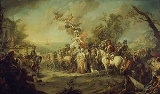
Russo-Turkish War, 1768-1774

Encyclopedia
The Russo-Turkish War of 1768–1774 was a decisive conflict that brought Southern Ukraine
, Northern Caucasus, and Crimea
within the orbit of the Russian Empire
.
where there was the knife between the nobility and the king Stanislaus Augustus Poniatowski, a former favorite of the Russia
n Empress Catherine II
. The king was dependent on Russian military backing, see: Peter III of Russia#Foreign policy.
A detachment of Cossacks in Russian service entered Balta
(on Ottoman
territory) during the pursuit of a Polish Bar Confederation
force. The Ottoman Empire
accused the troops of having conducted the slaughter of its subjects in the town of Balta, a charge denied by the Russian authorities.
Mustafa III
declared war on Russia on September 25, 1768. The Turks formed the alliance with the Polish opposition forces of the Bar Confederation
, while Russia was supported by Great Britain
, who offered naval advisers to the Imperial Russian Navy
.
The Polish opposition was defeated by Aleksandr Suvorov. After that, he was transferred to the Turkish theatre of operations, where in 1773 and 1774 he won several minor and major battles for Russia following the previous successes of the Russian Field-Marshal Count Peter Rumiantsev
at Larga
and Kagul
.
The naval operations of the Russian Baltic Fleet
in the Mediterranean yielded even more spectacular victories under the command of Aleksey Grigoryevich Orlov. In 1771, Egypt
and Syria
rebelled against the Ottoman rule
while the Russian fleet totally destroyed the Turkish Navy
in the Battle of Chesma
.
Despite their naval success, the Russians were unable to capture Constantinople
due to the fortifications in the Dardanelles
and the Bosphorus strengthened with the help of the French military adviser Baron de Tott
.
formally gained its independence (but in reality became dependent on Russia), Russia received the war reparations
of 4.5 million rubles and two key seaports allowing the direct access to the Black Sea
.
This war was but a small part of the continuous process of expansion of the Russian Empire southwards and eastwards during the 18th and 19th centuries.
Ukraine
Ukraine is a country in Eastern Europe. It has an area of 603,628 km², making it the second largest contiguous country on the European continent, after Russia...
, Northern Caucasus, and Crimea
Crimea
Crimea , or the Autonomous Republic of Crimea , is a sub-national unit, an autonomous republic, of Ukraine. It is located on the northern coast of the Black Sea, occupying a peninsula of the same name...
within the orbit of the Russian Empire
Russian Empire
The Russian Empire was a state that existed from 1721 until the Russian Revolution of 1917. It was the successor to the Tsardom of Russia and the predecessor of the Soviet Union...
.
Background
The war followed the external tensions within PolandPoland
Poland , officially the Republic of Poland , is a country in Central Europe bordered by Germany to the west; the Czech Republic and Slovakia to the south; Ukraine, Belarus and Lithuania to the east; and the Baltic Sea and Kaliningrad Oblast, a Russian exclave, to the north...
where there was the knife between the nobility and the king Stanislaus Augustus Poniatowski, a former favorite of the Russia
Russia
Russia or , officially known as both Russia and the Russian Federation , is a country in northern Eurasia. It is a federal semi-presidential republic, comprising 83 federal subjects...
n Empress Catherine II
Catherine II of Russia
Catherine II, also known as Catherine the Great , Empress of Russia, was born in Stettin, Pomerania, Prussia on as Sophie Friederike Auguste von Anhalt-Zerbst-Dornburg...
. The king was dependent on Russian military backing, see: Peter III of Russia#Foreign policy.
A detachment of Cossacks in Russian service entered Balta
Balta, Ukraine
Balta is a small city in the Odessa Oblast of south-western Ukraine. It is the administrative center of the Baltsky Raion , and located approximately 200 kilometers from the oblast capital, Odessa...
(on Ottoman
Ottoman Empire
The Ottoman EmpireIt was usually referred to as the "Ottoman Empire", the "Turkish Empire", the "Ottoman Caliphate" or more commonly "Turkey" by its contemporaries...
territory) during the pursuit of a Polish Bar Confederation
Bar Confederation
The Bar Confederation was an association of Polish nobles formed at the fortress of Bar in Podolia in 1768 to defend the internal and external independence of the Polish–Lithuanian Commonwealth against Russian influence and against King Stanisław August Poniatowski and Polish reformers who were...
force. The Ottoman Empire
Ottoman Empire
The Ottoman EmpireIt was usually referred to as the "Ottoman Empire", the "Turkish Empire", the "Ottoman Caliphate" or more commonly "Turkey" by its contemporaries...
accused the troops of having conducted the slaughter of its subjects in the town of Balta, a charge denied by the Russian authorities.
War
Following this border incident at Balta, SultanSultan
Sultan is a title with several historical meanings. Originally, it was an Arabic language abstract noun meaning "strength", "authority", "rulership", and "dictatorship", derived from the masdar سلطة , meaning "authority" or "power". Later, it came to be used as the title of certain rulers who...
Mustafa III
Mustafa III
Mustafa III was the Sultan of the Ottoman Empire from 1757 to 1774. He was a son of Sultan Ahmed III and was succeeded by his brother Abdul Hamid I . He was born in Edirne...
declared war on Russia on September 25, 1768. The Turks formed the alliance with the Polish opposition forces of the Bar Confederation
Bar Confederation
The Bar Confederation was an association of Polish nobles formed at the fortress of Bar in Podolia in 1768 to defend the internal and external independence of the Polish–Lithuanian Commonwealth against Russian influence and against King Stanisław August Poniatowski and Polish reformers who were...
, while Russia was supported by Great Britain
Kingdom of Great Britain
The former Kingdom of Great Britain, sometimes described as the 'United Kingdom of Great Britain', That the Two Kingdoms of Scotland and England, shall upon the 1st May next ensuing the date hereof, and forever after, be United into One Kingdom by the Name of GREAT BRITAIN. was a sovereign...
, who offered naval advisers to the Imperial Russian Navy
Imperial Russian Navy
The Imperial Russian Navy refers to the Tsarist fleets prior to the February Revolution.-First Romanovs:Under Tsar Mikhail Feodorovich, construction of the first three-masted ship, actually built within Russia, was completed in 1636. It was built in Balakhna by Danish shipbuilders from Holstein...
.
The Polish opposition was defeated by Aleksandr Suvorov. After that, he was transferred to the Turkish theatre of operations, where in 1773 and 1774 he won several minor and major battles for Russia following the previous successes of the Russian Field-Marshal Count Peter Rumiantsev
Rumyantsev
The Rumyantsev family were Russian counts prominent in Russian imperial politics in the 18th and early 19th centuries. The family claimed descent from the boyar Rumyanets who broke his oath of allegiance and surrendered Nizhny Novgorod to Vasily I of Moscow in 1391.The first Rumyantsev to gain...
at Larga
Battle of Larga
The Battle of Larga was fought between 65,000 Crimean Tatars cavalry and 15,000 Ottoman infantry under Kaplan Girey against 38,000 Russians under Field-Marshal Rumyantsev on the banks of the Larga River for eight hours on 7 July 1770. It was fought on the same day as Battle of Chesma, a key naval...
and Kagul
Battle of Kagul
The Battle of Cahul was the most important land battle of the Russo-Turkish War, 1768-1774 and one of the largest battles of the 18th century...
.
The naval operations of the Russian Baltic Fleet
Baltic Fleet
The Twice Red Banner Baltic Fleet - is the Russian Navy's presence in the Baltic Sea. In previous historical periods, it has been part of the navy of Imperial Russia and later the Soviet Union. The Fleet gained the 'Twice Red Banner' appellation during the Soviet period, indicating two awards of...
in the Mediterranean yielded even more spectacular victories under the command of Aleksey Grigoryevich Orlov. In 1771, Egypt
Egypt
Egypt , officially the Arab Republic of Egypt, Arabic: , is a country mainly in North Africa, with the Sinai Peninsula forming a land bridge in Southwest Asia. Egypt is thus a transcontinental country, and a major power in Africa, the Mediterranean Basin, the Middle East and the Muslim world...
and Syria
Syria
Syria , officially the Syrian Arab Republic , is a country in Western Asia, bordering Lebanon and the Mediterranean Sea to the West, Turkey to the north, Iraq to the east, Jordan to the south, and Israel to the southwest....
rebelled against the Ottoman rule
Orlov Revolt
The Orlov Revolt was a precursor to the Greek War of Independence , which saw a Greek uprising in the Peloponnese at the instigation of Count Orlov, commander of the Russian Naval Forces of the Russo-Turkish War...
while the Russian fleet totally destroyed the Turkish Navy
Navy
A navy is the branch of a nation's armed forces principally designated for naval and amphibious warfare; namely, lake- or ocean-borne combat operations and related functions...
in the Battle of Chesma
Battle of Chesma
The naval Battle of Chesma took place on 5 -7 July 1770 near and in Çeşme Bay, in the area between the western tip of Anatolia and the island of Chios, which was the site of a number of past naval battles between the Ottoman Empire and the Republic of Venice...
.
Despite their naval success, the Russians were unable to capture Constantinople
Constantinople
Constantinople was the capital of the Roman, Eastern Roman, Byzantine, Latin, and Ottoman Empires. Throughout most of the Middle Ages, Constantinople was Europe's largest and wealthiest city.-Names:...
due to the fortifications in the Dardanelles
Dardanelles
The Dardanelles , formerly known as the Hellespont, is a narrow strait in northwestern Turkey connecting the Aegean Sea to the Sea of Marmara. It is one of the Turkish Straits, along with its counterpart the Bosphorus. It is located at approximately...
and the Bosphorus strengthened with the help of the French military adviser Baron de Tott
François Baron de Tott
François Baron de Tott was an aristocrat and a French military officer of Hungarian origin...
.
Peace treaty
On July 21, 1774, the Ottoman Empire signed the Treaty of Kuçuk Kainarji. According to the treaty, the Crimean KhanateCrimean Khanate
Crimean Khanate, or Khanate of Crimea , was a state ruled by Crimean Tatars from 1441 to 1783. Its native name was . Its khans were the patrilineal descendants of Toqa Temür, the thirteenth son of Jochi and grandson of Genghis Khan...
formally gained its independence (but in reality became dependent on Russia), Russia received the war reparations
War reparations
War reparations are payments intended to cover damage or injury during a war. Generally, the term war reparations refers to money or goods changing hands, rather than such property transfers as the annexation of land.- History :...
of 4.5 million rubles and two key seaports allowing the direct access to the Black Sea
Black Sea
The Black Sea is bounded by Europe, Anatolia and the Caucasus and is ultimately connected to the Atlantic Ocean via the Mediterranean and the Aegean seas and various straits. The Bosphorus strait connects it to the Sea of Marmara, and the strait of the Dardanelles connects that sea to the Aegean...
.
This war was but a small part of the continuous process of expansion of the Russian Empire southwards and eastwards during the 18th and 19th centuries.