
All Topics  
Kenaf

 
Kenaf

   Email Print
   Bookmark   Link


Kenaf


Kenaf [Etymology: Persian], Hibiscus cannabinus, is a plant in the Malvaceae
Malvaceae

Malvaceae, or the mallow family, is a family of flowering plants containing over 200 genera with close to 2,300 species. Judd & al. The largest genera in terms of number of species include Hibiscus , Sterculia , Dombeya , Pavonia and Sida ....
 family. Hibiscus cannabinus is in the genus Hibiscus
Hibiscus

Scientific name:Hibiscus rosa-sinensisThe Genus Hibiscus comprises plants also commonly called hibiscus and less widely known as rosemallow....
 and is probably native to southern Asia
Asia

Asia is the world's largest and most populous continent. It covers 8.6% of the Earth's total surface area and, with over 4 billion people, it contains more than 60% of the world's current human population....
, though its exact natural origin is unknown. The name also applies to the fibre obtained from this plant. Kenaf is one of the allied fibres of jute
Jute

Jute is a long, soft, shiny vegetable fiber that can be spun into coarse, strong threads. It is produced from plants in the genus Corchorus, family Tiliaceae....
 and shows similar characteristics. Other names include Bimli, Ambary, Ambari Hemp
Hemp (disambiguation)

Hemp may refer to:* Hemp, Cannabis as a source of industrial, food and other non-drug products, including cultivation information.* Cannabis, Cannabis as a genus of plant...
, Deccan Hemp, and Bimlipatum Jute.

It is an annual
Annual plant

An annual plant is a plant that usually germinates flowers and dies in one year. True annuals will only live longer than a year if they are prevented from setting seed....
 or biennial
Biennial plant

A biennial plant is a flowering plant that takes two years to complete its biological lifecycle. In the first year the plant grows leaves, stems, and roots , then it enters a period of dormancy over the colder months....
 herbaceous
Herbaceous

A herbaceous plant is a plant that has leaf and stem that die down at the end of the growing season to the soil level. A herbaceous plant may be Annual plant, Biennial plant or Perennial plant....
 plant (rarely a short-lived perennial
Perennial plant

A perennial plant or perennial is a plant that lives for more than two years. When used by gardeners or horticulturalists, this term applies specifically to perennial herbaceous plants....
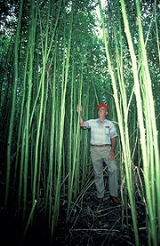
) growing to 1.5-3.5 m tall with a woody base.


Discussion
Ask a question about 'Kenaf'
Start a new discussion about 'Kenaf'
Answer questions from other users
Full Discussion Forum


Recent Posts


Encyclopedia


Kenaf [Etymology: Persian], Hibiscus cannabinus, is a plant in the Malvaceae
Malvaceae

Malvaceae, or the mallow family, is a family of flowering plants containing over 200 genera with close to 2,300 species. Judd & al. The largest genera in terms of number of species include Hibiscus , Sterculia , Dombeya , Pavonia and Sida ....
 family. Hibiscus cannabinus is in the genus Hibiscus
Hibiscus

Scientific name:Hibiscus rosa-sinensisThe Genus Hibiscus comprises plants also commonly called hibiscus and less widely known as rosemallow....
 and is probably native to southern Asia
Asia

Asia is the world's largest and most populous continent. It covers 8.6% of the Earth's total surface area and, with over 4 billion people, it contains more than 60% of the world's current human population....
, though its exact natural origin is unknown. The name also applies to the fibre obtained from this plant. Kenaf is one of the allied fibres of jute
Jute

Jute is a long, soft, shiny vegetable fiber that can be spun into coarse, strong threads. It is produced from plants in the genus Corchorus, family Tiliaceae....
 and shows similar characteristics. Other names include Bimli, Ambary, Ambari Hemp
Hemp (disambiguation)

Hemp may refer to:* Hemp, Cannabis as a source of industrial, food and other non-drug products, including cultivation information.* Cannabis, Cannabis as a genus of plant...
, Deccan Hemp, and Bimlipatum Jute.

It is an annual
Annual plant

An annual plant is a plant that usually germinates flowers and dies in one year. True annuals will only live longer than a year if they are prevented from setting seed....
 or biennial
Biennial plant

A biennial plant is a flowering plant that takes two years to complete its biological lifecycle. In the first year the plant grows leaves, stems, and roots , then it enters a period of dormancy over the colder months....
 herbaceous
Herbaceous

A herbaceous plant is a plant that has leaf and stem that die down at the end of the growing season to the soil level. A herbaceous plant may be Annual plant, Biennial plant or Perennial plant....
 plant (rarely a short-lived perennial
Perennial plant

A perennial plant or perennial is a plant that lives for more than two years. When used by gardeners or horticulturalists, this term applies specifically to perennial herbaceous plants....
) growing to 1.5-3.5 m tall with a woody base. The stems are 1-2 cm diameter, often but not always branched. The leaves
Leaf

In botany, a leaf is an above-ground plant Organ specialized for photosynthesis. For this purpose, a leaf is typically flat and thin, to expose the cells containing chloroplast to light over a broad area, and to allow light to penetrate fully into the tissues....
 are 10-15 cm long, variable in shape, with leaves near the base of the stems being deeply lobed with 3-7 lobes, while leaves near the top of the stem are shallowly lobed or unlobed lanceolate. The flower
Flower

A flower, sometimes known as a bloom or blossom, is the reproduction structure found in flowering plants . The biological function of a flower is to mediate the union of male sperm with female ovum in order to produce seeds....
s are 8-15 cm diameter, white, yellow, or purple; when white or yellow, the centre is still dark purple. The fruit
Fruit

The term fruit has different meanings dependent on context, and the term is not synonymous in food preparation and biology. In botany, which is the scientific study of plants, fruits are the ripened Ovary of flowering plants....
 is a capsule
Capsule (fruit)

In botany a capsule is a type of simple, dry fruit produced by many species of flowering plants. A capsule is a dehiscent structure composed of two or more carpels, that, at maturity, split apart to release the seeds within....
 2 cm diameter, containing several seed
Seed

A seed is a small Plant embryogenesis plant enclosed in a covering called the seed coat, usually with some Food storage. It is the product of the ripened ovule of gymnosperm and angiosperm plants which occurs after fertilization and some growth within the mother plant....
s.

Uses

Kenaf
Kenaf has a long history of cultivation for its fibre in India
India

India, officially the Republic of India , is a country in South Asia. It is the List of countries and outlying territories by total area country by geographical area, the List of countries by population country, and the most populous liberal democracy in the world....
, Bangladesh
Bangladesh

, officially the People's Republic of Bangladesh is a country in South Asia. It is bordered by India on all sides except for a small border with Burma to the far southeast and by the Bay of Bengal to the south....
, Thailand
Thailand

The Kingdom of Thailand is an independent country that lies in the heart of Southeast Asia. It is bordered to the north by Laos and Myanmar, to the east by Laos and Cambodia, to the south by the Gulf of Thailand and Malaysia, and to the west by the Andaman Sea and Myanmar....
, parts of Africa
Africa

Africa is the world's second-largest and second most-populous continent, after Asia. At about 30.2 million km? including adjacent islands, it covers 6% of the Earth's total surface area and 20.4% of the total land area....
, and to a small extent in southeast Europe
Europe

Europe is, conventionally, one of the world's seven continents. Comprising the westernmost peninsula of Eurasia, Europe is generally divided from Asia to its east by the water divide of the Ural Mountains, the Ural , the Caspian Sea, and by the Caucasus Mountains to the southeast....
. The stems produce two types of fibre, a coarser fibre in the outer layer (bast fibre
Bast fibre

Bast fibre or skin fibre is plant fibre collected from the phloem or bast surrounding the stem of certain, mainly dicotyledonic, plants....
), and a finer fibre in the core. It matures in 100 to 1,000 days. About 9,000 cultivar
Cultivar

A cultivar is a cultivated plant that has been selected and given a unique name because of its decorative or useful characteristics; it is usually distinct from similar plants and when Plant propagation it retains those characteristics....
s are produced . Grown for over 4,000 years in Africa
Africa

Africa is the world's second-largest and second most-populous continent, after Asia. At about 30.2 million km? including adjacent islands, it covers 6% of the Earth's total surface area and 20.4% of the total land area....
 where its leaves are consumed in human and animal diets, the bast fiber is used for cordage, and the woody core of the stalks burned for fuel. This crop was not introduced into southern Europe until the early 1900s. Today, principal farming areas are throughout China
China

China is a Culture of China, an ancient civilization, and, depending on perspective, a national or multinational entity extending over a large area in East Asia....
, India
India

India, officially the Republic of India , is a country in South Asia. It is the List of countries and outlying territories by total area country by geographical area, the List of countries by population country, and the most populous liberal democracy in the world....
, and in many other countries including the following: ; , to name a few.

The main uses of kenaf fiber have been rope
Rope

A rope is a length of fibers, twisted or braided together to improve strength for pulling and connecting. It has tensile strength but is too flexible to provide compressive strength ....
, twine
Twine

Twine is a strong thread or string composed of two or more smaller strands or yarns twisted together. More generally, the term can be applied to any thin cord....
, coarse cloth (similar to that made from jute
Jute

Jute is a long, soft, shiny vegetable fiber that can be spun into coarse, strong threads. It is produced from plants in the genus Corchorus, family Tiliaceae....
), and paper
Paper

Paper is thin material mainly used for writing upon, printing upon or packaging. It is produced by pressing together moist fibers, typically cellulose pulp derived from wood, rags or grasses, and drying them into flexible sheets....
. In California, Texas and Louisiana, 3,200 acres (13 kmē) of kenaf were grown in 1992, most of which was used for animal bedding and feed.

Emerging uses of kenaf fibre include engineered wood
Engineered wood

Engineered wood, also called composite wood, man-made wood or manufactured wood, includes a range of derivative wood products which are manufactured by binding together the strands, particles, wood fibre, or wood veneer of wood, together with adhesives, to form composite materials....
, insulation
Building insulation

Building insulation refers broadly to any object in a building used as insulation for any purpose. Whilst the majority of insulation in buildings is for thermal insulation purposes, the term also applies to acoustic insulation, Fireproofing, and Cushioning ....
, and clothing
Clothing

A feature of all human societies, except perhaps the most primitive, is the wearing of clothing or clothes, especially in public. The primary purpose of clothing is functional, as a protection from the weather....
-grade cloth. Panasonic
Panasonic

Panasonic is an international brand name for Japanese electric products manufacturer Panasonic Corporation Under this brand the company sells Plasma display and LCD display panels, DVD recorders and players, Blu-ray Disc players, camcorders, telephones, vacuum cleaners, microwave ovens, shavers, projectors, digital cameras, batteries, lapto...
 has set up a plant in Malaysia
Malaysia

Malaysia is a federation that consists of States of Malaysia in Southeast Asia with a total landmass of . The capital city is Kuala Lumpur, while Putrajaya is the seat of the federal government....
 to manufacture kenaf fibre boards and export them to Japan, oil absorbent (based on patent issued to H. and C. Willett), soil-less potting mixes, animal bedding, packing material, organic filler for blending with plastics for injection molding (using the technology developed and patented by Fibre Packaging International, Inc.), as an additive for drilling muds, and various types of mats, such as seeded grass mats for instant lawns and moldable mats for manufactured parts and containers.

Kenaf seeds yield a vegetable oil that is edible and high in omega antioxidants. The kenaf oil is also used for cosmetics, industrial lubricants and as bio-fuel.

Kenaf paper


The use of Kenaf in paper production offers various environmental advantages over producing paper from trees. In 1960, the USDA surveyed more than 500 plants and selected kenaf as the most promising source of "tree-free" newsprint. In 1970, kenaf newsprint produced in International Paper Company's mill in Pine Bluff, Arkansas, was successfully used by six U.S. newspapers. Printing and writing paper made from the fibrous kenaf plant has been offered in the United States since 1992. Again in 1987, a Canadian mill produced 13 rolls of kenaf newsprint which were used by four U.S. newspapers to print experimental issues. They found that kenaf newsprint made for stronger, brighter and cleaner pages than standard pine paper with less detriment to the environment. Due partly to kenaf fibers being naturally whiter than tree pulp, less bleaching is required to create a brighter sheet of paper. Hydrogen peroxide, an environmentally-safe bleaching agent that does not create dioxin
Dioxin

Polychlorinated dibenzodioxins , or simply dioxins, are a group of polyhalogenated compounds which are significant because they act as environmental pollutants....
, has been used with much success in the bleaching of kenaf.

Various reports suggest that the energy requirements for producing pulp from kenaf are about 20 percent less than those for wood pulp, mostly due to the lower lignin content of kenaf. Many of the facilities that now process Southern pine for paper use can be converted to accommodate kenaf.

USDA kenaf expert Daniel Kugler predicts that kenaf will be widely used to make paper, and that it represents a promising cash crop for American farmers. One acre of kenaf produces 7 to 11 tons of usable fiber in a single growing season. In contrast, an acre of forest (in the USA) produces approximately 1.5 to 3.5 tons of usable fiber per year. It is estimated that growing kenaf on 5,000 acres (20 kmē) can produce enough pulp to supply a paper plant having a capacity of 200 tons per day. Over 20 years, of farmland can produce 10 to 20 times the amount of fiber that of Southern pine.

As one of the world's important natural fibres, Kenaf is covered by the International Year of Natural Fibres
International Year of Natural Fibres

The United Nations General Assembly declared 2009 as the International Year of Natural fiber.The proposal for this International year originated in FAO at a joint meeting of the Intergovernmental Group on Hard Fibres and the Intergovernmental Group on Jute in 2004, and was endorsed by FAO Conference in 2005....
 2009.

Common names


English: kenaf (Persian origin) India (Bengal): mesta India (Madras): palungi India (Bombay): deccan hemp Taiwan: ambari Egypt & Northern Africa: til, teel, or teal Indonesia: Java jute Brazil: papoula de Sao Francisco South Africa: stokroos West Africa: dah, gambo, and rama.

Pesticide and fertilizer use in kenaf crops


Kenaf is considered a hardy plant that requires a minimum of fertilizers, pesticides and water in comparison to conventional row crops.