
All Topics  
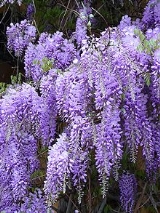
Wisteria

 
Wisteria

   Email Print
   Bookmark   Link


Wisteria


Wisteria is a genus
Genus

A genus is a low-level taxonomic rank used in the classification of living and fossil organisms. The taxonomic ranks are domain , kingdom , phylum, class , order , family , genus, and species....
 of about ten species of woody climbing vine
Vine

A vine is any plant of genus Grape or, by extension, any similar climbing or trailing plant. The word, derived from Latin vinea, referred to the grape-bearing variety....
s native to the eastern United States
United States

The United States of America is a Federal government constitutional republic comprising U.S. state and a federal district. The country is situated mostly in central North America, where its Contiguous United States and Washington, D.C., the Capital districts and territories, lie between the Pacific Ocean and Atlantic Oceans, Borders of the U...
 and the East Asian states of China
China

China is a Culture of China, an ancient civilization, and, depending on perspective, a national or multinational entity extending over a large area in East Asia....
, Korea
Korea

Korea is a geographic area composed of two sovereign countries, a civilization, and a former state situated on the Korean Peninsula in East Asia....
, and Japan
Japan

Japan is an island country in East Asia. Located in the Pacific Ocean, it lies to the east of the Sea of Japan, People's Republic of China, North Korea, South Korea and Russia, stretching from the Sea of Okhotsk in the north to the East China Sea and Taiwan in the south....
. Aquarists refer to the species Hygrophila difformis
Hygrophila difformis

Hygrophila difformis, commonly known as water wisteria , is an aquatic plant in the Acanthaceae. It is found in marshy habitats on the Indian subcontinent in Bangladesh, Bhutan, India and Nepal....
, in the genus Hygrophila
Hygrophila

Hygrophila, commonly known as the temple plants or hygros, is a genus of flowering plants in the family Acanthaceae. There are about 125 species, of which about 40 are aquatic....
, as water Wisteria.

Wisteria vines climb by twining their stem
Plant stem

A stem is one of two main structural axes of a vascular plant. The stem is normally divided into nodes and internodes, the nodes hold buds which grow into one or more leaf, inflorescence , conifer cones or other stems etc....
s either clockwise or counter-clockwise round any available support. They can climb as high as 20 m above ground and spread out 10 m laterally.


Discussion
Ask a question about 'Wisteria'
Start a new discussion about 'Wisteria'
Answer questions from other users
Full Discussion Forum


Encyclopedia


Wisteria is a genus
Genus

A genus is a low-level taxonomic rank used in the classification of living and fossil organisms. The taxonomic ranks are domain , kingdom , phylum, class , order , family , genus, and species....
 of about ten species of woody climbing vine
Vine

A vine is any plant of genus Grape or, by extension, any similar climbing or trailing plant. The word, derived from Latin vinea, referred to the grape-bearing variety....
s native to the eastern United States
United States

The United States of America is a Federal government constitutional republic comprising U.S. state and a federal district. The country is situated mostly in central North America, where its Contiguous United States and Washington, D.C., the Capital districts and territories, lie between the Pacific Ocean and Atlantic Oceans, Borders of the U...
 and the East Asian states of China
China

China is a Culture of China, an ancient civilization, and, depending on perspective, a national or multinational entity extending over a large area in East Asia....
, Korea
Korea

Korea is a geographic area composed of two sovereign countries, a civilization, and a former state situated on the Korean Peninsula in East Asia....
, and Japan
Japan

Japan is an island country in East Asia. Located in the Pacific Ocean, it lies to the east of the Sea of Japan, People's Republic of China, North Korea, South Korea and Russia, stretching from the Sea of Okhotsk in the north to the East China Sea and Taiwan in the south....
. Aquarists refer to the species Hygrophila difformis
Hygrophila difformis

Hygrophila difformis, commonly known as water wisteria , is an aquatic plant in the Acanthaceae. It is found in marshy habitats on the Indian subcontinent in Bangladesh, Bhutan, India and Nepal....
, in the genus Hygrophila
Hygrophila

Hygrophila, commonly known as the temple plants or hygros, is a genus of flowering plants in the family Acanthaceae. There are about 125 species, of which about 40 are aquatic....
, as water Wisteria.

Wisteria vines climb by twining their stem
Plant stem

A stem is one of two main structural axes of a vascular plant. The stem is normally divided into nodes and internodes, the nodes hold buds which grow into one or more leaf, inflorescence , conifer cones or other stems etc....
s either clockwise or counter-clockwise round any available support. They can climb as high as 20 m above ground and spread out 10 m laterally. The world's largest known Wisteria vine is located in Sierra Madre, California, measuring more than an acre
Acre

The acre is a Units of measurement of area in a number of different systems, including the Imperial unit#Measures of area and United States customary units#Units of area systems....
 in size and weighing 250 tons.

The leaves
Leaf

In botany, a leaf is an above-ground plant Organ specialized for photosynthesis. For this purpose, a leaf is typically flat and thin, to expose the cells containing chloroplast to light over a broad area, and to allow light to penetrate fully into the tissues....
 are alternate, 15 to 35 cm long, pinnate, with 9 to 19 leaflets. The flower
Flower

A flower, sometimes known as a bloom or blossom, is the reproduction structure found in flowering plants . The biological function of a flower is to mediate the union of male sperm with female ovum in order to produce seeds....
s are produced in pendulous raceme
Raceme

A raceme is a type of inflorescence that is unbranched and indeterminate growth and bears pedicellate flowers — flowers having short floral stalks called Pedicel s — along the axis....
s 10 to 80 cm long, similar to those of the genus Laburnum
Laburnum

Laburnum is a genus of two species of small trees in the subfamily Faboideae of the pea family Fabaceae, Laburnum anagyroides and Laburnum alpinum ....
, but are purple, violet, pink or white, not yellow. Flowering is in the spring (just before or as the leaves open) in some Asian species, and in mid to late summer in the American species and W. japonica. The flowers of some species are fragrant, most notably Chinese Wisteria. The seed
Seed

A seed is a small Plant embryogenesis plant enclosed in a covering called the seed coat, usually with some Food storage. It is the product of the ripened ovule of gymnosperm and angiosperm plants which occurs after fertilization and some growth within the mother plant....
s are produced in pods similar to those of laburnum, and, like that genus, are poison
Poison

In the context of biology, poisons are Chemical substance that can cause disturbances to organisms, usually by chemical reaction or other activity on the molecular scale, when a sufficient quantity is absorbed by an organism....
ous.

The genus was named after Dr. Caspar Wistar
Caspar Wistar (physician)

Caspar Wistar was an United States of America physician and anatomist.He was born at Philadelphia, Pennsylvania, the son of Thomas Wistar and Mary Waln Wistar and the grandson of Caspar Wistar , a Germany immigrant, Religious Society of Friends and glass....
 (1761 - 1818), a professor of anatomy at the University of Pennsylvania
University of Pennsylvania

The University of Pennsylvania is a private research university located in Philadelphia, Pennsylvania, United States. Penn is America's first university and is the fourth-oldest institution of higher education in the United States....
. As a consequence, the name is sometimes given as "Wistaria", but the spelling Wisteria is conserved under the International Code of Botanical Nomenclature
International Code of Botanical Nomenclature

The International Code of Botanical Nomenclature is the set of rules and recommendations dealing with the formal botanical names that are given to plants....
.

Wisteria species are used as food plants by the larva
Larva

A larva is a young form of animal with indirect developmental biology, going through or undergoing metamorphosis .The larva can look completely different from the adult form, for example, a caterpillar differs from a butterfly....
e of some Lepidoptera
Lepidoptera

Lepidoptera is an order of insect that includes moths and butterfly. It is one of the most speciose orders in the class Insecta, encompassing moths and the three superfamilies of butterfly, skipper , and Hedylidae....
 species including brown-tail
Brown-tail

The Brown-tail is a moth of the family Lymantriidae. It is distributed throughout Europe.The wings of this species are pure white, as is the body, apart from a tuft of brown hairs at the end of the abdomen....
. It is also an extremely popular ornament in China
China

China is a Culture of China, an ancient civilization, and, depending on perspective, a national or multinational entity extending over a large area in East Asia....
 and Japan
Japan

Japan is an island country in East Asia. Located in the Pacific Ocean, it lies to the east of the Sea of Japan, People's Republic of China, North Korea, South Korea and Russia, stretching from the Sea of Okhotsk in the north to the East China Sea and Taiwan in the south....
.

Cultivation

Wisteria At Nymans Gardens, West Sussex, England May 2006
Wisteria, especially Wisteria sinensis, is very hardy and fast-growing. It is considered an invasive species
Invasive species

Invasive species is a phrase with several definitions. The first definition expresses the phrase in terms of non-indigenous species that adversely affect the habitats they invade economically, environmentally or ecologically....
 in certain areas. It can grow in fairly poor-quality soils, but prefers fertile, moist, well-drained ones. It thrives in full sun to partial shade.

Wisteria can be propagated via hardwood cutting, softwood cuttings, or seed. However, seeded specimens can take decades to bloom; for that reason, gardeners usually grow plants that have been started from rooted cuttings or grafted cultivar
Cultivar

A cultivar is a cultivated plant that has been selected and given a unique name because of its decorative or useful characteristics; it is usually distinct from similar plants and when Plant propagation it retains those characteristics....
s known to flower well. Another reason for failure to bloom can be excessive fertilizer (particularly nitrogen
Nitrogen

Nitrogen is a chemical element that has the symbol N and atomic number 7 and atomic mass 14.00674?. Elemental nitrogen is a colorless, odorless, tasteless and mostly inert diatomic gas at standard conditions, constituting 78% by volume of Earth's atmosphere....
). Wisteria has nitrogen fixing capability (provided by Rhizobia
Rhizobia

Rhizobia are soil bacterium that Nitrogen fixation nitrogen after becoming established inside root nodules of legumes . Rhizobia require a plant host; they cannot independently fix nitrogen....
 bacteria in root nodules), and thus mature plants may benefit from added potassium
Potassium

Potassium is a chemical element. It has the symbol K , atomic number 19, and atomic mass 39.0983. Potassium was first isolated from potash, hence the name....
 and phosphate
Phosphate

A phosphate, an inorganic chemical, is a Salt of phosphoric acid. Inorganic phosphates are mining to obtain phosphorus for use in agriculture and industry....
, but not nitrogen. Finally, wisteria can be reluctant to bloom because it has not reached maturity. Maturation may require only a few years, as in Kentucky Wisteria, or nearly twenty, as in Chinese Wisteria. Maturation can be forced by physically abusing the main trunk
Trunk (botany)

In botany, trunk refers to the main structural member of a tree that supports the branches and is supported by and directly attached to the roots....
, root pruning, or drought
Drought

A drought is an extended period of months or years when a region notes a deficiency in its water supply. Generally, this occurs when a region receives consistently below average precipitation ....
 stress.

Wisteria can grow into a mound when unsupported, but is at its best when allowed to clamber up a tree
TREE

TREE was a Boston hardcore punk band formed in the summer of 1990. They were active in the Boston music scene until disbanding in 2002....
, pergola
Pergola

A pergola is a garden feature forming a shaded walk or passageway of pillars that support cross beams and a sturdy open lattice, upon which woody vines are trained....
, wall
Wall

A wall is a usually solid structure that defines and sometimes protects an area. Most commonly, a wall delineates a building and supports its superstructure, separates space in buildings into Room s, or protects or delineates a space in the open air....
, or other supporting structure. Whatever the case, the support must be very sturdy, because old wisteria can grow into immensely strong and heavy wrist-thick trunk
Trunk (botany)

In botany, trunk refers to the main structural member of a tree that supports the branches and is supported by and directly attached to the roots....
s and stem
Plant stem

A stem is one of two main structural axes of a vascular plant. The stem is normally divided into nodes and internodes, the nodes hold buds which grow into one or more leaf, inflorescence , conifer cones or other stems etc....
s. These will certainly rend latticework
Latticework

Latticework is an ornament , lattice framework consisting of a criss-crossed pattern of strips of building material, usually wood or metal, but it can be made of any building material....
, crush thin wooden posts, and can even strangle large trees. Its pendulous racemes are best viewed from below.

Wisteria flowers develop in buds near the base of the previous year's growth, so pruning
Pruning

Pruning is the process of removing certain above-ground elements from a plant; in landscaping this process usually involves removal of diseased, non-productive, or otherwise unwanted portions from a plant....
 back side shoots to the basal few buds in early spring can enhance the visibility of the flowers. If it is desired to control the size of the plant, the side shoots can be shortened to between 20 and 40 cm long in mid summer, and back to 10 to 20 cm in the fall. The flowers of some varieties are edible, and can even be used to make wine. Others are said to be toxic. Careful identification by an expert is strongly recommended before consuming this or any wild plant.

Species

  • Wisteria brachybotrys
  • Wisteria floribunda
    Wisteria floribunda

    Japanese wisteria is a Woody plant liana of the Wisteria family. It was brought from Japan to the United States in 1860 by George Rogers Hall....
     - Japanese Wisteria
  • Wisteria frutescens - American Wisteria
  • Wisteria japonica
  • Wisteria macrostachya - Kentucky Wisteria
  • Wisteria sinensis
    Wisteria sinensis

    Wisteria sinensis is a Woody plant, deciduous, Perennial plant climbing vine in the genus Wisteria, native to China in the provinces of Guangxi, Guizhou, Hebei, Henan, Hubei, Shaanxi, and Yunnan....
     - Chinese Wisteria
  • Wisteria venusta - Silky Wisteria
  • Wisteria villosa


Non-Wisteria species:
  • Hygrophila difformis
    Hygrophila difformis

    Hygrophila difformis, commonly known as water wisteria , is an aquatic plant in the Acanthaceae. It is found in marshy habitats on the Indian subcontinent in Bangladesh, Bhutan, India and Nepal....
     - Water Wisteria


External links

  • To learn about the Japanese Fuji Musume, or Wisteria Maiden see: .


Gallery