


Surcoat

Encyclopedia
Middle Ages
The Middle Ages is a periodization of European history from the 5th century to the 15th century. The Middle Ages follows the fall of the Western Roman Empire in 476 and precedes the Early Modern Era. It is the middle period of a three-period division of Western history: Classic, Medieval and Modern...
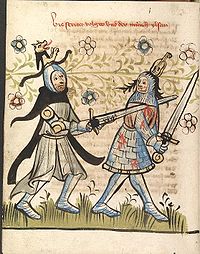
by both men and women. It can either refer to a coat worn over other garments or the outer garment of a person. The name derives from French
French language
French is a Romance language spoken as a first language in France, the Romandy region in Switzerland, Wallonia and Brussels in Belgium, Monaco, the regions of Quebec and Acadia in Canada, and by various communities elsewhere. Second-language speakers of French are distributed throughout many parts...
meaning "over the cotta", a long, wide coat reaching down to the feet without sleeves.
From about the 12th century, knight
Knight
A knight was a member of a class of lower nobility in the High Middle Ages.By the Late Middle Ages, the rank had become associated with the ideals of chivalry, a code of conduct for the perfect courtly Christian warrior....
s wore long and flowing surcoats over their armour
Armour
Armour or armor is protective covering used to prevent damage from being inflicted to an object, individual or a vehicle through use of direct contact weapons or projectiles, usually during combat, or from damage caused by a potentially dangerous environment or action...
, which were frequently emblazoned with the arms
Coat of arms
A coat of arms is a unique heraldic design on a shield or escutcheon or on a surcoat or tabard used to cover and protect armour and to identify the wearer. Thus the term is often stated as "coat-armour", because it was anciently displayed on the front of a coat of cloth...
of the wearer. They usually extended to about mid-calf, had slits in the bottom front and back, and were sleeved or sleeveless. Historians believe that the practice of wearing white surcoats was picked up from the Turks during the crusades, and their purpose was to reflect heat, thus protecting mail
Mail (armour)
Mail is a type of armour consisting of small metal rings linked together in a pattern to form a mesh.-History:Mail was a highly successful type of armour and was used by nearly every metalworking culture....
from direct sun, which heated the mail and the soldier inside. The surcoat also serves in areas of poor weather to keep the rain and muck of battle away from the easily corroded maille-links. The surcoat displayed the device of a knight
Knight
A knight was a member of a class of lower nobility in the High Middle Ages.By the Late Middle Ages, the rank had become associated with the ideals of chivalry, a code of conduct for the perfect courtly Christian warrior....
(origin of "coat of arms
Coat of arms
A coat of arms is a unique heraldic design on a shield or escutcheon or on a surcoat or tabard used to cover and protect armour and to identify the wearer. Thus the term is often stated as "coat-armour", because it was anciently displayed on the front of a coat of cloth...
") which identified him, which, with the rise of the great helm
Great helm
The great helm or heaume, also called pot helm, bucket helm and barrel helm, of the High Middle Ages arose in the late twelfth century in the context of the crusades and remained in use until the fourteenth century...
in the late 12th century and early 13th century, became more and more crucial. Some historians even cite this as a reason behind the spread of heraldry
Heraldry
Heraldry is the profession, study, or art of creating, granting, and blazoning arms and ruling on questions of rank or protocol, as exercised by an officer of arms. Heraldry comes from Anglo-Norman herald, from the Germanic compound harja-waldaz, "army commander"...
across medieval Europe. During the 13th century, knights also began to add plates of armour to the surcoat, the armored surcoat later became the medieval coat of plates
Coat of plates
A coat of plates is a form of torso armour consisting of metal plates sewn or riveted inside a cloth or leather garment. The coat of plates makes a fairly brief appearance in the history of European armour during the era of transitional armour, during a portion of the 14th century...
. In the early fourteenth century, the front of the knight's surcoat was shortened, so it was long at the back, but knee-length at the front. This allowed for easier movement and also eliminated the danger of the knight getting his spurs caught up in the long surcoat. By the mid-fourteenth century the long surcoat was replaced with the "Jupon" (or "Gipon"), a much shorter garment, which was often padded for extra protection.
In the 15th century, once suits of plate armour became common, the surcoat was phased out of use. The period in the history of armour development in which surcoats first generally become rare is referred to as the "surcoatless period" (1420-1485).
Sources
- Nunn, Joan, Fashion in costume, 1200-2000, New Amsterdam Books, 2000, ISBN 156663279X