

Balsfjord

Encyclopedia
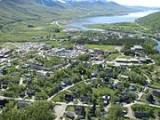
Balsfjord is a municipality
in Troms
county
, Norway
. The administrative centre of the municipality is the village of Storsteinnes
, while Nordkjosbotn
at the head of the fjord is another village.
The municipality consists of two fjords, Malangen and Balsfjorden, surrounded by comparatively rich farmlands under majestic peaks including the southern end of the Lyngen Alps
.
municipality, but it was separated from this in 1860 to form its own municipality. Balsfjord had an initial population of 3,610. On 1 January 1871, Malangen
(population: 1,425) was separated from it, leaving Balsfjord with 2,255 inhabitants. On 1 January 1875, a part of Lyngen
(population: 7) was transferred to Balsfjord. On 1 January 1905, a part of Balsfjord (population: 5) was transferred to Målselv.
On 1 January 1964, most of Balsfjord was merged together with most of neighboring Malangen to form a new, larger municipality of Balsfjord (population: 6,993). Also on that day, the Skogli ved Heia area (population: 2) was transferred to Målselv
and the uninhabited Elvebakken farm was transferred to Storfjord
. On 1 January 1966, the Sørelvmo area of Balsfjord (population: 131) was transferred to Målselv.
Baldr or the Old Norse
word bals meaning lump.
is from modern times. They were granted on 21 November 1986. The arms show a plough
symbolizing the fact that the main source of income in the municipality is agriculture
. The plough also symbolizes that the municipality is at the northernmost border on which grain
can be grown in Norway.
 The Sami people
were the original inhabitants of the area, but around 1800 new settlers came from Southern Norway, from the coast, and from Finland
, and today very few traces of Sami culture survive. From the 18th century until the 20th century, trappers from Balsfjord were active in the Arctic
, hunting in areas from Greenland
to Novaya Zemlya
.
parish in Tromsø
. The mindekirken movement in the Troms region was led by the seminary student, Johannes Andreas Johannessen Bomstad (born at Balsfjord on 23 August 1821), who split from the state church at the age of 28, under the leadership of the first Norwegian mindekirken movement leader, Rev. Lammers from Oslo
. In 1856, Bomstad and his original followers established their own church which they called the "Free Apostolic Christian Church" in Balsfjord.
"Rev. Bomstad" and his followers were said to have struggled and protested against the Tromsø state church minister and the Troms Bishop's religious rulings, eventually leading to a riot
in the town of Tromsø, when state-church members yelled at Bomstad and his fellow dissenters to "go back to Kautokeino (A small village in the most northern districts of Norway)". In 1862, Bomstad led a group of "mindekirken colonists" to America
, traveling first to Bergen
, where they sailed in mid-May 1862 aboard the Sleipner, arriving at the inland port of Chicago
, Illinois
on 2 August 1862. Their voyage was also noteworthy as the first transatlantic voyage sailing directly from Europe
to the port of Chicago (other previous transoceanic ships disembarked first at Quebec
, Canada
.) After arriving in Chicago, the mindekirken colonists traveled overland to the area of St. Peter, Minnesota
, where they remained during the "Dakota War of 1862
".
Rev. Bomstad left St. Peter traveling by mule
to Kandiyohi County, Minnesota
, where near the east bank of a lake (previously called "Lake Lillian"), he became the founding father of Lake Lillian, Minnesota
in May 1864 (one hour ahead of the town's next settler, Mr. O.E. Hart, previously of New York
). After staking his original claim, a month later on 3 June 1864, Rev. Bomstad led the rest of the colonists from St. Peter to their new settlement at Lake Lillian, where they built dugout shelters
to live in that first year (on the site later occupied by the First M.E. Methodist Church of Lake Lillian.) A few months later he and his family finished building and moved into their log cabin home.
. The dairy factory at Storsteinnes is one of the largest producers of the Norwegian brown cheese (brunost
). They also make their own brand of cheese, called Balsfjord, from goat
's milk
.
and European route E8
meet at the village of Nordkjosbotn, making it a major crossroad.
(close to the church), the old trading centre of Nordby, a Sami camp at Heia open over the summer months and the 18th century sawmill
at Aursfjord. There is also a smaller field of rock carvings at Åsli
. The Malangen Brygger resort on the water's edge has opened on the Malangen Peninsula and will expand further in May 2010 when a hotel and conference centre open.
Municipalities of Norway
Norway is divided into 19 administrative regions, called counties , and 430 municipalities...
in Troms
Troms
or Romsa is a county in North Norway, bordering Finnmark to the northeast and Nordland in the southwest. To the south is Norrbotten Län in Sweden and further southeast is a shorter border with Lapland Province in Finland. To the west is the Norwegian Sea...
county
Counties of Norway
Norway is divided into 19 administrative regions, called counties . The counties form the primary first-level subdivisions of Norway and are further divided into 430 municipalities...
, Norway
Norway
Norway , officially the Kingdom of Norway, is a Nordic unitary constitutional monarchy whose territory comprises the western portion of the Scandinavian Peninsula, Jan Mayen, and the Arctic archipelago of Svalbard and Bouvet Island. Norway has a total area of and a population of about 4.9 million...
. The administrative centre of the municipality is the village of Storsteinnes
Storsteinnes
Storsteinnes is the administrative center of the municipality of Balsfjord in Troms county, Norway. Its population of 937 makes it the largest urban area in the municipality.-Location:...
, while Nordkjosbotn
Nordkjosbotn
Nordkjosbotn is a small village in the municipality of Balsfjord in Troms county, Norway about southeast of the city of Tromsø. Its population is 378...
at the head of the fjord is another village.
The municipality consists of two fjords, Malangen and Balsfjorden, surrounded by comparatively rich farmlands under majestic peaks including the southern end of the Lyngen Alps
Lyngen Alps
The Lyngen Alps is a mountain range in northeastern Troms, North Norway, east of Tromsø, mostly in the municipalities of Lyngen and Balsfjord. The mountains follow the western shore of the Lyngen Fjord in a north-south direction...
.
General information
Balsfjord was originally a part of the great Tromsøe landdistriktTromsøysund
Tromsøysund is a former municipality in Troms county in Norway. It is located in the southern and eastern parts of the present-day municipality of Tromsø, including the villages of Tromsdalen and Movik.-History:...
municipality, but it was separated from this in 1860 to form its own municipality. Balsfjord had an initial population of 3,610. On 1 January 1871, Malangen
Malangen
Malangen is a fjord and a former municipality in Troms county in Norway. The fjord is located between the islands of Kvaløya and Senja and the area today is divided between the municipalities of Balsfjord, Lenvik, Tromsø, and Målselv...
(population: 1,425) was separated from it, leaving Balsfjord with 2,255 inhabitants. On 1 January 1875, a part of Lyngen
Lyngen
Lyngen is a municipality and a fjord in Troms county, Norway. The administrative centre of the municipality is the village of Lyngseidet.- General information :...
(population: 7) was transferred to Balsfjord. On 1 January 1905, a part of Balsfjord (population: 5) was transferred to Målselv.
On 1 January 1964, most of Balsfjord was merged together with most of neighboring Malangen to form a new, larger municipality of Balsfjord (population: 6,993). Also on that day, the Skogli ved Heia area (population: 2) was transferred to Målselv
Målselv
Målselv is a municipality in Troms county, Norway. The administrative centre of the municipality is the village of Moen. Some other villages include Andslimoen, Bardufoss, Alappmoen, Holmen, Fossmoen, and Heggelia...
and the uninhabited Elvebakken farm was transferred to Storfjord
Storfjord
Storfjord is a municipality in Troms county, Norway. The administrative centre of the municipality is the village of Hatteng.- General information :...
. On 1 January 1966, the Sørelvmo area of Balsfjord (population: 131) was transferred to Målselv.
Name
The municipality is named after the fjord Balsfjorden . The meaning of the first element is uncertain, but is likely assosciated with the Norse godÆsir
In Old Norse, áss is the term denoting a member of the principal pantheon in Norse paganism. This pantheon includes Odin, Frigg, Thor, Baldr and Tyr. The second pantheon comprises the Vanir...
Baldr or the Old Norse
Old Norse
Old Norse is a North Germanic language that was spoken by inhabitants of Scandinavia and inhabitants of their overseas settlements during the Viking Age, until about 1300....
word bals meaning lump.
Coat-of-arms
The coat-of-armsCoat of arms
A coat of arms is a unique heraldic design on a shield or escutcheon or on a surcoat or tabard used to cover and protect armour and to identify the wearer. Thus the term is often stated as "coat-armour", because it was anciently displayed on the front of a coat of cloth...
is from modern times. They were granted on 21 November 1986. The arms show a plough
Plough
The plough or plow is a tool used in farming for initial cultivation of soil in preparation for sowing seed or planting. It has been a basic instrument for most of recorded history, and represents one of the major advances in agriculture...
symbolizing the fact that the main source of income in the municipality is agriculture
Agriculture
Agriculture is the cultivation of animals, plants, fungi and other life forms for food, fiber, and other products used to sustain life. Agriculture was the key implement in the rise of sedentary human civilization, whereby farming of domesticated species created food surpluses that nurtured the...
. The plough also symbolizes that the municipality is at the northernmost border on which grain
GRAIN
GRAIN is a small international non-profit organisation that works to support small farmers and social movements in their struggles for community-controlled and biodiversity-based food systems. Our support takes the form of independent research and analysis, networking at local, regional and...
can be grown in Norway.
History
Sami people
The Sami people, also spelled Sámi, or Saami, are the arctic indigenous people inhabiting Sápmi, which today encompasses parts of far northern Sweden, Norway, Finland, the Kola Peninsula of Russia, and the border area between south and middle Sweden and Norway. The Sámi are Europe’s northernmost...
were the original inhabitants of the area, but around 1800 new settlers came from Southern Norway, from the coast, and from Finland
Finland
Finland , officially the Republic of Finland, is a Nordic country situated in the Fennoscandian region of Northern Europe. It is bordered by Sweden in the west, Norway in the north and Russia in the east, while Estonia lies to its south across the Gulf of Finland.Around 5.4 million people reside...
, and today very few traces of Sami culture survive. From the 18th century until the 20th century, trappers from Balsfjord were active in the Arctic
Arctic
The Arctic is a region located at the northern-most part of the Earth. The Arctic consists of the Arctic Ocean and parts of Canada, Russia, Greenland, the United States, Norway, Sweden, Finland, and Iceland. The Arctic region consists of a vast, ice-covered ocean, surrounded by treeless permafrost...
, hunting in areas from Greenland
Greenland
Greenland is an autonomous country within the Kingdom of Denmark, located between the Arctic and Atlantic Oceans, east of the Canadian Arctic Archipelago. Though physiographically a part of the continent of North America, Greenland has been politically and culturally associated with Europe for...
to Novaya Zemlya
Novaya Zemlya
Novaya Zemlya , also known in Dutch as Nova Zembla and in Norwegian as , is an archipelago in the Arctic Ocean in the north of Russia and the extreme northeast of Europe, the easternmost point of Europe lying at Cape Flissingsky on the northern island...
.
Mindekirken movement
According to the book Tromsø City History written by Nils Andreas Ytreberg (1896–1987) (published in Norwegian), during the mid-19th century, Balsfjord became the religious home of a group of "mindekirken" or "freechurch dissenters" who split from the state churchChurch of Norway
The Church of Norway is the state church of Norway, established after the Lutheran reformation in Denmark-Norway in 1536-1537 broke the ties to the Holy See. The church confesses the Lutheran Christian faith...
parish in Tromsø
Tromsø
Tromsø is a city and municipality in Troms county, Norway. The administrative centre of the municipality is the city of Tromsø.Tromsø city is the ninth largest urban area in Norway by population, and the seventh largest city in Norway by population...
. The mindekirken movement in the Troms region was led by the seminary student, Johannes Andreas Johannessen Bomstad (born at Balsfjord on 23 August 1821), who split from the state church at the age of 28, under the leadership of the first Norwegian mindekirken movement leader, Rev. Lammers from Oslo
Oslo
Oslo is a municipality, as well as the capital and most populous city in Norway. As a municipality , it was established on 1 January 1838. Founded around 1048 by King Harald III of Norway, the city was largely destroyed by fire in 1624. The city was moved under the reign of Denmark–Norway's King...
. In 1856, Bomstad and his original followers established their own church which they called the "Free Apostolic Christian Church" in Balsfjord.
"Rev. Bomstad" and his followers were said to have struggled and protested against the Tromsø state church minister and the Troms Bishop's religious rulings, eventually leading to a riot
Riot
A riot is a form of civil disorder characterized often by what is thought of as disorganized groups lashing out in a sudden and intense rash of violence against authority, property or people. While individuals may attempt to lead or control a riot, riots are thought to be typically chaotic and...
in the town of Tromsø, when state-church members yelled at Bomstad and his fellow dissenters to "go back to Kautokeino (A small village in the most northern districts of Norway)". In 1862, Bomstad led a group of "mindekirken colonists" to America
United States
The United States of America is a federal constitutional republic comprising fifty states and a federal district...
, traveling first to Bergen
Bergen
Bergen is the second largest city in Norway with a population of as of , . Bergen is the administrative centre of Hordaland county. Greater Bergen or Bergen Metropolitan Area as defined by Statistics Norway, has a population of as of , ....
, where they sailed in mid-May 1862 aboard the Sleipner, arriving at the inland port of Chicago
Chicago
Chicago is the largest city in the US state of Illinois. With nearly 2.7 million residents, it is the most populous city in the Midwestern United States and the third most populous in the US, after New York City and Los Angeles...
, Illinois
Illinois
Illinois is the fifth-most populous state of the United States of America, and is often noted for being a microcosm of the entire country. With Chicago in the northeast, small industrial cities and great agricultural productivity in central and northern Illinois, and natural resources like coal,...
on 2 August 1862. Their voyage was also noteworthy as the first transatlantic voyage sailing directly from Europe
Europe
Europe is, by convention, one of the world's seven continents. Comprising the westernmost peninsula of Eurasia, Europe is generally 'divided' from Asia to its east by the watershed divides of the Ural and Caucasus Mountains, the Ural River, the Caspian and Black Seas, and the waterways connecting...
to the port of Chicago (other previous transoceanic ships disembarked first at Quebec
Quebec
Quebec or is a province in east-central Canada. It is the only Canadian province with a predominantly French-speaking population and the only one whose sole official language is French at the provincial level....
, Canada
Canada
Canada is a North American country consisting of ten provinces and three territories. Located in the northern part of the continent, it extends from the Atlantic Ocean in the east to the Pacific Ocean in the west, and northward into the Arctic Ocean...
.) After arriving in Chicago, the mindekirken colonists traveled overland to the area of St. Peter, Minnesota
St. Peter, Minnesota
St. Peter is a city in Nicollet County, Minnesota, United States. The population was 11,196 at the 2010 census. It is the county seat of Nicollet County.St...
, where they remained during the "Dakota War of 1862
Dakota War of 1862
The Dakota War of 1862, also known as the Sioux Uprising, was an armed conflict between the United States and several bands of the eastern Sioux. It began on August 17, 1862, along the Minnesota River in southwest Minnesota...
".
Rev. Bomstad left St. Peter traveling by mule
Mule
A mule is the offspring of a male donkey and a female horse. Horses and donkeys are different species, with different numbers of chromosomes. Of the two F1 hybrids between these two species, a mule is easier to obtain than a hinny...
to Kandiyohi County, Minnesota
Kandiyohi County, Minnesota
Kandiyohi County is a county located in the U.S. state of Minnesota. As of 2010, its population was 42,239. Its county seat is Willmar.- History :...
, where near the east bank of a lake (previously called "Lake Lillian"), he became the founding father of Lake Lillian, Minnesota
Lake Lillian, Minnesota
Lake Lillian is a city in Kandiyohi County, Minnesota, United States. The population was 238 at the 2010 census.-Geography:According to the United States Census Bureau, the city has a total area of , all of it land....
in May 1864 (one hour ahead of the town's next settler, Mr. O.E. Hart, previously of New York
New York
New York is a state in the Northeastern region of the United States. It is the nation's third most populous state. New York is bordered by New Jersey and Pennsylvania to the south, and by Connecticut, Massachusetts and Vermont to the east...
). After staking his original claim, a month later on 3 June 1864, Rev. Bomstad led the rest of the colonists from St. Peter to their new settlement at Lake Lillian, where they built dugout shelters
Dugout (shelter)
A dugout or dug-out, also known as a pithouse, pit-house, earth lodge, mud hut, is a shelter for humans or domesticated animals and livestock based on a hole or depression dug into the ground. These structures are one of the most ancient types of human housing known to archeologists...
to live in that first year (on the site later occupied by the First M.E. Methodist Church of Lake Lillian.) A few months later he and his family finished building and moved into their log cabin home.
Economy
Farming is the single most important industry, although there is also some manufacturingManufacturing
Manufacturing is the use of machines, tools and labor to produce goods for use or sale. The term may refer to a range of human activity, from handicraft to high tech, but is most commonly applied to industrial production, in which raw materials are transformed into finished goods on a large scale...
. The dairy factory at Storsteinnes is one of the largest producers of the Norwegian brown cheese (brunost
Brunost
Brunost , or mesost , mysuostur or myseost is a brown Scandinavian whey cheese. The Norwegian name brunost means brown cheese, and the others mean simply whey cheese...
). They also make their own brand of cheese, called Balsfjord, from goat
Goat
The domestic goat is a subspecies of goat domesticated from the wild goat of southwest Asia and Eastern Europe. The goat is a member of the Bovidae family and is closely related to the sheep as both are in the goat-antelope subfamily Caprinae. There are over three hundred distinct breeds of...
's milk
Milk
Milk is a white liquid produced by the mammary glands of mammals. It is the primary source of nutrition for young mammals before they are able to digest other types of food. Early-lactation milk contains colostrum, which carries the mother's antibodies to the baby and can reduce the risk of many...
.
Transportation
European route E6European route E6
European route E 6 is the designation for the main north-south road in Norway, and the west coast of Sweden, running from the southern tip of Sweden, at Trelleborg, into Norway and through almost all of the country north to Finnmark. The route ends close to the Norwegian border with Russia...
and European route E8
European route E8
The European route E 8 is a European route that goes from Tromsø, Norway to Turku, Finland. The length of the route is .* E 8: Tromsø – Nordkjosbotn – Skibotn – Kilpisjärvi – Kaaresuvanto – Muonio – Tornio – Keminmaa – Kemi – Oulu – Liminka – Raahe – Kalajoki – Kokkola – Vaasa – Pori –...
meet at the village of Nordkjosbotn, making it a major crossroad.
Attractions
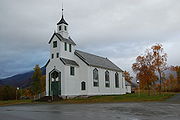
Apart from the impressive scenery, attractions include the 6000 year old rock carvings at TennesRock carvings at Tennes
Rock carvings at Tennes in Balsfjord, Troms county, Norway comprise figures of prehistoric rock art . The oldest figures have been dated to 4600 before the Current Era and the earliest to about 2600 BCE...
(close to the church), the old trading centre of Nordby, a Sami camp at Heia open over the summer months and the 18th century sawmill
Sawmill
A sawmill is a facility where logs are cut into boards.-Sawmill process:A sawmill's basic operation is much like those of hundreds of years ago; a log enters on one end and dimensional lumber exits on the other end....
at Aursfjord. There is also a smaller field of rock carvings at Åsli
Rock carvings at Åsli
The rock carvings at Åsli in Malangen in Balsfjord municipality in Norway comprise at least 15 figures in poor condition. The figures are from a hunting culture.-The rock carvings:...
. The Malangen Brygger resort on the water's edge has opened on the Malangen Peninsula and will expand further in May 2010 when a hotel and conference centre open.
External links
- Municipal fact sheet from Statistics NorwayStatistics NorwayStatistics Norway is the Norwegian statistics bureau. It was established in 1876.Relying on a staff of about 1,000, Statistics Norway publish about 1,000 new statistical releases every year on its web site. All releases are published both in Norwegian and English...