

Lyngen

Encyclopedia
Lyngen is a municipality
and a fjord
in Troms
county
, Norway
. The administrative centre of the municipality is the village of Lyngseidet
.
). On 1 January 1867, the Sørfjorden part of Karlsøy
municipality (population: 862) was transferred to Lyngen. Then on 1 January 1875, a small part of Lyngen (population: 7) was transferred to Balsfjord
. On 1 January 1902, the Sørfjorden area (population: 1,139) was separated from Lyngen to form a new municipality, which later was re-named Ullsfjord
.
In 1929, the southern part of Lyngen (population: 1,499) was separated from Lyngen to become the new municipality of Storfjord
, and the eastern part of Lyngen on the mainland (population: 2,482) was separated from Lyngen to become the new municipality of Kåfjord
. These changes left Lyngen with 2,225 residents.
On 1 January 1964, the northern part of the Lyngen peninsula
in Karlsøy municipality (population: 1,001) and the Svensby area of Ullsfjord (population: 171) were merged together with Lyngen. Then on 1 January 1992, the Nordnes area of Lyngen (population: 38) was transferred to the neighboring municipalities of Kåfjord and Storfjord.
: Lygnir). The name of the fjord is derived from the word logn which means "quiet, still, or calm".
is from modern times (1987). The arms show a black horse
of the local breed (Lyngshest) on a silver background. The silver color symbolizes the sea and fishing
industry and the horse represents the local agriculture
.
(See also the coat-of-arms for Eid
, Gloppen
, Levanger
, Nord-Fron
, Skedsmo
and Ski
.)
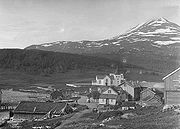 The Lyngen church was built at Karnes in 1731, and was moved to its present location at Lyngseidet in 1740. In 1775 the church was rebuilt in its current cross shape, with the material from the old church used for a boathouse in Oldervik. Finally in 1840–1845, the church was renovated with a new tower, galleries, windows and panelling.
Other interesting buildings include the large wooden school in Solhov, which was built in 1924 to strengthen the Norwegian influence in this area which was largely populated by the Sami
and Kven people.
During the Cold war the Norwegian Army planned to abandon Finnmark and halt the Soviets along the E6 highway at the choke point between the Lyngen fjord and the mountains. However, there were always great worries that the Soviets would also advance through Finland and the very sparsely defended extreme north of Sweden (north of Kiruna, south of Treriksröset) and attack the Lyngen position from the rear via Signaldalen.
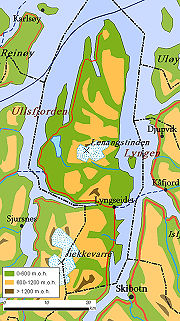 The municipality is situated on the Lyngen peninsula, with the Lyngen (fjord) to the east and Ullsfjord to the west. The municipal centre is Lyngseidet, a pretty settlement on an isthmus
that almost cuts the peninsula in the middle. Other villages include Furuflaten
, which has various industries, and Svensby. Nord-Lenangen faces the open sea, and is largely a fishing village. The municipality has its own shipping company, operating the car ferries west to Breivikeidet in Tromsø
and east to Olderdalen in Kåfjord meeting European route E6
. There is also a road going south along the shore of the fjord connecting to the main E6 road, giving ferry
-free access to the main road network.
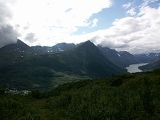
The Lyngen peninsula is a very scenic and mountainous area, known as the Lyngen Alps
, with the highest peaks in Troms county. The highest peak is Jiehkkevárri
, reaching 1833 metres (6,014 ft). Another prominent mountain is Store Lenangstind
. The Lyngen Alps are presently being discovered by off-piste skiers
from around the world.
 Winters in Lyngen are long and snow
-rich, but not very cold considering the very northerly latitude
. Average 24-hr temperatures are below freezing from November to early April, with a January average of -4.5 C. May is cool, with an average of 5.5 °C (42 °F); summer temperatures usually arrives in June. July is the warmest month with 24-hr average of 12.5 °C (55 °F); August's average is 11.6 °C (53 °F) and October's is 3.5 °C (38 °F). The average annual precipitation
varies from 500 millimetres (19.7 in) in Lyngseidet (half that of Tromsø) to 950 millimetres (37.4 in) in the northern part of the peninsula (Nord-Lenangen).
Spring often sees much sunshine and is the driest season; average monthly precipitation is approximately 30 millimetres (1.2 in) from March to June, while October is the wettest month. In the mountains of the Lyngen Alps, the average temperatures typically remain below freezing from October to May, and snow accumulation can exceed 5 metres (16.4 ft).
Municipalities of Norway
Norway is divided into 19 administrative regions, called counties , and 430 municipalities...
and a fjord
Fjord
Geologically, a fjord is a long, narrow inlet with steep sides or cliffs, created in a valley carved by glacial activity.-Formation:A fjord is formed when a glacier cuts a U-shaped valley by abrasion of the surrounding bedrock. Glacial melting is accompanied by rebound of Earth's crust as the ice...
in Troms
Troms
or Romsa is a county in North Norway, bordering Finnmark to the northeast and Nordland in the southwest. To the south is Norrbotten Län in Sweden and further southeast is a shorter border with Lapland Province in Finland. To the west is the Norwegian Sea...
county
Counties of Norway
Norway is divided into 19 administrative regions, called counties . The counties form the primary first-level subdivisions of Norway and are further divided into 430 municipalities...
, Norway
Norway
Norway , officially the Kingdom of Norway, is a Nordic unitary constitutional monarchy whose territory comprises the western portion of the Scandinavian Peninsula, Jan Mayen, and the Arctic archipelago of Svalbard and Bouvet Island. Norway has a total area of and a population of about 4.9 million...
. The administrative centre of the municipality is the village of Lyngseidet
Lyngseidet
Lyngseidet is the administrative centre of the municipality of Lyngen in Troms county, Norway. The population is 846. The town is located on an isthmus that is about wide....
.
General information
Lyngen was established as a municipality on 1 January 1838 (see formannskapsdistriktFormannskapsdistrikt
Formannskapsdistrikt was the name for a Norwegian local self-government districts put into force in 1838. This system of municipality was created in a bill approved by the Storting and signed into law by King Carl Johan on 14 January 1837...
). On 1 January 1867, the Sørfjorden part of Karlsøy
Karlsøy
Karlsøy is a municipality in Troms county, Norway. The administrative centre of the municipality is the village of Hansnes. Karlsøy is also the name of a village on Karlsøya island in the municipality of Karlsøy. The village of Karlsøy had a population of 70.- General information :Karlsøy was...
municipality (population: 862) was transferred to Lyngen. Then on 1 January 1875, a small part of Lyngen (population: 7) was transferred to Balsfjord
Balsfjord
Balsfjord is a municipality in Troms county, Norway. The administrative centre of the municipality is the village of Storsteinnes, while Nordkjosbotn at the head of the fjord is another village....
. On 1 January 1902, the Sørfjorden area (population: 1,139) was separated from Lyngen to form a new municipality, which later was re-named Ullsfjord
Ullsfjord
Ullsfjord is a former municipality in Troms county in Norway. It is located in the eastern part of the present-day municipality of Tromsø and also the southwestern part of Lyngen. It is also the name of a fjord east of Tromsø and west of Lyngen.-Name:...
.
In 1929, the southern part of Lyngen (population: 1,499) was separated from Lyngen to become the new municipality of Storfjord
Storfjord
Storfjord is a municipality in Troms county, Norway. The administrative centre of the municipality is the village of Hatteng.- General information :...
, and the eastern part of Lyngen on the mainland (population: 2,482) was separated from Lyngen to become the new municipality of Kåfjord
Kåfjord
Gáivuotna or Kåfjord , is a municipality in Troms county, Norway. The administrative centre of the municipality is the village of Olderdalen.- General information :...
. These changes left Lyngen with 2,225 residents.
On 1 January 1964, the northern part of the Lyngen peninsula
Peninsula
A peninsula is a piece of land that is bordered by water on three sides but connected to mainland. In many Germanic and Celtic languages and also in Baltic, Slavic and Hungarian, peninsulas are called "half-islands"....
in Karlsøy municipality (population: 1,001) and the Svensby area of Ullsfjord (population: 171) were merged together with Lyngen. Then on 1 January 1992, the Nordnes area of Lyngen (population: 38) was transferred to the neighboring municipalities of Kåfjord and Storfjord.
Name
The municipality is named after the Lyngen fjord (Old NorseOld Norse
Old Norse is a North Germanic language that was spoken by inhabitants of Scandinavia and inhabitants of their overseas settlements during the Viking Age, until about 1300....
: Lygnir). The name of the fjord is derived from the word logn which means "quiet, still, or calm".
Coat-of-arms
The coat-of-armsCoat of arms
A coat of arms is a unique heraldic design on a shield or escutcheon or on a surcoat or tabard used to cover and protect armour and to identify the wearer. Thus the term is often stated as "coat-armour", because it was anciently displayed on the front of a coat of cloth...
is from modern times (1987). The arms show a black horse
Horse
The horse is one of two extant subspecies of Equus ferus, or the wild horse. It is a single-hooved mammal belonging to the taxonomic family Equidae. The horse has evolved over the past 45 to 55 million years from a small multi-toed creature into the large, single-toed animal of today...
of the local breed (Lyngshest) on a silver background. The silver color symbolizes the sea and fishing
Fishing
Fishing is the activity of trying to catch wild fish. Fish are normally caught in the wild. Techniques for catching fish include hand gathering, spearing, netting, angling and trapping....
industry and the horse represents the local agriculture
Agriculture
Agriculture is the cultivation of animals, plants, fungi and other life forms for food, fiber, and other products used to sustain life. Agriculture was the key implement in the rise of sedentary human civilization, whereby farming of domesticated species created food surpluses that nurtured the...
.
(See also the coat-of-arms for Eid
Eid, Norway
Eid is a municipality in the county of Sogn og Fjordane, Norway. It is located in the traditional district of Nordfjord. The village of Nordfjordeid is the administrative center of the municipality. Other larger villages are Mogrenda, Stårheim, Haugen, Kjølsdalen, Heggjabygda, and LoteEid is...
, Gloppen
Gloppen
Gloppen is a municipality in the county of Sogn og Fjordane, Norway. It is located in the traditional district of Nordfjord. Gloppen is generally subdivided into three areas: Hyen in the west, Gloppen in the center, and Breim in the east. Each of the areas have their own main service centres. ...
, Levanger
Levanger
Levanger is a town and municipality in Nord-Trøndelag county, Norway. It is part of the Innherred region. The administrative centre of the municipality is the town of Levanger...
, Nord-Fron
Nord-Fron
Nord-Fron is a municipality in Oppland county, Norway. It is part of the traditional region of Gudbrandsdal. The administrative centre of the municipality is the village of Vinstra. The old municipality of Fron was divided into Nord-Fron and Sør-Fron in 1851...
, Skedsmo
Skedsmo
Skedsmo is a municipality in Akershus county, Norway. It is part of the traditional region of Romerike. The administrative centre of the municipality is the town of Lillestrøm. About one third of the municipal population lives in Lillestrøm. Other important towns are Skedsmokorset, Skjetten and...
and Ski
Ski
A ski is a long, flat device worn on the foot, usually attached through a boot, designed to help the wearer slide smoothly over snow. Originally intended as an aid to travel in snowy regions, they are now mainly used for recreational and sporting purposes...
.)
History
Other interesting buildings include the large wooden school in Solhov, which was built in 1924 to strengthen the Norwegian influence in this area which was largely populated by the Sami
Sami people
The Sami people, also spelled Sámi, or Saami, are the arctic indigenous people inhabiting Sápmi, which today encompasses parts of far northern Sweden, Norway, Finland, the Kola Peninsula of Russia, and the border area between south and middle Sweden and Norway. The Sámi are Europe’s northernmost...
and Kven people.
During the Cold war the Norwegian Army planned to abandon Finnmark and halt the Soviets along the E6 highway at the choke point between the Lyngen fjord and the mountains. However, there were always great worries that the Soviets would also advance through Finland and the very sparsely defended extreme north of Sweden (north of Kiruna, south of Treriksröset) and attack the Lyngen position from the rear via Signaldalen.
Geography
Isthmus
An isthmus is a narrow strip of land connecting two larger land areas usually with waterforms on either side.Canals are often built through isthmuses where they may be particularly advantageous to create a shortcut for marine transportation...
that almost cuts the peninsula in the middle. Other villages include Furuflaten
Furuflaten
Furuflaten is a village in the municipality of Lyngen in Troms county, Norway. Its population is 243. The village is located along the Lyngen fjord. Furuflaten is located at the mouth of the Lyngsdalselva river, about south of Lyngseidet, and about straight southeast of the city of Tromsø....
, which has various industries, and Svensby. Nord-Lenangen faces the open sea, and is largely a fishing village. The municipality has its own shipping company, operating the car ferries west to Breivikeidet in Tromsø
Tromsø
Tromsø is a city and municipality in Troms county, Norway. The administrative centre of the municipality is the city of Tromsø.Tromsø city is the ninth largest urban area in Norway by population, and the seventh largest city in Norway by population...
and east to Olderdalen in Kåfjord meeting European route E6
European route E6
European route E 6 is the designation for the main north-south road in Norway, and the west coast of Sweden, running from the southern tip of Sweden, at Trelleborg, into Norway and through almost all of the country north to Finnmark. The route ends close to the Norwegian border with Russia...
. There is also a road going south along the shore of the fjord connecting to the main E6 road, giving ferry
Ferry
A ferry is a form of transportation, usually a boat, but sometimes a ship, used to carry primarily passengers, and sometimes vehicles and cargo as well, across a body of water. Most ferries operate on regular, frequent, return services...
-free access to the main road network.
The Lyngen peninsula is a very scenic and mountainous area, known as the Lyngen Alps
Lyngen Alps
The Lyngen Alps is a mountain range in northeastern Troms, North Norway, east of Tromsø, mostly in the municipalities of Lyngen and Balsfjord. The mountains follow the western shore of the Lyngen Fjord in a north-south direction...
, with the highest peaks in Troms county. The highest peak is Jiehkkevárri
Jiehkkevárri
Jiehkkevárri is a mountain on the border of the municipalities of Lyngen and Tromsø in Troms county, Norway. It is the highest mountain in Troms county and has the second highest prominence among Norwegian mountains.It was first climbed by Geoffrey Hastings and Elias Hogrenning in 1899...
, reaching 1833 metres (6,014 ft). Another prominent mountain is Store Lenangstind
Store Lenangstind
Store Lenangstind is a mountain in Lyngen, Troms, Norway. It is within the Lyngen Alps mountain range and has the fourth highest primary factor in Norway. It's located about northwest of the village of Lyngseidet....
. The Lyngen Alps are presently being discovered by off-piste skiers
Backcountry skiing
Backcountry skiing is skiing in a sparsely inhabited rural region over ungroomed and unmarked slopes or pistes, including skiing in unmarked or unpatrolled areas either within the ski resort's boundaries or in the backcountry, frequently amongst trees , usually in pursuit of fresh fallen powder...
from around the world.
Climate
Snow
Snow is a form of precipitation within the Earth's atmosphere in the form of crystalline water ice, consisting of a multitude of snowflakes that fall from clouds. Since snow is composed of small ice particles, it is a granular material. It has an open and therefore soft structure, unless packed by...
-rich, but not very cold considering the very northerly latitude
Latitude
In geography, the latitude of a location on the Earth is the angular distance of that location south or north of the Equator. The latitude is an angle, and is usually measured in degrees . The equator has a latitude of 0°, the North pole has a latitude of 90° north , and the South pole has a...
. Average 24-hr temperatures are below freezing from November to early April, with a January average of -4.5 C. May is cool, with an average of 5.5 °C (42 °F); summer temperatures usually arrives in June. July is the warmest month with 24-hr average of 12.5 °C (55 °F); August's average is 11.6 °C (53 °F) and October's is 3.5 °C (38 °F). The average annual precipitation
Precipitation (meteorology)
In meteorology, precipitation In meteorology, precipitation In meteorology, precipitation (also known as one of the classes of hydrometeors, which are atmospheric water phenomena is any product of the condensation of atmospheric water vapor that falls under gravity. The main forms of precipitation...
varies from 500 millimetres (19.7 in) in Lyngseidet (half that of Tromsø) to 950 millimetres (37.4 in) in the northern part of the peninsula (Nord-Lenangen).
Spring often sees much sunshine and is the driest season; average monthly precipitation is approximately 30 millimetres (1.2 in) from March to June, while October is the wettest month. In the mountains of the Lyngen Alps, the average temperatures typically remain below freezing from October to May, and snow accumulation can exceed 5 metres (16.4 ft).
External links
- Municipal fact sheet from Statistics NorwayStatistics NorwayStatistics Norway is the Norwegian statistics bureau. It was established in 1876.Relying on a staff of about 1,000, Statistics Norway publish about 1,000 new statistical releases every year on its web site. All releases are published both in Norwegian and English...