

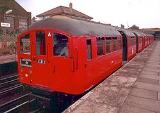
Bakerloo Line

Encyclopedia
The Bakerloo line is a line of the London Underground
, coloured brown on the Tube map
. It runs partly on the surface and partly at deep level, from Elephant and Castle
in the south-east to Harrow & Wealdstone in the north-west of London. The line serves 25 stations, of which 15 are underground. Its name comes from the fact that its route serves Baker Street
and Waterloo
.
The route had its origins in the failed projects of the pneumatic 1865 Waterloo and Whitehall Railway
and the 1882 Charing Cross and Waterloo Electric Railway.
Originally called the Baker Street & Waterloo Railway, the line was constructed by the Underground Electric Railways Company of London
(UERL) and opened between Baker Street
and Lambeth North
(then called Kennington Road) on 10 March 1906. It was extended to Elephant & Castle five months later, on 5 August. The contraction of the name to "Bakerloo" rapidly caught on, and the official name was changed to match in July 1906.
When work on the line started in June 1898, it had been financed by the mining entrepreneur and company promoter Whitaker Wright
, who fell foul of the law over the financial proceedings involved and dramatically committed suicide at the Royal Courts of Justice
, after being convicted in 1904. As a result, work on the line was stopped for a few months and did not resume until Charles Yerkes
and UERL stepped in and took over the project.
By 1913, the line had been extended from its original northern terminus at Baker Street
to the west with interchange station
s with the Great Central Railway
at Marylebone
and the Great Western Railway
at Paddington, and a new station at Edgware Road
.
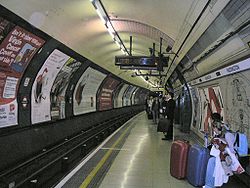 In 1915 the line was extended further to Queen's Park
, where it joined the DC
lines of the London and North Western Railway
(LNWR) that ran alongside the LNWR's main line (now the West Coast Main Line
) as far as Watford Junction
. Bakerloo services to Watford
were reduced in the 1960s and withdrawn in 1982, with Stonebridge Park
the new terminus.
Services to Harrow & Wealdstone were gradually restored from 1984 and in 1989 the present all-day service was instituted. Bakerloo trains share the tracks with London Overground
Watford DC Line
services from Euston
between Queen's Park and Harrow & Wealdstone.
was suffering from congestion caused by the limited capacity of its tracks between Baker Street and Finchley Road
stations. To relieve this pressure, the network-wide New Works Programme, 1935-1940
included the construction of new sections of tunnel between the Bakerloo line's platforms at Baker Street and Finchley Road and the replacement of three Metropolitan line stations (Lord's
, Marlborough Road
and Swiss Cottage
) between those points with two new Bakerloo stations (St. John's Wood
and Swiss Cottage
). The Bakerloo line took over the Metropolitan line's service to Stanmore
on 20 November 1939. The branch remained part of the Bakerloo line until 1 May 1979, when similar congestion problems for the Bakerloo line caused by two branches converging at Baker Street led to the opening of the Jubilee line
, initially created by connecting the Stanmore branch to new tunnels bored between Baker Street and Charing Cross
.
and Denmark Hill
was proposed and approved in 1931 as part of the London Electric Metropolitan District and Central London Railway Companies (Works) Act, 1931. In April 1937, the estimated cost of the extension was £5,000,000 (approximately £ today) and the London Passenger Transport Board
announced that, due to rising materials prices, the extension was postponed until the Board's finances improved. Apart from the extension of the sidings south of Elephant & Castle
no work on the extension took place before the Second World War
, but the powers were renewed by the government in 1947 under the Special Enactments (Extension of Time) Act, 1940. A projected extension as far as Camberwell
was shown on a 1949 edition of the Underground map but no further work was done. The train describers at Warwick Avenue
station showed Camberwell as a destination until the 1990s.
s reversed, the outside rail negative and the centre rail positive. This came about because the Bakerloo shared a power source with the District Railway
. On the Bakerloo, the outside conductor rail tended to leak to the tunnel wall, whereas on the District Railway, the centre rail shared a similar problem. The solution was to reverse the polarity on the Bakerloo line, so that the negative rail leaked on both systems. In 1917, the two lines were separated when the LNWR began its 'New Line' service between Euston and Watford Junction, which the Bakerloo would share north of Queens Park. As a result, normal operation was restored.
) from the Department for Transport
(DfT) to Transport for London
(TfL). This was in conjunction with the reorganisation of a number of north London railways under London Overground
.
Under a former London Plan it was projected that by 2026 the Bakerloo Line would be re-extended from Harrow & Wealdstone to Watford Junction, restoring the pre-1982 service. The railway line from Queens Park to Watford Junction, currently served by London Overground, would then be served only by the Bakerloo Line. The restoration of Bakerloo Line service to Watford Junction could coincide with the Croxley Rail Link
reopening, which would reroute Metropolitan line
trains from Watford
to Watford Junction.
, Ken Livingstone
, suggested that an extension was being considered within 20 years. However, there are no firm commitments to this extension and it is only at the proposal stage. TfL's "Transport T2025 - Transport Vision for a growing world city" investment programme identifies the ambition to separate the present Northern line
into two self-contained lines by 2025. In this plan, trains on the Northern line's Charing Cross branch would terminate at Kennington
, and it has been mooted that an extension of the line to the south east may be implemented, including to Camberwell. In this scenario, an extension to the Bakerloo line would therefore no longer be required. However, recent plans are instead to extend this Northern line branch towards Battersea via two new stations at Nine Elms
and Battersea Power Station
, meaning that the Bakerloo would once more be looked to provide any extension to Camberwell.
mentions the possibility of extending the Bakerloo line from Elephant & Castle to Lewisham station
and then taking over the Hayes branch line
. Network Rail states that this would free up four paths per hour into central London
and so increase capacity on the Tonbridge main line, which would also relieve the junctions around Lewisham station. However, it states that this would not be undertaken until after 2015.
A study by Lewisham
Council in September 2010 investigated possible extensions to Canary Wharf, Charlton, Peckham, Blackheath, Catford, Slade Green and Hayes.
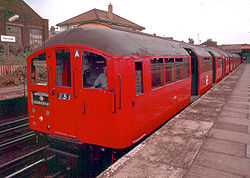 When opened in 1906, the Bakerloo line was operated by Gate Stock
trains, built at Trafford Park
, Manchester
. To cope with the extension to Queen's Park, 12 extra motor cars of the London Underground 1914 Stock
were ordered, ten from Brush
of Loughborough
and two from the Leeds Forge Company
.
To operate services north of Queen's Park, 72 additional cars were built by the Metropolitan Carriage, Waggon and Finance Company
of Birmingham
. These trains, known as the Watford Joint Stock
, were partly owned by the Underground and partly by the London and North Western Railway (later London, Midland and Scottish Railway
(LMS)). They were initially painted in LNWR livery. They were not equipped with air-operated doors and proved slow and unreliable, so they were replaced by new trains of Standard Stock
in 1930 (although a few were retained by the LMS). For some years in the 1930s Watford trains had a distinctive blue stripe at window level.
In 1932, some carriages that had been built for the Piccadilly line
by Cammell Laird in Nottingham
in 1919 were transferred to the Bakerloo line. When built, these had been the first Tube trains to be have air-operated doors. These (and other trains) were later replaced by more trains of Standard Stock, in turn being replaced by 1938 stock
and 1949 stock
.
Prior to the opening of the Jubilee line in 1979, the Bakerloo line was worked by both 1938 stock and 1972 stock
. The 1972 stock was intended for the Jubilee line, so from 1979 the Bakerloo line (now minus the Stanmore branch) was again entirely operated by 1938 stock. From 1983 the 1938 stock began to be replaced by trains of 1959 stock
, but this was a temporary measure until 1972 stock became available. The last 1938 stock train was withdrawn on 20 November 1985. From 1986, the 1959 stock was transferred to the Northern line.
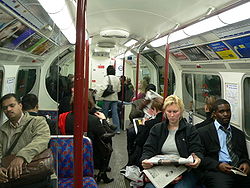 The Bakerloo line is now operated entirely by Mark 2 1972 stock, displaced from the Jubilee line by 1983 stock
. The stock is maintained at Stonebridge Park depot.
All Bakerloo line trains are painted in the distinctive London Underground livery of red, white and blue and are the smaller size of the two sizes used on the network, since the line goes deep underground in small tunnels.
In the early 2000s the interiors of these trains were 'deep-cleaned' and the upholstery replaced using a blue moquette
. The seating layouts are both longitudinal and transverse, with some cars having longitudinal seating only.
Transport for London states that the line is to be fully upgraded, with completion in 2020, and this will include the introduction of new trains, new signalling and a new control centre. Journey times should be reduced by two minutes and overall line capacity increased by 57%.
article.
branch was originally constructed by the Metropolitan Railway
(now the Metropolitan line) and was designated as the Stanmore branch of the Bakerloo Line in 1939. It was transferred to the Jubilee line on 1 May 1979. It connected to the main Bakerloo Line at Baker Street.
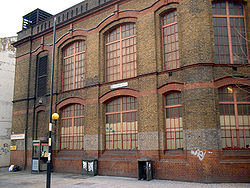 The Bakerloo line is currently served by three depots; a main depot at Stonebridge Park
, opened on 9 April 1978 on the site of a former British Rail
power station which contains the fleet's maintenance facilities, the original depot at London Road
(between the Elephant and Castle and Lambeth North), and a small depot immediately north of Queens Park
, built in 1915. The Queens Park depot is unique on the London Underground network in that trains in passenger service run through it.
When Bakerloo line services ran to Watford, there was also an additional depot at Croxley Green
; this depot closed in November 1985 following the withdrawal of services.
London Underground
The London Underground is a rapid transit system serving a large part of Greater London and some parts of Buckinghamshire, Hertfordshire and Essex in England...
, coloured brown on the Tube map
Tube map
The Tube map is a schematic transit map representing the lines and stations of London's rapid transit railway systems, namely the London Underground , the Docklands Light Railway and London Overground....
. It runs partly on the surface and partly at deep level, from Elephant and Castle
Elephant and Castle
The Elephant and Castle is a major road intersection in south London, England, located in the London Borough of Southwark. It is also used as a name for the surrounding area....
in the south-east to Harrow & Wealdstone in the north-west of London. The line serves 25 stations, of which 15 are underground. Its name comes from the fact that its route serves Baker Street
Baker Street
Baker Street is a street in the Marylebone district of the City of Westminster in London. It is named after builder William Baker, who laid the street out in the 18th century. The street is most famous for its connection to the fictional detective Sherlock Holmes, who lived at a fictional 221B...
and Waterloo
Waterloo, London
Waterloo is a district of London, England, and part of the London Borough of Lambeth. It is situated east of Charing Cross. The area is part of a business improvement district known as Waterloo Quarter, which includes The Cut and the Old Vic and Young Vic theatres, including some sections in the...
.
History
- For a detailed history of the line, see Baker Street and Waterloo RailwayBaker Street and Waterloo RailwayThe Baker Street and Waterloo Railway , also known as the Bakerloo tube, was a railway company established in 1893 that constructed a deep-level underground "tube" railway in London...
.
The route had its origins in the failed projects of the pneumatic 1865 Waterloo and Whitehall Railway
Waterloo and Whitehall Railway
The Waterloo and Whitehall Railway was a proposed and partly constructed 19th century Rammell pneumatic railway in central London intended to run under the River Thames from Waterloo station to the Whitehall end of Great Scotland Yard...
and the 1882 Charing Cross and Waterloo Electric Railway.
Originally called the Baker Street & Waterloo Railway, the line was constructed by the Underground Electric Railways Company of London
Underground Electric Railways Company of London
The Underground Electric Railways Company of London Limited , known operationally as The Underground for much of its existence, was established in 1902. It was the holding company for the three deep-level "tube"A "tube" railway is an underground railway constructed in a circular tunnel by the use...
(UERL) and opened between Baker Street
Baker Street
Baker Street is a street in the Marylebone district of the City of Westminster in London. It is named after builder William Baker, who laid the street out in the 18th century. The street is most famous for its connection to the fictional detective Sherlock Holmes, who lived at a fictional 221B...
and Lambeth North
Lambeth North tube station
Lambeth North tube station is a London Underground station in the neighbourhood of Lambeth, at the junction of Westminster Bridge Road and Baylis Road. It is on the Bakerloo line, between Elephant & Castle and Waterloo, and is in Travelcard Zone 1...
(then called Kennington Road) on 10 March 1906. It was extended to Elephant & Castle five months later, on 5 August. The contraction of the name to "Bakerloo" rapidly caught on, and the official name was changed to match in July 1906.
When work on the line started in June 1898, it had been financed by the mining entrepreneur and company promoter Whitaker Wright
Whitaker Wright
James Whitaker Wright was an exceptionally wealthy English mining company owner. He became infamous when he committed suicide at the Royal Courts of Justice in London immediately following his conviction for fraud....
, who fell foul of the law over the financial proceedings involved and dramatically committed suicide at the Royal Courts of Justice
Royal Courts of Justice
The Royal Courts of Justice, commonly called the Law Courts, is the building in London which houses the Court of Appeal of England and Wales and the High Court of Justice of England and Wales...
, after being convicted in 1904. As a result, work on the line was stopped for a few months and did not resume until Charles Yerkes
Charles Yerkes
Charles Tyson Yerkes was an American financier, born in Philadelphia. He played a major part in developing mass-transit systems in Chicago and London.-Philadelphia:...
and UERL stepped in and took over the project.
By 1913, the line had been extended from its original northern terminus at Baker Street
Baker Street tube station
Baker Street tube station is a station on the London Underground at the junction of Baker Street and the Marylebone Road. The station lies in Travelcard Zone 1 and is served by five different lines...
to the west with interchange station
Interchange station
An interchange station or a transfer station is a train station for more than one railway route in a public transport system, and allows passengers to change from one route to another. Transfer may occur within the same mode, or between rail modes, or to buses...
s with the Great Central Railway
Great Central Railway
The Great Central Railway was a railway company in England which came into being when the Manchester, Sheffield and Lincolnshire Railway changed its name in 1897 in anticipation of the opening in 1899 of its London Extension . On 1 January 1923, it was grouped into the London and North Eastern...
at Marylebone
Marylebone station
Marylebone station , also known as London Marylebone, is a central London railway terminus and London Underground complex. It stands midway between the mainline stations at Euston and Paddington, about 1 mile from each...
and the Great Western Railway
Great Western Railway
The Great Western Railway was a British railway company that linked London with the south-west and west of England and most of Wales. It was founded in 1833, received its enabling Act of Parliament in 1835 and ran its first trains in 1838...
at Paddington, and a new station at Edgware Road
Edgware Road tube station (Bakerloo Line)
Edgware Road is a London Underground station in the City of Westminster. It is served by the Bakerloo line and is between Paddington and Marylebone stations. It is in Travelcard Zone 1. The station is located on the north-east corner of the junction of Edgware Road, Harrow Road and Marylebone Road...
.
Watford branch
Queen's Park station
Queen's Park station is a station served by London Underground and London Overground. It is in West Kilburn at the southern end of Salusbury Road, near the public park from which it takes its name...
, where it joined the DC
Direct current
Direct current is the unidirectional flow of electric charge. Direct current is produced by such sources as batteries, thermocouples, solar cells, and commutator-type electric machines of the dynamo type. Direct current may flow in a conductor such as a wire, but can also flow through...
lines of the London and North Western Railway
London and North Western Railway
The London and North Western Railway was a British railway company between 1846 and 1922. It was created by the merger of three companies – the Grand Junction Railway, the London and Birmingham Railway and the Manchester and Birmingham Railway...
(LNWR) that ran alongside the LNWR's main line (now the West Coast Main Line
West Coast Main Line
The West Coast Main Line is the busiest mixed-traffic railway route in Britain, being the country's most important rail backbone in terms of population served. Fast, long-distance inter-city passenger services are provided between London, the West Midlands, the North West, North Wales and the...
) as far as Watford Junction
Watford Junction railway station
On 23 January 1975, an express train from Manchester to Euston derailed just south of Watford Junction after striking some stillages that had fallen on to the track. It then collided with a sleeper service from Euston to Glasgow. The driver of the Manchester train was killed, and eight passengers...
. Bakerloo services to Watford
Watford
Watford is a town and borough in Hertfordshire, England, situated northwest of central London and within the bounds of the M25 motorway. The borough is separated from Greater London to the south by the urbanised parish of Watford Rural in the Three Rivers District.Watford was created as an urban...
were reduced in the 1960s and withdrawn in 1982, with Stonebridge Park
Stonebridge Park station
Stonebridge Park station is a Network Rail station in Tokyngton, in the London Borough of Brent. It is served by London Overground and London Underground services, which use the same platforms....
the new terminus.
Services to Harrow & Wealdstone were gradually restored from 1984 and in 1989 the present all-day service was instituted. Bakerloo trains share the tracks with London Overground
London Overground
London Overground is a suburban rail network in London and Hertfordshire. It has been operated by London Overground Rail Operations since 2007 as part of the National Rail network, under the franchise control and branding of Transport for London...
Watford DC Line
Watford DC Line
The Watford DC Line is a commuter railway line from London Euston to Watford Junction. Services on the line are operated by London Overground....
services from Euston
Euston railway station
Euston railway station, also known as London Euston, is a central London railway terminus in the London Borough of Camden. It is the sixth busiest rail terminal in London . It is one of 18 railway stations managed by Network Rail, and is the southern terminus of the West Coast Main Line...
between Queen's Park and Harrow & Wealdstone.
Stanmore branch
By the mid-1930s, the Metropolitan lineMetropolitan Line
The Metropolitan line is part of the London Underground. It is coloured in Transport for London's Corporate Magenta on the Tube map and in other branding. It was the first underground railway in the world, opening as the Metropolitan Railway on 10 January 1863...
was suffering from congestion caused by the limited capacity of its tracks between Baker Street and Finchley Road
Finchley Road tube station
Finchley Road tube station is a London Underground station at the corner of Finchley Road and Canfield Gardens in the London Borough of Camden, North London. It is on the Jubilee Line, between West Hampstead and Swiss Cottage and on the Metropolitan Line between Baker Street and Wembley Park. It is...
stations. To relieve this pressure, the network-wide New Works Programme, 1935-1940
New Works Programme
The "New Works Programme, 1935 - 1940" was the major investment programme delivered by the London Passenger Transport Board , commonly known as London Transport, which had been created in 1933 to coordinate underground train, tram, trolleybus and bus services in the capital and the surrounding areas...
included the construction of new sections of tunnel between the Bakerloo line's platforms at Baker Street and Finchley Road and the replacement of three Metropolitan line stations (Lord's
Lord's tube station
Lord's is a disused London Underground station. It was opened in 1868 as St. John's Wood Road on the Metropolitan & St. John's Wood Railway, the first northward branch extension from Baker Street of the Metropolitan Railway ....
, Marlborough Road
Marlborough Road tube station
Marlborough Road is a disused London Underground station. It was opened in 1868 on the Metropolitan & St. John's Wood Railway, the first northward branch extension from Baker Street of the Metropolitan Railway...
and Swiss Cottage
Swiss Cottage (Metropolitan Line) tube station
Swiss Cottage is a disused London Underground station. It was opened in 1868 as the northern terminus of the Metropolitan and St John's Wood Railway, the first northward branch extension from Baker Street of the Metropolitan Railway...
) between those points with two new Bakerloo stations (St. John's Wood
St John's Wood tube station
St John's Wood tube station is a London Underground station at St John's Wood. It is on the Jubilee Line, between Swiss Cottage and Baker Street. It is in Travelcard Zone 2...
and Swiss Cottage
Swiss Cottage tube station
Swiss Cottage tube station is a London Underground station at Swiss Cottage. It is on the Jubilee Line, between and . It is in Travelcard Zone 2 and on the Finchley Road.-History:...
). The Bakerloo line took over the Metropolitan line's service to Stanmore
Stanmore tube station
Stanmore tube station is a London Underground station at Stanmore. It is the northern terminus of the Jubilee Line; the previous station is Canons Park. It is in Travelcard Zone 5...
on 20 November 1939. The branch remained part of the Bakerloo line until 1 May 1979, when similar congestion problems for the Bakerloo line caused by two branches converging at Baker Street led to the opening of the Jubilee line
Jubilee Line
The Jubilee line is a line on the London Underground , in the United Kingdom. It was built in two major sections—initially to Charing Cross, in central London, and later extended, in 1999, to Stratford, in east London. The later stations are larger and have special safety features, both aspects...
, initially created by connecting the Stanmore branch to new tunnels bored between Baker Street and Charing Cross
Charing Cross tube station
Charing Cross tube station is a London Underground station at Charing Cross in the City of Westminster with entrances located in Trafalgar Square and The Strand. The station is served by the Northern and Bakerloo lines and provides an interchange with the National Rail network at station...
.
Camberwell extension
An extension at the southern end of the line to CamberwellBakerloo line extension to Camberwell
The Bakerloo line extension to Camberwell is a proposed extension of the London Underground to Camberwell in South London by extending the Bakerloo line to Camberwell from . It was due to be built in the late 1940s, but the project was cancelled...
and Denmark Hill
Denmark Hill
Denmark Hill is an area and road in the London Borough of Southwark. The road forms part of the A215; north of Camberwell Green it becomes Camberwell Road; south of Red Post Hill it becomes Herne Hill. Its postcode is SE5. Nearby streets whose names refer to different aspects of the same...
was proposed and approved in 1931 as part of the London Electric Metropolitan District and Central London Railway Companies (Works) Act, 1931. In April 1937, the estimated cost of the extension was £5,000,000 (approximately £ today) and the London Passenger Transport Board
London Passenger Transport Board
The London Passenger Transport Board was the organisation responsible for public transport in London, UK, and its environs from 1933 to 1948...
announced that, due to rising materials prices, the extension was postponed until the Board's finances improved. Apart from the extension of the sidings south of Elephant & Castle
Elephant & Castle tube station
Elephant & Castle tube station is a station on the London Underground system. It is located in the London Borough of Southwark and on the boundary of Travelcard Zone 1 and 2...
no work on the extension took place before the Second World War
World War II
World War II, or the Second World War , was a global conflict lasting from 1939 to 1945, involving most of the world's nations—including all of the great powers—eventually forming two opposing military alliances: the Allies and the Axis...
, but the powers were renewed by the government in 1947 under the Special Enactments (Extension of Time) Act, 1940. A projected extension as far as Camberwell
Camberwell
Camberwell is a district of south London, England, and forms part of the London Borough of Southwark. It is a built-up inner city district located southeast of Charing Cross. To the west it has a boundary with the London Borough of Lambeth.-Toponymy:...
was shown on a 1949 edition of the Underground map but no further work was done. The train describers at Warwick Avenue
Warwick Avenue
Warwick Avenue may refer to:*Warwick Avenue, London, residential avenue in London* Warwick Avenue tube station, a London Underground station on the Bakerloo line located on the avenue...
station showed Camberwell as a destination until the 1990s.
Electricity supply
One oddity is that almost from its opening until 1917, the Bakerloo operated with the polarity of the conductor railThird rail
A third rail is a method of providing electric power to a railway train, through a semi-continuous rigid conductor placed alongside or between the rails of a railway track. It is used typically in a mass transit or rapid transit system, which has alignments in its own corridors, fully or almost...
s reversed, the outside rail negative and the centre rail positive. This came about because the Bakerloo shared a power source with the District Railway
Metropolitan District Railway
The Metropolitan District Railway was the predecessor of the District line of the London Underground. Set up on 29 July 1864, at first to complete the "Inner Circle" railway around central London, it was gradually extended into the suburbs...
. On the Bakerloo, the outside conductor rail tended to leak to the tunnel wall, whereas on the District Railway, the centre rail shared a similar problem. The solution was to reverse the polarity on the Bakerloo line, so that the negative rail leaked on both systems. In 1917, the two lines were separated when the LNWR began its 'New Line' service between Euston and Watford Junction, which the Bakerloo would share north of Queens Park. As a result, normal operation was restored.
Centenary
The line celebrated its centenary on 10 March 2006, when various events were organised on the line.Re-extension to Watford Junction
Over the next few years the northern section of the line may again see changes following the decision in February 2006 to transfer responsibility for Euston-Watford suburban services (on the Watford DC LineWatford DC Line
The Watford DC Line is a commuter railway line from London Euston to Watford Junction. Services on the line are operated by London Overground....
) from the Department for Transport
Department for Transport
In the United Kingdom, the Department for Transport is the government department responsible for the English transport network and a limited number of transport matters in Scotland, Wales and Northern Ireland which are not devolved...
(DfT) to Transport for London
Transport for London
Transport for London is the local government body responsible for most aspects of the transport system in Greater London in England. Its role is to implement the transport strategy and to manage transport services across London...
(TfL). This was in conjunction with the reorganisation of a number of north London railways under London Overground
London Overground
London Overground is a suburban rail network in London and Hertfordshire. It has been operated by London Overground Rail Operations since 2007 as part of the National Rail network, under the franchise control and branding of Transport for London...
.
Under a former London Plan it was projected that by 2026 the Bakerloo Line would be re-extended from Harrow & Wealdstone to Watford Junction, restoring the pre-1982 service. The railway line from Queens Park to Watford Junction, currently served by London Overground, would then be served only by the Bakerloo Line. The restoration of Bakerloo Line service to Watford Junction could coincide with the Croxley Rail Link
Croxley Rail Link
The Croxley Rail Link is a railway engineering proposal to re-route part of a London Underground line in Hertfordshire, outside London, UK. The project would divert Metropolitan line Watford branch services after station away from station to via intermediate stations using a reopened section of...
reopening, which would reroute Metropolitan line
Metropolitan Line
The Metropolitan line is part of the London Underground. It is coloured in Transport for London's Corporate Magenta on the Tube map and in other branding. It was the first underground railway in the world, opening as the Metropolitan Railway on 10 January 1863...
trains from Watford
Watford tube station
Watford is a station at the end of the Watford branch of London Underground's Metropolitan Line in the north-western part of the network in Zone 7, previously zone A.-Location and description:...
to Watford Junction.
Camberwell proposals
The 1949 extension to Camberwell proposal was resurrected in 2006 when the then London MayorMayor of London
The Mayor of London is an elected politician who, along with the London Assembly of 25 members, is accountable for the strategic government of Greater London. Conservative Boris Johnson has held the position since 4 May 2008...
, Ken Livingstone
Ken Livingstone
Kenneth Robert "Ken" Livingstone is an English politician who is currently a member of the centrist to centre-left Labour Party...
, suggested that an extension was being considered within 20 years. However, there are no firm commitments to this extension and it is only at the proposal stage. TfL's "Transport T2025 - Transport Vision for a growing world city" investment programme identifies the ambition to separate the present Northern line
Northern Line
The Northern line is a London Underground line. It is coloured black on the Tube map.For most of its length it is a deep-level tube line. The line carries 206,734,000 passengers per year. This is the highest number of any line on the London Underground system, but the Northern line is unique in...
into two self-contained lines by 2025. In this plan, trains on the Northern line's Charing Cross branch would terminate at Kennington
Kennington tube station
Kennington tube station is a London Underground station in Newington/ Walworth on Kennington Park Road, on both the Charing Cross and Bank branches of the Northern Line. Its neighbours to the north are Waterloo on the Charing Cross branch and Elephant & Castle on the Bank branch; the next station...
, and it has been mooted that an extension of the line to the south east may be implemented, including to Camberwell. In this scenario, an extension to the Bakerloo line would therefore no longer be required. However, recent plans are instead to extend this Northern line branch towards Battersea via two new stations at Nine Elms
Nine Elms
Nine Elms is a suburb of London, situated in the far north-eastern corner of the London Borough of Wandsworth between Battersea and Vauxhall.It is primarily an industrial area, dominated by Battersea Power Station, Battersea Dogs and Cats Home, railway lines, a major Royal Mail sorting office and...
and Battersea Power Station
Battersea Power Station
Battersea Power Station is a decommissioned coal-fired power station located on the south bank of the River Thames, in Battersea, South London. The station comprises two individual power stations, built in two stages in the form of a single building. Battersea A Power Station was built first in the...
, meaning that the Bakerloo would once more be looked to provide any extension to Camberwell.
Extension to Lewisham and Hayes
In its draft Kent Route Utilisation Strategy, Network RailNetwork Rail
Network Rail is the government-created owner and operator of most of the rail infrastructure in Great Britain .; it is not responsible for railway infrastructure in Northern Ireland...
mentions the possibility of extending the Bakerloo line from Elephant & Castle to Lewisham station
Lewisham station
Lewisham station is a National Rail and Docklands Light Railway station in Lewisham, south east London. It is on the south-east London commuter rail network operated by Southeastern. The Docklands Light Railway station opened in 1999 on a southward extension from Island Gardens on the Isle of Dogs...
and then taking over the Hayes branch line
Hayes Line
The Hayes Line is the railway service in south east London, United Kingdom operated by Southeastern between Charing Cross or Cannon Street and Hayes in the London Borough of Bromley...
. Network Rail states that this would free up four paths per hour into central London
Central London
Central London is the innermost part of London, England. There is no official or commonly accepted definition of its area, but its characteristics are understood to include a high density built environment, high land values, an elevated daytime population and a concentration of regionally,...
and so increase capacity on the Tonbridge main line, which would also relieve the junctions around Lewisham station. However, it states that this would not be undertaken until after 2015.
A study by Lewisham
Lewisham
Lewisham is a district in South London, England, located in the London Borough of Lewisham. It is situated south-east of Charing Cross. The area is identified in the London Plan as one of 35 major centres in Greater London.-History:...
Council in September 2010 investigated possible extensions to Canary Wharf, Charlton, Peckham, Blackheath, Catford, Slade Green and Hayes.
Former rolling stock
London Underground 1906 Stock
The 1906 Stock, also known as "Gate Stock", was built for the Yerkes tube lines, Baker Street and Waterloo Railway , Great Northern, Piccadilly and Brompton Railway , and Charing Cross, Euston and Hampstead Railway ....
trains, built at Trafford Park
Trafford Park
Trafford Park is an area of the Metropolitan Borough of Trafford, in Greater Manchester, England. Located opposite Salford Quays, on the southern side of the Manchester Ship Canal, it is west-southwest of Manchester city centre, and north of Stretford. Until the late 19th century it was the...
, Manchester
Manchester
Manchester is a city and metropolitan borough in Greater Manchester, England. According to the Office for National Statistics, the 2010 mid-year population estimate for Manchester was 498,800. Manchester lies within one of the UK's largest metropolitan areas, the metropolitan county of Greater...
. To cope with the extension to Queen's Park, 12 extra motor cars of the London Underground 1914 Stock
London Underground 1914 Stock
The 1914 Tube Stock was built for an extension of the BS&WR . Twelve motor cars were built, ten by Brush in Loughborough, England and two by the Leeds Forge Company...
were ordered, ten from Brush
Brush Traction
This article is about a British rail-locomotive maker. For the Detroit auto-maker, see Brush Motor Car CompanyBrush Traction is a manufacturer and maintainer of railway locomotives, part of the FKI group , based at Loughborough in Leicestershire, England situated alongside the Midland Main Line.-...
of Loughborough
Loughborough
Loughborough is a town within the Charnwood borough of Leicestershire, England. It is the seat of Charnwood Borough Council and is home to Loughborough University...
and two from the Leeds Forge Company
Leeds Forge Company
The Leeds Forge Company manufactured corrugated furnaces for marine boilers and later, pressed steel railway vehicles, in Leeds, England.- Early history :The company was founded by Samson Fox, who was born in Bradford in 1838...
.
To operate services north of Queen's Park, 72 additional cars were built by the Metropolitan Carriage, Waggon and Finance Company
Metro Cammell
The Metropolitan Cammell Carriage and Wagon Company was a Birmingham, England based manufacturer of railway carriages and wagons, based in Saltley and subsequently Washwood Heath....
of Birmingham
Birmingham
Birmingham is a city and metropolitan borough in the West Midlands of England. It is the most populous British city outside the capital London, with a population of 1,036,900 , and lies at the heart of the West Midlands conurbation, the second most populous urban area in the United Kingdom with a...
. These trains, known as the Watford Joint Stock
London Underground Watford Joint Stock
The Watford Joint Tube Stock was built for the service to Watford along both the Bakerloo tube and the London North Western Railway. As a result, the cars were owned by both the Underground and the London North Western Railway. To be able to operate on both lines, the car floors were higher than...
, were partly owned by the Underground and partly by the London and North Western Railway (later London, Midland and Scottish Railway
London, Midland and Scottish Railway
The London Midland and Scottish Railway was a British railway company. It was formed on 1 January 1923 under the Railways Act of 1921, which required the grouping of over 120 separate railway companies into just four...
(LMS)). They were initially painted in LNWR livery. They were not equipped with air-operated doors and proved slow and unreliable, so they were replaced by new trains of Standard Stock
London Underground Standard Stock
The Standard Stock title was applied to a variety of Tube stock built between 1923 and 1934, all of which shared the same basic characteristics, but with some detailed differences. This design is also sometimes referred to as 1923 Tube Stock or Pre 1938 Stock...
in 1930 (although a few were retained by the LMS). For some years in the 1930s Watford trains had a distinctive blue stripe at window level.
In 1932, some carriages that had been built for the Piccadilly line
Piccadilly Line
The Piccadilly line is a line of the London Underground, coloured dark blue on the Tube map. It is the fifth busiest line on the Underground network judged by the number of passengers transported per year. It is mainly a deep-level line, running from the north to the west of London via Zone 1, with...
by Cammell Laird in Nottingham
Nottingham
Nottingham is a city and unitary authority in the East Midlands of England. It is located in the ceremonial county of Nottinghamshire and represents one of eight members of the English Core Cities Group...
in 1919 were transferred to the Bakerloo line. When built, these had been the first Tube trains to be have air-operated doors. These (and other trains) were later replaced by more trains of Standard Stock, in turn being replaced by 1938 stock
London Underground 1938 Stock
The 1938 Tube Stock is a London Underground tube stock design. The trains were built by Metro-Cammell and Birmingham RC&W, and were used on the London Underground until 1988. During their long lives they worked on the Bakerloo, Piccadilly, Northern, East London and Central lines...
and 1949 stock
London Underground 1949 Stock
The 1949 Tube Stock was composed of ninety-one cars built by the Birmingham Railway Carriage and Wagon Company in Smethwick, England. These cars were identical to the earlier 1938 stock with which they were used....
.
Prior to the opening of the Jubilee line in 1979, the Bakerloo line was worked by both 1938 stock and 1972 stock
London Underground 1972 Stock
The London Underground 1972 stock is a fleet of trains used on the London Underground. The 1972 Stock was ordered to make up the shortfall in trains on the Northern line's 1959 Tube Stock fleet...
. The 1972 stock was intended for the Jubilee line, so from 1979 the Bakerloo line (now minus the Stanmore branch) was again entirely operated by 1938 stock. From 1983 the 1938 stock began to be replaced by trains of 1959 stock
London Underground 1959 Stock
The 1959 Tube Stock was a type of London Underground tube train constructed in the late 1950s. They were intended for use on the Piccadilly line, but also saw use on several other tube lines...
, but this was a temporary measure until 1972 stock became available. The last 1938 stock train was withdrawn on 20 November 1985. From 1986, the 1959 stock was transferred to the Northern line.
Current trains
London Underground 1983 Stock
The London Underground 1983 Stock was a class of electric multiple unit designed for the Jubilee Line.The 1983 Tube Stock could be considered the last train to be designed by London Underground; it was the last conventional Tube train in the long line of evolving design since the 1938 Tube...
. The stock is maintained at Stonebridge Park depot.
All Bakerloo line trains are painted in the distinctive London Underground livery of red, white and blue and are the smaller size of the two sizes used on the network, since the line goes deep underground in small tunnels.
In the early 2000s the interiors of these trains were 'deep-cleaned' and the upholstery replaced using a blue moquette
Moquette
Moquette is type of fabric with a thick, dense pile. It is a particularly versatile and hard-wearing material, predominantly wool with a small percentage of polyester. Moquette is renowned for its attractive, hard-wearing, durable, and fire-resistant qualities, hence it is commonly used for...
. The seating layouts are both longitudinal and transverse, with some cars having longitudinal seating only.
Transport for London states that the line is to be fully upgraded, with completion in 2020, and this will include the introduction of new trains, new signalling and a new control centre. Journey times should be reduced by two minutes and overall line capacity increased by 57%.
Stations
Note: For the former Stanmore branch of the Bakerloo line, see the Jubilee lineJubilee Line
The Jubilee line is a line on the London Underground , in the United Kingdom. It was built in two major sections—initially to Charing Cross, in central London, and later extended, in 1999, to Stratford, in east London. The later stations are larger and have special safety features, both aspects...
article.
| Station | Image | Opened | Additional Information |
|---|---|---|---|
| Harrow & Wealdstone |  |
Service withdrawn: 24 September 1982. Service restored: 4 June 1984. | |
| Kenton Kenton station Kenton station is a railway station served by London Underground and London Overground trains. It is located on the south side of Kenton Road in Kenton, a short walk from Northwick Park station on the London Underground Metropolitan Line.-History:The station was one of several built on the London... |
 |
Service withdrawn: 24 September 1982. Service restored: 4 June 1984. | |
| South Kenton South Kenton station South Kenton station is a Network Rail station served by London Underground Bakerloo Line and London Overground trains. It is between Kenton to the north, and North Wembley to the south... |
 |
Service withdrawn: 24 September 1982. Service restored: 4 June 1984. | |
| North Wembley North Wembley station North Wembley station is a Network Rail station served by London Overground and London Underground services. It is between South Kenton to the north, and Wembley Central to the south. It is located on the south side of East Lane in North Wembley... |
 |
Service withdrawn: 24 September 1982. Service restored: 4 June 1984. | |
| Wembley Central Wembley Central station Wembley Central is a Network Rail station served by London Underground Bakerloo Line, London Overground , Southern and a few London Midland services. It is located in the High Road of Wembley, northwest London... |
Opened as Wembley Central for Sudbury. Renamed: 5 July 1948. Service withdrawn: 24 September 1982. Service restored: 4 June 1984. | ||
| Stonebridge Park Stonebridge Park station Stonebridge Park station is a Network Rail station in Tokyngton, in the London Borough of Brent. It is served by London Overground and London Underground services, which use the same platforms.... |
 |
||
| Harlesden Harlesden station Harlesden station is a Network Rail station on Acton Lane in north London, served by London Overground and by London Underground Bakerloo line trains. The railway line here is the border between the Harlesden and Stonebridge residential area in the east, and the Park Royal industrial estate to the... |
 |
||
| Willesden Junction Willesden Junction station Willesden Junction station is a Network Rail station in Harlesden, northwest London, UK. It is served by both London Overground and the Bakerloo line of the London Underground.-History:The station developed on three contiguous sites:... |
 |
||
| Kensal Green Kensal Green station Kensal Green station is a Network Rail station served by London Underground Bakerloo line and London Overground trains. It is located in College Road, London NW10 close to the junction with Harrow Road... |
 |
||
| Queen's Park Queen's Park station Queen's Park station is a station served by London Underground and London Overground. It is in West Kilburn at the southern end of Salusbury Road, near the public park from which it takes its name... |
 |
||
| Kilburn Park Kilburn Park tube station Kilburn Park tube station is a London Underground station at Kilburn in the London Borough of Brent. The station is on the Bakerloo Line, between Queen's Park and Maida Vale stations, and is in Travelcard Zone 2.... |
 |
||
| Maida Vale Maida Vale tube station Maida Vale tube station is a London Underground station in Maida Vale in inner north-west London. The station is on the Bakerloo Line, between Kilburn Park and Warwick Avenue stations, and is in Travelcard Zone 2.... |
 |
||
| Warwick Avenue Warwick Avenue tube station Warwick Avenue tube station is a London Underground station near Little Venice in inner north-west London. The station is on the Bakerloo Line, between Paddington and Maida Vale stations, and is in Travelcard Zone 2.... |
 |
||
| Paddington ( Trains to Heathrow London Heathrow Airport London Heathrow Airport or Heathrow , in the London Borough of Hillingdon, is the busiest airport in the United Kingdom and the third busiest airport in the world in terms of total passenger traffic, handling more international passengers than any other airport around the globe... ) |
 |
||
| Edgware Road Edgware Road tube station (Bakerloo Line) Edgware Road is a London Underground station in the City of Westminster. It is served by the Bakerloo line and is between Paddington and Marylebone stations. It is in Travelcard Zone 1. The station is located on the north-east corner of the junction of Edgware Road, Harrow Road and Marylebone Road... |
|||
| Marylebone |  |
Opened as Great Central. Renamed, 15 April 1917 | |
| Baker Street Baker Street tube station Baker Street tube station is a station on the London Underground at the junction of Baker Street and the Marylebone Road. The station lies in Travelcard Zone 1 and is served by five different lines... |
 |
||
| Regent's Park Regent's Park tube station Regent's Park tube station is a London Underground station by Regent's Park. It is on the Bakerloo line, between Baker Street and Oxford Circus... |
 |
||
| Oxford Circus Oxford Circus tube station -External links:* ** ** * Plans of the station after the Victoria Line works , , *... |
 |
||
| Piccadilly Circus Piccadilly Circus tube station Piccadilly Circus tube station is the London Underground station located directly beneath Piccadilly Circus itself, with entrances at every corner... |
 |
||
| Charing Cross Charing Cross tube station Charing Cross tube station is a London Underground station at Charing Cross in the City of Westminster with entrances located in Trafalgar Square and The Strand. The station is served by the Northern and Bakerloo lines and provides an interchange with the National Rail network at station... |
|||
| Embankment Embankment tube station Embankment is a London Underground station in the City of Westminster, known by various names during its history. It is served by the Circle, District, Northern and Bakerloo lines. On the Northern and Bakerloo lines, the station is between Waterloo and Charing Cross stations; on the Circle and... |
 |
||
| Waterloo Waterloo tube station Waterloo tube station is a London Underground station located at Waterloo station. It is the second busiest station on the network and is served by the Bakerloo, Jubilee, Northern and the Waterloo & City lines... |
 |
||
| Lambeth North Lambeth North tube station Lambeth North tube station is a London Underground station in the neighbourhood of Lambeth, at the junction of Westminster Bridge Road and Baylis Road. It is on the Bakerloo line, between Elephant & Castle and Waterloo, and is in Travelcard Zone 1... |
 |
Opened as Kennington Road. Renamed Westminster Bridge Road: 5 August 1906, Renamed to Lambeth North: 15 April 1917 | |
| Elephant & Castle Elephant & Castle tube station Elephant & Castle tube station is a station on the London Underground system. It is located in the London Borough of Southwark and on the boundary of Travelcard Zone 1 and 2... |
 |
Watford branch
Between 1917 and 1982, Bakerloo line trains continued along the DC line past Harrow & Wealdstone to Watford Junction. These stations continue to be served by London Overground. Proposals have surfaced to re-extend the Bakerloo line to Watford Junction and service the following stations:| Station | Opened | Service withdrawn | Additional Information |
|---|---|---|---|
| Watford Junction Watford Junction railway station On 23 January 1975, an express train from Manchester to Euston derailed just south of Watford Junction after striking some stillages that had fallen on to the track. It then collided with a sleeper service from Euston to Glasgow. The driver of the Manchester train was killed, and eight passengers... |
16 April 1917 | 16 September 1982 | |
| Watford High Street Watford High Street railway station Watford High Street railway station is a railway station in Watford, Hertfordshire, United Kingdom. It is served by the Watford DC Line on the London Overground network.-Location:... |
16 April 1917 | 24 September 1982 | |
| Bushey & Oxhey | 16 April 1917 | 24 September 1982 | Renamed Bushey Bushey railway station Bushey railway station serves the towns of Bushey and Oxhey and is situated on the Watford DC Line, north of Harrow & Wealdstone. The station was renamed from "Bushey & Oxhey" to "Bushey" on 6 May 1974, even though it is actually sited in the neighbouring town of Oxhey, and the nearest part of... : 6 May 1974 |
| Carpenders Park Carpenders Park railway station Carpenders Park railway station is in between the Hertfordshire suburb of Carpenders Park and the South Oxhey housing estate. It is south of Watford Junction on the Watford DC Line.... |
5 April 1919 | 24 September 1982 | Closed 16 November 1952. Re-opened on new site 17 November 1952 |
| Pinner & Hatch End | 16 April 1917 | 24 September 1982 | Renamed Hatch End (for Pinner): 1 February 1920. Renamed Hatch End Hatch End railway station Hatch End railway station is in the London Borough of Harrow, in north London, and in Travelcard Zone 6.It is located at .The station has two platforms. The northbound platform is on the side of the ticket office and cafe. The southbound platform is reached via a footbridge... : 1956. |
| Headstone Lane Headstone Lane railway station Headstone Lane is a railway station near Headstone, in the London Borough of Harrow. The station is in Travelcard Zone 5.-Services:The typical off-peak service is three trains per hour to London Euston, and three trains per hour to Watford Junction, calling at all stations... |
16 April 1917 | 24 September 1982 |
Stanmore branch
The StanmoreStanmore
Stanmore is a suburban area of the London Borough of Harrow, in northwest London. It is situated northwest of Charing Cross. The area is home to Stanmore Hill, one of the highest points of London, high.-Toponymy:...
branch was originally constructed by the Metropolitan Railway
Metropolitan railway
Metropolitan Railway can refer to:* Metropolitan line, part of the London Underground* Metropolitan Railway, the first underground railway to be built in London...
(now the Metropolitan line) and was designated as the Stanmore branch of the Bakerloo Line in 1939. It was transferred to the Jubilee line on 1 May 1979. It connected to the main Bakerloo Line at Baker Street.
- StanmoreStanmore tube stationStanmore tube station is a London Underground station at Stanmore. It is the northern terminus of the Jubilee Line; the previous station is Canons Park. It is in Travelcard Zone 5...
- Canons ParkCanons Park tube stationCanons Park is a London Underground station at Canons Park, north London. It is on the Jubilee Line, between Stanmore and Queensbury. It is in Travelcard Zone 5 and is the least used station on the Jubilee Line with 1.56 million passengers per year.-History:...
- QueensburyQueensbury tube stationQueensbury tube station is a London Underground station in Queensbury, London. It is on the Jubilee line, between Canons Park and Kingsbury, and in Travelcard Zone 4.-History:...
- KingsburyKingsbury tube stationKingsbury tube station is a London Underground station in northwest London, England. Although now only served by deep-level tube trains, the section of line serving the station is built to surface gauge and trains to that larger LU loading gauge occasionally pass through.-History:It was opened on...
- Wembley ParkWembley Park tube stationWembley Park tube station is a London Underground station in Wembley Park, north west London. The station is served by the Underground's Metropolitan and Jubilee Lines and is in Travelcard Zone 4...
- NeasdenNeasden tube stationNeasden Underground station is a London Underground station in Neasden. It is on the Jubilee Line, between Wembley Park and Dollis Hill. Metropolitan Line trains pass through the station but do not stop, except on rare occasions...
- Dollis HillDollis Hill tube stationDollis Hill tube station is a London Underground station at Dollis Hill near to Willesden and Harlesden. It is on the Jubilee Line, between Willesden Green and Neasden. Metropolitan Line trains pass the station, but do not stop. The station is about 25 minutes from central London in Travelcard Zone...
- Willesden GreenWillesden Green tube stationWillesden Green tube station is a London Underground station in Willesden. It is served by the Jubilee Line and is between Dollis Hill and Kilburn. Metropolitan Line trains also pass through the station, but do not usually stop...
- KilburnKilburn tube stationKilburn tube station is a London Underground station at Kilburn in north-west London. It is on the Jubilee Line, situated between Willesden Green and West Hampstead tube stations. It is in Travelcard Zone 2...
- West HampsteadWest Hampstead tube stationWest Hampstead tube station is a London Underground Jubilee line station in West Hampstead. It is on West End Lane between Broadhurst Gardens and Blackburn Road and is in Travelcard Zone 2. It lies between Kilburn and Finchley Road tube stations...
- Finchley RoadFinchley Road tube stationFinchley Road tube station is a London Underground station at the corner of Finchley Road and Canfield Gardens in the London Borough of Camden, North London. It is on the Jubilee Line, between West Hampstead and Swiss Cottage and on the Metropolitan Line between Baker Street and Wembley Park. It is...
- Swiss CottageSwiss Cottage tube stationSwiss Cottage tube station is a London Underground station at Swiss Cottage. It is on the Jubilee Line, between and . It is in Travelcard Zone 2 and on the Finchley Road.-History:...
- St. John's WoodSt John's Wood tube stationSt John's Wood tube station is a London Underground station at St John's Wood. It is on the Jubilee Line, between Swiss Cottage and Baker Street. It is in Travelcard Zone 2...
- Baker StreetBaker Street tube stationBaker Street tube station is a station on the London Underground at the junction of Baker Street and the Marylebone Road. The station lies in Travelcard Zone 1 and is served by five different lines...
Depots
Stonebridge Park station
Stonebridge Park station is a Network Rail station in Tokyngton, in the London Borough of Brent. It is served by London Overground and London Underground services, which use the same platforms....
, opened on 9 April 1978 on the site of a former British Rail
British Rail
British Railways , which from 1965 traded as British Rail, was the operator of most of the rail transport in Great Britain between 1948 and 1997. It was formed from the nationalisation of the "Big Four" British railway companies and lasted until the gradual privatisation of British Rail, in stages...
power station which contains the fleet's maintenance facilities, the original depot at London Road
London Road, Southwark
London Road is a road in Southwark, southeast London, England, which connects St George's Circus and the Elephant and Castle roundabout . To the east is the campus of London South Bank University including the Technopark building and the London Road Building, in a triangle formed by London Road,...
(between the Elephant and Castle and Lambeth North), and a small depot immediately north of Queens Park
Queen's Park station
Queen's Park station is a station served by London Underground and London Overground. It is in West Kilburn at the southern end of Salusbury Road, near the public park from which it takes its name...
, built in 1915. The Queens Park depot is unique on the London Underground network in that trains in passenger service run through it.
When Bakerloo line services ran to Watford, there was also an additional depot at Croxley Green
Croxley Green
Croxley Green is a small town and civil parish of approximately 5,000 dwellings and 12,000 residents located between Watford and Rickmansworth in Hertfordshire, England...
; this depot closed in November 1985 following the withdrawal of services.
See also
- Leslie GreenLeslie GreenLeslie William Green was an English architect known especially for his design of iconic stations constructed on the London Underground railway system in central London during the first decade of the 20th century....
- architect of the Baker Street & Waterloo Railway's early stations - Stanley HeapsStanley HeapsStanley A. Heaps was an English architect responsible for the design of a number of stations on the London Underground system as well as the design of train depots and bus and trolleybus garages for London Transport.-Works:...
- architect of the extension stations from Warwick Avenue to Kilburn Park
External links
- A reproduction of the Bakerloo line for the freewareFreewareFreeware is computer software that is available for use at no cost or for an optional fee, but usually with one or more restricted usage rights. Freeware is in contrast to commercial software, which is typically sold for profit, but might be distributed for a business or commercial purpose in the...
train simulatorTrain simulatorA train simulator is a computer based simulation of rail transport operations.-Industrial train simulations:Like flight simulators, train simulators have been produced for railway training purposes...
BVEBVE TrainsimBVE Trainsim is a Japanese three-dimensional computer-based train simulator. It is notable for focusing on providing an accurate driving experience as viewed from inside the cab, rather than creating a network of other trains—other trains passed along the route are only displayed as stationary...