


Artaxiad Dynasty

Encyclopedia
| Flag |
|
| Starting and ending years of the dynasty | 190 BC-1 AD |
| Capitals | Artashat Artashat Artashat , is a city on Araks River in the Ararat valley, 30 km southeast of Yerevan. Being one of the oldest cities of Armenia, Artashat is the capital of Ararat Province. Modern Artashat is situated on the Yerevan-Nakhichevan-Baku and Nakhichevan-Tabriz railway and on... , Tigranakert Tigranakert Tigranakert was a city possibly located near present-day Silvan, Turkey, east of Diyarbakır. It was founded by the Armenian Emperor Tigranes the Great in the 1st century BC. Tigranakert was founded as the new capital of the Armenian Empire in order to be in a more central position within the... |
| Government | Monarchy Monarchy A monarchy is a form of government in which the office of head of state is usually held until death or abdication and is often hereditary and includes a royal house. In some cases, the monarch is elected... |
| Preceding states | Orontid Dynasty Satrapy of Armenia The Satrapy of Armenia , also known as Orontid Armenia after the ruling Orontid Dynasty, was one of the satrapies of the Achaemenid Empire in the 6th century BC, which later became an independent kingdom... |
| Succeeding state | Arsacid Dynasty of Armenia Arsacid Dynasty of Armenia The Arsacid dynasty or Arshakuni dynasty ruled the Kingdom of Armenia from 54 AD to 428 AD. Formerly a branch of the Iranian Parthian Arsacids, they became a distinctly Armenian dynasty. Arsacid Kings reigned intermittently throughout the chaotic years following the fall of the Artaxiad Dynasty... |
The Artaxiad Dynasty or Ardaxiad Dynasty (Artashessian Dynasty, Armenian: Արտաշեսեան արքայատոհմ) ruled the Kingdom of Armenia from 189 BC until their overthrow by the Romans
Roman Empire
The Roman Empire was the post-Republican period of the ancient Roman civilization, characterised by an autocratic form of government and large territorial holdings in Europe and around the Mediterranean....
in AD 12. Their realm included Greater Armenia, Sophene
Sophene
Sophene , or ) was a province of the Armenian Kingdom and of the Roman Empire, located in the south-west of the kingdom. It currently lies in modern-day southeastern Turkey....
and intermittently Lesser Armenia and parts of Mesopotamia
Mesopotamia
Mesopotamia is a toponym for the area of the Tigris–Euphrates river system, largely corresponding to modern-day Iraq, northeastern Syria, southeastern Turkey and southwestern Iran.Widely considered to be the cradle of civilization, Bronze Age Mesopotamia included Sumer and the...
. Their main enemies were the Seleucids and the Parthians, against whom the Armenians had to conduct multiple wars. During this period, Armenian culture experienced considerable Hellenistic influence.
Historical background
According to the geographer StraboStrabo
Strabo, also written Strabon was a Greek historian, geographer and philosopher.-Life:Strabo was born to an affluent family from Amaseia in Pontus , a city which he said was situated the approximate equivalent of 75 km from the Black Sea...
, Artaxias
Artaxias I
Artaxias I was the founder of the Artaxiad Dynasty whose members ruled the Kingdom of Armenia for nearly two centuries....
and Zariadres
Zariadres
Zariadres was a King of Sophene.Strabo cites Sophene being taken over by a "general" of king Antiochus III by 200 BC, called Zariadres.Following the defeat of Antiochus III by the Romans at the Battle of Magnesia in 190 BC, Zariadres and Artaxias* revolted and with Roman consent began to reign...
were two satrap
Satrap
Satrap was the name given to the governors of the provinces of the ancient Median and Achaemenid Empires and in several of their successors, such as the Sassanid Empire and the Hellenistic empires....
s of the Seleucid Empire
Seleucid Empire
The Seleucid Empire was a Greek-Macedonian state that was created out of the eastern conquests of Alexander the Great. At the height of its power, it included central Anatolia, the Levant, Mesopotamia, Persia, today's Turkmenistan, Pamir and parts of Pakistan.The Seleucid Empire was a major centre...
, who ruled over the provinces of Greater Armenia and Sophene
Sophene
Sophene , or ) was a province of the Armenian Kingdom and of the Roman Empire, located in the south-west of the kingdom. It currently lies in modern-day southeastern Turkey....
respectively. After the Seleucid defeat at the Battle of Magnesia
Battle of Magnesia
The Battle of Magnesia was fought in 190 BC near Magnesia ad Sipylum, on the plains of Lydia , between the Romans, led by the consul Lucius Cornelius Scipio and his brother, the famed general Scipio Africanus, with their ally Eumenes II of Pergamum against the army of Antiochus III the Great of the...
in 190 BC, they revolted and declared their independence, with Artaxias (Armenian: Արտաշես) becoming the first king of the Artaxiad dynasty of Armenia in 188. However, some Armenian scholars believe that Artaxias and Zariadres were not foreign generals but local figures related to the previous Orontid dynasty
Orontid Dynasty
The Orontid Dynasty The Orontid Dynasty The Orontid Dynasty (also known by their native name, Yervanduni was a hereditary Armenian dynasty and the rulers of the successor state to the Iron Age kingdom of Ararat...
, as their Irano-Armenian (and not Greek) names would indicate.
Consolidation of Armenian lands under Artaxias
Artaxias is regarded as one of the most important kings in Armenian history. He presented himself as a legitimate descendant of Orontids, although it is unknown if he was in fact related to that dynasty. In the beginning of his rule, parts of the Armenian HighlandArmenian Highland
The Armenian Highland is the central-most and highest of three land-locked plateaus that together form the northern sector of the Middle East...
s with Armenian speaking populations remained under the rule of neighbouring states. Artaxias made the reunification of those lands under his domain a priority. Greek geographer and historian Strabo
Strabo
Strabo, also written Strabon was a Greek historian, geographer and philosopher.-Life:Strabo was born to an affluent family from Amaseia in Pontus , a city which he said was situated the approximate equivalent of 75 km from the Black Sea...
recounts the conquests of Artaxias towards West, East, North and South as well as stating that the population of those territories was Armenian
Armenian language
The Armenian language is an Indo-European language spoken by the Armenian people. It is the official language of the Republic of Armenia as well as in the region of Nagorno-Karabakh. The language is also widely spoken by Armenian communities in the Armenian diaspora...
speaking.
Strabo, Geography, book 11, chapter 14:
- According to report, Armenia, though a small country in earlier times, was enlarged by Artaxias and Zariadris, who formerly were generals of Antiochus the Great, but later, after his defeat, reigned as kings (the former as king of Sophene, Acisene, Odomantis, and certain other countries, and the latter as king of the country round Artaxata), and jointly enlarged their kingdoms by cutting off for themselves parts of the surrounding nations,--I mean by cutting off Caspiane and Phaunitis and Basoropeda from the country of the Medes; and the country along the side of Mt. Paryadres and Chorsene and Gogarene, which last is on the far side of the Cyrus River, from that of the Iberians; and Carenitis and Xerxene, which border on Lesser Armenia or else are parts of it, from that of the Chalybians and the Mosynoeci; and Acilisene and the country round the Antitaurus from that of the Cataonians; and Taronitis from that of the Syrians; and therefore they all speak the same language.
According to Strabo and Plutarch
Plutarch
Plutarch then named, on his becoming a Roman citizen, Lucius Mestrius Plutarchus , c. 46 – 120 AD, was a Greek historian, biographer, essayist, and Middle Platonist known primarily for his Parallel Lives and Moralia...
, Artaxias also founded the Armenian capital Artaxata with the aid of the Carthaginian
Carthage
Carthage , implying it was a 'new Tyre') is a major urban centre that has existed for nearly 3,000 years on the Gulf of Tunis, developing from a Phoenician colony of the 1st millennium BC...
general Hannibal who was being sheltered from the Romans within Artaxias' court. The population of the previous Orontid capital of Ervandashat was transferred to Artaxata. Over a dozen stone boundary marker
Boundary marker
A boundary marker, boundary stone or border stone is a robust physical marker that identifies the start of a land boundary or the change in a boundary, especially a change in a direction of a boundary...
s have been discovered on the territory of modern Armenia from the time of the reign of Artaxias with Aramaic inscriptions, before their discovery the existence of these stones was attested by Moses of Khorene. In these inscriptions Artaxias claims descent from the Orontid Dynasty: King Artaxias, the son of Orontid Zariadres.
Hellenistic culture
Though Greater Armenia had only been superficially affected by the conquests of Alexander the Great, the country began to be influenced by the Hellenistic world under the Orontids in the third century and this process reached its peak under the Artaxiads, particularly King Tigranes the Great. During this time, Armenia incorporated many Greek elements into its culture. This is shown by the contemporary Armenian coins (which had first appeared under the Orontids). They clearly follow Greek models and have inscriptions in the Greek language. Some coins describe the Armenian kings as "Philhellenes" ("lovers of Greek culture"). Knowledge of Greek in Armenia is also evidenced by surviving parchments and rock inscriptions. CleopatraCleopatra of Pontus
Cleopatra of Pontus was a Pontian Princess, who was one of the daughters of King Mithridates VI of Pontus and Queen Laodice. Cleopatra is sometimes known as Cleopatra the Elder, to distinguish her from her sister of the same name and was born and raised in the Kingdom of Pontus...
, the wife of Tigranes the Great, invited Greeks such as the rhetor Amphicrates and the historian Metrodorus of Scepsis
Metrodorus of Scepsis
Metrodorus of Scepsis , from the town of Scepsis in ancient Mysia, was a friend of Mithridates VI of Pontus and celebrated in antiquity for the excellence of his memory. He may be the same Metrodorus who, according to the Elder Pliny, in consequence of his hostility to the Romans, was surnamed the...
to the Armenian court, and - according to Plutarch - when the Roman general Lucullus seized the Armenian capital Tigranocerta, he found a troupe of Greek actors who had arrived to perform plays for Tigranes. Tigranes' successor Artavasdes II even composed Greek tragedies himself. Nevertheless, Armenian culture still retained a strong Iran
Iran
Iran , officially the Islamic Republic of Iran , is a country in Southern and Western Asia. The name "Iran" has been in use natively since the Sassanian era and came into use internationally in 1935, before which the country was known to the Western world as Persia...
ian element, particularly in religious matters.
Armenian Empire
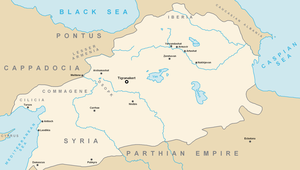
Tigranes the Great
Tigranes the Great was emperor of Armenia under whom the country became, for a short time, the strongest state east of the Roman Republic. He was a member of the Artaxiad Royal House...
(95 BC - 55 BC), the kingdom of Armenia was at the zenith of its power and briefly became the most powerful state to the Roman
Roman Republic
The Roman Republic was the period of the ancient Roman civilization where the government operated as a republic. It began with the overthrow of the Roman monarchy, traditionally dated around 508 BC, and its replacement by a government headed by two consuls, elected annually by the citizens and...
east. Artaxias and his followers had already constructed the base upon which Tigranes built his empire. Despite this fact, the territory of Armenia, being a mountainous one, was governed by nakharar
Nakharar
Nakharar was a hereditary title of the highest order given to houses of the ancient and medieval Armenian nobility.-Nakharar system:Medieval Armenia was divided into large estates, which were the property of an enlarged noble family and were ruled by a member of it, to whom the title of Nahapet...
s who were largely autonomous from the central authority. Tigranes unified them in order to create internal security in the kingdom.The borders of Armenia stretched from the Caspian Sea
Caspian Sea
The Caspian Sea is the largest enclosed body of water on Earth by area, variously classed as the world's largest lake or a full-fledged sea. The sea has a surface area of and a volume of...
to the Mediterranean Sea
Mediterranean Sea
The Mediterranean Sea is a sea connected to the Atlantic Ocean surrounded by the Mediterranean region and almost completely enclosed by land: on the north by Anatolia and Europe, on the south by North Africa, and on the east by the Levant...
. At that time, the Armenians had become so expansive, that the Romans and Parthians had to join forces in order to beat them. Tigranes found a more central capital within his domain and named it Tigranocerta.
Large chunks of lands were taken from Parthians, who were forced to sign a treaty of friendship with Tigranes. Iberia
Caucasian Iberia
Iberia , also known as Iveria , was a name given by the ancient Greeks and Romans to the ancient Georgian kingdom of Kartli , corresponding roughly to the eastern and southern parts of the present day Georgia...
, Albania
Caucasian Albania
Albania is a name for the historical region of the eastern Caucasus, that existed on the territory of present-day republic of...
, and Atropatene
Atropatene
Atropatene was an ancient kingdom established and ruled under local ethnic Iranian dynasts first with "Darius" of Persia and later "Alexander" of Macedonia, starting in the 4th century BC and includes the territory of modern-day Iranian Azarbaijan and Iranian Kurdistan. Its capital was Gazaca...
also lost territories and the remainder of their Kingdoms became vassal states. The Greeks within the Seleucid Empire offered Tigranes the Seleucid crown in 83, after which the Armenian Empire reached as far south as modern Acre, Israel
Acre, Israel
Acre , is a city in the Western Galilee region of northern Israel at the northern extremity of Haifa Bay. Acre is one of the oldest continuously inhabited sites in the country....
resulting in a conflict with Hasmonean
Hasmonean
The Hasmonean dynasty , was the ruling dynasty of Judea and surrounding regions during classical antiquity. Between c. 140 and c. 116 BCE, the dynasty ruled semi-autonomously from the Seleucids in the region of Judea...
s.
Decline
RomanAncient Rome
Ancient Rome was a thriving civilization that grew on the Italian Peninsula as early as the 8th century BC. Located along the Mediterranean Sea and centered on the city of Rome, it expanded to one of the largest empires in the ancient world....
involvement in Asia Minor
Asia Minor
Asia Minor is a geographical location at the westernmost protrusion of Asia, also called Anatolia, and corresponds to the western two thirds of the Asian part of Turkey...
brought Tigranes' empire to an end. Tigranes had allied himself with Rome's great enemy Mithridates the Great, King of Pontus
Pontus
Pontus or Pontos is a historical Greek designation for a region on the southern coast of the Black Sea, located in modern-day northeastern Turkey. The name was applied to the coastal region in antiquity by the Greeks who colonized the area, and derived from the Greek name of the Black Sea: Πόντος...
, and during the Third Mithridatic War
Third Mithridatic War
The Third Mithridatic War was the last and longest of three Mithridatic Wars fought between Mithridates VI of Pontus and his allies and the Roman Republic...
, in 69 BC, a Roman army led by Lucullus
Lucullus
Lucius Licinius Lucullus , was an optimate politician of the late Roman Republic, closely connected with Sulla Felix...
invaded the Armenian empire and routed Tigranes outside Tigranocerta. In 66, Lucullus' successor Pompey
Pompey
Gnaeus Pompeius Magnus, also known as Pompey or Pompey the Great , was a military and political leader of the late Roman Republic...
finally forced Tigranes to surrender. Pompey reduced Armenia to its former borders but allowed Tigranes to retain the throne as an ally of Rome. From now on, Armenia would become a buffer state
Buffer state
A buffer state is a country lying between two rival or potentially hostile greater powers, which by its sheer existence is thought to prevent conflict between them. Buffer states, when authentically independent, typically pursue a neutralist foreign policy, which distinguishes them from satellite...
between the two competing empires of the Romans and the Parthians.
Tigranes' heir Artavasdes II maintained the alliance with Rome, giving helpful advice to the Roman general Crassus on his campaign against the Parthians - advice which went unheeded and led to Crassus' disastrous defeat at the Battle of Carrhae
Battle of Carrhae
The Battle of Carrhae, fought in 53 BC near the town of Carrhae, was a major battle between the Parthian Empire and the Roman Republic. The Parthian Spahbod Surena decisively defeated a Roman invasion force led by Marcus Licinius Crassus...
. When Mark Antony
Mark Antony
Marcus Antonius , known in English as Mark Antony, was a Roman politician and general. As a military commander and administrator, he was an important supporter and loyal friend of his mother's cousin Julius Caesar...
became ruler of Rome's eastern provinces, he began to suspect the loyalty of Artavasdes, who had married his sister to the heir to the Parthian throne. In 35, Antony invaded Armenia and sent Artavasdes into captivity in Egypt
Egypt
Egypt , officially the Arab Republic of Egypt, Arabic: , is a country mainly in North Africa, with the Sinai Peninsula forming a land bridge in Southwest Asia. Egypt is thus a transcontinental country, and a major power in Africa, the Mediterranean Basin, the Middle East and the Muslim world...
, where he was later executed. Antony installed his own six-year old son by Cleopatra, Alexander Helios
Alexander Helios
Alexander Helios was a Ptolemaic prince and was the eldest son of Greek Ptolemaic queen Cleopatra VII of Egypt and Roman triumvir Mark Antony. His twin was Cleopatra Selene II. He was of Greek and Roman heritage. Cleopatra named him Alexander in honour of her Macedonian heritage, and after her...
, on the throne of Armenia. Artavasdes' son Artaxias II
Artaxias II
Artaxias II was a king of Armenia, the eldest son of Artavasdes II. He ascended the throne when his father was taken prisoner and executed by Triumvir Mark Antony, and after his own skirmish with the Romans was forced to flee to Parthia...
gained help from the Parthians, seized the throne back and massacred the Roman garrisons in Armenia, but after a reign of ten years he was murdered. The kingdom broke down into a civil war between pro-Roman and pro-Parthian parties until it decisively became a Roman protectorate under the Emperor Augustus. The Artaxiad dynasty petered out in chaos and it was a considerable time before the Arsacid dynasty
Arsacid Dynasty of Armenia
The Arsacid dynasty or Arshakuni dynasty ruled the Kingdom of Armenia from 54 AD to 428 AD. Formerly a branch of the Iranian Parthian Arsacids, they became a distinctly Armenian dynasty. Arsacid Kings reigned intermittently throughout the chaotic years following the fall of the Artaxiad Dynasty...
emerged as their undisputed successors.
Artaxiad Kings of Armenia
(Note: Some dates are approximate or doubtful).- Artaxias IArtaxias IArtaxias I was the founder of the Artaxiad Dynasty whose members ruled the Kingdom of Armenia for nearly two centuries....
(190 BC-159) - Tigranes ITigranes ITigranes I of Armenia reigned as King of Armenia from 115 BC to 95 BC. Artavasdes I did not leave any heir; his brother, Tigranes ascended to the throne of the Artaxiads. Some historians claim that Tigranes II the Great was the son of Tigranes I and not Artavasdes I....
(159 BC-123) - Artavasdes I (123 BC-95)
- Tigranes II the Great (95 BC-55)
- Artavasdes II (55 BC-34)
- Artaxias IIArtaxias IIArtaxias II was a king of Armenia, the eldest son of Artavasdes II. He ascended the throne when his father was taken prisoner and executed by Triumvir Mark Antony, and after his own skirmish with the Romans was forced to flee to Parthia...
(33 BC-20) - Tigranes IIITigranes IIITigranes III was king of Armenia from 20 BC until 8 BC. He was the son of Artavasdes II and brother of Artaxias II.Tacitus says that in 20 BC, the Armenians sent messengers to Roman Emperor Augustus to tell him that they no longer wanted Artaxias II as their king, and asked that his brother...
(20 BC-10) - Tigranes IVTigranes IVTigranes IV was an Armenian prince and the son of the King Tigranes III. He was the husband to his half-sister Erato of Armenia. Triganes ruled from 12 BC-1 BC...
(10 BC-5) - Artavasdes III (5 BC-4)
- Tigranes IVTigranes IVTigranes IV was an Armenian prince and the son of the King Tigranes III. He was the husband to his half-sister Erato of Armenia. Triganes ruled from 12 BC-1 BC...
and EratoErato of ArmeniaErato was a Princess, queen of Armenia and the last member on the throne of the Artaxiad Dynasty. She was the daughter of Armenian King Tigranes III and half-sister/wife of King Tigranes IV. In the centuries before Christianity, incestuous marriages were common at Hellenistic courts in order to...
(4 BC-1 BC)