


Bad Iburg

Encyclopedia
Bad Iburg is a town in the district of Osnabrück
, in Lower Saxony
, Germany
. It is situated in the Teutoburg Forest
, 16 km south of Osnabrück
.
Bad Iburg is also the name of a municipality
which includes the town and four outlying centres: Glane, Ostenfelde, Sentrup and Visbeck.
The most important building is Schloss Iburg above the city. It is a complex of a castle
which was the residence of the bishops of Osnabrück for six hundred years and a former monastery
of the Order of Saint Benedict
.
 Bad Iburg was first mentioned in 753 in a Frankish
document. In 772 the Frankish King Charlemagne
captured the “Royal castle Iburg”, from his chief antagonist, the Saxon
leader Widukind
. In a lasting period of struggles the ownership changed between Franks and Saxons. Frankish troops finally regained the castle in 783.
Bad Iburg became of more than local importance in the eleventh century when Bishop Benno I (1052–1067) built a new castle on the ruins of the first fortification. This castle was also ruined so Benno I's successor Bishop Benno II of Osnabrück
(1068–1088) built another castle. He also founded a Benedictine
monastery, the first twelve monks came from Mainz
. An interesting feature of the Roman Catholic Church of St. Clemens is the hagioscope
, which allowed lepers
to view the service from outside. Bishop Benno II was buried in St. Clemens, the monastery's church.
About 1100, after a large fire in Osnabrück, the castle became the residence of Osnabrück’s bishops. This period ended when Ernest Augustus, Elector of Hanover, duke of Brunswick-Lüneburg
and Protestant Prince-Bishop of Osnabrück
built a baroque
castle in Osnabrück to which he and his family moved in 1673. He added the small Protestant church Evangelisch-lutherische Schlosskirche to the Iburg castle, thus the complex of castle and monastery has had two churches, Protestant and Catholic, since the 17th century. In 1668 Sophia Charlotte of Hanover
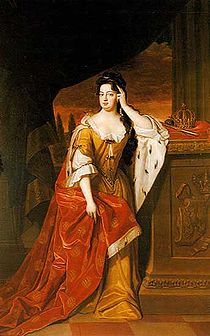
, the only daughter of Ernest Augustus and his wife Sophia of the Palatinate, was born in Schloss Iburg. She became the first Queen of Prussia. Of special importance is the castle's Rittersaal (hall of knights). The ceiling in pseudo-architecture was painted by Andrea Alovisii.
The monastery site has a baroque building designed by Johann Conrad Schlaun in Abbot
Adolph Hane’s (1706–1768) time. The monastery was active until 1803 when it was secularisated
by the Reichsdeputationshauptschluss.
In 1534 Bad Iburg was involved in the Münster Rebellion
when six Anabaptist
s were captured on their way from Münster to Osnabrück and imprisoned in the octagonal tower of the castle called the Bennoturm (Benno's Tower). Five of them died during torture or were executed, the sixth was set free after betraying the plans of Johann Bockelson
, the leader of the Anabaptists.
In 1910 the crash of the zeppelin
LZ7 Deutschland near Bad Iburg, brought international attention. The airship had had its maiden voyage on June 19, 1910, and nine days later was on a pleasure trip to popularize the zeppelin. On board were 19 journalists, among them two reporters of well known British newspapers. In bad weather, the crew decided to go to Osnabrück
, passing over the Teutoburg Forest. The airship crashed into Mount Limberg on June 28, 1910, just after 5 p.m. Nobody was injured.
A monument with a portrait of Count Ferdinand von Zeppelin
was erected on Mount Limberg after the crash, the inscription reads, Trotzdem vorwärts (Ahead nevertheless).
On January 18, 1962 a plane of British Royal Air Force crashed on the hill of the Dörenberg
. The two pilots, 24 and 26 years old, died. A monument at the Dörenberg commemorates them.
in the Osnabrück district
.
St. Jakobus der Ältere in Glane was erected in 1904/1905. The Roman Catholic Church in Gothic Revival architecture
contains a pietà from 1420.
St. Clemens in the castle complex was the church of the benedictine monastery. A Hagioscope
was rediscovered.
The Evangelische Schlosskirche which is also situated in the castle complex is the only Lutheran church in Bad Iburg.
The Schlossmühle, the castle's mill, was also erected by Philipp Sigismund.
The Gografenhof, a classicism building, is used as the town hall since 1967. The kurhaus (spa facility/ resort) was opened in 1967 and torn down in 2010 following great local community debate (the area is now a grassed field and mainly used for local community events such as Schuetzenfest).
Burg Scheventorf is a former water castle built in 1552, but its history dates from the 14th century. It is situated south of the city centre. Nearby Schleppenburg which was destroyed was also a water castle.
in 1764.
Osnabrück (district)
Osnabrück is a district in the southwest of Lower Saxony, Germany. With 2,121 km² it is the second largest district of Lower Saxony.- History :...
, in Lower Saxony
Lower Saxony
Lower Saxony is a German state situated in north-western Germany and is second in area and fourth in population among the sixteen states of Germany...
, Germany
Germany
Germany , officially the Federal Republic of Germany , is a federal parliamentary republic in Europe. The country consists of 16 states while the capital and largest city is Berlin. Germany covers an area of 357,021 km2 and has a largely temperate seasonal climate...
. It is situated in the Teutoburg Forest
Teutoburg Forest
The Teutoburg Forest is a range of low, forested mountains in the German states of Lower Saxony and North Rhine-Westphalia which used to be believed to be the scene of a decisive battle in AD 9...
, 16 km south of Osnabrück
Osnabrück
Osnabrück is a city in Lower Saxony, Germany, some 80 km NNE of Dortmund, 45 km NE of Münster, and some 100 km due west of Hanover. It lies in a valley penned between the Wiehen Hills and the northern tip of the Teutoburg Forest...
.
Bad Iburg is also the name of a municipality
Municipality
A municipality is essentially an urban administrative division having corporate status and usually powers of self-government. It can also be used to mean the governing body of a municipality. A municipality is a general-purpose administrative subdivision, as opposed to a special-purpose district...
which includes the town and four outlying centres: Glane, Ostenfelde, Sentrup and Visbeck.
The most important building is Schloss Iburg above the city. It is a complex of a castle
Castle
A castle is a type of fortified structure built in Europe and the Middle East during the Middle Ages by European nobility. Scholars debate the scope of the word castle, but usually consider it to be the private fortified residence of a lord or noble...
which was the residence of the bishops of Osnabrück for six hundred years and a former monastery
Monastery
Monastery denotes the building, or complex of buildings, that houses a room reserved for prayer as well as the domestic quarters and workplace of monastics, whether monks or nuns, and whether living in community or alone .Monasteries may vary greatly in size – a small dwelling accommodating only...
of the Order of Saint Benedict
Order of Saint Benedict
The Order of Saint Benedict is a Roman Catholic religious order of independent monastic communities that observe the Rule of St. Benedict. Within the order, each individual community maintains its own autonomy, while the organization as a whole exists to represent their mutual interests...
.
History
Franks
The Franks were a confederation of Germanic tribes first attested in the third century AD as living north and east of the Lower Rhine River. From the third to fifth centuries some Franks raided Roman territory while other Franks joined the Roman troops in Gaul. Only the Salian Franks formed a...
document. In 772 the Frankish King Charlemagne
Charlemagne
Charlemagne was King of the Franks from 768 and Emperor of the Romans from 800 to his death in 814. He expanded the Frankish kingdom into an empire that incorporated much of Western and Central Europe. During his reign, he conquered Italy and was crowned by Pope Leo III on 25 December 800...
captured the “Royal castle Iburg”, from his chief antagonist, the Saxon
Saxons
The Saxons were a confederation of Germanic tribes originating on the North German plain. The Saxons earliest known area of settlement is Northern Albingia, an area approximately that of modern Holstein...
leader Widukind
Widukind
Widukind was a pagan Saxon leader and the chief opponent of Charlemagne during the Saxon Wars. Widukind was the leader of the Saxons against the Frankish king Charlemagne...
. In a lasting period of struggles the ownership changed between Franks and Saxons. Frankish troops finally regained the castle in 783.
Bad Iburg became of more than local importance in the eleventh century when Bishop Benno I (1052–1067) built a new castle on the ruins of the first fortification. This castle was also ruined so Benno I's successor Bishop Benno II of Osnabrück
Benno II of Osnabrück
Benno II, Bishop of Osnabrück was born at Luningen in Swabia and died 27 July 1088, in the Benedictine monastery of Iburg near Osnabrück.His parents sent him at an early age to the monastic school of Strasburg where the learned Herman Contractus of Reichenau was then teaching...
(1068–1088) built another castle. He also founded a Benedictine
Benedictine
Benedictine refers to the spirituality and consecrated life in accordance with the Rule of St Benedict, written by Benedict of Nursia in the sixth century for the cenobitic communities he founded in central Italy. The most notable of these is Monte Cassino, the first monastery founded by Benedict...
monastery, the first twelve monks came from Mainz
Mainz
Mainz under the Holy Roman Empire, and previously was a Roman fort city which commanded the west bank of the Rhine and formed part of the northernmost frontier of the Roman Empire...
. An interesting feature of the Roman Catholic Church of St. Clemens is the hagioscope
Hagioscope
A hagioscope or squint, in architecture, is an opening through the wall of a church in an oblique direction, to enable the worshippers in the transepts or other parts of the church, from which the altar was not visible, to see the elevation of the host.Hagioscopes were also sometimes known as...
, which allowed lepers
Leprosy
Leprosy or Hansen's disease is a chronic disease caused by the bacteria Mycobacterium leprae and Mycobacterium lepromatosis. Named after physician Gerhard Armauer Hansen, leprosy is primarily a granulomatous disease of the peripheral nerves and mucosa of the upper respiratory tract; skin lesions...
to view the service from outside. Bishop Benno II was buried in St. Clemens, the monastery's church.
About 1100, after a large fire in Osnabrück, the castle became the residence of Osnabrück’s bishops. This period ended when Ernest Augustus, Elector of Hanover, duke of Brunswick-Lüneburg
Brunswick-Lüneburg
The Duchy of Brunswick-Lüneburg , or more properly Duchy of Brunswick and Lüneburg, was an historical ducal state from the late Middle Ages until the late Early Modern era within the North-Western domains of the Holy Roman Empire of the German Nation, in what is now northern Germany...
and Protestant Prince-Bishop of Osnabrück
Prince-Bishopric of Osnabrück
The Prince-Bishopric of Osnabrück was a prince-bishopric centred on the Roman Catholic Diocese of Osnabrück. The diocese was erected in 772 and is the oldest see founded by Charlemagne, in order to Christianize the conquered stem-duchy of Saxony....
built a baroque
Baroque
The Baroque is a period and the style that used exaggerated motion and clear, easily interpreted detail to produce drama, tension, exuberance, and grandeur in sculpture, painting, literature, dance, and music...
castle in Osnabrück to which he and his family moved in 1673. He added the small Protestant church Evangelisch-lutherische Schlosskirche to the Iburg castle, thus the complex of castle and monastery has had two churches, Protestant and Catholic, since the 17th century. In 1668 Sophia Charlotte of Hanover
Sophia Charlotte of Hanover
Sophia Charlotte of Hanover was the Queen consort of Prussia as wife of Frederick I of Prussia. She was the daughter of Ernst August, Elector of Hanover, and Sophia of the Palatinate...
, the only daughter of Ernest Augustus and his wife Sophia of the Palatinate, was born in Schloss Iburg. She became the first Queen of Prussia. Of special importance is the castle's Rittersaal (hall of knights). The ceiling in pseudo-architecture was painted by Andrea Alovisii.
The monastery site has a baroque building designed by Johann Conrad Schlaun in Abbot
Abbot
The word abbot, meaning father, is a title given to the head of a monastery in various traditions, including Christianity. The office may also be given as an honorary title to a clergyman who is not actually the head of a monastery...
Adolph Hane’s (1706–1768) time. The monastery was active until 1803 when it was secularisated
Secularization
Secularization is the transformation of a society from close identification with religious values and institutions toward non-religious values and secular institutions...
by the Reichsdeputationshauptschluss.
In 1534 Bad Iburg was involved in the Münster Rebellion
Münster Rebellion
The Münster Rebellion was an attempt by radical Anabaptists to establish a communal sectarian government in the German city of Münster. The city became an Anabaptist center from 1534 to 1535, and fell under Anabaptist rule for 18 months — from February 1534, when the city hall was seized and...
when six Anabaptist
Anabaptist
Anabaptists are Protestant Christians of the Radical Reformation of 16th-century Europe, and their direct descendants, particularly the Amish, Brethren, Hutterites, and Mennonites....
s were captured on their way from Münster to Osnabrück and imprisoned in the octagonal tower of the castle called the Bennoturm (Benno's Tower). Five of them died during torture or were executed, the sixth was set free after betraying the plans of Johann Bockelson
John of Leiden
John of Leiden , was an Anabaptist leader from the Dutch city of Leiden. He was the illegitimate son of a Dutch mayor, and a tailor's apprentice by trade.-Life:...
, the leader of the Anabaptists.
In 1910 the crash of the zeppelin
Zeppelin
A Zeppelin is a type of rigid airship pioneered by the German Count Ferdinand von Zeppelin in the early 20th century. It was based on designs he had outlined in 1874 and detailed in 1893. His plans were reviewed by committee in 1894 and patented in the United States on 14 March 1899...
LZ7 Deutschland near Bad Iburg, brought international attention. The airship had had its maiden voyage on June 19, 1910, and nine days later was on a pleasure trip to popularize the zeppelin. On board were 19 journalists, among them two reporters of well known British newspapers. In bad weather, the crew decided to go to Osnabrück
Osnabrück
Osnabrück is a city in Lower Saxony, Germany, some 80 km NNE of Dortmund, 45 km NE of Münster, and some 100 km due west of Hanover. It lies in a valley penned between the Wiehen Hills and the northern tip of the Teutoburg Forest...
, passing over the Teutoburg Forest. The airship crashed into Mount Limberg on June 28, 1910, just after 5 p.m. Nobody was injured.
A monument with a portrait of Count Ferdinand von Zeppelin
Ferdinand von Zeppelin
Ferdinand Adolf Heinrich August Graf von Zeppelin was a German general and later aircraft manufacturer. He founded the Zeppelin Airship company...
was erected on Mount Limberg after the crash, the inscription reads, Trotzdem vorwärts (Ahead nevertheless).
On January 18, 1962 a plane of British Royal Air Force crashed on the hill of the Dörenberg
Dörenberg
The Dörenberg is a hill, , in the Teutoburg Forest in the district of Osnabrück, in the German state of Lower Saxony.- Origin of the name :Dören could be derived, especially in the area of Ostwestfalen-Lippe, from Dör, the Low German word for a hill or mountain pass.- Location :The Dörenberg, the...
. The two pilots, 24 and 26 years old, died. A monument at the Dörenberg commemorates them.
Museums
Bad Iburg has three museums, Schlossmuseum mit Münzkabinett, the castle museum, which includes a numismatic department, the Uhrenmuseum (a clock museum), and Averbecks Speicher, a museum of local history in a former farm’s storehouse in Glane.Churches
The Fleckenskirche St. Nikolaus dates from the 13. century. The Roman Catholic Church is the oldest Hall ChurchHall church
A hall church is a church with nave and side aisles of approximately equal height, often united under a single immense roof. The term was first coined in the mid-19th century by the pioneering German art historian Wilhelm Lübke....
in the Osnabrück district
Osnabrück (district)
Osnabrück is a district in the southwest of Lower Saxony, Germany. With 2,121 km² it is the second largest district of Lower Saxony.- History :...
.
St. Jakobus der Ältere in Glane was erected in 1904/1905. The Roman Catholic Church in Gothic Revival architecture
Gothic Revival architecture
The Gothic Revival is an architectural movement that began in the 1740s in England...
contains a pietà from 1420.
St. Clemens in the castle complex was the church of the benedictine monastery. A Hagioscope
Hagioscope
A hagioscope or squint, in architecture, is an opening through the wall of a church in an oblique direction, to enable the worshippers in the transepts or other parts of the church, from which the altar was not visible, to see the elevation of the host.Hagioscopes were also sometimes known as...
was rediscovered.
The Evangelische Schlosskirche which is also situated in the castle complex is the only Lutheran church in Bad Iburg.
Buildings
The Jagdschlösschen (hunting château), also known as Altes Forsthaus Freudenthal, was erected in 1595 by prince bishop Philipp Sigismund von Wolfenbüttel.The Schlossmühle, the castle's mill, was also erected by Philipp Sigismund.
The Gografenhof, a classicism building, is used as the town hall since 1967. The kurhaus (spa facility/ resort) was opened in 1967 and torn down in 2010 following great local community debate (the area is now a grassed field and mainly used for local community events such as Schuetzenfest).
Burg Scheventorf is a former water castle built in 1552, but its history dates from the 14th century. It is situated south of the city centre. Nearby Schleppenburg which was destroyed was also a water castle.
Sculptures
Bad Iburg has a number of sculptures made by Hans Gerd Ruwe from Osnabrück. These are the sculpture of Bishop Benno II, founder of the monastery, near the town hall, the Handwerkerbrunnen (craftsmen's fountain) in Große Straße, and the Trommlerbrunnen (drummer boy's fountain) in Glane. The Trommlerbrunnen reminds of the conferment of becoming a market townMarket town
Market town or market right is a legal term, originating in the medieval period, for a European settlement that has the right to host markets, distinguishing it from a village and city...
in 1764.