

Angiogenesis

Encyclopedia
Angiogenesis is the physiological process involving the growth of new blood vessel
s from pre-existing vessels. Though there has been some debate over terminology, vasculogenesis
is the term used for spontaneous blood-vessel formation, and intussusception
is the term for the formation of new blood vessels by the splitting of exisiting ones.
Angiogenesis is a normal and vital process in growth and development, as well as in wound healing
and in granulation tissue
. However, it is also a fundamental step in the transition of tumor
s from a dormant state to a malignant
one, leading to the use of angiogenesis inhibitor
s. The identification of an angiogenic diffusible factor derived from tumors was made initially by Greenblatt and Shubik in 1968.
ing angiogenesis was the first identified form of angiogenesis. It occurs in several well-characterized stages. First, biological signals known as angiogenic growth factors activate receptor
s present on endothelial cells present in pre-existing blood vessels. Second, the activated endothelial cells begin to release enzyme
s called protease
s that degrade the basement membrane
to allow endothelial cells to escape from the original (parent) vessel walls. The endothelial cells then proliferate
into the surrounding matrix
and form solid sprouts connecting neighboring vessels. As sprouts extend toward the source of the angiogenic stimulus, endothelial cells migrate in tandem
, using adhesion molecules, the equivalent of cellular grappling hooks, called integrin
s. These sprouts then form loops to become a full-fledged vessel lumen
as cells migrate to the site of angiogenesis. Sprouting occurs at a rate of several millimeters per day, and enables new vessels to grow across gaps in the vasculature. It is markedly different from splitting angiogenesis, however, because it forms entirely new vessels as opposed to splitting existing vessels.
to split a single vessel in two. There are four phases of intussusceptive angiogenesis. First, the two opposing capillary walls establish a zone of contact. Second, the endothelial cell junction
s are reorganized and the vessel bilayer
is perforated to allow growth factors and cells to penetrate into the lumen. Third, a core is formed between the two new vessels at the zone of contact that is filled with pericyte
s and myofibroblast
s. These cells begin laying collagen
fibers into the core to provide an extracellular matrix
for growth of the vessel lumen. Finally, the core is fleshed out with no alterations to the basic structure. Intussusception is important because it is a reorganization of existing cells. It allows a vast increase in the number of capillaries without a corresponding increase in the number of endothelial cells. This is especially important in embryonic development as there are not enough resources to create a rich microvasculature with new cells every time a new vessel develops.
Vasculogenesis – Formation of vascular structures from circulating or tissue-resident endothelial stem cell
s (angioblast
s), which proliferate
into de novo
endothelial cells. This form particularly relates to the embryonal development of the vascular system.
Angiogenesis – Formation of thin-walled endothelium-lined structures with muscular smooth muscle
wall and pericyte
s (fibrocyte
s). This form plays an important role during the adult life span, also as "repair mechanism" of damaged tissues.
Arteriogenesis – Formation of medium-sized blood vessels possessing tunica media
plus adventitia
.
Because it turned out that even this differentiation is not a sharp one, today quite often the term “angiogenesis” is used summarizing all different types and modifications of arterial vessel growth.
References
, are the result of failure or insufficient blood vessel formation and may be treated by a local expansion of blood vessels, thus bringing new nutrients to the site, facilitating repair. Other diseases, such as age-related macular degeneration, may be created by a local expansion of blood vessels, interfering with normal physiological processes.
The modern clinical application of the principle of angiogenesis can be divided into two main areas: anti-angiogenic therapies, which angiogenic research began with, and pro-angiogenic therapies. Whereas anti-angiogenic therapies are being employed to fight cancer and malignancies, which require an abundance of oxygen and nutrients to proliferate, pro-angiogenic therapies are being explored as options to treat cardiovascular diseases, the number one cause of death in the Western world
. One of the first applications of pro-angiogenic methods in humans was a German trial using fibroblast growth factor 1 (FGF-1) for the treatment of coronary artery disease. Clinical research in therapeutic angiogenesis is ongoing for a variety of atherosclerotic diseases, like coronary heart disease, peripheral arterial disease, wound healing disorders, etc.
Also, regarding the mechanism of action
, pro-angiogenic methods can be differentiated into three main categories: gene-therapy, targeting genes of interest for amplification or inhibition; protein-therapy, which primarily manipulates angiogenic growth factors like FGF-1 or vascular endothelial growth factor
, VEGF; and cell-based therapies, which involve the implantation of specific cell types.
There are still serious, unsolved problems related to gene therapy. Difficulties include effective integration of the therapeutic genes into the genome of target cells, reducing the risk of an undesired immune response, potential toxicity, immunogenicity, inflammatory responses, and oncogenesis related to the viral vectors used in implanting genes and the sheer complexity of the genetic basis of angiogenesis. The most commonly-occurring disorders in humans, such as heart disease, high blood pressure, diabetes and Alzheimer’s disease, are most likely caused by the combined effects of variations in many genes, and, thus, injecting a single gene may not be significantly beneficial in such diseases.
In contrast, pro-angiogenic protein therapy uses well-defined, precisely-structured proteins, with previously-defined optimal doses of the individual protein for disease states, and with well-known biological effects. On the other hand, an obstacle of protein therapy is the mode of delivery. Oral, intravenous, intra-arterial, or intramuscular routes of protein administration are not always as effective, as the therapeutic protein may be metabolized or cleared before it can enter the target tissue. Cell-based pro-angiogenic therapies are still early stages of research, with many open questions regarding best cell types and dosages to use.
s.
FGF-1, unique among all 22 members of the FGF family, can bind to all seven FGF-receptor subtypes, making it the broadest-acting member of the FGF family, and a potent mitogen for the diverse cell types needed to mount an angiogenic response in damaged (hypoxic) tissues, where upregulation of FGF-receptors occurs. FGF-1 stimulates the proliferation and differentiation of all cell types necessary for building an arterial vessel, including endothelial cells and smooth muscle cells; this fact distinguishes FGF-1 from other pro-angiogenic growth factors, such as vascular endothelial growth factor (VEGF), which primarily drives the formation of new capillaries.
Until now (2007), three human clinical trials have been successfully completed with FGF-1, in which the angiogenic protein was injected directly into the damaged heart muscle. Also, one additional human FGF-1 trial has been completed to promote wound healing in diabetics with chronic wounds.
Besides FGF-1, one of the most important functions of fibroblast growth factor-2 (FGF-2 or bFGF) is the promotion of endothelial cell proliferation and the physical organization of endothelial cells into tube-like structures, thus promoting angiogenesis. FGF-2 is a more potent angiogenic factor than VEGF or PDGF (platelet-derived growth factor
); however, it is less potent than FGF-1. As well as stimulating blood vessel growth, aFGF (FGF-1) and bFGF (FGF-2) are important players in wound healing. They stimulate the proliferation of fibroblasts and endothelial cells that give rise to angiogenesis and developing granulation tissue; both increase blood supply and fill up a wound space/cavity early in the wound-healing process.
(VEGF) has been demonstrated to be a major contributor to angiogenesis, increasing the number of capillaries in a given network. Initial in vitro studies demonstrated bovine capillary endothelial cells will proliferate and show signs of tube structures upon stimulation by VEGF and bFGF, although the results were more pronounced with VEGF. Upregulation of VEGF is a major component of the physiological response to exercise and its role in angiogenesis is suspected to be a possible treatment in vascular injuries. In vitro studies clearly demonstrate that VEGF is a potent stimulator of angiogenesis because, in the presence of this growth factor, plated endothelial cells will proliferate and migrate, eventually forming tube structures resembling capillaries.
VEGF causes a massive signaling cascade in endothelial
cells. Binding to VEGF receptor-2 (VEGFR-2) starts a tyrosine kinase signaling cascade that stimulates the production of factors that variously stimulate vessel permeability (eNOS, producing NO), proliferation/survival (bFGF), migration (ICAMs/VCAMs/MMPs) and finally differentiation into mature blood vessels. Mechanically, VEGF is upregulated with muscle contractions as a result of increased blood flow to affected areas. The increased flow also causes a large increase in the mRNA production of VEGF receptors 1 and 2. The increase in receptor production means muscle contractions could cause upregulation of the signaling cascade relating to angiogenesis. As part of the angiogenic signaling cascade, NO is widely considered to be a major contributor to the angiogenic response because inhibition of NO significantly reduces the effects of angiogenic growth factors. However, inhibition of NO during exercise does not inhibit angiogenesis, indicating there are other factors involved in the angiogenic response.
when ligand binding causes a dimerization that initiates phosphorylation
on key tyrosines.
). MMP
s help degrade the proteins that keep the vessel walls solid. This proteolysis allows the endothelial cells to escape into the interstitial matrix as seen in sprouting angiogenesis. Inhibition of MMP
s prevents the formation of new capillaries. These enzyme
s are highly regulated during the vessel formation process because destruction of the extracellular matrix
would decrease the integrity of the microvasculature.
or a dietary component
.
cell
s are cells that have lost their ability to divide in a controlled fashion. A tumor consists of a population of rapidly dividing and growing cancer cells. Mutation
s rapidly accrue within the population. These mutations (variation) allow the cancer cells (or sub-populations of cancer cells within a tumor) to develop drug resistance
and escape therapy. Tumors cannot grow beyond a certain size, generally 1–2 mm3, due to a lack of oxygen and other essential nutrients.
Tumors induce blood vessel growth (angiogenesis) by secreting various growth factors (e.g. VEGF
). Growth factors such as bFGF and VEGF can induce capillary growth into the tumor, which some researchers suspect supply required nutrients, allowing for tumor expansion. In 2007, it was discovered that cancerous cells stop producing the anti-VEGF enzyme PKG
. In normal cells (but not in cancerous ones), PKG apparently limits beta-catenin
, which solicits angiogenesis. Other clinicians believe angiogenesis really serves as a waste pathway, taking away the biological end products secreted by rapidly dividing cancer cells. In either case, angiogenesis is a necessary and required step for transition from a small harmless cluster of cells, often said to be about the size of the metal ball at the end of a ball-point pen, to a large tumor. Angiogenesis is also required for the spread of a tumor, or metastasis
. Single cancer cells can break away from an established solid tumor, enter the blood vessel, and be carried to a distant site, where they can implant and begin the growth of a secondary tumor. Evidence now suggests the blood vessel in a given solid tumor may, in fact, be mosaic vessels, composed of endothelial cells
and tumor cells. This mosaicity allows for substantial shedding of tumor cells into the vasculature, possibly contributing to the appearance of circulating tumor cell
s in the peripheral blood of patients with malignancies. The subsequent growth of such metastases will also require a supply of nutrients and oxygen
and a waste disposal pathway.
Endothelial cells have long been considered genetically more stable than cancer cells. This genomic stability confers an advantage to targeting endothelial cells using antiangiogenic therapy, compared to chemotherapy directed at cancer cells, which rapidly mutate and acquire 'drug resistance' to treatment. For this reason, endothelial cells are thought to be an ideal target for therapies directed against them. Recent studies by Klagsbrun, et al. have shown, however, that endothelial cells growing within tumors do carry genetic abnormalities. Thus, tumor vessels have the theoretical potential for developing acquired resistance to drugs. This is a new area of angiogenesis research being actively pursued.
Two independent studies published in the journal Nature in 2010 November confirmed the ability of tumors to make their own blood vessels. When one group found that tumor stem cells could make their own blood vessels and avastin could not inhibit their early differentiation, the other group showed that selective targeting of endothelial cells generated by tumor-derived stem cells in mouse xenografts resulted in tumour reduction. These studies done in glioblastoma model may have implications in other tumors.
Angiogenesis research is a cutting-edge field in cancer research
, and recent evidence also suggests traditional therapies, such as radiation therapy, may actually work in part by targeting the genomically stable endothelial cell compartment, rather than the genomically unstable tumor cell compartment. New blood vessel formation is a relatively fragile process, subject to disruptive interference at several levels. In short, the therapy is the selection agent which is being used to kill a cell compartment. Tumor cells evolve resistance rapidly due to rapid generation time (days) and genomic instability (variation), whereas endothelial cells are a good target because of a long generation time (months) and genomic stability (low variation).
This is an example of selection
in action at the cellular level, using a selection pressure to target and differentiate between varying populations of cells. The end result is the extinction
of one species or population of cells (endothelial cells), followed by the collapse of the ecosystem
(the tumor) due either to nutrient deprivation or self-pollution from the destruction of necessary waste pathways.
Angiogenesis-based tumor therapy relies on natural and synthetic angiogenesis inhibitor
s like angiostatin
, endostatin
and tumstatin
. These are protein
s that mainly originate as specific fragments of pre-existing structural proteins like collagen
or plasminogen.
Recently, the first FDA-approved therapy targeted at angiogenesis in cancer came on the market in the US. This is a monoclonal antibody directed against an isoform of VEGF. The commercial name of this antibody is Avastin, and the therapy has been approved for use in colorectal cancer
in combination with established chemotherapy.
If one reviews in detail the various published angiogenesis clinical trials, it can be realized that most of these trials had success in achieving various secondary or supportive endpoints, but failed when attempting to demonstrate a statistically significant improvement in exercise performance, typically done by a treadmill exercise test. Perhaps the greatest reason for these trials’ failure to achieve success is the high occurrence of the “placebo effect” in studies employing treadmill exercise test readout. Thus, even though a majority of the treated patients in these trials experience relief of such clinical symptoms as chest pain (angina), and generally performed better on most efficacy readouts, there were enough “responders” in the blinded placebo groups to render the trial inconclusive. In addition to the placebo effect, more recent animal studies have also highlighted various factors that may inhibit an angiogenesis response, including certain drugs, smoking, and hypercholesterolemia.
Although shown to be relatively safe therapies, not one angiogenic therapeutic has yet made it through the gauntlet of clinical testing required for drug approval. By capitalizing on the large database of what did and did not work in previous clinical trials, results from more recent studies with redesigned clinical protocols give renewed hope that angiogenesis therapy will be a treatment choice for sufferers of cardiovascular disease resulting from occluded and/or stenotic vessels.
Early clinical studies with protein-based therapeutics largely focused on the intravenous or intracoronary administration of a particular growth factor to stimulate angiogenesis in the affected tissue or organ. Most of these trials did not achieve statistically significant improvements in their clinical endpoints. This ultimately led to an abandonment of this approach and a widespread belief in the field that protein therapy, especially with a single agent, was not a viable option to treat ischemic cardiovascular disease. However, the failure of gene- or cell-based therapy to deliver, as of yet, a suitable treatment choice for diseases resulting from poor blood flow, has led to a resurgence of interest in returning to protein-based therapy to stimulate angiogenesis.
These failures suggested that either these are the wrong molecular targets to induce neovascularization, that they can only be effectively used if formulated and administered correctly, or that their presentation
in the context of the overall cellular microenvironment may play a vital role in their utility. It may be necessary to present these proteins in a way that mimics natural signaling events, including the concentration
, spatial and temporal
profiles, and their simultaneous or sequential presentation with other appropriate factors.
Lessons learned from earlier protein-based studies, which indicated that intravenous or intracoronary delivery of the protein was not efficacious, have led to completed and ongoing clinical trials in which the angiogenic protein is injected directly into the beating ischemic heart.
Such localized administration of the potent angiogenic growth factor, human FGF-1, has recently given promising results in clinical trials in no-option heart patients. Angiogenesis was documented by angiographically visible “blushing”, and functional exercise tests were also performed on a subset of patients. The attractiveness of protein therapy is that large amounts of the therapeutic agent can be injected into the ischemic area of interest, to pharmacologically start the process of blood vessel growth and collateral arteries formation. In addition, from pharmacokinetic data collected from the recent FGF-1 studies in the human heart, it appears that FGF-1, once it exits the heart, is cleared in less than three hours from the circulation. This would presumably prevent FGF-1 from stimulating unwanted angiogenesis in other tissues of the bodies where it could potentially cause harm, such as the retina and in the kidneys. No serious adverse events have yet to be noted in any of the completed or ongoing clinical trials in which the FGF-1 protein is used as the therapeutic agent to stimulate angiogenesis.
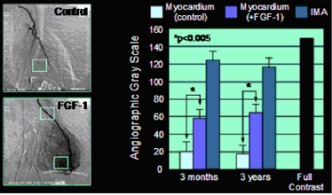
Left: Angiographic "blushing" following FGF-1 injection into the human heart. Right, measurements of pixel density in angiograms ("gray-value-analysis") indicating a threefold increase in vessel density in the treated human myocardium (3 months and 3 years).
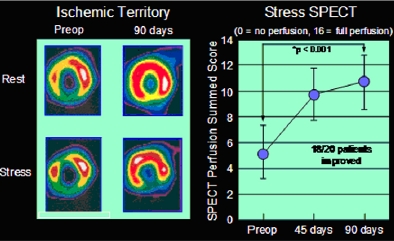
Improvement in myocardial perfusion (blood supply) after FGF-1 treatment as demonstrated by single photon emission computed tomography (SPECT) imaging.
Another approach for stimulation angiogenesis in the heart is using FGF gene (instead of the protein) delivered by adenoviral vectors (e.g. Ad5FGF-4, Generx) during intracoronary infusion.
Several clinical trials with angiogenic gene therapy have been completed with promising efficacy and safety data (e.g. AGENT trials). These trials tested intracoronary administration of Ad5FGF-4 in over 450 patients and demonstrated the safety of the product and the procedure. It is notable that when exercise tolerance was used as the primary end-point, the product did not achieve statistically significant effect primarily due to high placebo effect in the control groups. In contrast, when the more objective end-point of SPECT (measuring the extent of reversible myocardial ischemia) was used in the AGENT-2 clinical study, intracoronary administration of Ad5FGF4 resulted in a statistically significant therapeutic effect. Currently ongoing pivotal (Phase 3) clinical studies use myocardial perfusion (as measured by SPECT) as the primary end point.
and endurance exercise. While arteriogenesis
produces network changes that allow for a large increase in the amount of total flow in a network, angiogenesis causes changes that allow for greater nutrient delivery over a long period of time. Capillaries are designed to provide maximum nutrient delivery efficiency, so an increase in the number of capillaries allows the network to deliver more nutrients in the same amount of time. A greater number of capillaries also allows for greater oxygen exchange in the network. This is vitally important to endurance training, because it allows a person to continue training for an extended period of time. No experimental evidence exists, though, to suggest increased capillarity is required in endurance exercise to increase the maximum oxygen delivery.
, VEGF causes proliferation of capillaries into the retina. Since the increase in angiogenesis also causes edema
, blood and other retinal fluids leak into the retina, causing loss of vision. A novel treatment of this disease is to use a VEGF inhibiting siRNA
to stop the main signaling cascade for angiogenesis.
Matrigel tube formation assay
Blood vessel
The blood vessels are the part of the circulatory system that transports blood throughout the body. There are three major types of blood vessels: the arteries, which carry the blood away from the heart; the capillaries, which enable the actual exchange of water and chemicals between the blood and...
s from pre-existing vessels. Though there has been some debate over terminology, vasculogenesis
Vasculogenesis
Vasculogenesis is the process of blood vessel formation occurring by a de novo production of endothelial cells.-Process:Though similar to angiogenesis, the two are different in one aspect: The term angiogenesis denotes the formation of new blood vessels from pre-existing ones, whereas...
is the term used for spontaneous blood-vessel formation, and intussusception
Intussusception (blood vessel growth)
Intussusception is the process whereby a new blood vessel is created by the splitting of an existing blood vessel in two. It is one of the three ways that blood vessels are known to be formed in the human body, the other two being angiogenesis and vasculogenesis.Intussusception, also known as...
is the term for the formation of new blood vessels by the splitting of exisiting ones.
Angiogenesis is a normal and vital process in growth and development, as well as in wound healing
Wound healing
Wound healing, or cicatrisation, is an intricate process in which the skin repairs itself after injury. In normal skin, the epidermis and dermis exists in a steady-state equilibrium, forming a protective barrier against the external environment...
and in granulation tissue
Granulation tissue
Granulation tissue is the perfused, fibrous connective tissue that replaces a fibrin clot in healing wounds. Granulation tissue typically grows from the base of a wound and is able to fill wounds of almost any size it heals...
. However, it is also a fundamental step in the transition of tumor
Tumor
A tumor or tumour is commonly used as a synonym for a neoplasm that appears enlarged in size. Tumor is not synonymous with cancer...
s from a dormant state to a malignant
Malignant
Malignancy is the tendency of a medical condition, especially tumors, to become progressively worse and to potentially result in death. Malignancy in cancers is characterized by anaplasia, invasiveness, and metastasis...
one, leading to the use of angiogenesis inhibitor
Angiogenesis inhibitor
An angiogenesis inhibitor is a substance that inhibits the growth of new blood vessels . Some angiogenesis inhibitors are a normal part of the body's control, some are administered as drugs, and some come from diet....
s. The identification of an angiogenic diffusible factor derived from tumors was made initially by Greenblatt and Shubik in 1968.
Sprouting angiogenesis
SproutSprout
Sprout may refer to:* Shoot, the early growth of a plant** Edible sprouts* Sprouting, germination of seed* Brussels sprout, a green vegetable* Sprouts , a pencil-and-paper game...
ing angiogenesis was the first identified form of angiogenesis. It occurs in several well-characterized stages. First, biological signals known as angiogenic growth factors activate receptor
Receptor (biochemistry)
In biochemistry, a receptor is a molecule found on the surface of a cell, which receives specific chemical signals from neighbouring cells or the wider environment within an organism...
s present on endothelial cells present in pre-existing blood vessels. Second, the activated endothelial cells begin to release enzyme
Enzyme
Enzymes are proteins that catalyze chemical reactions. In enzymatic reactions, the molecules at the beginning of the process, called substrates, are converted into different molecules, called products. Almost all chemical reactions in a biological cell need enzymes in order to occur at rates...
s called protease
Protease
A protease is any enzyme that conducts proteolysis, that is, begins protein catabolism by hydrolysis of the peptide bonds that link amino acids together in the polypeptide chain forming the protein....
s that degrade the basement membrane
Basement membrane
The basement membrane is a thin sheet of fibers that underlies the epithelium, which lines the cavities and surfaces of organs including skin, or the endothelium, which lines the interior surface of blood vessels.- Composition :...
to allow endothelial cells to escape from the original (parent) vessel walls. The endothelial cells then proliferate
Cell growth
The term cell growth is used in the contexts of cell development and cell division . When used in the context of cell division, it refers to growth of cell populations, where one cell grows and divides to produce two "daughter cells"...
into the surrounding matrix
Matrix (biology)
In biology, matrix is the material between animal or plant cells, in which more specialized structures are embedded, and a specific part of the mitochondrion that is the site of oxidation of organic molecules. The internal structure of connective tissues is an extracellular matrix...
and form solid sprouts connecting neighboring vessels. As sprouts extend toward the source of the angiogenic stimulus, endothelial cells migrate in tandem
Tandem
Tandem is an arrangement where a team of machines, animals or people are lined up one behind another, all facing in the same direction....
, using adhesion molecules, the equivalent of cellular grappling hooks, called integrin
Integrin
Integrins are receptors that mediate attachment between a cell and the tissues surrounding it, which may be other cells or the ECM. They also play a role in cell signaling and thereby regulate cellular shape, motility, and the cell cycle....
s. These sprouts then form loops to become a full-fledged vessel lumen
Lumen (anatomy)
A lumen in biology is the inside space of a tubular structure, such as an artery or intestine...
as cells migrate to the site of angiogenesis. Sprouting occurs at a rate of several millimeters per day, and enables new vessels to grow across gaps in the vasculature. It is markedly different from splitting angiogenesis, however, because it forms entirely new vessels as opposed to splitting existing vessels.
Intussusceptive angiogenesis
Intussusception, also known as splitting angiogenesis, was first observed in neonatal rats. In this type of vessel formation, the capillary wall extends into the lumenLumen (anatomy)
A lumen in biology is the inside space of a tubular structure, such as an artery or intestine...
to split a single vessel in two. There are four phases of intussusceptive angiogenesis. First, the two opposing capillary walls establish a zone of contact. Second, the endothelial cell junction
Cell junction
A cell junction is a type of structure that exists within the tissue of a some multicellular organism . Cell junctions consist of protein complexes and provide contact between neighbouring cells or between a cell and the extracellular matrix...
s are reorganized and the vessel bilayer
Bilayer
A bilayer is a double layer of closely packed atoms or molecules. The properties of bilayers are studied in condensed matter physics, often in the context of semiconductor devices, where two distinct materials are united to form junctions ....
is perforated to allow growth factors and cells to penetrate into the lumen. Third, a core is formed between the two new vessels at the zone of contact that is filled with pericyte
Pericyte
A pericyte is a type of cell found in the central nervous system. These cells play an integral role in the maintenance of the blood brain barrier as well as several other homeostatic and hemostatic functions of the brain. Pericytes are also a key component of the neurovascular unit, which also...
s and myofibroblast
Myofibroblast
A Myofibroblast is a cell that is in between a fibroblast and a smooth muscle cell in differentiation.-Developmental origin:There are many possible ways of myofibroblast development:#Partial smooth muscle differentiation of a fibroblastic cell...
s. These cells begin laying collagen
Collagen
Collagen is a group of naturally occurring proteins found in animals, especially in the flesh and connective tissues of mammals. It is the main component of connective tissue, and is the most abundant protein in mammals, making up about 25% to 35% of the whole-body protein content...
fibers into the core to provide an extracellular matrix
Extracellular matrix
In biology, the extracellular matrix is the extracellular part of animal tissue that usually provides structural support to the animal cells in addition to performing various other important functions. The extracellular matrix is the defining feature of connective tissue in animals.Extracellular...
for growth of the vessel lumen. Finally, the core is fleshed out with no alterations to the basic structure. Intussusception is important because it is a reorganization of existing cells. It allows a vast increase in the number of capillaries without a corresponding increase in the number of endothelial cells. This is especially important in embryonic development as there are not enough resources to create a rich microvasculature with new cells every time a new vessel develops.
Modern terminology of angiogenesis
Besides the differentiation between “Sprouting angiogenesis” and “Intussusceptive angiogenesis” there exists the today more common differentiation between the following types of angiogenesis:Vasculogenesis – Formation of vascular structures from circulating or tissue-resident endothelial stem cell
Stem cell
This article is about the cell type. For the medical therapy, see Stem Cell TreatmentsStem cells are biological cells found in all multicellular organisms, that can divide and differentiate into diverse specialized cell types and can self-renew to produce more stem cells...
s (angioblast
Angioblast
Blood vessels first make their appearance in several scattered vascular areas that are developed simultaneously between the endoderm and the mesoderm of the yolk-sac, i. e., outside the body of the embryo...
s), which proliferate
Cell growth
The term cell growth is used in the contexts of cell development and cell division . When used in the context of cell division, it refers to growth of cell populations, where one cell grows and divides to produce two "daughter cells"...
into de novo
De novo
In general usage, de novo is a Latin expression meaning "from the beginning," "afresh," "anew," "beginning again." It is used in:* De novo transcriptome assembly, the method of creating a transcriptome without a reference genome...
endothelial cells. This form particularly relates to the embryonal development of the vascular system.
Angiogenesis – Formation of thin-walled endothelium-lined structures with muscular smooth muscle
Smooth muscle
Smooth muscle is an involuntary non-striated muscle. It is divided into two sub-groups; the single-unit and multiunit smooth muscle. Within single-unit smooth muscle tissues, the autonomic nervous system innervates a single cell within a sheet or bundle and the action potential is propagated by...
wall and pericyte
Pericyte
A pericyte is a type of cell found in the central nervous system. These cells play an integral role in the maintenance of the blood brain barrier as well as several other homeostatic and hemostatic functions of the brain. Pericytes are also a key component of the neurovascular unit, which also...
s (fibrocyte
Fibrocyte
A fibrocyte is an inactive mesenchymal cell, that is, a cell showing minimal cytoplasm, limited amounts of rough endoplasmic reticulum and lacks biochemical evidence of protein synthesis.The term fibrocyte contrasts with the term fibroblast...
s). This form plays an important role during the adult life span, also as "repair mechanism" of damaged tissues.
Arteriogenesis – Formation of medium-sized blood vessels possessing tunica media
Tunica media
The tunica media is the middle layer of an artery or vein.-Artery:It is made up of smooth muscle cells and elastic tissue...
plus adventitia
Adventitia
Adventitia is the outermost connective tissue covering of any organ, vessel, or other structure. It is also called the tunica adventitia or the tunica externa....
.
Because it turned out that even this differentiation is not a sharp one, today quite often the term “angiogenesis” is used summarizing all different types and modifications of arterial vessel growth.
References
- Rubanyi, G.M. (Ed): Angiogenesis in health and disease. M.Dekker, Inc., New York – Basel, 2000
- Raizada, M.K., Paton, J.F.R., Kasparov, S., Katovich, M.J. (Eds): Cardiovascular genomics. Humana Press, Totowa, N.J., 2005
- Kornowski, R., Epstein, S.E., Leon, M.B.(Eds.): Handbook of myocardial revascularization and angiogenesis. Martin Dunitz Ltd., London, 2000
- Stegmann, T.J.: New Vessels for the Heart. Angiogenesis as New Treatment for Coronary Heart Disease: The Story of its Discovery and Development. Henderson, Nevada: CardioVascular BioTherapeutics Inc., 2004
- Laham, R.J., Baim, D.S.: Angiogenesis and direct myocardial revascularization. Humana Press, Totowa, NJ, 2005
Angiogenesis as a therapeutic target
Angiogenesis may be a target for combating diseases characterized by either poor vascularisation or abnormal vasculature. Application of specific compounds that may inhibit or induce the creation of new blood vessels in the body may help combat such diseases. The presence of blood vessels where there should be none may affect the mechanical properties of a tissue, increasing the likelihood of failure. The absence of blood vessels in a repairing or otherwise metabolically active tissue may inhibit repair or other essential functions. Several diseases, such as ischemic chronic woundsIschemia
In medicine, ischemia is a restriction in blood supply, generally due to factors in the blood vessels, with resultant damage or dysfunction of tissue. It may also be spelled ischaemia or ischæmia...
, are the result of failure or insufficient blood vessel formation and may be treated by a local expansion of blood vessels, thus bringing new nutrients to the site, facilitating repair. Other diseases, such as age-related macular degeneration, may be created by a local expansion of blood vessels, interfering with normal physiological processes.
The modern clinical application of the principle of angiogenesis can be divided into two main areas: anti-angiogenic therapies, which angiogenic research began with, and pro-angiogenic therapies. Whereas anti-angiogenic therapies are being employed to fight cancer and malignancies, which require an abundance of oxygen and nutrients to proliferate, pro-angiogenic therapies are being explored as options to treat cardiovascular diseases, the number one cause of death in the Western world
Western world
The Western world, also known as the West and the Occident , is a term referring to the countries of Western Europe , the countries of the Americas, as well all countries of Northern and Central Europe, Australia and New Zealand...
. One of the first applications of pro-angiogenic methods in humans was a German trial using fibroblast growth factor 1 (FGF-1) for the treatment of coronary artery disease. Clinical research in therapeutic angiogenesis is ongoing for a variety of atherosclerotic diseases, like coronary heart disease, peripheral arterial disease, wound healing disorders, etc.
Also, regarding the mechanism of action
Mechanism of action
In pharmacology, the term mechanism of action refers to the specific biochemical interaction through which a drug substance produces its pharmacological effect...
, pro-angiogenic methods can be differentiated into three main categories: gene-therapy, targeting genes of interest for amplification or inhibition; protein-therapy, which primarily manipulates angiogenic growth factors like FGF-1 or vascular endothelial growth factor
Vascular endothelial growth factor
Vascular endothelial growth factor is a signal protein produced by cells that stimulates vasculogenesis and angiogenesis. It is part of the system that restores the oxygen supply to tissues when blood circulation is inadequate....
, VEGF; and cell-based therapies, which involve the implantation of specific cell types.
There are still serious, unsolved problems related to gene therapy. Difficulties include effective integration of the therapeutic genes into the genome of target cells, reducing the risk of an undesired immune response, potential toxicity, immunogenicity, inflammatory responses, and oncogenesis related to the viral vectors used in implanting genes and the sheer complexity of the genetic basis of angiogenesis. The most commonly-occurring disorders in humans, such as heart disease, high blood pressure, diabetes and Alzheimer’s disease, are most likely caused by the combined effects of variations in many genes, and, thus, injecting a single gene may not be significantly beneficial in such diseases.
In contrast, pro-angiogenic protein therapy uses well-defined, precisely-structured proteins, with previously-defined optimal doses of the individual protein for disease states, and with well-known biological effects. On the other hand, an obstacle of protein therapy is the mode of delivery. Oral, intravenous, intra-arterial, or intramuscular routes of protein administration are not always as effective, as the therapeutic protein may be metabolized or cleared before it can enter the target tissue. Cell-based pro-angiogenic therapies are still early stages of research, with many open questions regarding best cell types and dosages to use.
Mechanical stimulation
Mechanical stimulation of angiogenesis is not well characterized. There is a significant amount of controversy with regard to shear stress acting on capillaries to cause angiogenesis, although current knowledge suggests that increased muscle contractions may increase angiogenesis. This may be due to an increase in the production of nitric oxide during exercise. Nitric oxide results in vasodilation of blood vessels.Chemical stimulation
Chemical stimulation of angiogenesis is performed by various angiogenic proteins, including several growth factorGrowth factor
A growth factor is a naturally occurring substance capable of stimulating cellular growth, proliferation and cellular differentiation. Usually it is a protein or a steroid hormone. Growth factors are important for regulating a variety of cellular processes....
s.
Overview
| Stimulator | Mechanism |
|---|---|
| FGF Fibroblast growth factor Fibroblast growth factors, or FGFs, are a family of growth factors involved in angiogenesis, wound healing, and embryonic development. The FGFs are heparin-binding proteins and interactions with cell-surface associated heparan sulfate proteoglycans have been shown to be essential for FGF signal... |
Promotes proliferation & differentiation of endothelial cells, smooth muscle cells, and fibroblasts |
| VEGF Vascular endothelial growth factor Vascular endothelial growth factor is a signal protein produced by cells that stimulates vasculogenesis and angiogenesis. It is part of the system that restores the oxygen supply to tissues when blood circulation is inadequate.... |
Affects permeability |
| VEGFR and NRP-1 | Integrate survival signals |
| Ang1 and Ang2 | Stabilize vessels |
| PDGF (BB-homodimer) and PDGFR | recruit smooth muscle cells |
| TGF-β, endoglin Endoglin Endoglin is a type I membrane glycoprotein located on cell surfaces and is part of the TGF beta receptor complex.The protein consists of a homodimer of 180 kDA with disulfide links.... and TGF-β receptors |
↑extracellular matrix Extracellular matrix In biology, the extracellular matrix is the extracellular part of animal tissue that usually provides structural support to the animal cells in addition to performing various other important functions. The extracellular matrix is the defining feature of connective tissue in animals.Extracellular... production |
| MCP-1 | |
| Integrins αVβ3 Alpha-v beta-3 αVβ3 is a type of integrin that is a receptor for vitronectin. It consists of two components, integrin alpha V and integrin beta 3 , and is expressed by platelets. Furthermore it is a receptor for phagocytosis on macrophages or dendritic cells.... , αVβ5 Alpha-v beta-5 αVβ5 is a type of integrin that binds to matrix macromolecules and proteinases and thereby stimulates angiogenesis. However, recent studies indicate that it actually inhibits angiogenesis.... (?) and α5β1 Alpha-5 beta-1 α5β1 is an integrin that binds to matrix macromolecules and proteinases and thereby stimulates angiogenesis. It is composed of α5 and β1 subunits. It is the primary receptor for fibronectin... |
Bind matrix macromolecules and proteinases |
| VE-cadherin VE-cadherin Cadherin 5, type 2 or VE-cadherin also known as CD144 , is a type of cadherin... and CD31 CD31 Platelet endothelial cell adhesion molecule also known as cluster of differentiation 31 is a protein that in human is encoded by the PECAM1 gene found on chromosome 17... |
endothelial junctional molecules |
| ephrin Ephrin In molecular biology, ephrins are a family of proteins that are ligands of class V receptor protein-tyrosine kinases. These receptors and their ligands have been implicated in regulating neuronal axon guidance and in patterning of the developing nervous system and may also serve a patterning and... |
Determine formation of arteries or veins |
| plasminogen activator Plasminogen activator A plasminogen activator is a serine protease which converts plasminogen to plasmin, thus promoting fibrinolysis.Types include:* Tissue plasminogen activator* Urokinase... s |
remodels extracellular matrix Extracellular matrix In biology, the extracellular matrix is the extracellular part of animal tissue that usually provides structural support to the animal cells in addition to performing various other important functions. The extracellular matrix is the defining feature of connective tissue in animals.Extracellular... , releases and activates growth factors |
| plasminogen activator inhibitor-1 Plasminogen activator inhibitor-1 Plasminogen activator inhibitor-1 also known as endothelial plasminogen activator inhibitor or serpin E1 is a protein that in humans is encoded by the SERPINE1 gene.... |
stabilizes nearby vessels |
| eNOS Nitric oxide synthase Nitric oxide synthases are a family of enzymes that catalyze the production of nitric oxide from L-arginine. NO is an important cellular signaling molecule, having a vital role in many biological processes... and COX-2 |
|
| AC133 | regulates angioblast Angioblast Blood vessels first make their appearance in several scattered vascular areas that are developed simultaneously between the endoderm and the mesoderm of the yolk-sac, i. e., outside the body of the embryo... differentiation |
| Id1 ID1 DNA-binding protein inhibitor ID-1 is a protein that in mice and humans is encoded by the ID1 gene.. The protein encoded by this gene is a helix-loop-helix protein that can form heterodimers with members of the basic HLH family of transcription factors... /Id3 ID3 ID3 is a metadata container most often used in conjunction with the MP3 audio file format. It allows information such as the title, artist, album, track number, and other information about the file to be stored in the file itself.... |
Regulates endothelial transdifferentiation Transdifferentiation Transdifferentiation in biology takes place when a non-stem cell transforms into a different type of cell, or when an already differentiated stem cell creates cells outside its already established differentiation path... |
FGF
The fibroblast growth factor (FGF) family with its prototype members FGF-1 (acidic FGF) and FGF-2 (basic FGF) consists to date of at least 22 known members. Most are single-chain peptides of 16-18 kDa and display high affinity to heparin and heparan sulfate. In general, FGFs stimulate a variety of cellular functions by binding to cell surface FGF-receptors in the presence of heparin proteoglycans. The FGF-receptor family is composed of seven members, and all the receptor proteins are single-chain receptor tyrosine kinases that become activated through autophosphorylation induced by a mechanism of FGF-mediated receptor dimerization. Receptor activation gives rise to a signal transduction cascade that leads to gene activation and diverse biological responses, including cell differentiation, proliferation, and matrix dissolution, thus initiating a process of mitogenic activity critical for the growth of endothelial cells, fibroblasts, and smooth muscle cells.FGF-1, unique among all 22 members of the FGF family, can bind to all seven FGF-receptor subtypes, making it the broadest-acting member of the FGF family, and a potent mitogen for the diverse cell types needed to mount an angiogenic response in damaged (hypoxic) tissues, where upregulation of FGF-receptors occurs. FGF-1 stimulates the proliferation and differentiation of all cell types necessary for building an arterial vessel, including endothelial cells and smooth muscle cells; this fact distinguishes FGF-1 from other pro-angiogenic growth factors, such as vascular endothelial growth factor (VEGF), which primarily drives the formation of new capillaries.
Until now (2007), three human clinical trials have been successfully completed with FGF-1, in which the angiogenic protein was injected directly into the damaged heart muscle. Also, one additional human FGF-1 trial has been completed to promote wound healing in diabetics with chronic wounds.
Besides FGF-1, one of the most important functions of fibroblast growth factor-2 (FGF-2 or bFGF) is the promotion of endothelial cell proliferation and the physical organization of endothelial cells into tube-like structures, thus promoting angiogenesis. FGF-2 is a more potent angiogenic factor than VEGF or PDGF (platelet-derived growth factor
Platelet-derived growth factor
In molecular biology, platelet-derived growth factor is one of the numerous growth factors, or proteins that regulate cell growth and division. In particular, it plays a significant role in blood vessel formation , the growth of blood vessels from already-existing blood vessel tissue. Uncontrolled...
); however, it is less potent than FGF-1. As well as stimulating blood vessel growth, aFGF (FGF-1) and bFGF (FGF-2) are important players in wound healing. They stimulate the proliferation of fibroblasts and endothelial cells that give rise to angiogenesis and developing granulation tissue; both increase blood supply and fill up a wound space/cavity early in the wound-healing process.
VEGF
Vascular endothelial growth factorVascular endothelial growth factor
Vascular endothelial growth factor is a signal protein produced by cells that stimulates vasculogenesis and angiogenesis. It is part of the system that restores the oxygen supply to tissues when blood circulation is inadequate....
(VEGF) has been demonstrated to be a major contributor to angiogenesis, increasing the number of capillaries in a given network. Initial in vitro studies demonstrated bovine capillary endothelial cells will proliferate and show signs of tube structures upon stimulation by VEGF and bFGF, although the results were more pronounced with VEGF. Upregulation of VEGF is a major component of the physiological response to exercise and its role in angiogenesis is suspected to be a possible treatment in vascular injuries. In vitro studies clearly demonstrate that VEGF is a potent stimulator of angiogenesis because, in the presence of this growth factor, plated endothelial cells will proliferate and migrate, eventually forming tube structures resembling capillaries.
VEGF causes a massive signaling cascade in endothelial
Endothelium
The endothelium is the thin layer of cells that lines the interior surface of blood vessels, forming an interface between circulating blood in the lumen and the rest of the vessel wall. These cells are called endothelial cells. Endothelial cells line the entire circulatory system, from the heart...
cells. Binding to VEGF receptor-2 (VEGFR-2) starts a tyrosine kinase signaling cascade that stimulates the production of factors that variously stimulate vessel permeability (eNOS, producing NO), proliferation/survival (bFGF), migration (ICAMs/VCAMs/MMPs) and finally differentiation into mature blood vessels. Mechanically, VEGF is upregulated with muscle contractions as a result of increased blood flow to affected areas. The increased flow also causes a large increase in the mRNA production of VEGF receptors 1 and 2. The increase in receptor production means muscle contractions could cause upregulation of the signaling cascade relating to angiogenesis. As part of the angiogenic signaling cascade, NO is widely considered to be a major contributor to the angiogenic response because inhibition of NO significantly reduces the effects of angiogenic growth factors. However, inhibition of NO during exercise does not inhibit angiogenesis, indicating there are other factors involved in the angiogenic response.
Angiopoietins
The angiopoietins, Ang1 and Ang2, are required for the formation of mature blood vessels, as demonstrated by mouse knock out studies. Ang1 and Ang2 are protein growth factors which act by binding their receptors, Tie-1 and Tie-2; while this is somewhat controversial, it seems that cell signals are transmitted mostly by Tie-2; though some papers show physiologic signaling via Tie-1 as well. These receptors are tyrosine kinases. Thus, they can initiate cell signalingCell signaling
Cell signaling is part of a complex system of communication that governs basic cellular activities and coordinates cell actions. The ability of cells to perceive and correctly respond to their microenvironment is the basis of development, tissue repair, and immunity as well as normal tissue...
when ligand binding causes a dimerization that initiates phosphorylation
Phosphorylation
Phosphorylation is the addition of a phosphate group to a protein or other organic molecule. Phosphorylation activates or deactivates many protein enzymes....
on key tyrosines.
MMP
Another major contributor to angiogenesis is matrix metalloproteinase (MMPMMP
MMP is a three letter acronym that may refer to:*International Organization of Masters, Mates & Pilots , a maritime labor union*Manitoba Marijuana Party, now Freedom Party of Manitoba, a Canadian political party* Mathematics-Mechanization Platform...
). MMP
MMP
MMP is a three letter acronym that may refer to:*International Organization of Masters, Mates & Pilots , a maritime labor union*Manitoba Marijuana Party, now Freedom Party of Manitoba, a Canadian political party* Mathematics-Mechanization Platform...
s help degrade the proteins that keep the vessel walls solid. This proteolysis allows the endothelial cells to escape into the interstitial matrix as seen in sprouting angiogenesis. Inhibition of MMP
MMP
MMP is a three letter acronym that may refer to:*International Organization of Masters, Mates & Pilots , a maritime labor union*Manitoba Marijuana Party, now Freedom Party of Manitoba, a Canadian political party* Mathematics-Mechanization Platform...
s prevents the formation of new capillaries. These enzyme
Enzyme
Enzymes are proteins that catalyze chemical reactions. In enzymatic reactions, the molecules at the beginning of the process, called substrates, are converted into different molecules, called products. Almost all chemical reactions in a biological cell need enzymes in order to occur at rates...
s are highly regulated during the vessel formation process because destruction of the extracellular matrix
Extracellular matrix
In biology, the extracellular matrix is the extracellular part of animal tissue that usually provides structural support to the animal cells in addition to performing various other important functions. The extracellular matrix is the defining feature of connective tissue in animals.Extracellular...
would decrease the integrity of the microvasculature.
DII4
Delta-like ligand 4 (DII4) is a recently discovered protein with an important negative regulatory effect on angiogenesis. Dll4 is a transmembrane ligand, for the notch family of receptors.Chemical inhibition
Angiogenesis inhibitor can be endogenous or come from outside as drugMedication
A pharmaceutical drug, also referred to as medicine, medication or medicament, can be loosely defined as any chemical substance intended for use in the medical diagnosis, cure, treatment, or prevention of disease.- Classification :...
or a dietary component
Diet (nutrition)
In nutrition, diet is the sum of food consumed by a person or other organism. Dietary habits are the habitual decisions an individual or culture makes when choosing what foods to eat. With the word diet, it is often implied the use of specific intake of nutrition for health or weight-management...
.
Tumor angiogenesis
CancerCancer
Cancer , known medically as a malignant neoplasm, is a large group of different diseases, all involving unregulated cell growth. In cancer, cells divide and grow uncontrollably, forming malignant tumors, and invade nearby parts of the body. The cancer may also spread to more distant parts of the...
cell
Cell (biology)
The cell is the basic structural and functional unit of all known living organisms. It is the smallest unit of life that is classified as a living thing, and is often called the building block of life. The Alberts text discusses how the "cellular building blocks" move to shape developing embryos....
s are cells that have lost their ability to divide in a controlled fashion. A tumor consists of a population of rapidly dividing and growing cancer cells. Mutation
Mutation
In molecular biology and genetics, mutations are changes in a genomic sequence: the DNA sequence of a cell's genome or the DNA or RNA sequence of a virus. They can be defined as sudden and spontaneous changes in the cell. Mutations are caused by radiation, viruses, transposons and mutagenic...
s rapidly accrue within the population. These mutations (variation) allow the cancer cells (or sub-populations of cancer cells within a tumor) to develop drug resistance
Drug resistance
Drug resistance is the reduction in effectiveness of a drug such as an antimicrobial or an antineoplastic in curing a disease or condition. When the drug is not intended to kill or inhibit a pathogen, then the term is equivalent to dosage failure or drug tolerance. More commonly, the term is used...
and escape therapy. Tumors cannot grow beyond a certain size, generally 1–2 mm3, due to a lack of oxygen and other essential nutrients.
Tumors induce blood vessel growth (angiogenesis) by secreting various growth factors (e.g. VEGF
Vascular endothelial growth factor
Vascular endothelial growth factor is a signal protein produced by cells that stimulates vasculogenesis and angiogenesis. It is part of the system that restores the oxygen supply to tissues when blood circulation is inadequate....
). Growth factors such as bFGF and VEGF can induce capillary growth into the tumor, which some researchers suspect supply required nutrients, allowing for tumor expansion. In 2007, it was discovered that cancerous cells stop producing the anti-VEGF enzyme PKG
CGMP-dependent protein kinase
cGMP-dependent protein kinase or Protein Kinase G is a serine/threonine-specific protein kinase that is activated by cGMP. It phosphorylates a number of biologically important targets and is implicated in the regulation of smooth muscle relaxation, platelet function, sperm metabolism, cell...
. In normal cells (but not in cancerous ones), PKG apparently limits beta-catenin
Beta-catenin
Beta-catenin is a protein that in humans is encoded by the CTNNB1 gene. In Drosophila, the homologous protein is called armadillo...
, which solicits angiogenesis. Other clinicians believe angiogenesis really serves as a waste pathway, taking away the biological end products secreted by rapidly dividing cancer cells. In either case, angiogenesis is a necessary and required step for transition from a small harmless cluster of cells, often said to be about the size of the metal ball at the end of a ball-point pen, to a large tumor. Angiogenesis is also required for the spread of a tumor, or metastasis
Metastasis
Metastasis, or metastatic disease , is the spread of a disease from one organ or part to another non-adjacent organ or part. It was previously thought that only malignant tumor cells and infections have the capacity to metastasize; however, this is being reconsidered due to new research...
. Single cancer cells can break away from an established solid tumor, enter the blood vessel, and be carried to a distant site, where they can implant and begin the growth of a secondary tumor. Evidence now suggests the blood vessel in a given solid tumor may, in fact, be mosaic vessels, composed of endothelial cells
Endothelium
The endothelium is the thin layer of cells that lines the interior surface of blood vessels, forming an interface between circulating blood in the lumen and the rest of the vessel wall. These cells are called endothelial cells. Endothelial cells line the entire circulatory system, from the heart...
and tumor cells. This mosaicity allows for substantial shedding of tumor cells into the vasculature, possibly contributing to the appearance of circulating tumor cell
Circulating Tumor Cell
Circulating tumor cells are cells that have detached from a primary tumor and circulate in the bloodstream. CTCs may constitute seeds for subsequent growth of additional tumors in different tissues....
s in the peripheral blood of patients with malignancies. The subsequent growth of such metastases will also require a supply of nutrients and oxygen
Oxygen
Oxygen is the element with atomic number 8 and represented by the symbol O. Its name derives from the Greek roots ὀξύς and -γενής , because at the time of naming, it was mistakenly thought that all acids required oxygen in their composition...
and a waste disposal pathway.
Endothelial cells have long been considered genetically more stable than cancer cells. This genomic stability confers an advantage to targeting endothelial cells using antiangiogenic therapy, compared to chemotherapy directed at cancer cells, which rapidly mutate and acquire 'drug resistance' to treatment. For this reason, endothelial cells are thought to be an ideal target for therapies directed against them. Recent studies by Klagsbrun, et al. have shown, however, that endothelial cells growing within tumors do carry genetic abnormalities. Thus, tumor vessels have the theoretical potential for developing acquired resistance to drugs. This is a new area of angiogenesis research being actively pursued.
Two independent studies published in the journal Nature in 2010 November confirmed the ability of tumors to make their own blood vessels. When one group found that tumor stem cells could make their own blood vessels and avastin could not inhibit their early differentiation, the other group showed that selective targeting of endothelial cells generated by tumor-derived stem cells in mouse xenografts resulted in tumour reduction. These studies done in glioblastoma model may have implications in other tumors.
Formation of tumor blood vessels
Tumor blood vessels have perivascular detachment, vessel dilation, and irregular shape. It is believed tumor blood vessels are not smooth like normal tissues, and are not ordered sufficiently to give oxygen to all of the tissues.[1] Endothelial precursor cells are organized from bone marrow, which are then integrated into the growing blood vessels.[2] Then the endothelial cells differentiate and migrate into perivascular space, to form tumour cells. VEGF plays a crucial role in the formation of blood vessels that lead to tumor growth, which allows the vessel to expand. It is called sprouting angiogenesis.Angiogenesis research is a cutting-edge field in cancer research
Cancer research
Cancer research is basic research into cancer in order to identify causes and develop strategies for prevention, diagnosis, treatments and cure....
, and recent evidence also suggests traditional therapies, such as radiation therapy, may actually work in part by targeting the genomically stable endothelial cell compartment, rather than the genomically unstable tumor cell compartment. New blood vessel formation is a relatively fragile process, subject to disruptive interference at several levels. In short, the therapy is the selection agent which is being used to kill a cell compartment. Tumor cells evolve resistance rapidly due to rapid generation time (days) and genomic instability (variation), whereas endothelial cells are a good target because of a long generation time (months) and genomic stability (low variation).
This is an example of selection
Selection
In the context of evolution, certain traits or alleles of genes segregating within a population may be subject to selection. Under selection, individuals with advantageous or "adaptive" traits tend to be more successful than their peers reproductively—meaning they contribute more offspring to the...
in action at the cellular level, using a selection pressure to target and differentiate between varying populations of cells. The end result is the extinction
Extinction
In biology and ecology, extinction is the end of an organism or of a group of organisms , normally a species. The moment of extinction is generally considered to be the death of the last individual of the species, although the capacity to breed and recover may have been lost before this point...
of one species or population of cells (endothelial cells), followed by the collapse of the ecosystem
Ecosystem
An ecosystem is a biological environment consisting of all the organisms living in a particular area, as well as all the nonliving , physical components of the environment with which the organisms interact, such as air, soil, water and sunlight....
(the tumor) due either to nutrient deprivation or self-pollution from the destruction of necessary waste pathways.
Angiogenesis-based tumor therapy relies on natural and synthetic angiogenesis inhibitor
Angiogenesis inhibitor
An angiogenesis inhibitor is a substance that inhibits the growth of new blood vessels . Some angiogenesis inhibitors are a normal part of the body's control, some are administered as drugs, and some come from diet....
s like angiostatin
Angiostatin
Angiostatin is a naturally occurring protein found in several animal species, including humans. It is an endogenous angiogenesis inhibitor , and it is currently undergoing clinical trials for its use in anticancer therapy.-Structure:Angiostatin is a 38 kDa fragment of a larger protein, plasmin ...
, endostatin
Endostatin
]Endostatin is a naturally-occurring 20-kDa C-terminal fragment derived from type XVIII collagen. It is reported to serve as an anti-angiogenic agent, similar to angiostatin and thrombospondin....
and tumstatin
Tumstatin
Tumstatin is a protein fragment cleaved from collagen that serves as both an antiangiogenic and proapoptotic agent. It has similar function to canstatin, endostatin, restin, and arresten, which also affect angiogenesis. Angiogenesis is the growth of new blood vessels from pre-existing blood...
. These are protein
Protein
Proteins are biochemical compounds consisting of one or more polypeptides typically folded into a globular or fibrous form, facilitating a biological function. A polypeptide is a single linear polymer chain of amino acids bonded together by peptide bonds between the carboxyl and amino groups of...
s that mainly originate as specific fragments of pre-existing structural proteins like collagen
Collagen
Collagen is a group of naturally occurring proteins found in animals, especially in the flesh and connective tissues of mammals. It is the main component of connective tissue, and is the most abundant protein in mammals, making up about 25% to 35% of the whole-body protein content...
or plasminogen.
Recently, the first FDA-approved therapy targeted at angiogenesis in cancer came on the market in the US. This is a monoclonal antibody directed against an isoform of VEGF. The commercial name of this antibody is Avastin, and the therapy has been approved for use in colorectal cancer
Colorectal cancer
Colorectal cancer, commonly known as bowel cancer, is a cancer caused by uncontrolled cell growth , in the colon, rectum, or vermiform appendix. Colorectal cancer is clinically distinct from anal cancer, which affects the anus....
in combination with established chemotherapy.
Angiogenesis for cardiovascular disease
Angiogenesis represents an excellent therapeutic target for the treatment of cardiovascular disease. It is a potent, physiological process that underlies the natural manner in which our bodies respond to a diminution of blood supply to vital organs, namely the production of new collateral vessels to overcome the ischemic insult. A large number of preclinical studies have been performed with protein-, gene- and cell-based therapies in animal models of cardiac ischemia, as well as models of peripheral artery disease. Reproducible and credible successes in these early animal studies led to high enthusiasm that this new therapeutic approach could be rapidly translated to a clinical benefit for millions of patients in the Western world suffering from these disorders. A decade of clinical testing both gene- and protein-based therapies designed to stimulate angiogenesis in underperfused tissues and organs, however, has led from one disappointment to another. Although all of these preclinical readouts, which offered great promise for the transition of angiogenesis therapy from animals to humans, were in one fashion or another, incorporated into early stage clinical trials, the FDA has, to date (2007), insisted that the primary endpoint for approval of an angiogenic agent must be an improvement in exercise performance of treated patients.If one reviews in detail the various published angiogenesis clinical trials, it can be realized that most of these trials had success in achieving various secondary or supportive endpoints, but failed when attempting to demonstrate a statistically significant improvement in exercise performance, typically done by a treadmill exercise test. Perhaps the greatest reason for these trials’ failure to achieve success is the high occurrence of the “placebo effect” in studies employing treadmill exercise test readout. Thus, even though a majority of the treated patients in these trials experience relief of such clinical symptoms as chest pain (angina), and generally performed better on most efficacy readouts, there were enough “responders” in the blinded placebo groups to render the trial inconclusive. In addition to the placebo effect, more recent animal studies have also highlighted various factors that may inhibit an angiogenesis response, including certain drugs, smoking, and hypercholesterolemia.
Although shown to be relatively safe therapies, not one angiogenic therapeutic has yet made it through the gauntlet of clinical testing required for drug approval. By capitalizing on the large database of what did and did not work in previous clinical trials, results from more recent studies with redesigned clinical protocols give renewed hope that angiogenesis therapy will be a treatment choice for sufferers of cardiovascular disease resulting from occluded and/or stenotic vessels.
Early clinical studies with protein-based therapeutics largely focused on the intravenous or intracoronary administration of a particular growth factor to stimulate angiogenesis in the affected tissue or organ. Most of these trials did not achieve statistically significant improvements in their clinical endpoints. This ultimately led to an abandonment of this approach and a widespread belief in the field that protein therapy, especially with a single agent, was not a viable option to treat ischemic cardiovascular disease. However, the failure of gene- or cell-based therapy to deliver, as of yet, a suitable treatment choice for diseases resulting from poor blood flow, has led to a resurgence of interest in returning to protein-based therapy to stimulate angiogenesis.
These failures suggested that either these are the wrong molecular targets to induce neovascularization, that they can only be effectively used if formulated and administered correctly, or that their presentation
Presentation
Presentation is the practice of showing and explaining the content of a topic to an audience or learner. Presentations come in nearly as many forms as there are life situations...
in the context of the overall cellular microenvironment may play a vital role in their utility. It may be necessary to present these proteins in a way that mimics natural signaling events, including the concentration
Concentration
In chemistry, concentration is defined as the abundance of a constituent divided by the total volume of a mixture. Four types can be distinguished: mass concentration, molar concentration, number concentration, and volume concentration...
, spatial and temporal
Time
Time is a part of the measuring system used to sequence events, to compare the durations of events and the intervals between them, and to quantify rates of change such as the motions of objects....
profiles, and their simultaneous or sequential presentation with other appropriate factors.
Lessons learned from earlier protein-based studies, which indicated that intravenous or intracoronary delivery of the protein was not efficacious, have led to completed and ongoing clinical trials in which the angiogenic protein is injected directly into the beating ischemic heart.
Such localized administration of the potent angiogenic growth factor, human FGF-1, has recently given promising results in clinical trials in no-option heart patients. Angiogenesis was documented by angiographically visible “blushing”, and functional exercise tests were also performed on a subset of patients. The attractiveness of protein therapy is that large amounts of the therapeutic agent can be injected into the ischemic area of interest, to pharmacologically start the process of blood vessel growth and collateral arteries formation. In addition, from pharmacokinetic data collected from the recent FGF-1 studies in the human heart, it appears that FGF-1, once it exits the heart, is cleared in less than three hours from the circulation. This would presumably prevent FGF-1 from stimulating unwanted angiogenesis in other tissues of the bodies where it could potentially cause harm, such as the retina and in the kidneys. No serious adverse events have yet to be noted in any of the completed or ongoing clinical trials in which the FGF-1 protein is used as the therapeutic agent to stimulate angiogenesis.
Left: Angiographic "blushing" following FGF-1 injection into the human heart. Right, measurements of pixel density in angiograms ("gray-value-analysis") indicating a threefold increase in vessel density in the treated human myocardium (3 months and 3 years).
Improvement in myocardial perfusion (blood supply) after FGF-1 treatment as demonstrated by single photon emission computed tomography (SPECT) imaging.
Another approach for stimulation angiogenesis in the heart is using FGF gene (instead of the protein) delivered by adenoviral vectors (e.g. Ad5FGF-4, Generx) during intracoronary infusion.
Several clinical trials with angiogenic gene therapy have been completed with promising efficacy and safety data (e.g. AGENT trials). These trials tested intracoronary administration of Ad5FGF-4 in over 450 patients and demonstrated the safety of the product and the procedure. It is notable that when exercise tolerance was used as the primary end-point, the product did not achieve statistically significant effect primarily due to high placebo effect in the control groups. In contrast, when the more objective end-point of SPECT (measuring the extent of reversible myocardial ischemia) was used in the AGENT-2 clinical study, intracoronary administration of Ad5FGF4 resulted in a statistically significant therapeutic effect. Currently ongoing pivotal (Phase 3) clinical studies use myocardial perfusion (as measured by SPECT) as the primary end point.
Exercise
Angiogenesis is generally associated with aerobic exerciseAerobic exercise
Aerobic exercise is physical exercise of relatively low intensity that depends primarily on the aerobic energy-generating process. Aerobic literally means "living in air", and refers to the use of oxygen to adequately meet energy demands during exercise via aerobic metabolism...
and endurance exercise. While arteriogenesis
Arteriogenesis
-Mechanical Stimulation:Mechanically, arteriogenesis is linked to elevated pressure, which increases radial wall stress, and elevated flow, which increases endothelial surface stress. The vessel increases in diameter until the stress is normalized . Arteriogenesis does not occur every time there...
produces network changes that allow for a large increase in the amount of total flow in a network, angiogenesis causes changes that allow for greater nutrient delivery over a long period of time. Capillaries are designed to provide maximum nutrient delivery efficiency, so an increase in the number of capillaries allows the network to deliver more nutrients in the same amount of time. A greater number of capillaries also allows for greater oxygen exchange in the network. This is vitally important to endurance training, because it allows a person to continue training for an extended period of time. No experimental evidence exists, though, to suggest increased capillarity is required in endurance exercise to increase the maximum oxygen delivery.
Macular degeneration
Overexpression of VEGF causes increased permeability in blood vessels in addition to stimulating angiogenesis. In wet macular degenerationMacular degeneration
Age-related macular degeneration is a medical condition which usually affects older adults and results in a loss of vision in the center of the visual field because of damage to the retina. It occurs in “dry” and “wet” forms. It is a major cause of blindness and visual impairment in older adults...
, VEGF causes proliferation of capillaries into the retina. Since the increase in angiogenesis also causes edema
Edema
Edema or oedema ; both words from the Greek , oídēma "swelling"), formerly known as dropsy or hydropsy, is an abnormal accumulation of fluid beneath the skin or in one or more cavities of the body that produces swelling...
, blood and other retinal fluids leak into the retina, causing loss of vision. A novel treatment of this disease is to use a VEGF inhibiting siRNA
Sírna
Sírna Sáeglach , son of Dian mac Demal, son of Demal mac Rothechtaid, son of Rothechtaid mac Main, was, according to medieval Irish legend and historical tradition, a High King of Ireland...
to stop the main signaling cascade for angiogenesis.
Quantification
Aortic ring assayMatrigel tube formation assay
See also
- Aerobic exerciseAerobic exerciseAerobic exercise is physical exercise of relatively low intensity that depends primarily on the aerobic energy-generating process. Aerobic literally means "living in air", and refers to the use of oxygen to adequately meet energy demands during exercise via aerobic metabolism...
- Angiogenesis inhibitorAngiogenesis inhibitorAn angiogenesis inhibitor is a substance that inhibits the growth of new blood vessels . Some angiogenesis inhibitors are a normal part of the body's control, some are administered as drugs, and some come from diet....
- ArteriogenesisArteriogenesis-Mechanical Stimulation:Mechanically, arteriogenesis is linked to elevated pressure, which increases radial wall stress, and elevated flow, which increases endothelial surface stress. The vessel increases in diameter until the stress is normalized . Arteriogenesis does not occur every time there...
- Judah FolkmanJudah FolkmanMoses Judah Folkman was an American medical scientist best known for his research on tumor angiogenesis, the process by which a tumor attracts blood vessels to nourish itself and sustain its existence...
- Proteases in angiogenesis
External links
- Attacking Tumor Vasculature, A cure for Cancer. PMAP The Proteolysis MapThe Proteolysis MapThe Proteolysis MAP is an integrated web resource focused on proteases.-Rationale:PMAP is to aid the protease researchers in reasoning about proteolytic networks and metabolic pathways.-History and funding:...
-animation - Angiogenesis for Heart Disease from Angioplasty.Org
- What You Need to Get Started Researching Your Options from CancerGuide
- Angiogenesis - The Virtual Library of Biochemistry and Cell Biology
- Visualizing Angiogenesis with GFP
- NCI Understanding Cancer series on Angiogenesis
- TherapeuticAngiogenesis.com
- Angiogenesis Foundation
- Iris Pharma : animal models of Ocular Angiogenesis / Neovascularization
- Image analysis of angiogenesis with digital pathology
- William Li: Can we eat to starve cancer?
- Tumors Beware, Part 2 (from Beaker Blog)