

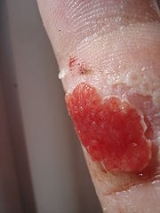
Granulation tissue

Encyclopedia
Granulation tissue is the perfused
, fibrous connective tissue that replaces a fibrin
clot in healing wounds
. Granulation tissue typically grows from the base of a wound and is able to fill wounds of almost any size it heals. In addition, it is also found in ulcers like oesophageal ulcer.
, granulation tissue is:
An excess of granulation tissue (caro luxurians) is informally referred to as "proud flesh."
, a weaker form of the structural protein that can be produced rapidly. This is later replaced by the stronger, long-stranded Type I collagen, as evidenced in scar
tissue.
s, the main cells that deposit granulation tissue, depend on oxygen to proliferate and lay down the new extracellular matrix
.
In vascularisation, also called angiogenesis
, endothelial cells quickly grow into the tissue from older, intact blood vessel
s. These branch out in a systematic way, forming anastomoses
with other vessels.
Perfusion
In physiology, perfusion is the process of nutritive delivery of arterial blood to a capillary bed in the biological tissue. The word is derived from the French verb "perfuser" meaning to "pour over or through."...
, fibrous connective tissue that replaces a fibrin
Fibrin
Fibrin is a fibrous, non-globular protein involved in the clotting of blood. It is a fibrillar protein that is polymerised to form a "mesh" that forms a hemostatic plug or clot over a wound site....
clot in healing wounds
Wound healing
Wound healing, or cicatrisation, is an intricate process in which the skin repairs itself after injury. In normal skin, the epidermis and dermis exists in a steady-state equilibrium, forming a protective barrier against the external environment...
. Granulation tissue typically grows from the base of a wound and is able to fill wounds of almost any size it heals. In addition, it is also found in ulcers like oesophageal ulcer.
Appearance
During the proliferative phase of wound healingWound healing
Wound healing, or cicatrisation, is an intricate process in which the skin repairs itself after injury. In normal skin, the epidermis and dermis exists in a steady-state equilibrium, forming a protective barrier against the external environment...
, granulation tissue is:
- light red or dark pink in color, being perfused (permeated) with new capillary loops or "buds";
- soft to the touch;
- moist; and
- bumpy (granular) in appearance.
Structure
Granulation tissue is composed of tissue matrix supporting a variety of cell types, most of which can be associated with one of the following functions:- extracellular matrixExtracellular matrixIn biology, the extracellular matrix is the extracellular part of animal tissue that usually provides structural support to the animal cells in addition to performing various other important functions. The extracellular matrix is the defining feature of connective tissue in animals.Extracellular...
, - immune systemImmune systemAn immune system is a system of biological structures and processes within an organism that protects against disease by identifying and killing pathogens and tumor cells. It detects a wide variety of agents, from viruses to parasitic worms, and needs to distinguish them from the organism's own...
, or - vascularisationAngiogenesisAngiogenesis is the physiological process involving the growth of new blood vessels from pre-existing vessels. Though there has been some debate over terminology, vasculogenesis is the term used for spontaneous blood-vessel formation, and intussusception is the term for the formation of new blood...
.
An excess of granulation tissue (caro luxurians) is informally referred to as "proud flesh."
Extracellular matrix
The extracellular matrix of granulation tissue is created and modified by fibroblasts. Initially, it consists of a network of Type III collagenCollagen
Collagen is a group of naturally occurring proteins found in animals, especially in the flesh and connective tissues of mammals. It is the main component of connective tissue, and is the most abundant protein in mammals, making up about 25% to 35% of the whole-body protein content...
, a weaker form of the structural protein that can be produced rapidly. This is later replaced by the stronger, long-stranded Type I collagen, as evidenced in scar
Scar
Scars are areas of fibrous tissue that replace normal skin after injury. A scar results from the biological process of wound repair in the skin and other tissues of the body. Thus, scarring is a natural part of the healing process. With the exception of very minor lesions, every wound results in...
tissue.
Immunity
The main immune cells active in the tissue are macrophages and neutrophils, although other leukocytes are also present. These work to phagocytize old or damaged tissue, and protect the healing tissue from pathogenic infection. This is necessary both to aid the healing process and to protect against invading pathogens, as the wound often does not have an effective skin barrier to act as a first line of defense.Vascularization
It is necessary for a network of blood vessels to be established as soon as possible to provide the growing tissue with nutrients, to take away cellular wastes, and transport new leukocytes to the area. FibroblastFibroblast
A fibroblast is a type of cell that synthesizes the extracellular matrix and collagen, the structural framework for animal tissues, and plays a critical role in wound healing...
s, the main cells that deposit granulation tissue, depend on oxygen to proliferate and lay down the new extracellular matrix
Extracellular matrix
In biology, the extracellular matrix is the extracellular part of animal tissue that usually provides structural support to the animal cells in addition to performing various other important functions. The extracellular matrix is the defining feature of connective tissue in animals.Extracellular...
.
In vascularisation, also called angiogenesis
Angiogenesis
Angiogenesis is the physiological process involving the growth of new blood vessels from pre-existing vessels. Though there has been some debate over terminology, vasculogenesis is the term used for spontaneous blood-vessel formation, and intussusception is the term for the formation of new blood...
, endothelial cells quickly grow into the tissue from older, intact blood vessel
Blood vessel
The blood vessels are the part of the circulatory system that transports blood throughout the body. There are three major types of blood vessels: the arteries, which carry the blood away from the heart; the capillaries, which enable the actual exchange of water and chemicals between the blood and...
s. These branch out in a systematic way, forming anastomoses
Anastomosis
An anastomosis is the reconnection of two streams that previously branched out, such as blood vessels or leaf veins. The term is used in medicine, biology, mycology and geology....
with other vessels.