

1975 Atlantic hurricane season

Encyclopedia
The 1975 Atlantic hurricane season officially began on June 1, 1975, and lasted until November 30, 1975. These dates conventionally delimit the period of each year when most tropical cyclone
s form in the Atlantic basin
. The activity level of the season
was average, with nine storms forming of which six reached hurricane strength.
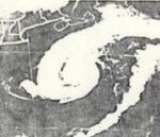
The only notable storm of the season was September's Hurricane Eloise
, which caused heavy damage and 80 deaths in Puerto Rico
, Hispaniola
, and Florida
.
(ACE) rating of 76. ACE is, broadly speaking, a measure of the power of the hurricane multiplied by the length of time it existed, so storms that last a long time, as well as particularly strong hurricanes, have high ACEs. ACE is only calculated for full advisories on tropical systems at or exceeding 34 knots (39 mph, 63 km/h) or tropical storm strength. Subtropical storms are not included, therefore, the subtropical stage of Doris is excluded from the ACE value.
landfall. On June 29, the depression finally organized and intensified enough to become Tropical Storm Amy. Upper-level shear prevented this storm from becoming fully tropical, but the storm strengthened to a 70 mph (112.7 km/h) tropical storm on June 30. Amy maintained that intensity for the next two days, but on July 3, a major trough developed over southeastern Canada
, pulling Amy rapidly out to sea. The storm lost tropical characteristics on July 4.
.
n coast on July 28, and lost all tropical characteristics later that day.
In Atlantic Canada
, the remnants of Blanche produced high winds, gusting up to 70 mph (110 km/h) and moderate rainfall, peaking at 3.1 in (78.7 mm) in Chatham, New Brunswick
.
, it had only minor evidence of a surface circulation. After the storm moved through the northwestern Caribbean Sea
, it started to become more organized, with the depression becoming Tropical Storm Caroline on August 29. Intensification became steadier, with Caroline reaching hurricane strength on August 30. Just prior to its landfall 100 mi (160.9 km) south of Brownsville, Texas
, Caroline rapidly strengthened to a 115 mph (185.1 km/h) major hurricane, but dissipated over land on September 1.
Doris made meteorological history when, on August 31, it became the first Atlantic hurricane ever to be upgraded to hurricane intensity solely on the basis of satellite pictures.
. Tracking generally westward, the cyclone eventually dissipated on September 6.
on September 9.
, it strengthened to a hurricane, but land interaction with Hispanola weakened it to a tropical storm. Eloise moved through the Caribbean and Gulf of Mexico
, where it hit near Panama City, Florida
as a major hurricane.
Eloise caused roughly $490 million ($1.5 billion in 2000 US dollars) in damage and killed 80. Most of the deaths occurred in Puerto Rico
and Hispaniola
, and were the result of torrential rain. Property damage was concentrated in the heavily developed shoreline at Panama City Beach, Florida
, where Eloise caused a 16 ft (4.9 m) storm surge
.
. The depression reached tropical storm strength on 19th, but couldn't strengthen much further due to increasing upper-level shear. It weakened to a tropical depression on September 23, but managed to become a tropical storm again on September 25 and a hurricane on the September 26 due to more favorable conditions. It passed by Bermuda
on the September 27, but the island was spared from major damage. Later that day it turned eastward, and after two days became extratropical.
As the eye of Faye passed roughly 40 mi (65 km) northeast of Bermuda, winds up to 69 mph (111 km/h) and heavy rains were recorded on the island. Up to 2.8 in (71.1 mm) of rain fell in Bermuda from the hurricane. Already severely impacted by flooding from Eloise days earlier, New England
prepared for additional flooding from Faye. The National Weather Service issued flash flood watches, resulting in more evacuations.
. On September 24, it became Tropical Storm Gladys, and on September 25, Hurricane Gladys. Intensification stopped due to the same upper level shear Faye experienced less than a week earlier. After the next week it moved to the northwest. On October 1, as Gladys moved more to the north and northeast, intensification became much more rapid, reaching 140 mph (225.3 km/h) winds at 35º North, an extreme intensity for such a latitude. Not long after did it succumb to cooler waters and upper level shear, and Hurricane Gladys became extratropical on October 4.
on September 25 and tracked westward. By September 28, the depression made landfall in northern Belize before dissipating two days later.
, the depression strengthened while moving northeast towards the central Gulf coast ahead of an advancing cold front. Moving inland late on October 16, the depression became an extratropical cyclone
as it through the Southeast and Mid-Atlantic states, before moving offshore New England. Heavy rains fell along the frontal boundary ahead of the system, leading to flooding across eastern Louisiana, central Mississippi, the western Florida panhandle, central Tennessee, western Virginia, and eastern New York.
The heavy rains which fell upon Jackson, Mississippi
established a new daily rainfall record for October 16 and a new 24-hour rainfall record for the month of October. Eight bridges were damaged across Jackson County, Tennessee due to the floods. Heavy rains led to extensive damage to the soybean and corn crops in Hickman and Marion counties in Tennessee. Six tornadoes touched down in association with this system, with two reported in Alabama, two across northwest Florida, and two across North Carolina. One died due to flooding in Mississippi.
. Tracking northwest, the system dissipated on October 17 north of Puerto Rico.
-Honduras
border and made another landfall in southern Belize shortly before dissipating.
and the Carolinas, gaining tropical characteristics and intensity on the way. Hallie, reaching tropical storm strength on October 26, became extratropical on October 27.
Tropical cyclone
A tropical cyclone is a storm system characterized by a large low-pressure center and numerous thunderstorms that produce strong winds and heavy rain. Tropical cyclones strengthen when water evaporated from the ocean is released as the saturated air rises, resulting in condensation of water vapor...
s form in the Atlantic basin
Atlantic Basin
The Atlantic Basin is the Atlantic Ocean.Atlantic Basin may also refer to:* Atlantic Basin Iron Works, an ironworks that operated in Brooklyn, New York, in the early to mid-20th century...
. The activity level of the season
Atlantic hurricane season
The Atlantic hurricane season is the period in a year when hurricanes usually form in the Atlantic Ocean. Tropical cyclones in the North Atlantic are called hurricanes, tropical storms, or tropical depressions. In addition, there have been several storms over the years that have not been fully...
was average, with nine storms forming of which six reached hurricane strength.
The only notable storm of the season was September's Hurricane Eloise
Hurricane Eloise
Hurricane Eloise was the most destructive tropical cyclone of the 1975 Atlantic hurricane season. The fifth tropical storm, fourth hurricane, and second major hurricane of the season, Eloise formed as a tropical depression on September 13 to the east of the Virgin Islands...
, which caused heavy damage and 80 deaths in Puerto Rico
Puerto Rico
Puerto Rico , officially the Commonwealth of Puerto Rico , is an unincorporated territory of the United States, located in the northeastern Caribbean, east of the Dominican Republic and west of both the United States Virgin Islands and the British Virgin Islands.Puerto Rico comprises an...
, Hispaniola
Hispaniola
Hispaniola is a major island in the Caribbean, containing the two sovereign states of the Dominican Republic and Haiti. The island is located between the islands of Cuba to the west and Puerto Rico to the east, within the hurricane belt...
, and Florida
Florida
Florida is a state in the southeastern United States, located on the nation's Atlantic and Gulf coasts. It is bordered to the west by the Gulf of Mexico, to the north by Alabama and Georgia and to the east by the Atlantic Ocean. With a population of 18,801,310 as measured by the 2010 census, it...
.
Season summary
The season's activity was reflected with a cumulative accumulated cyclone energyAccumulated cyclone energy
Accumulated cyclone energy is a measure used by the National Oceanic and Atmospheric Administration to express the activity of individual tropical cyclones and entire tropical cyclone seasons, particularly the North Atlantic hurricane season. It uses an approximation of the energy used by a...
(ACE) rating of 76. ACE is, broadly speaking, a measure of the power of the hurricane multiplied by the length of time it existed, so storms that last a long time, as well as particularly strong hurricanes, have high ACEs. ACE is only calculated for full advisories on tropical systems at or exceeding 34 knots (39 mph, 63 km/h) or tropical storm strength. Subtropical storms are not included, therefore, the subtropical stage of Doris is excluded from the ACE value.
Tropical Depression One
The first tropical cyclone of the season formed late on June 5 to the northeast of the Bahamas. Steadily tracking northeast, the system did not intensity and was last noted on June 7 over open waters.Tropical Depression Two
On June 24, the season's second tropical depression developed over the central Atlantic. The depression tracked westward for two days before executing a counter-clockwise loop. By June 28, the system had completed the loop and was tracking north. The depression was last noted early on June 29 over open waters.Tropical Storm Amy
The third tropical depression of the season developed from a weak surface trough of low pressure. A circulation developed on June 26, and on June 27, it had become organized enough to be classified a tropical depression. The cyclone moved northward initially, but turned sharply to the east, preventing a North CarolinaNorth Carolina
North Carolina is a state located in the southeastern United States. The state borders South Carolina and Georgia to the south, Tennessee to the west and Virginia to the north. North Carolina contains 100 counties. Its capital is Raleigh, and its largest city is Charlotte...
landfall. On June 29, the depression finally organized and intensified enough to become Tropical Storm Amy. Upper-level shear prevented this storm from becoming fully tropical, but the storm strengthened to a 70 mph (112.7 km/h) tropical storm on June 30. Amy maintained that intensity for the next two days, but on July 3, a major trough developed over southeastern Canada
Canada
Canada is a North American country consisting of ten provinces and three territories. Located in the northern part of the continent, it extends from the Atlantic Ocean in the east to the Pacific Ocean in the west, and northward into the Arctic Ocean...
, pulling Amy rapidly out to sea. The storm lost tropical characteristics on July 4.
Tropical Depression Four
On July 4, a tropical depression formed northeast of the Bahamas. Tracking northeastward, the system did not intensify and was last noted over open waters midday on July 5.Tropical Depression Five
On July 12, a slow moving depression formed over the central Atlantic. Tracking southwestward, the cyclone dissipated the following day.Tropical Depression Six
A brief depression existed in the Gulf of Mexico between July 18 and July 19. Before dissipating, the system made landfall near Veracruz, MexicoVeracruz, Veracruz
Veracruz, officially known as Heroica Veracruz, is a major port city and municipality on the Gulf of Mexico in the Mexican state of Veracruz. The city is located in the central part of the state. It is located along Federal Highway 140 from the state capital Xalapa, and is the state's most...
.
Hurricane Blanche
The tropical depression that became Hurricane Blanche formed from a tropical wave on July 24 while 500 mi (804.7 km) north of Hispanola. It moved northwestward for the following days, but as it turned northeastward, it rapidly intensified, first to a tropical storm on July 26, then to a hurricane on July 27. The hurricane crossed the Nova ScotiaNova Scotia
Nova Scotia is one of Canada's three Maritime provinces and is the most populous province in Atlantic Canada. The name of the province is Latin for "New Scotland," but "Nova Scotia" is the recognized, English-language name of the province. The provincial capital is Halifax. Nova Scotia is the...
n coast on July 28, and lost all tropical characteristics later that day.
In Atlantic Canada
Atlantic Canada
Atlantic Canada is the region of Canada comprising the four provinces located on the Atlantic coast, excluding Quebec: the three Maritime provinces – New Brunswick, Prince Edward Island, and Nova Scotia – and Newfoundland and Labrador...
, the remnants of Blanche produced high winds, gusting up to 70 mph (110 km/h) and moderate rainfall, peaking at 3.1 in (78.7 mm) in Chatham, New Brunswick
Chatham, New Brunswick
Chatham is a Canadian urban neighbourhood in the city of Miramichi, New Brunswick.Prior to municipal amalgamation in 1995, Chatham was an incorporated town in Northumberland County along the south bank of the Miramichi River opposite Douglastown...
.
Tropical Depression Eight
On July 24, the eighth tropical depression of the season formed over the southwestern Gulf of Mexico. Deep convection associated with the system persisted around the center of circulation. Forecasters at the time anticipated the depression to intensify into a tropical storm before moving over land. Not long after forming, the depression made landfall in Tampico, Mexico at peak intensity; a barometric pressure of 1007 mbar (hPa; 29.74 inHg) was recorded in the city with sustained winds of 37 mph (60 km/h). Just prior to this, an air force reconnaissance mission into the cyclone found 50 mph (85 km/h) winds; however, due to the interaction with land, the NHC did not upgrade the depression. The system was no longer monitored by the NHC after landfall.Tropical Depression Nine
A tropical depression formed in the northeast Gulf of Mexico on July 28, moving west-northwest into the Mouth of the Mississippi river at the end of the month. The system slowly tracked through Louisiana and Arkansas over the next couple days, dropping heavy rains primarily to the right of its track across southern Alabama and the western Florida panhandle.Hurricane Caroline
Hurricane Caroline began as a tropical depression on August 24 from a tropical wave, located 200 mi (321.9 km) north of Hispanola. As it moved west-southwestward, it failed to strengthen further, and after it crossed CubaCuba
The Republic of Cuba is an island nation in the Caribbean. The nation of Cuba consists of the main island of Cuba, the Isla de la Juventud, and several archipelagos. Havana is the largest city in Cuba and the country's capital. Santiago de Cuba is the second largest city...
, it had only minor evidence of a surface circulation. After the storm moved through the northwestern Caribbean Sea
Caribbean Sea
The Caribbean Sea is a sea of the Atlantic Ocean located in the tropics of the Western hemisphere. It is bounded by Mexico and Central America to the west and southwest, to the north by the Greater Antilles, and to the east by the Lesser Antilles....
, it started to become more organized, with the depression becoming Tropical Storm Caroline on August 29. Intensification became steadier, with Caroline reaching hurricane strength on August 30. Just prior to its landfall 100 mi (160.9 km) south of Brownsville, Texas
Brownsville, Texas
Brownsville is a city in the southernmost tip of the state of Texas, in the United States. It is located on the northern bank of the Rio Grande, directly north and across the border from Matamoros, Tamaulipas, Mexico. Brownsville is the 16th largest city in the state of Texas with a population of...
, Caroline rapidly strengthened to a 115 mph (185.1 km/h) major hurricane, but dissipated over land on September 1.
Hurricane Doris
The subtropical storm that became Hurricane Doris formed from a frontal low on August 28 over the north-central Atlantic. Subtropical Storm One moved to the northwest, where it gained tropical characteristics. On August 31, it was designated Hurricane Doris. It peaked as a 105 mi/h hurricane, but a nontropical low-pressure system caused the storm to lose its tropical characteristics on September 4.Doris made meteorological history when, on August 31, it became the first Atlantic hurricane ever to be upgraded to hurricane intensity solely on the basis of satellite pictures.
Tropical Depression Twelve
On September 3, an unusual tropical depression developed near the coast of southern MoroccoMorocco
Morocco , officially the Kingdom of Morocco , is a country located in North Africa. It has a population of more than 32 million and an area of 710,850 km², and also primarily administers the disputed region of the Western Sahara...
. Tracking generally westward, the cyclone eventually dissipated on September 6.
Tropical Depression Thirteen
Hours after Tropical Depression Twelve formed near the African coast on September 3, another tropical depression developed near the southwestern Cape Verde Islands. Generally tracking west, the depression eventually dissipated near the Lesser AntillesLesser Antilles
The Lesser Antilles are a long, partly volcanic island arc in the Western Hemisphere. Most of its islands form the eastern boundary of the Caribbean Sea with the Atlantic Ocean, with the remainder located in the southern Caribbean just north of South America...
on September 9.
Tropical Depression Fourteen
On September 5, the season's fourteenth tropical depression formed over the southwestern Gulf of Mexico. Tracking northwestward, the system nearly attained tropical storm-status; however, it made landfall later that day near Tampico, Mexico and dissipated not long after.Tropical Depression Fifteen
The fifteenth cyclone of the year developed near Bermuda on September 11. Initially, the depression drifted northeastward but later accelerated and dissipated by September 14.Hurricane Eloise
Hurricane Eloise formed from a tropical wave on September 13. As it moved westward north of the Lesser AntillesLesser Antilles
The Lesser Antilles are a long, partly volcanic island arc in the Western Hemisphere. Most of its islands form the eastern boundary of the Caribbean Sea with the Atlantic Ocean, with the remainder located in the southern Caribbean just north of South America...
, it strengthened to a hurricane, but land interaction with Hispanola weakened it to a tropical storm. Eloise moved through the Caribbean and Gulf of Mexico
Gulf of Mexico
The Gulf of Mexico is a partially landlocked ocean basin largely surrounded by the North American continent and the island of Cuba. It is bounded on the northeast, north and northwest by the Gulf Coast of the United States, on the southwest and south by Mexico, and on the southeast by Cuba. In...
, where it hit near Panama City, Florida
Panama City, Florida
-Personal income:The median income for a household in the city was $31,572, and the median income for a family was $40,890. Males had a median income of $30,401 versus $21,431 for females. The per capita income for the city was $17,830...
as a major hurricane.
Eloise caused roughly $490 million ($1.5 billion in 2000 US dollars) in damage and killed 80. Most of the deaths occurred in Puerto Rico
Puerto Rico
Puerto Rico , officially the Commonwealth of Puerto Rico , is an unincorporated territory of the United States, located in the northeastern Caribbean, east of the Dominican Republic and west of both the United States Virgin Islands and the British Virgin Islands.Puerto Rico comprises an...
and Hispaniola
Hispaniola
Hispaniola is a major island in the Caribbean, containing the two sovereign states of the Dominican Republic and Haiti. The island is located between the islands of Cuba to the west and Puerto Rico to the east, within the hurricane belt...
, and were the result of torrential rain. Property damage was concentrated in the heavily developed shoreline at Panama City Beach, Florida
Panama City Beach, Florida
Panama City Beach is a city in Bay County, Florida, United States, on the Gulf of Mexico coast. The city is often referred to under the umbrella term of "Panama City", despite being a distinct municipality from the older and larger inland Panama City to the east, making Panama City and Panama City...
, where Eloise caused a 16 ft (4.9 m) storm surge
Storm surge
A storm surge is an offshore rise of water associated with a low pressure weather system, typically tropical cyclones and strong extratropical cyclones. Storm surges are caused primarily by high winds pushing on the ocean's surface. The wind causes the water to pile up higher than the ordinary sea...
.
Hurricane Faye
The tropical depression that became Hurricane Faye developed from a tropical wave on September 18, located 500 mi (804.7 km) west of Cape VerdeCape Verde
The Republic of Cape Verde is an island country, spanning an archipelago of 10 islands located in the central Atlantic Ocean, 570 kilometres off the coast of Western Africa...
. The depression reached tropical storm strength on 19th, but couldn't strengthen much further due to increasing upper-level shear. It weakened to a tropical depression on September 23, but managed to become a tropical storm again on September 25 and a hurricane on the September 26 due to more favorable conditions. It passed by Bermuda
Bermuda
Bermuda is a British overseas territory in the North Atlantic Ocean. Located off the east coast of the United States, its nearest landmass is Cape Hatteras, North Carolina, about to the west-northwest. It is about south of Halifax, Nova Scotia, Canada, and northeast of Miami, Florida...
on the September 27, but the island was spared from major damage. Later that day it turned eastward, and after two days became extratropical.
As the eye of Faye passed roughly 40 mi (65 km) northeast of Bermuda, winds up to 69 mph (111 km/h) and heavy rains were recorded on the island. Up to 2.8 in (71.1 mm) of rain fell in Bermuda from the hurricane. Already severely impacted by flooding from Eloise days earlier, New England
New England
New England is a region in the northeastern corner of the United States consisting of the six states of Maine, New Hampshire, Vermont, Massachusetts, Rhode Island, and Connecticut...
prepared for additional flooding from Faye. The National Weather Service issued flash flood watches, resulting in more evacuations.
Hurricane Gladys
A tropical depression formed from a tropical wave on September 22 in the tropical Atlantic OceanAtlantic Ocean
The Atlantic Ocean is the second-largest of the world's oceanic divisions. With a total area of about , it covers approximately 20% of the Earth's surface and about 26% of its water surface area...
. On September 24, it became Tropical Storm Gladys, and on September 25, Hurricane Gladys. Intensification stopped due to the same upper level shear Faye experienced less than a week earlier. After the next week it moved to the northwest. On October 1, as Gladys moved more to the north and northeast, intensification became much more rapid, reaching 140 mph (225.3 km/h) winds at 35º North, an extreme intensity for such a latitude. Not long after did it succumb to cooler waters and upper level shear, and Hurricane Gladys became extratropical on October 4.
Tropical Depression Nineteen
A slow moving depression formed near the Gulf of HondurasGulf of Honduras
The Gulf or Bay of Honduras is a large inlet of the Caribbean Sea, indenting the coasts of Belize, Guatemala, and Honduras. From north to south, it runs for approximately 200 km from Dangriga, Belize, to La Ceiba, Honduras....
on September 25 and tracked westward. By September 28, the depression made landfall in northern Belize before dissipating two days later.
Tropical Depression Twenty
On October 1, a fast-moving tropical depression formed in the northern Gulf of Mexico. By the afternoon, the cyclone made landfall near Panama City, Florida before dissipating that evening.Tropical Depression Twenty-One
On October 3, a tropical depression of the year developed over the northeastern Atlantic. The system tracked in a curved westward track and dissipated on October 5.Tropical Depression Twenty-Two
A tropical depression formed in the southern Gulf of Mexico on October 14. Rounding the western periphery of the subtropical ridgeSubtropical ridge
The subtropical ridge is a significant belt of high pressure situated around the latitudes of 30°N in the Northern Hemisphere and 30°S in the Southern Hemisphere. It is characterized by mostly calm winds, which acts to reduce air quality under its axis by causing fog overnight, and haze during...
, the depression strengthened while moving northeast towards the central Gulf coast ahead of an advancing cold front. Moving inland late on October 16, the depression became an extratropical cyclone
Extratropical cyclone
Extratropical cyclones, sometimes called mid-latitude cyclones or wave cyclones, are a group of cyclones defined as synoptic scale low pressure weather systems that occur in the middle latitudes of the Earth having neither tropical nor polar characteristics, and are connected with fronts and...
as it through the Southeast and Mid-Atlantic states, before moving offshore New England. Heavy rains fell along the frontal boundary ahead of the system, leading to flooding across eastern Louisiana, central Mississippi, the western Florida panhandle, central Tennessee, western Virginia, and eastern New York.
The heavy rains which fell upon Jackson, Mississippi
Jackson, Mississippi
Jackson is the capital and the most populous city of the US state of Mississippi. It is one of two county seats of Hinds County ,. The population of the city declined from 184,256 at the 2000 census to 173,514 at the 2010 census...
established a new daily rainfall record for October 16 and a new 24-hour rainfall record for the month of October. Eight bridges were damaged across Jackson County, Tennessee due to the floods. Heavy rains led to extensive damage to the soybean and corn crops in Hickman and Marion counties in Tennessee. Six tornadoes touched down in association with this system, with two reported in Alabama, two across northwest Florida, and two across North Carolina. One died due to flooding in Mississippi.
Tropical Depression Twenty-Three
A short-lived depression formed late on October 15 near the Leeward IslandsLeeward Islands
The Leeward Islands are a group of islands in the West Indies. They are the northern islands of the Lesser Antilles chain. As a group they start east of Puerto Rico and reach southward to Dominica. They are situated where the northeastern Caribbean Sea meets the western Atlantic Ocean...
. Tracking northwest, the system dissipated on October 17 north of Puerto Rico.
Tropical Depression Twenty-Four
Tropical Depression Twenty-Four formed on October 26 over the southwestern Caribbean Sea and tracked northwest. After turning nearly due west, the depression briefly made landfall near the NicaraguaNicaragua
Nicaragua is the largest country in the Central American American isthmus, bordered by Honduras to the north and Costa Rica to the south. The country is situated between 11 and 14 degrees north of the Equator in the Northern Hemisphere, which places it entirely within the tropics. The Pacific Ocean...
-Honduras
Honduras
Honduras is a republic in Central America. It was previously known as Spanish Honduras to differentiate it from British Honduras, which became the modern-day state of Belize...
border and made another landfall in southern Belize shortly before dissipating.
Tropical Storm Hallie
Tropical Storm Hallie began as a subtropical depression on October 24 100 mi (160.9 km) off the coast of Florida, forming from the combination of a frontal zone and a tropical wave. The depression paralleled the coasts of GeorgiaGeorgia (U.S. state)
Georgia is a state located in the southeastern United States. It was established in 1732, the last of the original Thirteen Colonies. The state is named after King George II of Great Britain. Georgia was the fourth state to ratify the United States Constitution, on January 2, 1788...
and the Carolinas, gaining tropical characteristics and intensity on the way. Hallie, reaching tropical storm strength on October 26, became extratropical on October 27.
Tropical Depression Twenty-Six
On November 8, the season's twenty-sixth tropical depression developed off the coast of Honduras. Moving towards the north-northwest, the system gradually intensified. Between November 9 and 10, reconnaissance missions into the depression found winds of 40 mph (65 km/h) and a minimum pressure of 1004 mbar (hPa); however, the NHC did not upgrade it to a tropical storm as it began to weaken shortly after. Over the following few days, the system gradually turned to the south and made landfall in the southwestern edge of the Yucatan Peninsula on November 12 shortly before dissipating.Tropical Depression Twenty-Seven
In late November, another tropical depression formed over the central Atlantic. A short-lived system, Tropical Depression Twenty-Seven formed on November 29 and dissipated on December 1.Subtropical Storm Two
An extratropical low pressure system moved southward in early December, gaining some tropical characteristics on the way. On December 9, it was declared a subtropical storm, and it reached its peak of 70 mph (112.7 km/h) the next day. After moving southward for the first three days, it moved eastward where it met its demise.Season effects
This is a table of the storms in 1975 and their landfall(s), if any. Deaths in parentheses are additional and indirect (an example of an indirect death would be a traffic accident), but are still storm-related. Damage and deaths include totals while the storm was extratropical or a wave or low.Storm names
The following names were used for named storms (tropical storms and hurricanes) that formed in the North Atlantic in 1975. Storms were named Amy, Caroline, Doris, Eloise and Faye for the first time in 1975. Names that were not assigned are marked in .
|
|
Retirement
The name Eloise was later retired.See also
- List of Atlantic hurricanes
- List of Atlantic hurricane seasons
- 1975 Pacific hurricane season1975 Pacific hurricane seasonThe 1975 Pacific hurricane season officially started May 15, 1975 in the eastern Pacific, and June 1, 1975 in the central Pacific, and lasted until November 30, 1975. These dates conventionally delimit the period of each year when most tropical cyclones form in the northeast Pacific Ocean.The 1975...
- 1975 Pacific typhoon season1975 Pacific typhoon seasonThe 1975 Pacific typhoon season has no official bounds; it ran year-round in 1975, but most tropical cyclones tend to form in the northwestern Pacific Ocean between June and December...
- 1975 North Indian Ocean cyclone season
- Southern Hemisphere tropical cyclone seasons: 1974–75, 1975–76