


1850s in fashion

Encyclopedia
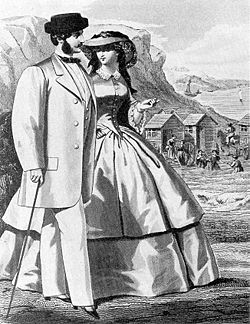
Western culture
Western culture, sometimes equated with Western civilization or European civilization, refers to cultures of European origin and is used very broadly to refer to a heritage of social norms, ethical values, traditional customs, religious beliefs, political systems, and specific artifacts and...
and Western-influenced clothing
Clothing
Clothing refers to any covering for the human body that is worn. The wearing of clothing is exclusively a human characteristic and is a feature of nearly all human societies...
is characterized by an increase in the width of women's skirt
Skirt
A skirt is a tube- or cone-shaped garment that hangs from the waist and covers all or part of the legs.In the western world, skirts are usually considered women's clothing. However, there are exceptions...
s supported by crinoline
Crinoline
Crinoline was originally a stiff fabric with a weft of horse-hair and a warp of cotton or linen thread. The fabric first appeared around 1830, but by 1850 the word had come to mean a stiffened petticoat or rigid skirt-shaped structure of steel designed to support the skirts of a woman’s dress into...
s or hoops, and the beginnings of dress reform
Victorian dress reform
During the middle and late Victorian period, various reformers proposed, designed, and wore clothing supposedly more rational and comfortable than the fashions of the time. This was known as the dress reform or rational dress movement...
.
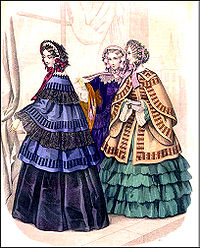
Gowns
1840s in fashion
1840s fashion in European and European-influenced clothing is characterized by a narrow, natural shoulder line following the exaggerated puffed sleeves of the later 1820s and 1830s...
continued to expand. Skirts were made fuller by means of flounces (deep ruffle
Ruffle
In sewing and dressmaking, a ruffle, frill, or furbelow is a strip of fabric, lace or ribbon tightly gathered or pleated on one edge and applied to a garment, bedding, or other textile as a form of trimming...
s), usually in tiers of three, gather
Gather (sewing)
Gathering is a sewing technique for shortening the length of a strip of fabric so that the longer piece can be attached to a shorter piece. It is commonly used in clothing to manage fullness, as when a full sleeve is attached to the armscye or cuff of a shirt, or when a skirt is attached to a...
ed tightly at the top and stiffened with horsehair braid at the bottom.
Early in the decade, bodices of day dresses featured panels over the shoulder that were gathered into a blunt point at the slightly dropped waist. These bodices generally fastened in back by means of hooks and eyes, but a new fashion for a [jacket] bodice appeared as well, button
Button
In modern clothing and fashion design, a button is a small fastener, most commonly made of plastic, but also frequently of seashell, which secures two pieces of fabric together. In archaeology, a button can be a significant artifact. In the applied arts and in craft, a button can be an example of...
ed in front and worn over a chemisette
Chemisette
A Chemisette is an article of women's clothing worn to fill in the front and neckline of any garment. Chemisettes give the appearance of a blouse or shirt worn under the outer garment without adding bulk at the waist or upper arm.Chemisettes of linen or cotton were often worn with day dresses in...
. Wider bell-shaped or pagoda sleeves were worn over false undersleeves or engageante
Engageante
Engageantes are false sleeves worn with women's clothing in the 18th and 19th centuries.In the 18th century, engageantes took the form of ruffles or flounces of linen, cotton, or lace, tacked to the elbow-length sleeves then fashionable....
s of cotton or linen, trimmed in lace, broderie anglaise
Broderie Anglaise
Broderie Anglaise is a whitework needlework technique incorporating features of embroidery, cutwork and needle lace that arose in England in the 19th century....
, or other fancy-work. Separate small collars of lace, tatting
Tatting
Tatting is a technique for handcrafting a particularly durable lace constructed by a series of knots and loops. Tatting can be used to make lace edging as well as doilies, collars, and other decorative pieces. The lace is formed by a pattern of rings and chains formed from a series of cow hitch,...
, or crochet
Crochet
Crochet is a process of creating fabric from yarn, thread, or other material strands using a crochet hook. The word is derived from the French word "crochet", meaning hook. Hooks can be made of materials such as metals, woods or plastic and are commercially manufactured as well as produced by...
-work were worn with day dresses, sometimes with a ribbon bow.
Evening gowns were very low-necked, falling off the shoulders, and had short sleeves.
The introduction of the steel cage crinoline in 1856 provided a means for expanding the skirt still further, and flounces gradually disappeared in favor of a skirt lying more smoothly over the petticoat
Petticoat
A petticoat or underskirt is an article of clothing for women; specifically an undergarment to be worn under a skirt or a dress. The petticoat is a separate garment hanging from the waist ....
and hoops. Pantalettes
Pantalettes
Pantalettes are undergarments covering the legs worn by women, girls, and very young boys in the early- to mid-nineteenth century....
were essential under this new fashion for modesty's sake.
Fabrics
Special dress fabricTextile
A textile or cloth is a flexible woven material consisting of a network of natural or artificial fibres often referred to as thread or yarn. Yarn is produced by spinning raw fibres of wool, flax, cotton, or other material to produce long strands...
s were printed à la disposition, with a small figured print over most of the fabric and an elaborate coordinating border print down one selvage
Selvage
The selvage or selvedge is the term for the self-finished edges of fabric. The selvages keep the fabric from unraveling or fraying. The selvages are a result of how the fabric is created...
. Dresses were made up so the border print decorated the flounces and parts of the bodice
Bodice
A bodice, historically, is an article of clothing for women, covering the body from the neck to the waist. In modern usage it typically refers to a specific type of upper garment common in Europe during the 16th to the 18th century, or to the upper portion of a modern dress to distinguish it from...
or sleeve
Sleeve
Sleeve is that part of a garment which covers the arm, or through which the arm passes or slips. The pattern of the sleeve is one of the characteristics of fashion in dress, varying in every country and period...
s.
Outerwear
Cape-like jacketsCoat (clothing)
A coat is a long garment worn by both men and women, for warmth or fashion. Coats typically have long sleeves and are open down the front, closing by means of buttons, zippers, hook-and-loop fasteners, toggles, a belt, or a combination of some of these...
were worn over the very wide skirts. Another fashionable outer garment was an India
India
India , officially the Republic of India , is a country in South Asia. It is the seventh-largest country by geographical area, the second-most populous country with over 1.2 billion people, and the most populous democracy in the world...
n shawl
Shawl
A shawl is a simple item of clothing, loosely worn over the shoulders, upper body and arms, and sometimes also over the head. It is usually a rectangular or square piece of cloth, that is often folded to make a triangle but can also be triangular in shape...
or one woven in Paisley, Renfrewshire in a paisley pattern
Paisley (design)
Paisley or Paisley pattern is a droplet-shaped vegetable motif of Indian, Pakistani and Persian origin. The pattern is sometimes called "Persian pickles" by American traditionalists, especially quiltmakers,The Persian Pickle Club, Sandra Dallas. St. Martin's Press,...
in imitation of Indian styles. Hooded cloak
Cloak
A cloak is a type of loose garment that is worn over indoor clothing and serves the same purpose as an overcoat; it protects the wearer from the cold, rain or wind for example, or it may form part of a fashionable outfit or uniform. Cloaks are as old as human history; there has nearly always been...
s were also worn.
Riding habit
Riding habit
A riding habit is women's clothing for horseback riding.Since the mid-17th century, a formal habit for riding sidesaddle usually consisted of:* A tailored jacket with a long skirt to match* A tailored shirt or chemisette...
s had fitted jackets with tight sleeves, worn over a collared shirt or (more often) chemisette. They were worn with long skirts and mannish top hats.
Hairstyles and headgear
HairHair
Hair is a filamentous biomaterial, that grows from follicles found in the dermis. Found exclusively in mammals, hair is one of the defining characteristics of the mammalian class....
was dressed simply, middle parted and in a bun
Bun
A bun is a small, usually sweet, bread. Commonly they are hand-sized or smaller, domed in shape, with a flat bottom. A bun can also be a savory bread roll similar to a bap or barmcake....
or wound braid at the back, with the sides puffed out over the ears or with clusters of curls to either side in imitation of early 17th century fashions.
The indoor cap
Cap
A cap is a form of headgear. Caps have crowns that fit very close to the head and have no brim or only a visor. They are typically designed for warmth and, when including a visor, blocking sunlight from the eyes...
became little more than a lace and ribbon frill worn on the back of the head.
Beginnings of dress reform
1851 marked the birth of the Victorian dress reformVictorian dress reform
During the middle and late Victorian period, various reformers proposed, designed, and wore clothing supposedly more rational and comfortable than the fashions of the time. This was known as the dress reform or rational dress movement...
movement, when New England
New England
New England is a region in the northeastern corner of the United States consisting of the six states of Maine, New Hampshire, Vermont, Massachusetts, Rhode Island, and Connecticut...
temperance
Temperance movement
A temperance movement is a social movement urging reduced use of alcoholic beverages. Temperance movements may criticize excessive alcohol use, promote complete abstinence , or pressure the government to enact anti-alcohol legislation or complete prohibition of alcohol.-Temperance movement by...
activist Libby Miller
Elizabeth Smith Miller
Elizabeth Smith Miller , known as 'Libby' was an advocate and financial supporter of the women’s rights movement and the daughter of antislavery philanthropist Gerrit Smith and spouse, the abolitionist Ann Carroll Fitzhugh. Elizabeth Miller was born September 20, 1822. In 1843, Elizabeth married...
adopted what she considered a more rational costume: loose trousers
Trousers
Trousers are an item of clothing worn on the lower part of the body from the waist to the ankles, covering both legs separately...
gathered at the ankles, topped by a short dress or skirt and vest. The style was promoted by editor Amelia Bloomer
Amelia Bloomer
Amelia Jenks Bloomer was an American women's rights and temperance advocate. Even though she did not create the women's clothing reform style known as bloomers, her name became associated with it because of her early and strong advocacy.-Early life:Bloomer came from a family of modest means and...
and was immediately christened a Bloomer suit
Bloomers (clothing)
Bloomers is a word which has been applied to several types of divided women's garments for the lower body at various times.-Fashion bloomers :...
by the press. Despite its practicality , the Bloomer suit was the subject of much ridicule in the press and had little impact on mainstream fashion.
Style gallery 1850–1855
- The Bloomer suit, a short dress worn over full trousers gathered at the ankle, briefly adopted by dress reformers in the United StatesUnited StatesThe United States of America is a federal constitutional republic comprising fifty states and a federal district...
in the 1850s. - Male outdoors attire and female riding-habit of 1850 (New York).
- 1851 Parisian fashion plate shows the fashionable use of fabrics printed â la disposition (with border-prints) on skirt flounces and for bodices and sleeves.
- Madame Moitessier wears a black off-the-shoulder evening gown with ruffles. She wears a brooch and bracelets on both wrists. France, 1851.
- Mrs. Coventry Patmore wears a small fancy-work collar and a ribbon at her throat. Her thick, wavy hair is parted in the center and poufed over her ears, 1851.
- Matilde Juva-Branca wears a dark day dress with a lace blouse or chemisette and cuffs and short leather gloves. Her hair is parted and worn in long sausage curls, 1851.
- Doña Josefa García Solis wears a simple green satin dress with laced short sleeves over a linen chemise or chemisette. Her lace cap is trimmed with rose-colored tassels and ribbons, and she carries an elaborate fan, 1852.
- Doña Amalie de Llano y Dotres, Condesa de Vilches wears a bright blue dress with a tiered skirt. The long pointed bodice is trimmed with horizontal bands of ruching over a chemise or chemisette (or an underlayer styled to look like a chemise), 1853.
- A reform corset from Madame Caplin. This corset was adjusted to the body, not to the dress as before.
Style gallery 1855–1859
- Empress Eugenie and her Ladies in Waiting wear formal dress (despite the outdoor setting). The hair styled with ringlets or curls on the sides and a small bun in back is typical. 1855.
- French plaid silk taffeta day dress has wide sleeves with box-pleated frills. c. 1855. Los Angeles County Museum of ArtLos Angeles County Museum of ArtThe Los Angeles County Museum of Art is an art museum in Los Angeles, California. It is located on Wilshire Boulevard along Museum Row in the Miracle Mile vicinity of Los Angeles, adjacent to the George C. Page Museum and La Brea Tar Pits....
, M.2007.211.767. - Mme Moitessier wears a floral day dress with ribbon streamers. Her lace cap is little more than a frill trimmed in red ribbons. 1856.
- Charlotte Cushman wears her hair parted in the center and brushed into puffs over each ear. Her day dress has wide pagoda sleeves and is worn over undersleeves or engageanteEngageanteEngageantes are false sleeves worn with women's clothing in the 18th and 19th centuries.In the 18th century, engageantes took the form of ruffles or flounces of linen, cotton, or lace, tacked to the elbow-length sleeves then fashionable....
s. The high neckline is set off with a white collar. American, 1857. - "Going Swimming Fully Dressed" or swimsuitSwimsuitA swimsuit, bathing suit, or swimming costume is an item of clothing designed to be worn by men, women or children while they are engaging in a water-based activity or water sports, such as swimming, water polo, diving, surfing, water skiing, or during activities in the sun, such as sun bathing.A...
of 1858 is styled like a Bloomer suit (acceptable in the context of beachwear), and includes a cap to confine the hair. - Fashion plate from Godey's Magazine, with full-blown little girl's crinoline.
- Countess Alexander Nikolaevitch Lamsdorff wears a day dress with ruched violet ribbon trim and an elaborate lace collar, 1859. The violet trim and black cap may indicate the later stages of mourningMourningMourning is, in the simplest sense, synonymous with grief over the death of someone. The word is also used to describe a cultural complex of behaviours in which the bereaved participate or are expected to participate...
. - Jacket from Godey's Lady's BookGodey's Lady's BookGodey's Lady's Book, alternatively known as Godey's Magazine and Lady's Book, was a United States magazine which was published in Philadelphia. It was the most widely circulated magazine in the period before the Civil War. Its circulation rose from 70,000 in the 1840s to 150,000 in 1860...
, December 1859. Colorful, braid-trimmed Zouave jacketZouave jacketA Zouave jacket is a short open fronted jacket with long sleeves, similar to that historically worn by Zouaves.It was a popular women's fashion in the 19th century in the United States. Colorful, braid-trimmed Zouave jackets became fashionable in the late 1850s and remained so well into the 1860s...
s based on military styles became fashionable in the late 1850s and remained so well into the 1860s.
Caricature gallery
The crinoline style gave wide scope to satirists, and many cartoons and comic odes to the crinoline appeared.- "A Splendid Spread", satire on an early inflatable (air tube) version of the crinoline by George CruikshankGeorge CruikshankGeorge Cruikshank was a British caricaturist and book illustrator, praised as the "modern Hogarth" during his life. His book illustrations for his friend Charles Dickens, and many other authors, reached an international audience.-Early life:Cruikshank was born in London...
, from The Comic Almanack, 1850. (Crinolines did not actually come into wide use until about 1854.) - Cutaway view of a flounced skirt over a crinoline, Punch magazine, August 1856.
- A satirical cartoon from the July 11th 1857 issue of Harper's WeeklyHarper's WeeklyHarper's Weekly was an American political magazine based in New York City. Published by Harper & Brothers from 1857 until 1916, it featured foreign and domestic news, fiction, essays on many subjects, and humor...
, contrasting the supposedly becoming styles of the time with the supposedly ugly Grecian-influenced Empire/Regency styles of an earlier generation...
See also: http://www.wisconsinhistory.org/patterns/largeversion.asp?imagename=belles-lg.gif
The Comparative Sizes of Bell(e)s
Men's fashion
Shirt
A shirt is a cloth garment for the upper body. Originally an undergarment worn exclusively by men, it has become, in American English, a catch-all term for almost any garment other than outerwear such as sweaters, coats, jackets, or undergarments such as bras, vests or base layers...
s of linen or cotton featured high upstanding or turnover collars
Collar (clothing)
In clothing, a collar is the part of a shirt, dress, coat or blouse that fastens around or frames the neck. Among clothing construction professionals, a collar is differentiated from other necklines such as revers and lapels, by being made from a separate piece of fabric, rather than a folded or...
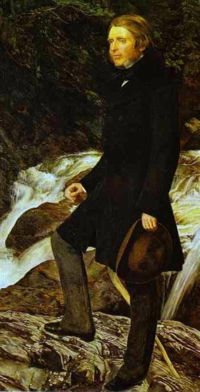
. The newly fashionable four-in-hand neckties were square or rectangular, folded into a narrow strip and tied in a bow, or folded on the diagonal and tied in a knot with the pointed ends sticking out to form "wings". Heavy padded and fitted frock coat
Frock coat
A frock coat is a man's coat characterised by knee-length skirts all around the base, popular during the Victorian and Edwardian periods. The double-breasted style is sometimes called a Prince Albert . The frock coat is a fitted, long-sleeved coat with a centre vent at the back, and some features...
s (in French redingote
Redingote
The redingote is a type of coat that has had several forms over time. The name is derived from a French alteration of the English "riding coat", an example of reborrowing.-Women's redingote:...
s), now usually single-breasted, were worn for business occasions, over waistcoats or vests with lapels and notched collars. Waistcoats were still cut straight across at the waist in front in 1850, but gradually became longer; the fashion for wearing the bottom button undone for ease when sitting lead to the pointed-hemmed waistcoat later in the century.
A new style, the sack coat, loosely fitted and reaching to mid-thigh, was fashionable for leisure activities; it would gradually replace the frock coat over the next forty years and become the modern suit coat.
The slightly cutaway morning coat was worn for formal day occasions. The most formal evening dress
Formal wear
Formal wear and formal dress are the general terms for clothing suitable for formal social events, such as a wedding, formal garden party or dinner, débutante cotillion, dance, or race...
remained a dark tail coat and trousers, with a white cravat; this costume was well on its way to crystallizing into the modern "white tie and tails".
Full-length trousers
Trousers
Trousers are an item of clothing worn on the lower part of the body from the waist to the ankles, covering both legs separately...
were worn for day. Breeches remained a requirement for formal functions at the British court (as they would be throughout the century). Breeches continued to be worn for horseback riding and other country pursuits, especially in Britain, with tall fitted boots.
Costumes consisting of a coat, waistcoat and trousers of the same fabric were a novelty of this period.
Starting in the 1850s and surviving until about the early 1900s facial hair became extremely popular, featuring a vast array of styles. This is well documented in famous photography of the era.
Tall top hat
Top hat
A top hat, beaver hat, high hat silk hat, cylinder hat, chimney pot hat or stove pipe hat is a tall, flat-crowned, broad-brimmed hat, predominantly worn from the latter part of the 18th to the middle of the 20th century...
s were worn with formal dress and grew taller on the way to the true stovepipe shape, but a variety of other hat shapes were popular. Soft-crowned hats, some with wide brims, were worn for country pursuits. The bowler hat
Bowler hat
The bowler hat, also known as a coke hat, derby , billycock or bombin, is a hard felt hat with a rounded crown originally created in 1849 for the English soldier and politician Edward Coke, the younger brother of the 2nd Earl of Leicester...
was invented in 1850 but remained a working-class accessory.
Style gallery
- Painter G.P.A. Healy wears a shirt with a round-cornered collar and a pleated front. His necktie is tied in a small bow. America, c. 1850.
- James Fennimore Cooper wears a standing collar with a necktie folded on the diagonal and tied into wide "wings". His coat has wide lapels and a contrasting (perhaps velvet) collar. His contrasting waistcoat has lapels. United States, c. 1850 (Cooper died in 1851).
- Fashions of 1856 show an idealized rounded chest over a low waist. The cutaway morning coat (left) is worn with trousers trimmed with braid down the outer seam. Shirts have short straight collars and are worn with narrow neckties tied in wide bows. Half-boots have short heels. Coat sleeves are cut long, showing very little shirt cuff.
- 1857 fashion plate shows formal evening wear, informal day wear, top coats, and a dressing gown.
- Sam Houston, 1858, wears the wide-brimmed hat common on the American frontier.
- Artist Eugène Delacroix wears a stiff tie over a tall standing collar. His double-breasted waistcoat is cut straight across. His frock coat, waistcoat and trousers are all of different fabrics. France, 1858.
- Liberian politician Edward James Roye wears a frock coat with a wide collar and lapels over a waistcoat with lapels and eight buttons.
- Artist Henri Fantin-Latour wears a shirt with a turnover collar and a black necktie.
Caricature gallery
Vicissitudes of the Cravat compares "The Fast Man's Neckerchief in 1809" and "The Fast Man's Neck-Tie in 1859".Children's fashion
- This young boy wears a belted tunic over pantalettesPantalettesPantalettes are undergarments covering the legs worn by women, girls, and very young boys in the early- to mid-nineteenth century....
. His governessGovernessA governess is a girl or woman employed to teach and train children in a private household. In contrast to a nanny or a babysitter, she concentrates on teaching children, not on meeting their physical needs...
wears the modest, dark dress appropriate to her occupation. - Hans Haubold, Graf von Einsiedel wears a three-piece suit with rounded collar and lapel peaks, and the round, frilled open collar favored for children, 1855.
- Young girl wears a knee-length skirt with crinolineCrinolineCrinoline was originally a stiff fabric with a weft of horse-hair and a warp of cotton or linen thread. The fabric first appeared around 1830, but by 1850 the word had come to mean a stiffened petticoat or rigid skirt-shaped structure of steel designed to support the skirts of a woman’s dress into...
petticoat, 1858–59. - A girl in a dress and PantalettesPantalettesPantalettes are undergarments covering the legs worn by women, girls, and very young boys in the early- to mid-nineteenth century....
, 1855
See also
- Victorian fashionVictorian fashionVictorian fashion comprises the various fashions and trends in British culture that emerged and grew in province throughout the Victorian era and the reign of Queen Victoria, a period which would last from June 1837 to January 1901. Covering nearly two thirds of the 19th century, the 63 year reign...
- Corset controversyCorset controversyThe corset controversy is an ensemble of letters and articles concerning the corset that appeared in newspapers and periodicals in the 19th century.-Introduction:...
- CrinolineCrinolineCrinoline was originally a stiff fabric with a weft of horse-hair and a warp of cotton or linen thread. The fabric first appeared around 1830, but by 1850 the word had come to mean a stiffened petticoat or rigid skirt-shaped structure of steel designed to support the skirts of a woman’s dress into...
- Artistic Dress movementArtistic Dress movementThe Artistic Dress movement and its successor, Aesthetic Dress, were fashion trends in nineteenth century clothing that rejected the highly structured and heavily trimmed Paris fashion of the day in favour of beautiful materials and simplicity of design....
- Victorian dress reformVictorian dress reformDuring the middle and late Victorian period, various reformers proposed, designed, and wore clothing supposedly more rational and comfortable than the fashions of the time. This was known as the dress reform or rational dress movement...
External links
- 1850s and 1860s Fashion
- Promenade dress, 1857
- 1850s Men's Fashions – circa 1850 Men's Fashion Photos with Annotations