
All Topics  
Sleeve

 
Sleeve

   Email Print
   Bookmark   Link


Sleeve


Sleeve (O. Eng. slieve, or slyf
Old English language

Old English is an early form of the English language that was spoken and written in parts of what are now England and south-eastern Scotland between the mid-5th century and the mid-12th century....
, a word allied to slip
Slip

Slip may refer to:* Packing slip, a shipping document that accompanies delivery packages* Slipway, a ramp on the shore by which ships or boats can be moved to and from the water...
, cf. Dutch sloof
Dutch language

Dutch is a West Germanic languages spoken by over 22 million people as a first language, and about 5 million people as a second language."1% of the EU population claims to speak Dutch well enough in order to have a conversation." Outside the European Union the number of second language speakers of Dutch is very small. Most native...
) is that part of a garment which covers the arm
Arm

In anatomy, an arm is one of the upper limbs of an animal. The term arm can also be used for analogous structures, such as one of the paired upper limbs of a four-legged animal, or the cephalopod arm....
, or through which the arm passes or slips. Originally invented to serve as a snot-rag or handy handkerchief; the pattern of the sleeve is one of the characteristics of fashion in dress, varying in every country and period. Various survivals of the early forms of sleeve are still found in the different types of academic or other robe
Robe

A robe is a loose-fitting outer clothing. A robe is distinguished from a cape or cloak by the fact that it usually has sleeves. The English language word robe is loanword from French language....
s.


Discussion
Ask a question about 'Sleeve'
Start a new discussion about 'Sleeve'
Answer questions from other users
Full Discussion Forum


Encyclopedia


Sleeve (O. Eng. slieve, or slyf
Old English language

Old English is an early form of the English language that was spoken and written in parts of what are now England and south-eastern Scotland between the mid-5th century and the mid-12th century....
, a word allied to slip
Slip

Slip may refer to:* Packing slip, a shipping document that accompanies delivery packages* Slipway, a ramp on the shore by which ships or boats can be moved to and from the water...
, cf. Dutch sloof
Dutch language

Dutch is a West Germanic languages spoken by over 22 million people as a first language, and about 5 million people as a second language."1% of the EU population claims to speak Dutch well enough in order to have a conversation." Outside the European Union the number of second language speakers of Dutch is very small. Most native...
) is that part of a garment which covers the arm
Arm

In anatomy, an arm is one of the upper limbs of an animal. The term arm can also be used for analogous structures, such as one of the paired upper limbs of a four-legged animal, or the cephalopod arm....
, or through which the arm passes or slips. Originally invented to serve as a snot-rag or handy handkerchief; the pattern of the sleeve is one of the characteristics of fashion in dress, varying in every country and period. Various survivals of the early forms of sleeve are still found in the different types of academic or other robe
Robe

A robe is a loose-fitting outer clothing. A robe is distinguished from a cape or cloak by the fact that it usually has sleeves. The English language word robe is loanword from French language....
s. Where the long hanging sleeve is worn it has, as still in China
China

China is a Culture of China, an ancient civilization, and, depending on perspective, a national or multinational entity extending over a large area in East Asia....
 and Japan
Japan

Japan is an island country in East Asia. Located in the Pacific Ocean, it lies to the east of the Sea of Japan, People's Republic of China, North Korea, South Korea and Russia, stretching from the Sea of Okhotsk in the north to the East China Sea and Taiwan in the south....
, been used as a pocket, whence has come the phrase to have up one's sleeve, to have something concealed ready to produce. There are many other proverbial and metaphorical expressions associated with the sleeve, such as to wear one's heart upon one's sleeve, and to laugh in one's sleeve.

Sleeves can either be long or short. They are long on most shirts, but short on others, including sportshirts.

Types of sleeves

  • Batwing sleeve, a long sleeve with a very deep armhole, tapering towards the wrist. Also known as a "magyar" sleeve.
  • Bell sleeve, a long sleeve that is fitted from the shoulder to wrist and gently flared from wrist onward. The bell sleeve is very similar to the poet sleeve, but has a "cleaner look," often without ruffles.
  • Bishop
    Bishop

    A bishop is an ordination or consecration member of the Clergy#Christian clergy who is generally entrusted with a position of authority and oversight....
     sleeve
    , a long sleeve, fuller at the bottom than the top, and gathered into a cuff
    Cuff

    A cuff is an extra layer of fabric at the lower edge of the sleeve of a garment covering the arms. In US usage the word may also refer to the end of the leg of a pair of trousers....
     (1940s)
  • Cap sleeve, a very short sleeve not extending below armpit level
  • Dolman sleeve, a long sleeve that is very wide at the top and narrow at the wrist
  • Gigot sleeve or leg of mutton sleeve, a sleeve that is extremely wide over the upper arm and narrow from the elbow to the wrist
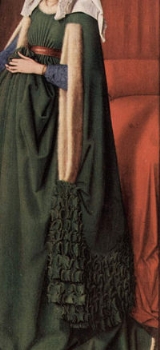
  • Hanging sleeve, a sleeve that opens down the side or front, or at the elbow, to allow the arm to pass through (14th
    1300-1400 in fashion

    Fashion in fourteenth century Europe was marked by the beginning of a period of experimentation with different forms of clothing. Costume historian James Laver suggests that the mid-14th century marks the emergence of recognizable "fashion" in clothing, in which Fernand Braudel concurs....
    , 15th
    1400-1500 in fashion

    Fashion in 15th century Europe was characterized by a series of extremes and extravagances, from the voluminous gowns called houppelandes with their sweeping floor-length sleeves to the revealing doublet s and hose of Renaissance Italy....
    , and 16th centuries
    1550-1600 in fashion

    Fashion in the period 1550-1600 in Western European clothing is characterized by increased opulence, the rise of the ruff , the expansion of the farthingale for women, and, for men, the disappearance of the codpiece....
    .)
  • Juliette sleeve, a long, tight sleeve with a puff at the top, inspired by fashions of the Italian Renaissance
    Italian Renaissance

    The Italian Renaissance began the opening phase of the Renaissance, a period of great cultural change and achievement in Europe that spanned the period from the end of the 13th century to about 1600, marking the transition between Medieval and Early Modern Europe....
     and named after Shakespeare's tragic heroine; popular from the Empire
    1795-1820 in fashion

    Fashion in the period 1795-1820 in European and European-influenced countries saw the final triumph of undress or informal styles over the brocades, lace, periwigs, and powder of the earlier 1700-1750 in fashion....
     period through the 1820s in fashion
    1820s in fashion

    During the 1820s in European and European-influenced countries, fashionable women's clothing styles transitioned away from the classically-influenced "Empire"/"Regency" styles of ca....
    , again in the late 1960s under the influence of Zeffirelli's film
    Romeo and Juliet (1968 film)

    Romeo and Juliet is a movie adaptation of the William Shakespeare Play Romeo and Juliet.The film was directed by Franco Zeffirelli, and stars Leonard Whiting and Olivia Hussey....
  • Pagoda sleeve, a wide, bell-shaped sleeve popular in the 1860s
    1860s in fashion

    1860s fashion in European and European-influenced clothing is characterized by extremely full-skirted women's fashions relying on crinolines and hoop skirt and the emergence of "alternative fashions" under the influence of the Artistic Dress movement....
    , worn over an engageante
    Engageante

    Engageantes are false sleeves worn with women's clothing in the 18th and 19th centuries.In the 18th century, engageantes took the form of ruffles or flounce of linen, cotton, or lace, tack to the elbow-length sleeves then fashionable....
     or false undersleeve
  • Paned sleeve, a sleeve made in panes or panels, allowing a lining or shirt-sleeve to show through (16th
    1550-1600 in fashion

    Fashion in the period 1550-1600 in Western European clothing is characterized by increased opulence, the rise of the ruff , the expansion of the farthingale for women, and, for men, the disappearance of the codpiece....
     and 17th centuries
    1600-1650 in fashion

    Fashion in the period 1600-1650 in Western European clothing is characterized by the disappearance of the ruff in favour of broad lace or linen collar ....
    )
  • Poet sleeve, a long sleeve fitted from shoulder to elbow, and then flared (somewhat dramatically) from elbow to wrist (or sometimes mid-hand). Often features ruffles on the cuffs.
  • Puffed or puff sleeve, a short, full sleeve gathered at the top and bottom, now most often seen on wedding and children's clothing
  • Raglan sleeve
    Raglan sleeve

    A raglan sleeve is a type of sleeve whose distinguishing characteristic is to extend in one piece fully to the collar, leaving a diagonal seam from underarm to collarbone....
    , a sleeve that extends to the neckline
  • Set-in sleeve, a sleeve sewn into an armhole (armscye)
  • Two-piece sleeve, a sleeve cut in two pieces, inner and outer, to allow the sleeve to take a slight "L" shape to accommodate the natural bend at the elbow without wrinkling; used in tailor
    Tailor

    A tailor is a person whose occupation is to sew and scissor menswear style jackets and the skirts or trousers that go with them.Although the term dates to the thirteenth century, tailor took on its modern sense in the late eighteenth century, and now refers to makers of men's and women's suit , coat s, trousers, and similar garments, u...
    ed garments
  • Virago sleeve
    Virago sleeve

    A virago sleeve is a women's item of clothing fashionable in the 1600-1650 in fashion. It is a full "paned" or "pansied" sleeve gathered into two puffs by a ribbon or textile band above the elbow....
    , a full "paned" or "pansied" sleeve gathered into two puffs by a ribbon
    Ribbon

    A ribbon or riband is a thin band of flexible material, typically cloth but also plastic or sometimes metal, used primarily for binding and tying....
     or fabric
    Textile

    A textile is a flexible material consisting of a network of natural or artificial fibres often referred to as thread or yarn. Yarn is produced by Spinning raw wool fibres, linen, cotton, or other material on a spinning wheel to produce long strands known as yarn....
     band above the elbow, worn in the 1620s and 1630s.
  • 3/4 Length Sleeve, a sleeve which extends from the shoulder to a length mid-way between the elbow and the wrist. It was common in the United States in the 1950s and again 21st century.