

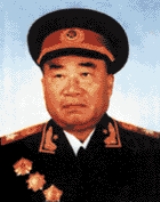
Zhu De

Encyclopedia
Zhu De was a Chinese militarist, politician, revolutionary, and one of the pioneers of the Chinese Communist Party
. After the founding of the People's Republic of China
, in 1955 Zhu became one of the Ten Marshal
s of the People's Liberation Army
, of which he is regarded as the founder.
, a hilly and isolated part of northern Sichuan
province. His father, a Hakka
, was born in Guangdong province. His ancestors relocated to Sichuan
during the migration from Hunan
province and Guangdong
province. Despite their poverty, Zhu was sent to a classic private school in 1892. Before the repeal of imperial examinations in 1906, he attained the rank of Xiucai, which allowed him to qualify as a civil servant. Enrolling in Sichuan
high school around 1907, upon graduating in 1908 he returned to Yilong high primary school as a gym instructor. An advocate of modern science and political teaching, rather than the strict classical education afforded by schools, he was dismissed from his post and entered the Yunnan Military Academy in Kunming
. There he joined the Beiyang Army
and the Tongmenghui
secret political society (the forerunner of Guomindang)
(Tsai Ao). He continued to teach at the Academy after his graduation in July 1911. Siding with the revolutionary forces after the Chinese Revolution, he joined Brigadier Cai E in the October 1911 expeditionary force that marched on Qing forces in Sichuan, and served as a regimental commander in the campaign to unseat Yuan Shikai
in 1915-16. When Cai became governor of Sichuan after Yuan's death in June 1916, Zhu was made a brigade commander.
Following the death of his mentor Cai E and his own wife, Zhu developed a strong opium habit and fell into a life of decadence. His troops continued to support him and he became a warlord
. In 1920, after his troops were driven from Sichuan toward the Tibet border, he returned to Yunnan as a public security commissioner of the provincial government. Around this time, his second wife and child were murdered by rival warlords, which may have contributed to his decision to leave China for study in Europe. He first travelled to Shanghai where he broke his opium habit and apparently met Dr Sun Yat-sen. He attempted to join the Chinese Communist Party in early 1922, but was rejected due to his former warlord ties.
, studying at Göttingen University in Germany until 1925. Here he met Zhou Enlai
and was expelled from Germany for his role in a number of student protests. Around this time he joined the Communist Party
. Zhou Enlai was one of his sponsors. In July 1925 he traveled to the Soviet Union
to study military affairs, returning to China in July 1926 to persuade Sichuan warlord Yang Sen to support the Northern Expedition. His failure to do this did not affect his standing in the Communist Party however, as he was soon named head of a new First United Front military institute in Nanchang.
In 1927, following the collapse of the First United Front, KMT authorities ordered Zhu lead a force against Zhou Enlai and Liu Bocheng
's Nanchang Uprising
. However, having helped orchestrate the uprising, Zhu and his army defected from the Guomindang. The uprising failed to gather support, however, and Zhu was forced to flee Nanchang
with his army. Under the false name of Wang Kai, Zhu managed to find shelter for his remaining forces by joining the warlord Fan Shisheng.
began in 1928 when under the assistance of Chen Yi
and Lin Biao
, Zhu defected from Fan Shisheng's protection and marched his army of 10,000 men to the Jinggang Mountains
. Here Mao had formed a soviet in 1927, and Zhu began building up his army into the Red Army
, consolidating and expanding the Soviet areas of control.
Zhu's leadership made him a figure of immense prestige. Locals credited him with supernatural abilities. During this time Mao and Zhu became so closely connected that to the local peasant farmers they were known collectively as "Zhu Mao" (homophonic to 猪毛, or pig's pelage).
In 1929 Zhu and Mao were forced to flee Jinggangshan
to Ruijin
following Guomindang military pressure. Here they formed the Jiangxi Soviet
which would eventually grow to cover some 30,000 square kilometers and include some three million people. In 1931 Zhu was appointed leader of the Red Army in Ruijin
by the CPC leadership. Zhu successfully led a conventional military force against the Guomindang in the lead up to the Fourth Counter Encirclement Campaign
; however he was not able to do the same during the Fifth Counter Encirclement Campaign
and the CPC fled. Zhu helped form the 1934 break out that began the Long March
.
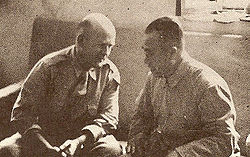 During the Long March
, Zhu and Zhang Guotao
commanded the "western column" of the Red Army, which barely survived the retreat through Sichuan
Province. Arriving in Yan'an
, Zhu directed the reconstruction of the Red Army under the political guidance of Mao.
During the Second Sino-Japanese War
and the Chinese Civil War
, he held the position of Commander-in-Chief
of the Red Army and in 1940 Zhu devised and organized the Hundred Regiments Offensive
without Mao's support. While a successful campaign, it has since been attributed as the main provocation for the devastating Japanese Three Alls Policy
.
(PLA). He was also the Vice-Chairman of the Communist Party (1956–1966) and Vice-Chairman of the People's Republic of China (1954–1959). In 1950 Zhu oversaw the PLA during the Korean War
. In 1955, he was made a marshal.
In 1966, during the onset of the Cultural Revolution
, Zhu was dismissed from his position on the Politburo Standing Committee of the Communist Party of China
, and the activity of the National People's Congress
was halted. However, due to the support of Zhou Enlai
, he was not harmed or imprisoned. In 1973 Zhu was reinstated in the Standing Committee.
He continued to be a prominent elder statesman until his death in July 1976.
|-
|-
|-
|-
Communist Party of China
The Communist Party of China , also known as the Chinese Communist Party , is the founding and ruling political party of the People's Republic of China...
. After the founding of the People's Republic of China
People's Republic of China
China , officially the People's Republic of China , is the most populous country in the world, with over 1.3 billion citizens. Located in East Asia, the country covers approximately 9.6 million square kilometres...
, in 1955 Zhu became one of the Ten Marshal
Yuan Shuai
Yuan Shuai was a Chinese military rank that corresponds to a marshal in other nations. It is given to distinguished generals during China's dynastic and republican periods. A higher level rank of Da Yuan Shuai , which corresponds to a Generalissimo, also existed.-People's Republic of China:The...
s of the People's Liberation Army
People's Liberation Army
The People's Liberation Army is the unified military organization of all land, sea, strategic missile and air forces of the People's Republic of China. The PLA was established on August 1, 1927 — celebrated annually as "PLA Day" — as the military arm of the Communist Party of China...
, of which he is regarded as the founder.
Early life
Zhu was born to a poor tenant farmer's family in Yilong CountyYilong County
Yilong County is a county of Sichuan Province, China. It is under the administration of Nanchong city....
, a hilly and isolated part of northern Sichuan
Sichuan
' , known formerly in the West by its postal map spellings of Szechwan or Szechuan is a province in Southwest China with its capital in Chengdu...
province. His father, a Hakka
Hakka people
The Hakka , sometimes Hakka Han, are Han Chinese who speak the Hakka language and have links to the provincial areas of Guangdong, Jiangxi, Guangxi, Sichuan, Hunan and Fujian in China....
, was born in Guangdong province. His ancestors relocated to Sichuan
Sichuan
' , known formerly in the West by its postal map spellings of Szechwan or Szechuan is a province in Southwest China with its capital in Chengdu...
during the migration from Hunan
Hunan
' is a province of South-Central China, located to the south of the middle reaches of the Yangtze River and south of Lake Dongting...
province and Guangdong
Guangdong
Guangdong is a province on the South China Sea coast of the People's Republic of China. The province was previously often written with the alternative English name Kwangtung Province...
province. Despite their poverty, Zhu was sent to a classic private school in 1892. Before the repeal of imperial examinations in 1906, he attained the rank of Xiucai, which allowed him to qualify as a civil servant. Enrolling in Sichuan
Sichuan
' , known formerly in the West by its postal map spellings of Szechwan or Szechuan is a province in Southwest China with its capital in Chengdu...
high school around 1907, upon graduating in 1908 he returned to Yilong high primary school as a gym instructor. An advocate of modern science and political teaching, rather than the strict classical education afforded by schools, he was dismissed from his post and entered the Yunnan Military Academy in Kunming
Kunming
' is the capital and largest city of Yunnan Province in Southwest China. It was known as Yunnan-Fou until the 1920s. A prefecture-level city, it is the political, economic, communications and cultural centre of Yunnan, and is the seat of the provincial government...
. There he joined the Beiyang Army
Beiyang Army
The Beiyang Army was a powerful, Western-style Chinese military force created by the Qing Dynasty government in the late 19th century. It was the centerpiece of a general reconstruction of China's military system. The Beiyang Army played a major role in Chinese politics for at least three decades...
and the Tongmenghui
Tongmenghui
The Tongmenghui, also known as the Chinese United League, United League, Chinese Revolutionary Alliance, Chinese Alliance and United Allegiance Society, was a secret society and underground resistance movement formed when merging many Chinese revolutionary groups together by Sun Yat-sen, Song...
secret political society (the forerunner of Guomindang)
Nationalism and Warlordism
At the Yunnan Military Academy Zhu met Cai ECai E
Cai E or Tsai Ao was a Chinese revolutionary leader and warlord. He was born Cai Genyin in Shaoyang, Hunan, and his courtesy name was Songpo...
(Tsai Ao). He continued to teach at the Academy after his graduation in July 1911. Siding with the revolutionary forces after the Chinese Revolution, he joined Brigadier Cai E in the October 1911 expeditionary force that marched on Qing forces in Sichuan, and served as a regimental commander in the campaign to unseat Yuan Shikai
Yuan Shikai
Yuan Shikai was an important Chinese general and politician famous for his influence during the late Qing Dynasty, his role in the events leading up to the abdication of the last Qing Emperor of China, his autocratic rule as the second President of the Republic of China , and his short-lived...
in 1915-16. When Cai became governor of Sichuan after Yuan's death in June 1916, Zhu was made a brigade commander.
Following the death of his mentor Cai E and his own wife, Zhu developed a strong opium habit and fell into a life of decadence. His troops continued to support him and he became a warlord
Warlord
A warlord is a person with power who has both military and civil control over a subnational area due to armed forces loyal to the warlord and not to a central authority. The term can also mean one who espouses the ideal that war is necessary, and has the means and authority to engage in war...
. In 1920, after his troops were driven from Sichuan toward the Tibet border, he returned to Yunnan as a public security commissioner of the provincial government. Around this time, his second wife and child were murdered by rival warlords, which may have contributed to his decision to leave China for study in Europe. He first travelled to Shanghai where he broke his opium habit and apparently met Dr Sun Yat-sen. He attempted to join the Chinese Communist Party in early 1922, but was rejected due to his former warlord ties.
Converting to Communism
In late 1922, Zhu went to EuropeEurope
Europe is, by convention, one of the world's seven continents. Comprising the westernmost peninsula of Eurasia, Europe is generally 'divided' from Asia to its east by the watershed divides of the Ural and Caucasus Mountains, the Ural River, the Caspian and Black Seas, and the waterways connecting...
, studying at Göttingen University in Germany until 1925. Here he met Zhou Enlai
Zhou Enlai
Zhou Enlai was the first Premier of the People's Republic of China, serving from October 1949 until his death in January 1976...
and was expelled from Germany for his role in a number of student protests. Around this time he joined the Communist Party
Communist party
A political party described as a Communist party includes those that advocate the application of the social principles of communism through a communist form of government...
. Zhou Enlai was one of his sponsors. In July 1925 he traveled to the Soviet Union
Soviet Union
The Soviet Union , officially the Union of Soviet Socialist Republics , was a constitutionally socialist state that existed in Eurasia between 1922 and 1991....
to study military affairs, returning to China in July 1926 to persuade Sichuan warlord Yang Sen to support the Northern Expedition. His failure to do this did not affect his standing in the Communist Party however, as he was soon named head of a new First United Front military institute in Nanchang.
In 1927, following the collapse of the First United Front, KMT authorities ordered Zhu lead a force against Zhou Enlai and Liu Bocheng
Liu Bocheng
Liu Bocheng was a Chinese Communist military commander and Marshal of the People's Liberation Army.Liu is known as one of the "Three and A Half" Strategists of China in modern history...
's Nanchang Uprising
Nanchang Uprising
The Nanchang Uprising was the first major Kuomintang-Communist engagement of the Chinese Civil War, in order to counter the anti-communist purges by the Nationalist Party of China....
. However, having helped orchestrate the uprising, Zhu and his army defected from the Guomindang. The uprising failed to gather support, however, and Zhu was forced to flee Nanchang
Nanchang
Nanchang is the capital of Jiangxi Province in southeastern China. It is located in the north-central portion of the province. As it is bounded on the west by the Jiuling Mountains, and on the east by Poyang Lake, it is famous for its scenery, rich history and cultural sites...
with his army. Under the false name of Wang Kai, Zhu managed to find shelter for his remaining forces by joining the warlord Fan Shisheng.
'Zhu Mao'
Zhu's close affiliation with Mao ZedongMao Zedong
Mao Zedong, also transliterated as Mao Tse-tung , and commonly referred to as Chairman Mao , was a Chinese Communist revolutionary, guerrilla warfare strategist, Marxist political philosopher, and leader of the Chinese Revolution...
began in 1928 when under the assistance of Chen Yi
Chen Yi (communist)
Chen Yi was a Chinese communist military commander and politician. He served as the 2nd Mayor of Shanghai and the 2nd Foreign Minister of China.-Biography:Chen was born in Lezhi, near Chengdu, Sichuan, into a moderately wealthy magistrate's family....
and Lin Biao
Lin Biao
Lin Biao was a major Chinese Communist military leader who was pivotal in the communist victory in the Chinese Civil War, especially in Northeastern China...
, Zhu defected from Fan Shisheng's protection and marched his army of 10,000 men to the Jinggang Mountains
Jinggangshan
Jinggangshan is located in the Luoxian Mountains , in the remote border region between Jiangxi and Hunan provinces of China. It lies at the junction of four counties - Ninggang, Yongxing, Suichuan and Lingxian. The mountains cover some 670 km², with an average elevation of 381.5 m above sea...
. Here Mao had formed a soviet in 1927, and Zhu began building up his army into the Red Army
People's Liberation Army
The People's Liberation Army is the unified military organization of all land, sea, strategic missile and air forces of the People's Republic of China. The PLA was established on August 1, 1927 — celebrated annually as "PLA Day" — as the military arm of the Communist Party of China...
, consolidating and expanding the Soviet areas of control.
Zhu's leadership made him a figure of immense prestige. Locals credited him with supernatural abilities. During this time Mao and Zhu became so closely connected that to the local peasant farmers they were known collectively as "Zhu Mao" (homophonic to 猪毛, or pig's pelage).
In 1929 Zhu and Mao were forced to flee Jinggangshan
Jinggangshan
Jinggangshan is located in the Luoxian Mountains , in the remote border region between Jiangxi and Hunan provinces of China. It lies at the junction of four counties - Ninggang, Yongxing, Suichuan and Lingxian. The mountains cover some 670 km², with an average elevation of 381.5 m above sea...
to Ruijin
Ruijin
Ruijin is a county-level city of Ganzhou in the mountains bordering Fujian Province in south-eastern Jiangxi.The name derives from the ancient God, Rui Jin. It is most famous as one of the earliest centers of Chinese communist activity...
following Guomindang military pressure. Here they formed the Jiangxi Soviet
Jiangxi Soviet
The Chinese Soviet Republic , also translated as the Soviet Republic of China or the China Soviet Republic, and often referred to in historical literature as the Jiangxi Soviet , was a state established in November 1931 by the future Communist Party of China leader Mao...
which would eventually grow to cover some 30,000 square kilometers and include some three million people. In 1931 Zhu was appointed leader of the Red Army in Ruijin
Ruijin
Ruijin is a county-level city of Ganzhou in the mountains bordering Fujian Province in south-eastern Jiangxi.The name derives from the ancient God, Rui Jin. It is most famous as one of the earliest centers of Chinese communist activity...
by the CPC leadership. Zhu successfully led a conventional military force against the Guomindang in the lead up to the Fourth Counter Encirclement Campaign
Fourth Encirclement Campaign
The Fourth Encirclement Campaign is an abbreviated name used for several different encirclement campaigns launched by the Nationalist Government with the goal of destroying the developing Chinese Red Army and its communist bases. The battles took place in several separate locations in China during...
; however he was not able to do the same during the Fifth Counter Encirclement Campaign
Fifth Encirclement Campaign
The Fifth Encirclement Campaign is an abbreviated name used for several different encirclement campaigns launched by the Nationalist Government with the goal of destroying the developing Chinese Red Army and its communist bases in several separate locations in China during the early stage of...
and the CPC fled. Zhu helped form the 1934 break out that began the Long March
Long March
The Long March was a massive military retreat undertaken by the Red Army of the Communist Party of China, the forerunner of the People's Liberation Army, to evade the pursuit of the Kuomintang army. There was not one Long March, but a series of marches, as various Communist armies in the south...
.
Red Army leader
Long March
The Long March was a massive military retreat undertaken by the Red Army of the Communist Party of China, the forerunner of the People's Liberation Army, to evade the pursuit of the Kuomintang army. There was not one Long March, but a series of marches, as various Communist armies in the south...
, Zhu and Zhang Guotao
Zhang Guotao
Zhang Guotao was a founding member and important leader of the Chinese Communist Party and bitter rival to Mao Zedong. During the 1920s he studied in the Soviet Union and became a key contact with the Comintern and organized the CCP labor movement in the United Front with the Guomindang...
commanded the "western column" of the Red Army, which barely survived the retreat through Sichuan
Sichuan
' , known formerly in the West by its postal map spellings of Szechwan or Szechuan is a province in Southwest China with its capital in Chengdu...
Province. Arriving in Yan'an
Yan'an
Yan'an , is a prefecture-level city in the Shanbei region of Shaanxi province in China, administering several counties, including Zhidan County , which served as the Chinese communist capital before the city of Yan'an proper took that role....
, Zhu directed the reconstruction of the Red Army under the political guidance of Mao.
During the Second Sino-Japanese War
Second Sino-Japanese War
The Second Sino-Japanese War was a military conflict fought primarily between the Republic of China and the Empire of Japan. From 1937 to 1941, China fought Japan with some economic help from Germany , the Soviet Union and the United States...
and the Chinese Civil War
Chinese Civil War
The Chinese Civil War was a civil war fought between the Kuomintang , the governing party of the Republic of China, and the Communist Party of China , for the control of China which eventually led to China's division into two Chinas, Republic of China and People's Republic of...
, he held the position of Commander-in-Chief
Commander-in-Chief
A commander-in-chief is the commander of a nation's military forces or significant element of those forces. In the latter case, the force element may be defined as those forces within a particular region or those forces which are associated by function. As a practical term it refers to the military...
of the Red Army and in 1940 Zhu devised and organized the Hundred Regiments Offensive
Hundred Regiments Offensive
The Hundred Regiments Offensive was a major campaign of the Communist Party of China's Red Army commanded by Peng Dehuai against the Imperial Japanese Army in Central China.-Background:...
without Mao's support. While a successful campaign, it has since been attributed as the main provocation for the devastating Japanese Three Alls Policy
Three Alls Policy
The Three Alls Policy was a Japanese scorched earth policy adopted in China during World War II, the three alls being: "Kill All", "Burn All" and "Loot All" . In Japanese documents, the policy was originally referred to as...
.
Later life
After 1949 Zhu was named Commander-in-Chief of the People's Liberation ArmyPeople's Liberation Army
The People's Liberation Army is the unified military organization of all land, sea, strategic missile and air forces of the People's Republic of China. The PLA was established on August 1, 1927 — celebrated annually as "PLA Day" — as the military arm of the Communist Party of China...
(PLA). He was also the Vice-Chairman of the Communist Party (1956–1966) and Vice-Chairman of the People's Republic of China (1954–1959). In 1950 Zhu oversaw the PLA during the Korean War
Korean War
The Korean War was a conventional war between South Korea, supported by the United Nations, and North Korea, supported by the People's Republic of China , with military material aid from the Soviet Union...
. In 1955, he was made a marshal.
In 1966, during the onset of the Cultural Revolution
Cultural Revolution
The Great Proletarian Cultural Revolution, commonly known as the Cultural Revolution , was a socio-political movement that took place in the People's Republic of China from 1966 through 1976...
, Zhu was dismissed from his position on the Politburo Standing Committee of the Communist Party of China
Politburo Standing Committee of the Communist Party of China
The Politburo Standing Committee of the Communist Party of China is a committee consisting of the top leadership of the Communist Party of China, whose membership varies between 5 and 9 people. The inner workings of the PSC are not well known, although it is believed that decisions of the PSC are...
, and the activity of the National People's Congress
National People's Congress
The National People's Congress , abbreviated NPC , is the highest state body and the only legislative house in the People's Republic of China. The National People's Congress is held in the Great Hall of the People, Beijing, capital of the People's Republic of China; with 2,987 members, it is the...
was halted. However, due to the support of Zhou Enlai
Zhou Enlai
Zhou Enlai was the first Premier of the People's Republic of China, serving from October 1949 until his death in January 1976...
, he was not harmed or imprisoned. In 1973 Zhu was reinstated in the Standing Committee.
He continued to be a prominent elder statesman until his death in July 1976.
See also
- Eighth Route ArmyEighth Route ArmyThe Eighth Route Army was the larger of the two major Chinese communist forces that formed a unit of the National Revolutionary Army of the Republic of China which fought the Japanese from 1937 to 1945. In contrast to most of the National Revolutionary Army, it was controlled by the Communist...
- History of the People's Republic of China (1949–1976)
- List of officers of the People's Liberation Army
External links
- Zhu De Biography From Spartacus Educational
- People's Daily Biography
|-
|-
|-
|-