

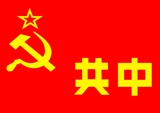
Jiangxi Soviet

Encyclopedia
The Chinese Soviet Republic , also translated as the Soviet Republic of China or the China Soviet Republic, and often referred to in historical literature as the Jiangxi Soviet (after its largest component territory the Jiangxi-Fujian Soviet
, seat of its central government), was a state established in November 1931 by the future Communist Party of China
leader Mao Zedong
, general Zhu De
and others. Its other discontiguous territories were:
Haifeng-Lufeng Soviet
in eastern Guangdong, China's first Soviet territory, had been crushed before the declaration of the CSR and is considered more a predecessor than a constituent part.
Mao Zedong was CSR State Chair and Prime Minister - at once the Head of the State and of its Government. It was from this "small state within a state" that he gained the experience in Mobile Warfare
and peasant
organization that he later used to accomplish the Communist reunification of China in the late 1940s.
The CSR was destroyed by the Kuomintang
(KMT)'s National Revolutionary Army
in a series of Encirclement Campaigns
.
Revolution, with the help of the Soviet Union
, a National Soviet People's Delegates Conference took place in Ruijin
(瑞金), Jiangxi province, which was selected as the national capital. "Chinese Soviet Republic" (Chinese: "中華蘇維埃共和國") was born, even though the majority of China was still under the control of the nationalist Government of the Republic of China
. On that day, they had an open ceremony for the new country, and Mao Zedong and other Communists attended the military parade. Because it had its own bank, printed its own money, collected tax through its own tax bureau, therefore, it is considered as the beginning of Two Chinas
.
With Mao Zedong as both Head of State ("國家主席", 'State Chairman') and Government ("總理", Prime Minister), the Jiangxi Soviet gradually expanded, reaching a peak of more than 30,000 square kilometres and a population that numbered more than three million, covering considerable parts of two provinces (with Tingzhou
in Fujian
). Furthermore, its economy was doing better than most areas that were under the control of the Chinese warlords. In addition to the militia and guerilla, its regular Chinese Red Army alone already numbered more than 140,000 by the early 1930s, and they were better armed than most Chinese warlords' armies at the time. For example, not only did the Chinese Red Army already have modern communication means such as telephones, telegraphs and radios which most Chinese warlords' armies still lacked, it was already regularly transmitting wireless messages in codes and breaking nationalist codes. Only Chiang Kai-shek
's army could match this formidable Communist force.
The Kuomintang
(KMT), led by Chiang Kai-shek, felt threatened by the Soviet republic and led other Chinese warlords to have the National Revolutionary Army
besiege the Soviet Republic repeatedly, launching what Chiang and his fellow nationalists called Encirclement Campaigns
at the time, while the Communists called their counter attacks counter encirclement campaigns. Chiang Kai-shek's first
, second
and third
encirclement campaigns were defeated by the Chinese Red Army led by Mao. However, after the third counter encirclement campaign, Mao was removed from the leadership and replaced by the Chinese Communists returning from the Soviet Union such as Wang Ming
, and the command of the Chinese Red Army was handled by a three man committee that included Wang Ming's associates Otto Braun (Li De)
, the Comintern
military advisor, Bo Gu, and Zhou Enlai
. The Jiangxi Soviet thus began its inevitable rapid downfall under their policy of extreme leftism and incompetent military command, though the new leadership could not immediately rid itself of Mao's influence which prevailed during the Fourth Encirclement Campaign
, and thus saved the Communists temporarily. However, as a result of the complete dominance the new Communist leadership achieved after the fourth counter encirclement campaign, the Red Army was nearly halved, with most its equipment lost during Chiang's fifth encirclement campaign
, started in 1933 and orchestrated by his German advisors, that involved the systematic encirclement of the Jiangxi Soviet region with fortified blockhouses. This method proved to be very effective. In an effort to break the blockade, the Red Army under the orders of the three man committee besieged the forts many times but suffered heavy casualties with little success, resulting in the Jiangxi Soviet shrinking significantly in size due to the Chinese Red Army's disastrous manpower and material losses.
in Chiang Kai-shek
's inner circle, including at the general headquarters for the nationalist forces at Nanchang
. Surprisingly, the most important of the agents, Mo Xiong
(莫雄), was actually never a Communist, but his contribution eventually saved the Communist Party of China
and the Chinese Red Army.
Under the recommendation of Chiang Kai-shek's secretary-general Yang Yongtai (楊永泰), who was unaware of Mo's Communist activities, Mo Xiong (莫雄) steadily excelled in Chiang Kai-shek's regime, eventually becoming an important member within Chiang Kai-shek's general headquarters in the early 1930s. In January 1934, Chiang Kai-shek named him as the administrator and commander-in-chief of the Fourth Special District in northern Jiangxi. Mo used his position to plant more than a dozen Communist agents within Chiang's general headquarters, including Liu Yafo (劉亞佛),the Communist who first introduced to the Communist Party of China, Xiang Yunian (項與年) his Communist handler, whom he hired as his secretary, and Lu Zhiying (盧志英), the Communist agent who was the acting head of the spy ring, which was directly under the command of Zhou Enlai
.
After successfully besieging the adjacent regions of Ruijin
, the capital of the Jiangxi Soviet, and occupying most of Jiangxi Soviet itself, Chiang was confident that he would finish off the Communists in a final decisive strike. In late September 1934, Chiang distributed his top secret plan named "Iron Bucket Plan" to everyone in his general headquarter at Lushan
(the alternative summer site to Nanchang
), which detailed the final push to totally annihilate the Communist forces. The plan was to build 30 blockade lines supported by 30 barbed wire
fences, most of them electric, in the region 150 km around Ruijin, to starve the Communists. In addition, more than 1,000 trucks were to be mobilized to form a rapid reaction force in order to prevent any Communist breakout. Realizing the certain annihilation of the Communists, Mo Xiong (莫雄) handed the document weighing several kilograms to his Communist handler Xiang Yunian (項與年) the same night he received it, risking not only his own life, but that of his entire family.
With the help of Liu Yafo (劉亞佛) and Lu Zhiying (盧志英), the Communist agents copied the important intelligence onto four dictionaries and Xiang Yunian (項與年) was tasked to take the intelligence personally to the Jiangxi Soviet. The trip was hazardous, as the nationalist force would arrest and even execute anyone who attempted to cross the blockade. Xiang Yunian (項與年) was forced to hide in the mountains for a while, and then used rocks to knock out 4 of his own teeth, resulting in swollen face. Disguised as a beggar, he tore off the covers of the four dictionaries and hid them at the bottom of his bag with rotten food, then successfully crossed several lines of the blockade and reached Ruijin on October 7, 1934. The valuable intelligence provided by Mo Xiong (莫雄) finally convinced the Communists in Jiangxi Soviet to abandon its base and started a general retreat before Chiang could complete the building of his blockade lines with supporting barbed wire fences, and mobilizing trucks and troops, thus saving themselves from total annihilation.
as its president. The CSR Central Mint issued three kinds of currency, including the paper bill, the copper coin, and the silver dollar
.
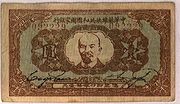 The Central Mint briefly issued both the paper bills and copper coins, but neither circulated for long, primarily because the currency could not be used in the rest of China.
The paper bill had the Chinese Soviet Republic (中華蘇維埃共和國) printed on the bill in traditional Chinese character
s, and a picture of Vladimir Lenin
.
s so that these copper coins were recalled and replaced by silver dollar
s.
. Unlike the paper bills and the copper coins, the silver dollars had no Communist symbols and instead, they were the direct copy of other silver dollars produced by other mints in China, including the most popular Chinese silver dollar with Yuan Shikai
's head engraved, and the eagle silver dollar of the Mexican peso
. This and the fact that the coin was made of the precious metal silver, enabled them to be circulated in the rest of China and thus was the trade currency of choice.
When the Chinese Red Army's First Front began their Long March
in October 1934, the Communist bank was part of the retreating force, with 14 bank employees, over a hundred coolies and a company of soldiers escorting them while they carried all of the money and mint machinery. One of the important tasks of the bank during the Long March whenever the Chinese Red Army stayed in a place for longer than a day was to tell the local population to exchange any Communist paper bills and copper coins to goods and currency used in nationalist controlled regions, so that the local population would not be persecuted by the pursuing nationalists after the Communists had left. After the Zunyi Conference
, it was decided that carrying the entire bank on the march was not practical, so on January 29, 1935, at Earth Town (Tucheng, 土城), the bank employees burned all Communist paper bills and mint machinery under order. By the time the Long March had concluded in October 1935, only 8 out of the 14 original employees survived; the other 6 had died along the way.
on May 1st 1932. . The first stamps were designed by Huang Yaguang and printed lithographically by the Printing House of the Ministry of Finance in Ruijin. White paper or newspaper was used. They were imperforate and denominated in the Chinese Soviet silver dollar currency. They are all fairly rare and highly sought after by collectors. There are also many forgeries and bogus issues imitating the early stamps of the communist areas.
, fully abandoning the Jiangxi Soviet. 17 days after the main Communist force had already left its base, the nationalists were finally aware that the enemy had escaped after reaching the empty city of Ruijin on November 5, 1934. Contrary to the common erroneous belief, the original destination was He Long
's Communist base in Hubei
, and the final destination Yan'an
was not decided on until much later during the Long March, well after the rise of Mao Zedong. To avoid panic, the goal was kept a secret from most people, including Mao Zedong, and the public was told that only a portion of the Chinese Red Army would be engaged in mobile warfare to defeat nationalist forces, and thus this part of the army would be renamed as the “Field Army”.
By the fall of 1934, the Communists faced total annihilation. This situation had already convinced Mao Zedong and his supporters to believe that the Communists should abandon their bases in the Jiangxi Soviet republic. However, the Communist leadership stubbornly refused to accept the inevitable failure and still daydreamed of defeating the victorious nationalist forces. The three man committee devised a plan of diversions, and then a regroup after a temporary retreat. Once the regroup was complete, a counterattack would be launched in conjunction with the earlier diversion forces, driving the enemy out of the Jiangxi Soviet.
The first movements of the retreating diversion were undertaken by Fang Zhimin
. Fang Zhimin and his deputy, Xun Weizhou, were first to break through Kuomintang lines in June, followed by Xiao Ke
in August. These movements surprised the Kuomintang, who were numerically superior to the Communists at the time and did not expect an attack on their fortified perimeter. However, things did not turn out as the Communists had hoped: Fang Zhimin's force was crushed after its initial success, and with Xun Weizhou killed in action, nearly every commander in this force was wounded and captured alive, including Fang Zhimin himself, and all were executed later by the nationalists. The only exception was Su Yu
, who managed to escape. Xiao Ke fared no better: although his force initially managed to break through and then reached He Long
's Communist base in Hubei
, but even with their combined forces, they were unable to challenge the far superior nationalist force besieging the Jiangxi Soviet, never to return until the establishment of the People's Republic of China
15 years later.
The failure of the diversion forces resulted in their loss of contacts with the Jiangxi Soviet, and the Communist leadership failed to coordinate its next proper move in a timely fashion, still believing that a temporary retreat near or within the Jiangxi Soviet would allow them to recover and counterattack, eventually driving out the nationalist force.
muzzle-loading rifled muskets and smoothbore muskets
. Bao'an was for a time the Soviet Republic's capital, until the communist government was moved to Yan'an
. The Chinese Soviet Republic was officially dissolved on 22 September 1937, when the Chinese Communist Party issued, in the context of the Second United Front, its manifesto on unity with the Kuomintang, as the Second Sino-Japanese War
was only a few weeks old. The Chinese Communist Party remained, however, de facto in control of Yan'an, which remained its stronghold for the remainder of the war with Japan.
Jiangxi-Fujian Soviet
The Jiangxi–Fujian Soviet was the largest component territory of the Chinese Soviet Republic , an unrecognized state established in November 1931 by Mao Zedong and Zhu De during the Chinese civil war...
, seat of its central government), was a state established in November 1931 by the future Communist Party of China
Communist Party of China
The Communist Party of China , also known as the Chinese Communist Party , is the founding and ruling political party of the People's Republic of China...
leader Mao Zedong
Mao Zedong
Mao Zedong, also transliterated as Mao Tse-tung , and commonly referred to as Chairman Mao , was a Chinese Communist revolutionary, guerrilla warfare strategist, Marxist political philosopher, and leader of the Chinese Revolution...
, general Zhu De
Zhu De
Zhu De was a Chinese militarist, politician, revolutionary, and one of the pioneers of the Chinese Communist Party. After the founding of the People's Republic of China, in 1955 Zhu became one of the Ten Marshals of the People's Liberation Army, of which he is regarded as the founder.-Early...
and others. Its other discontiguous territories were:
- Northeastern Jiangxi SovietNortheastern Jiangxi SovietThe North-eastern Jiangxi Soviet was a constituent part of the Chinese Soviet Republic . Any military threat it posed to the Nationalist Party-controlled Chinese State had been roundly neutered by an early 1931 campaign The North-eastern Jiangxi Soviet (赣东北苏维埃, Gandongbei Suweiai) was a...
- Hunan-Jiangxi SovietHunan-Jiangxi SovietThe Hunan–Jiangxi Soviet was a constituent part of the Chinese Soviet Republic, an unrecognised sovereign state that existed from November 1931 to 1935...
- Hunan-Hubei-Jiangxi SovietHunan-Hubei-Jiangxi SovietThe Hunan–Hubei–Jiangxi Soviet was a Comintern and local communist-led liberated zone in the 1930s south of the Yangzi River, comprising parts of counties in what are now the municipal regions of Yueyang in Hunan, Xianning in Hubei and, in Jiangxi, Jiujiang and Yichun...
- Hunan-Western Hubei Soviet
- Hunan-Hubei-Sichuan-Guizhou SovietHunan-Hubei-Sichuan-Guizhou SovietThe Hunan–Hubei–Sichuan–Guizhou Soviet , was a revolutionary base area and constituent part of the Chinese Soviet Republic ....
- Shaanxi-Gansu Soviet
- Szechuan-Shensi Soviet
- Hubei-Henan-Anhui Soviet
- Honghu Soviet
Haifeng-Lufeng Soviet
Hailufeng Soviet
The Hailufeng Soviet was the first Chinese Soviet territory, established in November 1927, by Peng Pai with Ye Ting's remnant troops from the Nanchang Uprising...
in eastern Guangdong, China's first Soviet territory, had been crushed before the declaration of the CSR and is considered more a predecessor than a constituent part.
Mao Zedong was CSR State Chair and Prime Minister - at once the Head of the State and of its Government. It was from this "small state within a state" that he gained the experience in Mobile Warfare
Mobile Warfare
Mobile Warfare is the correct English term for Mao Zedong's main military methods. For the general topic of military mobility, see maneuver warfare....
and peasant
Peasant
A peasant is an agricultural worker who generally tend to be poor and homeless-Etymology:The word is derived from 15th century French païsant meaning one from the pays, or countryside, ultimately from the Latin pagus, or outlying administrative district.- Position in society :Peasants typically...
organization that he later used to accomplish the Communist reunification of China in the late 1940s.
The CSR was destroyed by the Kuomintang
Kuomintang
The Kuomintang of China , sometimes romanized as Guomindang via the Pinyin transcription system or GMD for short, and translated as the Chinese Nationalist Party is a founding and ruling political party of the Republic of China . Its guiding ideology is the Three Principles of the People, espoused...
(KMT)'s National Revolutionary Army
National Revolutionary Army
The National Revolutionary Army , pre-1928 sometimes shortened to 革命軍 or Revolutionary Army and between 1928-1947 as 國軍 or National Army was the Military Arm of the Kuomintang from 1925 until 1947, as well as the national army of the Republic of China during the KMT's period of party rule...
in a series of Encirclement Campaigns
Encirclement Campaigns
Encirclement Campaigns is a term used to describe several different campaigns launched by forces of the Chinese Nationalist Government against forces of the Communist Party of China during the Chinese Civil War. The campaigns were launched between the late 1920s to the mid-1930s with the goal of...
.
Establishment
On November 7, 1931, the anniversary of the 1917 Russian BolshevikBolshevik
The Bolsheviks, originally also Bolshevists , derived from bol'shinstvo, "majority") were a faction of the Marxist Russian Social Democratic Labour Party which split apart from the Menshevik faction at the Second Party Congress in 1903....
Revolution, with the help of the Soviet Union
Soviet Union
The Soviet Union , officially the Union of Soviet Socialist Republics , was a constitutionally socialist state that existed in Eurasia between 1922 and 1991....
, a National Soviet People's Delegates Conference took place in Ruijin
Ruijin
Ruijin is a county-level city of Ganzhou in the mountains bordering Fujian Province in south-eastern Jiangxi.The name derives from the ancient God, Rui Jin. It is most famous as one of the earliest centers of Chinese communist activity...
(瑞金), Jiangxi province, which was selected as the national capital. "Chinese Soviet Republic" (Chinese: "中華蘇維埃共和國") was born, even though the majority of China was still under the control of the nationalist Government of the Republic of China
Government of the Republic of China
The Republic of China was formally established by Dr. Sun Yat-sen in 1912 in Nanjing under the Provisional Constitution of the Republic of China but this government was moved to Beijing in the same year and continued as the internationally recognized government of China until 1928. In the history...
. On that day, they had an open ceremony for the new country, and Mao Zedong and other Communists attended the military parade. Because it had its own bank, printed its own money, collected tax through its own tax bureau, therefore, it is considered as the beginning of Two Chinas
Two Chinas
The term Two Chinas refers to the two states with "China" in their official names: People's Republic of China , commonly known as "China", established in 1949, controlling mainland China and two special administrative regions, Hong Kong and Macau...
.
With Mao Zedong as both Head of State ("國家主席", 'State Chairman') and Government ("總理", Prime Minister), the Jiangxi Soviet gradually expanded, reaching a peak of more than 30,000 square kilometres and a population that numbered more than three million, covering considerable parts of two provinces (with Tingzhou
Changting Prefecture
Changting was a prefecture in western Fujian during the Chinese Republic . Its centre was the city on the upper Tingjiang River now called Tingzhou....
in Fujian
Fujian
' , formerly romanised as Fukien or Huguing or Foukien, is a province on the southeast coast of mainland China. Fujian is bordered by Zhejiang to the north, Jiangxi to the west, and Guangdong to the south. Taiwan lies to the east, across the Taiwan Strait...
). Furthermore, its economy was doing better than most areas that were under the control of the Chinese warlords. In addition to the militia and guerilla, its regular Chinese Red Army alone already numbered more than 140,000 by the early 1930s, and they were better armed than most Chinese warlords' armies at the time. For example, not only did the Chinese Red Army already have modern communication means such as telephones, telegraphs and radios which most Chinese warlords' armies still lacked, it was already regularly transmitting wireless messages in codes and breaking nationalist codes. Only Chiang Kai-shek
Chiang Kai-shek
Chiang Kai-shek was a political and military leader of 20th century China. He is known as Jiǎng Jièshí or Jiǎng Zhōngzhèng in Mandarin....
's army could match this formidable Communist force.
The Kuomintang
Kuomintang
The Kuomintang of China , sometimes romanized as Guomindang via the Pinyin transcription system or GMD for short, and translated as the Chinese Nationalist Party is a founding and ruling political party of the Republic of China . Its guiding ideology is the Three Principles of the People, espoused...
(KMT), led by Chiang Kai-shek, felt threatened by the Soviet republic and led other Chinese warlords to have the National Revolutionary Army
National Revolutionary Army
The National Revolutionary Army , pre-1928 sometimes shortened to 革命軍 or Revolutionary Army and between 1928-1947 as 國軍 or National Army was the Military Arm of the Kuomintang from 1925 until 1947, as well as the national army of the Republic of China during the KMT's period of party rule...
besiege the Soviet Republic repeatedly, launching what Chiang and his fellow nationalists called Encirclement Campaigns
Encirclement Campaigns
Encirclement Campaigns is a term used to describe several different campaigns launched by forces of the Chinese Nationalist Government against forces of the Communist Party of China during the Chinese Civil War. The campaigns were launched between the late 1920s to the mid-1930s with the goal of...
at the time, while the Communists called their counter attacks counter encirclement campaigns. Chiang Kai-shek's first
First Encirclement Campaign
The First Encirclement Campaign is an abbreviated name used for several different encirclement campaigns launched by the Nationalist Government with the goal of destroying the developing Chinese Red Army and its communist bases in several separate locations in China during the early stage of...
, second
Second Encirclement Campaign
The Second Encirclement Campaign is an abbreviated name used for several different encirclement campaigns launched by the Nationalist Government with the goal of destroying the developing Chinese Red Army and its communist bases in several separate locations in China during the early stage of...
and third
Third Encirclement Campaign
The Third Encirclement Campaigns is an abbreviated name used for several different encirclement campaigns launched by the Nationalist Government with the goal of destroying the developing Chinese Red Army and its communist bases in several separate locations in China during the early stage of...
encirclement campaigns were defeated by the Chinese Red Army led by Mao. However, after the third counter encirclement campaign, Mao was removed from the leadership and replaced by the Chinese Communists returning from the Soviet Union such as Wang Ming
Wang Ming
Wang Ming was a senior leader of the early Chinese Communist Party and the mastermind of the famous 28 Bolsheviks group. Wang was also a major political rival of Mao Zedong during the 1930s, opposing Mao's nationalist deviation from the Comintern and orthodox Marxism and Leninism lines...
, and the command of the Chinese Red Army was handled by a three man committee that included Wang Ming's associates Otto Braun (Li De)
Otto Braun (Li De)
Otto Braun was a German Communist with a long and varied career.His most significant role was as a Comintern agent sent to China in 1934, to advise the Communist Party of China on military strategy during the Chinese Civil War...
, the Comintern
Comintern
The Communist International, abbreviated as Comintern, also known as the Third International, was an international communist organization initiated in Moscow during March 1919...
military advisor, Bo Gu, and Zhou Enlai
Zhou Enlai
Zhou Enlai was the first Premier of the People's Republic of China, serving from October 1949 until his death in January 1976...
. The Jiangxi Soviet thus began its inevitable rapid downfall under their policy of extreme leftism and incompetent military command, though the new leadership could not immediately rid itself of Mao's influence which prevailed during the Fourth Encirclement Campaign
Fourth Encirclement Campaign
The Fourth Encirclement Campaign is an abbreviated name used for several different encirclement campaigns launched by the Nationalist Government with the goal of destroying the developing Chinese Red Army and its communist bases. The battles took place in several separate locations in China during...
, and thus saved the Communists temporarily. However, as a result of the complete dominance the new Communist leadership achieved after the fourth counter encirclement campaign, the Red Army was nearly halved, with most its equipment lost during Chiang's fifth encirclement campaign
Fifth Encirclement Campaign
The Fifth Encirclement Campaign is an abbreviated name used for several different encirclement campaigns launched by the Nationalist Government with the goal of destroying the developing Chinese Red Army and its communist bases in several separate locations in China during the early stage of...
, started in 1933 and orchestrated by his German advisors, that involved the systematic encirclement of the Jiangxi Soviet region with fortified blockhouses. This method proved to be very effective. In an effort to break the blockade, the Red Army under the orders of the three man committee besieged the forts many times but suffered heavy casualties with little success, resulting in the Jiangxi Soviet shrinking significantly in size due to the Chinese Red Army's disastrous manpower and material losses.
Intelligence
The Communists seemed to be doomed under the crushing blows of the nationalists. However, Zhou Enlai had previously achieved a brilliant intelligence success by planting more than a dozen molesMole (espionage)
A mole is a spy who works for an enemy nation, but whose loyalty ostensibly lies with his own nation's government. In some usage, a mole differs from a defector in that a mole is a spy before gaining access to classified information, while a defector becomes a spy only after gaining access...
in Chiang Kai-shek
Chiang Kai-shek
Chiang Kai-shek was a political and military leader of 20th century China. He is known as Jiǎng Jièshí or Jiǎng Zhōngzhèng in Mandarin....
's inner circle, including at the general headquarters for the nationalist forces at Nanchang
Nanchang
Nanchang is the capital of Jiangxi Province in southeastern China. It is located in the north-central portion of the province. As it is bounded on the west by the Jiuling Mountains, and on the east by Poyang Lake, it is famous for its scenery, rich history and cultural sites...
. Surprisingly, the most important of the agents, Mo Xiong
Mo Xiong
Mo Xiong was born in Yingde, and was a close friend of Sun Yat-sen, and member of Tongmenghui, a member of Kuomintang, and a communist sympathizer / agent. He served high ranking positions in both the Republic of China and the People's Republic of China...
(莫雄), was actually never a Communist, but his contribution eventually saved the Communist Party of China
Communist Party of China
The Communist Party of China , also known as the Chinese Communist Party , is the founding and ruling political party of the People's Republic of China...
and the Chinese Red Army.
Under the recommendation of Chiang Kai-shek's secretary-general Yang Yongtai (楊永泰), who was unaware of Mo's Communist activities, Mo Xiong (莫雄) steadily excelled in Chiang Kai-shek's regime, eventually becoming an important member within Chiang Kai-shek's general headquarters in the early 1930s. In January 1934, Chiang Kai-shek named him as the administrator and commander-in-chief of the Fourth Special District in northern Jiangxi. Mo used his position to plant more than a dozen Communist agents within Chiang's general headquarters, including Liu Yafo (劉亞佛),the Communist who first introduced to the Communist Party of China, Xiang Yunian (項與年) his Communist handler, whom he hired as his secretary, and Lu Zhiying (盧志英), the Communist agent who was the acting head of the spy ring, which was directly under the command of Zhou Enlai
Zhou Enlai
Zhou Enlai was the first Premier of the People's Republic of China, serving from October 1949 until his death in January 1976...
.
After successfully besieging the adjacent regions of Ruijin
Ruijin
Ruijin is a county-level city of Ganzhou in the mountains bordering Fujian Province in south-eastern Jiangxi.The name derives from the ancient God, Rui Jin. It is most famous as one of the earliest centers of Chinese communist activity...
, the capital of the Jiangxi Soviet, and occupying most of Jiangxi Soviet itself, Chiang was confident that he would finish off the Communists in a final decisive strike. In late September 1934, Chiang distributed his top secret plan named "Iron Bucket Plan" to everyone in his general headquarter at Lushan
Lushan
Lushan District, also anglicised as Kuling, is the name of a district in Jiujiang, Jiangxi Province, People's Republic of China. With a history dating back thousand of years it is a popular domestic and foreign tourist attraction as well as home to the mountain resort town of Lushan and the high...
(the alternative summer site to Nanchang
Nanchang
Nanchang is the capital of Jiangxi Province in southeastern China. It is located in the north-central portion of the province. As it is bounded on the west by the Jiuling Mountains, and on the east by Poyang Lake, it is famous for its scenery, rich history and cultural sites...
), which detailed the final push to totally annihilate the Communist forces. The plan was to build 30 blockade lines supported by 30 barbed wire
Barbed wire
Barbed wire, also known as barb wire , is a type of fencing wire constructed with sharp edges or points arranged at intervals along the strand. It is used to construct inexpensive fences and is used atop walls surrounding secured property...
fences, most of them electric, in the region 150 km around Ruijin, to starve the Communists. In addition, more than 1,000 trucks were to be mobilized to form a rapid reaction force in order to prevent any Communist breakout. Realizing the certain annihilation of the Communists, Mo Xiong (莫雄) handed the document weighing several kilograms to his Communist handler Xiang Yunian (項與年) the same night he received it, risking not only his own life, but that of his entire family.
With the help of Liu Yafo (劉亞佛) and Lu Zhiying (盧志英), the Communist agents copied the important intelligence onto four dictionaries and Xiang Yunian (項與年) was tasked to take the intelligence personally to the Jiangxi Soviet. The trip was hazardous, as the nationalist force would arrest and even execute anyone who attempted to cross the blockade. Xiang Yunian (項與年) was forced to hide in the mountains for a while, and then used rocks to knock out 4 of his own teeth, resulting in swollen face. Disguised as a beggar, he tore off the covers of the four dictionaries and hid them at the bottom of his bag with rotten food, then successfully crossed several lines of the blockade and reached Ruijin on October 7, 1934. The valuable intelligence provided by Mo Xiong (莫雄) finally convinced the Communists in Jiangxi Soviet to abandon its base and started a general retreat before Chiang could complete the building of his blockade lines with supporting barbed wire fences, and mobilizing trucks and troops, thus saving themselves from total annihilation.
Bank and currency
February 1 of 1932, National Bank of Chinese Soviet Republic was established with Mao ZeminMao Zemin
Mao Zemin , also using Zhoubin as his alias, was born in Xiangtan, Hunan province. He was the head of the state bank of the Red State in Ruijin and also the Minister of National Economic Department. He was a younger brother of Mao Zedong , and joined the Communist Party of China early on...
as its president. The CSR Central Mint issued three kinds of currency, including the paper bill, the copper coin, and the silver dollar
Chinese yuan
The yuan is the base unit of a number of modern Chinese currencies. The yuan is the primary unit of account of the Renminbi.A yuán is also known colloquially as a kuài . One yuán is divided into 10 jiǎo or colloquially máo...
.
Banknotes
The paper bill had the Chinese Soviet Republic (中華蘇維埃共和國) printed on the bill in traditional Chinese character
Traditional Chinese character
Traditional Chinese characters refers to Chinese characters in any character set which does not contain newly created characters or character substitutions performed after 1946. It most commonly refers to characters in the standardized character sets of Taiwan, of Hong Kong, or in the Kangxi...
s, and a picture of Vladimir Lenin
Vladimir Lenin
Vladimir Ilyich Lenin was a Russian Marxist revolutionary and communist politician who led the October Revolution of 1917. As leader of the Bolsheviks, he headed the Soviet state during its initial years , as it fought to establish control of Russia in the Russian Civil War and worked to create a...
.
Copper coin
Like the paper bill, the copper coins issued by the Central Mint also had the Chinese Soviet Republic (中華蘇維埃共和國) in the traditional Chinese character engraved, and due to the fact that the coin lasts longer than the paper bill, these coins were issued and circulated in much greater numbers. However, these coins are currently rarer than the paper bill, mainly because the copper used was in dire need to make cartridgeCartridge (firearms)
A cartridge, also called a round, packages the bullet, gunpowder and primer into a single metallic case precisely made to fit the firing chamber of a firearm. The primer is a small charge of impact-sensitive chemical that may be located at the center of the case head or at its rim . Electrically...
s so that these copper coins were recalled and replaced by silver dollar
Dollar
The dollar is the name of the official currency of many countries, including Australia, Belize, Canada, Ecuador, El Salvador, Hong Kong, New Zealand, Singapore, Taiwan, and the United States.-Etymology:...
s.
Silver dollar
The largest and most predominant currency produced by the Central Mint was the silver dollarChinese yuan
The yuan is the base unit of a number of modern Chinese currencies. The yuan is the primary unit of account of the Renminbi.A yuán is also known colloquially as a kuài . One yuán is divided into 10 jiǎo or colloquially máo...
. Unlike the paper bills and the copper coins, the silver dollars had no Communist symbols and instead, they were the direct copy of other silver dollars produced by other mints in China, including the most popular Chinese silver dollar with Yuan Shikai
Yuan Shikai
Yuan Shikai was an important Chinese general and politician famous for his influence during the late Qing Dynasty, his role in the events leading up to the abdication of the last Qing Emperor of China, his autocratic rule as the second President of the Republic of China , and his short-lived...
's head engraved, and the eagle silver dollar of the Mexican peso
Mexican peso
The peso is the currency of Mexico. Modern peso and dollar currencies have a common origin in the 15th–19th century Spanish dollar, most continuing to use its sign, "$". The Mexican peso is the 12th most traded currency in the world, the third most traded in the Americas, and by far the most...
. This and the fact that the coin was made of the precious metal silver, enabled them to be circulated in the rest of China and thus was the trade currency of choice.
When the Chinese Red Army's First Front began their Long March
Long March
The Long March was a massive military retreat undertaken by the Red Army of the Communist Party of China, the forerunner of the People's Liberation Army, to evade the pursuit of the Kuomintang army. There was not one Long March, but a series of marches, as various Communist armies in the south...
in October 1934, the Communist bank was part of the retreating force, with 14 bank employees, over a hundred coolies and a company of soldiers escorting them while they carried all of the money and mint machinery. One of the important tasks of the bank during the Long March whenever the Chinese Red Army stayed in a place for longer than a day was to tell the local population to exchange any Communist paper bills and copper coins to goods and currency used in nationalist controlled regions, so that the local population would not be persecuted by the pursuing nationalists after the Communists had left. After the Zunyi Conference
Zunyi Conference
The Zunyi Conference was a meeting of the Communist Party of China in January of 1935 during the Long March. This meeting involved a power struggle between the leadership of Bo Gu and Otto Braun and the opposition led by Mao Zedong. The result was that Mao left the meeting in position to take...
, it was decided that carrying the entire bank on the march was not practical, so on January 29, 1935, at Earth Town (Tucheng, 土城), the bank employees burned all Communist paper bills and mint machinery under order. By the time the Long March had concluded in October 1935, only 8 out of the 14 original employees survived; the other 6 had died along the way.
Tax bureau
In November 1931, the National Tax Bureau was founded.- Red Tourism: In 2002, the original building was fixed for people to visit.
Postal Administration
The Directorate General of Chinese Soviet Posts was founded at RuijinRuijin
Ruijin is a county-level city of Ganzhou in the mountains bordering Fujian Province in south-eastern Jiangxi.The name derives from the ancient God, Rui Jin. It is most famous as one of the earliest centers of Chinese communist activity...
on May 1st 1932. . The first stamps were designed by Huang Yaguang and printed lithographically by the Printing House of the Ministry of Finance in Ruijin. White paper or newspaper was used. They were imperforate and denominated in the Chinese Soviet silver dollar currency. They are all fairly rare and highly sought after by collectors. There are also many forgeries and bogus issues imitating the early stamps of the communist areas.
Collapse of Jiangxi Soviet and Long march
On October 10, 1934, the three-man committee Communist leadership formally issued the order of the general retreat, and on October 16, 1934, the Chinese Red Army begun what was later known as the Long MarchLong March
The Long March was a massive military retreat undertaken by the Red Army of the Communist Party of China, the forerunner of the People's Liberation Army, to evade the pursuit of the Kuomintang army. There was not one Long March, but a series of marches, as various Communist armies in the south...
, fully abandoning the Jiangxi Soviet. 17 days after the main Communist force had already left its base, the nationalists were finally aware that the enemy had escaped after reaching the empty city of Ruijin on November 5, 1934. Contrary to the common erroneous belief, the original destination was He Long
He Long
He Long was a Chinese military leader. He rose to the rank of Marshal and Vice Premier after the founding of the People's Republic of China.-Early life:He Long was a member of the Tujia ethnic group...
's Communist base in Hubei
Hubei
' Hupeh) is a province in Central China. The name of the province means "north of the lake", referring to its position north of Lake Dongting...
, and the final destination Yan'an
Yan'an
Yan'an , is a prefecture-level city in the Shanbei region of Shaanxi province in China, administering several counties, including Zhidan County , which served as the Chinese communist capital before the city of Yan'an proper took that role....
was not decided on until much later during the Long March, well after the rise of Mao Zedong. To avoid panic, the goal was kept a secret from most people, including Mao Zedong, and the public was told that only a portion of the Chinese Red Army would be engaged in mobile warfare to defeat nationalist forces, and thus this part of the army would be renamed as the “Field Army”.
By the fall of 1934, the Communists faced total annihilation. This situation had already convinced Mao Zedong and his supporters to believe that the Communists should abandon their bases in the Jiangxi Soviet republic. However, the Communist leadership stubbornly refused to accept the inevitable failure and still daydreamed of defeating the victorious nationalist forces. The three man committee devised a plan of diversions, and then a regroup after a temporary retreat. Once the regroup was complete, a counterattack would be launched in conjunction with the earlier diversion forces, driving the enemy out of the Jiangxi Soviet.
The first movements of the retreating diversion were undertaken by Fang Zhimin
Fang Zhimin
Fang Zhimin was a Chinese communist military and political leader.Born in a poor peasant household in Yixian, Jiangxi Province, he joined the CPC in 1924 and assisted in setting up a provincial Party organization. After the failure of the Shanghai Uprising in 1927, Fang returned to Jiangxi, where...
. Fang Zhimin and his deputy, Xun Weizhou, were first to break through Kuomintang lines in June, followed by Xiao Ke
Xiao Ke
Xiao Ke was a general in the People's Liberation Army of China, former vice chairman of the CPPCC, as well as principal of the University of Military and Politics.-Early life:Xiao was born in Jiahe County, Hunan Province of China....
in August. These movements surprised the Kuomintang, who were numerically superior to the Communists at the time and did not expect an attack on their fortified perimeter. However, things did not turn out as the Communists had hoped: Fang Zhimin's force was crushed after its initial success, and with Xun Weizhou killed in action, nearly every commander in this force was wounded and captured alive, including Fang Zhimin himself, and all were executed later by the nationalists. The only exception was Su Yu
Su Yu
Su Yu was a Chinese Communist military leader. He was considered by many to be among the best commanders of the PLA only next to Lin Biao and Liu Bocheng. Su Yu fought in the Sino-Japanese War and in the Chinese Civil War...
, who managed to escape. Xiao Ke fared no better: although his force initially managed to break through and then reached He Long
He Long
He Long was a Chinese military leader. He rose to the rank of Marshal and Vice Premier after the founding of the People's Republic of China.-Early life:He Long was a member of the Tujia ethnic group...
's Communist base in Hubei
Hubei
' Hupeh) is a province in Central China. The name of the province means "north of the lake", referring to its position north of Lake Dongting...
, but even with their combined forces, they were unable to challenge the far superior nationalist force besieging the Jiangxi Soviet, never to return until the establishment of the People's Republic of China
People's Republic of China
China , officially the People's Republic of China , is the most populous country in the world, with over 1.3 billion citizens. Located in East Asia, the country covers approximately 9.6 million square kilometres...
15 years later.
The failure of the diversion forces resulted in their loss of contacts with the Jiangxi Soviet, and the Communist leadership failed to coordinate its next proper move in a timely fashion, still believing that a temporary retreat near or within the Jiangxi Soviet would allow them to recover and counterattack, eventually driving out the nationalist force.
the Main Retreating Force
The portion of the First Front Red Army engaged in the so-called mobile warfare was actually the bulk of the Communist force making a general retreat, but this force was only much diminished from its peak of more than 140,000 men army. With most of its equipment lost, many of the surviving members of the Chinese Red Army were forced to arm themselves with ancient weaponry. According to the Statistical Chart of the Field Army Personnel, Weaponry, Ammunition, and Supply completed by the Chinese Red Army on October 8, 1934, two days before the Long March begun, the Communist Long March force consisted of:Combat formations
- 5 combat corpsCorpsA corps is either a large formation, or an administrative grouping of troops within an armed force with a common function such as Artillery or Signals representing an arm of service...
totaling 72,313 combatants:- The 1st Corps (The largest of the five, with 19,880 combatants)
- The 3rd Corps
- The 5th Corps
- The 8th Corps (The newest and smallest of the five, with 10,922 combatants)
- The 9th Corps
- 2 ColumnsColumn (formation)A military column is a formation of soldiers marching together in one or more files in which the file is significantly longer than the width of ranks in the formation...
- Central Committee 1st Column
- Central Committee 2nd Column
- The 5 corps and the 2 columns had a total of 86,859 combatants.
Weaponry
The Statistical Chart of Field Army Personnel, Weaponry, Ammunition, and Supply (Currently kept at the People's Liberation Armys Archives) also provided the weaponry and provisions prepared for the Long March, and the weapons deployed included:- ArtilleryArtilleryOriginally applied to any group of infantry primarily armed with projectile weapons, artillery has over time become limited in meaning to refer only to those engines of war that operate by projection of munitions far beyond the range of effect of personal weapons...
: 39 total- MortarMortar (weapon)A mortar is an indirect fire weapon that fires explosive projectiles known as bombs at low velocities, short ranges, and high-arcing ballistic trajectories. It is typically muzzle-loading and has a barrel length less than 15 times its caliber....
: 38 - Mountain gunMountain gunMountain guns are artillery pieces designed for use in mountain warfare and areas where usual wheeled transport is not possible. They are similar to infantry support guns, and are generally capable of being broken down into smaller loads .Due to their ability to be broken down into smaller...
: 1 (originally not included, but was added later on)
- Mortar
- Breechloading FirearmsBreech-loading weaponA breech-loading weapon is a firearm in which the cartridge or shell is inserted or loaded into a chamber integral to the rear portion of a barrel....
: 33,244 total (with 1,858,156 rounds of munition), and of these, a total of 29,016 were distributed to the 5 corps, including:- RifleRifleA rifle is a firearm designed to be fired from the shoulder, with a barrel that has a helical groove or pattern of grooves cut into the barrel walls. The raised areas of the rifling are called "lands," which make contact with the projectile , imparting spin around an axis corresponding to the...
s: 25,317 - Heavy machine gunHeavy machine gunThe heavy machine gun or HMG is a larger class of machine gun generally recognized to refer to two separate stages of machine gun development. The term was originally used to refer to the early generation of machine guns which came into widespread use in World War I...
s: 333 - Light machine gunLight machine gunA light machine gun is a machine gun designed to be employed by an individual soldier, with or without an assistant, as an infantry support weapon. Light machine guns are often used as squad automatic weapons.-Characteristics:...
s: 285 - Submachine gunSubmachine gunA submachine gun is an automatic carbine, designed to fire pistol cartridges. It combines the automatic fire of a machine gun with the cartridge of a pistol. The submachine gun was invented during World War I , but the apex of its use was during World War II when millions of the weapon type were...
s: 28 - HandgunHandgunA handgun is a firearm designed to be held and operated by one hand. This characteristic differentiates handguns as a general class of firearms from long guns such as rifles and shotguns ....
s: 2,804
- Rifle
- Other weapons included:
- LanceLanceA Lance is a pole weapon or spear designed to be used by a mounted warrior. The lance is longer, stout and heavier than an infantry spear, and unsuited for throwing, or for rapid thrusting. Lances did not have tips designed to intentionally break off or bend, unlike many throwing weapons of the...
: 6,101 - Chinese saberDao (sword)Daois a category of single-edge Chinese swords primarily used for slashing and chopping , often called a broadsword in English translation because some varieties have wide blades. In China, the dao is known as one of the four major weapons, along with the gun , qiang , and the jian , and referred...
: 882
- Lance
- Various weapons were also deployed but their numbers were not counted, and these included:
muzzle-loading rifled muskets and smoothbore muskets
-
- FlintlockFlintlockFlintlock is the general term for any firearm based on the flintlock mechanism. The term may also apply to the mechanism itself. Introduced at the beginning of the 17th century, the flintlock rapidly replaced earlier firearm-ignition technologies, such as the doglock, matchlock and wheellock...
and SnaphanceSnaphanceA Snaphance or Snaphaunce is a particular type of mechanism for firing a gun . The name is Dutch in origin but the mechanism can not be attributed to the Netherlands with certainty. It is the mechanical progression of the wheel-lock firing mechanism and the predecessor of the flintlock firing...
guns - MatchlockMatchlockThe matchlock was the first mechanism, or "lock" invented to facilitate the firing of a hand-held firearm. This design removed the need to lower by hand a lit match into the weapon's flash pan and made it possible to have both hands free to keep a firm grip on the weapon at the moment of firing,...
and WheellockWheellockA wheellock, wheel-lock or wheel lock, is a friction-wheel mechanism to cause a spark for firing a firearm. It was the next major development in firearms technology after the matchlock and the first self-igniting firearm. The mechanism is so-called because it uses a rotating steel wheel to provide...
guns - SpearSpearA spear is a pole weapon consisting of a shaft, usually of wood, with a pointed head.The head may be simply the sharpened end of the shaft itself, as is the case with bamboo spears, or it may be made of a more durable material fastened to the shaft, such as flint, obsidian, iron, steel or...
s and rakesRake (tool)A rake is a broom for outside; an horticultural implement consisting of a toothed bar fixed transversely to a handle, and used to collect leaves, hay, grass, etc., and, in gardening, for loosening the soil, light weeding and levelling, removing dead grass from...
(though later during the Long MarchLong MarchThe Long March was a massive military retreat undertaken by the Red Army of the Communist Party of China, the forerunner of the People's Liberation Army, to evade the pursuit of the Kuomintang army. There was not one Long March, but a series of marches, as various Communist armies in the south...
, spearSpearA spear is a pole weapon consisting of a shaft, usually of wood, with a pointed head.The head may be simply the sharpened end of the shaft itself, as is the case with bamboo spears, or it may be made of a more durable material fastened to the shaft, such as flint, obsidian, iron, steel or...
s were most useful as canes) - AxeAxeThe axe, or ax, is an implement that has been used for millennia to shape, split and cut wood; to harvest timber; as a weapon; and as a ceremonial or heraldic symbol...
s and poleSwitch (rod)A switch is a flexible rod, typically used for corporal punishment of the birching type, called switching after it, especially when using a single branch: multiple branches are rather called a rod, a less flexible single rod is rather called a cane, an inflexible one a stick; a paddle is broader...
s (though later during the Long MarchLong MarchThe Long March was a massive military retreat undertaken by the Red Army of the Communist Party of China, the forerunner of the People's Liberation Army, to evade the pursuit of the Kuomintang army. There was not one Long March, but a series of marches, as various Communist armies in the south...
, poles were most useful as building material such as that for stretchers) - daggerDaggerA dagger is a fighting knife with a sharp point designed or capable of being used as a thrusting or stabbing weapon. The design dates to human prehistory, and daggers have been used throughout human experience to the modern day in close combat confrontations...
s and knivesKnifeA knife is a cutting tool with an exposed cutting edge or blade, hand-held or otherwise, with or without a handle. Knives were used at least two-and-a-half million years ago, as evidenced by the Oldowan tools...
- Flintlock
- Provision
- Winter clothing: 83,100 sets
- HorseHorseThe horse is one of two extant subspecies of Equus ferus, or the wild horse. It is a single-hooved mammal belonging to the taxonomic family Equidae. The horse has evolved over the past 45 to 55 million years from a small multi-toed creature into the large, single-toed animal of today...
s: 338 - Herbal medicine: 35,700 kgKilogramThe kilogram or kilogramme , also known as the kilo, is the base unit of mass in the International System of Units and is defined as being equal to the mass of the International Prototype Kilogram , which is almost exactly equal to the mass of one liter of water...
- SaltSaltIn chemistry, salts are ionic compounds that result from the neutralization reaction of an acid and a base. They are composed of cations and anions so that the product is electrically neutral...
: 17,413 kg - Money: 1.642 million dollarsChinese yuanThe yuan is the base unit of a number of modern Chinese currencies. The yuan is the primary unit of account of the Renminbi.A yuán is also known colloquially as a kuài . One yuán is divided into 10 jiǎo or colloquially máo...
of the Soviet Republic.
Dissolution
The Chinese Soviet Republic continued to exist formally after the fall of the Jiangxi Soviet, as the communists still controlled some areas like the Hubei-Henan-Shaanxi SovietHubei-Henan-Shaanxi Soviet
The Hubei–Henan–Shaanxi Soviet was a communist controlled region in north-central China in the mid-1930s, a constituent part of the Chinese Soviet Republic, a self-declared sovereign state....
. Bao'an was for a time the Soviet Republic's capital, until the communist government was moved to Yan'an
Yan'an
Yan'an , is a prefecture-level city in the Shanbei region of Shaanxi province in China, administering several counties, including Zhidan County , which served as the Chinese communist capital before the city of Yan'an proper took that role....
. The Chinese Soviet Republic was officially dissolved on 22 September 1937, when the Chinese Communist Party issued, in the context of the Second United Front, its manifesto on unity with the Kuomintang, as the Second Sino-Japanese War
Second Sino-Japanese War
The Second Sino-Japanese War was a military conflict fought primarily between the Republic of China and the Empire of Japan. From 1937 to 1941, China fought Japan with some economic help from Germany , the Soviet Union and the United States...
was only a few weeks old. The Chinese Communist Party remained, however, de facto in control of Yan'an, which remained its stronghold for the remainder of the war with Japan.
See also
- Two ChinasTwo ChinasThe term Two Chinas refers to the two states with "China" in their official names: People's Republic of China , commonly known as "China", established in 1949, controlling mainland China and two special administrative regions, Hong Kong and Macau...
- National Revolutionary ArmyNational Revolutionary ArmyThe National Revolutionary Army , pre-1928 sometimes shortened to 革命軍 or Revolutionary Army and between 1928-1947 as 國軍 or National Army was the Military Arm of the Kuomintang from 1925 until 1947, as well as the national army of the Republic of China during the KMT's period of party rule...
- Whampoa Military AcademyWhampoa Military AcademyThe Nationalist Party of China Army Officer Academy , commonly known as the Whampoa Military Academy , was a military academy in the Republic of China that produced many prestigious commanders who fought in many of China's conflicts in the 20th century, notably the Northern Expedition, the Second...
- History of the Republic of ChinaHistory of the Republic of ChinaThe History of the Republic of China begins after the Qing Dynasty in 1912, when the formation of the Republic of China put an end to over two thousand years of Imperial rule. The Qing Dynasty, also known as the Manchu Dynasty, ruled from 1644 to 1912...
- Military of the Republic of ChinaMilitary of the Republic of ChinaThe Republic of China Armed Forces encompass the Army, Navy, Air Force, and Military Police Force of the Republic of China . It is a military establishment, which accounted for 16.8% of the central budget in the fiscal year of 2003...
- History of ChinaHistory of ChinaChinese civilization originated in various regional centers along both the Yellow River and the Yangtze River valleys in the Neolithic era, but the Yellow River is said to be the Cradle of Chinese Civilization. With thousands of years of continuous history, China is one of the world's oldest...
- Politics of the People's Republic of ChinaPolitics of the People's Republic of ChinaThe politics of the People's Republic of China take place in a framework of a single-party socialist republic. The leadership of the Communist Party is stated in the Constitution of the People's Republic of China...
- Chinese political partiesChinese political partiesThe first major political party in China was the Kuomintang which moved to Taiwan in 1949. It was founded in Guangdong Province on August 25, 1912 from a union of several revolutionary groups. The Republic of China was founded by Kuomintang's leader Dr. Sun Yat-sen later that year...
- Futian incidentFutian incidentThe Futian incident is the common title for the December 1930 purge of a battalion of the Jiangxi-Fujian Soviet's "Red Army" at Futian...
- Anti-Bolshevik League incidentAnti-Bolshevik League incidentThe Anti-Bolshevik League incident, or AB League Incident , was a period of political purge in the territory of a Chinese Communist revolutionary bases in Jiangxi province. Mao Zedong accused his political rivals of belonging to the Kuomintang intelligence agency "Anti-Bolshevik League"...
- China's Red Army MarchesChina's Red Army MarchesChina's Red Army Marches , by Agnes Smedley. Also published in the USSR as Red Flood Over China.This book gives a detailed account of the Chinese Soviet Republic in Jiangxi from 1928 to 1931, ending with the proclamation of the Soviet Republic of China in 1931...
, an English-language report on the Jiangxi Soviet
External links
- Preface to Fundamental Laws of the Chinese Soviet Repub
- flags from FOTW website
- coins
- 12 stamps (explanatory caption in Simplified Chinese)