

Zamia pumila

Encyclopedia
Zamia pumila, or Coontie, is a small, tough, woody cycad
of the West Indies and Cuba
. Zamia pumila was the first species described for the genus and hence is the type species
for the genus Zamia and the family Zamiaceae.
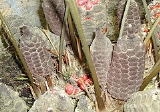
This cycad contains reddish seed cones
with a distinct acuminate tip. The leaves are 60–120 cm (2–3.9 ft) long, with 5-30 pairs of leaflets (pinnae). Each leaflet is linear to lanceolate or oblong-obovate, 8–25 cm long and 0.5–2 cm broad, with distinct teeth at the tip. They are often revolute, with prickly petioles. It is similar in many respects to Zamia furfuracea
, but with slightly narrower leaflets, and to Zamia integrifolia
, which differs in the more commonly entire (untoothed or only slightly so) leaflets.
This is a low-growing plant, with trunk that grows to 3–25 cm high and diameter, but is often subterranean. Over time, it forms a multi-branched cluster, with a large, tuberous root system, which is actually an extension of the above-ground stems.
Like other cycads, Zamia pumila is dioecious
, having male or female plants. The male cones are cylindrical, growing to 3–15 cm long; they are often clustered. The female cones are elongate-ovoid and grow to 6–15 cm long and 4–6 cm in diameter. Pollination
is by certain insect
s, namely the belid
weevil
Rhopalotria slossoni.
Zamia pumila inhabits a variety of habitats with well-drained sands or sandy loam
soils. It prefers filtered sunlight to partial shade. It is now confined to central Cuba
and the Dominican Republic
; populations formerly also occurred in southern Puerto Rico
and Haiti
, but have become extinct there due to intensive land use.
This plant is poison
ous, producing a toxin called cycasin that affects the gastrointestinal tract
and nervous system
. The toxin can however be removed by careful leaching, and the roots and half-buried stems were used by Native American people for their yield of a starch
, formerly known as Florida arrowroot
. The plant is also fed upon by various insects, including the butterfly Eumaeus atala
, which sequesters the toxin inside its body for use in its own defense.
Controversy has long existed over the classification and circumscription of Zamia in the southeastern United States
and West Indies. At one extreme, Eckenwalder (1980) included all these plants in a single broadly defined species, Z. pumila. Most other botanists have recognized several more narrowly defined species. The Flora of North America treats the American plants as Z. integrifolia
, although some references continue to refer to these populations as Z. pumila.
Cycad
Cycads are seed plants typically characterized by a stout and woody trunk with a crown of large, hard and stiff, evergreen leaves. They usually have pinnate leaves. The individual plants are either all male or all female . Cycads vary in size from having a trunk that is only a few centimeters...
of the West Indies and Cuba
Cuba
The Republic of Cuba is an island nation in the Caribbean. The nation of Cuba consists of the main island of Cuba, the Isla de la Juventud, and several archipelagos. Havana is the largest city in Cuba and the country's capital. Santiago de Cuba is the second largest city...
. Zamia pumila was the first species described for the genus and hence is the type species
Type species
In biological nomenclature, a type species is both a concept and a practical system which is used in the classification and nomenclature of animals and plants. The value of a "type species" lies in the fact that it makes clear what is meant by a particular genus name. A type species is the species...
for the genus Zamia and the family Zamiaceae.
This cycad contains reddish seed cones
Conifer cone
A cone is an organ on plants in the division Pinophyta that contains the reproductive structures. The familiar woody cone is the female cone, which produces seeds. The male cones, which produce pollen, are usually herbaceous and much less conspicuous even at full maturity...
with a distinct acuminate tip. The leaves are 60–120 cm (2–3.9 ft) long, with 5-30 pairs of leaflets (pinnae). Each leaflet is linear to lanceolate or oblong-obovate, 8–25 cm long and 0.5–2 cm broad, with distinct teeth at the tip. They are often revolute, with prickly petioles. It is similar in many respects to Zamia furfuracea
Zamia furfuracea
Zamia furfuracea is a cycad native to southeastern Veracruz state in eastern Mexico. Although not a palm tree , its growth habit is superficially similar to a palm; therefore it is commonly known as "Cardboard Palm" but the alternate name Cardboard Cycad is preferable...
, but with slightly narrower leaflets, and to Zamia integrifolia
Zamia integrifolia
Zamia integrifolia is a small, tough, woody cycad native to the southeast United States , the Bahamas and the Caribbean south to Grand Cayman and Puerto Rico ....
, which differs in the more commonly entire (untoothed or only slightly so) leaflets.
This is a low-growing plant, with trunk that grows to 3–25 cm high and diameter, but is often subterranean. Over time, it forms a multi-branched cluster, with a large, tuberous root system, which is actually an extension of the above-ground stems.
Like other cycads, Zamia pumila is dioecious
Dioecious
Dioecy is the property of a group of biological organisms that have males and females, but not members that have organs of both sexes at the same time. I.e., those whose individual members can usually produce only one type of gamete; each individual organism is thus distinctly female or male...
, having male or female plants. The male cones are cylindrical, growing to 3–15 cm long; they are often clustered. The female cones are elongate-ovoid and grow to 6–15 cm long and 4–6 cm in diameter. Pollination
Pollination
Pollination is the process by which pollen is transferred in plants, thereby enabling fertilisation and sexual reproduction. Pollen grains transport the male gametes to where the female gamete are contained within the carpel; in gymnosperms the pollen is directly applied to the ovule itself...
is by certain insect
Insect
Insects are a class of living creatures within the arthropods that have a chitinous exoskeleton, a three-part body , three pairs of jointed legs, compound eyes, and two antennae...
s, namely the belid
Belidae
Belidae is a family of weevils, called belids or primitive weevils because they have straight antennae, unlike the "true weevils" or Curculionidae which have elbowed antennae...
weevil
Weevil
A weevil is any beetle from the Curculionoidea superfamily. They are usually small, less than , and herbivorous. There are over 60,000 species in several families, mostly in the family Curculionidae...
Rhopalotria slossoni.
Zamia pumila inhabits a variety of habitats with well-drained sands or sandy loam
Loam
Loam is soil composed of sand, silt, and clay in relatively even concentration . Loam soils generally contain more nutrients and humus than sandy soils, have better infiltration and drainage than silty soils, and are easier to till than clay soils...
soils. It prefers filtered sunlight to partial shade. It is now confined to central Cuba
Cuba
The Republic of Cuba is an island nation in the Caribbean. The nation of Cuba consists of the main island of Cuba, the Isla de la Juventud, and several archipelagos. Havana is the largest city in Cuba and the country's capital. Santiago de Cuba is the second largest city...
and the Dominican Republic
Dominican Republic
The Dominican Republic is a nation on the island of La Hispaniola, part of the Greater Antilles archipelago in the Caribbean region. The western third of the island is occupied by the nation of Haiti, making Hispaniola one of two Caribbean islands that are shared by two countries...
; populations formerly also occurred in southern Puerto Rico
Puerto Rico
Puerto Rico , officially the Commonwealth of Puerto Rico , is an unincorporated territory of the United States, located in the northeastern Caribbean, east of the Dominican Republic and west of both the United States Virgin Islands and the British Virgin Islands.Puerto Rico comprises an...
and Haiti
Haiti
Haiti , officially the Republic of Haiti , is a Caribbean country. It occupies the western, smaller portion of the island of Hispaniola, in the Greater Antillean archipelago, which it shares with the Dominican Republic. Ayiti was the indigenous Taíno or Amerindian name for the island...
, but have become extinct there due to intensive land use.
This plant is poison
Poison
In the context of biology, poisons are substances that can cause disturbances to organisms, usually by chemical reaction or other activity on the molecular scale, when a sufficient quantity is absorbed by an organism....
ous, producing a toxin called cycasin that affects the gastrointestinal tract
Gastrointestinal tract
The human gastrointestinal tract refers to the stomach and intestine, and sometimes to all the structures from the mouth to the anus. ....
and nervous system
Nervous system
The nervous system is an organ system containing a network of specialized cells called neurons that coordinate the actions of an animal and transmit signals between different parts of its body. In most animals the nervous system consists of two parts, central and peripheral. The central nervous...
. The toxin can however be removed by careful leaching, and the roots and half-buried stems were used by Native American people for their yield of a starch
Starch
Starch or amylum is a carbohydrate consisting of a large number of glucose units joined together by glycosidic bonds. This polysaccharide is produced by all green plants as an energy store...
, formerly known as Florida arrowroot
Florida arrowroot
Florida arrowroot was the commercial name of an edible starch extracted from Zamia integrifolia , a small cycad native to North America.-Use:...
. The plant is also fed upon by various insects, including the butterfly Eumaeus atala
Eumaeus atala
The Atala, Eumaeus atala, is a small colorful butterfly in the family Lycaenidae. It is found in southeastern Florida, the Bahamas, and Cuba. Its coloration and habits are unique among butterflies within its range....
, which sequesters the toxin inside its body for use in its own defense.
Controversy has long existed over the classification and circumscription of Zamia in the southeastern United States
United States
The United States of America is a federal constitutional republic comprising fifty states and a federal district...
and West Indies. At one extreme, Eckenwalder (1980) included all these plants in a single broadly defined species, Z. pumila. Most other botanists have recognized several more narrowly defined species. The Flora of North America treats the American plants as Z. integrifolia
Zamia integrifolia
Zamia integrifolia is a small, tough, woody cycad native to the southeast United States , the Bahamas and the Caribbean south to Grand Cayman and Puerto Rico ....
, although some references continue to refer to these populations as Z. pumila.