

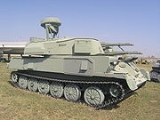
ZSU-23-4

Unanswered Questions

Encyclopedia
The ZSU-23-4 "Shilka" is a lightly armored, self-propelled
, radar
guided anti-aircraft weapon
system (SPAAG
). ZSU stands for Zenitnaya Samokhodnaya Ustanovka , meaning "anti-aircraft self-propelled mount". The "23" signifies the bore diameter in millimeters. The "4" signifies the number of gun barrels. It is named after the Russia
n Shilka River
. Polish soldiers nicknamed it maszyna do szycia (sewing machine
) due to the sound of firing guns and because the similarity of name "Shilka" and Russian word "шить" ("shic'") (to sew). It is also referred to by its nickname of "Zeus".
, was armed with two 57 mm autocannon
s; it was aimed optically using a basic tracking and lead calculating system. The ZSU-57-2 was not particularly successful despite its very powerful autocannons; it could only carry a relatively small amount of ammunition, was inaccurate as it lacked radar, and could not fire while on the move.
The ZPU series armed with 14.5 mm heavy machine gun
s carried on a towed mount for stationary, point air defence had a much higher rate of fire. The 23 mm version of this weapon system was known as the ZU-23-2
, a towed mount carrying two 23 mm cannons.
The development of the ZSU-23-4 "Shilka" began in 1957 along with ZSU-37-2 "Yenisei" and the vehicle was brought into service in 1965, replacing all ZSU-57-2s in air defense units toward the beginning of the 1970s. The ZSU-23-4 was intended for AA defense of military facilities, troops, and mechanized columns on the march. Initially, tank regiments should have had the anti-aircraft artillery battalion of "Shilka" (consisting of two batteries, four ZSU-23-4s in each). At the end of 1960s, one battery was equipped with ZSU-23-4s and the other with ZSU-57-2s. Motorized rifle and tank regiment standard anti-aircraft batteries consisted of two platoons later (one platoon was equipped with four ZSU-23-4s and another with four mobile surface-to-air missile
systems 9K31 Strela-1 or 9K35 Strela-10). The ZSU-23-4 combined a proven radar system, the non-amphibious chassis based on GM-575 tracked vehicle, and four 23 mm autocannons. This delivered a highly effective combination of mobility with heavy firepower and considerable accuracy. The ZSU-23-4 outclassed all NATO anti-aircraft guns at the time, and it is still regarded as posing a major threat for low-flying fixed-wing aircraft and helicopters.
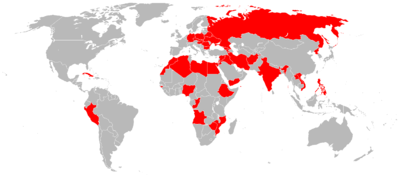
The system was widely fielded throughout the Warsaw Pact
, other pro-Soviet states and Middle East
states. Around 2,500 ZSU-23-4s, of the total 6,500 produced, were exported to 23 countries. The Soviet Union's successor states continue to manufacture and supply variants of the ZSU-23-4, notably the Ukrainian
"Donets" and Polish "Biala" variants.
 ZSU-23-4 units saw active service in the Yom Kippur War
(1973) and other Arab-Israeli conflicts, the Iran–Iraq War (1980–1988), and the First Gulf War
(1990). During the 1973 Yom Kippur War
, the system was particularly effective against the Israeli Air Force
. Israeli pilots attempting to fly low in order to avoid SA-6 missiles were often shot down by ZSU-23-4s as in Operation Doogman 5. During the Soviet-Afghan War
ZSU-23-4 units were used widely and to great effect against mujahideen
positions in the mountains, the ZSU-23-4's guns being able to elevate much higher than the weapons on BMPs
, BTRs
, T-55
s, or T-62
s. They were also used to suppress defensive positions around the presidential palace during the initial coup in Kabul
at the start of the Soviet-Afghan war. The Russian Army used the ZSU-23-4 for mountain combat in Chechnya
.
s, was a revolutionary SPAAG, proving to be an extremely effective weapon against enemy attack aircraft and helicopters under every weather and light condition. The ZSU-23-4 has a very high density, rate and accuracy of fire, as well as the capability for each of the four autocannons to fire its own type of projectile from separate belts. While it is technically possible that each cannon shoots different type of ammo, there were two types commonly used in late '70s: OFZT incendiary fragmentation and BZT armour-piercing tracer, which were to be loaded in 3:1 ratio—three OFZT, then one BZT, every 10th BZT round equipped with so-called "copper remover" and marked. It was strongly recommended against shooting from a single barrel. The appearance of the "Shilka" caused significant changes in NATO tactics in aircraft use at low altitude over the battlefield.
Despite its present obsolescence as a modern short-range anti-aircraft weapon, the ZSU-23-4 is still deadly for enemy light armoured vehicles, infantry and firing points as an infantry-support vehicle. With its high rate of accurate fire, the ZSU-23-4 can even neutralize tanks by destroying their gun sights, radio antennas, or other vulnerable parts. ZSU-23-4s, especially late models, have excellent performance and good systems reliability.
Based on the GM-575
tracked vehicle chassis, which used components from the PT-76
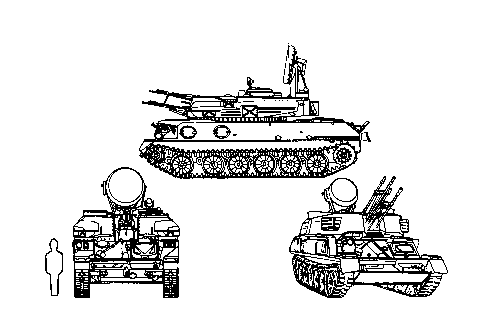
light amphibious tank, the ZSU-23-4 mounts an armored turret holding four liquid-cooled 23 mm (0.9") 2A7 autocannons linked to an RPK-2 "Tobol" Radar (nicknamed "Gun Dish"). The vehicle weighs 19 tonnes (late modifications up to 21 tonnes), has a movement range of 450 km (279.6 mi) and a top speed of 50 km/h (31 mph). Additional firepower of late modifications can be supplied by a roof-mounted pod of six short-range SA-18 SAMs, or side mounted SA-16s.
The crew numbers four: driver, commander, gunner and radar operator. The driver's compartment is located in the nose part of the vehicle. The fighting compartment is in the center, and the engine compartment is in the rear part of the vehicle. The ZSU-23-4 provides minimal comfort for the crew. Whereas the driver's compartment has a good self-contained air pump with an electric heating system, other crew members suffer from cold in winter because the heating system of the fighting compartment, heated handrails and floor, is ineffective. It is hot inside the vehicle in summer.
The transmission consists of a multi-plate metal-contact main clutch, a manual gearbox with five forward gears, two planetary two-step steering gears with locking frictions and two final drive groups. The vehicle chassis has six single rubber tired road wheels, a rear drive sprocket with detachable sprocket rings (lantern-wheel gear) and one idler wheel per side. The first and fifth left, and sixth right road wheels have hydraulic shock absorbers. The track is 11.904 m long, 382 mm (15") wide and has 93 links.
Because of a large number of different pipes and tubes to detach during maintenance, the repair procedure for some of the vehicle's mechanisms is hard (for example, replacement or repair of a starter). The electric drive of an air outlet hatch of a gas turbine engine (part of the vehicle's electric power supply system) has an inconvenient location (at the bottom of the hull) which causes overheating and sometimes, jamming of the electric drive. On the other hand, the construction of the electric power supply system is very reliable. Changing the main engine oil and coolant is easy, as is replacement of fuel and oil filters, and sections of the air filter.
The ZSU-23-4 can cross vertical obstacles 0.7 m (2.3') high, trenches 2.5 m (8.2') wide, has a 1.0 m (3.3') fording depth and can climb 30° gradients. The ZSU-23-4 has good maneuverability and cross-country ability, but its diesel engine's power is insufficient for a vehicle of its weight. As a result, off-road acceleration capabilities are sub-par, and the vehicle lags behind MBTs and IFVs on up-hill terrain.
The ZSU-23-4 is equipped with an NBC system with an air filtration unit, fire-fighting equipment, TNA-2 navigational system, infrared vision device, R-123 radio set, R-124 intercom and electric power supply system consisting of a DG4M-1 single-shaft gas turbine engine (70 hp at 6,000 rpm) and a direct-current generator (which provides 27 V and 54 V direct current or 220 V 400 Hz alternate current).
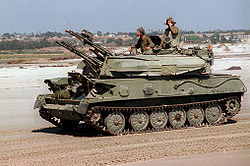
designation for ZSU-23-4 turret with 23 mm (0.9") AZP-23 "Amur" quad automatic gun is 2A10. An armoured plate inside the turret protects crew members from fire and explosive gas during intense firing.
The water-cooled 2A7 23mm guns of ZSU-23-4 fire the same 23×152 mmB caliber ammunition as the 2A14 guns of the twin-barrel ZU-23-2 towed gun
. While the 23mm Volkov-Yartsev VYa-23
aircraft gun used in the Second World War era Il-2 Sturmovik also fired ammunition of same cartridge case dimensions, the rounds differed in loading and primer, and are thus not interchangeable with the post-war AA gun ammunition. Compared to the VYa and its ammunition, the air defence guns have slightly higher muzzle velocity, and explosive rounds also have slightly larger HE fillings. The VYa ammunition has brass cases, while 2A7/2A14 ammunition has steel cases.
Three main types of 23mm anti-aircraft ammunition were manufactured post-war: API-T, HEI and HEI-T. Additionally to the original Soviet rounds, a number of ammunition manufacturers have since begun to produce ammunition for what is still a widely used caliber; these include also new ammunition types such as sub-caliber armour-piercing rounds and frangible ammunition. The following table lists the main characteristics of some of the available 23×152 mmB ammunition used in 23mm AA guns:
A typical loading of each ammunition belt contains 40 OFZT and 10 BZT rounds. They can be fired to a maximum horizontal range of 7 km (4.3 mi), and a vertical range of 5.1 km (3.2 mi). The effective vertical range is 1.5 km (0.93205910497471 mi) at a direct range to target of 2.5 km (1.6 mi) and target speed of 250 m/s (up to 500 m/s if a modern fire control system is used). The usual autocannon burst consists of 3–10 projectiles and target lead angle is calculated for each burst (fire without adjustment) by computer. In attacking targets on the ground, its effective range is around 2.5 km (1.6 mi). The short range of its 23 mm autocannons and relatively low explosive effect of its small-calibre projectiles mean it is less able to engage threats such as jet attack aircraft and cruise missiles than modern systems like the 9K22 Tunguska armed with more powerful 30 mm autocannons and integrated missile armaments. A special 23 mm round with composite projectiles was developed for a modern modification of SPAAG (ZSU-23-4M4) to be used against cruise missiles.
and can detect aircraft up to 20 km (12.4 mi) away. It has excellent target tracking capability and is relatively hard to detect by the enemy. However, the radar picks up many false returns (ground clutter) under 60 m (200 ft) of altitude. The radar antenna is mounted on collapsible supports in the top rear of the turret. There is an optical alignment sight. The RPK-2 radar proved to have good protection against enemy passive electronic radar counter-measures. Nevertheless, the radar system of the ZSU-23-4 has a short detection range during target search, depending on weather conditions (mainly dependent on rain and snow conditions). It is hard to automatically track the target at ranges less than 7–8 km (4.3-5.0 mi) because of the high angular speed of the target at close distances. The radar needs to be reset quite often because of the unstable parameters of electronic cathode-ray tubes of the target selection system. The absence of an automatic laser range finder requires a skillful commander and gunner.
" even if the operator was not pulling the trigger, discharging the weapon and chambering a new round, which would then also cook off, and continue to do so. This would sometimes continue until the entire belt of ammunition had been expended. Overheating barrels could jam and even break away from the vehicle. The problem resulted from a deficient cooling system and made the early ZSU-23-4s dangerous even to friendly troops standing nearby if this happened. Despite the fact that this seldom happened, Soviet operators learned to give these machines a wide berth.(Perrett 1987:100) It was not recommended to perform continuous fire (bursts longer than 15 seconds without pause) on earlier models until the problem with autocannon reliability and overheating during intense fire was solved on ZSU-23-4M (welded tubes of coolant outlet were replaced with flexible pipes). After the autocannon cooling system was improved, the autocannons became extremely reliable.
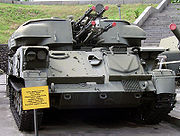 Soviet doctrine supplied the vehicle since 1965 in an anti-aircraft artillery battalion of two, four-vehicle platoons for anti-aircraft defence of motor rifle and tank regiments. At the end of the 1960s one platoon was equipped with ZSU-23-4 SPAAGs while another one was still equipped with ZSU-57-2
SPAAGs. ZSU-57-2 was completely replaced with ZSU-23-4 by the beginning of 1970s. In the 1970s, Soviet motor rifle and tank regiments were equipped with an anti-aircraft missile artillery battery consisting of two platoons, one equipped with four ZSU-23-4 SPAAGs and the other with four 9K31 Strela-1 (SA-9 Gaskin) or later with four 9K35 Strela-10 (SA-13 Gopher) short-range surface-to-air missile
systems which cover the dead zones of 2K12 Kub (SA-6 Gainful) surface-to-air missile systems belonging to the divisional level. Since the 1980s Soviet motor rifle and tank regiments were equipped with an anti-aircraft artillery battalion of three batteries (one was equipped with ZSU-23-4 or 9K22 Tunguska SPAAGs, the second one was equipped with 9K35 Strela-10 (SA-13 Gopher) short-range surface-to-air missile systems and the third battery with 9K38 Igla man-portable surface-to-air missiles on IFVs or APCs.
The ZSU-23-4 is very vulnerable to enemy anti-tank missiles, cannons and heavy machine guns; the armour is thin (not exceeding 15 mm) and the exposed wheels, tracks, radar, and gun barrels can easily be damaged in combat. Firing positions of ZSU-23-4 SPAAGs are typically placed near the forward edge of the battle area (FEBA
) but behind the main forces, usually 600–1000 m behind objectives when on the defensive or 400–600 m behind the leading tanks on the offensive. ZSU-23-4 SPAAGs are divided evenly along the troop columns on the march.
At first each ZSU-23-4 operated in combat autonomously, without target marking from regimental or divisional air defence. In 1978, the PPRU-1 (mobile reconnaissance and control post) was passed into service of the Soviet Army. The PPRU-1 ("Ovod-M-SV") vehicle is based on MTL-BU armoured tracked chassis and it was intended for control of motor rifle or tank regimental anti-aircraft unit equipped with ZSU-23-4 SPAAGs and 9K31 "Strela-1M" mobile surface-to-air missile systems. The PPRU-1 is equipped with "Luk-23" radar and an automatic fire control system associated with the divisional air defence system.
 The guns are useful against low-flying aircraft and lightly protected ground targets. Due to its effectiveness against ground targets, ZSU-23-4s have been used in urban environments (e.g., Afghanistan
, Abkhazia
, Chechnya
, and Lebanon
). This is primarily because the guns can elevate much higher than a tank or APC cannon, enabling armored units equipped with ZSU-23-4s to return fire against ambushes from above.
Apart from the Russian Army, a small number of ZSU-23-4 SPAAGs are still in use by the Russian Naval Infantry (specifically the 61st and 175th brigades of the Northern Fleet and the 336th brigade of the Baltic Fleet
).
Self-propelled
Self-propelled often refers to some form of self-propelled travel. It can refer to* Self-propelled anti-aircraft weapon* Self-propelled anti-tank gun* Self-propelled artillery* Self-propelled barge T-36* Self-propelled gun* Self-propelled mortar...
, radar
Radar
Radar is an object-detection system which uses radio waves to determine the range, altitude, direction, or speed of objects. It can be used to detect aircraft, ships, spacecraft, guided missiles, motor vehicles, weather formations, and terrain. The radar dish or antenna transmits pulses of radio...
guided anti-aircraft weapon
Weapon
A weapon, arm, or armament is a tool or instrument used with the aim of causing damage or harm to living beings or artificial structures or systems...
system (SPAAG
Self-propelled anti-aircraft weapon
An anti-aircraft vehicle, also known as a self-propelled anti-aircraft weapon or self-propelled air defense system , is a mobile vehicle with a dedicated anti-aircraft capability...
). ZSU stands for Zenitnaya Samokhodnaya Ustanovka , meaning "anti-aircraft self-propelled mount". The "23" signifies the bore diameter in millimeters. The "4" signifies the number of gun barrels. It is named after the Russia
Russia
Russia or , officially known as both Russia and the Russian Federation , is a country in northern Eurasia. It is a federal semi-presidential republic, comprising 83 federal subjects...
n Shilka River
Shilka River
Shilka is a river in Zabaykalsky Krai, south-eastern Russia. It has a length . It originates as a confluence of the Onon and Ingoda rivers. Its confluence with the Ergune on the Russia-China border gives rise to the Amur River. The river is navigable for its entire length....
. Polish soldiers nicknamed it maszyna do szycia (sewing machine
Sewing machine
A sewing machine is a textile machine used to stitch fabric, cards and other material together with thread. Sewing machines were invented during the first Industrial Revolution to decrease the amount of manual sewing work performed in clothing companies...
) due to the sound of firing guns and because the similarity of name "Shilka" and Russian word "шить" ("shic'") (to sew). It is also referred to by its nickname of "Zeus".
History
The previous Soviet Union self-propelled anti-aircraft gun (SPAAG), the ZSU-57-2ZSU-57-2
The ZSU-57-2 is a Soviet self-propelled anti-aircraft gun , armed with two 57 mm autocannons. 'ZSU' stands for Zenitnaya Samokhodnaya Ustanovka , meaning "anti-aircraft self-propelled mount", '57' stands for the bore of the armament in millimetres and '2' stands for the number of gun barrels....
, was armed with two 57 mm autocannon
Autocannon
An autocannon or automatic cannon is a rapid-fire projectile weapon firing a shell as opposed to the bullet fired by a machine gun. Autocannons often have a larger caliber than a machine gun . Usually, autocannons are smaller than a field gun or other artillery, and are mechanically loaded for a...
s; it was aimed optically using a basic tracking and lead calculating system. The ZSU-57-2 was not particularly successful despite its very powerful autocannons; it could only carry a relatively small amount of ammunition, was inaccurate as it lacked radar, and could not fire while on the move.
The ZPU series armed with 14.5 mm heavy machine gun
Heavy machine gun
The heavy machine gun or HMG is a larger class of machine gun generally recognized to refer to two separate stages of machine gun development. The term was originally used to refer to the early generation of machine guns which came into widespread use in World War I...
s carried on a towed mount for stationary, point air defence had a much higher rate of fire. The 23 mm version of this weapon system was known as the ZU-23-2
ZU-23-2
The ZU-23-2, also known as ZU-23, is a Soviet towed 23 mm anti-aircraft twin-barreled autocannon. ZU stands for Zenitnaya Ustanovka - anti-aircraft mount.-Development history:...
, a towed mount carrying two 23 mm cannons.
The development of the ZSU-23-4 "Shilka" began in 1957 along with ZSU-37-2 "Yenisei" and the vehicle was brought into service in 1965, replacing all ZSU-57-2s in air defense units toward the beginning of the 1970s. The ZSU-23-4 was intended for AA defense of military facilities, troops, and mechanized columns on the march. Initially, tank regiments should have had the anti-aircraft artillery battalion of "Shilka" (consisting of two batteries, four ZSU-23-4s in each). At the end of 1960s, one battery was equipped with ZSU-23-4s and the other with ZSU-57-2s. Motorized rifle and tank regiment standard anti-aircraft batteries consisted of two platoons later (one platoon was equipped with four ZSU-23-4s and another with four mobile surface-to-air missile
Surface-to-air missile
A surface-to-air missile or ground-to-air missile is a missile designed to be launched from the ground to destroy aircraft or other missiles...
systems 9K31 Strela-1 or 9K35 Strela-10). The ZSU-23-4 combined a proven radar system, the non-amphibious chassis based on GM-575 tracked vehicle, and four 23 mm autocannons. This delivered a highly effective combination of mobility with heavy firepower and considerable accuracy. The ZSU-23-4 outclassed all NATO anti-aircraft guns at the time, and it is still regarded as posing a major threat for low-flying fixed-wing aircraft and helicopters.
The system was widely fielded throughout the Warsaw Pact
Warsaw Pact
The Warsaw Treaty Organization of Friendship, Cooperation, and Mutual Assistance , or more commonly referred to as the Warsaw Pact, was a mutual defense treaty subscribed to by eight communist states in Eastern Europe...
, other pro-Soviet states and Middle East
Middle East
The Middle East is a region that encompasses Western Asia and Northern Africa. It is often used as a synonym for Near East, in opposition to Far East...
states. Around 2,500 ZSU-23-4s, of the total 6,500 produced, were exported to 23 countries. The Soviet Union's successor states continue to manufacture and supply variants of the ZSU-23-4, notably the Ukrainian
Ukraine
Ukraine is a country in Eastern Europe. It has an area of 603,628 km², making it the second largest contiguous country on the European continent, after Russia...
"Donets" and Polish "Biala" variants.
Yom Kippur War
The Yom Kippur War, Ramadan War or October War , also known as the 1973 Arab-Israeli War and the Fourth Arab-Israeli War, was fought from October 6 to 25, 1973, between Israel and a coalition of Arab states led by Egypt and Syria...
(1973) and other Arab-Israeli conflicts, the Iran–Iraq War (1980–1988), and the First Gulf War
Gulf War
The Persian Gulf War , commonly referred to as simply the Gulf War, was a war waged by a U.N.-authorized coalition force from 34 nations led by the United States, against Iraq in response to Iraq's invasion and annexation of Kuwait.The war is also known under other names, such as the First Gulf...
(1990). During the 1973 Yom Kippur War
Yom Kippur War
The Yom Kippur War, Ramadan War or October War , also known as the 1973 Arab-Israeli War and the Fourth Arab-Israeli War, was fought from October 6 to 25, 1973, between Israel and a coalition of Arab states led by Egypt and Syria...
, the system was particularly effective against the Israeli Air Force
Israeli Air Force
The Israeli Air Force is the air force of the State of Israel and the aerial arm of the Israel Defense Forces. It was founded on May 28, 1948, shortly after the Israeli Declaration of Independence...
. Israeli pilots attempting to fly low in order to avoid SA-6 missiles were often shot down by ZSU-23-4s as in Operation Doogman 5. During the Soviet-Afghan War
Soviet war in Afghanistan
The Soviet war in Afghanistan was a nine-year conflict involving the Soviet Union, supporting the Marxist-Leninist government of the Democratic Republic of Afghanistan against the Afghan Mujahideen and foreign "Arab–Afghan" volunteers...
ZSU-23-4 units were used widely and to great effect against mujahideen
Mujahideen
Mujahideen are Muslims who struggle in the path of God. The word is from the same Arabic triliteral as jihad .Mujahideen is also transliterated from Arabic as mujahedin, mujahedeen, mudžahedin, mudžahidin, mujahidīn, mujaheddīn and more.-Origin of the concept:The beginnings of Jihad are traced...
positions in the mountains, the ZSU-23-4's guns being able to elevate much higher than the weapons on BMPs
BMP-1
The BMP-1 is a Soviet amphibious tracked infantry fighting vehicle. BMP stands for Boyevaya Mashina Pekhoty 1 , meaning "infantry fighting vehicle". The BMP-1 was the world's first mass-produced infantry fighting vehicle...
, BTRs
BTR-60
The BTR-60 is the first vehicle in a series of Soviet eight-wheeled armoured personnel carriers. It was developed in the late 1950s as a replacement for the BTR-152 and was seen first time in public in 1961...
, T-55
T-55
The T-54 and T-55 tanks were a series of main battle tanks designed in the Soviet Union. The first T-54 prototype appeared in March 1945, just before the end of the Second World War. The T-54 entered full production in 1947 and became the main tank for armored units of the Soviet Army, armies of...
s, or T-62
T-62
The T-62 is a Soviet main battle tank, a further development of the T-55. Its 115 mm gun was the first smoothbore tank gun in use.The T-62 was produced between 1961 and 1975. It became a standard tank in the Soviet arsenal, partly replacing the T-55, although that tank continued to be...
s. They were also used to suppress defensive positions around the presidential palace during the initial coup in Kabul
Operation Storm-333
Operation Storm-333 was the codename of the Soviet special forces operation on December 27, 1979 in which Soviet special forces stormed the Tajbeg Palace in Afghanistan and killed President Hafizullah Amin and his 200 personal guards...
at the start of the Soviet-Afghan war. The Russian Army used the ZSU-23-4 for mountain combat in Chechnya
Chechnya
The Chechen Republic , commonly referred to as Chechnya , also spelled Chechnia or Chechenia, sometimes referred to as Ichkeria , is a federal subject of Russia . It is located in the southeastern part of Europe in the Northern Caucasus mountains. The capital of the republic is the city of Grozny...
.
Description
The radar-guided ZSU-23-4 "Shilka" SPAAG, with its four 23 mm (0.90") autocannonAutocannon
An autocannon or automatic cannon is a rapid-fire projectile weapon firing a shell as opposed to the bullet fired by a machine gun. Autocannons often have a larger caliber than a machine gun . Usually, autocannons are smaller than a field gun or other artillery, and are mechanically loaded for a...
s, was a revolutionary SPAAG, proving to be an extremely effective weapon against enemy attack aircraft and helicopters under every weather and light condition. The ZSU-23-4 has a very high density, rate and accuracy of fire, as well as the capability for each of the four autocannons to fire its own type of projectile from separate belts. While it is technically possible that each cannon shoots different type of ammo, there were two types commonly used in late '70s: OFZT incendiary fragmentation and BZT armour-piercing tracer, which were to be loaded in 3:1 ratio—three OFZT, then one BZT, every 10th BZT round equipped with so-called "copper remover" and marked. It was strongly recommended against shooting from a single barrel. The appearance of the "Shilka" caused significant changes in NATO tactics in aircraft use at low altitude over the battlefield.
Despite its present obsolescence as a modern short-range anti-aircraft weapon, the ZSU-23-4 is still deadly for enemy light armoured vehicles, infantry and firing points as an infantry-support vehicle. With its high rate of accurate fire, the ZSU-23-4 can even neutralize tanks by destroying their gun sights, radio antennas, or other vulnerable parts. ZSU-23-4s, especially late models, have excellent performance and good systems reliability.
Based on the GM-575
GM chassis
thumb|300px|[[Tor missile system]] on GM-5955 chassis.GM is a series of tracked vehicle chassis. Generally, the series is produced by Metrovagonmash , part of the Transmashholding since 2002...
tracked vehicle chassis, which used components from the PT-76
PT-76
The PT-76 is a Soviet amphibious light tank which was introduced in the early 1950s and soon became the standard reconnaissance tank of the Soviet Army and the other Warsaw Pact armed forces. It was widely exported to other friendly states, like India, Iraq, North Korea and North Vietnam. Overall,...
light amphibious tank, the ZSU-23-4 mounts an armored turret holding four liquid-cooled 23 mm (0.9") 2A7 autocannons linked to an RPK-2 "Tobol" Radar (nicknamed "Gun Dish"). The vehicle weighs 19 tonnes (late modifications up to 21 tonnes), has a movement range of 450 km (279.6 mi) and a top speed of 50 km/h (31 mph). Additional firepower of late modifications can be supplied by a roof-mounted pod of six short-range SA-18 SAMs, or side mounted SA-16s.
The crew numbers four: driver, commander, gunner and radar operator. The driver's compartment is located in the nose part of the vehicle. The fighting compartment is in the center, and the engine compartment is in the rear part of the vehicle. The ZSU-23-4 provides minimal comfort for the crew. Whereas the driver's compartment has a good self-contained air pump with an electric heating system, other crew members suffer from cold in winter because the heating system of the fighting compartment, heated handrails and floor, is ineffective. It is hot inside the vehicle in summer.
The transmission consists of a multi-plate metal-contact main clutch, a manual gearbox with five forward gears, two planetary two-step steering gears with locking frictions and two final drive groups. The vehicle chassis has six single rubber tired road wheels, a rear drive sprocket with detachable sprocket rings (lantern-wheel gear) and one idler wheel per side. The first and fifth left, and sixth right road wheels have hydraulic shock absorbers. The track is 11.904 m long, 382 mm (15") wide and has 93 links.
Because of a large number of different pipes and tubes to detach during maintenance, the repair procedure for some of the vehicle's mechanisms is hard (for example, replacement or repair of a starter). The electric drive of an air outlet hatch of a gas turbine engine (part of the vehicle's electric power supply system) has an inconvenient location (at the bottom of the hull) which causes overheating and sometimes, jamming of the electric drive. On the other hand, the construction of the electric power supply system is very reliable. Changing the main engine oil and coolant is easy, as is replacement of fuel and oil filters, and sections of the air filter.
The ZSU-23-4 can cross vertical obstacles 0.7 m (2.3') high, trenches 2.5 m (8.2') wide, has a 1.0 m (3.3') fording depth and can climb 30° gradients. The ZSU-23-4 has good maneuverability and cross-country ability, but its diesel engine's power is insufficient for a vehicle of its weight. As a result, off-road acceleration capabilities are sub-par, and the vehicle lags behind MBTs and IFVs on up-hill terrain.
The ZSU-23-4 is equipped with an NBC system with an air filtration unit, fire-fighting equipment, TNA-2 navigational system, infrared vision device, R-123 radio set, R-124 intercom and electric power supply system consisting of a DG4M-1 single-shaft gas turbine engine (70 hp at 6,000 rpm) and a direct-current generator (which provides 27 V and 54 V direct current or 220 V 400 Hz alternate current).
Weapons and fire control
Guns
Each water-cooled 23 mm 2A7 autocannon has a cyclic rate of 850–1,000 rounds per minute for a combined rate of fire of 3,400–4,000 rounds per minute. The welded turret has a race ring transplanted from a T-54 medium tank with a 1,840 mm (6') diameter. The 360° rotatory turret is fully stabilised and capable of firing on the move. The turret rotation and autocannon elevation mechanisms provide very good speed and guidance accuracy. The hydraulically driven aiming mechanisms have been proven to be very reliable. Manual aim is used against ground targets. The quad automatic anti-aircraft gun AZP-23 "Amur" has a range of elevation from -4° to +85°. The GRAUGrau
Grau is a German word meaning "gray" and a Catalan word meaning "grade". It may refer to:* BAP Almirante Grau , a De Zeven Provinciën class cruiser in service with the Peruvian Navy* Grau Käse, Tyrolean grey cheese...
designation for ZSU-23-4 turret with 23 mm (0.9") AZP-23 "Amur" quad automatic gun is 2A10. An armoured plate inside the turret protects crew members from fire and explosive gas during intense firing.
Ammunition
Ammunition capacity is 2,000 rounds stowed aboard (520 rounds per each upper autocannon and 480 rounds per each lower autocannon) loaded in 50-round or shorter belts.The water-cooled 2A7 23mm guns of ZSU-23-4 fire the same 23×152 mmB caliber ammunition as the 2A14 guns of the twin-barrel ZU-23-2 towed gun
ZU-23-2
The ZU-23-2, also known as ZU-23, is a Soviet towed 23 mm anti-aircraft twin-barreled autocannon. ZU stands for Zenitnaya Ustanovka - anti-aircraft mount.-Development history:...
. While the 23mm Volkov-Yartsev VYa-23
Volkov-Yartsev VYa-23
Volkov-Yartsev VYa-23 is a autocannon used on Soviet aircraft during World War II.-Development:In 1940, A.A. Volkov and S.A.Yartsev created an autocannon called TKB-201 for the new 23 mm round. It was intended to be the primary weapon of the Ilyushin Il-2 ground attack aircraft...
aircraft gun used in the Second World War era Il-2 Sturmovik also fired ammunition of same cartridge case dimensions, the rounds differed in loading and primer, and are thus not interchangeable with the post-war AA gun ammunition. Compared to the VYa and its ammunition, the air defence guns have slightly higher muzzle velocity, and explosive rounds also have slightly larger HE fillings. The VYa ammunition has brass cases, while 2A7/2A14 ammunition has steel cases.
Three main types of 23mm anti-aircraft ammunition were manufactured post-war: API-T, HEI and HEI-T. Additionally to the original Soviet rounds, a number of ammunition manufacturers have since begun to produce ammunition for what is still a widely used caliber; these include also new ammunition types such as sub-caliber armour-piercing rounds and frangible ammunition. The following table lists the main characteristics of some of the available 23×152 mmB ammunition used in 23mm AA guns:
| Designation | Type | Projectile Weight [g] | Bursting charge [g] | Muzzle Velocity [m/s] | Description |
|---|---|---|---|---|---|
| BZT | API | 190 | ? | 970 | Blunt AP steel core, with incendiary charge inside windshield cap. Penetration 15 mm RHA at 100 m range and 30-degree impact angle, or 25mm at 400m and 0-degree impact. Tracer burn time 5 seconds. |
| OFZ | HE | 184 | 19 | 980 | HE fragmentation round with nose fuzes incorporating self-destruct mechanism. |
| OFZT | HE-T | 188 | 13 | 980 | HE fragmentation round with a reduced HE charge due to the space taken by the tracer; tracer burn time 5 seconds. |
| APDS-T | APDS-T | 103 | none | 1220 | A Polish sub-caliber armour-piercing round with tracer. Penetration 30 mm RHA at 100 m range and 30-degree impact angle (from perpendicular), tracer burn time >2.5 s. |
A typical loading of each ammunition belt contains 40 OFZT and 10 BZT rounds. They can be fired to a maximum horizontal range of 7 km (4.3 mi), and a vertical range of 5.1 km (3.2 mi). The effective vertical range is 1.5 km (0.93205910497471 mi) at a direct range to target of 2.5 km (1.6 mi) and target speed of 250 m/s (up to 500 m/s if a modern fire control system is used). The usual autocannon burst consists of 3–10 projectiles and target lead angle is calculated for each burst (fire without adjustment) by computer. In attacking targets on the ground, its effective range is around 2.5 km (1.6 mi). The short range of its 23 mm autocannons and relatively low explosive effect of its small-calibre projectiles mean it is less able to engage threats such as jet attack aircraft and cruise missiles than modern systems like the 9K22 Tunguska armed with more powerful 30 mm autocannons and integrated missile armaments. A special 23 mm round with composite projectiles was developed for a modern modification of SPAAG (ZSU-23-4M4) to be used against cruise missiles.
Radar
The RPK-2 "Tobol" radar operates in the J bandJ band
J band can refer to two different regions of the electromagnetic spectrum, in the radio and near-infrared.-Radio:The J band is the range of radio frequencies from 10 GHz to 20 GHz in the electromagnetic spectrum. This is equal to wave lengths between...
and can detect aircraft up to 20 km (12.4 mi) away. It has excellent target tracking capability and is relatively hard to detect by the enemy. However, the radar picks up many false returns (ground clutter) under 60 m (200 ft) of altitude. The radar antenna is mounted on collapsible supports in the top rear of the turret. There is an optical alignment sight. The RPK-2 radar proved to have good protection against enemy passive electronic radar counter-measures. Nevertheless, the radar system of the ZSU-23-4 has a short detection range during target search, depending on weather conditions (mainly dependent on rain and snow conditions). It is hard to automatically track the target at ranges less than 7–8 km (4.3-5.0 mi) because of the high angular speed of the target at close distances. The radar needs to be reset quite often because of the unstable parameters of electronic cathode-ray tubes of the target selection system. The absence of an automatic laser range finder requires a skillful commander and gunner.
Limitations and problems
Early versions of the ZSU-23-4 sometimes had problems with "runaway guns": after prolonged periods of firing, the guns would get so hot that chambered rounds would "cook offCooking off
Cooking off refers to ammunition exploding prematurely due to heat in the surrounding environment. It can also refer to a technique used when throwing grenades to achieve a controlled, predictable explosion....
" even if the operator was not pulling the trigger, discharging the weapon and chambering a new round, which would then also cook off, and continue to do so. This would sometimes continue until the entire belt of ammunition had been expended. Overheating barrels could jam and even break away from the vehicle. The problem resulted from a deficient cooling system and made the early ZSU-23-4s dangerous even to friendly troops standing nearby if this happened. Despite the fact that this seldom happened, Soviet operators learned to give these machines a wide berth.(Perrett 1987:100) It was not recommended to perform continuous fire (bursts longer than 15 seconds without pause) on earlier models until the problem with autocannon reliability and overheating during intense fire was solved on ZSU-23-4M (welded tubes of coolant outlet were replaced with flexible pipes). After the autocannon cooling system was improved, the autocannons became extremely reliable.
Deployment
ZSU-57-2
The ZSU-57-2 is a Soviet self-propelled anti-aircraft gun , armed with two 57 mm autocannons. 'ZSU' stands for Zenitnaya Samokhodnaya Ustanovka , meaning "anti-aircraft self-propelled mount", '57' stands for the bore of the armament in millimetres and '2' stands for the number of gun barrels....
SPAAGs. ZSU-57-2 was completely replaced with ZSU-23-4 by the beginning of 1970s. In the 1970s, Soviet motor rifle and tank regiments were equipped with an anti-aircraft missile artillery battery consisting of two platoons, one equipped with four ZSU-23-4 SPAAGs and the other with four 9K31 Strela-1 (SA-9 Gaskin) or later with four 9K35 Strela-10 (SA-13 Gopher) short-range surface-to-air missile
Surface-to-air missile
A surface-to-air missile or ground-to-air missile is a missile designed to be launched from the ground to destroy aircraft or other missiles...
systems which cover the dead zones of 2K12 Kub (SA-6 Gainful) surface-to-air missile systems belonging to the divisional level. Since the 1980s Soviet motor rifle and tank regiments were equipped with an anti-aircraft artillery battalion of three batteries (one was equipped with ZSU-23-4 or 9K22 Tunguska SPAAGs, the second one was equipped with 9K35 Strela-10 (SA-13 Gopher) short-range surface-to-air missile systems and the third battery with 9K38 Igla man-portable surface-to-air missiles on IFVs or APCs.
The ZSU-23-4 is very vulnerable to enemy anti-tank missiles, cannons and heavy machine guns; the armour is thin (not exceeding 15 mm) and the exposed wheels, tracks, radar, and gun barrels can easily be damaged in combat. Firing positions of ZSU-23-4 SPAAGs are typically placed near the forward edge of the battle area (FEBA
Front line
A front line is the farthest-most forward position of an armed force's personnel and equipment - generally in respect of maritime or land forces. Forward Line of Own Troops , or Forward Edge of Battle Area are technical terms used by all branches of the armed services...
) but behind the main forces, usually 600–1000 m behind objectives when on the defensive or 400–600 m behind the leading tanks on the offensive. ZSU-23-4 SPAAGs are divided evenly along the troop columns on the march.
At first each ZSU-23-4 operated in combat autonomously, without target marking from regimental or divisional air defence. In 1978, the PPRU-1 (mobile reconnaissance and control post) was passed into service of the Soviet Army. The PPRU-1 ("Ovod-M-SV") vehicle is based on MTL-BU armoured tracked chassis and it was intended for control of motor rifle or tank regimental anti-aircraft unit equipped with ZSU-23-4 SPAAGs and 9K31 "Strela-1M" mobile surface-to-air missile systems. The PPRU-1 is equipped with "Luk-23" radar and an automatic fire control system associated with the divisional air defence system.
Afghanistan
Afghanistan , officially the Islamic Republic of Afghanistan, is a landlocked country located in the centre of Asia, forming South Asia, Central Asia and the Middle East. With a population of about 29 million, it has an area of , making it the 42nd most populous and 41st largest nation in the world...
, Abkhazia
Abkhazia
Abkhazia is a disputed political entity on the eastern coast of the Black Sea and the south-western flank of the Caucasus.Abkhazia considers itself an independent state, called the Republic of Abkhazia or Apsny...
, Chechnya
Chechnya
The Chechen Republic , commonly referred to as Chechnya , also spelled Chechnia or Chechenia, sometimes referred to as Ichkeria , is a federal subject of Russia . It is located in the southeastern part of Europe in the Northern Caucasus mountains. The capital of the republic is the city of Grozny...
, and Lebanon
Lebanon
Lebanon , officially the Republic of LebanonRepublic of Lebanon is the most common term used by Lebanese government agencies. The term Lebanese Republic, a literal translation of the official Arabic and French names that is not used in today's world. Arabic is the most common language spoken among...
). This is primarily because the guns can elevate much higher than a tank or APC cannon, enabling armored units equipped with ZSU-23-4s to return fire against ambushes from above.
Apart from the Russian Army, a small number of ZSU-23-4 SPAAGs are still in use by the Russian Naval Infantry (specifically the 61st and 175th brigades of the Northern Fleet and the 336th brigade of the Baltic Fleet
Baltic Fleet
The Twice Red Banner Baltic Fleet - is the Russian Navy's presence in the Baltic Sea. In previous historical periods, it has been part of the navy of Imperial Russia and later the Soviet Union. The Fleet gained the 'Twice Red Banner' appellation during the Soviet period, indicating two awards of...
).
Variants
- ZSU-23-4 "Shilka" (1964): pre-production and then initial production models.
- ZSU-23-4V "Shilka" (1968): modernized variant with enhanced reliability of some details, ventilation system case located on the right side of the hull. Commander vision device was added.
- ZSU-23-4V1 "Shilka" (1970): modernized variant with enhanced reliability of radar system and other details, ventilation system cases located on front bilges of the turret. Guidance-system computer was improved (as well as accuracy and efficiency of anti-aircraft fire on the move at 40 km/h). It is fitted with a slightly improved diesel engine V-6R-1.
- ZSU-23-4M "Biryusa" (1973): armed with modernized autocannonsAutocannonAn autocannon or automatic cannon is a rapid-fire projectile weapon firing a shell as opposed to the bullet fired by a machine gun. Autocannons often have a larger caliber than a machine gun . Usually, autocannons are smaller than a field gun or other artillery, and are mechanically loaded for a...
2A7M—pneumatic loading was replaced with pyrotechnic loading (unreliable compressor was removed), welded tubes of coolant outlet were replaced with flexible pipes which increased autocannon barrel life from 3500 rounds to 4500 rounds.- ZSU-23-4MZ "Biryusa" (Z stands for "zaproschik"—"inquirer") (1977): equipped with identification friend-or-foe system "Luk". All ZSU-23-4M were upgraded to ZSU-23-4MZ level during scheduled repairs. It should be noted that army unofficially continued to use the name "Shilka" for all variants of ZSU-23-4.
- ZSU-23-4M2 (1978): so-called "Afghan" variant. Reequipment performed during the Soviet War in AfghanistanSoviet war in AfghanistanThe Soviet war in Afghanistan was a nine-year conflict involving the Soviet Union, supporting the Marxist-Leninist government of the Democratic Republic of Afghanistan against the Afghan Mujahideen and foreign "Arab–Afghan" volunteers...
for mountain combats. Radar system was removed and night-sight was added. Ammunition increased from 2,000 rounds to 4,000 rounds. - ZSU-23-4M4 (1999): modernized variant developed by UlyanovskUlyanovskUlyanovsk The city is the birthplace of Vladimir Lenin , for whom it is named.-History:Simbirsk was founded in 1648 by the boyar Bogdan Khitrovo. The fort of "Simbirsk" was strategically placed on a hill on the Western bank of the Volga River...
Mechanical Plant. The vehicle armed with two additional paired man-portable air-defense systems "Igla" (on each side of the turret) and equipped with laser emission sensors, electro-optical vision devices (including television system for driver) and improved weapon radar system. Mechanical transmission was replaced on hydrostatic transmission, hydraulic boosters were installed. Mobility increased to the level of main battle tanks. First shown on public during exhibition MAKS-99 in ZhukovskyZhukovsky (city)Zhukovsky is a city in Moscow Oblast, Russia, located on the Moskva River, southeast of Moscow. Population: The urban-type settlement of Stakhanovo was founded in 1935 from the dacha settlement Otdykh . It was named after Alexey Stakhanov - a famous Soviet miner...
.
- ZSU-23-4M "Biryusa" (1973): armed with modernized autocannons
- ZSU-23-4V1 "Shilka" (1970): modernized variant with enhanced reliability of radar system and other details, ventilation system cases located on front bilges of the turret. Guidance-system computer was improved (as well as accuracy and efficiency of anti-aircraft fire on the move at 40 km/h). It is fitted with a slightly improved diesel engine V-6R-1.
- Donets (1999): Ukrainian modernization developed by Malyshev Tank Factory in Kharkov. Improved turret from ZSU-23-4 armed with two additional paired man-portable air-defense systems "Strela-10" was installed on chassis from T-80UD main battle tank. Ammunition for 23 mm autocannons increased two times.
- ZSU-23-4MP "Biała" (2000): Polish upgrade, GromGrom (missile)The Grom is a man-portable air-defense system produced in Poland. It consists of a 72 mm anti-aircraft missile set with a flight speed of 650 m/s, as well as a single-use launcher, re-usable gripstock and thermal battery coolant assembly electric unit...
anti-aircraft missiles, fully digital passive aiming devices instead of the radar.
- ZSU-23-4V "Shilka" (1968): modernized variant with enhanced reliability of some details, ventilation system case located on the right side of the hull. Commander vision device was added.
Combat history
- 1968–1970: War of AttritionWar of AttritionThe international community and both countries attempted to find a diplomatic solution to the conflict. The Jarring Mission of the United Nations was supposed to ensure that the terms of UN Security Council Resolution 242 would be observed, but by late 1970 it was clear that this mission had been...
- 1973: Yom Kippur WarYom Kippur WarThe Yom Kippur War, Ramadan War or October War , also known as the 1973 Arab-Israeli War and the Fourth Arab-Israeli War, was fought from October 6 to 25, 1973, between Israel and a coalition of Arab states led by Egypt and Syria...
- 1959–1975: Vietnam WarVietnam WarThe Vietnam War was a Cold War-era military conflict that occurred in Vietnam, Laos, and Cambodia from 1 November 1955 to the fall of Saigon on 30 April 1975. This war followed the First Indochina War and was fought between North Vietnam, supported by its communist allies, and the government of...
, during the last stage of Ho Chi Minh CampaignHo Chi Minh CampaignThe Hồ Chí Minh Campaign was the final title applied to a series of increasingly large-scale and ambitious offensive operations by the Democratic Republic of Vietnam and the National Front for the Liberation of South Vietnam which began on 13 December 1974...
in 1975 by battery of 237th Anti-aircraft Artillery Regiment. - 1975–1990: Lebanese Civil WarLebanese Civil WarThe Lebanese Civil War was a multifaceted civil war in Lebanon. The war lasted from 1975 to 1990 and resulted in an estimated 150,000 to 230,000 civilian fatalities. Another one million people were wounded, and today approximately 350,000 people remain displaced. There was also a mass exodus of...
- 1975–1991: Angolan Civil WarAngolan Civil WarThe Angolan Civil War was a major civil conflict in the Southern African state of Angola, beginning in 1975 and continuing, with some interludes, until 2002. The war began immediately after Angola became independent from Portugal in November 1975. Prior to this, a decolonisation conflict had taken...
, 1st Civil War - 1975–1991: Western Sahara WarWestern Sahara WarThe Western Sahara War was an armed conflict primarily between the Polisario Front and Morocco, the conflict erupted after the withdrawal of Spain from the Spanish Sahara in accordance with the Madrid Accords by which it gave administrative control of the territory to Morocco and Mauritania...
- 1977: Libyan-Egyptian WarLibyan-Egyptian WarThe Egyptian–Libyan War was a short border war between Libya and Egypt in July, 1977.On July 21, 1977, there were first gun battles between troops on the border, followed by land and air strikes...
- 1977–1978: Ogaden WarOgaden WarThe Ogaden War was a conventional conflict between Somalia and Ethiopia in 1977 and 1978 over the Ogaden region of Ethiopia. In a notable illustration of the nature of Cold War alliances, the Soviet Union switched from supplying aid to Somalia to supporting Ethiopia, which had previously been...
- 1979–1988: Soviet War in AfghanistanSoviet war in AfghanistanThe Soviet war in Afghanistan was a nine-year conflict involving the Soviet Union, supporting the Marxist-Leninist government of the Democratic Republic of Afghanistan against the Afghan Mujahideen and foreign "Arab–Afghan" volunteers...
- 1980–1988: Iran–Iraq War
- 1982: Lebanon War1982 Lebanon WarThe 1982 Lebanon War , , called Operation Peace for Galilee by Israel, and later known in Israel as the Lebanon War and First Lebanon War, began on 6 June 1982, when the Israel Defense Forces invaded southern Lebanon...
- 1990–1991: Gulf WarGulf WarThe Persian Gulf War , commonly referred to as simply the Gulf War, was a war waged by a U.N.-authorized coalition force from 34 nations led by the United States, against Iraq in response to Iraq's invasion and annexation of Kuwait.The war is also known under other names, such as the First Gulf...
- 1992–1993: Georgian–Abkhazian conflict
- 1994–1996: First Chechen WarFirst Chechen WarThe First Chechen War, also known as the War in Chechnya, was a conflict between the Russian Federation and the Chechen Republic of Ichkeria, fought from December 1994 to August 1996...
- 1999: Second Chechen WarSecond Chechen WarThe Second Chechen War, in a later phase better known as the War in the North Caucasus, was launched by the Russian Federation starting 26 August 1999, in response to the Invasion of Dagestan by the Islamic International Peacekeeping Brigade ....
- 2003: Invasion of Iraq
- 2008: War in South Ossetia
- 2011: Libyan Civil War2011 Libyan civil warThe 2011 Libyan civil war was an armed conflict in the North African state of Libya, fought between forces loyal to Colonel Muammar Gaddafi and those seeking to oust his government. The war was preceded by protests in Benghazi beginning on 15 February 2011, which led to clashes with security...
- 2011: 2011 Syrian uprising2011 Syrian uprisingThe 2011 Syrian uprising is an ongoing internal conflict occurring in Syria. Protests started on 26 January 2011, and escalated into an uprising by 15 March 2011...
Operators
- 20 were delivered from USSR.: 210 in 1995. According to another sources 310 were delivered from USSR.: 20+ were delivered from USSR.: 30 (27 in active service): 8: 36 in 1995 (delivered from Russia).: 350 in 1995. 330 were delivered from USSR, also a new contract was signed with Russia in 2005.: 34 from Nicaragua in 1997.: 60: 38: 131 were delivered from USSR.: 16 were delivered from USSR.: 20 in 1995. 14 were delivered from USSR.: 100 were delivered from USSR.: 100+: 200+: 60: 16 in 1995 (delivered from USSR). 45 in 2008: 10+: ex-PLO vehicles operated by the Lebanese Army (2), Lebanese ForcesLebanese ForcesThe Lebanese Forces is a Lebanese political party. Founded as a militia by Bachir Gemayel during the Lebanese Civil War, the movement fought as the main militia within the Christian-dominated Lebanese Front...
(3), Al-MurabitunAl-MurabitunThe Independent Nasserite Movement or al-Murabitoun , also termed variously Mouvement des Nasséristes Indépendants ' in French, Independent Nasserite Organization , or Movement of Independent Nasserists, is a Nasserist political party in Lebanon.-Political...
(3).: 250: 30: >100 were delivered from USSR."/>* 36: 44 to 87. 150 were delivered from USSR.: 4/ Russia: ~133 in active service in 2011 (Used by Marines): 400 were delivered from USSR.: the United States operates a few ZSU-23-4 for testing. (most of them are at Camp Pendleton): 28: 100: 30 to 40 in 1995 (delivered to South Yemen from USSR).
See also
- Use in urban environments
- Tunguska-M1Tunguska-M1The 2K22 Tunguska is a Russian tracked self-propelled anti-aircraft weapon armed with a surface-to-air gun and missile system. It is designed to provide day and night protection for infantry and tank regiments against low-flying aircraft, helicopters, and cruise missiles in all weather conditions...
- ZSU-57-2ZSU-57-2The ZSU-57-2 is a Soviet self-propelled anti-aircraft gun , armed with two 57 mm autocannons. 'ZSU' stands for Zenitnaya Samokhodnaya Ustanovka , meaning "anti-aircraft self-propelled mount", '57' stands for the bore of the armament in millimetres and '2' stands for the number of gun barrels....
- M163 VADSM163 VADSThe M163 Vulcan Air Defense System is a self-propelled anti-aircraft gun that was used by the United States Army. The M168 gun is a variant of the General Dynamics 20 mm M61 Vulcan rotary cannon, the standard cannon in most US combat aircraft since the 1960s, mounted on either an armored...
- M247 Sergeant YorkM247 Sergeant YorkThe M247 Sergeant York DIVAD was a self-propelled anti-aircraft weapon , developed by Ford Aerospace in the late 1970s. Based on the M48 Patton tank, it replaced the Patton's turret with a new one that featured twin radar-directed 40 mm rapid-fire guns...
- KS-23KS-23The KS-23 is a Russian shotgun, although because it uses a rifled barrel it is officially designated by the Russian military as a carbine. KS stands for Karabin Spetsialniy, "Special Carbine"...
, a enormous-caliber RussiaRussiaRussia or , officially known as both Russia and the Russian Federation , is a country in northern Eurasia. It is a federal semi-presidential republic, comprising 83 federal subjects...
n shotgunShotgunA shotgun is a firearm that is usually designed to be fired from the shoulder, which uses the energy of a fixed shell to fire a number of small spherical pellets called shot, or a solid projectile called a slug...
, made from rejected ZSU-23-4 barrels.