

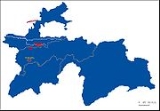
Yaghnobi language

Encyclopedia
The Yaghnobi language is a living East Iranian
language (the other living members being Pashto
, Ossetic
and Pamir languages
). Yaghnobi is spoken in the upper valley
of the Yaghnob River
in the Zarafshan
area of Tajikistan
by the Yaghnobi people
. It is considered to be a direct descendant of Sogdian
and has often been called Neo-Sogdian in academic literature.
There are some 12,500 Yaghnobi speakers. They are divided into several communities. The principal group lives in the Zafarobod
area. There are also re-settlers in the Yaghnob valley
. Some communities live in the villages of Zumand and Kůkteppa and in Dushanbe
or in its vicinity.
Most Yaghnobi speakers are bilingual in the West Iranian Tajik
. Yaghnobi is mostly used for daily family communication, while Tajik
is used by Yaghnobi speakers for business and formal transactions. A single Russian ethnographer was told by nearby Tajiks—long hostile to the Yaghnobis, who were late to adopt Islam—that the Yaghnobis used their language as a "secret" mode of communication to confuse the Tajiks; this account led to the belief by some (especially those reliant solely on Russian sources) that Yaghnobi or some derivative of it was used as a code for nefarious purposes.
There are two main dialects, a western and an eastern one. These dialects differ primarily in phonetics. For example, historical *θ corresponds to t in the western dialects and s in the eastern, e.g. met - mes 'day' from Sogdian mēθ. Western ay corresponds to eastern e, e.g. wayš - weš 'grass' from Sogdian wayš or wēš . The early Sogdian group θr (later ṣ̌) is reflected as sar in the east but tir in the west, e.g. saráy - tiráy 'three' from Sogdian θrē/θray or ṣ̌ē/ṣ̌ay <δry>. t/s and ay/e are not the only features recognised as relevant to distinguish those two dialects, there are also some differences in verbal endings and in the lexicon
. In between these two main dialects there is a transitional dialect. It shares some features of the western language and some features of the eastern one.
. Nowadays the language is transcribed by scholars using a modified Latin alphabet, with the following symbols:
a (á), ā (ā́), b, č, d, e (é), f, g, ɣ, h, ḥ, i (í), ī (ī́), ǰ, k, q, l, m (m̃), n (ñ), o (ó), p, r, s, š, t, u (ú), ū (ū́), ʏ (ʏ́), v, w (u̯), x, x°, y, z, ž, ع
In recent times Sayfiddīn Mīrzozoda from the Tajik Academy of Sciences uses a modified Tajik alphabet
for writing Yaghnobi. This alphabet is quite unsuitable for Yaghnobi—it does not distinguish short and long vowels, the difference v/w or does not mark stress etc. Yaghnobi alphabet follows with Latin equivalents given in parenthesis:
А а (a) Б б (b) В в (v) (w) Г г (g) Ғ ғ (ɣ)
Д д (d) Е е (e/ye) Ё ё (yo) Ж ж (ž) З з (z)
И и (i, ī) Ӣ ӣ (ī) й (y) К к (k) Қ қ (q)
Л л (l) М м (m) Н н (n) О о (o) П п (p)
Р р (r) С с (s) Т т (t) У у (u, ū, ʏ) Ӯ ӯ (ū, ʏ)
Ф ф (f) Х х (x) Хԝ хԝ (x°) Ҳ ҳ (h, ḥ) Ч ч (č) Ҷ ҷ (ǰ)
Ш ш (š) Ъ ъ (ع) Э э (e) Ю ю (yu, yū, yʏ) Я я (ya)
Notes to the Cyrillic alphabet
:
1) Letter й does not have capital form, it never appears at the beginning of a word. Words beginning with ya-, yo- and yu-/yū-/yʏ- are written as я-, ё- and ю-; in a similar way are these combinations written in the middle of the word, f.ex. viyóra is виёра [vɪ̆ˈjoːra].
2) The usage of letters ӣ and ӯ is not exactly known, it appears, that those letters can be used to distinguish two similar sounding words by orthography (f.ex. иранка and ӣранка, рупак and рӯпак). Maybe letter ӣ is also used as a stress marker as it is also in Tajik
. Letter ӯ can also be used in Tajik
loanwords to indicate a Tajik
vowel <ů> [ɵː], but it can have some other usage that is not known yet.
3) In older texts Yaghnobi alphabet did not use letters Ъ ъ and Э э—instead of Tajik ъ is used Yaghnobi letter ’ and Yaghnobi е covered both Tajik
е and э for value /e/; in later notation those letters were integrated into the alphabet—so the older writing етк was changed into этк to represent pronunciation [ˈeːtkʰ] (and not *[ˈjeːtkʰ]), older writing ша’мак was changed to шаъмак [ʃʲɑʕˈmak].
4) Sound combinations /ji/ and /je/ are written е and и. Yaghnobi letter и can have value */ji/ after a vowel as it has in Tajik
, letter ӣ after a vowel has value */jiː/. Letter е has two values—in word-initial position and after a vowel it is pronounced [jeː], in position after a consonant it means [eː], please note that /je/ is rare in Yaghnobi—it can be found only in Tajik
or Russian
loans, the only example for /je/ is a Европа [ˈjeːvrɔpa], this word itself is a Russian
loanword.
5) Russian
letters Ц ц, Щ щ, Ы ы and Ь ь, that can be used in Tajik
loans from Russian
are not used in Yaghnobi—the Russian
words are written as they are pronounced by the Yaghnobi speakers, not as they are written originally in Russian
(f.ex. aeroplane is самолет/самолёт in Russian
, written самолёт in Tajik
and pronounced [səmʌˈʎot] in Russian
and similar in Tajik
, in Yaghnobi it is written as самалиёт respecting Yaghnobi pronunciation [samalɪˈjoːtʰ] or [samajlˈoːtʰ]; word concert is borrowed to Yaghnobi from Russian
концерт [kʌnˈtse̠rt] in form кансерт [kʰanˈseːrtʰ]), see Tajik
консерт.
6) By consultation with Sayfiddīn Mīrzozoda distinction between sounds /v/ and /w/ is needed to be established—for the sound /v/ letter в will be used but for /w/ another letter should be adopted. By the agreement Latin letter W w would be the best choice, also for representation of /x°/ letter combination Хw хw should be used. Mīrzozoda uses letter w in some texts, this notation was unfortunately inconsistent.
long: ī [i:], e [ɛ:-e:], ā [(a:)-ɑ:], o [(ɒ:-)ɔ:(-o:-u:)], ū [u:], ʏ [(u:-)y:(-i:)]
diphthongs: ay [ai̯] (ay in native words appears only in the western dialects, in the eastern it changes to e, ay can also appear in the eastern dialect, but by different etymology), oy [ɔ:i̯], uy [ʊi̯], ūy [u:i̯], ʏy [y:i̯], iy [ɪi̯]; ow [ɔ:u̯], aw [au̯]
|-
| style="height:30px; font-size:smaller; text-align:right;" | Near-close
|-
| style="height:30px; font-size:smaller; text-align:right;" | Close-mid
|-
| style="height:30px; font-size:smaller; text-align:right;" | Mid
|-
| style="height:30px; font-size:smaller; text-align:right;" | Open-mid
|-
| style="height:30px; font-size:smaller; text-align:right;" | Near-open
|-
| style="height:30px; font-size:smaller; text-align:right;" | Open
|}
Eastern Iranian languages
The Eastern Iranian languages are a subgroup of the Iranian languages emerging in Middle Iranian times .The Avestan language is often classified as early Eastern Iranian. The largest living Eastern Iranian language is Pashto, with some 50 million speakers between the Hindu Kush mountains in...
language (the other living members being Pashto
Pashto language
Pashto , known as Afghani in Persian and Pathani in Punjabi , is the native language of the indigenous Pashtun people or Afghan people who are found primarily between an area south of the Amu Darya in Afghanistan and...
, Ossetic
Ossetic language
Ossetian , also sometimes called Ossete, is an East Iranian language spoken in Ossetia, a region on the slopes of the Caucasus Mountains....
and Pamir languages
Pamir languages
The Pamir languages are a group of the Eastern Iranian languages, spoken by numerous people in the Pamir Mountains, primarily along the Panj River and its tributaries. This includes the Badakhshan Province of northeastern Afghanistan and the Gorno-Badakhshan Autonomous Province of eastern Tajikistan...
). Yaghnobi is spoken in the upper valley
Yagnob Valley
Yagnob Valley North West Tajikistan, is situated between the southern slope of the Zarafshan Range and the northern slope of the Gissar Range. The valley is formed by the Yagnob River and belongs to the Zarafshan basin...
of the Yaghnob River
Yaghnob River
The Yaghnob River is a tributary of the Zeravshan River of Sughd , Tajikistan. Its valley is the location of the Yaghnobi people and Yaghnobi language. The river flows west south of and parallel to the upper Zarafshan River. It joins the east-flowing Iskander River to form the Fan River which...
in the Zarafshan
Zarafshan
Zarafshan is a city of over 65,000 inhabitants in the center of Uzbekistan's Navoiy Province. Located in the Kyzylkum desert, it receives water from the Amudarya by a 220-km pipeline....
area of Tajikistan
Tajikistan
Tajikistan , officially the Republic of Tajikistan , is a mountainous landlocked country in Central Asia. Afghanistan borders it to the south, Uzbekistan to the west, Kyrgyzstan to the north, and China to the east....
by the Yaghnobi people
Yaghnobi people
Yaghnobi people, or Yagnobian people, is the name of an isolated people who live in the Sughd province of Tajikistan in the valleys of the Yagnob, Kul and Varzob rivers. These are the last living relics of the great Sogdian nation that once inhabited most of Central Asia beyond the Oxus/Amu Darya...
. It is considered to be a direct descendant of Sogdian
Sogdian language
The Sogdian language is a Middle Iranian language that was spoken in Sogdiana , located in modern day Uzbekistan and Tajikistan ....
and has often been called Neo-Sogdian in academic literature.
There are some 12,500 Yaghnobi speakers. They are divided into several communities. The principal group lives in the Zafarobod
Zafarobod
Zafarobod is a town and jamoat in north-western Tajikistan . It is located in Sughd province. It is the capital of Zafarobod district-External links:*...
area. There are also re-settlers in the Yaghnob valley
Yagnob Valley
Yagnob Valley North West Tajikistan, is situated between the southern slope of the Zarafshan Range and the northern slope of the Gissar Range. The valley is formed by the Yagnob River and belongs to the Zarafshan basin...
. Some communities live in the villages of Zumand and Kůkteppa and in Dushanbe
Dushanbe
-Economy:Coal, lead, and arsenic are mined nearby in the cities of Nurek and Kulob allowing for the industrialization of Dushanbe. The Nurek Dam, the world's highest as of 2008, generates 95% of Tajikistan's electricity, and another dam, the Roghun Dam, is planned on the Vakhsh River...
or in its vicinity.
Most Yaghnobi speakers are bilingual in the West Iranian Tajik
Tajik language
Tajik, Tajik Persian, or Tajiki, is a variety of modern Persian spoken in Central Asia. Historically Tajiks called their language zabani farsī , meaning Persian language in English; the term zabani tajikī, or Tajik language, was introduced in the 20th century by the Soviets...
. Yaghnobi is mostly used for daily family communication, while Tajik
Tajik language
Tajik, Tajik Persian, or Tajiki, is a variety of modern Persian spoken in Central Asia. Historically Tajiks called their language zabani farsī , meaning Persian language in English; the term zabani tajikī, or Tajik language, was introduced in the 20th century by the Soviets...
is used by Yaghnobi speakers for business and formal transactions. A single Russian ethnographer was told by nearby Tajiks—long hostile to the Yaghnobis, who were late to adopt Islam—that the Yaghnobis used their language as a "secret" mode of communication to confuse the Tajiks; this account led to the belief by some (especially those reliant solely on Russian sources) that Yaghnobi or some derivative of it was used as a code for nefarious purposes.
There are two main dialects, a western and an eastern one. These dialects differ primarily in phonetics. For example, historical *θ corresponds to t in the western dialects and s in the eastern, e.g. met - mes 'day' from Sogdian mēθ
Lexis (linguistics)
In linguistics, a lexis is the total word-stock or lexicon having items of lexical, rather than grammatical, meaning. This notion contrasts starkly with the Chomskian proposition of a “Universal Grammar” as the prime mover for language...
. In between these two main dialects there is a transitional dialect. It shares some features of the western language and some features of the eastern one.
Writing
Yaghnobi was a scriptless language until 1990s, but according to some ethnographers the Yaghnobis used a modified form of the Arabic alphabetArabic alphabet
The Arabic alphabet or Arabic abjad is the Arabic script as it is codified for writing the Arabic language. It is written from right to left, in a cursive style, and includes 28 letters. Because letters usually stand for consonants, it is classified as an abjad.-Consonants:The Arabic alphabet has...
. Nowadays the language is transcribed by scholars using a modified Latin alphabet, with the following symbols:
a (á), ā (ā́), b, č, d, e (é), f, g, ɣ, h, ḥ, i (í), ī (ī́), ǰ, k, q, l, m (m̃), n (ñ), o (ó), p, r, s, š, t, u (ú), ū (ū́), ʏ (ʏ́), v, w (u̯), x, x°, y, z, ž, ع
In recent times Sayfiddīn Mīrzozoda from the Tajik Academy of Sciences uses a modified Tajik alphabet
Tajik alphabet
The Tajik language has been written in three alphabets over the course of its history: an adaptation of the Arabic script , an adaptation of the Latin script, and an adaptation of the Cyrillic script...
for writing Yaghnobi. This alphabet is quite unsuitable for Yaghnobi—it does not distinguish short and long vowels, the difference v/w or does not mark stress etc. Yaghnobi alphabet follows with Latin equivalents given in parenthesis:
А а (a) Б б (b) В в (v) (w) Г г (g) Ғ ғ (ɣ)
Д д (d) Е е (e/ye) Ё ё (yo) Ж ж (ž) З з (z)
И и (i, ī) Ӣ ӣ (ī) й (y) К к (k) Қ қ (q)
Л л (l) М м (m) Н н (n) О о (o) П п (p)
Р р (r) С с (s) Т т (t) У у (u, ū, ʏ) Ӯ ӯ (ū, ʏ)
Ф ф (f) Х х (x) Хԝ хԝ (x°) Ҳ ҳ (h, ḥ) Ч ч (č) Ҷ ҷ (ǰ)
Ш ш (š) Ъ ъ (ع) Э э (e) Ю ю (yu, yū, yʏ) Я я (ya)
Notes to the Cyrillic alphabet
Cyrillic alphabet
The Cyrillic script or azbuka is an alphabetic writing system developed in the First Bulgarian Empire during the 10th century AD at the Preslav Literary School...
:
1) Letter й does not have capital form, it never appears at the beginning of a word. Words beginning with ya-, yo- and yu-/yū-/yʏ- are written as я-, ё- and ю-; in a similar way are these combinations written in the middle of the word, f.ex. viyóra is виёра [vɪ̆ˈjoːra].
2) The usage of letters ӣ and ӯ is not exactly known, it appears, that those letters can be used to distinguish two similar sounding words by orthography (f.ex. иранка and ӣранка, рупак and рӯпак). Maybe letter ӣ is also used as a stress marker as it is also in Tajik
Tajik alphabet
The Tajik language has been written in three alphabets over the course of its history: an adaptation of the Arabic script , an adaptation of the Latin script, and an adaptation of the Cyrillic script...
. Letter ӯ can also be used in Tajik
Tajik language
Tajik, Tajik Persian, or Tajiki, is a variety of modern Persian spoken in Central Asia. Historically Tajiks called their language zabani farsī , meaning Persian language in English; the term zabani tajikī, or Tajik language, was introduced in the 20th century by the Soviets...
loanwords to indicate a Tajik
Tajik language
Tajik, Tajik Persian, or Tajiki, is a variety of modern Persian spoken in Central Asia. Historically Tajiks called their language zabani farsī , meaning Persian language in English; the term zabani tajikī, or Tajik language, was introduced in the 20th century by the Soviets...
vowel <ů> [ɵː], but it can have some other usage that is not known yet.
3) In older texts Yaghnobi alphabet did not use letters Ъ ъ and Э э—instead of Tajik ъ is used Yaghnobi letter ’ and Yaghnobi е covered both Tajik
Tajik alphabet
The Tajik language has been written in three alphabets over the course of its history: an adaptation of the Arabic script , an adaptation of the Latin script, and an adaptation of the Cyrillic script...
е and э for value /e/; in later notation those letters were integrated into the alphabet—so the older writing етк was changed into этк to represent pronunciation [ˈeːtkʰ] (and not *[ˈjeːtkʰ]), older writing ша’мак was changed to шаъмак [ʃʲɑʕˈmak].
4) Sound combinations /ji/ and /je/ are written е and и. Yaghnobi letter и can have value */ji/ after a vowel as it has in Tajik
Tajik alphabet
The Tajik language has been written in three alphabets over the course of its history: an adaptation of the Arabic script , an adaptation of the Latin script, and an adaptation of the Cyrillic script...
, letter ӣ after a vowel has value */jiː/. Letter е has two values—in word-initial position and after a vowel it is pronounced [jeː], in position after a consonant it means [eː], please note that /je/ is rare in Yaghnobi—it can be found only in Tajik
Tajik language
Tajik, Tajik Persian, or Tajiki, is a variety of modern Persian spoken in Central Asia. Historically Tajiks called their language zabani farsī , meaning Persian language in English; the term zabani tajikī, or Tajik language, was introduced in the 20th century by the Soviets...
or Russian
Russian language
Russian is a Slavic language used primarily in Russia, Belarus, Uzbekistan, Kazakhstan, Tajikistan and Kyrgyzstan. It is an unofficial but widely spoken language in Ukraine, Moldova, Latvia, Turkmenistan and Estonia and, to a lesser extent, the other countries that were once constituent republics...
loans, the only example for /je/ is a Европа [ˈjeːvrɔpa], this word itself is a Russian
Russian language
Russian is a Slavic language used primarily in Russia, Belarus, Uzbekistan, Kazakhstan, Tajikistan and Kyrgyzstan. It is an unofficial but widely spoken language in Ukraine, Moldova, Latvia, Turkmenistan and Estonia and, to a lesser extent, the other countries that were once constituent republics...
loanword.
5) Russian
Russian alphabet
The Russian alphabet is a form of the Cyrillic script, developed in the First Bulgarian Empire during the 10th century AD at the Preslav Literary School...
letters Ц ц, Щ щ, Ы ы and Ь ь, that can be used in Tajik
Tajik language
Tajik, Tajik Persian, or Tajiki, is a variety of modern Persian spoken in Central Asia. Historically Tajiks called their language zabani farsī , meaning Persian language in English; the term zabani tajikī, or Tajik language, was introduced in the 20th century by the Soviets...
loans from Russian
Russian language
Russian is a Slavic language used primarily in Russia, Belarus, Uzbekistan, Kazakhstan, Tajikistan and Kyrgyzstan. It is an unofficial but widely spoken language in Ukraine, Moldova, Latvia, Turkmenistan and Estonia and, to a lesser extent, the other countries that were once constituent republics...
are not used in Yaghnobi—the Russian
Russian language
Russian is a Slavic language used primarily in Russia, Belarus, Uzbekistan, Kazakhstan, Tajikistan and Kyrgyzstan. It is an unofficial but widely spoken language in Ukraine, Moldova, Latvia, Turkmenistan and Estonia and, to a lesser extent, the other countries that were once constituent republics...
words are written as they are pronounced by the Yaghnobi speakers, not as they are written originally in Russian
Russian alphabet
The Russian alphabet is a form of the Cyrillic script, developed in the First Bulgarian Empire during the 10th century AD at the Preslav Literary School...
(f.ex. aeroplane is самолет/самолёт in Russian
Russian alphabet
The Russian alphabet is a form of the Cyrillic script, developed in the First Bulgarian Empire during the 10th century AD at the Preslav Literary School...
, written самолёт in Tajik
Tajik language
Tajik, Tajik Persian, or Tajiki, is a variety of modern Persian spoken in Central Asia. Historically Tajiks called their language zabani farsī , meaning Persian language in English; the term zabani tajikī, or Tajik language, was introduced in the 20th century by the Soviets...
and pronounced [səmʌˈʎot] in Russian
Russian language
Russian is a Slavic language used primarily in Russia, Belarus, Uzbekistan, Kazakhstan, Tajikistan and Kyrgyzstan. It is an unofficial but widely spoken language in Ukraine, Moldova, Latvia, Turkmenistan and Estonia and, to a lesser extent, the other countries that were once constituent republics...
and similar in Tajik
Tajik language
Tajik, Tajik Persian, or Tajiki, is a variety of modern Persian spoken in Central Asia. Historically Tajiks called their language zabani farsī , meaning Persian language in English; the term zabani tajikī, or Tajik language, was introduced in the 20th century by the Soviets...
, in Yaghnobi it is written as самалиёт respecting Yaghnobi pronunciation [samalɪˈjoːtʰ] or [samajlˈoːtʰ]; word concert is borrowed to Yaghnobi from Russian
Russian language
Russian is a Slavic language used primarily in Russia, Belarus, Uzbekistan, Kazakhstan, Tajikistan and Kyrgyzstan. It is an unofficial but widely spoken language in Ukraine, Moldova, Latvia, Turkmenistan and Estonia and, to a lesser extent, the other countries that were once constituent republics...
концерт [kʌnˈtse̠rt] in form кансерт [kʰanˈseːrtʰ]), see Tajik
Tajik language
Tajik, Tajik Persian, or Tajiki, is a variety of modern Persian spoken in Central Asia. Historically Tajiks called their language zabani farsī , meaning Persian language in English; the term zabani tajikī, or Tajik language, was introduced in the 20th century by the Soviets...
консерт.
6) By consultation with Sayfiddīn Mīrzozoda distinction between sounds /v/ and /w/ is needed to be established—for the sound /v/ letter в will be used but for /w/ another letter should be adopted. By the agreement Latin letter W w would be the best choice, also for representation of /x°/ letter combination Хw хw should be used. Mīrzozoda uses letter w in some texts, this notation was unfortunately inconsistent.
Cyrillic Alphabet
| А а | Б б | В в | Г г | Ғ ғ | |
| Д д | Е е | Ё ё | Ж ж | З з | И и |
| Ӣ ӣ | Й й | К к | Қ қ | Л л | М м |
| Н н | О о | П п | Р р | С с | Т т |
| У у | Ӯ ӯ | Ф ф | Х х | Ҳ ҳ | Ч ч |
| Ҷ ҷ | Ш ш | ъ | Э э | Ю ю | Я я |
Vowels
short: i [i-ɪ-e], a [(æ-)a(-ɑ)], u [(y-)u-ʊ-o] (all short vowels might be reduced approximately to [ə] in pretonic positions)long: ī [i:], e [ɛ:-e:], ā [(a:)-ɑ:], o [(ɒ:-)ɔ:(-o:-u:)], ū [u:], ʏ [(u:-)y:(-i:)]
diphthongs: ay [ai̯] (ay in native words appears only in the western dialects, in the eastern it changes to e, ay can also appear in the eastern dialect, but by different etymology), oy [ɔ:i̯], uy [ʊi̯], ūy [u:i̯], ʏy [y:i̯], iy [ɪi̯]; ow [ɔ:u̯], aw [au̯]
|-
| style="height:30px; font-size:smaller; text-align:right;" | Near-close
Near-close vowel
A near-close vowel is a type of vowel sound used in some spoken languages. The defining characteristic of a near-close vowel is that the tongue is positioned similarly to a close vowel, but slightly less constricted. Near-close vowels are sometimes described as lax variants of the fully close vowels...
|-
| style="height:30px; font-size:smaller; text-align:right;" | Close-mid
Close-mid vowel
A close-mid vowel is a type of vowel sound used in some spoken languages. The defining characteristic of a close-mid vowel is that the tongue is positioned two-thirds of the way from a close vowel to a mid vowel...
|-
| style="height:30px; font-size:smaller; text-align:right;" | Mid
Mid vowel
A mid vowel is a vowel sound used in some spoken languages. The defining characteristic of a mid vowel is that the tongue is positioned mid-way between an open vowel and a close vowel...
|-
| style="height:30px; font-size:smaller; text-align:right;" | Open-mid
Open-mid vowel
An open-mid vowel is a type of vowel sound used in some spoken languages. The defining characteristic of an open-mid vowel is that the tongue is positioned two-thirds of the way from an open vowel to a mid vowel...
|-
| style="height:30px; font-size:smaller; text-align:right;" | Near-open
Near-open vowel
A near-open vowel is a type of vowel sound used in some spoken languages. The defining characteristic of a near-open vowel is that the tongue is positioned similarly to an open vowel, but slightly more constricted. Near-open vowels are sometimes described as lax variants of the fully open vowels...
|-
| style="height:30px; font-size:smaller; text-align:right;" | Open
Open vowel
An open vowel is defined as a vowel sound in which the tongue is positioned as far as possible from the roof of the mouth. Open vowels are sometimes also called low vowels in reference to the low position of the tongue...
|}
Notes:
1) Please note that long e, o and ʏ are conventionally not written with the lengthening sign.
2) Long ā is recognised, but it appears only as a result of secondary lengthening (f.ex. ǰām < ǰaعm < ǰamع).
3) In recent borrowings from Tajik
Tajik language
Tajik, Tajik Persian, or Tajiki, is a variety of modern Persian spoken in Central Asia. Historically Tajiks called their language zabani farsī , meaning Persian language in English; the term zabani tajikī, or Tajik language, was introduced in the 20th century by the Soviets...
ů [ɵ:] and/or Uzbek
Uzbek language
Uzbek is a Turkic language and the official language of Uzbekistan. It has about 25.5 million native speakers, and it is spoken by the Uzbeks in Uzbekistan and elsewhere in Central Asia...
oʻ [ɵ, ø] can also appear, but its pronunciation usually merges with ū).
4) Vowel ʏ is recognised by some authorities, by some other not. It seems that it is an allophone
Allophone
In phonology, an allophone is one of a set of multiple possible spoken sounds used to pronounce a single phoneme. For example, and are allophones for the phoneme in the English language...
of ū. The origin of ʏ comes from historical stressed *ū, but historical *ō, changed in Yaghnobi to ū, remains unchanged. It seems, that the status of ʏ is unstable and it is not recorded in all varieties of Yaghnobi, while ʏ is often realised as ū, ūy/ūy, uy/uy or ʏ. In summary: *ū́ (under stress) > ū/ūy/uy/ʏ or ū, *ō > ū (f.ex. vʏz/vūz, goat; Tajik
Tajik language
Tajik, Tajik Persian, or Tajiki, is a variety of modern Persian spoken in Central Asia. Historically Tajiks called their language zabani farsī , meaning Persian language in English; the term zabani tajikī, or Tajik language, was introduced in the 20th century by the Soviets...
buz, Avestan
Avestan language
Avestan is an East Iranian language known only from its use as the language of Zoroastrian scripture, i.e. the Avesta, from which it derives its name...
buza-). By some authorities ʏ can be transcribed as ü.
5) Vowel o can change to ū in front of a nasal (cf. Toǰīkistón × Toǰīkistū́n, nom × nūm).
6) Vowel e is considered as a long vowel, but in front of h or ع its pronunciation is somewhat shorter—so than e is realised as a half-short (or even short) vowel. Etymologically this "short" e in front of h, ع comes from older *i, in pronunciation of Yaghnobi we can see alternation e/i in front of h/ع—in case when the historical cluster *ih or *iع appears in a closed syllable, than *i changes to e, in open syllable this change does not take place (this development is similar to Tajik
Tajik language
Tajik, Tajik Persian, or Tajiki, is a variety of modern Persian spoken in Central Asia. Historically Tajiks called their language zabani farsī , meaning Persian language in English; the term zabani tajikī, or Tajik language, was introduced in the 20th century by the Soviets...
one)—this change can be seen in case of verb dih-/deh-: infinitive díhak × 3rd sg. present déhči.
7) In Yaghnobi dialects there can be seen a different development of historical svarabhakti vowel
Epenthesis
In phonology, epenthesis is the addition of one or more sounds to a word, especially to the interior of a word. Epenthesis may be divided into two types: excrescence, for the addition of a consonant, and anaptyxis for the addition of a vowel....
: in the Western and Transitional dialects this is rendered as i (or u under certain circumstances) but in the Eastern dialects it changes to a (but also i or u): f.ex. *θray > *θəráy > W./Tr. tiráy × E. saráy but *βrāt > *vərāt > W./Tr./E. virót; when the second vowel is a back vowel *ə usually changes to u in Western or Transitional dialects: *(čə)θβār > *tfār > *təfór > W./Tr. tufór (but also tifór) × E. tafór, *pδūfs- > *bədū́fs > W./Tr./E. budū́fs-. The later change appears also in morphology: verb tifárak (the form is same in all three dialects) has form in 3rd sg. present tufórči < *təfár- < *tfar- < *θβar-. Alternation i/a can be seen also in Tajik
Tajik language
Tajik, Tajik Persian, or Tajiki, is a variety of modern Persian spoken in Central Asia. Historically Tajiks called their language zabani farsī , meaning Persian language in English; the term zabani tajikī, or Tajik language, was introduced in the 20th century by the Soviets...
loans where an unstressed vowel can undergo this change: W./Tr. širī́k × E. šarī́k < Tajik
Tajik language
Tajik, Tajik Persian, or Tajiki, is a variety of modern Persian spoken in Central Asia. Historically Tajiks called their language zabani farsī , meaning Persian language in English; the term zabani tajikī, or Tajik language, was introduced in the 20th century by the Soviets...
šarīk /šarīk/, W./Tr. xipár × E. xapár < Tajik
Tajik language
Tajik, Tajik Persian, or Tajiki, is a variety of modern Persian spoken in Central Asia. Historically Tajiks called their language zabani farsī , meaning Persian language in English; the term zabani tajikī, or Tajik language, was introduced in the 20th century by the Soviets...
xabar /xabar/. The former svarabhakti vowels
Epenthesis
In phonology, epenthesis is the addition of one or more sounds to a word, especially to the interior of a word. Epenthesis may be divided into two types: excrescence, for the addition of a consonant, and anaptyxis for the addition of a vowel....
are often ultra-short or reduced in pronunciation, in some cases they can disappear in a fast speech: xišáp /xišáp × xⁱšáp × xšap/ < *xəšáp < *xšap.
8) Vowel a changes to o in verbal stems of the type -Car- when an ending containing historical *θ or *t is added: tifár-, infinitive tifárak, 1st sg. present tifarómišt but 3rd sg. present tufórči (ending -či comes from older -tišt), 2nd pl. present W./Tr. tufórtišt E. tufórsišt, x°ar-: x°árak : x°arómišt : xórči : xórtišt/xórsišt (please note also that when a changes to o after x°, x loses its labilisation). This change takes place with all verbs of Yaghnobi origin and also in case of older loans from Tajik
Tajik language
Tajik, Tajik Persian, or Tajiki, is a variety of modern Persian spoken in Central Asia. Historically Tajiks called their language zabani farsī , meaning Persian language in English; the term zabani tajikī, or Tajik language, was introduced in the 20th century by the Soviets...
, in case of new loans a remains unchanged, f. ex.: gudár(ak) : gudórči × pár(ak) : párči - the first verb is an old loan from Tajik
Tajik language
Tajik, Tajik Persian, or Tajiki, is a variety of modern Persian spoken in Central Asia. Historically Tajiks called their language zabani farsī , meaning Persian language in English; the term zabani tajikī, or Tajik language, was introduced in the 20th century by the Soviets...
guzaštan < guδaštan, the later is recent loan from parrīdan.
Consonants
stops: p, b, t, d, k, ɡ, q (/k/ and /ɡ/ are palatalised to c and ɟ respectively before a front vowel or after a front vowel at the end of a word)fricatives: f, v, s, z, ɕ <š>, ʑ <ž>, χ
affricates: tʃ <č>, dʒ <ǰ>
nasals: m, n (both have allophones ŋ and ɱ before /k, ɡ/ and /f, v/, respectively)
trill: r
lateral: l
approximant: β̞
| Place of articulation Place of articulation In articulatory phonetics, the place of articulation of a consonant is the point of contact where an obstruction occurs in the vocal tract between an articulatory gesture, an active articulator , and a passive location... → |
Bilabial Bilabial consonant In phonetics, a bilabial consonant is a consonant articulated with both lips. The bilabial consonants identified by the International Phonetic Alphabet are:... |
Labio‐ dental Labiodental consonant In phonetics, labiodentals are consonants articulated with the lower lip and the upper teeth.-Labiodental consonant in IPA:The labiodental consonants identified by the International Phonetic Alphabet are:... |
Alveolar Alveolar consonant Alveolar consonants are articulated with the tongue against or close to the superior alveolar ridge, which is called that because it contains the alveoli of the superior teeth... |
Post‐ alveolar Postalveolar consonant Postalveolar consonants are consonants articulated with the tongue near or touching the back of the alveolar ridge, further back in the mouth than the alveolar consonants, which are at the ridge itself, but not as far back as the hard palate... or Palatal Palatal consonant Palatal consonants are consonants articulated with the body of the tongue raised against the hard palate... |
Velar Velar consonant Velars are consonants articulated with the back part of the tongue against the soft palate, the back part of the roof of the mouth, known also as the velum).... |
Uvular Uvular consonant Uvulars are consonants articulated with the back of the tongue against or near the uvula, that is, further back in the mouth than velar consonants. Uvulars may be plosives, fricatives, nasal stops, trills, or approximants, though the IPA does not provide a separate symbol for the approximant, and... or Labialised Uvular |
Pharyn‐ geal Pharyngeal consonant A pharyngeal consonant is a type of consonant which is articulated with the root of the tongue against the pharynx.-Pharyngeal consonants in the IPA:Pharyngeal consonants in the International Phonetic Alphabet :... |
Glottal Glottal consonant Glottal consonants, also called laryngeal consonants, are consonants articulated with the glottis. Many phoneticians consider them, or at least the so-called fricative, to be transitional states of the glottis without a point of articulation as other consonants have; in fact, some do not consider... |
||||||
|---|---|---|---|---|---|---|---|---|---|---|---|---|---|---|
| Manner of articulation Manner of articulation In linguistics, manner of articulation describes how the tongue, lips, jaw, and other speech organs are involved in making a sound. Often the concept is only used for the production of consonants, even though the movement of the articulars will also greatly alter the resonant properties of the... ↓ |
||||||||||||||
| Nasal Nasal consonant A nasal consonant is a type of consonant produced with a lowered velum in the mouth, allowing air to escape freely through the nose. Examples of nasal consonants in English are and , in words such as nose and mouth.- Definition :... |
m | n | ||||||||||||
| Plosive | p b | t d | c ɟ | k ɡ | q | |||||||||
| Affricate Affricate consonant Affricates are consonants that begin as stops but release as a fricative rather than directly into the following vowel.- Samples :... |
tʃ dʒ | |||||||||||||
| Fricative Fricative consonant Fricatives are consonants produced by forcing air through a narrow channel made by placing two articulators close together. These may be the lower lip against the upper teeth, in the case of ; the back of the tongue against the soft palate, in the case of German , the final consonant of Bach; or... |
f v | s z | ɕ ʑ | χ χʷ | ʁ | ħ | ʕ | h | ||||||
| Approximant Approximant consonant Approximants are speech sounds that involve the articulators approaching each other but not narrowly enough or with enough articulatory precision to create turbulent airflow. Therefore, approximants fall between fricatives, which do produce a turbulent airstream, and vowels, which produce no... |
β̞ | j | ||||||||||||
| Trill Trill consonant In phonetics, a trill is a consonantal sound produced by vibrations between the articulator and the place of articulation. Standard Spanish <rr> as in perro is an alveolar trill, while in Parisian French it is almost always uvular.... |
r | |||||||||||||
| Lateral Approximant Lateral consonant A lateral is an el-like consonant, in which airstream proceeds along the sides of the tongue, but is blocked by the tongue from going through the middle of the mouth.... |
l | |||||||||||||
All voiced consonants are pronounced voiceless at the end of the word, in speech when after an unvoiced consonant comes a voiced one, the unoviced is voiced by assimilation. In case of voicing q the voiced opposition is ɣ, not [ɢ].
Note: Sounds b, g, h, ḥ, ǰ, q, l and ع appear mostly in loan-words, native words with those sounds are rare, mostly onomatopoeic.
Grammar
Note: In following sections symbols W, E and Tr. refer to the western, eastern or transitional dialect.Noun
Case endings:| Case | Stem ending is consonant | Stem ending is vowel other than -a | Stem ending is -a |
|---|---|---|---|
| Sg. Direct (Nominative) | - | - | -a |
| Sg. Oblique | -i | -y | -ay (W), -e (E) |
| Pl. Direct (Nominative) | -t | -t | -ot |
| Pl. Oblique | -ti | -ti | -oti |
Examples:
- kat : obl.sg. káti, pl. katt, obl.pl. kátti
- mayn (W) / men (E) : obl.sg. máyni/méni, pl. maynt/ment, obl.pl. máynti/ménti
- póda : obl.sg. póday/póde, pl. pódot, obl.pl. pódoti
- čalló : obl.sg. čallóy, pl. čallót, obl.pl. čallóti
- zindagī́ : obl.sg. zindagī́y, pl. zindagī́t, obl.pl. zindagī́ti
- mórti : obl.sg. mórtiy, pl. mórtit, obl.pl. mórtiti
- Also the izofat construction is used in Yaghnobi, it appears in phrases and constructions adopted form TajikTajik languageTajik, Tajik Persian, or Tajiki, is a variety of modern Persian spoken in Central Asia. Historically Tajiks called their language zabani farsī , meaning Persian language in English; the term zabani tajikī, or Tajik language, was introduced in the 20th century by the Soviets...
, or with words of TajikTajik languageTajik, Tajik Persian, or Tajiki, is a variety of modern Persian spoken in Central Asia. Historically Tajiks called their language zabani farsī , meaning Persian language in English; the term zabani tajikī, or Tajik language, was introduced in the 20th century by the Soviets...
origin.
Pronouns
Forms of the personal pronouns:| Person | Nominative Singular | Oblique Singular | Enclitic Singular | Nominative Plural | Oblique Plural | Enclitic Plural |
|---|---|---|---|---|---|---|
| 1st | man | man | -(i)m | mox | mox | -mox |
| 2nd | tu | taw | -(i)t | šumóx | šumóx | -šint |
| 3rd | ax, iš | áwi, ít(i) | -(i)š | áxtit, íštit | áwtiti, ítiti | -šint |
The 2nd person plural, šumóx also finds use as the polite form of the 2nd person.
Numerals
| Eastern Yaghnobi | Western Yaghnobi | Tajik loan | |
| 1 | ī | ī | yak, yag, ya |
| 2 | dū | dʏ | du |
| 3 | saráy | tⁱráy | se, say |
| 4 | tafór | tᵘfór, tⁱfór | čor |
| 5 | panč | panč | panǰ |
| 6 | uxš | uxš | šiš, šaš |
| 7 | avd | aft | haft |
| 8 | ašt | ašt | hašt |
| 9 | nau̯ | nau̯ | nuʰ |
| 10 | das | das | daʰ |
| 11 | das ī | das ī | yozdáʰ |
| 12 | das dū | das dʏ | dᵘwozdáʰ |
| 13 | das saráy | das tⁱráy | senzdáʰ |
| 14 | das tafór | das tᵘfór / tⁱfór | čordáʰ |
| 15 | das panč | das panč | ponzdáʰ |
| 16 | das uxš | das uxš | šonzdáʰ |
| 17 | das avd | das aft | habdáʰ, havdáʰ |
| 18 | das ašt | das ašt | haždáʰ |
| 19 | das nau̯ | das nau̯ | nūzdáʰ |
| 20 | bīst | ||
| 30 | bī́st-at das | bī́st-at das | sī |
| 40 | dū bīst | dʏ bīst | čil |
| 50 | dū nī́ma bīst | dʏ nī́ma bīst | pinǰóʰ, panǰóʰ |
| 60 | saráy bīst | tⁱráy bīst | šast |
| 70 | saráy nī́ma bīst | tⁱráy nī́ma bīst, tⁱráy bī́st-u das | haftód |
| 80 | tafór bīst | tᵘfór / tⁱfór bīst | haštód |
| 90 | tafór nī́ma bīst | tᵘfór / tⁱfór nī́ma bīst | navád |
| 100 | sad | ||
| 1000 | hazór |
Verb
Personal endings - present:| Person | Singular | Plural |
|---|---|---|
| 1st | -omišt | -īmišt |
| 2nd | -īšt | -tišt (W, Tr.), -sišt (E) |
| 3rd | -tišt (W), -či (E, Tr.) | -ošt |
Personal endings - preterite
Preterite
The preterite is the grammatical tense expressing actions that took place or were completed in the past...
(with augment
Augment (linguistics)
In linguistics, the augment is a syllable added to the beginning of the word in certain Indo-European languages, most notably Greek, Armenian, and the Indo-Iranian languages such as Sanskrit, to form the past tenses.-Indo-European languages:...
a-):
| Person | Singular | Plural |
|---|---|---|
| 1st | a- -im | a- -om (W), a- -īm (E, Tr.) |
| 2nd | a- -ī | a- -ti (W, Tr.), a- -si (E) |
| 3rd | a- - | a- -or |
By adding the ending -išt (-št after a vowel) to the preterite a durative preterite is formed.
Participle
Participle
In linguistics, a participle is a word that shares some characteristics of both verbs and adjectives. It can be used in compound verb tenses or voices , or as a modifier...
: Present participle is formed by adding -na to the verbal stem. Past participle (or perfect participle) is formed by addition of -ta to the stem.
Infinitive
Infinitive
In grammar, infinitive is the name for certain verb forms that exist in many languages. In the usual description of English, the infinitive of a verb is its basic form with or without the particle to: therefore, do and to do, be and to be, and so on are infinitives...
is formed by addition of ending -ak to the verbal stem.
Negation
Negation
In logic and mathematics, negation, also called logical complement, is an operation on propositions, truth values, or semantic values more generally. Intuitively, the negation of a proposition is true when that proposition is false, and vice versa. In classical logic negation is normally identified...
is formed by prefix na-, in combination with augment in preterite it changes to nē-.
Copula - Present:
| Person | Singular | Plural |
|---|---|---|
| 1st | īm | om |
| 2nd | išt | ot (W, Tr.), os (E) |
| 3rd | ast, -x, xast, ásti, xásti | or |
Lexicon
Present knowledge of Yaghnobi lexicon comes from three main works - from a Yaghnobi-RussianRussian language
Russian is a Slavic language used primarily in Russia, Belarus, Uzbekistan, Kazakhstan, Tajikistan and Kyrgyzstan. It is an unofficial but widely spoken language in Ukraine, Moldova, Latvia, Turkmenistan and Estonia and, to a lesser extent, the other countries that were once constituent republics...
dictionary presented in Yaghnobi texts by Andreyev and Peščereva and then from a supplementary wordlist presented in Yaghnobi grammar by Xromov. The last work is Yaghnobi-Tajik dictionary compiled by Xromov's student Sayfiddīn Mīrzozoda (being himself Yaghnobi native speaker). What is now known, in Yaghnobi Tajik
Tajik language
Tajik, Tajik Persian, or Tajiki, is a variety of modern Persian spoken in Central Asia. Historically Tajiks called their language zabani farsī , meaning Persian language in English; the term zabani tajikī, or Tajik language, was introduced in the 20th century by the Soviets...
words represent the majority of lexicum (some 60%), then come words of Turkic origin (up to 5%, mainly from Uzbek
Uzbek language
Uzbek is a Turkic language and the official language of Uzbekistan. It has about 25.5 million native speakers, and it is spoken by the Uzbeks in Uzbekistan and elsewhere in Central Asia...
) and few Russian
Russian language
Russian is a Slavic language used primarily in Russia, Belarus, Uzbekistan, Kazakhstan, Tajikistan and Kyrgyzstan. It is an unofficial but widely spoken language in Ukraine, Moldova, Latvia, Turkmenistan and Estonia and, to a lesser extent, the other countries that were once constituent republics...
words (approx. 2%; note that through Russian language
Russian language
Russian is a Slavic language used primarily in Russia, Belarus, Uzbekistan, Kazakhstan, Tajikistan and Kyrgyzstan. It is an unofficial but widely spoken language in Ukraine, Moldova, Latvia, Turkmenistan and Estonia and, to a lesser extent, the other countries that were once constituent republics...
also many international words
Internationalism (linguistics)
In linguistics, an internationalism or international word is a loanword that occurs in several languages with the same or at least similar meaning and etymology. These words exist in "several different languages as a result of simultaneous or successive borrowings from the ultimate source"...
came to Yaghnobi). So only about one third of the lexicon is Eastern-Iranian origin, those words can be easily comparable to those known from Sogdian
Sogdian language
The Sogdian language is a Middle Iranian language that was spoken in Sogdiana , located in modern day Uzbekistan and Tajikistan ....
, Ossetian
Ossetic language
Ossetian , also sometimes called Ossete, is an East Iranian language spoken in Ossetia, a region on the slopes of the Caucasus Mountains....
, Pamir languages
Pamir languages
The Pamir languages are a group of the Eastern Iranian languages, spoken by numerous people in the Pamir Mountains, primarily along the Panj River and its tributaries. This includes the Badakhshan Province of northeastern Afghanistan and the Gorno-Badakhshan Autonomous Province of eastern Tajikistan...
or Pashto.
Sample text
"Fálɣar-at Yáɣnob asosī́ láfz-šint ī-x gumū́n, néki áxtit toǰīkī́-pi wó(v)ošt, mox yaɣnobī́-pi. 'Mʏ́štif' wó(v)omišt, áxtit 'Muždív' wó(v)ošt."[ˈfalʁɑratʰ ˈjɑʁnɔˑb asɔˑˈsiː ˈlafzɕɪntʰ ˈiːχ ɡʊˈmoːn ˈneːcʰe ˈɑχtʰɪtʰ tʰɔˑdʒiˑˈcʰiːpʰe ˈβ̞oːˀɔˑɕtʰ moːʁ jɑʁnɔˑˈbiːpʰe ˈmyːɕtʰɪf ˈβ̞oːˀɔˑmɪɕtʰ ˈɑχtʰɪtʰ mʊʒˈdɪv ˈβ̞oːˀɔˑʃtʰ]
"In Falghar and in Yaghnob is certainly one basic language, but they speak Tajik and we speak Yaghnobi. We say 'Müštif', they say 'Muždiv'."
(In edited Cyrillic orthography it could have been written this way: "Фалғарат Яғноб асосӣ лафзшинт ӣх гумун, неки ахтит тоҷикипӣ ԝоошт, мох яғнобипӣ. 'Мӯштиф' ԝоомишт, ахтит 'Муждив' ԝоошт.")
An anecdote about Nasreddin
Nasreddin
Nasreddin was a Seljuq satirical Sufi figure, sometimes believed to have lived during the Middle Ages and considered a populist philosopher and wise man, remembered for his funny stories and anecdotes. He appears in thousands of stories, sometimes witty, sometimes wise, but often, too, a fool or...
: 1. Nasriddī́n ī xūd či bozór uxš tangái axirī́n. 2. Kaxík woxúrdš avī́, čáwi apursóšt: 3. “Xūd čof pūl axirī́nī?” 4. Nasriddī́n ī́ipiš ǰawób atifár, dúipiš ǰawób atifár, tiráyipiš ǰawób atifár, aɣór: 5. “Hámaipi ǰawób tifaróm, zīq vómišt.” 6. Ax xūdš či sarš anós, bozórisa adáu̯, fayród akún: 7. “E odámt! 8. Daràu̯-daráwi maydónisa šau̯t, īyóka ǰām vʏt! 9. Kattóti šumóxpi árkšint ast!” 10. Odámt hamáš maydóni īyóka ǰām avór, áni šáhri hičúxs nàapiráxs. 11. Nasriddī́n balandī́i sári asán, fayród akún: 12. “E odámt, ɣiríft, nihíš xūd man uxš tangái axirī́nim”.
IPA Transcription: [1. nasre̝ˈdːiːn ˈiː ˈχuːd ˈtʃɪ̞ bɔˑˈzoːr ˈʋ̘χʆ tʰaŋˈɟa̝jĕ̝ ɑχĕ̝ˈriːn. 2. cʰaˈχecʰ β̞ɔˑˈχʋˑrdʆ aˈve̝ː, ˈtʃaβ̞e apʰʋrˈsoːɕt: 3. „ˈχuːd ˈtʃoːf ˈpʰuːl ɑχĕ̝ˈriːne̝ˑ?“ 4. nasre̝ˈdːiːn ˈiːjĕ̝pʰe̝ʆ dʒaˈβ̞oːb atʰĕ̝ˈfar, ˈdʋ̘je̝pʰe̝ʆ dʒaˈβ̞oːb atʰĕ̝ˈfar, tʰɪ̆ˈraje̝pʰe̝ʆ dʒaˈβ̞oːb atʰĕ̝ˈfar, ɑˈʁoːr: 5. „ˈhama̝jĕ̝pʰe̝ dʒaˈβ̞oːb tʰĕ̝faˈro̝ːm, ˈze̝ˑqʰ ˈvo̝ːmɪʆtʰ.“ 6. ˈaχ ˈχuːdʆ ˈtʃɪ̞ ˈsarɪ̆ʆ aˈnoːs, bɔˑˈzoːrɪsa aˈdau̯, fai̯ˈroːd aˈkʰʋn: 7. „ˈeː ɔˑˈdamtʰ! 8. darˌau̯-daˈraβ̞e mai̯ˈdoːne̝sa ˈʆau̯tʰ, iˑjˈoːcʰa ˈdʒɑːm ˈvyːtʰ! 9. cʰaˈtʰːoːtʰe̝ ʆʋ̆ˈmoːχpʰe̝ ˈarcʆɪ̞nt ˌastʰ!“ 10. ɔˑˈdamtʰ haˈmaʆ mai̯ˈdoːne̝ iˑjˈoːcʰa ˈdʒɑːm aˈvoːr, ˈane̝ ˈʆahrɪ he̝ˑˈtʃʋ̝χs ˌna̝ˀa̝pʰĕ̝ˈraχs. 11. nasre̝ˈdːiːn balanˈdiːjĕ̝ ˈsare̝ aˈsan, fai̯ˈroːd aˈkʰʋn: 12. „ˈeː ɔˑˈdamtʰ, ʁĕ̝ˈre̝ftʰ, nĕ̝ˈhe̝ˑʆ ˈχūd ˈman ˈʋ̘χʆ tʰaŋˈɟa̝jĕ̝ ɑχĕ̝ˈriːne̝m“.]
Cyrillic version: 1. Насриддин ӣ хӯд чи бозор ухш тангаи ахирин. 2. Кахик ԝохурдш авӣ, чаԝи апурсошт: 3. “Худ чоф пул ахиринӣ?” 4. Насриддин ӣипиш ҷаԝоб атифар, дуипиш ҷаԝоб атифар, тирайипиш ҷаԝоб атифар, ағор: 5. “Ҳамаипӣ ҷаԝоб тифаром, зиқ вомишт.” 6. Ах хӯдш чи сарш анос, бозориса адаԝ, файрод акун: 7. Э одамт! 8. Дараԝ-дараԝи майдониса шаԝт, ӣёка ҷаъм вӯйт! 9. Каттоти шумохпӣ аркшинт аст.” 10. Одамт ҳамаш майдони ӣёка ҷаъм авор, ани шаҳри ҳичухс наапирахс. 11. Насриддин баландии сари асан, файрод акун: 12. “Э одамт, ғирифт, ниҳиш хӯд ман ухш тангаи ахириним.”
Translation: 1. Nasreddin
Nasreddin
Nasreddin was a Seljuq satirical Sufi figure, sometimes believed to have lived during the Middle Ages and considered a populist philosopher and wise man, remembered for his funny stories and anecdotes. He appears in thousands of stories, sometimes witty, sometimes wise, but often, too, a fool or...
has bought a tubeteika
Tubeteika
A tubeteika or tübätäy is a Central Asian cap, today worn in Tajikistan, Kazakhstan, Kyrgyzstan, and Uzbekistan, as well as in Muslim-populated regions of Russia . The tubeteika is worn typically by the Turkic ethnic groups of the region. It bears some superficial resemblance to the yurt, another...
at the bazaar
Bazaar
A bazaar , Cypriot Greek: pantopoula) is a permanent merchandising area, marketplace, or street of shops where goods and services are exchanged or sold. The term is sometimes also used to refer to the "network of merchants, bankers and craftsmen" who work that area...
for six tangas. 2. Everyone he met, asked him: 3. “For how much money have you bought the tubeteika
Tubeteika
A tubeteika or tübätäy is a Central Asian cap, today worn in Tajikistan, Kazakhstan, Kyrgyzstan, and Uzbekistan, as well as in Muslim-populated regions of Russia . The tubeteika is worn typically by the Turkic ethnic groups of the region. It bears some superficial resemblance to the yurt, another...
?” 4. Nasreddin
Nasreddin
Nasreddin was a Seljuq satirical Sufi figure, sometimes believed to have lived during the Middle Ages and considered a populist philosopher and wise man, remembered for his funny stories and anecdotes. He appears in thousands of stories, sometimes witty, sometimes wise, but often, too, a fool or...
has answered to the first of them, he has answered to the second of them, he has answered to the third of them, than he sow: 5. “If I will answer to everyone, I will go crazy.” 6. He has taken the tubeteika
Tubeteika
A tubeteika or tübätäy is a Central Asian cap, today worn in Tajikistan, Kazakhstan, Kyrgyzstan, and Uzbekistan, as well as in Muslim-populated regions of Russia . The tubeteika is worn typically by the Turkic ethnic groups of the region. It bears some superficial resemblance to the yurt, another...
of his head, run to the bazaar
Bazaar
A bazaar , Cypriot Greek: pantopoula) is a permanent merchandising area, marketplace, or street of shops where goods and services are exchanged or sold. The term is sometimes also used to refer to the "network of merchants, bankers and craftsmen" who work that area...
, cried: 7. “Hey, people! 8. Go quickly to the square, gather somewhere there! 9. The Big-ones have something to deal with you.” 10. All the people have gathered somewhere at the square, no one else has remained in the city. 11. Nasreddin
Nasreddin
Nasreddin was a Seljuq satirical Sufi figure, sometimes believed to have lived during the Middle Ages and considered a populist philosopher and wise man, remembered for his funny stories and anecdotes. He appears in thousands of stories, sometimes witty, sometimes wise, but often, too, a fool or...
came upon a high place, cried: 12. “Hey people, let you know, I bought this tubeteika
Tubeteika
A tubeteika or tübätäy is a Central Asian cap, today worn in Tajikistan, Kazakhstan, Kyrgyzstan, and Uzbekistan, as well as in Muslim-populated regions of Russia . The tubeteika is worn typically by the Turkic ethnic groups of the region. It bears some superficial resemblance to the yurt, another...
for six tangas”
External links
- Yaghnobi Wikipedia (Beta)
- http://www.rferl.org/content/Linguists_Scramble_To_Save_The_Worlds_Languages/1964101.html Linguists Scramble to Save the World's Languages. Feb. 21, 2010.
- http://www.eki.ee/books/redbook/yaghnabis.shtml
- http://www.iles.umn.edu/faculty/bashiri/Tajling%20folder/yaghnob.html
- Yaghnobi blog & online Yaghnobi-Tajik-English lexicon