


Wye (railroad)

Encyclopedia

Rail terminology
Rail terminology is a form of technical terminology. The difference between the American term railroad and the international term railway is the most obvious difference in rail terminology...
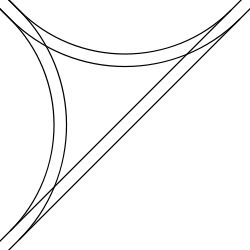
, is a triangular
Triangle
A triangle is one of the basic shapes of geometry: a polygon with three corners or vertices and three sides or edges which are line segments. A triangle with vertices A, B, and C is denoted ....
shaped arrangement of rail tracks
Rail tracks
The track on a railway or railroad, also known as the permanent way, is the structure consisting of the rails, fasteners, sleepers and ballast , plus the underlying subgrade...
with a switch or set of points
Railroad switch
A railroad switch, turnout or [set of] points is a mechanical installation enabling railway trains to be guided from one track to another at a railway junction....
at each corner. In mainline railroads, this can be used at a rail junction
Junction (rail)
A junction, in the context of rail transport, is a place at which two or more rail routes converge or diverge.This implies a physical connection between the tracks of the two routes , 'points' and signalling.one or two tracks each meet at a junction, a fairly simple layout of tracks suffices to...
, where three rail lines join, in order to allow trains to pass from any line to any other line.
Wyes can also be used for turning railway equipment. By performing the railway equivalent of a three point turn
Turning in the road
In driving unarticulated wheeled vehicles with reversible propulsion systems, turning in the road is a category of maneuvers, each reversing a vehicle's direction of travel along a road, with neither the use of any intersections nor leaving the right-of-way....
, the direction of a locomotive or railway vehicle can be swapped around, leaving it facing in the direction from which it came. Where a wye is built specifically for turning purposes, one or more of the tracks making up the junction will typically be a stub siding.
Tram or streetcar
Tram
A tram is a passenger rail vehicle which runs on tracks along public urban streets and also sometimes on separate rights of way. It may also run between cities and/or towns , and/or partially grade separated even in the cities...
tracks also make use of triangular junctions and sometimes have a short triangle or wye stubs to turn the car at the end of the line.
At junctions
The use of triangular junctions allows flexibility in routing trains from any line to any other line, without the need to reverse the train. For this reason they are common across most rail networks. Slower bi-directional trains may enter a wye, letting a faster one pass, and continue on the same direction providing service to nearby freight transport or a passenger station.Where one or more of the lines meeting at the junction are multi-track, the presence of a triangular junction does introduce a number of potential conflicting moves. For this reason, where traffic is heavy, the junction may incorporate flying junction
Flying junction
A flying junction or flyover is a railway junction at which one or more diverging or converging tracks in a multiple-track route cross other tracks on the route by bridge to avoid conflict with other train movements. A more technical term is "grade-separated junction"...
s on some, or all, or the legs of the triangle.
For turning equipment
From time to time it is necessary to turn both individual pieces of railroad equipment or whole trains. This may be because the piece of equipment is not directionally symmetrical, for example in the case of most steam locomotiveSteam locomotive
A steam locomotive is a railway locomotive that produces its power through a steam engine. These locomotives are fueled by burning some combustible material, usually coal, wood or oil, to produce steam in a boiler, which drives the steam engine...
s and, in certain parts of the world, diesel locomotive
Diesel locomotive
A diesel locomotive is a type of railroad locomotive in which the prime mover is a diesel engine, a reciprocating engine operating on the Diesel cycle as invented by Dr. Rudolf Diesel...
s, or where the train needs to run a particular direction, for example where it has dedicated tail end car such as an observation car
Observation car
An observation car/carriage/coach is a type of railroad passenger car, generally operated in a passenger train as the last carriage, with windows on the rear of the car for passengers' viewing pleasure...
. Even where equipment is symmetrical, periodic turning may still be necessary in order to even wear.
There are several different techniques that can be used to achieve such turning. Rail turntables require the least space, but can generally only deal with a single piece of equipment at a time. Balloon or turning loops
Balloon loop
A balloon loop or turning loop allows a rail vehicle or train to reverse direction without having to shunt or even stop. Balloon loops can be useful for passenger trains and unit freight trains, such as coal trains....
can turn trains of any length in a single operation, but are expensive in terms of land usage. Rail wyes can be constructed on sites where a loop would not be possible, and can turn trains up the length of the stub tracks at the end of the wye.
Railroad systems in North America and Australia have tended to have more wyes than railroads elsewhere. North American locomotives and cars (such as observation cars) tend to be more likely to be directional than those found on other continents. In Canada and the United States, the railroad often came first and railway builders had much more freedom to lay down tracks where they wished. Australia has a large amount of open space, and similarly at many rural railway locations in Australia triangles were used as an alternative to turntables for reasons of space availability and cost saving.
In Europe, although some use was made of bi-directional tank locomotive
Tank locomotive
A tank locomotive or tank engine is a steam locomotive that carries its water in one or more on-board water tanks, instead of pulling it behind it in a tender. It will most likely also have some kind of bunker to hold the fuel. There are several different types of tank locomotive dependent upon...
s and push-pull train
Push-pull train
Push–pull is a mode of operation for locomotive-hauled trains allowing them to be driven from either end.A push–pull train has a locomotive at one end of the train, connected via some form of remote control, such as multiple-unit train control, to a vehicle equipped with a control cab at the other...
s, most steam locomotives were uni-directional. Because of land usage considerations turntables were normally used to turn such locomotives, and most terminal stations and locomotive depots were so equipped. However most diesel and electric locomotive
Electric locomotive
An electric locomotive is a locomotive powered by electricity from overhead lines, a third rail or an on-board energy storage device...
s ordered in Europe have been designed to be fully bi-directional, symmetrical and normally with two driving cabs. Thus most turntables and, where they existed, rail wyes, have been taken out of use.
Streetcar or tram systems
Similar considerations apply to the use of triangular junctions and reversing wyes on streetcar and tram systems, as apply to mainline rail systems. Many, although by no means all, streetcar and tram systems use single ended vehicles that have doors on one side only and that must be turned at each end of the route.However the vehicles used on such systems tend to have much smaller minimum curvature requirements than heavy rail equipment. This renders the use of a balloon loop more practical in a small amount of space, and with street-running vehicles such a loop can make of side streets or street squares. However, although turning loops are the most common way of turning such vehicles, wye tracks are also sometimes used.
Disadvantages
A triangle has a disadvantage if a train by taking the triangle bypasses a main station. This happened at Cootamundra West where an extra passenger station had to be built to serve trains taking the shortcut.Woodville Railway Station, New Zealand avoids this problem by building a balloon loop so that trains can serve the main station in either direction without the need to reverse.
Land usage
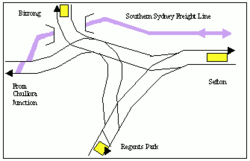
The land within a triangle tends to be cut off from the adjacent suburbs, and has marginal value, mainly for railway uses, such as maintenance depots. The triangular shape tends to be unsuited for rectangular buildings. On electrified lines, substations tend to be located inside triangles, in part because the land is cheap, and also because it provides the most convenient and flexible sectioning arrangements. Indeed SeftonSefton, New South Wales
Sefton, a suburb of local government area City of Bankstown, is located 23 kilometres west of the Sydney central business district, in the state of New South Wales, Australia, and is a part of the Western Sydney region....
triangle contains such a substation. Because it is difficult to see approaching trains, the Sefton triangle depot has a level crossing
Level crossing
A level crossing occurs where a railway line is intersected by a road or path onone level, without recourse to a bridge or tunnel. It is a type of at-grade intersection. The term also applies when a light rail line with separate right-of-way or reserved track crosses a road in the same fashion...
protected by flashing lights.
Earliest examples
The earliest British (and possibly worldwide) example is the double-tracked triangle within Earlestown railway stationEarlestown railway station
Earlestown railway station is a railway station in Earlestown, Newton-le-Willows in Merseyside, England. Since recent restoration of a platform for Warrington Bank Quay to Liverpool trains, it is one of the few "triangular" stations in Britain ....
on the Liverpool and Manchester Railway
Liverpool and Manchester Railway
The Liverpool and Manchester Railway was the world's first inter-city passenger railway in which all the trains were timetabled and were hauled for most of the distance solely by steam locomotives. The line opened on 15 September 1830 and ran between the cities of Liverpool and Manchester in North...
, which was completed by the Grand Junction Railway
Grand Junction Railway
The Grand Junction Railway was an early railway company in the United Kingdom, which existed between 1833 and 1846 when it was merged into the London and North Western Railway...
in 1837. The triangle has two passenger platform faces on each of its three sides and five of the six platforms are in frequent (half-hourly etc.) use by passenger trains. When steam engines were in regular use the triangle (which is of course also traversed by freight trains) was also used to turn locomotives and can still be so used.
There is an example on the Cromford and High Peak Railway
Cromford and High Peak Railway
The Cromford and High Peak Railway in Derbyshire, England, was completed in 1831, to carry minerals and goods between the Cromford Canal wharf at High Peak Junction and the Peak Forest Canal at Whaley Bridge -Origins:...
, which was opened in 1831 as a horse-drawn railway, which may be earlier. This appears to have been used for reversing trains of wagons with end doors that have just come up the rope-hauled inclines
Cable railway
A cable railway is a steeply graded railway that uses a cable or rope to haul trains.-Introduction:...
to the highest level of the railway before they proceeded down the remaining inclines. The site of this can still be seen near Hindlow, in Derbyshire
Derbyshire
Derbyshire is a county in the East Midlands of England. A substantial portion of the Peak District National Park lies within Derbyshire. The northern part of Derbyshire overlaps with the Pennines, a famous chain of hills and mountains. The county contains within its boundary of approx...
, .
Oceania
North America
Many North American passenger terminalsTrain station
A train station, also called a railroad station or railway station and often shortened to just station,"Station" is commonly understood to mean "train station" unless otherwise qualified. This is evident from dictionary entries e.g...
in large cities had wye tracks to allow the turning and backing of directional passenger trains onto a main line. Freight traffic could bypass the terminal through the wye. Notable examples include the Los Angeles Union Passenger Terminal, which has a double wye, and the Saint Paul Union Depot
Saint Paul Union Depot
The Saint Paul Union Depot was the main train station in the city of Saint Paul, Minnesota. The Saint Paul Union Depot Company controlled of St. Paul trackage and terminal facilities, including the depot building...
.
The Keddie Wye
Keddie Wye
The Keddie Wye is a favorite railfan spot at a wye along the Feather River Route, located at Keddie, California, named after Arthur Keddie. Mr. Keddie purchased the survey rights and the right to build a railroad through the Feather River Canyon from George Jay Gould I, the son of Jay Gould...
in Keddie, California
Keddie, California
Keddie is a census-designated place in Plumas County, California, United States. The population was 66 at the 2010 census.-Geography:Keddie is located at ....
, was built by the Western Pacific Railroad
Western Pacific Railroad
The Western Pacific Railroad was a Class I railroad in the United States. It was formed in 1903 as an attempt to break the near-monopoly the Southern Pacific Railroad had on rail service into northern California...
and is a remarkable engineering feat. Two sides of the wye are built on tall trestle
Trestle
A trestle is a rigid frame used as a support, especially referring to a bridge composed of a number of short spans supported by such frames. In the context of trestle bridges, each supporting frame is generally referred to as a bent...
s and one side is a tunnel
Tunnel
A tunnel is an underground passageway, completely enclosed except for openings for egress, commonly at each end.A tunnel may be for foot or vehicular road traffic, for rail traffic, or for a canal. Some tunnels are aqueducts to supply water for consumption or for hydroelectric stations or are sewers...
bored through solid rock.
The town of Wyeville, Wisconsin
Wyeville, Wisconsin
Wyeville is a village in Monroe County, Wisconsin, United States. The population was 146 at the 2000 census. It takes its name from the railroad wye where rail lines of the former Chicago and North Western Transportation Company, now Union Pacific Railway, cross.-Geography:Wyeville is located at ...
is named after the Union Pacific Railway, formerly the Chicago and North Western Transportation Company wye and crossover nearby.
Metro-North Railroad
Metro-North Railroad
The Metro-North Commuter Railroad , trading as MTA Metro-North Railroad, or, more commonly, Metro-North, is a suburban commuter rail service that is run and managed by the Metropolitan Transportation Authority , an authority of New York State. It is the busiest commuter railroad in the United...
maintains a very busy wye at Mott Haven, New York, in the Bronx
The Bronx
The Bronx is the northernmost of the five boroughs of New York City. It is also known as Bronx County, the last of the 62 counties of New York State to be incorporated...
. New Haven Line and Harlem Line trains use this wye to access the Hudson Line
Hudson Line (Metro-North)
Metro-North Railroad's Hudson Line is a commuter rail line running north from New York City along the east shore of the Hudson River. Metro-North service ends at Poughkeepsie, with Amtrak's Empire Corridor trains continuing north to and beyond Albany...
to reach the Yankees – East 153rd Street station.
Europe
Maindee
Maindee is a large inner-city area in the city of Newport, South Wales.It lies mostly within the electoral district and community of Victoria, although some areas traditionally associated with Maindee are in the Beechwood ward....
triangle in Newport
Newport
Newport is a city and unitary authority area in Wales. Standing on the banks of the River Usk, it is located about east of Cardiff and is the largest urban area within the historic county boundaries of Monmouthshire and the preserved county of Gwent...
, South Wales
South Wales
South Wales is an area of Wales bordered by England and the Bristol Channel to the east and south, and Mid Wales and West Wales to the north and west. The most densely populated region in the south-west of the United Kingdom, it is home to around 2.1 million people and includes the capital city of...
. Here the ex-GWR
Great Western Railway
The Great Western Railway was a British railway company that linked London with the south-west and west of England and most of Wales. It was founded in 1833, received its enabling Act of Parliament in 1835 and ran its first trains in 1838...
South Wales mainline from London
London
London is the capital city of :England and the :United Kingdom, the largest metropolitan area in the United Kingdom, and the largest urban zone in the European Union by most measures. Located on the River Thames, London has been a major settlement for two millennia, its history going back to its...
to Swansea
Swansea
Swansea is a coastal city and county in Wales. Swansea is in the historic county boundaries of Glamorgan. Situated on the sandy South West Wales coast, the county area includes the Gower Peninsula and the Lliw uplands...
is joined by another GWR line from Shrewsbury
Shrewsbury
Shrewsbury is the county town of Shropshire, in the West Midlands region of England. Lying on the River Severn, it is a civil parish home to some 70,000 inhabitants, and is the primary settlement and headquarters of Shropshire Council...
via Hereford
Hereford
Hereford is a cathedral city, civil parish and county town of Herefordshire, England. It lies on the River Wye, approximately east of the border with Wales, southwest of Worcester, and northwest of Gloucester...
. The significance of it is that steam-hauled trains can run to Newport and their engines be turned using the triangle. Its OS
Ordnance Survey
Ordnance Survey , an executive agency and non-ministerial government department of the Government of the United Kingdom, is the national mapping agency for Great Britain, producing maps of Great Britain , and one of the world's largest producers of maps.The name reflects its creation together with...
National Grid
British national grid reference system
The Ordnance Survey National Grid reference system is a system of geographic grid references used in Great Britain, different from using latitude and longitude....
location is . Shrewsbury
Shrewsbury railway station
Shrewsbury railway station is the railway station serving Shrewsbury, county town of Shropshire, England. It is the only remaining railway station in the town; Shrewsbury Abbey, as well as other small stations around the town, having long closed. The station was built in 1848 and has been extended...
also has a triangular route formation that was used to turn steam locomotives, and is still available. Valley railway station
Valley railway station
Valley railway station is a railway station that serves the village of Valley in Anglesey, Wales. It is the last station before the western terminus of the North Wales Coast Line at Holyhead...
on Anglesey
Anglesey
Anglesey , also known by its Welsh name Ynys Môn , is an island and, as Isle of Anglesey, a county off the north west coast of Wales...
in Wales
Wales
Wales is a country that is part of the United Kingdom and the island of Great Britain, bordered by England to its east and the Atlantic Ocean and Irish Sea to its west. It has a population of three million, and a total area of 20,779 km²...
still retains its triangle, which is occasionally used for turning charter trains or diesel hauled Pendolino
British Rail Class 390
The Class 390 Pendolino is a type of train used in Great Britain. They are electric multiple units using Fiat's tilting train pendolino technology and built by Alstom. Fifty-three 9-car units were originally built for Virgin Trains from 2001 to 2004 for operation on the West Coast Main Line , with...
electric sets terminating 4 miles (6.4 km) away at Holyhead
Holyhead railway station
Holyhead railway station serves the town of Holyhead on Holy Island, Anglesey. It is the western terminus of the North Wales Coast Line and is managed by Arriva Trains Wales, although Virgin Trains also serves it....
.
An unusual arrangement, unique in Britain, was constructed at Grantham
Grantham
Grantham is a market town within the South Kesteven district of Lincolnshire, England. It bestrides the East Coast Main Line railway , the historic A1 main north-south road, and the River Witham. Grantham is located approximately south of the city of Lincoln, and approximately east of Nottingham...
. Its location was and it is shown on the 1963 edition of OS 1 inch to 1 mile sheet 113. It was built in the 1950s after the turntable at the locomotive shed failed and expenditure on a replacement was no longer justified. Locomotives requiring to be turned had to travel to Barkston Junction to traverse the triangular layout there (this was where Mallard
LNER Class A4 4468 Mallard
Number 4468 Mallard is a London and North Eastern Railway Class A4 4-6-2 Pacific steam locomotive built at Doncaster, England in 1938. While in other respects a relatively typical member of its class, it is historically significant for being the holder of the official world speed record for steam...
with a dynamometer car
Dynamometer car
A dynamometer car is a railroad maintenance of way car used for measuring various aspects of a locomotive's performance. Measurements include tractive effort , power, top speed, etc.-History:...
attached was turned before starting out south on its record-breaking run on 3 July 1938). The journey to Barkston Junction and back was a time consuming business involving a round trip of some 8 miles (12.9 km) along the busy East Coast Main Line
East Coast Main Line
The East Coast Main Line is a long electrified high-speed railway link between London, Peterborough, Doncaster, Wakefield, Leeds, York, Darlington, Newcastle and Edinburgh...
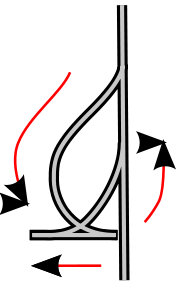
. Eventually authority was given to construct a turning arrangement on a strip of spare land to the west of the main line, just south of Grantham station. There was insufficient space for a conventional triangle but this was overcome by laying a short length of track at right angles to the main line and arranging the approach tracks to intersect in a scissors crossing.
Africa
Tsumeb railway stationTsumeb railway station
Tsumeb is a mining town in northeastern Namibia.- Transport :It is served by a mostly freight railway. With the extension of the railway towards the Angolan border in 2007, the Tsumeb station finds itself on a dead end, with a new bypass formed by a Triangle provided direct access from the capital...
in Namibia has two triangles. The first and smaller one is for turning engines and is near the station. The second and larger one is to bypass the deadend station at Tsumeb
Tsumeb
Tsumeb is a city of 15,000 inhabitants and the largest town in Oshikoto region in northern Namibia. Tsumeb is the home of the world-famous Tsumeb mine, and the "gateway to the north" of Namibia. It is the closest town to the Etosha National Park...
for trains travelling directly between the new extension towards Angola
Angola
Angola, officially the Republic of Angola , is a country in south-central Africa bordered by Namibia on the south, the Democratic Republic of the Congo on the north, and Zambia on the east; its west coast is on the Atlantic Ocean with Luanda as its capital city...
and Windhoek
Transport in Namibia
- Road :Namibia's road network is regarded as one of the best on the continent; road construction and maintenance adheres to international standards. It consists of 25,000 km of gravel roads and 9,000 km of earth-graded roads...
. http://imageatlas.globexplorer.com/ImageAtlas/view.do?group=ImageAtlas&lat=-19.252&lon=17.712&zoom_level=10 This direct bypass line can save 60 minutes shunting time, particularly if the train is longer than the loops in the station.