


LNER Class A4 4468 Mallard

Encyclopedia
Number 4468 Mallard is a London and North Eastern Railway
Class A4
4-6-2 Pacific
steam locomotive
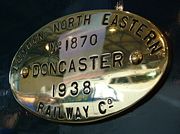
built at Doncaster
, England in 1938. While in other respects a relatively typical member of its class, it is historically significant for being the holder of the official world speed record for steam locomotives.
Mallard was designed by Sir Nigel Gresley as an express locomotive to power high-speed streamlined trains. Its wind-tunnel-tested, aerodynamic body and high power allowed it to reach speeds of over 100 miles per hour (44.7 m/s). Mallard was in service until 1963, when it was retired, having covered almost one and a half million miles (2.4 million km).
It was restored to working order in the 1980s, but has not operated since, apart from hauling some specials between York and Scarborough in July 1986 and a couple of runs between York and Harrogate/Leeds around Easter 1987. Mallard is now part of the National Collection at the United Kingdom's National Railway Museum
in York
. On the weekend of 5 July 2008, Mallard was taken outside for the first time in years and displayed alongside her A4 sisters, thus reuniting all four A4s extant in the UK for the first time since preservation. She departed the museum for Locomotion
, the NRM's outbase at Shildon
on the 23 June 2010, where she was a static exhibit, until she was hauled back to York on 19 July 2011 and put back on display in its original location in the Great Hall.
The locomotive is 70 ft (21.3 m) long and weighs 165 tons, including the tender
. It is painted LNER garter blue with red wheels and steel rims.
for steam locomotive
s at 126 mph (56.3 m/s). The record was achieved on 3 July 1938 on the slight downward grade of Stoke Bank south of Grantham
on the East Coast Main Line
, and the highest speed was recorded at milepost 90¼, between Little Bytham
and Essendine
. It broke the German (DRG Class 05
) 002's 1936 record of 200.4 km/h (124.5 mph).
Mallard was the perfect vehicle for such an endeavour; one of the A4 class of streamlined locomotives designed for sustained 100+ mph (160+ km/h) running, it was one of a small number built with a double chimney and double Kylchap
blastpipe
, which made for improved draughting and better exhaust flow at speed; the remainder of the class were retro-fitted in the late 1950s. The A4's three-cylinder design made for stability at speed, and the large 6 in 8 in (2.03 m) driving wheels meant that the maximum revolutions per minute was within the capabilities of the technology of the day. Mallard was five months old, meaning that it was sufficiently broken-in to run freely, but not overly worn. Selected to crew the locomotive on its record attempt were driver Joseph Duddington (a man renowned within the LNER for taking calculated risks) and fireman Thomas Bray.
The locomotive had previously had problems with the big end bearing
for the middle cylinder, so a "stink bomb" of aniseed oil was placed inside the big end, that would be released if it overheated. Shortly after the attainment of this record speed, Mallard suffered an overheated middle big end and had to limp back to Peterborough after setting the record. It then travelled to Doncaster for repair. This had been foreseen by the publicity department, who had many pictures taken for the press, in case Mallard did not make it back to Kings Cross. The Ivatt Atlantic that replaced Mallard at Peterborough was only just in sight when the head of publicity started handing out the pictures. Inaccuracies in the machining and setup of the Gresley-Holcroft derived motion
(which derived the valve motion of the inside (middle) cylinder from those of the other two, avoiding a hard-to-maintain valve gear linkage between the frames) meant that the inside cylinder of the A4 did more work at high speed than the two outside cylinders; this overloading was mostly responsible for the failure.
 Stoke Bank had a descending gradient of between 1:178 and 1:200. Mallard, with six coaches plus a dynamometer car
in tow, topped Stoke Summit at 75 mph (34 m/s) and began to accelerate downhill. The speeds at the end of each mile (1.6 km) from the summit were recorded at: 87½, 96½, 104, 107, 111½, 116 and 119 mph (141, 155, 167, 172, 179, 187 and 192 km/h); half-mile (800 m) readings after that gave 120¾, 122½, 123, 124¼ and finally 125 mph (194, 197, 198, 200 and 201 km/h). The speed recorded by instruments in the dynamometer car reached a momentary maximum of 126 mph (56.3 m/s).
's world record has never been officially exceeded by a steam locomotive, though the German Class 05
was at least very close: in 1936, two years before Mallard's run, 05 002
had reached 200.4 km/h (124.5 mph) between Hamburg
and Berlin. Unlike the LNER's long, straight, slightly downhill raceway of Stoke Bank, the 1936 run of the German Class 05
took place on a horizontal stretch of track (unlike world records for car
s, there is no requirement for an average of two runs in both directions, and assistance from gradient or wind has always been acceptable in rail speed records). Also, unlike Mallard, 05 002 survived the attempt undamaged and did not even seem to be at its limit. Additionally, the Mallards speed documentation is not beyond doubt, although most probably it did in fact reach the 124.5 mph (200.4 km/h) required to equal the German record.
 There are reports about higher speeds from North American steam locomotives, although none of these records was officially documented. Locomotives that may have exceeded the 126 mph (203 km/h) record include the Pennsylvania Railroad
's S1
prototype which was unofficially clocked at 127.1 miles per hour, and the Milwaukee Road class F7
. The Milwaukee Road had the fastest scheduled steam-powered passenger trains in the world. Both it and the Chicago & North Western (see CNW Class E-4
) had timetables requiring running in excess of 100 mph (160 km/h); it is believed that both railroads' locomotives exceeded 120 mi/h.
One fact that is often ignored when considering rival claims is that Gresley and the LNER had just one serious attempt at the record, which was far from a perfect run with a permanent way check through Grantham. Despite this a record was set. Gresley planned to have another attempt in September 1939, but this was prevented by the outbreak of World War II. Prior to the record run on 3 July 1938, it was calculated that 130 mi/h was possible.
Thus, Mallard still officially holds the record; plaques affixed to each side of the locomotive commemorate the feat.
The express passenger locomotive designs which would be compared were: London Midland Region (former LMS
) Princess Coronation class
, Eastern Region (former LNER) Class A4
, Southern Region (former Southern
) Merchant Navy class
and Western Region (former GWR
) 6000 Class
or King class.
Three Gresley A4 locomotives were chosen to represent the Eastern Region: E22 Mallard, 60033 Seagull
and 60034 Lord Farringdon
. All of the locomotives had the Kylchap double blastpipe chimney arrangement and were fresh from Doncaster works. Mallard had emerged from Doncaster with a fresh coat of post-war garter blue livery, stainless steel numbers 22 with a small 'E' painted above them (for Eastern region), new boiler (her fourth) and third tender of her career.
E22 Mallard was used on 8 June 1948 on the Waterloo-Exeter route. Driver Marrable took the famous A4 with a load of 481 tons tare, 505 tons full, the same that had been used on the previous trip by 35018 British India Line
. Mallard got through Clapham Junction in 6 minutes 57 seconds, Woking in 28 minutes 47 seconds. At Hook there were adverse signals, causing Mallard to slow to a crawl. Even so, by Axminster, Mallard had reached 82 miles per hour. Salisbury was reached in 108 minutes and 28 seconds. Despite the signals earlier, the train was only 5-and-a-half minutes late. The net time was 95.5 minutes.
Mallard failed after this trial and 60033 Seagull took over. 10 June saw Seagull achieve the run in 96 minutes 22 seconds, but had departed 3 minutes late, meaning Seagull had arrived with the same load 3.5 minutes early. For Mallard, the 1948 Locomotive Exchange Trials
were over, but Mallard was to return to the Waterloo-Exeter line for a Locomotive Club of Great Britain (LCGB) railtour in 24 February 1963.
 Mallard was released into traffic for the first time on 3 March 1938. She was the first A4 to be fitted with a Kylchap double blast pipe from new. This was one of the factors that led to her selection for the attempt on the world rail speed record in the following July.
Mallard wore a variety of liveries throughout her career, these were: garter blue as 4468, LNER wartime black from 13 June 1942, later wartime black with the tender marked as "NE" from 21 October 1943 as 22 with yellow small stencilled numbers, post-war garter blue with white and red lining from 5 March 1948 with stainless steel cabside number 22, British railways dark blue as 60022 from 16 September 1949, brunswick green from 4 July 1952 and regaining her original LNER garter blue for preservation in 1963.
As with all 35 of the Gresley A4 pacific steam locomotives, Mallard was fitted with streamlined valances, or side skirting, when she was built. This was removed to ease maintenance in wartime, as it was on her sister engines. 4468 lost her valances during a works visit 13 June 1942, regaining them in preservation in 1963.
Mallard was fitted with twelve boilers during her 25 year career. These boilers were: 9024 (from construction), 8959 (from 4496 Golden Shuttle, 13 June 1942), 8907 (from 2511 Silver King, 1 August 1946), 8948 (from 31 Golden Plover, 5 March 1948), 8957 (from 60009 Union of South Africa, 16 September 1949), 29282 (from 60028 Walter K Whigham, 10 January 1951), 29301 (from 60019 Bittern, 4 July 1952), 29315 (from 60014 Silver Link, 23 April 1954), 29328 (new-build boiler, 7 June 1957), 29308 (from 60008 Dwight D. Eisenhower, 27 August 1958), 29310 (from 60009 Union of South Africa, 9 March 1960) and 27965 (from 60009 Union of South Africa, 10 August 1961).
Mallard has had seven tenders throughout her career. She started off with a non-corridor tender in 1938, had corridor design tenders during her British Railways days and was fitted with a non-corridor tender in 1963 to recreate her original appearance. The tenders she has been fitted with are: 5642 (3 March 1938 - 14 March 1939), 5639 (5 May 1939 - 16 January 1948), 5323 (5 March 1948 - 12 March 1953), 5648 (12 March 1953 - 21 July 1958), 5330 (27 August 1958 - 30 May 1962), 5651 (30 May 1962 - 25 April 1963) and 5670 (current tender, masquerading as original tender 5642).
Mallard was allocated to three sheds during her career: Doncaster, Grantham (transferring 21 October 1943) and Kings Cross ('Top Shed'), transferring on 11 April 1948.
London and North Eastern Railway
The London and North Eastern Railway was the second-largest of the "Big Four" railway companies created by the Railways Act 1921 in Britain...
Class A4
LNER Class A4
The Class A4 is a class of streamlined 4-6-2 steam locomotive, designed by Nigel Gresley for the London and North Eastern Railway in 1935. Their streamlined design gave them high-speed capability as well as making them instantly recognizable, and one of the class, 4468 Mallard, still claims the...
4-6-2 Pacific
4-6-2
4-6-2, in the Whyte notation for the classification of steam locomotives, represents the wheel arrangement of four leading wheels on two axles , six powered and coupled driving wheels on three axles, and two trailing wheels on one axle .These locomotives are also known as Pacifics...
steam locomotive
Steam locomotive
A steam locomotive is a railway locomotive that produces its power through a steam engine. These locomotives are fueled by burning some combustible material, usually coal, wood or oil, to produce steam in a boiler, which drives the steam engine...
built at Doncaster
Doncaster
Doncaster is a town in South Yorkshire, England, and the principal settlement of the Metropolitan Borough of Doncaster. The town is about from Sheffield and is popularly referred to as "Donny"...
, England in 1938. While in other respects a relatively typical member of its class, it is historically significant for being the holder of the official world speed record for steam locomotives.
Mallard was designed by Sir Nigel Gresley as an express locomotive to power high-speed streamlined trains. Its wind-tunnel-tested, aerodynamic body and high power allowed it to reach speeds of over 100 miles per hour (44.7 m/s). Mallard was in service until 1963, when it was retired, having covered almost one and a half million miles (2.4 million km).
It was restored to working order in the 1980s, but has not operated since, apart from hauling some specials between York and Scarborough in July 1986 and a couple of runs between York and Harrogate/Leeds around Easter 1987. Mallard is now part of the National Collection at the United Kingdom's National Railway Museum
National Railway Museum
The National Railway Museum is a museum in York forming part of the British National Museum of Science and Industry and telling the story of rail transport in Britain and its impact on society. It has won many awards, including the European Museum of the Year Award in 2001...
in York
York
York is a walled city, situated at the confluence of the Rivers Ouse and Foss in North Yorkshire, England. The city has a rich heritage and has provided the backdrop to major political events throughout much of its two millennia of existence...
. On the weekend of 5 July 2008, Mallard was taken outside for the first time in years and displayed alongside her A4 sisters, thus reuniting all four A4s extant in the UK for the first time since preservation. She departed the museum for Locomotion
Shildon Locomotion Museum
Shildon Locomotion Museum is a railway museum in Shildon, County Durham, England. The museum is a branch of the National Railway Museum , which is part of the National Museum of Science and Industry...
, the NRM's outbase at Shildon
Shildon
Shildon is a town in County Durham, in England. It is situated 2 miles to the south east of Bishop Auckland and 11 miles north of Darlington. It is 13 miles away from Durham, 23 miles from Sunderland and 23 miles from Newcastle-upon-Tyne...
on the 23 June 2010, where she was a static exhibit, until she was hauled back to York on 19 July 2011 and put back on display in its original location in the Great Hall.
The locomotive is 70 ft (21.3 m) long and weighs 165 tons, including the tender
Tender locomotive
A tender or coal-car is a special rail vehicle hauled by a steam locomotive containing the locomotive's fuel and water. Steam locomotives consume large quantities of water compared to the quantity of fuel, so tenders are necessary to keep the locomotive running over long distances. A locomotive...
. It is painted LNER garter blue with red wheels and steel rims.
Record
Mallard is the holder of the official world speed recordLand speed record for railed vehicles
Determination of the fastest rail vehicle in the world varies depending on the definition of "rail".Official absolute world record for conventional train is held by the French TGV...
for steam locomotive
Steam locomotive
A steam locomotive is a railway locomotive that produces its power through a steam engine. These locomotives are fueled by burning some combustible material, usually coal, wood or oil, to produce steam in a boiler, which drives the steam engine...
s at 126 mph (56.3 m/s). The record was achieved on 3 July 1938 on the slight downward grade of Stoke Bank south of Grantham
Grantham
Grantham is a market town within the South Kesteven district of Lincolnshire, England. It bestrides the East Coast Main Line railway , the historic A1 main north-south road, and the River Witham. Grantham is located approximately south of the city of Lincoln, and approximately east of Nottingham...
on the East Coast Main Line
East Coast Main Line
The East Coast Main Line is a long electrified high-speed railway link between London, Peterborough, Doncaster, Wakefield, Leeds, York, Darlington, Newcastle and Edinburgh...
, and the highest speed was recorded at milepost 90¼, between Little Bytham
Little Bytham
Little Bytham is a small village in South Kesteven in south Lincolnshire, situated between Corby Glen and Stamford on the B1176, which is straddled by brick railway viaducts of the East Coast Main Line as the road passes through the village.On the edge of the village to the east is the West Glen...
and Essendine
Essendine railway station
Essendine railway station was a station in Essendine, Rutland. It was situated on the East Coast Main Line of the Great Northern Railway.-Overview:...
. It broke the German (DRG Class 05
DRG Class 05
The Deutsche Reichsbahn's Class 05 was a German class of three express passenger steam locomotives of 4-6-4 wheel arrangement in the Whyte notation, or 2'C2' in the UIC notation used in continental Europe...
) 002's 1936 record of 200.4 km/h (124.5 mph).
Mallard was the perfect vehicle for such an endeavour; one of the A4 class of streamlined locomotives designed for sustained 100+ mph (160+ km/h) running, it was one of a small number built with a double chimney and double Kylchap
Kylchap
The Kylchap steam locomotive steam locomotive exhaust system was designed and patented by the famous French steam engineer André Chapelon, using a second-stage nozzle designed by the Finnish engineer Kyösti Kylälä and known as the Kylälä spreader; thus the name KylChap for this design.The Kylchap...
blastpipe
Blastpipe
The blastpipe is part of the exhaust system of a steam locomotive that discharges exhaust steam from the cylinders into the smokebox beneath the chimney in order to increase the draught through the fire.- History :...
, which made for improved draughting and better exhaust flow at speed; the remainder of the class were retro-fitted in the late 1950s. The A4's three-cylinder design made for stability at speed, and the large 6 in 8 in (2.03 m) driving wheels meant that the maximum revolutions per minute was within the capabilities of the technology of the day. Mallard was five months old, meaning that it was sufficiently broken-in to run freely, but not overly worn. Selected to crew the locomotive on its record attempt were driver Joseph Duddington (a man renowned within the LNER for taking calculated risks) and fireman Thomas Bray.
The locomotive had previously had problems with the big end bearing
Bearing (mechanical)
A bearing is a device to allow constrained relative motion between two or more parts, typically rotation or linear movement. Bearings may be classified broadly according to the motions they allow and according to their principle of operation as well as by the directions of applied loads they can...
for the middle cylinder, so a "stink bomb" of aniseed oil was placed inside the big end, that would be released if it overheated. Shortly after the attainment of this record speed, Mallard suffered an overheated middle big end and had to limp back to Peterborough after setting the record. It then travelled to Doncaster for repair. This had been foreseen by the publicity department, who had many pictures taken for the press, in case Mallard did not make it back to Kings Cross. The Ivatt Atlantic that replaced Mallard at Peterborough was only just in sight when the head of publicity started handing out the pictures. Inaccuracies in the machining and setup of the Gresley-Holcroft derived motion
Gresley conjugated valve gear
The Gresley conjugated valve gear is a valve gear for steam locomotives designed by Sir Nigel Gresley, chief mechanical engineer of the LNER, assisted by Harold Holcroft...
(which derived the valve motion of the inside (middle) cylinder from those of the other two, avoiding a hard-to-maintain valve gear linkage between the frames) meant that the inside cylinder of the A4 did more work at high speed than the two outside cylinders; this overloading was mostly responsible for the failure.
Dynamometer car
A dynamometer car is a railroad maintenance of way car used for measuring various aspects of a locomotive's performance. Measurements include tractive effort , power, top speed, etc.-History:...
in tow, topped Stoke Summit at 75 mph (34 m/s) and began to accelerate downhill. The speeds at the end of each mile (1.6 km) from the summit were recorded at: 87½, 96½, 104, 107, 111½, 116 and 119 mph (141, 155, 167, 172, 179, 187 and 192 km/h); half-mile (800 m) readings after that gave 120¾, 122½, 123, 124¼ and finally 125 mph (194, 197, 198, 200 and 201 km/h). The speed recorded by instruments in the dynamometer car reached a momentary maximum of 126 mph (56.3 m/s).
Rival claims
MallardDRG Class 05
The Deutsche Reichsbahn's Class 05 was a German class of three express passenger steam locomotives of 4-6-4 wheel arrangement in the Whyte notation, or 2'C2' in the UIC notation used in continental Europe...
was at least very close: in 1936, two years before Mallard
DRG Class 05
The Deutsche Reichsbahn's Class 05 was a German class of three express passenger steam locomotives of 4-6-4 wheel arrangement in the Whyte notation, or 2'C2' in the UIC notation used in continental Europe...
had reached 200.4 km/h (124.5 mph) between Hamburg
Hamburg
-History:The first historic name for the city was, according to Claudius Ptolemy's reports, Treva.But the city takes its modern name, Hamburg, from the first permanent building on the site, a castle whose construction was ordered by the Emperor Charlemagne in AD 808...
and Berlin. Unlike the LNER's long, straight, slightly downhill raceway of Stoke Bank, the 1936 run of the German Class 05
DRG Class 05
The Deutsche Reichsbahn's Class 05 was a German class of three express passenger steam locomotives of 4-6-4 wheel arrangement in the Whyte notation, or 2'C2' in the UIC notation used in continental Europe...
took place on a horizontal stretch of track (unlike world records for car
Automobile
An automobile, autocar, motor car or car is a wheeled motor vehicle used for transporting passengers, which also carries its own engine or motor...
s, there is no requirement for an average of two runs in both directions, and assistance from gradient or wind has always been acceptable in rail speed records). Also, unlike Mallard, 05 002 survived the attempt undamaged and did not even seem to be at its limit. Additionally, the Mallards speed documentation is not beyond doubt, although most probably it did in fact reach the 124.5 mph (200.4 km/h) required to equal the German record.
Pennsylvania Railroad
The Pennsylvania Railroad was an American Class I railroad, founded in 1846. Commonly referred to as the "Pennsy", the PRR was headquartered in Philadelphia, Pennsylvania....
's S1
PRR S1
The PRR S1 class steam locomotive was an experimental locomotive that was the largest rigid frame passenger locomotive ever built. The streamlined Art Deco styled shell of the locomotive was designed by Raymond Loewy....
prototype which was unofficially clocked at 127.1 miles per hour, and the Milwaukee Road class F7
Milwaukee Road class F7
The Milwaukee Road's class F7 comprised six high-speed, streamlined 4-6-4 "Baltic" or "Hudson" type steam locomotives built by ALCO in 1937–38 to haul the Milwaukee's Hiawatha express passenger trains...
. The Milwaukee Road had the fastest scheduled steam-powered passenger trains in the world. Both it and the Chicago & North Western (see CNW Class E-4
CNW Class E-4
The Chicago and North Western Railway's Class E-4 comprised nine coal-burning streamlined 4-6-4 "Hudson" steam locomotives built in 1937 by ALCO....
) had timetables requiring running in excess of 100 mph (160 km/h); it is believed that both railroads' locomotives exceeded 120 mi/h.
One fact that is often ignored when considering rival claims is that Gresley and the LNER had just one serious attempt at the record, which was far from a perfect run with a permanent way check through Grantham. Despite this a record was set. Gresley planned to have another attempt in September 1939, but this was prevented by the outbreak of World War II. Prior to the record run on 3 July 1938, it was calculated that 130 mi/h was possible.
Thus, Mallard still officially holds the record; plaques affixed to each side of the locomotive commemorate the feat.
1948 Locomotive Exchange Trials
In 1948, shortly after the formation of British Railways, the decision was taken to test locomotives from all of the former 'Big Four' companies to find the best attributes of speed, power and efficiency with coal and water. There were two ways of testing and comparing locomotives: either at the Rugby Locomotive testing plant, which was not ready until late 1948 or by testing in the field itself. The results of these trials would be used to help design the British Railways Standard design of locomotives.The express passenger locomotive designs which would be compared were: London Midland Region (former LMS
London, Midland and Scottish Railway
The London Midland and Scottish Railway was a British railway company. It was formed on 1 January 1923 under the Railways Act of 1921, which required the grouping of over 120 separate railway companies into just four...
) Princess Coronation class
LMS Princess Coronation Class
The London Midland and Scottish Railway Coronation Class is a class of express passenger steam locomotives designed by William Stanier. They were an enlarged version of the LMS Princess Royal Class. Several examples were originally built as streamlined, though this was later removed...
, Eastern Region (former LNER) Class A4
LNER Class A4
The Class A4 is a class of streamlined 4-6-2 steam locomotive, designed by Nigel Gresley for the London and North Eastern Railway in 1935. Their streamlined design gave them high-speed capability as well as making them instantly recognizable, and one of the class, 4468 Mallard, still claims the...
, Southern Region (former Southern
Southern Railway (Great Britain)
The Southern Railway was a British railway company established in the 1923 Grouping. It linked London with the Channel ports, South West England, South coast resorts and Kent...
) Merchant Navy class
SR Merchant Navy class
The SR Merchant Navy class , was a class of air-smoothed 4-6-2 Pacific steam locomotives designed for the Southern Railway of the United Kingdom by Oliver Bulleid...
and Western Region (former GWR
Great Western Railway
The Great Western Railway was a British railway company that linked London with the south-west and west of England and most of Wales. It was founded in 1833, received its enabling Act of Parliament in 1835 and ran its first trains in 1838...
) 6000 Class
GWR 6000 Class
The Great Western Railway 6000 Class or King is a class of 4-6-0 steam locomotive designed for express passenger work. With the exception of one Pacific , they were the largest locomotives the GWR built. They were named after kings of the United Kingdom and of England, beginning with the reigning...
or King class.
Three Gresley A4 locomotives were chosen to represent the Eastern Region: E22 Mallard, 60033 Seagull
LNER Class A4 4902 Seagull
LNER 4902 Seagull was one of 35 Doncaster built Class A4 Gresley Pacific steam locomotives.It entered service on the 28th June 1938 and was withdrawn on the 29th December 1962....
and 60034 Lord Farringdon
LNER Class A4 60034 Lord Faringdon
Ex-LNER 60034 Lord Faringdon was one of 35 Doncaster built Class A4 Gresley Pacific steam locomotives....
. All of the locomotives had the Kylchap double blastpipe chimney arrangement and were fresh from Doncaster works. Mallard had emerged from Doncaster with a fresh coat of post-war garter blue livery, stainless steel numbers 22 with a small 'E' painted above them (for Eastern region), new boiler (her fourth) and third tender of her career.
E22 Mallard was used on 8 June 1948 on the Waterloo-Exeter route. Driver Marrable took the famous A4 with a load of 481 tons tare, 505 tons full, the same that had been used on the previous trip by 35018 British India Line
SR Merchant Navy class
The SR Merchant Navy class , was a class of air-smoothed 4-6-2 Pacific steam locomotives designed for the Southern Railway of the United Kingdom by Oliver Bulleid...
. Mallard got through Clapham Junction in 6 minutes 57 seconds, Woking in 28 minutes 47 seconds. At Hook there were adverse signals, causing Mallard to slow to a crawl. Even so, by Axminster, Mallard had reached 82 miles per hour. Salisbury was reached in 108 minutes and 28 seconds. Despite the signals earlier, the train was only 5-and-a-half minutes late. The net time was 95.5 minutes.
Mallard failed after this trial and 60033 Seagull took over. 10 June saw Seagull achieve the run in 96 minutes 22 seconds, but had departed 3 minutes late, meaning Seagull had arrived with the same load 3.5 minutes early. For Mallard, the 1948 Locomotive Exchange Trials
1948 Locomotive Exchange Trials
The 1948 Locomotive Exchange Trials were organised by the newly nationalised British Railways . Locomotives from the former "Big Four" constituent companies were transferred to and worked on other regions...
were over, but Mallard was to return to the Waterloo-Exeter line for a Locomotive Club of Great Britain (LCGB) railtour in 24 February 1963.
Technical specifications
Mallard wore a variety of liveries throughout her career, these were: garter blue as 4468, LNER wartime black from 13 June 1942, later wartime black with the tender marked as "NE" from 21 October 1943 as 22 with yellow small stencilled numbers, post-war garter blue with white and red lining from 5 March 1948 with stainless steel cabside number 22, British railways dark blue as 60022 from 16 September 1949, brunswick green from 4 July 1952 and regaining her original LNER garter blue for preservation in 1963.
As with all 35 of the Gresley A4 pacific steam locomotives, Mallard was fitted with streamlined valances, or side skirting, when she was built. This was removed to ease maintenance in wartime, as it was on her sister engines. 4468 lost her valances during a works visit 13 June 1942, regaining them in preservation in 1963.
Mallard was fitted with twelve boilers during her 25 year career. These boilers were: 9024 (from construction), 8959 (from 4496 Golden Shuttle, 13 June 1942), 8907 (from 2511 Silver King, 1 August 1946), 8948 (from 31 Golden Plover, 5 March 1948), 8957 (from 60009 Union of South Africa, 16 September 1949), 29282 (from 60028 Walter K Whigham, 10 January 1951), 29301 (from 60019 Bittern, 4 July 1952), 29315 (from 60014 Silver Link, 23 April 1954), 29328 (new-build boiler, 7 June 1957), 29308 (from 60008 Dwight D. Eisenhower, 27 August 1958), 29310 (from 60009 Union of South Africa, 9 March 1960) and 27965 (from 60009 Union of South Africa, 10 August 1961).
Mallard has had seven tenders throughout her career. She started off with a non-corridor tender in 1938, had corridor design tenders during her British Railways days and was fitted with a non-corridor tender in 1963 to recreate her original appearance. The tenders she has been fitted with are: 5642 (3 March 1938 - 14 March 1939), 5639 (5 May 1939 - 16 January 1948), 5323 (5 March 1948 - 12 March 1953), 5648 (12 March 1953 - 21 July 1958), 5330 (27 August 1958 - 30 May 1962), 5651 (30 May 1962 - 25 April 1963) and 5670 (current tender, masquerading as original tender 5642).
Mallard was allocated to three sheds during her career: Doncaster, Grantham (transferring 21 October 1943) and Kings Cross ('Top Shed'), transferring on 11 April 1948.