

Ware

Encyclopedia
Ware is a town of around 18,000 people in Hertfordshire
, England close to the county town of Hertford
. It is also a civil parish in East Hertfordshire
district. The Prime Meridian
passes to the east of Ware.
(for Hertford to the west and Harlow
to the east). There is a large viaduct
over the River Lea
at Kings Meads. The £3.6m two-mile bypass opened on 17 August 1976. At the north end of the bypass is the Wodson Park Sports Centre, with an athletics track, and Hanbury Manor, a hotel and country club. The former route of the A10 is now the A1170. The railway station
is on the Hertford East Branch Line
and operated by National Express East Anglia and is only single track.
period (which ended about 4000 BC) The Romans
had a sizable settlement here and foundations of several buildings, including a temple, and two cemeteries have been found. A well-preserved Roman skeleton of a teenage girl has also been found. Ware was on Ermine Street
, the Roman road from London to Lincoln. It has been said that Ware is one of the oldest continuously occupied sites in Europe
.
The modern name of the town dates from the Anglo-Saxon period when weirs were built to stop the invading Vikings from escaping in their longships after defeat by Alfred the Great
in a battle near Ware. It was also a great coaching town, being on the Old North Road, less than a day's journey from London. In the seventeenth century Ware became the source of the New River
, constructed to bring fresh water to London.
The Ware Mutiny occurred on 15 November 1647, during the early stages the Second English Civil War
at Corkbush Field
, when soldiers were ordered to sign a declaration of loyalty to Thomas Fairfax
, the commander-in-chief of the New Model Army
(NMA), and the Army Council. When some with Leveller sympathies refused to do this they were arrested, and one of the ringleaders, Private Richard Arnold, was court-martialled and shot.
England's first turnpike
(toll) road ran from Wadesmill
to Ware. The town was once a major centre of malting.
The Ware Town Council coat of arms was issued in 1956 by the College of Arms to Ware Urban District Council, and transferred to Ware Town Council in 1975. The arms are derived from matters with which Ware is associated — the barge rudders reference the bargemen of Ware, with the red and white striping on the rudders being the livery colours of the City of London, associating the Ware bargemen's free entry rights to that City (q.v.); the crossed coach horns reference the town's long history as a coaching town; and the sheaves of barley reference the malting history of Ware. The motto of the town "cave" (Latin for "beware") was suggested by the College of Heralds, with the intent of its being a pun on the town's name.
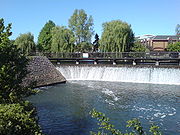 With the River Lea flowing through the centre of Ware, transport by water was for many years a significant industry. As an old brewing town (and some of the old maltings still stand, although none are functional), barley was transported in, and beer out via the river. Bargemen born in Ware were given the "freedom of the River Thames" — avoiding the requirement of paying lock dues — as a result of their transport of fresh water and food in during the great plague of 1665–66. A local legend says that dead bodies were brought out of London, but there is no evidence for this. "Buryfield" in Ware is thought by many to be where these supposed bodies were buried. The name apparently originates from before 1666, with the burial of large numbers of Roman inhabitants of Ware.
Tragedy struck the town on 25 January 1990 when a 15-year-old local girl struck by a falling tree was one of 39 people to die in a storm that ravaged Britain.
s, several of which have been restored recently. It is also famous for the Great Bed of Ware
, which was mentioned by Shakespeare and is now in the Victoria and Albertis Museum in London. Ware is also mentioned in the Canterbury Tales. Ware was the unintended destination of John Gilpin
in William Cowper's
comic poem.
Today the town's main employer is GlaxoSmithKline
which has a large plant in the town, but there are also many other small factories. It is also a commuting town for London, with regular rail services between Ware railway station
and London Liverpool Street.
Ware is home to Scott's Grotto
, built for John Scott
, an 18th-century poet who owned Amwell House from 1768. The grotto, the largest in the UK, is a series of chambers extending over 65 ft into the chalk hillside. The chambers are decorated with shells, stones such as flint and coloured glass. The grotto is owned by East Herts District Council and was restored in 1990 by the Ware Society.
During two weeks of the summer, Ware Council holds the 'Ware Festival' culminating in the 'Rock in the Priory' a one-day open-air Music Festival that grows each year in popularity.
There are many building along the town's high street that date back hundred of years. The large gates are still visible between shops that once lead the way to the stables where horses would stay overnight. Crib street is another example of this. One can actually walk down crib street and feel like they are walking through time. At one end is St Mary's Church which is over 1000 years old and the other is a block of modern flats. In the middle is a wide variety of buildings including Victorian terraced housing and 14th Century pubs. There was once at least 10 pubs along crib street, but today there is only one pub still open for trade; The Albion. It was run by Ron Herse, his wife Bella and her sister Stella until 1987 and by John and Christine Broughton till 1998.
The statue of a Maltmaker was unveiled in November 1999 outside St Mary's Church in time with the Millennium celebrations. This statue commemorates the days in which Ware was the principal malt supplier to London
. The maltmaking days of Ware were at their peak in the 18th Century despite being initiated in the Middle Ages
for girls, a former grammar school
, which is now a successful language college
and The Chauncy School
, once a poor education center but now thriving and often surpassing Presdales. Between the town and Hoddesdon
, to the west of the A10 is Haileybury and Imperial Service College
. There is also St Edmund's College
, a private school near Puckeridge
to the north. Hertford Regional College
is the further education college in Ware. There are currently eight primary schools in Ware, the largest being St Mary's School and Christ Church School.
Hertfordshire
Hertfordshire is a ceremonial and non-metropolitan county in the East region of England. The county town is Hertford.The county is one of the Home Counties and lies inland, bordered by Greater London , Buckinghamshire , Bedfordshire , Cambridgeshire and...
, England close to the county town of Hertford
Hertford
Hertford is the county town of Hertfordshire, England, and is also a civil parish in the East Hertfordshire district of the county. Forming a civil parish, the 2001 census put the population of Hertford at about 24,180. Recent estimates are that it is now around 28,000...
. It is also a civil parish in East Hertfordshire
East Hertfordshire
East Hertfordshire is a local government district in Hertfordshire, England. Its council has offices in Bishop's Stortford and Hertford ....
district. The Prime Meridian
Prime Meridian
The Prime Meridian is the meridian at which the longitude is defined to be 0°.The Prime Meridian and its opposite the 180th meridian , which the International Date Line generally follows, form a great circle that divides the Earth into the Eastern and Western Hemispheres.An international...
passes to the east of Ware.
Location
The town lies on the north-south A10 road which is partly shared with the east-west A414A414 road
The A414 is a major road in England. It runs from the A41 at a junction west of Hemel Hempstead in Hertfordshire, through the town to junction 8 of the M1 motorway at Buncefield, and running parallel to the M1 until junction 7, heading south of St Albans, east through Hatfield, Hertford, then...
(for Hertford to the west and Harlow
Harlow
Harlow is a new town and local government district in Essex, England. It is located in the west of the county and on the border with Hertfordshire, on the Stort Valley, The town is near the M11 motorway and forms part of the London commuter belt.The district has a current population of 78,889...
to the east). There is a large viaduct
Kingsmead Viaduct
The Kingsmead Viaduct is a raised dual-carriageway viaduct of the A10 road. It is often referred to colloquially as the Ware Viaduct....
over the River Lea
River Lee (England)
The River Lea in England originates in Marsh Farm , Leagrave, Luton in the Chiltern Hills and flows generally southeast, east, and then south to London where it meets the River Thames , the last section being known as Bow Creek.-Etymology:...
at Kings Meads. The £3.6m two-mile bypass opened on 17 August 1976. At the north end of the bypass is the Wodson Park Sports Centre, with an athletics track, and Hanbury Manor, a hotel and country club. The former route of the A10 is now the A1170. The railway station
Ware railway station
Ware railway station is in Ware in Hertfordshire, England. It is on the Hertford East Branch Line, and train services are provided by National Express East Anglia, who also manage the station...
is on the Hertford East Branch Line
Hertford East Branch Line
The Hertford East Branch Line is a railway line in Hertfordshire in the United Kingdom. It runs between and . The line follows the route of the Lea Valley; serving many towns and villages along the way...
and operated by National Express East Anglia and is only single track.
Historical information
Archaeology has shown that Ware has been occupied since at least the MesolithicMesolithic
The Mesolithic is an archaeological concept used to refer to certain groups of archaeological cultures defined as falling between the Paleolithic and the Neolithic....
period (which ended about 4000 BC) The Romans
Roman Empire
The Roman Empire was the post-Republican period of the ancient Roman civilization, characterised by an autocratic form of government and large territorial holdings in Europe and around the Mediterranean....
had a sizable settlement here and foundations of several buildings, including a temple, and two cemeteries have been found. A well-preserved Roman skeleton of a teenage girl has also been found. Ware was on Ermine Street
Ermine Street
Ermine Street is the name of a major Roman road in England that ran from London to Lincoln and York . The Old English name was 'Earninga Straete' , named after a tribe called the Earningas, who inhabited a district later known as Armingford Hundred, around Arrington, Cambridgeshire and Royston,...
, the Roman road from London to Lincoln. It has been said that Ware is one of the oldest continuously occupied sites in Europe
Europe
Europe is, by convention, one of the world's seven continents. Comprising the westernmost peninsula of Eurasia, Europe is generally 'divided' from Asia to its east by the watershed divides of the Ural and Caucasus Mountains, the Ural River, the Caspian and Black Seas, and the waterways connecting...
.
The modern name of the town dates from the Anglo-Saxon period when weirs were built to stop the invading Vikings from escaping in their longships after defeat by Alfred the Great
Alfred the Great
Alfred the Great was King of Wessex from 871 to 899.Alfred is noted for his defence of the Anglo-Saxon kingdoms of southern England against the Vikings, becoming the only English monarch still to be accorded the epithet "the Great". Alfred was the first King of the West Saxons to style himself...
in a battle near Ware. It was also a great coaching town, being on the Old North Road, less than a day's journey from London. In the seventeenth century Ware became the source of the New River
New River (England)
The New River is an artificial waterway in England, opened in 1613 to supply London with fresh drinking water taken from the River Lea and from Amwell Springs , and other springs and wells along its course....
, constructed to bring fresh water to London.
The Ware Mutiny occurred on 15 November 1647, during the early stages the Second English Civil War
Second English Civil War
The Second English Civil War was the second of three wars known as the English Civil War which refers to the series of armed conflicts and political machinations which took place between Parliamentarians and Royalists from 1642 until 1652 and also include the First English Civil War and the...
at Corkbush Field
Corkbush Field
Corkbush Field is the land to the east of Hertford along the Ware road, lying between the King's Meads at the bottom of the valley of the River Lea and the higher ground to the south known as Barrow Green Common. It is alternatively known as Cockbush Field in some sources as the 'r' and 'c' are...
, when soldiers were ordered to sign a declaration of loyalty to Thomas Fairfax
Thomas Fairfax, 3rd Lord Fairfax of Cameron
Thomas Fairfax, 3rd Lord Fairfax of Cameron was a general and parliamentary commander-in-chief during the English Civil War...
, the commander-in-chief of the New Model Army
New Model Army
The New Model Army of England was formed in 1645 by the Parliamentarians in the English Civil War, and was disbanded in 1660 after the Restoration...
(NMA), and the Army Council. When some with Leveller sympathies refused to do this they were arrested, and one of the ringleaders, Private Richard Arnold, was court-martialled and shot.
England's first turnpike
Turnpike trust
Turnpike trusts in the United Kingdom were bodies set up by individual Acts of Parliament, with powers to collect road tolls for maintaining the principal highways in Britain from the 17th but especially during the 18th and 19th centuries...
(toll) road ran from Wadesmill
Wadesmill
Wadesmill is a hamlet in Hertfordshire, England, located on the north side of the River Rib with an estimated population of 264. Running through the center of Wadesmill is the road formerly known as the A10 - the main London to King's Lynn road - but now that the A10 by-pass has been built,...
to Ware. The town was once a major centre of malting.
The Ware Town Council coat of arms was issued in 1956 by the College of Arms to Ware Urban District Council, and transferred to Ware Town Council in 1975. The arms are derived from matters with which Ware is associated — the barge rudders reference the bargemen of Ware, with the red and white striping on the rudders being the livery colours of the City of London, associating the Ware bargemen's free entry rights to that City (q.v.); the crossed coach horns reference the town's long history as a coaching town; and the sheaves of barley reference the malting history of Ware. The motto of the town "cave" (Latin for "beware") was suggested by the College of Heralds, with the intent of its being a pun on the town's name.
Tragedy struck the town on 25 January 1990 when a 15-year-old local girl struck by a falling tree was one of 39 people to die in a storm that ravaged Britain.
Features
Ware has a fourteenth-century priory, now the local council offices and a conference centre. Recent restoration work has shown that the 'priory' – it was really a friary – dates from the thirteenth century. Opposite the priory is the large fourteenth-century parish church of St. Mary. It is known for its elaborate font with large carved stone figures. The town is also famous for its many 18th-century riverside gazeboGazebo
A gazebo is a pavilion structure, sometimes octagonal, that may be built, in parks, gardens, and spacious public areas. Gazebos are freestanding or attached to a garden wall, roofed, and open on all sides; they provide shade, shelter, ornamental features in a landscape, and a place to rest...
s, several of which have been restored recently. It is also famous for the Great Bed of Ware
Great Bed of Ware
The Great Bed of Ware is an extremely large oak four poster bed, carved with marquetry, that was originally housed in the White Hart Inn in Ware, England. Built by Hertfordshire carpenter Jonas Fosbrooke circa 1590, the bed measures ten by eleven feet and can "sleep" over fifteen people at once...
, which was mentioned by Shakespeare and is now in the Victoria and Albertis Museum in London. Ware is also mentioned in the Canterbury Tales. Ware was the unintended destination of John Gilpin
John Gilpin
John Gilpin was a based on real-life character whose exploits became legendary and featured in a well-known comic ballad of 1782 by William Cowper entitled The Diverting History of John Gilpin...
in William Cowper's
William Cowper
William Cowper was an English poet and hymnodist. One of the most popular poets of his time, Cowper changed the direction of 18th century nature poetry by writing of everyday life and scenes of the English countryside. In many ways, he was one of the forerunners of Romantic poetry...
comic poem.
Today the town's main employer is GlaxoSmithKline
GlaxoSmithKline
GlaxoSmithKline plc is a global pharmaceutical, biologics, vaccines and consumer healthcare company headquartered in London, United Kingdom...
which has a large plant in the town, but there are also many other small factories. It is also a commuting town for London, with regular rail services between Ware railway station
Ware railway station
Ware railway station is in Ware in Hertfordshire, England. It is on the Hertford East Branch Line, and train services are provided by National Express East Anglia, who also manage the station...
and London Liverpool Street.
Ware is home to Scott's Grotto
Scott's Grotto
Scott's Grotto, is a grotto in Ware, Hertfordshire built for John Scott, an 18th Century poet who owned Amwell House from 1768. The grotto, the largest in the United Kingdom, is a series of chambers extending over 65ft into the chalk hillside. The chambers are decorated with shells, stones such...
, built for John Scott
John Scott of Amwell
John Scott , known as Scott of Amwell, was a poet and writer on the alleviation of poverty.He was a wealthy Quaker who lived at Amwell near Ware in Hertfordshire, England...
, an 18th-century poet who owned Amwell House from 1768. The grotto, the largest in the UK, is a series of chambers extending over 65 ft into the chalk hillside. The chambers are decorated with shells, stones such as flint and coloured glass. The grotto is owned by East Herts District Council and was restored in 1990 by the Ware Society.
During two weeks of the summer, Ware Council holds the 'Ware Festival' culminating in the 'Rock in the Priory' a one-day open-air Music Festival that grows each year in popularity.
There are many building along the town's high street that date back hundred of years. The large gates are still visible between shops that once lead the way to the stables where horses would stay overnight. Crib street is another example of this. One can actually walk down crib street and feel like they are walking through time. At one end is St Mary's Church which is over 1000 years old and the other is a block of modern flats. In the middle is a wide variety of buildings including Victorian terraced housing and 14th Century pubs. There was once at least 10 pubs along crib street, but today there is only one pub still open for trade; The Albion. It was run by Ron Herse, his wife Bella and her sister Stella until 1987 and by John and Christine Broughton till 1998.
The statue of a Maltmaker was unveiled in November 1999 outside St Mary's Church in time with the Millennium celebrations. This statue commemorates the days in which Ware was the principal malt supplier to London
London
London is the capital city of :England and the :United Kingdom, the largest metropolitan area in the United Kingdom, and the largest urban zone in the European Union by most measures. Located on the River Thames, London has been a major settlement for two millennia, its history going back to its...
. The maltmaking days of Ware were at their peak in the 18th Century despite being initiated in the Middle Ages
Education facilities
The town's secondary schools include Presdales SchoolPresdales School
Presdales School is a secondary school for girls located in Ware, Hertfordshire in the East of England.-Admissions:The sixth form centre at Presdales House is co-educational...
for girls, a former grammar school
Grammar school
A grammar school is one of several different types of school in the history of education in the United Kingdom and some other English-speaking countries, originally a school teaching classical languages but more recently an academically-oriented secondary school.The original purpose of mediaeval...
, which is now a successful language college
Language College
Language Colleges were introduced in 1995 as part of the Specialist Schools Programme in the United Kingdom. The system enables secondary schools to specialise in certain fields, in this case, modern foreign languages...
and The Chauncy School
The Chauncy School
The Chauncy School is a secondary school located in Ware, Hertfordshire in the East of England. It is the only mixed secondary school in Ware. The current headmaster is Dennis O'Sullivan. The school pride themselves on accepting students of any ability...
, once a poor education center but now thriving and often surpassing Presdales. Between the town and Hoddesdon
Hoddesdon
Hoddesdon is a town in the English county of Hertfordshire, situated in the Lea Valley. The town grew up as a coaching stop on the route between Cambridge and London. It is located southeast of Hertford, north of Waltham Cross and southwest of Bishop's Stortford. At its height during the 18th...
, to the west of the A10 is Haileybury and Imperial Service College
Haileybury and Imperial Service College
Haileybury and Imperial Service College, , is a prestigious British independent school founded in 1862. The school is located at Hertford Heath, near Hertford, from central London, on of parkland occupied until 1858 by the East India College...
. There is also St Edmund's College
St. Edmund's College, Ware
St Edmund's College is the oldest post-Reformation Roman Catholic school in England. It is an independent school in the British public school tradition set on in Ware, Hertfordshire. During two periods of its history, it has also incorporated a seminary....
, a private school near Puckeridge
Puckeridge
Puckeridge is a village in East Hertfordshire, England.The earliest settlers in the area were the Belgae, who arrived around 180 BC. A Roman town existed just to the north of the existing village and the village is at the cross roads of two major Roman roads, Ermine Street and Stane Street...
to the north. Hertford Regional College
Hertford Regional College
Hertford Regional College is a further education college located over two sites in Hertfordshire, England.The College was formed from the merger of Ware College and East Herts College in the early 1990s. Today, Hertford Regional College is based at two sites in Broxbourne and Ware...
is the further education college in Ware. There are currently eight primary schools in Ware, the largest being St Mary's School and Christ Church School.
Ware FC
The football club was founded in 1892, and although first called Ware Town soon changed its name to plain Ware FC. This unassuming designation probably makes it the shortest named affiliate of the Football Association and has caused problems for programme editors and journalists ever since. Ware FC train at Wodson Park sports centre in Ware, Hertfordshire.Notable residents
- Michael William BalfeMichael William BalfeMichael William Balfe was an Irish composer, best-remembered for his opera The Bohemian Girl.After a short career as a violinist, Balfe pursued an operatic singing career, while he began to compose. In a career spanning more than 40 years, he composed 38 operas, almost 250 songs and other works...
— composer, owned the country estate Rowney Abbey, where he died in 1870. - Henry CoddingtonHenry CoddingtonHenry Coddington was an English natural philosopher, fellow and tutor of Trinity College, Cambridge and Church of England clergyman....
— vicar of Ware 1832–45. - Nigel HawthorneNigel HawthorneSir Nigel Barnard Hawthorne, CBE was an English actor, perhaps best remembered for his role as Sir Humphrey Appleby, the Permanent Secretary in the 1980s sitcom Yes Minister and the Cabinet Secretary in its sequel, Yes, Prime Minister. For this role he won four BAFTA Awards during the 1980s in the...
— actor, lived in the nearby village of Cold Christmas. - Marc NorthMarc NorthMarc Victor North was a professional footballer who was active from 1985 to 1993. He was born in Ware, England.-Career:North came up through the youth ranks at Luton Town where he spent two years at the club...
— professional footballer with Leicester CityLeicester City F.C.Leicester City Football Club , also known as The Foxes, is an English professional football club based at the King Power Stadium in Leicester...
and Grimsby TownGrimsby Town F.C.Grimsby Town Football Club is an English football club based in the seaside town of Cleethorpes, in North East Lincolnshire, England, who compete in the Conference National. They were formed in 1878 as Grimsby Pelham and later became Grimsby Town...
— born in Ware. - Brian WildeBrian WildeBrian George Wilde was an English actor, best known for his roles in television comedy, including Mr Barrowclough in Porridge and "Foggy" Dewhurst in Last of the Summer Wine...
— played Foggy in Last of the Summer WineLast of the Summer WineLast of the Summer Wine is a British sitcom written by Roy Clarke that was broadcast on BBC One. Last of the Summer Wine premiered as an episode of Comedy Playhouse on 4 January 1973 and the first series of episodes followed on 12 November 1973. From 1983 to 2010, Alan J. W. Bell produced and...
and Mr Barrowclough PorridgePorridge (TV series)Porridge is a British situation comedy broadcast on BBC1 from 1974 to 1977, running for three series, two Christmas specials and a feature film. Written by Dick Clement and Ian La Frenais, it stars Ronnie Barker and Richard Beckinsale as two inmates at the fictional HMP Slade in Cumberland...
— lived in Myddleton Road, Ware. - Russ BallardRuss BallardRussell Glyn Ballard is an English singer, songwriter and musician.-Career:Ballard was initially a guitarist with Buster Meikle & The Day Breakers in 1961, together with Roy Ballard, Russ's older brother on piano and Bob Henrit on drums...
- musician and composer. Lead singer and guitarist of Argent. Lives between Ware and Thundridge
External links
- Ware Online — Official Town Website
- Read a detailed historical record about Ware Priory
- YPSound
- A guide to the town
- Ware Cricket Club website
- Scouting in Ware
- Pre-Schools in Ware
- Scotts Grotto site by Peter Watson
- The official Ware FC Website
- The Ware Museum Website
- Commercial site with old photos of Ware from the 1920s–60s
- Ware Tourist Information