


Walter Gieseking

Encyclopedia
Walter Wilhelm Gieseking (5 November 189526 October 1956) was a French
-born German
pianist
and composer
.
, France
, the son of a German doctor and lepidopterist
, Gieseking first started playing the piano at the age of four, but without formal instruction. His family travelled frequently and he was privately schooled.
From 1911 to early 1916 he studied at the conservatorium in Hanover
. There his mentor was the director Karl Leimer, with whom he later co-authored a piano method. He made his first appearance in 1915, but was conscripted in 1916 and spent the remainder of World War I
as a regimental bandsman. His first London piano recital took place in 1923, and as a result he acquired a reputation as an exceptional performer.
During World War II
Gieseking continued to reside in Germany, while continuing his career in Europe. Because he performed in Nazi-occupied countries such as France, he was later accused of having collaborated with the Nazi Party. Like many German artists, Gieseking was blacklisted during the initial post-war period. By January 1947, however, he had been cleared by the U.S. Military Government and was able to resume his career. Nevertheless, his initial U.S. return, scheduled for January 1949, was cancelled owing to the protest of a number of organizations such as the Anti-Defamation League and the American Veterans Committee. Although there had been other protests (in Australia
and Peru
for example), his 1949 American tour was the only group of concerts actually cancelled because of the outcry. He continued to play in a great many other countries, and in 1953 he returned to the States. His concert at Carnegie Hall
was sold out and well received, and Gieseking was more popular than ever.
Because of his gifts — he had a natural technique, perfect pitch, and an abnormally acute faculty for memorisation — Gieseking was able to master unfamiliar repertoire (however difficult) with relatively little practice. As taught in the Gieseking-Leimer method, he usually studied new pieces away from the piano. Consequently, it became well publicised that he often committed new works to memory while traveling by train, ship, or plane. Sometimes, according to Harold C. Schonberg
's book The Great Pianists (1963), he could learn an entire concerto by heart in one day.
Gieseking had a very wide repertoire, ranging from various pieces by Bach
and the core works by Beethoven
through to the concertos of Rachmaninoff
(the composer was impressed with his traversal of the Third
) and more modern works by the likes of Busoni
, Hindemith
, Schoenberg
, and the lesser-known Italian Petrassi
. He gave the premiere of the Piano Concerto by Pfitzner
in 1923. Today, though, he is primarily remembered as one of the greatest interpreters of two French composers in particular: Claude Debussy
and Maurice Ravel
.
His recording of the complete solo piano works of Debussy was the first such undertaking and has been re-released on CD, as have his traversals of the complete solo piano works of Mozart
and Ravel. Gieseking's historic 1944 performance of Beethoven's "Emperor" Concerto
, in which anti-aircraft fire is audible, is one of the earliest stereo recordings. His last recording project was the complete cycle of Beethoven's Piano Sonatas. Gieseking suddenly fell ill in London
, however, during a recording of Beethoven's Piano Sonata No. 15
for HMV
. He had completed the first three movements and, the following day, was due to record the fourth. He died a few days later due to post-operative complications. HMV released the unfinished recording, and since then broadcast recordings of Gieseking playing all of Beethoven's Piano Sonatas (with the exception of Op. 54) have been issued. Although some of his readings - particularly the live ones - can at times be erratic and marred by wrong notes, when Gieseking was in form he exhibited superb technical equipment. The subtle shadings of his playing, at its finest, seemed extraordinary in so physically huge a man.
Running parallel to Gieseking's performing activity was his much lesser known work as a composer. Even in his own lifetime his original creations were hardly known, and he made no attempt to give them publicity. A few of them have, nevertheless, been recorded on CD in recent years.
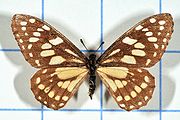 As Gieseking's father had earned a living as a lepidopterist
, Gieseking, too, devoted much time to the collecting of butterflies
and moth
s throughout his life. His private collection is deposited in the Natural History Collection of the Museum Wiesbaden
.
France
The French Republic , The French Republic , The French Republic , (commonly known as France , is a unitary semi-presidential republic in Western Europe with several overseas territories and islands located on other continents and in the Indian, Pacific, and Atlantic oceans. Metropolitan France...
-born German
Germany
Germany , officially the Federal Republic of Germany , is a federal parliamentary republic in Europe. The country consists of 16 states while the capital and largest city is Berlin. Germany covers an area of 357,021 km2 and has a largely temperate seasonal climate...
pianist
Pianist
A pianist is a musician who plays the piano. A professional pianist can perform solo pieces, play with an ensemble or orchestra, or accompany one or more singers, solo instrumentalists, or other performers.-Choice of genres:...
and composer
Composer
A composer is a person who creates music, either by musical notation or oral tradition, for interpretation and performance, or through direct manipulation of sonic material through electronic media...
.
Biography
Born in LyonLyon
Lyon , is a city in east-central France in the Rhône-Alpes region, situated between Paris and Marseille. Lyon is located at from Paris, from Marseille, from Geneva, from Turin, and from Barcelona. The residents of the city are called Lyonnais....
, France
France
The French Republic , The French Republic , The French Republic , (commonly known as France , is a unitary semi-presidential republic in Western Europe with several overseas territories and islands located on other continents and in the Indian, Pacific, and Atlantic oceans. Metropolitan France...
, the son of a German doctor and lepidopterist
Lepidopterist
A lepidopterist is a person who specialises in the study of Lepidoptera, members of an order encompassing moths and the three superfamilies of butterflies, skipper butterflies, and moth-butterflies...
, Gieseking first started playing the piano at the age of four, but without formal instruction. His family travelled frequently and he was privately schooled.
From 1911 to early 1916 he studied at the conservatorium in Hanover
Hanover
Hanover or Hannover, on the river Leine, is the capital of the federal state of Lower Saxony , Germany and was once by personal union the family seat of the Hanoverian Kings of Great Britain, under their title as the dukes of Brunswick-Lüneburg...
. There his mentor was the director Karl Leimer, with whom he later co-authored a piano method. He made his first appearance in 1915, but was conscripted in 1916 and spent the remainder of World War I
World War I
World War I , which was predominantly called the World War or the Great War from its occurrence until 1939, and the First World War or World War I thereafter, was a major war centred in Europe that began on 28 July 1914 and lasted until 11 November 1918...
as a regimental bandsman. His first London piano recital took place in 1923, and as a result he acquired a reputation as an exceptional performer.
During World War II
World War II
World War II, or the Second World War , was a global conflict lasting from 1939 to 1945, involving most of the world's nations—including all of the great powers—eventually forming two opposing military alliances: the Allies and the Axis...
Gieseking continued to reside in Germany, while continuing his career in Europe. Because he performed in Nazi-occupied countries such as France, he was later accused of having collaborated with the Nazi Party. Like many German artists, Gieseking was blacklisted during the initial post-war period. By January 1947, however, he had been cleared by the U.S. Military Government and was able to resume his career. Nevertheless, his initial U.S. return, scheduled for January 1949, was cancelled owing to the protest of a number of organizations such as the Anti-Defamation League and the American Veterans Committee. Although there had been other protests (in Australia
Australia
Australia , officially the Commonwealth of Australia, is a country in the Southern Hemisphere comprising the mainland of the Australian continent, the island of Tasmania, and numerous smaller islands in the Indian and Pacific Oceans. It is the world's sixth-largest country by total area...
and Peru
Peru
Peru , officially the Republic of Peru , is a country in western South America. It is bordered on the north by Ecuador and Colombia, on the east by Brazil, on the southeast by Bolivia, on the south by Chile, and on the west by the Pacific Ocean....
for example), his 1949 American tour was the only group of concerts actually cancelled because of the outcry. He continued to play in a great many other countries, and in 1953 he returned to the States. His concert at Carnegie Hall
Carnegie Hall
Carnegie Hall is a concert venue in Midtown Manhattan in New York City, United States, located at 881 Seventh Avenue, occupying the east stretch of Seventh Avenue between West 56th Street and West 57th Street, two blocks south of Central Park....
was sold out and well received, and Gieseking was more popular than ever.
Because of his gifts — he had a natural technique, perfect pitch, and an abnormally acute faculty for memorisation — Gieseking was able to master unfamiliar repertoire (however difficult) with relatively little practice. As taught in the Gieseking-Leimer method, he usually studied new pieces away from the piano. Consequently, it became well publicised that he often committed new works to memory while traveling by train, ship, or plane. Sometimes, according to Harold C. Schonberg
Harold C. Schonberg
Harold Charles Schonberg was an American music critic and journalist, most notably for The New York Times. He was the first music critic to win the Pulitzer Prize for Criticism...
's book The Great Pianists (1963), he could learn an entire concerto by heart in one day.
Gieseking had a very wide repertoire, ranging from various pieces by Bach
Johann Sebastian Bach
Johann Sebastian Bach was a German composer, organist, harpsichordist, violist, and violinist whose sacred and secular works for choir, orchestra, and solo instruments drew together the strands of the Baroque period and brought it to its ultimate maturity...
and the core works by Beethoven
Ludwig van Beethoven
Ludwig van Beethoven was a German composer and pianist. A crucial figure in the transition between the Classical and Romantic eras in Western art music, he remains one of the most famous and influential composers of all time.Born in Bonn, then the capital of the Electorate of Cologne and part of...
through to the concertos of Rachmaninoff
Sergei Rachmaninoff
Sergei Vasilievich Rachmaninoff was a Russian composer, pianist, and conductor. Rachmaninoff is widely considered one of the finest pianists of his day and, as a composer, one of the last great representatives of Romanticism in Russian classical music...
(the composer was impressed with his traversal of the Third
Piano Concerto No. 3 (Rachmaninoff)
The Piano Concerto No. 3 in D minor, Op. 30, composed in 1909 by Sergei Rachmaninoff is famous for its technical and musical demands on the performer...
) and more modern works by the likes of Busoni
Ferruccio Busoni
Ferruccio Busoni was an Italian composer, pianist, editor, writer, piano and composition teacher, and conductor.-Biography:...
, Hindemith
Paul Hindemith
Paul Hindemith was a German composer, violist, violinist, teacher, music theorist and conductor.- Biography :Born in Hanau, near Frankfurt, Hindemith was taught the violin as a child...
, Schoenberg
Arnold Schoenberg
Arnold Schoenberg was an Austrian composer, associated with the expressionist movement in German poetry and art, and leader of the Second Viennese School...
, and the lesser-known Italian Petrassi
Goffredo Petrassi
Goffredo Petrassi was an Italian composer of modern classical music, conductor, and teacher. He is considered one of the most influential Italian composers of the twentieth century.-Life:...
. He gave the premiere of the Piano Concerto by Pfitzner
Hans Pfitzner
Hans Erich Pfitzner was a German composer and self-described anti-modernist. His best known work is the post-Romantic opera Palestrina, loosely based on the life of the great sixteenth-century composer Giovanni Pierluigi da Palestrina.-Biography:Pfitzner was born in Moscow, Russia, where his...
in 1923. Today, though, he is primarily remembered as one of the greatest interpreters of two French composers in particular: Claude Debussy
Claude Debussy
Claude-Achille Debussy was a French composer. Along with Maurice Ravel, he was one of the most prominent figures working within the field of impressionist music, though he himself intensely disliked the term when applied to his compositions...
and Maurice Ravel
Maurice Ravel
Joseph-Maurice Ravel was a French composer known especially for his melodies, orchestral and instrumental textures and effects...
.
His recording of the complete solo piano works of Debussy was the first such undertaking and has been re-released on CD, as have his traversals of the complete solo piano works of Mozart
Wolfgang Amadeus Mozart
Wolfgang Amadeus Mozart , baptismal name Johannes Chrysostomus Wolfgangus Theophilus Mozart , was a prolific and influential composer of the Classical era. He composed over 600 works, many acknowledged as pinnacles of symphonic, concertante, chamber, piano, operatic, and choral music...
and Ravel. Gieseking's historic 1944 performance of Beethoven's "Emperor" Concerto
Piano Concerto No. 5 (Beethoven)
The Piano Concerto No. 5 in E-flat major, Op. 73, by Ludwig van Beethoven, popularly known as the Emperor Concerto, was his last piano concerto. It was written between 1809 and 1811 in Vienna, and was dedicated to Archduke Rudolf, Beethoven's patron and pupil...
, in which anti-aircraft fire is audible, is one of the earliest stereo recordings. His last recording project was the complete cycle of Beethoven's Piano Sonatas. Gieseking suddenly fell ill in London
London
London is the capital city of :England and the :United Kingdom, the largest metropolitan area in the United Kingdom, and the largest urban zone in the European Union by most measures. Located on the River Thames, London has been a major settlement for two millennia, its history going back to its...
, however, during a recording of Beethoven's Piano Sonata No. 15
Piano Sonata No. 15 (Beethoven)
Piano Sonata No. 15 in D major, Op. 28, is a piano sonata by Ludwig van Beethoven. It was named Pastoral or Pastorale by Beethoven's publisher at the time, A. Cranz. While nowhere near as widely recognised as its predecessor, the Piano Sonata No. 14, known often as the Moonlight Sonata, it is...
for HMV
HMV
His Master's Voice is a trademark in the music business, and for many years was the name of a large record label. The name was coined in 1899 as the title of a painting of the dog Nipper listening to a wind-up gramophone...
. He had completed the first three movements and, the following day, was due to record the fourth. He died a few days later due to post-operative complications. HMV released the unfinished recording, and since then broadcast recordings of Gieseking playing all of Beethoven's Piano Sonatas (with the exception of Op. 54) have been issued. Although some of his readings - particularly the live ones - can at times be erratic and marred by wrong notes, when Gieseking was in form he exhibited superb technical equipment. The subtle shadings of his playing, at its finest, seemed extraordinary in so physically huge a man.
Running parallel to Gieseking's performing activity was his much lesser known work as a composer. Even in his own lifetime his original creations were hardly known, and he made no attempt to give them publicity. A few of them have, nevertheless, been recorded on CD in recent years.
Lepidopterist
A lepidopterist is a person who specialises in the study of Lepidoptera, members of an order encompassing moths and the three superfamilies of butterflies, skipper butterflies, and moth-butterflies...
, Gieseking, too, devoted much time to the collecting of butterflies
Butterfly
A butterfly is a mainly day-flying insect of the order Lepidoptera, which includes the butterflies and moths. Like other holometabolous insects, the butterfly's life cycle consists of four parts: egg, larva, pupa and adult. Most species are diurnal. Butterflies have large, often brightly coloured...
and moth
Moth
A moth is an insect closely related to the butterfly, both being of the order Lepidoptera. Moths form the majority of this order; there are thought to be 150,000 to 250,000 different species of moth , with thousands of species yet to be described...
s throughout his life. His private collection is deposited in the Natural History Collection of the Museum Wiesbaden
Museum Wiesbaden
Museum Wiesbaden is a museum in the Hessian capital Wiesbaden, Germany. Besides the museums in Kassel and Darmstadt, it is one of the three Hessian state museums. The museum comprises an art collection, a natural history collection and a collection of Nassauian antiquities.-External links:***...
.
Notable students
- Mary Louise BoehmMary Louise BoehmMary Louise Boehm was a pianist and painter who was born on July 25, 1928 in Sumner, Iowa and died on November 29, 2002 in Spain.Mary Louise Boehm was a descendant of Joseph Böhm, a piano maker active in Vienna during the early 19th century. Born in Iowa, her early aptitude for the piano earned her...
- Albert FerberAlbert FerberAlbert Ferber was a Swiss pianist whose international performing career spanned four decades, taking him all over the world.-Training:...
- Marian FilarMarian FilarMarian Filar was a Polish concert pianist and virtuoso.-Early life:Filar began to study piano at the age of five, and a year or so later he gave his first recital at the Warsaw Conservatory as a wunderkind. When 12 years of age, he played Mozart's Concerto in D Minor with the Warsaw Philharmonic...
- Werner HaasWerner Haas (pianist)Werner Haas was a German classical pianist. He was known for his performances of early 20th century compositions, particularly those of Claude Debussy and Maurice Ravel...
- Hans OtteHans OtteHans Otte born Hans Günther Franz Otte in Plauen, Germany was a German composer, pianist, radio promoter, and author of many pieces of musical theatre, sound installations, poems, drawings, and art videos. From 1959 to 1984 he served as music director for Radio Bremen...
- Peter SchmalfussPeter SchmalfussPeter Schmalfuss was a German classical pianist born in Berlin, Germany.He studied with Walter Gieseking, Adrian Aeschbacher and, at the Beethoven-Class Positano, with Wilhelm Kempff...
- Ward SwingleWard SwingleWard Swingle is an American vocalist and jazz musician.Swingle was born in Mobile, Alabama. He studied music, particularly jazz, from a very young age. He was playing in Mobile-area Big Bands before finishing high school. After high school, Swingle graduated Summa Cum Laude from the Cincinnati...
- Narciso YepesNarciso YepesNarciso Yepes was a Spanish guitarist.-Biography:Yepes was born into a family of humble origin in Lorca, Region of Murcia. His father gave him his first guitar when he was four years old. He took his first lessons from Jesus Guevara, in Lorca...
- Stewart L. GordonStewart L. GordonStewart Lynell Gordon is an American musician, teacher, writer, editor, composer, and impresario.Currently Stewart Gordon is Professor of Keyboard Studies at the USC Thornton School of Music of the University of Southern California....