

Volkspolizei

Encyclopedia
The Volkspolizei or VP, were the national police
of the German Democratic Republic (East Germany). The Volkspolizei were responsible for most law enforcement
in East Germany, but its organisation and structure were such that it could be considered a paramilitary
force as well. Unlike typical police in most countries, they were equipped with armoured personnel carrier
s and artillery and trained as military units.
While any East German citizen could be a non-commissioned officer, all members of the commissioned officer corps were required to be members of the Socialist Unity Party of Germany
(SED), as the force was expected to maintain the interests of the party and its regime as well as public order. The VP was founded after World War II
, taking the East German remnant of the Nazi
Ordnungspolizei
(Orpo) and Kriminalpolizei (Kripo), and was abolished after German reunification
.
East Germans nicknamed the Volkspolizei the VoPo.
control. The VP transferred most of their reports to the Ministry of State Security
(MfS) and the high density of MfS informants in the GDR, especially in the forces, meant that every police action and investigation could be monitored as besides the official MfS liaison-officer (VO-Verbindungsoffizier), the MfS had agents in nearly every police unit.
The Volkspolizei was a national police
force and was directly administered by and subordinate only to the Ministry of the Interior.
Rather than the civil service
status that West German police enjoyed, each Volkspolizist had a personal contract
with the government. The monthly salary was above the average income.
The military part of the Volkspolizei, that is the Kasernierte Einheiten, was administered by the Deputy Minister of the Interior and Chief of the Administrative Center (Stellvertreter des Minister und Chef der Hauptinspektion).
Chief of the German Volkpolizei (Chef der deutschen Volkspolizei)
Minister of the Interior and head of the German People's Police (Minister des Innern und Chef der deutschen Volkspolizei)
Upon joining, a recruit would take a five-month course at the Police Academy (VP-Schule). The schedule contained political education, police law, criminal law and procedures, and military-style fitness training. Afterwards the recruit completed a 6-month practical internship.
The reasons Volkspolizei officers gave for joining the force were a desire to work with people, idealism
, family
tradition, belief in the system
and the wish to serve one's country.
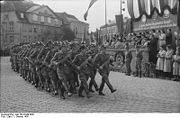 From 1962, the DVP had its own school in Berlin-Biesdorf which trained around 3,500 officers up to 1989. There were several other schools. The Kasernierten Einheiten (barracks units) had their own training facilities. Officers were initially trained in the army ground forces, from 1963 at the Officers' school and from 1971 to the officers' school in Dresden-Wilder Mann.
The Volkspolizei had approximately 80,000 full-time police officers and 177,500 volunteers.
With the accession of the GDR to the Federal Republic on 3 October 1990, authority over the police went to the newly created federal jurisdiction. About 40 percent of the DVP employees had to leave the service.
and the Volkspolizei erected the Berlin Wall
in 1961. The leadership declared it would protect the country against what they represented as the negative elements of West German and NATO societies, particularly fascist
sympathisers (the wall was officially called the "anti-fascist protection rampart") and help on the way to a crime
-free workers' state.
, when the Soviet Union
established central police forces in the regions of Germany
it occupied (in violation of the agreements at the Yalta Conference
and the Potsdam Conference
). The SVAG approved the arming of community
-level police forces on 31 October 1945.
The basic categories of uniforms were field, service, semi-dress, and parade.
Field uniforms (Felddienstuniform) were for only the Kasernierte Volkspolizei. The field uniform consisted of the NVA's service uniform. The uniform was worn with a field cap, service cap, or steel helmet; high black boots; and a leather belt with vertical web shoulder suspenders. In the winter, a quilted stone-grey padded suit without a camouflage pattern is worn over the service uniform. The winter uniform also includes a fur pile cap or a steel helmet, boots, knitted grey gloves, belt, and suspenders.
The service uniform (Dienstuniform) was a summer service uniform for officers with a bloused jacket, worn without a shirt, trousers, and a visored service cap. The winter service uniform featured a jacket had four large patch pockets with button-down tabs, worn with a black belt, the service cap, breeches, shirt, tie, belt, and high boots are provided for officers and NCOs. For winter, there also is a long, heavy, belted overcoat.
The semi-dress uniform (Ausgangsuniform), except in details, was the same for all ranks and was worn on off-duty or off-post occasions. It included the service cap, jacket, long trousers, and black low-quarter shoes. The single-breasted jacket was worn without a belt, with a white or grey-green shirt and a green tie. Officers were allowed to wear the jacket with a white shirt. During periods of warm summer weather, either the shirt and tie or the jacket may be omitted. For a while a double-breasted jacket could be worn as optional wear by officers and warrant officers.
The parade uniform (Paradeuniform) for officers was the semi-dress jacket worn with all awards and decorations, breeches and riding boots, steel helmet or police shako
(Tschako) from 1950 to the late 1960s, white shirt, green neck-tie, and a ceremonial dagger on the left side, fastened to a silver-grey parade belt. Officers in guards of honour carry sabres. In winter, overcoat, scarf, and gloves were worn.
The type of work uniform (Arbeitsuniform) worn was governed by seasonal considerations and weather. Generally, reconditioned items of service clothing; field, semi-dress and winter padded uniforms; some dyed black, were issued for all types of fatigue and maintenance details. Coveralls are also used by the lower ranks, especially heavy vehicle and flying personnel. Officers in technical branches supervising fatigue details wear a laboratory-style smock.
Other types of Volkspolizei uniforms existed. High-ranking officers occasionally wore white uniforms, or at least a white jacket, and staff officers were supplied with staff service uniforms. Women had their own uniforms consisting of jackets, skirts or slacks, blouses, caps, boots or pumps, and other appropriate items in accordance with the season and the occasion. Traffic police, motorcyclists, armoured vehicle personnel, and others have special items of apparel.
n, but later reverted to white except for the transport police who wore blue. The uniform of the Kasernierte Volkspolizei is distinguished from that of the NVA ground force and Air Defence Force by a green armband with large silver letters identifying the wearer's affiliation.
Police
The police is a personification of the state designated to put in practice the enforced law, protect property and reduce civil disorder in civilian matters. Their powers include the legitimized use of force...
of the German Democratic Republic (East Germany). The Volkspolizei were responsible for most law enforcement
Law enforcement agency
In North American English, a law enforcement agency is a government agency responsible for the enforcement of the laws.Outside North America, such organizations are called police services. In North America, some of these services are called police while others have other names In North American...
in East Germany, but its organisation and structure were such that it could be considered a paramilitary
Paramilitary
A paramilitary is a force whose function and organization are similar to those of a professional military, but which is not considered part of a state's formal armed forces....
force as well. Unlike typical police in most countries, they were equipped with armoured personnel carrier
Armoured personnel carrier
An armoured personnel carrier is an armoured fighting vehicle designed to transport infantry to the battlefield.APCs are usually armed with only a machine gun although variants carry recoilless rifles, anti-tank guided missiles , or mortars...
s and artillery and trained as military units.
While any East German citizen could be a non-commissioned officer, all members of the commissioned officer corps were required to be members of the Socialist Unity Party of Germany
Socialist Unity Party of Germany
The Socialist Unity Party of Germany was the governing party of the German Democratic Republic from its formation on 7 October 1949 until the elections of March 1990. The SED was a communist political party with a Marxist-Leninist ideology...
(SED), as the force was expected to maintain the interests of the party and its regime as well as public order. The VP was founded after World War II
World War II
World War II, or the Second World War , was a global conflict lasting from 1939 to 1945, involving most of the world's nations—including all of the great powers—eventually forming two opposing military alliances: the Allies and the Axis...
, taking the East German remnant of the Nazi
Nazi Germany
Nazi Germany , also known as the Third Reich , but officially called German Reich from 1933 to 1943 and Greater German Reich from 26 June 1943 onward, is the name commonly used to refer to the state of Germany from 1933 to 1945, when it was a totalitarian dictatorship ruled by...
Ordnungspolizei
Ordnungspolizei
The Ordnungspolizei or Orpo were the uniformed regular police force in Nazi Germany between 1936 and 1945. It was increasingly absorbed into the Nazi police system. Owing to their green uniforms, they were also referred to as Grüne Polizei...
(Orpo) and Kriminalpolizei (Kripo), and was abolished after German reunification
German reunification
German reunification was the process in 1990 in which the German Democratic Republic joined the Federal Republic of Germany , and when Berlin reunited into a single city, as provided by its then Grundgesetz constitution Article 23. The start of this process is commonly referred by Germans as die...
.
East Germans nicknamed the Volkspolizei the VoPo.
Organization
The Volkspolizei executed traditional police duties such as investigation and trafficTraffic
Traffic on roads may consist of pedestrians, ridden or herded animals, vehicles, streetcars and other conveyances, either singly or together, while using the public way for purposes of travel...
control. The VP transferred most of their reports to the Ministry of State Security
Stasi
The Ministry for State Security The Ministry for State Security The Ministry for State Security (German: Ministerium für Staatssicherheit (MfS), commonly known as the Stasi (abbreviation , literally State Security), was the official state security service of East Germany. The MfS was headquartered...
(MfS) and the high density of MfS informants in the GDR, especially in the forces, meant that every police action and investigation could be monitored as besides the official MfS liaison-officer (VO-Verbindungsoffizier), the MfS had agents in nearly every police unit.
The Volkspolizei was a national police
Police
The police is a personification of the state designated to put in practice the enforced law, protect property and reduce civil disorder in civilian matters. Their powers include the legitimized use of force...
force and was directly administered by and subordinate only to the Ministry of the Interior.
Rather than the civil service
Civil service
The term civil service has two distinct meanings:* A branch of governmental service in which individuals are employed on the basis of professional merit as proven by competitive examinations....
status that West German police enjoyed, each Volkspolizist had a personal contract
Contract
A contract is an agreement entered into by two parties or more with the intention of creating a legal obligation, which may have elements in writing. Contracts can be made orally. The remedy for breach of contract can be "damages" or compensation of money. In equity, the remedy can be specific...
with the government. The monthly salary was above the average income.
Main administration of the Volkspolizei
The Volkspolizei was administered by the Ministry of the Interior. The overall commander was the First Deputy Minister of the Interior and Chief of Police (Erster Stellvertreter des Ministers und Chef der Deutschen Volkspolizei). His section was subdivided into five departments:- Criminal Investigation Department (Hauptabteilung KriminalpolizeiKriminalpolizeiis the standard term for the criminal investigation agency within the police forces of Germany, Austria and the German-speaking cantons of Switzerland. In Nazi Germany during 1936, the Kripo became the Criminal Police Department for the entire Reich...
) - Uniformed Police Department (Hauptabteilung SchutzpolizeiSchutzpolizeiThe Schutzpolizei , or Schupo for short, is a branch of the Landespolizei, the state level police of the German states. Schutzpolizei literally means security or protection police but is best translated as Uniformed Police....
) - Railway Police Department (Hauptabteilung TransportpolizeiTransportpolizeiThe Transportpolizei was the transit police of the German Democratic Republic , whose officers were commonly nicknamed TraPos. It was part of the Volkspolizei and dealt with all modes of transit but primarily with trains and railroads...
) - Traffic Police Department (Hauptabteilung VerkehrspolizeiAutobahnpolizeiAutobahnpolizei is the term in Germany, Austria and the German-speaking parts of Switzerland for the highway patrol. Heavy traffic and high-speed accidents resulted in the creation of special police units to patrol the expressways known as Autobahnen....
) - Registration Department (Hauptabteilung Pass- und Meldewesen)
The military part of the Volkspolizei, that is the Kasernierte Einheiten, was administered by the Deputy Minister of the Interior and Chief of the Administrative Center (Stellvertreter des Minister und Chef der Hauptinspektion).
Regional commands
- BerlinEast BerlinEast Berlin was the name given to the eastern part of Berlin between 1949 and 1990. It consisted of the Soviet sector of Berlin that was established in 1945. The American, British and French sectors became West Berlin, a part strongly associated with West Germany but a free city...
PresidiumPresidiumThe presidium or praesidium is the name for the heading organ of various legislative and organizational bodies.-Historical usage:...
of the People's Police (Präsidium der Volkspolizei)- Eight police inspectorateInspectorateAn Inspectorate or Inspectorate-General is a civil or military body charged with inspecting and reporting on some institution or institutions in its field of competence...
s (Volkspolizei-Inspektionen) - River PoliceWater policeWater police, also called harbour patrols, port police, marine/maritime police, nautical patrols, bay constables or river police, are police officers, usually a department of a larger police organisation, who patrol in water craft...
Inspectorate (Wasserschutzpolizei-Inspektion)
- Eight police inspectorate
- Fourteen district commands—one per East German District, excluding Karl Marx StadtChemnitzChemnitz is the third-largest city of the Free State of Saxony, Germany. Chemnitz is an independent city which is not part of any county and seat of the government region Direktionsbezirk Chemnitz. Located in the northern foothills of the Ore Mountains, it is a part of the Saxon triangle...
. - Area Command of the Volkpolizei, Wismut-Karl Marx Stadt in Siegmer-Schönau, to protect the state enterprise of Wismut AGSDAG WismutThe SAG/SDAG Wismut was a uranium mining company in East Germany producing 230,400 tonnes of uranium between 1947 and 1990. In 1991 it was transformed into the Wismut GmbH owned by the state of Germany which is now responsible for the recultivation of the former mining and milling areas...
.
Leadership
Minister of the Interior (Minister des Innern)- Dr. Karl SteinhoffKarl SteinhoffKarl Steinhoff was a Minister-President of the German state of Brandenburg, then part of East Germany, and later served as East Germany's Minister of the Interior....
(1949–52) - Willi StophWilli StophWilli Stoph was an East German politician. He served as Prime Minister of the German Democratic Republic from 1964 to 1973, and again from 1976 until 1989.-Biography:...
(1952–55)
Chief of the German Volkpolizei (Chef der deutschen Volkspolizei)
- Dr. Kurt Fischer (1949–50)
- Karl Maron (1950–55)
Minister of the Interior and head of the German People's Police (Minister des Innern und Chef der deutschen Volkspolizei)
- Karl Maron (1955–63)
- Friedrich Dickel (1963–1989)
- Lothar Ahrendt (1989)
Recruitment
Recruitment to the Volkspolizei required at least ten years of education, vocational training (see education in East Germany), military service, and a history of political loyalty.Upon joining, a recruit would take a five-month course at the Police Academy (VP-Schule). The schedule contained political education, police law, criminal law and procedures, and military-style fitness training. Afterwards the recruit completed a 6-month practical internship.
The reasons Volkspolizei officers gave for joining the force were a desire to work with people, idealism
Idealism
In philosophy, idealism is the family of views which assert that reality, or reality as we can know it, is fundamentally mental, mentally constructed, or otherwise immaterial. Epistemologically, idealism manifests as a skepticism about the possibility of knowing any mind-independent thing...
, family
Family
In human context, a family is a group of people affiliated by consanguinity, affinity, or co-residence. In most societies it is the principal institution for the socialization of children...
tradition, belief in the system
Socialism
Socialism is an economic system characterized by social ownership of the means of production and cooperative management of the economy; or a political philosophy advocating such a system. "Social ownership" may refer to any one of, or a combination of, the following: cooperative enterprises,...
and the wish to serve one's country.
Training
- VP-Schule "Ernst Thälmann", NeustrelitzNeustrelitzNeustrelitz is a town in the Mecklenburgische Seenplatte district in the state of Mecklenburg-Vorpommern, Germany. It is situated on the shore of the Zierker See in the Mecklenburg Lake District. From 1738 until 1918 it was the capital of the duchy of Mecklenburg-Strelitz...
(since 1984 central service similar school) - Schule für Abschnittsbevollmächtigte (school for the section represented), WolfenWolfenWolfen may refer to:In geography:* Wolfen, Germany, a town in Saxony-Anhalt, GermanyIn fiction:* The Wolfen, a 1978 horror novel by Whitley Strieber...
- Transportpolizei-Schule (Transport Police School), Halle (SaaleSaaleThe Saale, also known as the Saxon Saale and Thuringian Saale , is a river in Germany and a left-bank tributary of the Elbe. It is not to be confused with the smaller Franconian Saale, a right-bank tributary of the Main, or the Saale in Lower Saxony, a tributary of the Leine.-Course:The Saale...
) - Verkehrspolizei-Schule "Hans Beimler" (Traffic Police School), MagdeburgMagdeburgMagdeburg , is the largest city and the capital city of the Bundesland of Saxony-Anhalt, Germany. Magdeburg is situated on the Elbe River and was one of the most important medieval cities of Europe....
- Schule des Nachrichtenwesens (School of Intelligence), DommitzschDommitzschDommitzsch is a town in the district Nordsachsen, in the Free State of Saxony, Germany and is Saxony's northmost city. It lies on the left bank of the Elbe, 12 km northwest of Torgau and 31 km southeast of Wittenberg....
- Spezialschule des MdI für Diensthundewesen — Special School for service dogs, Pretzsch (Elbe)
- Spezialschule des MdI für medizinische Dienste (im Bezirk Magdeburg ) - Special School of medical services (in the district of Magdeburg)
- Fachschule des MdI "Heinrich Rau" - College of MdI "Heinrich Rau", Radebeul
- Fachschule des MdI, „ Wilhelm Pieck “ - College of the MdI, "Wilhelm Pieck", Aschersleben
- Hochschule der VP — University of the VP, Berlin-Biesdorf (Cecilienstraße)
- Offiziershochschule Bereitschaften "Artur Becker", Dresden (school readiness officer, "Artur Becker", Dresden (now the headquarters of the State Criminal Office Saxony)
- Humboldt-Universität zu Berlin /Sektion Kriminalistik — Humboldt University Berlin / Criminalistics Section
The Volkspolizei had approximately 80,000 full-time police officers and 177,500 volunteers.
With the accession of the GDR to the Federal Republic on 3 October 1990, authority over the police went to the newly created federal jurisdiction. About 40 percent of the DVP employees had to leave the service.
Effectiveness
The National People's ArmyNational People's Army
The National People’s Army were the armed forces of the German Democratic Republic .The NVA was established in 1956 and disestablished in 1990. There were frequent reports of East German advisors with Communist African countries during the Cold War...
and the Volkspolizei erected the Berlin Wall
Berlin Wall
The Berlin Wall was a barrier constructed by the German Democratic Republic starting on 13 August 1961, that completely cut off West Berlin from surrounding East Germany and from East Berlin...
in 1961. The leadership declared it would protect the country against what they represented as the negative elements of West German and NATO societies, particularly fascist
Fascism
Fascism is a radical authoritarian nationalist political ideology. Fascists seek to rejuvenate their nation based on commitment to the national community as an organic entity, in which individuals are bound together in national identity by suprapersonal connections of ancestry, culture, and blood...
sympathisers (the wall was officially called the "anti-fascist protection rampart") and help on the way to a crime
Crime
Crime is the breach of rules or laws for which some governing authority can ultimately prescribe a conviction...
-free workers' state.
History
The Volkspolizei was effectively founded just following World War IIWorld War II
World War II, or the Second World War , was a global conflict lasting from 1939 to 1945, involving most of the world's nations—including all of the great powers—eventually forming two opposing military alliances: the Allies and the Axis...
, when the Soviet Union
Soviet Union
The Soviet Union , officially the Union of Soviet Socialist Republics , was a constitutionally socialist state that existed in Eurasia between 1922 and 1991....
established central police forces in the regions of Germany
Germany
Germany , officially the Federal Republic of Germany , is a federal parliamentary republic in Europe. The country consists of 16 states while the capital and largest city is Berlin. Germany covers an area of 357,021 km2 and has a largely temperate seasonal climate...
it occupied (in violation of the agreements at the Yalta Conference
Yalta Conference
The Yalta Conference, sometimes called the Crimea Conference and codenamed the Argonaut Conference, held February 4–11, 1945, was the wartime meeting of the heads of government of the United States, the United Kingdom, and the Soviet Union, represented by President Franklin D...
and the Potsdam Conference
Potsdam Conference
The Potsdam Conference was held at Cecilienhof, the home of Crown Prince Wilhelm Hohenzollern, in Potsdam, occupied Germany, from 16 July to 2 August 1945. Participants were the Soviet Union, the United Kingdom, and the United States...
). The SVAG approved the arming of community
Community
The term community has two distinct meanings:*a group of interacting people, possibly living in close proximity, and often refers to a group that shares some common values, and is attributed with social cohesion within a shared geographical location, generally in social units larger than a household...
-level police forces on 31 October 1945.
Oath
The official oath that all Volkspolizei officers swore was:| Original German | English translation |
|---|---|
| Ich schwöre meinem sozialistischen Vaterland, der Deutschen Demokratischen Republik und ihrer Regierung allzeit treu ergeben zu sein, Dienst- und Staatsgeheimnisse zu wahren und die Gesetze und Weisungen genau einzuhalten. Ich werde unentwegt danach streben, gewissenhaft, ehrlich, mutig, diszipliniert und wachsam meine Dienstpflichten zu erfüllen. Ich schwöre, daß ich, ohne meine Kräfte zu schonen, auch unter Einsatz meines Lebens, die sozialistische Gesellschafts-, Staats- und Rechtsordnung, das sozialistische Eigentum, die Persönlichkeit, die Rechte und das persönliche Eigentum der Bürger vor verbrecherischen Anschlägen schützen werde. Sollte ich dennoch diesen meinen feierlichen Eid brechen, so möge mich die Strafe der Gesetze unserer Republik treffen. |
I swear, to be loyal to my socialist fatherland, the German Democratic Republic and its government at all times, to keep official and state secrets, and to strictly obey laws and instructions. I will unswervingly strive to fulfill my official duties conscientiously, honestly, courageously, vigilantly and with discipline. I swear, that I will, without reservation, under risk of my life protect the socialist social, state and legal order, the socialist property, the personality, the rights and the personal property of the citizens against felonious attacks. If I nevertheless break this, my solemn oath, I shall be confronted with the punishment of the laws of our republic. |
Uniforms
With the exception of the Kasernierte Volkspolizei, whose stone-grey uniforms follow the style of the East German National People’s Army (Nationale Volksarmee - NVA), all Volkspolizei services wore the same basic uniform adopted in 1956 when it was officially established. There were various kinds of uniforms, worn according to the work or social situation and differing in material for summer or winter wear. Most uniforms — service, semi-dress, and parade — are gray-green but the transport police wore dark blue. The better quality and texture of the cloth in officers' uniforms distinguished them from the uniforms of enlisted personnel. The field and service uniforms became normal attire in garrison and for most other duty activities.The basic categories of uniforms were field, service, semi-dress, and parade.
Field uniforms (Felddienstuniform) were for only the Kasernierte Volkspolizei. The field uniform consisted of the NVA's service uniform. The uniform was worn with a field cap, service cap, or steel helmet; high black boots; and a leather belt with vertical web shoulder suspenders. In the winter, a quilted stone-grey padded suit without a camouflage pattern is worn over the service uniform. The winter uniform also includes a fur pile cap or a steel helmet, boots, knitted grey gloves, belt, and suspenders.
The service uniform (Dienstuniform) was a summer service uniform for officers with a bloused jacket, worn without a shirt, trousers, and a visored service cap. The winter service uniform featured a jacket had four large patch pockets with button-down tabs, worn with a black belt, the service cap, breeches, shirt, tie, belt, and high boots are provided for officers and NCOs. For winter, there also is a long, heavy, belted overcoat.
The semi-dress uniform (Ausgangsuniform), except in details, was the same for all ranks and was worn on off-duty or off-post occasions. It included the service cap, jacket, long trousers, and black low-quarter shoes. The single-breasted jacket was worn without a belt, with a white or grey-green shirt and a green tie. Officers were allowed to wear the jacket with a white shirt. During periods of warm summer weather, either the shirt and tie or the jacket may be omitted. For a while a double-breasted jacket could be worn as optional wear by officers and warrant officers.
The parade uniform (Paradeuniform) for officers was the semi-dress jacket worn with all awards and decorations, breeches and riding boots, steel helmet or police shako
Shako
A shako is a tall, cylindrical military cap, usually with a peak or visor and sometimes tapered at the top...
(Tschako) from 1950 to the late 1960s, white shirt, green neck-tie, and a ceremonial dagger on the left side, fastened to a silver-grey parade belt. Officers in guards of honour carry sabres. In winter, overcoat, scarf, and gloves were worn.
The type of work uniform (Arbeitsuniform) worn was governed by seasonal considerations and weather. Generally, reconditioned items of service clothing; field, semi-dress and winter padded uniforms; some dyed black, were issued for all types of fatigue and maintenance details. Coveralls are also used by the lower ranks, especially heavy vehicle and flying personnel. Officers in technical branches supervising fatigue details wear a laboratory-style smock.
Other types of Volkspolizei uniforms existed. High-ranking officers occasionally wore white uniforms, or at least a white jacket, and staff officers were supplied with staff service uniforms. Women had their own uniforms consisting of jackets, skirts or slacks, blouses, caps, boots or pumps, and other appropriate items in accordance with the season and the occasion. Traffic police, motorcyclists, armoured vehicle personnel, and others have special items of apparel.
Waffenfarben
Volkspolizei uniform initially had green waffenfarbeWaffenfarbe
Waffenfarbe is a means the German military uses to distinguish between different corps or troop functions in its armed services...
n, but later reverted to white except for the transport police who wore blue. The uniform of the Kasernierte Volkspolizei is distinguished from that of the NVA ground force and Air Defence Force by a green armband with large silver letters identifying the wearer's affiliation.