

Unification of Karnataka

Encyclopedia
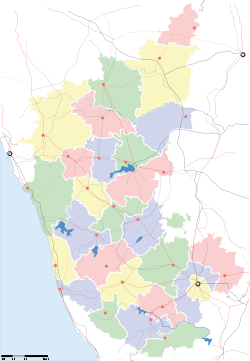
India
India , officially the Republic of India , is a country in South Asia. It is the seventh-largest country by geographical area, the second-most populous country with over 1.2 billion people, and the most populous democracy in the world...
n state of Karnataka
Karnataka
Karnataka , the land of the Kannadigas, is a state in South West India. It was created on 1 November 1956, with the passing of the States Reorganisation Act and this day is annually celebrated as Karnataka Rajyotsava...
, then called as Mysore State
Mysore State
The Kingdom of Mysore was one of the three largest princely states within the erstwhile British Empire of India. Upon India gaining its independence in 1947, the Maharaja of Mysore merged his realm with the Union of India...
, in 1956 when several Indian states were created by redrawing borders based on linguistic demographics. The formation of the state of Mysore was the culmination of a movement that had started several decades earlier during British rule when the first demands for a state based on Kannada demographics had been put forward.
Historical background
During the period of British ruleBritish Raj
British Raj was the British rule in the Indian subcontinent between 1858 and 1947; The term can also refer to the period of dominion...
, areas that today comprise Karnataka were under as many as 20 different administrative units with the princely state of Mysore
Kingdom of Mysore
The Kingdom of Mysore was a kingdom of southern India, traditionally believed to have been founded in 1399 in the vicinity of the modern city of Mysore. The kingdom, which was ruled by the Wodeyar family, initially served as a vassal state of the Vijayanagara Empire...
, Nizam's Hyderabad
Hyderabad State
-After Indian independence :When India gained independence in 1947 and Pakistan came into existence in 1947, the British left the local rulers of the princely states the choice of whether to join one of the new dominions or to remain independent...
, the Bombay Presidency
Bombay Presidency
The Bombay Presidency was a province of British India. It was established in the 17th century as a trading post for the English East India Company, but later grew to encompass much of western and central India, as well as parts of post-partition Pakistan and the Arabian Peninsula.At its greatest...
, the Madras Presidency
Madras Presidency
The Madras Presidency , officially the Presidency of Fort St. George and also known as Madras Province, was an administrative subdivision of British India...
and the territory of Kodagu
Kodagu
Kodagu , also known by its anglicised former name of Coorg, is an administrative district in Karnataka, India. It occupies an area of in the Western Ghats of southwestern Karnataka. As of 2001, the population was 548,561, 13.74% of which resided in the district's urban centres, making it the least...
being the most important ones. In effect, nearly two-thirds of what is now Karnataka fell outside the rule of the Wodeyar kings of Mysore
Wodeyar
The Wodeyar dynasty was an Indian royal dynasty that ruled the Kingdom of Mysore from 1399 to 1947, until the independence of India from British rule and the subsequent unification of the Indian dominion and princely states into the Republic of India.The spelling Wodeyar/Wadiyar is found in most...
.
What this meant for the Kannadigas
Kannadigas
Kannadiga , or Kannadati is a reference to the people who natively speak the Kannada language. Kannadigas are mainly located in the state of Karnataka in India and in the neighboring states of Andhra Pradesh, Tamil Nadu, Kerala, Goa and Maharashtra...
in these regions was that they in spite of their large numbers they did not enjoy an administrative patronage. Kannadigas in the Hubli-Karnataka region for example, came under the rule of the Bombay Presidency where Marathi
Marathi language
Marathi is an Indo-Aryan language spoken by the Marathi people of western and central India. It is the official language of the state of Maharashtra. There are over 68 million fluent speakers worldwide. Marathi has the fourth largest number of native speakers in India and is the fifteenth most...
was the official language. Those in the Hyderabad-Karnataka region came under the Nizam's rule where Urdu
Urdu
Urdu is a register of the Hindustani language that is identified with Muslims in South Asia. It belongs to the Indo-European family. Urdu is the national language and lingua franca of Pakistan. It is also widely spoken in some regions of India, where it is one of the 22 scheduled languages and an...
ruled. Kannadigas in South Canara
South Canara
South Canara was a district under the British empire, located at . It was bifurcated in 1859 from Canara district. It was the undivided Dakshina Kannada district...
came under the rule from Madras Presidency which used Tamil
Tamil language
Tamil is a Dravidian language spoken predominantly by Tamil people of the Indian subcontinent. It has official status in the Indian state of Tamil Nadu and in the Indian union territory of Pondicherry. Tamil is also an official language of Sri Lanka and Singapore...
as the main language.
Under these conditions, a feeling of discontent had started brewing among Kannadigas outside Mysore. They felt that their interests and their language was being mortgaged to the interests of the higher ups. Thus, while the Kannadigas under the Nizam felt that Urdu was being thrust on them at the expense of Kannada
Kannada language
Kannada or , is a language spoken in India predominantly in the state of Karnataka. Kannada, whose native speakers are called Kannadigas and number roughly 50 million, is one of the 30 most spoken languages in the world...
, those in the Bombay Presidency felt similarly vis a vis Marathi. Economically also, these areas remained undeveloped, neglected and backward. It was against this backdrop that the movement that first started as a protest against linguistic oppression, soon morphed into one that began demanding a separate state be created consolidating all Kannada-speaking regions. This was essentially a movement that was spearheaded by the poets, journalists and writers and was called the Ekikarana or 'Unification' movement.
The role of North Karnataka
Almost the entire southern half of Karnataka was then under the Wodeyars of Mysore with Nalvadi Krishnaraja Wodeyar and his dewan Sir M V at the helm. The official language of the state was Kannada and the state was also one of the more progressive states of the day. Given these circumstances, Kannadigas in Mysore had few complaints and were mostly content. But the northern regions of what is now KarnatakaKarnataka
Karnataka , the land of the Kannadigas, is a state in South West India. It was created on 1 November 1956, with the passing of the States Reorganisation Act and this day is annually celebrated as Karnataka Rajyotsava...
were under the British and the Nizam and they mostly bore the brunt of the misrule of these governments. Not surprisingly, the seeds of the Ekikarana movement and all its most important protagonists including Aluru Venkata Rao
Aluru Venkata Rao
Aluru Venkata Rao was one of the most eminent leaders of the Karnataka Ekikarana movement. He had a very strong impact on the Ekikarana movement which was fighting for a separate state encompassing all Kannada speaking areas of Mysore, Bombay Presidency and Nizam's Hyderabad...
were from northern parts of Karnataka. One of the earliest and most important organisations that spearheaded the entire movement, the Karnataka Vidyavardhaka Sangha also took birth in Dharwad
Dharwad
Dharwad, also known as Dharwar, is a city and a DISTRICT PLACE in India's Karnataka state.Dharwad is the administrative seat of the Dharwad District. The municipality of Hubli-Dharwad covers an area of 200.23 km²...
. Thus the contribution of the people and leaders of North Karnataka towards the unification of Karnataka is central.
The Vidyavardhaka Sangha and other organisations
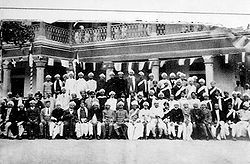
Karnataka Vidyavardhaka Sangha
The Karnataka Vidyavardhaka Sangha was an institution established on 20 July 1890 by Sri R H Deshpande in Dharwad, India which was then under the British rule of Bombay Presidency...
, Dharwad
Dharwad
Dharwad, also known as Dharwar, is a city and a DISTRICT PLACE in India's Karnataka state.Dharwad is the administrative seat of the Dharwad District. The municipality of Hubli-Dharwad covers an area of 200.23 km²...
in 1890 was a defining point in the history of the movement. It was established by R H Deshpande with the objective working for the resurgence of Kannada language which had been marginalised under the rule of the Bombay Presidency where Marathi was the official language. The Vidyavardhaka Sangha became the aegis under which leaders from all over Karnataka gathered to further their agitation. The influence and success of the Vidyavardhaka Sangha soon paved the way to setting up more such organisations across the length and breadth of Karnataka. The most notable of these were the Kannada Sahitya Parishat
Kannada Sahitya Parishat
Kannada Saahithya Parishath is an Indian non-profit organisation that promotes the Kannada language. Its headquarters are in the city of Bangalore, in the state of Karnataka, India. It strives to promote Kannada through publishing books, organising literary seminars and promoting research projects...
(Bangalore) that was set up in 1915, the Karnataka Sangha (Shivamogga) that took birth in 1916 and the Karnataka Samithi in Kasargod
Karnataka Samithi (R), Kasaragod
Karnataka Samithi (R), Kasaragod is an organisation set up in Kasaragod in the year 1955 which advocates a merger of Kasaragod with Karanataka State. Late Sri Umesha Rao, popularly known as 'Gadinadu Gandhi'was the first President. Sri Rao was the only person to be elected to the Kerala Assembly unanimously. This record is yet to be broken in Kearala State. On his death in 1957, Late Sri B. S. Kakkillaya, a well known Advocate was holding the office of the President till 1967. Sri Kakkillaya was also one of the leading personalities who fought for the unification of Karnataka. His services for the cause of unification of Karnataka was recognised by the Government of Karnataka and he was one of the persons whose photograph was printed in the Karnataka Government Suvarna Karnataka calendar published in the year 2006. Sri Kallige Mahabala Bhandari, Advocate was elected to the Kerala Assembly from Manjeshwara Constituency in Kasaragod under the Samithi banner. Late Sri U.P. Kunikullaya was also elected to the Kerala Assembly in 1967 under the Samithi Banner.Due to the continuous efforts of the Samithi, the issue of merger of Kasaragod was referred to Justice Mahajan Commission by the Govt. of India in the year 1966.Late Sri B.S.Kakkillaya prepared a case for presenting before the Commission. Late Sri K.R.Karanth, a former Minister under Late Sri Rajagopalachari in the then State of Madras and a leading advocate represented the Samithi before the Commission. The Commission upheld the claim for merger of Kasaragod with the State of Karnataka in his report to the Govt. of India. The report was placed before the Indian Parliament. The Parliament is yet to take a final decision in the matter. sri B.V. Kakkillaya took over the Presidentship of the Samithi in the year 2000. During his term as the President, the Govt. of Kerala nominated him as a member of the State Level Committee for Linguistic Minorities in Kerala. The Govt. of Karnataka awarded 'Suvarna Karnataka Ekikarana Award' to the Samithi on the occasion of Suvarna Karnataka Rajyotsava in the year 2006. Sri B.V.Kakkillaya, the President of the Samithi, received the award. Sri B.V.Kakkillaya, Ex. MLA, Mangalore (uncle of Sri B.V.Kakkillaya, President of Karnataka Samithi) was also awarded Suvarna Karnataka Ekikarana Award on the same occasion.Aluru Venkata Rao
Even though the first strains of resentment and protest had started as early as in 1856 and the Karnataka Vidyavardhaka SanghaKarnataka Vidyavardhaka Sangha
The Karnataka Vidyavardhaka Sangha was an institution established on 20 July 1890 by Sri R H Deshpande in Dharwad, India which was then under the British rule of Bombay Presidency...
had been established in 1890, the movement took a dramatic turn with the arrival of Aluru Venkata Rao on the scene. Speaking at a meeting of the Sangha in 1903, Alur Venkata Rao made a case for integrating all Kannada regions of Madras Province and north Karnataka with Mysore kingdom. Aluru himself found inspiration in the vehement protests that followed the British partitioning of Bengal.
In 1907 and again in 1908, Rao organised the All-Karnataka Writers’ Conference in Dharwad
Dharwad
Dharwad, also known as Dharwar, is a city and a DISTRICT PLACE in India's Karnataka state.Dharwad is the administrative seat of the Dharwad District. The municipality of Hubli-Dharwad covers an area of 200.23 km²...
. Drawing inspiration from the Vidyavardhaka Sangha and the efforts of Deshpande, Aluru helped found the Kannada Sahitya Parishat
Kannada Sahitya Parishat
Kannada Saahithya Parishath is an Indian non-profit organisation that promotes the Kannada language. Its headquarters are in the city of Bangalore, in the state of Karnataka, India. It strives to promote Kannada through publishing books, organising literary seminars and promoting research projects...
in Bengalooru in 1915. This Parishat found an eager patron in the ruler of Mysore. The Parishat began holding annual literary conferences(that continue even today) in different parts of the state. Intellectuals from across the Kannada speaking regions attended these conferences. During the Home Rule Movement
Home Rule Movement
The All India Home Rule League was a national political organization founded in 1916 to lead the national demand for self-government, termed Home Rule, and to obtain the status of a Dominion within the British Empire as enjoyed by Australia, Canada, South Africa, New Zealand and Newfoundland at the...
, Aluru floated the idea of a Karnataka 'Provincial' unit of the Indian National Congress
Indian National Congress
The Indian National Congress is one of the two major political parties in India, the other being the Bharatiya Janata Party. It is the largest and one of the oldest democratic political parties in the world. The party's modern liberal platform is largely considered center-left in the Indian...
. This soon took shape and the Karnataka Pradesh Congress committee was formed.
Karnataka Gatha Vaibhava
Amidst all this, Aluru published his magnum opus, the Karnataka Gatha Vaibhava in 1912. Karnataka Gatha Vaibhava literally means The glory that was Karnataka!. It was a book that recounted in great detail the glorious history that had been Karnataka's until the fall of VijayanagarVijayanagara Empire
The Vijayanagara Empire , referred as the Kingdom of Bisnaga by the Portuguese, was an empire based in South Indian in the Deccan Plateau region. It was established in 1336 by Harihara I and his brother Bukka Raya I of the Yadava lineage. The empire rose to prominence as a culmination of attempts...
after which the Marathas, Nizam and the British took over. The book created tremendous impact on the young and old alike. The movement soon caught the imagination of the public and people started rallying around the Ekikarana movement and the movement picked up momentum. For all these efforts and for being the one who inspired a whole movement, Aluru is today fondly remembered as the Kannada Kula Purohita or the 'High priest of the Kannada clan'.
The movement gathers momentum
Starting with Aluru's call for a Kannada linguistic state, the movement had slowly started gaining momentum and following. It was also around the time that the Indian independence movement itself was gathering steam. For freedom fighters in Karnataka, the incentive to fight on was not just independence for India but also a chance to fulfill their dreams of building a united Karnataka. These organisations began organising numerous rallies, talks and conferences where vociferous demands for a separate state for Kannada speaking people was made.Apart from Aluru
Aluru Venkata Rao
Aluru Venkata Rao was one of the most eminent leaders of the Karnataka Ekikarana movement. He had a very strong impact on the Ekikarana movement which was fighting for a separate state encompassing all Kannada speaking areas of Mysore, Bombay Presidency and Nizam's Hyderabad...
himself, stalwarts like Gudlappa Hallikeri, Siddappa Kambli, R H Deshpande, Rangarao Diwakar, Koujalgi Srinivasarao,Srinivas Rao Mangalvedhe, Kengal Hanumanthaiah
Kengal Hanumanthaiah
Kengal Hanumanthaiah was the chief minister of the old Mysore State in India from 30 March 1952 to 19 August 1956...
, Goruru Ramaswamy Iyengar, S Nijalingappa
S. Nijalingappa
Siddavanahalli Nijalingappa was a senior Congress politician and the Chief Minister of Karnataka between 1956 and 1958 and once again between 1962 and 1968...
, T Mariyappa, Subramanya, Sowcar Chennaiah, H K Veerangowda, H C Dasappa, H Siddaiah and Anakru were by now at the forefront of the agitations. Anakru in particular, had a mesmerising impact on the masses with his writing and powerful oratory.
The Nagpur Conference
Due to the efforts of these organisations and leaders, the movement not only gained in momentum but also attained a quasi-political clout. In 1920, Karnataka State Political Conference was held at Dharwad. At this conference, which was presided over by V P Madhav Rao, a unanimous resolution was passed demanding the unification of all Kannada speaking areas. The conference also exhorted Kannadigas to attend the Nagpur Congress to be held later that year in large numbers. Almost 800 delegates answered the call and attended the Nagpur conference where the Indian National Congress took the landmark decision to create the Karnataka Pradesh Congress Committee.This provided further fillip to the movement and many influential leaders of the Congress like S NijalingappaS. Nijalingappa
Siddavanahalli Nijalingappa was a senior Congress politician and the Chief Minister of Karnataka between 1956 and 1958 and once again between 1962 and 1968...
and Kengal Hanumanthaiah
Kengal Hanumanthaiah
Kengal Hanumanthaiah was the chief minister of the old Mysore State in India from 30 March 1952 to 19 August 1956...
(both of whom went on to become Chief Ministers of Karnataka) and Gudlappa Hallikeri also served as active members of the Ekikarana movement.
The Belgaum Conference of 1924
In 1924, the Belgaum congress was held under the aegis of the newly formed Karnataka Pradesh Congress committee arm of the INC. Mahatma GandhiMahatma Gandhi
Mohandas Karamchand Gandhi , pronounced . 2 October 1869 – 30 January 1948) was the pre-eminent political and ideological leader of India during the Indian independence movement...
presided over this historic conference. This conference was attended by Kannadigas from all parts in large numbers. The first Karnataka Unification Conference was also organised at the same venue. This was presided over by Siddappa Kambli.
These twin conferences drew numerous leaders, writers, poets and intellectuals from all over Karnataka and forceful speeches were made extolling the glory and greatness of Karnataka. It was here that Narayanrao Huilgol first sang his famous Udayavagali namma cheluva kannada nadu, which meant Let our charming Kannada land dawn!. The INC, for the first time lent formal support to the cause. This marked an important event in the history of the movement as for the first time, the movement got explicit political support. As a result of these conferences, the Karnataka Ekikarana Sabha which was to work in close collaboration with the KPCC took birth with the objective of the unification of Karnataka. The Karntaka Ekikarana Sabha later came to be known as the Karnataka Ekikarana Sangha.
The Nehru committee recommendation
In 1928, due to the efforts of Gudlappa Hallikeri, the formation of a single province by uniting all Kannada speaking areas was recommended by the Nehru Committee. It was observed by the committee that there was a “strong prima facie case for unification”. It also went on to state that it believed Karnataka could also be a financially strong province. This recommendation provided tremendous boost to the movement. It was supplanted by the intellectual and emotional support that came from stalwarts of the literary world like KuvempuKuvempu
Kuppali Venkatappagowda Puttappa was a Kannada writer and poet, widely regarded as the greatest poet of 20th century Kannada literature. He is the first among eight recipients of Jnanpith Award for Kannada. Puttappa wrote all his literary works using the pen name Kuvempu...
, Bendre, Gokak, S B Joshi, Betgeri Krishna Sharma, M Govinda Pai, Shivarama Karanth, Kayyara Kiyyanna Rai et al. There was also widespread support growing from the newspapers and media. Several smaller public and college organisations also sprang up, notably in Bengalur, Shivamogga and Raichur.
The elections of 1937
Following the Simon CommissionSimon Commission
The Indian Statutory Commission was a group of seven British Members of Parliament that had been dispatched to India in 1927 to study constitutional reform in Britain's most important colonial dependency. It was commonly referred to as the Simon Commission after its chairman, Sir John Simon...
, elections were held in 1937. The Congress took the stand that it would favour the formation of separate Karnataka and Andhra states. This however met with some resistance from the British and also some of the princely states. While the princely states feared that they might stand to lose some territory, the British themselves were unsure of how they would handle the reorganisation.
Siddappa Kambli sensing the reluctance, decided that the movement had to approach the Simon Commission
Simon Commission
The Indian Statutory Commission was a group of seven British Members of Parliament that had been dispatched to India in 1927 to study constitutional reform in Britain's most important colonial dependency. It was commonly referred to as the Simon Commission after its chairman, Sir John Simon...
with their case. But the other leaders of the movement like Gangadhar Deshpande, Rangarao Diwakar, Koujalgi Srinivasarao and Aluru
Aluru Venkata Rao
Aluru Venkata Rao was one of the most eminent leaders of the Karnataka Ekikarana movement. He had a very strong impact on the Ekikarana movement which was fighting for a separate state encompassing all Kannada speaking areas of Mysore, Bombay Presidency and Nizam's Hyderabad...
prevailed upon him not to do so as they had boycotted the commission. Gudlappa Hallikeri invited the Maharaja of Mysore to tour the Kannada speaking provinces of Bombay and Hyderabad. After the tour and several discussions the movement gained the active support of the Maharaja of Mysore.
The 1946 conference
The year 1946 was a defining point in the history of the movement. The tenth conference of the Ekikarana movement was held on January 10 of 1946 in BombayMumbai
Mumbai , formerly known as Bombay in English, is the capital of the Indian state of Maharashtra. It is the most populous city in India, and the fourth most populous city in the world, with a total metropolitan area population of approximately 20.5 million...
. This was a very high profile conference which inaugurated by Sardar Patel and attended by the likes of B G Kher, the then Chief Minister of Bombay presidency. In his speech at the conference, Sardar Patel declared that the interests of all linguistic groups would be high on the list of priorities for the new government of independent India. This served to assuage any apprehensions of the movement leaders and the common people. This was also to have a bearing on the constituent assembly that met in the same year.
In the same year, the All-Karnataka convention, a massive gathering of Kannadigas was held in Davanagere
Davanagere
Davangere or Davanagere is a city in the Indian state of Karnataka. It is the administrative headquarters of Davangere district which lies at the centre of the state of Karnataka. The city is located on National Highway 4 at a distance of about 265 km from the state capital, Bangalore...
, which is practically the geographic center of Karnataka
Karnataka
Karnataka , the land of the Kannadigas, is a state in South West India. It was created on 1 November 1956, with the passing of the States Reorganisation Act and this day is annually celebrated as Karnataka Rajyotsava...
. This was presided over by Mr. M P Patil, the revenue minister of Bombay. This convention attracted tens of thousands of Kannadigas from all over Karnataka. Influential leaders like Gudlappa Hallikeri, Kengal Hanumanthaiah, T Mariyappa, Subramanya, Sowcar Chennaiah, H K Veerangowda, H C Dasappa and H Siddaiah attended this convention and urged the constituent assembly to create the linguistic states.
Post Independence
India soon gained independence in 1947. The joy of independence soon gave way to disappointment as the new government started dragging its feet on Karnataka Ekikarana movement. Kannada speaking areas now got grouped under five administrative units of the Bombay and Madras provinces, Kodagu, and the princely states of Mysore and Hyderabad. The Akhila Karnataka Ekikarana Parishat met in Kasargod and reiterated the demand for a separate state for KannadigasKannadigas
Kannadiga , or Kannadati is a reference to the people who natively speak the Kannada language. Kannadigas are mainly located in the state of Karnataka in India and in the neighboring states of Andhra Pradesh, Tamil Nadu, Kerala, Goa and Maharashtra...
.
Liberation of Hyderabad-Karnataka
While Karnataka became independent with the rest of the country on the 15th of August, 1947, the story was a little different in some parts of the state that were under the rule of the Nizam of HyderabadHyderabad State
-After Indian independence :When India gained independence in 1947 and Pakistan came into existence in 1947, the British left the local rulers of the princely states the choice of whether to join one of the new dominions or to remain independent...
. Hyderabad consisted of large portions of what were later to be the north eastern districts of Bidar
Bidar District
Bidar is a district of Karnataka state in southern India. The historic city of Bidar is the administrative centre of the district. The district is located in the northeastern corner of the state, near the borders with Andhra Pradesh to the east and Maharashtra to the north and west...
, Gulbarga
Gulbarga District
Gulbarga district is one of the 30 districts of Karnataka state in southern India. Gulbarga city is the administrative headquarters of the district...
and Raichur
Raichur district
Raichur District is an administrative district in the Indian state of Karnataka. It is located in the northeast part of the state and is bounded by Yadgir district in the north, Bijapur and Bagalkot district in the northwest, Koppal district in the west, Bellary district in the south, Anantapur...
of Karnataka
Karnataka
Karnataka , the land of the Kannadigas, is a state in South West India. It was created on 1 November 1956, with the passing of the States Reorganisation Act and this day is annually celebrated as Karnataka Rajyotsava...
state. The lingayat minority in these regions also nursed the grouse that they had been neglected and resented the oppression of the Nizam
Nizam
Nizam-ul-Mulk of Hyderabad popularly known as Nizams of Hyderabad was a former monarchy of the Hyderabad State, now in the states of Andhra Pradesh , Karnataka , and Maharashtra in India...
and the Razakars. The Nizam refused to accede to India until his rule got overthrown by force
Operation Polo
Operation Polo code name for The Hyderabad Police Action was a military operation in September 1948 in which the Indian Armed Forces engaged those of the State of Hyderabad and ended the rule of Nizam, annexing the state into the Indian Union....
. Following the 'police action' against the Nizam, Hyderabad province and its citizens became independent on 17 September 1948. This day is celebrated by the Karnataka government as the Hyderabad-Karnataka liberation day.
The Dhar and JVP committee
In the same year, the government appointed the Dhar commission to look into the demands of the Ekikarana movement as well as those of the other parallel movements in the other states. The Dhar commission in its report, opposed any reorganisation of the states. This came in for severe flak from all quarters including the Jaipur Congress.The government now formed the 'JVP' committee. This committee had Jawaharlal Nehru
Jawaharlal Nehru
Jawaharlal Nehru , often referred to with the epithet of Panditji, was an Indian statesman who became the first Prime Minister of independent India and became noted for his “neutralist” policies in foreign affairs. He was also one of the principal leaders of India’s independence movement in the...
, Vallabhai Patel and Dr Pattabhi Sitaramayya on the board. This committee took another look into the demands and came out with its report. The JVP report, however, favoured only the creation of the Andhra state while the Karnataka Ekikarana movement was given the cold shoulder. The Ekikarana movement saw this as a betrayal of the Congress which had declared the creation of linguistic provinces as one of its goals in its 1951 manifesto.
The movement now formed the Karnataka Ekikarana Paksha to contest the 1951 polls. This was supported strongly by the literary giants as well as influential politicians like Gudlappa Hallikeri, Kengal Hanumantayya, S Nijalingappa and C M Poonacha the Chief Minister of Kodagu.
The Fazal Ali Committee
In January 1953, the movement entered its last leg when at the Congress session in Hyderabad, a resolution was also passed favouring just the creation of Andhra Pradesh but not Karnataka. This was the last straw and A J Dodmeti, a senior Congress leader and the member of the Bombay assembly, immediately resigned from his seat and launched a hunger strike at Jakkali in Dharwad. This found widespread support and the situation also took a violent turn. In the Hubli riots that followed, many people were injured and several courted arrest.In the Hubli-Dharwad by elections that followed, the Congress suffered thumping defeat while the Karnataka Ekikarana Paksha's candidate won by a landslide. Buckling under pressure, Prime Minister Nehru constituted the States Reorganisation Committee or the Fazal Ali commission which was headed by Justice Fazal Ali. At the same time, the Mysore government appointed a fact-finding committee, headed by M Sheshadri. This committee, inexplicably opposed the unification but was swept away by overwhelming support that was accorded to it by all eminent Mysoreans including statesman Bharata Ratna Sir M Vishweshwarayya.
Eminent congress leader Gudlappa Hallikeri furthered the cause of Karnataka Unification within the congress party by strongly advocating for states based on linguistic demographics. He also represented and urged for complete unification of Karnataka before the States reorganization commission. The States Reorganisation Commission eventually recommended the reorganisation of the states
States Reorganisation Act
The States Reorganisation Act of 1956 was a major reform of the boundaries and governance of India's states and territories. The act reorganised the boundaries of India's states along linguistic lines, and amended the Indian Constitution to replace the three types of states, known as Parts A, B,...
based on linguistic demographics and it got ratified in parliament soon.
Aftermath
The ratification in parliament of the recommendations of the Fazal Ali Committee brought unbounded joy to the entire Kannadiga population that now was merged under the state of MysoreMysore State
The Kingdom of Mysore was one of the three largest princely states within the erstwhile British Empire of India. Upon India gaining its independence in 1947, the Maharaja of Mysore merged his realm with the Union of India...
. Along with all the joy, came the acute disappointment at the non inclusion of certain parts in the Mysore state. The biggest disappointment lay in the non inclusion of Kasargod in the newly formed state. The irony also lay in the fact that Kasargod was one of the bastions from which the Ekikarana movement had launched its agitation. This is an issue that continues to rankle those who fought for the unification of Karnataka. Some like literary giant and nonagenarian Kayyara Kiyyanna Rai who was part of the movement since its earliest days still continues to fight for Kasargod's merger with Karnataka
Karnataka
Karnataka , the land of the Kannadigas, is a state in South West India. It was created on 1 November 1956, with the passing of the States Reorganisation Act and this day is annually celebrated as Karnataka Rajyotsava...
albeit peacefully.
On 1 November 1973, under Devaraj Urs as Chief Minister, Mysore state was renamed as Karnataka since it was felt that Karnataka was more 'inclusive' of all the other regions of Karnataka than the name Mysore.
Ekikarana Awards
To mark the celebrations of the 50th year of Karnataka's unification, the state governmentGovernment of Karnataka
The Government of Karnataka is a democratically elected body with the Governor as the constitutional head. The Governor who is appointed for a period of five years appoints the Chief Minister and his council of ministers...
headed by the then Chief Minister H D Kumarswamy
H. D. Kumaraswamy
Hardanahalli Deve Gowda Kumaraswamy was Chief Minister of the state of Karnataka, India from February 4, 2006 to October 9, 2007. He is one of the sons of former Prime Minister of India H. D. Deve Gowda...
decorated 36 individuals and 4 organisations with the Ekikarana Award for the invaluable service they had rendered to uniting Karnataka
Karnataka
Karnataka , the land of the Kannadigas, is a state in South West India. It was created on 1 November 1956, with the passing of the States Reorganisation Act and this day is annually celebrated as Karnataka Rajyotsava...
.
Fittingly, the Karnataka Vidyavardhaka Sangha
Karnataka Vidyavardhaka Sangha
The Karnataka Vidyavardhaka Sangha was an institution established on 20 July 1890 by Sri R H Deshpande in Dharwad, India which was then under the British rule of Bombay Presidency...
, Dharwad and the Kannada Sahitya Parishat
Kannada Sahitya Parishat
Kannada Saahithya Parishath is an Indian non-profit organisation that promotes the Kannada language. Its headquarters are in the city of Bangalore, in the state of Karnataka, India. It strives to promote Kannada through publishing books, organising literary seminars and promoting research projects...
, Bengalooru (that Aluru
Aluru Venkata Rao
Aluru Venkata Rao was one of the most eminent leaders of the Karnataka Ekikarana movement. He had a very strong impact on the Ekikarana movement which was fighting for a separate state encompassing all Kannada speaking areas of Mysore, Bombay Presidency and Nizam's Hyderabad...
once nurtured and headed) and Karnataka Samithi (R), Kasaragod figured among the recipients.
See also
- Aluru Venkata RaoAluru Venkata RaoAluru Venkata Rao was one of the most eminent leaders of the Karnataka Ekikarana movement. He had a very strong impact on the Ekikarana movement which was fighting for a separate state encompassing all Kannada speaking areas of Mysore, Bombay Presidency and Nizam's Hyderabad...
- Karnataka Vidyavardhaka SanghaKarnataka Vidyavardhaka SanghaThe Karnataka Vidyavardhaka Sangha was an institution established on 20 July 1890 by Sri R H Deshpande in Dharwad, India which was then under the British rule of Bombay Presidency...
- States Reorganisation ActStates Reorganisation ActThe States Reorganisation Act of 1956 was a major reform of the boundaries and governance of India's states and territories. The act reorganised the boundaries of India's states along linguistic lines, and amended the Indian Constitution to replace the three types of states, known as Parts A, B,...
- Fazal Ali Committee
- Mysore (disambiguation)Mysore (disambiguation)Mysore refers to several places in southern India:*Mysore State, the name of today's Karnataka until November 1, 1973*Mysore Division, an area that includes the districts of Mysore, Chamarajanagar, Mandya, Dakshina Kannada, Udupi, Kodagu, Chikmagalur and Hassan*Mysore district, an administrative...
- History of HyderabadHistory of HyderabadHyderabad is an historic city noted for its many monuments, temples, churches, masjids, and bazaars. A multitude of influences has shaped the character of the city in the last 400 years....
- Karnataka History TimelineKarnataka History TimelineThe name Karnataka is derived from "Karunadu" which means Loftyland . As Karnataka lies in the middle of Deccan plateau the name is justified. The name can also mean "Land of black soil" in Kannada. The history of Karnataka goes back to epics "Ramayana" and "Mahabharatha"...