

Kuvempu

Encyclopedia
Kuppali Venkatappagowda Puttappa (December 29, 1904 – November 11, 1994) was a Kannada
writer
and poet
, widely regarded as the greatest poet of 20th century Kannada literature
. He is the first among eight recipients of Jnanpith Award
for Kannada
. Puttappa wrote all his literary works using the pen name
Kuvempu. He is the second among Kannada
poets to be revered as Rashtrakavi (after M. Govinda Pai
). His work Sri Ramayana Darshanam
, the rewriting of the great ancient India
n epic Ramayana
in modern Kannada, is regarded as revival of the era of Mahakavya (Epic poetry) in a contemporary form and charm. He is immortalised by some of his phrases, and in particular for his contribution to Universal Humanism or in his own words Vishwa maanavataa Vaada. He was conferred Padma Bhushan
by Government of India. He has penned the Karnataka State anthem 'Jaya Bharata Jananiya tanujate'.
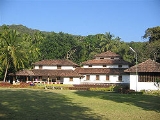
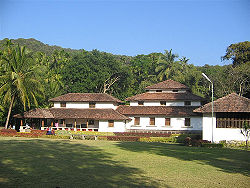 Kuvempu was born in Hirekodige, Koppa taluk, of Chikmagalur district
to a native Kannada
family. He was brought up in a place in the lush Malenadu region of Tirthahalli, called Kuppali, of Shivamogga district. His education began at his home by an appointed teacher from Dakshina Kannada
. He joined Anglo Vernacular school in Tirthahalli to continue his middle school education. He lost his father Venkatappa Gowda at the early age of 12 due to ill health. Kuvempu finished his lower and secondary education in Kannada
and English
in Theerthahalli. He moved to Mysore for further education and completed his high school from the Wesleyan high school. He pursued his college studies in from Maharaja College of Mysore
and graduated in 1929 majoring in Kannada
. He married Hemavathi on 30 April 1937.
, Kokilodaya Chaitra, Indukala and Tharini. Tharini is married to K. Chidananda Gowda
, the former Vice-Chancellor of Kuvempu University
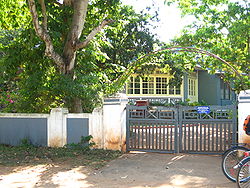
. He responded poetically to even mundane events. When he got a car, he is quoted to have said, "Chakracharanake swagatha!" - Welcome to wheel footed! He named his house as "Udayaravi", "Rising Sun", called the farmer "uluva Yogi" the "tilling Yogi", and called for egalatarian society in his message "Sarvarige samapaalu, sarvarige samabaalu" "Equal share for all, Equal life for all". His "Raso Vai Saha" is a famous work of "kavya mimamsa", the "Principles of literary criticism", in the Kannada thought of twentieth century. He is credited for giving Kannada hundreds of new words, phrases and terminologies with distinctly precise ideas; literary, social, philosophical and spiritual. This led to common people asking him to suggest a name for their newborns, for decades, through postal correspondece, which he obliged!
at Maharaja College of Mysore in 1929. He served as an assistant professor in central college of Bangalore
from 1936. He rejoined Maharaja college of Mysore in 1946 as a professor. He went on to become a principal of Maharaja college in 1955. Soon in 1956 he was elected as the Vice-Chancellor of Mysore University where he served till retirement in 1960. He was the first graduate from Mysore University to rise to that position.
 Kuvempu started his literary work in English
first, with a collection of poetry called Beginner's Muse, and later switched to Kannada
.
He spearheaded Kannada
as a medium for education, emphasizing the theme of "Education in Mother tongues". To cater to the needs of Kannada
research, he founded the Kannada
Adhyayana Samsthe (The Institute of Kannada Studies) in Mysore University, which has since been renamed after him as Kuvempu Institute of Kannada Studies. As Vice-Chancellor of Mysore University, he pioneered the study of Basic Sciences and Languages. He also championed the Publishing of knowledge for laymen, started by G. Hanumanta Rao.
Kuvempu was more than a writer, and the way he lived his life was in itself a great message. He was against caste
ism, meaningless practices and rituals. Kuvempu's writings also reflect his resentment against the caste system
according to which the "Shoodra Tapaswi" (1946) shudra
s were unfit to attain knowledge. Kuvempu (from the Vokkaliga
community) also gives a different perspective to the characters in the Ramayana
unlike the portrayal of characters by Valmiki
in his Sri Ramayana Darshanam
which won him Jnanpith Award
. This work is the complete Ramayana
in Kannada
. It underscores his vision of sarvodaya (Upliftment of One & All). Rama
of his Ramayana
personifies this when he tests himself along with his wife Seeta, by jumping into the fire.
O nanna chetana, Agu nee aniketana (ಓ ನನ್ನ ಚೇತನ, ಆಗು ನೀ ಅನಿಕೇತನ ) which can be translated as "Be unhoused o my soul, only the infinite is your goal" is a very popular note by Kuvempu on Universal Humanism.
His speech during the convocation ceremony of Bangalore University
has been published in the book, vichaarakranthige aahwaana. It calls for a re-assessment of developmental policies. Though it was delivered in 1974, the message is still considered relevant.
In the year 1987, a new university was started in Shimoga district
, Karnataka
in the name of Kuvempu. It is located in Jnana Sahyadri campus, 28 km from Shimoga.
His son Poornachandra Tejaswi
was a polymath
, contributing significantly to Literature
, Photography
, Calligraphy
, Digital Imaging
, Social Movements, and Agriculture
.
poornachandra Tejaswi
Kannada language
Kannada or , is a language spoken in India predominantly in the state of Karnataka. Kannada, whose native speakers are called Kannadigas and number roughly 50 million, is one of the 30 most spoken languages in the world...
writer
Writer
A writer is a person who produces literature, such as novels, short stories, plays, screenplays, poetry, or other literary art. Skilled writers are able to use language to portray ideas and images....
and poet
Poet
A poet is a person who writes poetry. A poet's work can be literal, meaning that his work is derived from a specific event, or metaphorical, meaning that his work can take on many meanings and forms. Poets have existed since antiquity, in nearly all languages, and have produced works that vary...
, widely regarded as the greatest poet of 20th century Kannada literature
Kannada literature
Kannada literature is the corpus of written forms of the Kannada language, a member of the Dravidian family spoken mainly in the Indian state of Karnataka and written in the Kannada script....
. He is the first among eight recipients of Jnanpith Award
Jnanpith Award
The Jnanpith Award is a literary award in India. Along with the Sahitya Akademi Fellowship, it is one of the two most prestigious literary honours in the country...
for Kannada
Kannada language
Kannada or , is a language spoken in India predominantly in the state of Karnataka. Kannada, whose native speakers are called Kannadigas and number roughly 50 million, is one of the 30 most spoken languages in the world...
. Puttappa wrote all his literary works using the pen name
Pen name
A pen name, nom de plume, or literary double, is a pseudonym adopted by an author. A pen name may be used to make the author's name more distinctive, to disguise his or her gender, to distance an author from some or all of his or her works, to protect the author from retribution for his or her...
Kuvempu. He is the second among Kannada
Kannada language
Kannada or , is a language spoken in India predominantly in the state of Karnataka. Kannada, whose native speakers are called Kannadigas and number roughly 50 million, is one of the 30 most spoken languages in the world...
poets to be revered as Rashtrakavi (after M. Govinda Pai
M. Govinda Pai
Manjeshwar Govinda Pai , also known as Rastrakavi Govinda Pai, was a Kannada poet. He was awarded the Rashtrakavi title by the Madras Government...
). His work Sri Ramayana Darshanam
Sri Ramayana Darshanam
Sri Ramayana Darshanam is the most famous work and the magnum opus by Kuvempu in Kannada based on the Hindu epic Ramayana. It earned him many distinctions including the Sahitya Akademi and the Jnanapeeth award in 1967....
, the rewriting of the great ancient India
India
India , officially the Republic of India , is a country in South Asia. It is the seventh-largest country by geographical area, the second-most populous country with over 1.2 billion people, and the most populous democracy in the world...
n epic Ramayana
Ramayana
The Ramayana is an ancient Sanskrit epic. It is ascribed to the Hindu sage Valmiki and forms an important part of the Hindu canon , considered to be itihāsa. The Ramayana is one of the two great epics of India and Nepal, the other being the Mahabharata...
in modern Kannada, is regarded as revival of the era of Mahakavya (Epic poetry) in a contemporary form and charm. He is immortalised by some of his phrases, and in particular for his contribution to Universal Humanism or in his own words Vishwa maanavataa Vaada. He was conferred Padma Bhushan
Padma Bhushan
The Padma Bhushan is the third highest civilian award in the Republic of India, after the Bharat Ratna and the Padma Vibhushan, but comes before the Padma Shri. It is awarded by the Government of India.-History:...
by Government of India. He has penned the Karnataka State anthem 'Jaya Bharata Jananiya tanujate'.
Early life and education
Chikmagalur District
Chikkamagaluru is a district in the Indian state of Karnataka. Chikkamagaluru is where coffee was first cultivated in India. The mountains here which are a part of the Western Ghats are the source of rivers like Tunga and Bhadra. Chikkamagaluru district also contains Mullayanagiri; which is the...
to a native Kannada
Kannada language
Kannada or , is a language spoken in India predominantly in the state of Karnataka. Kannada, whose native speakers are called Kannadigas and number roughly 50 million, is one of the 30 most spoken languages in the world...
family. He was brought up in a place in the lush Malenadu region of Tirthahalli, called Kuppali, of Shivamogga district. His education began at his home by an appointed teacher from Dakshina Kannada
Dakshina Kannada
- Geography :The district geography consists of sea shore in the west and Western Ghats in the east. The major rivers are Netravathi, Kumaradhara, Phalguni, Shambhavi, Nandini or Pavanje and Payaswini which all join Arabian sea. Vast areas of evergreen forests which once covered this district, have...
. He joined Anglo Vernacular school in Tirthahalli to continue his middle school education. He lost his father Venkatappa Gowda at the early age of 12 due to ill health. Kuvempu finished his lower and secondary education in Kannada
Kannada language
Kannada or , is a language spoken in India predominantly in the state of Karnataka. Kannada, whose native speakers are called Kannadigas and number roughly 50 million, is one of the 30 most spoken languages in the world...
and English
English language
English is a West Germanic language that arose in the Anglo-Saxon kingdoms of England and spread into what was to become south-east Scotland under the influence of the Anglian medieval kingdom of Northumbria...
in Theerthahalli. He moved to Mysore for further education and completed his high school from the Wesleyan high school. He pursued his college studies in from Maharaja College of Mysore
Maharaja College of Mysore
-History & Evolution:It was one of the constituent colleges of Madras University and transferred to Mysore University in 1916. It is one of the oldest colleges of South India. It is the first college for higher studies built by an Indian king at the time of British rule. Former President of India...
and graduated in 1929 majoring in Kannada
Kannada language
Kannada or , is a language spoken in India predominantly in the state of Karnataka. Kannada, whose native speakers are called Kannadigas and number roughly 50 million, is one of the 30 most spoken languages in the world...
. He married Hemavathi on 30 April 1937.
Later life
He had two sons and two daughters. K Poornachandra TejaswiPoornachandra Tejaswi
Kuppali Puttappa Poornachandra Tejaswi was a prominent Kannada writer and novelist who has made a great impession in "Navya" period of Kannada literature and inaugurated the bandaya or "protest literature" with his short-story collection Abachoorina Post Offisu.At early stages of his writing...
, Kokilodaya Chaitra, Indukala and Tharini. Tharini is married to K. Chidananda Gowda
K. Chidananda Gowda
Prof. K. Chidananda Gowda is the former Vice-Chancellor of the Kuvempu University, which is located in the state of Karnataka, India. He is also the son-in-law of the Kannada playwright, Kuvempu, after whom the Kuvempu University is named. He has published many papers, mainly in the field of...
, the former Vice-Chancellor of Kuvempu University
Kuvempu University
Kuvempu University is a public state university located in Shimoga, Karnataka, India established in 1987 by the act of the Karnataka state legislature through an amendment No.28/1976 dated 29 January 1989 under the Karnataka State University Act 1976. The university offers undergraduate and...
. He responded poetically to even mundane events. When he got a car, he is quoted to have said, "Chakracharanake swagatha!" - Welcome to wheel footed! He named his house as "Udayaravi", "Rising Sun", called the farmer "uluva Yogi" the "tilling Yogi", and called for egalatarian society in his message "Sarvarige samapaalu, sarvarige samabaalu" "Equal share for all, Equal life for all". His "Raso Vai Saha" is a famous work of "kavya mimamsa", the "Principles of literary criticism", in the Kannada thought of twentieth century. He is credited for giving Kannada hundreds of new words, phrases and terminologies with distinctly precise ideas; literary, social, philosophical and spiritual. This led to common people asking him to suggest a name for their newborns, for decades, through postal correspondece, which he obliged!
Career
Kuvempu began his academic career as a lecturer of Kannada languageKannada language
Kannada or , is a language spoken in India predominantly in the state of Karnataka. Kannada, whose native speakers are called Kannadigas and number roughly 50 million, is one of the 30 most spoken languages in the world...
at Maharaja College of Mysore in 1929. He served as an assistant professor in central college of Bangalore
Bangalore
Bengaluru , formerly called Bengaluru is the capital of the Indian state of Karnataka. Bangalore is nicknamed the Garden City and was once called a pensioner's paradise. Located on the Deccan Plateau in the south-eastern part of Karnataka, Bangalore is India's third most populous city and...
from 1936. He rejoined Maharaja college of Mysore in 1946 as a professor. He went on to become a principal of Maharaja college in 1955. Soon in 1956 he was elected as the Vice-Chancellor of Mysore University where he served till retirement in 1960. He was the first graduate from Mysore University to rise to that position.
Works and Message
English language
English is a West Germanic language that arose in the Anglo-Saxon kingdoms of England and spread into what was to become south-east Scotland under the influence of the Anglian medieval kingdom of Northumbria...
first, with a collection of poetry called Beginner's Muse, and later switched to Kannada
Kannada language
Kannada or , is a language spoken in India predominantly in the state of Karnataka. Kannada, whose native speakers are called Kannadigas and number roughly 50 million, is one of the 30 most spoken languages in the world...
.
He spearheaded Kannada
Kannada language
Kannada or , is a language spoken in India predominantly in the state of Karnataka. Kannada, whose native speakers are called Kannadigas and number roughly 50 million, is one of the 30 most spoken languages in the world...
as a medium for education, emphasizing the theme of "Education in Mother tongues". To cater to the needs of Kannada
Kannada language
Kannada or , is a language spoken in India predominantly in the state of Karnataka. Kannada, whose native speakers are called Kannadigas and number roughly 50 million, is one of the 30 most spoken languages in the world...
research, he founded the Kannada
Kannada language
Kannada or , is a language spoken in India predominantly in the state of Karnataka. Kannada, whose native speakers are called Kannadigas and number roughly 50 million, is one of the 30 most spoken languages in the world...
Adhyayana Samsthe (The Institute of Kannada Studies) in Mysore University, which has since been renamed after him as Kuvempu Institute of Kannada Studies. As Vice-Chancellor of Mysore University, he pioneered the study of Basic Sciences and Languages. He also championed the Publishing of knowledge for laymen, started by G. Hanumanta Rao.
Kuvempu was more than a writer, and the way he lived his life was in itself a great message. He was against caste
Caste
Caste is an elaborate and complex social system that combines elements of endogamy, occupation, culture, social class, tribal affiliation and political power. It should not be confused with race or social class, e.g. members of different castes in one society may belong to the same race, as in India...
ism, meaningless practices and rituals. Kuvempu's writings also reflect his resentment against the caste system
Caste
Caste is an elaborate and complex social system that combines elements of endogamy, occupation, culture, social class, tribal affiliation and political power. It should not be confused with race or social class, e.g. members of different castes in one society may belong to the same race, as in India...
according to which the "Shoodra Tapaswi" (1946) shudra
Shudra
Shudra is the fourth Varna, as prescribed in the Purusha Sukta of the Rig veda, which constitutes society into four varnas or Chaturvarna. The other three varnas are Brahmans - priests, Kshatriya - those with governing functions, Vaishya - agriculturalists, cattle rearers and traders...
s were unfit to attain knowledge. Kuvempu (from the Vokkaliga
Vokkaliga
The Vokkaligas are an Indian caste or social group found mainly in the Old Mysore Region of southern Karnataka state. In Tamil Nadu they are known as Okkaligar and use Gowder as a title...
community) also gives a different perspective to the characters in the Ramayana
Ramayana
The Ramayana is an ancient Sanskrit epic. It is ascribed to the Hindu sage Valmiki and forms an important part of the Hindu canon , considered to be itihāsa. The Ramayana is one of the two great epics of India and Nepal, the other being the Mahabharata...
unlike the portrayal of characters by Valmiki
Valmiki
Valmiki is celebrated as the poet harbinger in Sanskrit literature. He is the author of the epic Ramayana, based on the attribution in the text of the epic itself. He is revered as the Adi Kavi, which means First Poet, for he discovered the first śloka i.e...
in his Sri Ramayana Darshanam
Sri Ramayana Darshanam
Sri Ramayana Darshanam is the most famous work and the magnum opus by Kuvempu in Kannada based on the Hindu epic Ramayana. It earned him many distinctions including the Sahitya Akademi and the Jnanapeeth award in 1967....
which won him Jnanpith Award
Jnanpith Award
The Jnanpith Award is a literary award in India. Along with the Sahitya Akademi Fellowship, it is one of the two most prestigious literary honours in the country...
. This work is the complete Ramayana
Ramayana
The Ramayana is an ancient Sanskrit epic. It is ascribed to the Hindu sage Valmiki and forms an important part of the Hindu canon , considered to be itihāsa. The Ramayana is one of the two great epics of India and Nepal, the other being the Mahabharata...
in Kannada
Kannada language
Kannada or , is a language spoken in India predominantly in the state of Karnataka. Kannada, whose native speakers are called Kannadigas and number roughly 50 million, is one of the 30 most spoken languages in the world...
. It underscores his vision of sarvodaya (Upliftment of One & All). Rama
Rama
Rama or full name Ramachandra is considered to be the seventh avatar of Vishnu in Hinduism, and a king of Ayodhya in ancient Indian...
of his Ramayana
Ramayana
The Ramayana is an ancient Sanskrit epic. It is ascribed to the Hindu sage Valmiki and forms an important part of the Hindu canon , considered to be itihāsa. The Ramayana is one of the two great epics of India and Nepal, the other being the Mahabharata...
personifies this when he tests himself along with his wife Seeta, by jumping into the fire.
O nanna chetana, Agu nee aniketana (ಓ ನನ್ನ ಚೇತನ, ಆಗು ನೀ ಅನಿಕೇತನ ) which can be translated as "Be unhoused o my soul, only the infinite is your goal" is a very popular note by Kuvempu on Universal Humanism.
His speech during the convocation ceremony of Bangalore University
Bangalore University
Bangalore University is a public university located in Bangalore, Karnataka State, India. The university is one of the oldest in India, dating back to 1886...
has been published in the book, vichaarakranthige aahwaana. It calls for a re-assessment of developmental policies. Though it was delivered in 1974, the message is still considered relevant.
In the year 1987, a new university was started in Shimoga district
Shimoga District
Shimoga District is a district in the Karnataka state of India. A major part of Shimoga District lies in the Malnad region of the Western Ghats, a hilly area known for its green forests, plentiful rainfall, and as the source of many of the area's rivers. Shimoga City is the administrative centre...
, Karnataka
Karnataka
Karnataka , the land of the Kannadigas, is a state in South West India. It was created on 1 November 1956, with the passing of the States Reorganisation Act and this day is annually celebrated as Karnataka Rajyotsava...
in the name of Kuvempu. It is located in Jnana Sahyadri campus, 28 km from Shimoga.
His son Poornachandra Tejaswi
Poornachandra Tejaswi
Kuppali Puttappa Poornachandra Tejaswi was a prominent Kannada writer and novelist who has made a great impession in "Navya" period of Kannada literature and inaugurated the bandaya or "protest literature" with his short-story collection Abachoorina Post Offisu.At early stages of his writing...
was a polymath
Polymath
A polymath is a person whose expertise spans a significant number of different subject areas. In less formal terms, a polymath may simply be someone who is very knowledgeable...
, contributing significantly to Literature
Literature
Literature is the art of written works, and is not bound to published sources...
, Photography
Photography
Photography is the art, science and practice of creating durable images by recording light or other electromagnetic radiation, either electronically by means of an image sensor or chemically by means of a light-sensitive material such as photographic film...
, Calligraphy
Calligraphy
Calligraphy is a type of visual art. It is often called the art of fancy lettering . A contemporary definition of calligraphic practice is "the art of giving form to signs in an expressive, harmonious and skillful manner"...
, Digital Imaging
Digital imaging
Digital imaging or digital image acquisition is the creation of digital images, typically from a physical scene. The term is often assumed to imply or include the processing, compression, storage, printing, and display of such images...
, Social Movements, and Agriculture
Agriculture
Agriculture is the cultivation of animals, plants, fungi and other life forms for food, fiber, and other products used to sustain life. Agriculture was the key implement in the rise of sedentary human civilization, whereby farming of domesticated species created food surpluses that nurtured the...
.
Further reading
- Poornachandra TejaswiPoornachandra TejaswiKuppali Puttappa Poornachandra Tejaswi was a prominent Kannada writer and novelist who has made a great impession in "Navya" period of Kannada literature and inaugurated the bandaya or "protest literature" with his short-story collection Abachoorina Post Offisu.At early stages of his writing...
, Annana Nenapu - K.C. Shiva Reddy, Yugada Kavi
- Dr. Pradhan Gurudatta, Kuvempu
- Tharini Chidananda, "Magalu Kanda Kuvempu"
poornachandra Tejaswi
Awards
- Jnanpith AwardJnanpith AwardThe Jnanpith Award is a literary award in India. Along with the Sahitya Akademi Fellowship, it is one of the two most prestigious literary honours in the country...
- 1967 - Padma BhushanPadma BhushanThe Padma Bhushan is the third highest civilian award in the Republic of India, after the Bharat Ratna and the Padma Vibhushan, but comes before the Padma Shri. It is awarded by the Government of India.-History:...
- 1958 - Sahitya Akademi AwardSahitya Akademi AwardSahitya Akademi Award is a literary honor in India which Sahitya Akademi, India's National Academy of Letters, annually confers on writers of outstanding works in one of the following twenty-four major Indian languagesAssamese, Bengali, Bodo, Dogri, English, Gujarati, Hindi, Kannada, Kashmiri,...
- 1955 - National Poet - 1964
- Pampa AwardAdikavi PampaPampa , called by the honorific Ādikavi is one of the greatest Kannada poets of all time.He is very famous even today for his philosophical beliefs...
- 1987 - Padma VibhushanPadma VibhushanThe Padma Vibhushan is the second highest civilian award in the Republic of India. It consists of a medal and a citation and is awarded by the President of India. It was established on 2 January 1954. It ranks behind the Bharat Ratna and comes before the Padma Bhushan...
- 1988 - Karnataka RatnaKarnataka RatnaKarnataka Ratna is the highest civilian honour of the State of Karnataka. It is awarded to a person for his extraordinary contribution in any field. It was constituted in the year 1992 by the Government of Karnataka. There have been a total of 8 recipients of this award.- The Award :The Award...
- 1992
Collection of Poems
- Kolalu (1930)
- Panchajanya (1936)
- Navilu (1937)
- Kindarijogi Mattu Itara Kavanagalu (1938)
- Kogile Mattu Soviet Russia (1944)
- Shoodra Tapaswi (1946)
- Kavya Vihara (1946)
- Kinkini (1946)
- Agnihamsa (1946)
- Prema Kashmira (1946)
- Chandramanchake Baa Chakori (1954)
- Ikshugangotri (1957)
- Kabbigana kaibutti
- Pakshikaashi
- Jenaaguvaa
- Kutichaka
- Kadiradake
- Kathana KavanagaLu
Plays
- Birugaali (1930)
- Maharatri (1931)
- SmashaaNa kurukshetram (1931)
- Jalagaara (1931)
- Raktaakshi(1932)
- Shoodra tapaswi (1944)
- Beralge koral (1947)
- Yamana solu
- Chandrahaasa
- Balidaana
Collection of stories
- Malenadina Chitragalu (1933)
- Sanyaasi Mattu Itare KategaLu (1937)
- Nanna Devaru Mattu Itara Kategalu (1940)
Literary criticism
- Atmashreegagi Nirankushamatigalagi (1944)
- Kavyavihara (1946)
- Taponandana (1951)
- Vibhuthi Pooje (1953)
- Draupadiya Shrimudi (1960)
- Vicharakrantige Ahvana (1976)
- Sahityaprachara
Biography
- Swami Vivekananda(1926)
- Sri Ramakrishna Paramahamsa(1934)
- Guruvinodane Devaredege
Stories for children
- Bommanahalliya kindarijogi(1936)
- Mari vijnani(1947)
- Meghapura(1947)
- Nanna mane(1947)
- Nanna gopaala
- Amalana kathe
See also
- KannadaKannada languageKannada or , is a language spoken in India predominantly in the state of Karnataka. Kannada, whose native speakers are called Kannadigas and number roughly 50 million, is one of the 30 most spoken languages in the world...
- Kannada literatureKannada literatureKannada literature is the corpus of written forms of the Kannada language, a member of the Dravidian family spoken mainly in the Indian state of Karnataka and written in the Kannada script....
- Kannada poetryKannada poetryKannada poetry is poetry written in the Kannada language spoken in Karnataka. Karnataka is the land that gave birth to eight Jnanapeeth award winners, the highest honour bestowed for Indian literature...