

.gif)
USS Wabash (1855)

Encyclopedia
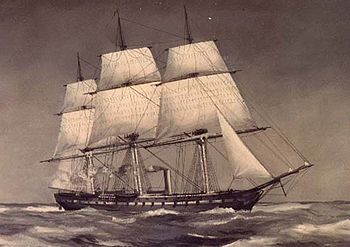
USS Wabash (1855) was a steam screw frigate
Frigate
A frigate is any of several types of warship, the term having been used for ships of various sizes and roles over the last few centuries.In the 17th century, the term was used for any warship built for speed and maneuverability, the description often used being "frigate-built"...
of the United States Navy
United States Navy
The United States Navy is the naval warfare service branch of the United States Armed Forces and one of the seven uniformed services of the United States. The U.S. Navy is the largest in the world; its battle fleet tonnage is greater than that of the next 13 largest navies combined. The U.S...
that served during the American Civil War
American Civil War
The American Civil War was a civil war fought in the United States of America. In response to the election of Abraham Lincoln as President of the United States, 11 southern slave states declared their secession from the United States and formed the Confederate States of America ; the other 25...
. She was based on the same plans as . Post-war she continued to serve her country in Europe
Europe
Europe is, by convention, one of the world's seven continents. Comprising the westernmost peninsula of Eurasia, Europe is generally 'divided' from Asia to its east by the watershed divides of the Ural and Caucasus Mountains, the Ural River, the Caspian and Black Seas, and the waterways connecting...
an operations and eventually served as a barracks ship
Barracks ship
Barracks ship or barracks barge are terms used to indicate a ship or a non-self-propelled barge containing a superstructure of a type suitable for use as a temporary barracks for sailors. A barracks ship may also be used as a "Receiving Unit" for sailors who need temporary residence prior to being...
in Boston, Massachusetts, and was sold in 1912.
Pre-Civil War service
Wabash—the first U.S. Navy ship to bear that name—was laid down on 16 May 1854 by the Philadelphia Navy Yard; launched on 24 October 1855, sponsored by Miss Pennsylvania Grice; and commissioned there on 18 August 1856, Captain Frederick K. EngleFrederick K. Engle
Frederick K. Engle was a rear admiral of the United States Navy.-Early life and career:Engle was born in Delaware County, Pennsylvania. He entered the navy as a midshipman on November 30, 1814, and became lieutenant on January 13, 1825...
in command.
Wabash departed Philadelphia, Pennsylvania
Philadelphia, Pennsylvania
Philadelphia is the largest city in the Commonwealth of Pennsylvania and the county seat of Philadelphia County, with which it is coterminous. The city is located in the Northeastern United States along the Delaware and Schuylkill rivers. It is the fifth-most-populous city in the United States,...
on 7 September 1856, stopping at Portsmouth, New Hampshire
Portsmouth, New Hampshire
Portsmouth is a city in Rockingham County, New Hampshire in the United States. It is the largest city but only the fourth-largest community in the county, with a population of 21,233 at the 2010 census...
, to embark President
President of the United States
The President of the United States of America is the head of state and head of government of the United States. The president leads the executive branch of the federal government and is the commander-in-chief of the United States Armed Forces....
Franklin Pierce
Franklin Pierce
Franklin Pierce was the 14th President of the United States and is the only President from New Hampshire. Pierce was a Democrat and a "doughface" who served in the U.S. House of Representatives and the Senate. Pierce took part in the Mexican-American War and became a brigadier general in the Army...
for passage to Annapolis, Maryland
Annapolis, Maryland
Annapolis is the capital of the U.S. state of Maryland, as well as the county seat of Anne Arundel County. It had a population of 38,394 at the 2010 census and is situated on the Chesapeake Bay at the mouth of the Severn River, south of Baltimore and about east of Washington, D.C. Annapolis is...
. She arrived at New York on 23 October 1856, sailing on 28 November 1856 to become flagship
Flagship
A flagship is a vessel used by the commanding officer of a group of naval ships, reflecting the custom of its commander, characteristically a flag officer, flying a distinguishing flag...
of Commodore Hiram Paulding
Hiram Paulding
Hiram Paulding was a Rear Admiral in the United States Navy, who served from the War of 1812 until after the Civil War.-Naval career:...
's Home Squadron
Home Squadron
The Home Squadron was part of the United States Navy in the mid-19th century. Organized as early as 1838, ships were assigned to protect coastal commerce, aid ships in distress, suppress piracy and the slave trade, make coastal surveys, and train ships to relieve others on distant stations...
. The squadron was instrumental in foiling the expedition against Nicaragua
Nicaragua
Nicaragua is the largest country in the Central American American isthmus, bordered by Honduras to the north and Costa Rica to the south. The country is situated between 11 and 14 degrees north of the Equator in the Northern Hemisphere, which places it entirely within the tropics. The Pacific Ocean...
underway by American filibuster
Filibuster (military)
A filibuster, or freebooter, is someone who engages in an unauthorized military expedition into a foreign country to foment or support a revolution...
, William Walker, who had dreamed of uniting the nations of Central America
Central America
Central America is the central geographic region of the Americas. It is the southernmost, isthmian portion of the North American continent, which connects with South America on the southeast. When considered part of the unified continental model, it is considered a subcontinent...
into a vast military empire led by himself. Through insurrection, he became president of Nicaragua in 1855 only to have Cornelius Vanderbilt
Cornelius Vanderbilt
Cornelius Vanderbilt , also known by the sobriquet Commodore, was an American entrepreneur who built his wealth in shipping and railroads. He was also the patriarch of the Vanderbilt family and one of the richest Americans in history...
—who controlled the country's shipping lifelines—shut off supplies and aid. A revolt toppled Walker from power, and he was trying for a military comeback before he was captured in 1857 by the Home Squadron. Stateside controversy over the questionable legality of seizing American nationals in foreign, neutral lands prompted President James Buchanan
James Buchanan
James Buchanan, Jr. was the 15th President of the United States . He is the only president from Pennsylvania, the only president who remained a lifelong bachelor and the last to be born in the 18th century....
to relieve Commodore Paulding of his command. Wabash was decommissioned on 1 March 1858 at the New York Navy Yard.
First recommissioning, 1858-1859
Wabash was recommissioned on 25 May 1858, Captain Samuel Barron in command, and became the flagship of Commodore Elie A. F. La ValletteElie A. F. La Vallette
Elie Augustus Frederick La Vallette was one of the first rear admirals appointed in the United States Navy when President Abraham Lincoln created the rank in July 1862.-Biography:...
's Mediterranean Squadron. The future naval hero of the Battle of Manila Bay
Battle of Manila Bay (1898)
The Battle of Manila Bay took place on 1 May 1898, during the Spanish-American War. The American Asiatic Squadron under Commodore George Dewey engaged and destroyed the Spanish Pacific Squadron under Admiral Patricio Montojo y Pasarón...
during the Spanish-American War
Spanish-American War
The Spanish–American War was a conflict in 1898 between Spain and the United States, effectively the result of American intervention in the ongoing Cuban War of Independence...
, George Dewey
George Dewey
George Dewey was an admiral of the United States Navy. He is best known for his victory at the Battle of Manila Bay during the Spanish-American War...
—then a midshipman
Midshipman
A midshipman is an officer cadet, or a commissioned officer of the lowest rank, in the Royal Navy, United States Navy, and many Commonwealth navies. Commonwealth countries which use the rank include Australia, New Zealand, South Africa, India, Pakistan, Singapore, Sri Lanka and Kenya...
—served aboard the Wabash when she touched at her first port of call, Gibraltar
Gibraltar
Gibraltar is a British overseas territory located on the southern end of the Iberian Peninsula at the entrance of the Mediterranean. A peninsula with an area of , it has a northern border with Andalusia, Spain. The Rock of Gibraltar is the major landmark of the region...
, on 17 August 1858. Dewey would later write in his autobiography that “The Wabash was quite the finest ship of the foreign fleet and also the largest.” Wabash returned to the New York Navy Yard on 16 December 1859 and decommissioned there on 20 December 1859.
Civil War service, 1861-1865
With the outbreak of the American Civil WarAmerican Civil War
The American Civil War was a civil war fought in the United States of America. In response to the election of Abraham Lincoln as President of the United States, 11 southern slave states declared their secession from the United States and formed the Confederate States of America ; the other 25...
, Wabash was recommissioned on 16 May 1861, Captain Samuel Mercer
Samuel Mercer Sr
Samuel Mercer entered the United States Navy at a young age; he became a Midshipman in 1815. He served his country during the Mexican-American and US Civil war’s, He is also the father of Marine Corps Captain “Samuel Mercer”....
in command, and departed New York on 30 May 1861 as flagship of the Atlantic Blockading Squadron
Atlantic Blockading Squadron
The Atlantic Blockading Squadron was a unit of the United States Navy created in the early days of the American Civil War to enforce a blockade of the ports of the Confederate States...
under Rear Admiral Silas H. Stringham
Silas Stringham
Silas Horton Stringham was an admiral in the United States Navy.-Biography:Born in Middletown, New York, Stringham served in the United States Navy from the War of 1812 through the American Civil War. During the War of 1812, he served in the frigate and took part in the engagements with the...
.
Wabash captured the brigantine
Brigantine
In sailing, a brigantine or hermaphrodite brig is a vessel with two masts, only the forward of which is square rigged.-Origins of the term:...
Sarah Starr off Charleston, South Carolina
Charleston, South Carolina
Charleston is the second largest city in the U.S. state of South Carolina. It was made the county seat of Charleston County in 1901 when Charleston County was founded. The city's original name was Charles Towne in 1670, and it moved to its present location from a location on the west bank of the...
, on 3 August 1861, and recaptured the American schooner
Schooner
A schooner is a type of sailing vessel characterized by the use of fore-and-aft sails on two or more masts with the forward mast being no taller than the rear masts....
Mary Alice, taken earlier by . By this date, she had also captured the brigantines Hannah, Balch, and Solferino, along with 22 Confederate
Confederate States of America
The Confederate States of America was a government set up from 1861 to 1865 by 11 Southern slave states of the United States of America that had declared their secession from the U.S...
prisoners from the four vessels.
On 26 August 1861, Wabash departed Hampton Roads
Hampton Roads
Hampton Roads is the name for both a body of water and the Norfolk–Virginia Beach metropolitan area which surrounds it in southeastern Virginia, United States...
, bound for Hatteras Inlet
Hatteras Inlet
Hatteras Inlet is a estuary in North Carolina, located along the Outer Banks, separating Hatteras Island and Ocracoke Island. It connects the Atlantic Ocean to the Pamlico Sound. Hatteras Inlet is located entirely within Hyde County.- History :...
, North Carolina
North Carolina
North Carolina is a state located in the southeastern United States. The state borders South Carolina and Georgia to the south, Tennessee to the west and Virginia to the north. North Carolina contains 100 counties. Its capital is Raleigh, and its largest city is Charlotte...
, to take part in the first combined amphibious assault of the war. Wabash accompanied , , revenue cutter , the tug Fanny, and two transports, carrying over 900 troops under Major General Benjamin Butler
Benjamin Franklin Butler (politician)
Benjamin Franklin Butler was an American lawyer and politician who represented Massachusetts in the United States House of Representatives and later served as the 33rd Governor of Massachusetts....
. Union forces secured Hatteras Inlet with the capture of Forts Hatteras
Battle of Hatteras Inlet Batteries
The Battle of Hatteras Inlet Batteries, sometimes known as the Battle of Forts Hatteras and Clark, was a small but significant engagement in the early days of the American Civil War. Two Confederate forts on the North Carolina Outer Banks were subjected to an amphibious assault by Union forces that...
and Clark on 29 August 1861. The attacking force suffered no casualties and took over 700 prisoners. Among these was Captain Samuel Barron of the Confederate Navy, the former commander in the United States Navy of Wabash when she served under Rear Admiral La Vallette. Wabash was later designated the flagship of Flag Officer Samuel Francis du Pont
Samuel Francis du Pont
Samuel Francis Du Pont was an American naval officer who achieved the rank of Rear Admiral in the United States Navy, and a member of the prominent Du Pont family; he was the only member of his generation to use a capital D...
, the new commander of the South Atlantic Blockading Squadron, and was sent to the New York Navy Yard for repairs on 21 September 1861.
Fort Monroe
Fort Monroe was a military installation in Hampton, Virginia—at Old Point Comfort, the southern tip of the Virginia Peninsula...
on 29 October 1861 to spearhead the Federal assault on Port Royal, South Carolina
Port Royal, South Carolina
Port Royal is a town in Beaufort County, South Carolina, United States. Largely because of annexation of surrounding areas , the population of Port Royal rose from 3,950 in 2000 to 10,678 in 2010, a 170% increase. As defined by the U.S...
. The assembled invasion fleet was the largest yet organized by the Navy, containing 77 vessels and 16,000 Army troops under Brigadier General Thomas W. Sherman
Thomas W. Sherman
Thomas West Sherman was a United States Army officer with service during the Mexican-American War and the American Civil War....
. The combined force secured Port Royal Sound on 7 November 1861 after a furious four-hour battle. Wabash led the battle line in this major strategic Union victory.
Wabash now took up permanent station on the Charleston blockade, operating out of Port Royal. On 11 March 1862, a landing party led by ship's commanding officer, Commander C. R. P. Rodgers
Christopher Raymond Perry Rodgers
Christopher Raymond Perry Rodgers was an officer in the United States Navy. He served in the Mexican-American War, the American Civil War, as Superintendent of the Naval Academy, and Commander-in-Chief of the Pacific Squadron.-Early career:Rodgers was born in Brooklyn, New York, into a naval family...
, occupied St. Augustine, Florida
St. Augustine, Florida
St. Augustine is a city in the northeast section of Florida and the county seat of St. Johns County, Florida, United States. Founded in 1565 by Spanish explorer and admiral Pedro Menéndez de Avilés, it is the oldest continuously occupied European-established city and port in the continental United...
. A detachment of seamen and officers from Wabash landed and manned a battery which bombarded Fort Pulaski, Georgia
Georgia (U.S. state)
Georgia is a state located in the southeastern United States. It was established in 1732, the last of the original Thirteen Colonies. The state is named after King George II of Great Britain. Georgia was the fourth state to ratify the United States Constitution, on January 2, 1788...
, on 10 April and 11 April 1862 and was instrumental in forcing that Southern fort to surrender. A naval battery of three 12 pounder howitzers from Wabash supported Union troops at the Battle of Pocotaligo, on 22 October 1862.
Confederate vessels twice harassed Wabash while on duty in Port Royal Sound. On 5 August 1863, , a small steamer on picket duty below Fort Sumter
Fort Sumter
Fort Sumter is a Third System masonry coastal fortification located in Charleston Harbor, South Carolina. The fort is best known as the site upon which the shots initiating the American Civil War were fired, at the Battle of Fort Sumter.- Construction :...
, fired upon and ran down a launch from Wabash, capturing 10 sailors and drowning two. The submarine torpedo boat also attacked Wabash on 18 April 1864. Ensign Charles H. Craven, officer of the deck, spotted the cigar-shaped vessel in time for Wabash to get underway. The David disengaged from the attack in the face of musket fire and round shot discharged from Wabash.
Wabash departed her station on 1 October, bound for the Norfolk Navy Yard and an overhaul. En route, she grounded briefly on Frying Pan Shoals
Frying Pan Shoals
The Frying Pan Shoals are a long, shifting area of shoals off the coast of Cape Fear in North Carolina, United States. The shoals have been a hazard to ships in the area since the beginning of European exploration of the area; the area is littered with shipwrecks. The southern edge of the shoals...
, suffering minor damage to her rudder. Repairs and overhaul were completed by 16 December, in time for Wabash to join the North Atlantic Blockading Squadron and to participate in the first attack on Fort Fisher, North Carolina, on 24 December and 25 December 1864. The failure of this initial attempt to take the fort necessitated a second, successful combined operation between 13 January and 15 January 1865. It was during this second attack on Fort Fisher
Fort Fisher
Fort Fisher was a Confederate fort during the American Civil War. It protected the vital trading routes of the port at Wilmington, North Carolina, from 1861 until its capture by the Union in 1865....
, that corporal Andrew J. Tomlin
Andrew J. Tomlin
Andrew Jackson Tomlin was a United States Marine and a recipient of the American military's highest award - the Medal of Honor - for his actions during the Second Battle of Fort Fisher during the Civil War....
and ordinary seamen Louis C. Shepard
Louis C. Shepard
Lewis Capet Shepard was born in Ashtabula County, Ohio and was a Union Navy sailor during the American Civil War who received America's highest military decoration the Medal of Honor for his actions at the Second Battle of Fort Fisher...
earned the Medal of Honor.
Wabash returned to Hampton Roads
Hampton Roads
Hampton Roads is the name for both a body of water and the Norfolk–Virginia Beach metropolitan area which surrounds it in southeastern Virginia, United States...
on 17 January 1865, receiving orders on 25 January 1865 to proceed to the Boston Navy Yard
Boston Navy Yard
The Boston Navy Yard, originally called the Charlestown Navy Yard and later Boston Naval Shipyard, was one of the oldest shipbuilding facilities in the United States Navy. Established in 1801, it was officially closed as an active naval installation on July 1, 1974, and the property was...
. Wabash was decommissioned at Boston on 14 February 1865.
Officers during Fort Fisher Siege
- Captain, Melancton SmithMelancton Smith (1810-1893)Melancton Smith was a United States Navy officer who served during the Seminole Wars and the American Civil War.-Early life:...
- Lieutenant CommanderLieutenant CommanderLieutenant Commander is a commissioned officer rank in many navies. The rank is superior to a lieutenant and subordinate to a commander...
, C. H. Cushman. - Lieutenants, Ellicot C. V. Blake, H. C. Tallman
- SurgeonSurgeonIn medicine, a surgeon is a specialist in surgery. Surgery is a broad category of invasive medical treatment that involves the cutting of a body, whether human or animal, for a specific reason such as the removal of diseased tissue or to repair a tear or breakage...
, H. F. McSherry. - Passed Ass't Surgeon, James H. Tinkham.
- Acting Ass't Surgeon, N. L. Campbell.
- PaymasterPaymasterA paymaster often is, but is not required to be, a lawyer . When dealing with commission payments on contracts dealing with large amounts of money , most banks in the United States are very wary of handling such large amounts of money...
, George Cochran. - ChaplainChaplainTraditionally, a chaplain is a minister in a specialized setting such as a priest, pastor, rabbi, or imam or lay representative of a religion attached to a secular institution such as a hospital, prison, military unit, police department, university, or private chapel...
, Charles A. Davis. - Marine Second LieutenantSecond LieutenantSecond lieutenant is a junior commissioned officer military rank in many armed forces.- United Kingdom and Commonwealth :The rank second lieutenant was introduced throughout the British Army in 1871 to replace the rank of ensign , although it had long been used in the Royal Artillery, Royal...
, L. E. Fagan. - Acting Masters, W. U. Grozier, S. J. White.
- Acting EnsignsEnsign (rank)Ensign is a junior rank of a commissioned officer in the armed forces of some countries, normally in the infantry or navy. As the junior officer in an infantry regiment was traditionally the carrier of the ensign flag, the rank itself acquired the name....
, George T. DavisGeorge T. DavisGeorge Thomas Davis was a U.S. Representative from Massachusetts.-Early life and education:George Davis was born in Sandwich, Massachusetts...
, Whitman Chase, E. A. Small, Joseph F. Brown.
Notable Crew
- Samuel Barron, CaptainCaptain (nautical)A sea captain is a licensed mariner in ultimate command of the vessel. The captain is responsible for its safe and efficient operation, including cargo operations, navigation, crew management and ensuring that the vessel complies with local and international laws, as well as company and flag...
1858, United StatesUnited StatesThe United States of America is a federal constitutional republic comprising fifty states and a federal district...
, and later Confederate naval officer, Confederacy representative to EuropeEuropeEurope is, by convention, one of the world's seven continents. Comprising the westernmost peninsula of Eurasia, Europe is generally 'divided' from Asia to its east by the watershed divides of the Ural and Caucasus Mountains, the Ural River, the Caspian and Black Seas, and the waterways connecting...
. - George DeweyGeorge DeweyGeorge Dewey was an admiral of the United States Navy. He is best known for his victory at the Battle of Manila Bay during the Spanish-American War...
, MidshipmanMidshipmanA midshipman is an officer cadet, or a commissioned officer of the lowest rank, in the Royal Navy, United States Navy, and many Commonwealth navies. Commonwealth countries which use the rank include Australia, New Zealand, South Africa, India, Pakistan, Singapore, Sri Lanka and Kenya...
1858, future Admiral of the Navy and Presidential candidate 1900. - Samuel Francis Du PontSamuel Francis du PontSamuel Francis Du Pont was an American naval officer who achieved the rank of Rear Admiral in the United States Navy, and a member of the prominent Du Pont family; he was the only member of his generation to use a capital D...
, flag officer 1861 - 1862 - Frederick K. EngleFrederick K. EngleFrederick K. Engle was a rear admiral of the United States Navy.-Early life and career:Engle was born in Delaware County, Pennsylvania. He entered the navy as a midshipman on November 30, 1814, and became lieutenant on January 13, 1825...
, CaptainCaptain (nautical)A sea captain is a licensed mariner in ultimate command of the vessel. The captain is responsible for its safe and efficient operation, including cargo operations, navigation, crew management and ensuring that the vessel complies with local and international laws, as well as company and flag...
1856, - Oscar Walter Farenholt, Ordinary SeamanOrdinary Seaman (occupation)An ordinary seaman is an unlicensed member of the deck department of a merchant ship. The position is an apprenticeship to become an able seaman, and has been for centuries...
1861, first enlisted man in the Navy to reach flag rank - Samuel MercerSamuel Mercer SrSamuel Mercer entered the United States Navy at a young age; he became a Midshipman in 1815. He served his country during the Mexican-American and US Civil war’s, He is also the father of Marine Corps Captain “Samuel Mercer”....
, CaptainCaptain (nautical)A sea captain is a licensed mariner in ultimate command of the vessel. The captain is responsible for its safe and efficient operation, including cargo operations, navigation, crew management and ensuring that the vessel complies with local and international laws, as well as company and flag...
1861, - Edward D. RobieEdward D. RobieEdward Dunham Robie , was a naval engineer, inventor, and Union naval officer during the American Civil War.-Early life and career:Robie was born in Burlington, Vermont, the son of Jacob and Louisa Robie...
, Naval engineerNaval architectureNaval architecture is an engineering discipline dealing with the design, construction, maintenance and operation of marine vessels and structures. Naval architecture involves basic and applied research, design, development, design evaluation and calculations during all stages of the life of a...
1871, inventor, Union naval officer during the American Civil War and future Rear Admiral. - Christopher Raymond Perry RodgersChristopher Raymond Perry RodgersChristopher Raymond Perry Rodgers was an officer in the United States Navy. He served in the Mexican-American War, the American Civil War, as Superintendent of the Naval Academy, and Commander-in-Chief of the Pacific Squadron.-Early career:Rodgers was born in Brooklyn, New York, into a naval family...
, CaptainCaptain (nautical)A sea captain is a licensed mariner in ultimate command of the vessel. The captain is responsible for its safe and efficient operation, including cargo operations, navigation, crew management and ensuring that the vessel complies with local and international laws, as well as company and flag...
1861 , Superintendent of the United States Naval Academy, and Commander-in-Chief of the Pacific SquadronPacific SquadronThe Pacific Squadron was part of the United States Navy squadron stationed in the Pacific Ocean in the 19th and early 20th centuries. Initially with no United States ports in the Pacific, they operated out of storeships which provided naval supplies and purchased food and obtained water from local...
. - Melancton SmithMelancton Smith (1810-1893)Melancton Smith was a United States Navy officer who served during the Seminole Wars and the American Civil War.-Early life:...
, CaptainCaptain (nautical)A sea captain is a licensed mariner in ultimate command of the vessel. The captain is responsible for its safe and efficient operation, including cargo operations, navigation, crew management and ensuring that the vessel complies with local and international laws, as well as company and flag...
1865, Commander during the Siege of Fort fisherFort FisherFort Fisher was a Confederate fort during the American Civil War. It protected the vital trading routes of the port at Wilmington, North Carolina, from 1861 until its capture by the Union in 1865....
. - John Henry UpshurJohn Henry UpshurJohn Henry Upshur was an admiral in the United States Navy who served during the Mexican-American War and the American Civil War.-Early life:...
, Executive officerExecutive officerAn executive officer is generally a person responsible for running an organization, although the exact nature of the role varies depending on the organization.-Administrative law:...
1862 during the Battle of Port RoyalBattle of Port RoyalThe Battle of Port Royal was one of the earliest amphibious operations of the American Civil War, in which a United States Navy fleet and United States Army expeditionary force captured Port Royal Sound, South Carolina, between Savannah, Georgia and Charleston, South Carolina, on November 7, 1861...
, Port Royal, South CarolinaPort Royal, South CarolinaPort Royal is a town in Beaufort County, South Carolina, United States. Largely because of annexation of surrounding areas , the population of Port Royal rose from 3,950 in 2000 to 10,678 in 2010, a 170% increase. As defined by the U.S...
.
Honored Crew
- Albert BurtonAlbert BurtonAlbert Burton was a sailor in the U.S. Navy during the American Civil War. He received the Medal of Honor for his actions during the Second Battle of Fort Fisher on January 15, 1865.-Military service:...
, SeamanSeamanSeaman is one of the lowest ranks in a Navy. In the Commonwealth it is the lowest rank in the Navy, followed by Able Seaman and Leading Seaman, and followed by the Petty Officer ranks....
1865, Medal of HonorMedal of HonorThe Medal of Honor is the highest military decoration awarded by the United States government. It is bestowed by the President, in the name of Congress, upon members of the United States Armed Forces who distinguish themselves through "conspicuous gallantry and intrepidity at the risk of his or her...
recipient from New YorkNew YorkNew York is a state in the Northeastern region of the United States. It is the nation's third most populous state. New York is bordered by New Jersey and Pennsylvania to the south, and by Connecticut, Massachusetts and Vermont to the east... - Edward RingoldEdward RingoldEdward Ringold was a United States Navy coxswain and a Medal of Honor recipient for his actions in the American Civil War.-Biography:...
, CoxswainCoxswainThe coxswain is the person in charge of a boat, particularly its navigation and steering. The etymology of the word gives us a literal meaning of "boat servant" since it comes from cox, a coxboat or other small vessel kept aboard a ship, and swain, which can be rendered as boy, in authority. ...
1862, Medal of HonorMedal of HonorThe Medal of Honor is the highest military decoration awarded by the United States government. It is bestowed by the President, in the name of Congress, upon members of the United States Armed Forces who distinguish themselves through "conspicuous gallantry and intrepidity at the risk of his or her...
recipient from Baltimore, Maryland - Louis C. ShepardLouis C. ShepardLewis Capet Shepard was born in Ashtabula County, Ohio and was a Union Navy sailor during the American Civil War who received America's highest military decoration the Medal of Honor for his actions at the Second Battle of Fort Fisher...
, Ordinary SeamanOrdinary Seaman (occupation)An ordinary seaman is an unlicensed member of the deck department of a merchant ship. The position is an apprenticeship to become an able seaman, and has been for centuries...
1865, Medal of HonorMedal of HonorThe Medal of Honor is the highest military decoration awarded by the United States government. It is bestowed by the President, in the name of Congress, upon members of the United States Armed Forces who distinguish themselves through "conspicuous gallantry and intrepidity at the risk of his or her...
recipient from Ashtabula County, buried in Lakeview cemetery, Port ClintonPort Clinton, OhioPort Clinton is a city in and the county seat of Ottawa County, Ohio, United States. The population was 6,056 at the 2010 census. The city has been nicknamed the "Walleye Capital of the World."...
, Ottawa County, OhioOttawa County, OhioOttawa County is a county located in the state of Ohio, United States. As of the 2010 census, the population was 41,428. Its county seat is Port Clinton and is named either for the Ottawa Indians who lived there, or for an Indian word meaning "trader"....
. - Andrew J. TomlinAndrew J. TomlinAndrew Jackson Tomlin was a United States Marine and a recipient of the American military's highest award - the Medal of Honor - for his actions during the Second Battle of Fort Fisher during the Civil War....
, CorporalCorporalCorporal is a rank in use in some form by most militaries and by some police forces or other uniformed organizations. It is usually equivalent to NATO Rank Code OR-4....
1865, Medal of HonorMedal of HonorThe Medal of Honor is the highest military decoration awarded by the United States government. It is bestowed by the President, in the name of Congress, upon members of the United States Armed Forces who distinguish themselves through "conspicuous gallantry and intrepidity at the risk of his or her...
recipient from Goshen, New JerseyGoshen, New JerseyGoshen is an unincorporated community in Cape May County, New Jersey, United States . Route 47, also known as Delsea Drive, runs directly through the center of the community....
, buried in Goshen Methodist cemetery, Goshen, New JerseyGoshen, New JerseyGoshen is an unincorporated community in Cape May County, New Jersey, United States . Route 47, also known as Delsea Drive, runs directly through the center of the community....
.
Post-Civil War service, 1866-1912
Wabash was placed in ordinary from 1866 to 1869; overhauled during 1870 to 1871; and recommissioned on 24 October 1871, Captain Robert W. Shufeldt commanding. Wabash departed the Boston Navy YardBoston Navy Yard
The Boston Navy Yard, originally called the Charlestown Navy Yard and later Boston Naval Shipyard, was one of the oldest shipbuilding facilities in the United States Navy. Established in 1801, it was officially closed as an active naval installation on July 1, 1974, and the property was...
on 17 November 1871 and served as the flagship of Rear Admiral James Alden, commanding the Mediterranean Squadron. She arrived at Cadiz, Spain, on 14 December 1871 and cruised throughout the Mediterranean until 30 November 1873 when she departed Gibraltar, bound for Key West, Florida
Key West, Florida
Key West is a city in Monroe County, Florida, United States. The city encompasses the island of Key West, the part of Stock Island north of U.S. 1 , Sigsbee Park , Fleming Key , and Sunset Key...
. Wabash arrived in Key West on 3 January 1874. She was decommissioned on 25 April 1874 at the Boston Navy Yard
Boston Navy Yard
The Boston Navy Yard, originally called the Charlestown Navy Yard and later Boston Naval Shipyard, was one of the oldest shipbuilding facilities in the United States Navy. Established in 1801, it was officially closed as an active naval installation on July 1, 1974, and the property was...
. In 1875, she was placed in ordinary and served as a housed-over receiving ship from 1876 to 1912. Wabash was struck from the Navy list on 15 November 1912 and sold that same day to the Boston Iron and Metal Company, Boston, Massachusetts.
Surviving Guns
Five IX-inch Dahlgren smooth-bore cannon which served on the Wabash survived at the Boston Navy YardBoston Navy Yard
The Boston Navy Yard, originally called the Charlestown Navy Yard and later Boston Naval Shipyard, was one of the oldest shipbuilding facilities in the United States Navy. Established in 1801, it was officially closed as an active naval installation on July 1, 1974, and the property was...
. They were transferred in 2010 to the National Civil War Naval Museum in Columbus, GA., where they are on display. Four of the guns are Tredegar Iron Works
Tredegar Iron Works
The Tredegar Iron Works was a historic iron foundry in Richmond, Virginia, United States of America, opened in 1837. During the American Civil War, the works served as the primary iron and artillery production facility of the Confederate States of America...
pieces. One is registry # 45, one is either #50 or 51, one is probably #34, and the number of the fourth is unknown. All were cast in 1855. The fifth Dahlgren gun
Dahlgren gun
Dahlgren guns were muzzle loading naval artillery designed by Rear Admiral John A. Dahlgren USN, mostly used in the period of the American Civil War. Dahlgren's design philosophy evolved from an accidental explosion in 1849 of a 32-pounder being tested for accuracy, killing a gunner...
was cast by Cyrus Alger & Co., Boston, MA., in 1864, registry # 852.
Additionally, a 6.4-inch (100-pounder) Parrott rifle
Parrott rifle
The Parrott rifle was a type of muzzle loading rifled artillery weapon used extensively in the American Civil War.-Parrott Rifle:The gun was invented by Robert Parker Parrott, a West Point graduate. He resigned from the service in 1836 and became the superintendent of the West Point Foundry in Cold...
which served on the Wabash survives in Danvers, MA. It is a West Point Foundry
West Point Foundry
The West Point Foundry was an early ironworks in Cold Spring, New York that operated from 1817 to 1911. Set up to remedy deficiencies in national armaments production after the War of 1812, it became most famous for its production of Parrott rifles and other munitions during the Civil War, although...
foundry piece, registry #116, cast in 1863.
External links
- The Steam Frigate USS Wabash
- Pictures of USS Wabash
- Letter from Henry Goulton on board USS Wabash to his mother - 25 January 1859
- USS Wabash at Navy history
- USS Wabash (1856-1912)
- Admiral DuPont and staff Deck of U.S.S. "Wabash."
- USS Wabash Musicians
- Deck of the USS Wabash
- USS Wabash After pivot gun. X in. Dahlgren
- USS Wabash Forward pivot gun Officers and sailors
- USS Wabash Forward pivot gun. 200 pdr Parrott
- U.S.S. Wabash Horizontal Steeple Engines
- U.S.S. Wabash Horizontal Steeple Engines


