

Cotyledon

Encyclopedia
Embryo
An embryo is a multicellular diploid eukaryote in its earliest stage of development, from the time of first cell division until birth, hatching, or germination...
within the seed
Seed
A seed is a small embryonic plant enclosed in a covering called the seed coat, usually with some stored food. It is the product of the ripened ovule of gymnosperm and angiosperm plants which occurs after fertilization and some growth within the mother plant...
of a plant
Plant
Plants are living organisms belonging to the kingdom Plantae. Precise definitions of the kingdom vary, but as the term is used here, plants include familiar organisms such as trees, flowers, herbs, bushes, grasses, vines, ferns, mosses, and green algae. The group is also called green plants or...
. Upon germination
Germination
Germination is the process in which a plant or fungus emerges from a seed or spore, respectively, and begins growth. The most common example of germination is the sprouting of a seedling from a seed of an angiosperm or gymnosperm. However the growth of a sporeling from a spore, for example the...
, the cotyledon may become the embryonic first leaves
Leaf
A leaf is an organ of a vascular plant, as defined in botanical terms, and in particular in plant morphology. Foliage is a mass noun that refers to leaves as a feature of plants....
of a seedling. The number of cotyledons present is one characteristic used by botanists to classify the flowering plant
Flowering plant
The flowering plants , also known as Angiospermae or Magnoliophyta, are the most diverse group of land plants. Angiosperms are seed-producing plants like the gymnosperms and can be distinguished from the gymnosperms by a series of synapomorphies...
s (angiosperms). Species with one cotyledon are called monocotyledonous (or, "monocots") and placed in the class Liliopsida
Liliopsida
Liliopsida is a botanical name for the class containing the family Liliaceae . It is considered synonymous with the name monocotyledon. Publication of the name is credited to Scopoli : see author citation...
. Plants with two embryonic leaves are termed dicotyledonous dicots and placed in the class Magnoliopsida
Magnoliopsida
Magnoliopsida is a valid botanical name for a class of flowering plants. By definition the class will include the family Magnoliaceae, but its circumscription can otherwise vary, being more inclusive or less inclusive depending upon the classification system being discussed.-Cronquist and...
.
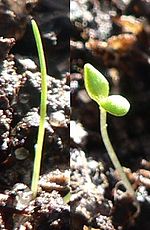
In the case of dicot seedlings whose cotyledons are photosynthetic, the cotyledons are functionally similar to leaves. However, true leaves and cotyledons are developmentally distinct. Cotyledons are formed during embryogenesis, along with the root and shoot meristems, and are therefore present in the seed prior to germination. True leaves, however, are formed post-embryonically (i.e. after germination) from the shoot apical meristem, which is responsible for generating subsequent aerial portions of the plant.
The cotyledon of grasses
Poaceae
The Poaceae is a large and nearly ubiquitous family of flowering plants. Members of this family are commonly called grasses, although the term "grass" is also applied to plants that are not in the Poaceae lineage, including the rushes and sedges...
and many other monocotyledons is a highly modified leaf composed of a scutellum
Scutellum (botany)
The scutellum is part of the structure of a barley seed—the modified seed leaf.The scutellum can also refer to the equivalence of a thin cotyledon in monocots...
and a coleoptile
Coleoptile
Coleoptile is the pointed protective sheath covering the emerging shoot in monocotyledons such as oats and grasses. Coleoptiles have two vascular bundles, one on either side. Unlike the flag leaves rolled up within, the pre-emergent coleoptile does not accumulate significant protochlorophyll or...
. The scutellum is a tissue within the seed that is specialized to absorb stored food from the adjacent endosperm
Endosperm
Endosperm is the tissue produced inside the seeds of most flowering plants around the time of fertilization. It surrounds the embryo and provides nutrition in the form of starch, though it can also contain oils and protein. This makes endosperm an important source of nutrition in human diet...
. The coleoptile is a protective cap that covers the plumule (precursor to the stem and leaves of the plant).
| Features | Monocotyledon | Dicotyledon |
|---|---|---|
| Leaf structure | Parallel veins | Network veins |
| Roots | Fibrous roots | Tap roots |
| Stem | Soft | Hard |
| No. of cotyledons | 1 | 2 |
| Number of petals | Divisible by 3 | Divisible by 4 or 5 |
Gymnosperm
Gymnosperm
The gymnosperms are a group of seed-bearing plants that includes conifers, cycads, Ginkgo, and Gnetales. The term "gymnosperm" comes from the Greek word gymnospermos , meaning "naked seeds", after the unenclosed condition of their seeds...
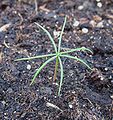
seedlings also have cotyledons, and these are often variable in number (multicotyledonous), with from 2 to 24 cotyledons forming a whorl at the top of the hypocotyl
Hypocotyl
The hypocotyl is the stem of a germinating seedling, found below the cotyledons and above the radicle .-Dicots:...
(the embryonic stem) surrounding the plumule. Within each species, there is often still some variation in cotyledon numbers, e.g. Monterey Pine
Monterey Pine
The Monterey Pine, Pinus radiata, family Pinaceae, also known as the Insignis Pine or Radiata Pine is a species of pine native to the Central Coast of California....
(Pinus radiata) seedlings have 5–9, and Jeffrey Pine
Jeffrey Pine
The Jeffrey Pine, Pinus jeffreyi, named in honor of its botanist documenter John Jeffrey, is a North American pine related to Ponderosa Pine.-Distribution and habitat:...
(Pinus jeffreyi) 7–13 (Mirov 1967), but other species are more fixed, with e.g. Mediterranean Cypress
Cupressus sempervirens
Cupressus sempervirens, the Mediterranean Cypress is a species of cypress native to the eastern Mediterranean region, in northeast Libya, southeast Greece , southern Turkey, Cyprus, Northern Egypt, western Syria, Lebanon, Israel, Malta, Italy, western Jordan, and also a disjunct population in...
always having just two cotyledons. The highest number reported is for Big-cone Pinyon
Big-cone Pinyon
Big-cone Pinyon is a pine in the pinyon pine group, native to central Mexico. The range is highly localised, confined to a small area of the southern Sierra Madre Occidental in southern Zacatecas...
(Pinus maximartinezii), with 24 (Farjon & Styles 1997).
_14d_1.jpg)
Seed
A seed is a small embryonic plant enclosed in a covering called the seed coat, usually with some stored food. It is the product of the ripened ovule of gymnosperm and angiosperm plants which occurs after fertilization and some growth within the mother plant...
. As these reserves are used up, the cotyledons may turn green and begin photosynthesis
Photosynthesis
Photosynthesis is a chemical process that converts carbon dioxide into organic compounds, especially sugars, using the energy from sunlight. Photosynthesis occurs in plants, algae, and many species of bacteria, but not in archaea. Photosynthetic organisms are called photoautotrophs, since they can...
, or may wither as the first true leaves take over food production for the seedling.
Epigeal versus hypogeal development
Cotyledons may be either epigealEpigeal
Epigeal, epigean, epigeic and epigeous are biological terms describing an organism's activity above the soil surface.In botany, a seed is described as epigeal when the cotyledons of the germinating seed expand, throw off the seed shell and become photosynthetic above the ground...
, expanding on the germination of the seed, throwing off the seed shell, rising above the ground, and perhaps becoming photosynthetic; or hypogeal
Hypogeal
Hypogeal means "underground".* In botany, a seed is described as hypogeal when the cotyledons of the germinating seed remain non-photosynthetic, inside the seed shell, and below ground...
, not expanding, remaining below ground and not becoming photosynthetic. The latter is typically the case where the cotyledons act as a storage organ, as in many nuts
Nut (fruit)
A nut is a hard-shelled fruit of some plants having an indehiscent seed. While a wide variety of dried seeds and fruits are called nuts in English, only a certain number of them are considered by biologists to be true nuts...
and acorn
Acorn
The acorn, or oak nut, is the nut of the oaks and their close relatives . It usually contains a single seed , enclosed in a tough, leathery shell, and borne in a cup-shaped cupule. Acorns vary from 1–6 cm long and 0.8–4 cm broad...
s.
Hypogeal plants have (on average) significantly larger seeds than epigeal ones. They also are capable of surviving if the seedling is clipped off, as meristem
Meristem
A meristem is the tissue in most plants consisting of undifferentiated cells , found in zones of the plant where growth can take place....
buds remain underground (with epigeal plants, the meristem is clipped off if the seedling is grazed). The tradeoff is whether the plant should produce a large number of small seeds, or a smaller number of seeds which are more likely to survive.
Related plants show a mixture of hypogeal and epigeal development, even within the same plant family. Groups which contain both hypogeal and epigeal species include, for example, the Araucariaceae
Araucariaceae
Araucariaceae, commonly referred to as araucarians, is a very ancient family of coniferous trees. It achieved its maximum diversity in the Jurassic and Cretaceous periods, when it was distributed almost worldwide...
family of Southern Hemisphere conifers, the Fabaceae
Fabaceae
The Fabaceae or Leguminosae, commonly known as the legume, pea, or bean family, is a large and economically important family of flowering plants. The group is the third largest land plant family, behind only the Orchidaceae and Asteraceae, with 730 genera and over 19,400 species...
(pea family), and the genus Lilium
Lilium
Lilium is a genus of herbaceous flowering plants growing from bulbs. Most species are native to the temperate northern hemisphere, though the range extends into the northern subtropics...
(see Lily seed germination types
Lily Seed Germination Types
Lilies seed germination is classified as either epigeal or hypogeal. These classifications may be further refined as immediate or delayed. Whether a lily is epigeal or hypogeal may be related to survival strategies developed according to the climate where the lily originated. Epigeal lilies...
).
History
The term cotyledon was coined by Marcello MalpighiMarcello Malpighi
Marcello Malpighi was an Italian doctor, who gave his name to several physiological features, like the Malpighian tubule system.-Early years:...
. John Ray
John Ray
John Ray was an English naturalist, sometimes referred to as the father of English natural history. Until 1670, he wrote his name as John Wray. From then on, he used 'Ray', after "having ascertained that such had been the practice of his family before him".He published important works on botany,...
was the first botanist to recognise that some plants have two and others only one, and eventually the first to recognise the immense importance of this fact to systematics
Systematics
Biological systematics is the study of the diversification of terrestrial life, both past and present, and the relationships among living things through time. Relationships are visualized as evolutionary trees...
.