

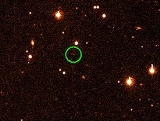
90377 Sedna

Encyclopedia
90377 Sedna is a trans-Neptunian object
discovered in 2003, which was about three times as far from the Sun
as Neptune
. For most of its orbit it is even further from the Sun, with its aphelion
estimated at 960 astronomical unit
s (32 times Neptune's distance), making it one of the most distant known objects in the Solar System
other than long-period comets.
It is thought to be "nearly certainly" a dwarf planet
, though the IAU has not formally designated it as such. Though roughly two-thirds the size of Pluto
, its distance from the Sun makes determining its shape, and thus demonstrating that it is in hydrostatic equilibrium
, difficult. Spectroscopy
has revealed that Sedna's surface composition is similar to that of some other trans-Neptunian objects, being largely a mixture of water, methane
and nitrogen
ices
with tholin
s. Its surface is one of the reddest in the Solar System.
Sedna's exceptionally long and elongated orbit, taking approximately 11,400 years to complete, and distant point of closest approach to the Sun, at 76 AU, have led to much speculation as to its origin. The Minor Planet Center
currently places Sedna in the scattered disc
, a group of objects sent into highly elongated orbits by the gravitational influence of Neptune. However, this classification has been contested, as Sedna never comes close enough to Neptune to have been scattered by it, leading some astronomers to conclude that it is in fact the first known member of the inner Oort cloud
. Others speculate that it might have been tugged into its current orbit by a passing star, perhaps one within the Sun's birth cluster
, or even that it was captured from another star system. Another hypothesis suggests that its orbit may be evidence for a large planet beyond the orbit of Neptune
. Astronomer Michael E. Brown
, co-discoverer of Sedna and the dwarf planets , , and , believes it to be the most scientifically important trans-Neptunian object found to date, as understanding its unusual orbit is likely to yield valuable information about the origin and early evolution of the Solar System.
(Caltech
), Chad Trujillo
(Gemini Observatory
) and David Rabinowitz
(Yale University
) on November 14, 2003. The discovery formed part of a survey begun in 2001 with the Samuel Oschin telescope
at Palomar Observatory
near San Diego
, California
using Yale's 160 megapixel Palomar Quest camera. On that day, an object was observed to move by 4.6 arcseconds
over 3.1 hours relative to stars, which indicated that its distance was about 100 AU. Follow-up observations in November–December 2003 with the SMARTS telescope at Cerro Tololo Inter-American Observatory
in Chile
as well as with the Tenagra IV telescope at the W. M. Keck Observatory in Hawaii
revealed that the object was moving along a distant highly eccentric
orbit. Later the object was identified on older precovery
images made by the Samuel Oschin telescope as well as on images from the Near Earth Asteroid Tracking
consortium. These previous positions expanded its known orbital arc and allowed a more precise calculation of its orbit.
"Our newly discovered object is the coldest most distant place known in the Solar System," said Mike Brown on his website, "so we feel it is appropriate to name it in honor of Sedna, the Inuit goddess
of the sea, who is thought to live at the bottom of the frigid Arctic Ocean
." Brown also suggested to the International Astronomical Union
's (IAU) Minor Planet Center that any future objects discovered in Sedna's orbital region should also be named after entities in arctic mythologies. The team made the name "Sedna" public before the object had been officially numbered. Brian Marsden, the head of the Minor Planet Center, said that such an action was a violation of protocol, and that some members of the IAU might vote against it. However, no objection was raised to the name, and no competing names were suggested. The IAU's Committee on Small Body Nomenclature formally accepted the name in September 2004, and also considered that, in similar cases of extraordinary interest, it might in the future allow names to be announced before they were officially numbered.
, Sedna has the longest orbital period
of any known object in the Solar System, calculated at around 11,400 years. Its orbit
is extremely eccentric
, with an aphelion estimated at 937 AU and a perihelion
at about 76 AU, the most distant perihelion ever observed for any Solar System object. At its discovery it was approaching perihelion at 89.6 AU from the Sun, and was the most distant object in the Solar System yet observed. Eris
was later detected by the same survey at 97 AU. Although the orbits of some long-period comets extend farther than that of Sedna, they are too dim to be discovered except when approaching perihelion in the inner Solar System. Even as Sedna nears its perihelion in mid 2076, the Sun would appear merely as a very bright star in its sky, only 100 times brighter than a full Moon on Earth, and too far away to be visible as a disc to the naked eye.
When first discovered, Sedna was thought to have an unusually long rotational period (20 to 50 days). It was initially speculated that Sedna's rotation was slowed by the gravitational pull of a large binary companion, similar to Pluto's moon Charon. A search for such a satellite by the Hubble Space Telescope
in March 2004 found nothing, and subsequent measurements from the MMT
telescope suggest a much shorter rotation period of about 10 hours; rather typical for a body of its size.
of 0.16 to 0.30, thus giving it a diameter between 1,200 and 1,600 km. At the time of its discovery it was the largest object found in the Solar System since Pluto in 1930. Mike Brown and colleagues now believe it to be the fifth largest known trans-Neptunian object
after Eris, Pluto, , and . In 2004, the discoverers placed an upper limit of 1,800 km on its diameter, but by 2007 this was revised downward to less than 1,600 km after observation by the Spitzer Space Telescope
. As Sedna has no known moons, determining its mass is very difficult. However, if the above estimates for its diameter are coupled with Pluto's density of 2.0 g/cm3, the resultant estimated mass range is 1.8–4.3 x 10²¹ kg.
Observations from the SMARTS telescope show that in visible light Sedna is one of the reddest objects in the Solar System, nearly as red as Mars
. Chad Trujillo and his colleagues suggest that Sedna's dark red colour is caused by a surface coating of hydrocarbon
sludge, or tholin
, formed from simpler organic compounds after long exposure to ultraviolet
radiation. Its surface is homogeneous in colour and spectrum
; this may be because Sedna, unlike objects nearer the Sun, is rarely impacted by other bodies, which would expose bright patches of fresh icy material like that on 8405 Asbolus
. Sedna and two other very distant objects ( and ) share their colour with outer classical Kuiper belt objects and the centaur
5145 Pholus
, suggesting a similar region of origin.
Trujillo and colleagues have placed upper limits in Sedna's surface composition of 60% for methane ice and 70% for water ice. The presence of methane further supports the existence of tholins on Sedna's surface, as they are produced by irradiation of methane. Barucci and colleagues compared Sedna's spectrum with that of Triton
and detected weak absorption bands belonging to methane and nitrogen ices. From these observations, they suggested the following model of the surface: 24% Triton-type tholin
s, 7% amorphous carbon
, 10% nitrogen, 26% methanol
and 33% methane. The detection of methane and water ices was confirmed in 2006 by Spitzer Space Telescope mid-infrared photometry. The presence of nitrogen on the surface suggests the possibility that, at least for a short time, Sedna may possess an atmosphere. During a 200-year period near perihelion the maximum temperature on Sedna should exceed 35.6 kelvin (-237.6 °C), the transition temperature between alpha-phase solid N2 and the beta phase seen on Triton. At 38 K the N2 vapor pressure
would be 14 microbar (0.000014 Atmospheres). However, its deep red spectral slope
is indicative of high concentrations of organic material
on its surface, and its weak methane absorption bands indicate that methane on Sedna's surface is ancient, rather than freshly deposited. This means that Sedna is too cold for methane to evaporate from its surface and then fall back as snow, as happens on Triton and probably on Pluto.
Models of internal heating via radioactive decay
suggest that Sedna might be capable of supporting a subsurface ocean of liquid water.
s thought to exist nearly a light-year from the Sun. They observed that, unlike scattered disc
objects such as Eris
, Sedna's perihelion (76 AU) is too distant for it to have been scattered by the gravitational influence of Neptune. Because it is a great deal closer to the Sun than was expected for an Oort cloud object, and has an inclination
roughly in line with the planets and the Kuiper belt, they described the planetoid as being an "inner Oort cloud object", situated in the disc reaching from the Kuiper belt to the spherical part of the cloud.
If Sedna formed in its current location, the Sun's original protoplanetary disc must have extended as far as 11 billion km into space. Also, Sedna's initial orbit must have been circular, otherwise its formation by the accretion
of smaller bodies into a whole would not have been possible, as the large relative velocities
between planetesimals would have been too disruptive. Therefore, it must have been tugged into its current eccentric orbit by a gravitational interaction with another body. In their initial paper, Brown, Rabinowitz and colleagues suggested three possible candidates for the perturbing body: an unseen planet beyond the Kuiper belt, a single passing star, or one of the young stars embedded with the Sun in the stellar cluster in which it formed.
Mike Brown and his team favored the hypothesis that Sedna was lifted into its current orbit by a star from the Sun's birth cluster, arguing that Sedna's aphelion of about 1,000 AU, which is relatively close compared to those of long period comets, is not distant enough to be affected by passing stars at their current distances from the Sun. They propose that Sedna's orbit is best explained by the Sun having formed in an open cluster
of several stars that gradually disassociated over time. That hypothesis has also been advanced by both Alessandro Morbidelli
and Scott J. Kenyon. Computer simulations by Julio A. Fernandez and Adrian Brunini suggest that multiple close passes by young stars in such a cluster would pull many objects into Sedna-like orbits. A study by Morbidelli and Hal Levison suggested that the most likely explanation for Sedna's orbit was that it had been perturbed by a close (approximately 800 AU) pass by another star in the first 100 million years or so of the Solar System's existence.
The trans-Neptunian planet hypothesis has been advanced in several forms by a number of astronomers, including Gomes and Patryk Lykawka. One scenario involves perturbations of Sedna's orbit by a hypothetical planetary-sized body in the inner Oort cloud. Recent simulations show that Sedna's orbital traits could be explained by perturbations by a Neptune-mass object at 2,000 AU (or less), a Jupiter-mass at 5,000 AU, or even an Earth-mass object at 1,000 AU. Computer simulations by Patryk Lykawka have suggested that Sedna's orbit may have been caused by a body roughly the size of Earth, ejected outward by Neptune early in the Solar System's formation and currently in an elongated orbit between 80 and 170 AU from the Sun. Mike Brown's various sky surveys have not detected any Earth-sized objects out to a distance of about 100 AU. However, it is possible that such an object may have been scattered out of the Solar System after the formation of the inner Oort cloud.
It has been suggested that Sedna's orbit is the result of influence by a large binary companion to the Sun, thousands of AU distant. One such hypothetical companion is Nemesis
, a dim companion to the Sun which has been proposed to be responsible for the supposed periodicity of mass extinctions
on Earth from cometary impacts, the lunar impact record, and the common orbital elements of a number of long period comets. However, to date no direct evidence of Nemesis has been found, and many lines of evidence (such as crater counts
), have thrown its existence into doubt. John J. Matese and Daniel P. Whitmire, longtime proponents of the possibility of a wide binary companion to the Sun, have suggested that an object of five times the mass of Jupiter lying at roughly 7850 AU from the Sun could produce a body in Sedna's orbit.
Morbidelli and Kenyon have also suggested that Sedna did not originate in our Solar System, but was captured by the Sun from a passing extrasolar planetary system
, specifically that of a brown dwarf
about 20 times less massive than the Sun
.
Each of the proposed mechanisms for Sedna's extreme orbit would leave a distinct mark on the structure and dynamics of any wider population. If a trans-Neptunian planet was responsible, all such objects would share roughly the same perihelion (~80 AU). If Sedna were captured from another planetary system that rotated in the same direction as the Solar System, then Sedna's population would all possess relatively low inclinations and possess semi-major axes
ranging from 100–500 AU. If it rotated in the opposite direction, then two populations would form, one with low inclinations and one with high. The gravity of perturbing stars would produce a wide variety of perihelia and inclinations, each dependent on the number and angle of such encounters.
Gaining a larger sample of such objects could therefore help in determining which scenario is most likely. "I call Sedna a fossil record of the earliest Solar System", said Brown in 2006. "Eventually, when other fossil records are found, Sedna will help tell us how the Sun formed and the number of stars that were close to the Sun when it formed." A 2007–2008 survey by Brown, Rabinowitz and Megan Schwamb attempted to locate another member of Sedna's hypothetical population. Although the survey was sensitive to movement out to 1,000 AU and discovered the dwarf planet candidate , it detected no new bodies in Sedna-like orbits. Subsequent simulations incorporating the new data suggested about 40 Sedna-sized objects probably exist in this region.
, which officially catalogs the objects in the Solar System, classifies Sedna as a scattered object. However, this grouping is heavily questioned, and many astronomers have suggested that it, together with a few other objects (e.g. ), be placed in a new category of distant objects named extended scattered disc objects (E-SDO), detached objects, distant detached objects (DDO) or scattered-extended in the formal classification by the Deep Ecliptic Survey
.
The discovery of Sedna resurrected the question of which astronomical objects should be considered planet
s and which should not. On March 15, 2004, articles on Sedna in the popular press reported that a tenth planet had been discovered. This question was answered under the International Astronomical Union
definition of a planet, adopted on August 24, 2006, which mandated that a planet must have cleared the neighborhood around its orbit. Sedna has a Stern–Levison parameter estimated to be much less than 1, and therefore cannot be considered to have cleared the neighborhood, even though no other objects have yet been discovered in its vicinity. To qualify as a dwarf planet, Sedna must be shown to be in hydrostatic equilibrium
. It is bright enough, and therefore large enough, that this is expected to be the case.
Trans-Neptunian object
A trans-Neptunian object is any minor planet in the Solar System that orbits the Sun at a greater distance on average than Neptune.The first trans-Neptunian object to be discovered was Pluto in 1930...
discovered in 2003, which was about three times as far from the Sun
Sun
The Sun is the star at the center of the Solar System. It is almost perfectly spherical and consists of hot plasma interwoven with magnetic fields...
as Neptune
Neptune
Neptune is the eighth and farthest planet from the Sun in the Solar System. Named for the Roman god of the sea, it is the fourth-largest planet by diameter and the third largest by mass. Neptune is 17 times the mass of Earth and is slightly more massive than its near-twin Uranus, which is 15 times...
. For most of its orbit it is even further from the Sun, with its aphelion
Apsis
An apsis , plural apsides , is the point of greatest or least distance of a body from one of the foci of its elliptical orbit. In modern celestial mechanics this focus is also the center of attraction, which is usually the center of mass of the system...
estimated at 960 astronomical unit
Astronomical unit
An astronomical unit is a unit of length equal to about or approximately the mean Earth–Sun distance....
s (32 times Neptune's distance), making it one of the most distant known objects in the Solar System
Solar System
The Solar System consists of the Sun and the astronomical objects gravitationally bound in orbit around it, all of which formed from the collapse of a giant molecular cloud approximately 4.6 billion years ago. The vast majority of the system's mass is in the Sun...
other than long-period comets.
It is thought to be "nearly certainly" a dwarf planet
Dwarf planet
A dwarf planet, as defined by the International Astronomical Union , is a celestial body orbiting the Sun that is massive enough to be spherical as a result of its own gravity but has not cleared its neighboring region of planetesimals and is not a satellite...
, though the IAU has not formally designated it as such. Though roughly two-thirds the size of Pluto
Pluto
Pluto, formal designation 134340 Pluto, is the second-most-massive known dwarf planet in the Solar System and the tenth-most-massive body observed directly orbiting the Sun...
, its distance from the Sun makes determining its shape, and thus demonstrating that it is in hydrostatic equilibrium
Hydrostatic equilibrium
Hydrostatic equilibrium or hydrostatic balance is the condition in fluid mechanics where a volume of a fluid is at rest or at constant velocity. This occurs when compression due to gravity is balanced by a pressure gradient force...
, difficult. Spectroscopy
Spectroscopy
Spectroscopy is the study of the interaction between matter and radiated energy. Historically, spectroscopy originated through the study of visible light dispersed according to its wavelength, e.g., by a prism. Later the concept was expanded greatly to comprise any interaction with radiative...
has revealed that Sedna's surface composition is similar to that of some other trans-Neptunian objects, being largely a mixture of water, methane
Methane
Methane is a chemical compound with the chemical formula . It is the simplest alkane, the principal component of natural gas, and probably the most abundant organic compound on earth. The relative abundance of methane makes it an attractive fuel...
and nitrogen
Nitrogen
Nitrogen is a chemical element that has the symbol N, atomic number of 7 and atomic mass 14.00674 u. Elemental nitrogen is a colorless, odorless, tasteless, and mostly inert diatomic gas at standard conditions, constituting 78.08% by volume of Earth's atmosphere...
ices
Volatiles
In planetary science, volatiles are that group of chemical elements and chemical compounds with low boiling points that are associated with a planet's or moon's crust and/or atmosphere. Examples include nitrogen, water, carbon dioxide, ammonia, hydrogen, and methane, all compounds of C, H, O...
with tholin
Tholin
Tholin [after the ancient Greek word meaning "not clear"] is a heteropolymer molecule formed by solar ultraviolet irradiation of simple organic compounds such as methane or ethane. Tholins do not form naturally on modern-day Earth, but are found in great abundance on the surface of icy bodies in...
s. Its surface is one of the reddest in the Solar System.
Sedna's exceptionally long and elongated orbit, taking approximately 11,400 years to complete, and distant point of closest approach to the Sun, at 76 AU, have led to much speculation as to its origin. The Minor Planet Center
Minor Planet Center
The Minor Planet Center operates at the Smithsonian Astrophysical Observatory , which is part of the Center for Astrophysics along with the Harvard College Observatory ....
currently places Sedna in the scattered disc
Scattered disc
The scattered disc is a distant region of the Solar System that is sparsely populated by icy minor planets, a subset of the broader family of trans-Neptunian objects. The scattered-disc objects have orbital eccentricities ranging as high as 0.8, inclinations as high as 40°, and perihelia greater...
, a group of objects sent into highly elongated orbits by the gravitational influence of Neptune. However, this classification has been contested, as Sedna never comes close enough to Neptune to have been scattered by it, leading some astronomers to conclude that it is in fact the first known member of the inner Oort cloud
Oort cloud
The Oort cloud , or the Öpik–Oort cloud , is a hypothesized spherical cloud of comets which may lie roughly 50,000 AU, or nearly a light-year, from the Sun. This places the cloud at nearly a quarter of the distance to Proxima Centauri, the nearest star to the Sun...
. Others speculate that it might have been tugged into its current orbit by a passing star, perhaps one within the Sun's birth cluster
Open cluster
An open cluster is a group of up to a few thousand stars that were formed from the same giant molecular cloud and have roughly the same age. More than 1,100 open clusters have been discovered within the Milky Way Galaxy, and many more are thought to exist...
, or even that it was captured from another star system. Another hypothesis suggests that its orbit may be evidence for a large planet beyond the orbit of Neptune
Planets beyond Neptune
Following the discovery of the planet Neptune in 1846, there was considerable speculation that another planet might exist beyond its orbit. The search began in the mid-19th century but culminated at the start of the 20th with Percival Lowell's quest for Planet X...
. Astronomer Michael E. Brown
Michael E. Brown
Michael E. Brown has been a professor of planetary astronomy at the California Institute of Technology since 2003....
, co-discoverer of Sedna and the dwarf planets , , and , believes it to be the most scientifically important trans-Neptunian object found to date, as understanding its unusual orbit is likely to yield valuable information about the origin and early evolution of the Solar System.
Discovery and naming
Sedna (provisionally designated ) was discovered by Mike BrownMichael E. Brown
Michael E. Brown has been a professor of planetary astronomy at the California Institute of Technology since 2003....
(Caltech
California Institute of Technology
The California Institute of Technology is a private research university located in Pasadena, California, United States. Caltech has six academic divisions with strong emphases on science and engineering...
), Chad Trujillo
Chad Trujillo
Chadwick A. "Chad" Trujillo is an astronomer and the co-discoverer of the dwarf planet Eris.Trujillo works with computer software and has examined the orbits of the numerous trans-Neptunian objects , which is the outer area of the solar system that he specialized in. In late August 2005, it was...
(Gemini Observatory
Gemini Observatory
The Gemini Observatory is an astronomical observatory consisting of two telescopes at sites in Hawai‘i and Chile. Together, the twin Gemini telescopes provide almost complete coverage of both the northern and southern skies...
) and David Rabinowitz
David L. Rabinowitz
David Lincoln Rabinowitz is a researcher at Yale University. He has built CCD cameras and software for the detection of near-Earth asteroids and Kuiper Belt Objects, and his research has helped reduce the assumed number of near-Earth asteroids by half, from 1,000-2,000 to 500-1,000 He has also...
(Yale University
Yale University
Yale University is a private, Ivy League university located in New Haven, Connecticut, United States. Founded in 1701 in the Colony of Connecticut, the university is the third-oldest institution of higher education in the United States...
) on November 14, 2003. The discovery formed part of a survey begun in 2001 with the Samuel Oschin telescope
Samuel Oschin telescope
The Samuel Oschin telescope is a 48-inch aperture Schmidt camera at the Palomar Observatory in northern San Diego County, California. It consists of a 49.75-inch Schmidt corrector plate and a 72-inch mirror. The instrument is strictly a camera; there is no provision for an eyepiece to look...
at Palomar Observatory
Palomar Observatory
Palomar Observatory is a privately owned observatory located in San Diego County, California, southeast of Pasadena's Mount Wilson Observatory, in the Palomar Mountain Range. At approximately elevation, it is owned and operated by the California Institute of Technology...
near San Diego
San Diego, California
San Diego is the eighth-largest city in the United States and second-largest city in California. The city is located on the coast of the Pacific Ocean in Southern California, immediately adjacent to the Mexican border. The birthplace of California, San Diego is known for its mild year-round...
, California
California
California is a state located on the West Coast of the United States. It is by far the most populous U.S. state, and the third-largest by land area...
using Yale's 160 megapixel Palomar Quest camera. On that day, an object was observed to move by 4.6 arcseconds
Minute of arc
A minute of arc, arcminute, or minute of angle , is a unit of angular measurement equal to one sixtieth of one degree. In turn, a second of arc or arcsecond is one sixtieth of one minute of arc....
over 3.1 hours relative to stars, which indicated that its distance was about 100 AU. Follow-up observations in November–December 2003 with the SMARTS telescope at Cerro Tololo Inter-American Observatory
Cerro Tololo Inter-American Observatory
The Cerro Tololo Inter-American Observatory is a complex of astronomical telescopes and instruments located at 30.169 S, 70.804 W, approximately 80 km to the East of La Serena, Chile at an altitude of 2200 metres. The complex is part of the National Optical Astronomy Observatory along with Kitt...
in Chile
Chile
Chile ,officially the Republic of Chile , is a country in South America occupying a long, narrow coastal strip between the Andes mountains to the east and the Pacific Ocean to the west. It borders Peru to the north, Bolivia to the northeast, Argentina to the east, and the Drake Passage in the far...
as well as with the Tenagra IV telescope at the W. M. Keck Observatory in Hawaii
Hawaii
Hawaii is the newest of the 50 U.S. states , and is the only U.S. state made up entirely of islands. It is the northernmost island group in Polynesia, occupying most of an archipelago in the central Pacific Ocean, southwest of the continental United States, southeast of Japan, and northeast of...
revealed that the object was moving along a distant highly eccentric
Orbital eccentricity
The orbital eccentricity of an astronomical body is the amount by which its orbit deviates from a perfect circle, where 0 is perfectly circular, and 1.0 is a parabola, and no longer a closed orbit...
orbit. Later the object was identified on older precovery
Precovery
Precovery is a term used in astronomy that describes the process of finding the image of an object in old archived images or photographic plates, for the purpose of calculating a more accurate orbit...
images made by the Samuel Oschin telescope as well as on images from the Near Earth Asteroid Tracking
Near Earth Asteroid Tracking
Near-Earth Asteroid Tracking is a program run by NASA and Jet Propulsion Laboratory to discover near-Earth objects. The NEAT project began in December 1995 and ran until April 2007.-History:...
consortium. These previous positions expanded its known orbital arc and allowed a more precise calculation of its orbit.
"Our newly discovered object is the coldest most distant place known in the Solar System," said Mike Brown on his website, "so we feel it is appropriate to name it in honor of Sedna, the Inuit goddess
Inuit mythology
Inuit mythology has many similarities to the religions of other polar regions. Inuit traditional religious practices could be very briefly summarised as a form of shamanism based on animist principles....
of the sea, who is thought to live at the bottom of the frigid Arctic Ocean
Arctic Ocean
The Arctic Ocean, located in the Northern Hemisphere and mostly in the Arctic north polar region, is the smallest and shallowest of the world's five major oceanic divisions...
." Brown also suggested to the International Astronomical Union
International Astronomical Union
The International Astronomical Union IAU is a collection of professional astronomers, at the Ph.D. level and beyond, active in professional research and education in astronomy...
's (IAU) Minor Planet Center that any future objects discovered in Sedna's orbital region should also be named after entities in arctic mythologies. The team made the name "Sedna" public before the object had been officially numbered. Brian Marsden, the head of the Minor Planet Center, said that such an action was a violation of protocol, and that some members of the IAU might vote against it. However, no objection was raised to the name, and no competing names were suggested. The IAU's Committee on Small Body Nomenclature formally accepted the name in September 2004, and also considered that, in similar cases of extraordinary interest, it might in the future allow names to be announced before they were officially numbered.
Orbit and rotation
Barring comets and a handful of small Solar System bodiesSmall Solar System body
A small Solar System body is an object in the Solar System that is neither a planet nor a dwarf planet, nor a satellite of a planet or dwarf planet:...
, Sedna has the longest orbital period
Orbital period
The orbital period is the time taken for a given object to make one complete orbit about another object.When mentioned without further qualification in astronomy this refers to the sidereal period of an astronomical object, which is calculated with respect to the stars.There are several kinds of...
of any known object in the Solar System, calculated at around 11,400 years. Its orbit
Orbit
In physics, an orbit is the gravitationally curved path of an object around a point in space, for example the orbit of a planet around the center of a star system, such as the Solar System...
is extremely eccentric
Orbital eccentricity
The orbital eccentricity of an astronomical body is the amount by which its orbit deviates from a perfect circle, where 0 is perfectly circular, and 1.0 is a parabola, and no longer a closed orbit...
, with an aphelion estimated at 937 AU and a perihelion
Apsis
An apsis , plural apsides , is the point of greatest or least distance of a body from one of the foci of its elliptical orbit. In modern celestial mechanics this focus is also the center of attraction, which is usually the center of mass of the system...
at about 76 AU, the most distant perihelion ever observed for any Solar System object. At its discovery it was approaching perihelion at 89.6 AU from the Sun, and was the most distant object in the Solar System yet observed. Eris
Eris (dwarf planet)
Eris, formal designation 136199 Eris, is the most massive known dwarf planet in the Solar System and the ninth most massive body known to orbit the Sun directly...
was later detected by the same survey at 97 AU. Although the orbits of some long-period comets extend farther than that of Sedna, they are too dim to be discovered except when approaching perihelion in the inner Solar System. Even as Sedna nears its perihelion in mid 2076, the Sun would appear merely as a very bright star in its sky, only 100 times brighter than a full Moon on Earth, and too far away to be visible as a disc to the naked eye.
When first discovered, Sedna was thought to have an unusually long rotational period (20 to 50 days). It was initially speculated that Sedna's rotation was slowed by the gravitational pull of a large binary companion, similar to Pluto's moon Charon. A search for such a satellite by the Hubble Space Telescope
Hubble Space Telescope
The Hubble Space Telescope is a space telescope that was carried into orbit by a Space Shuttle in 1990 and remains in operation. A 2.4 meter aperture telescope in low Earth orbit, Hubble's four main instruments observe in the near ultraviolet, visible, and near infrared...
in March 2004 found nothing, and subsequent measurements from the MMT
MMT Observatory
The MMT Observatory is an astronomical observatory on the site of Fred Lawrence Whipple Observatory . The Whipple observatory complex is located on Mount Hopkins, Arizona, USA in the Santa Rita Mountains...
telescope suggest a much shorter rotation period of about 10 hours; rather typical for a body of its size.
Physical characteristics
Sedna has an absolute magnitude (H) of 1.6, and it is estimated to have an albedoAlbedo
Albedo , or reflection coefficient, is the diffuse reflectivity or reflecting power of a surface. It is defined as the ratio of reflected radiation from the surface to incident radiation upon it...
of 0.16 to 0.30, thus giving it a diameter between 1,200 and 1,600 km. At the time of its discovery it was the largest object found in the Solar System since Pluto in 1930. Mike Brown and colleagues now believe it to be the fifth largest known trans-Neptunian object
Trans-Neptunian object
A trans-Neptunian object is any minor planet in the Solar System that orbits the Sun at a greater distance on average than Neptune.The first trans-Neptunian object to be discovered was Pluto in 1930...
after Eris, Pluto, , and . In 2004, the discoverers placed an upper limit of 1,800 km on its diameter, but by 2007 this was revised downward to less than 1,600 km after observation by the Spitzer Space Telescope
Spitzer Space Telescope
The Spitzer Space Telescope , formerly the Space Infrared Telescope Facility is an infrared space observatory launched in 2003...
. As Sedna has no known moons, determining its mass is very difficult. However, if the above estimates for its diameter are coupled with Pluto's density of 2.0 g/cm3, the resultant estimated mass range is 1.8–4.3 x 10²¹ kg.
Observations from the SMARTS telescope show that in visible light Sedna is one of the reddest objects in the Solar System, nearly as red as Mars
Mars
Mars is the fourth planet from the Sun in the Solar System. The planet is named after the Roman god of war, Mars. It is often described as the "Red Planet", as the iron oxide prevalent on its surface gives it a reddish appearance...
. Chad Trujillo and his colleagues suggest that Sedna's dark red colour is caused by a surface coating of hydrocarbon
Hydrocarbon
In organic chemistry, a hydrocarbon is an organic compound consisting entirely of hydrogen and carbon. Hydrocarbons from which one hydrogen atom has been removed are functional groups, called hydrocarbyls....
sludge, or tholin
Tholin
Tholin [after the ancient Greek word meaning "not clear"] is a heteropolymer molecule formed by solar ultraviolet irradiation of simple organic compounds such as methane or ethane. Tholins do not form naturally on modern-day Earth, but are found in great abundance on the surface of icy bodies in...
, formed from simpler organic compounds after long exposure to ultraviolet
Ultraviolet
Ultraviolet light is electromagnetic radiation with a wavelength shorter than that of visible light, but longer than X-rays, in the range 10 nm to 400 nm, and energies from 3 eV to 124 eV...
radiation. Its surface is homogeneous in colour and spectrum
Spectrograph
A spectrograph is an instrument that separates an incoming wave into a frequency spectrum. There are several kinds of machines referred to as spectrographs, depending on the precise nature of the waves...
; this may be because Sedna, unlike objects nearer the Sun, is rarely impacted by other bodies, which would expose bright patches of fresh icy material like that on 8405 Asbolus
8405 Asbolus
8405 Asbolus is a centaur, that is, an icy asteroid that orbits between Jupiter and Neptune. It was discovered by James V. Scotti and Robert Jedicke of Spacewatch at Kitt Peak Observatory on April 5, 1995. It is named after Asbolus , a centaur in Greek mythology...
. Sedna and two other very distant objects ( and ) share their colour with outer classical Kuiper belt objects and the centaur
Centaur (planetoid)
Centaurs are an unstable orbital class of minor planets that behave with characteristics of both asteroids and comets. They are named after the mythological race of beings, centaurs, which were a mixture of horse and human...
5145 Pholus
5145 Pholus
5145 Pholus is a centaur in an eccentric orbit, with a perihelion less than Saturn's and aphelion greater than Neptune's. Pholus has not come within one astronomical unit of a planet since 764 BC, and will not until 5290. It is believed that Pholus originated as a Kuiper belt object.It was...
, suggesting a similar region of origin.
Trujillo and colleagues have placed upper limits in Sedna's surface composition of 60% for methane ice and 70% for water ice. The presence of methane further supports the existence of tholins on Sedna's surface, as they are produced by irradiation of methane. Barucci and colleagues compared Sedna's spectrum with that of Triton
Triton (moon)
Triton is the largest moon of the planet Neptune, discovered on October 10, 1846, by English astronomer William Lassell. It is the only large moon in the Solar System with a retrograde orbit, which is an orbit in the opposite direction to its planet's rotation. At 2,700 km in diameter, it is...
and detected weak absorption bands belonging to methane and nitrogen ices. From these observations, they suggested the following model of the surface: 24% Triton-type tholin
Tholin
Tholin [after the ancient Greek word meaning "not clear"] is a heteropolymer molecule formed by solar ultraviolet irradiation of simple organic compounds such as methane or ethane. Tholins do not form naturally on modern-day Earth, but are found in great abundance on the surface of icy bodies in...
s, 7% amorphous carbon
Amorphous carbon
Amorphous carbon or free, reactive carbon, is an allotrope of carbon that does not have any crystalline structure. As with all glassy materials, some short-range order can be observed...
, 10% nitrogen, 26% methanol
Methanol
Methanol, also known as methyl alcohol, wood alcohol, wood naphtha or wood spirits, is a chemical with the formula CH3OH . It is the simplest alcohol, and is a light, volatile, colorless, flammable liquid with a distinctive odor very similar to, but slightly sweeter than, ethanol...
and 33% methane. The detection of methane and water ices was confirmed in 2006 by Spitzer Space Telescope mid-infrared photometry. The presence of nitrogen on the surface suggests the possibility that, at least for a short time, Sedna may possess an atmosphere. During a 200-year period near perihelion the maximum temperature on Sedna should exceed 35.6 kelvin (-237.6 °C), the transition temperature between alpha-phase solid N2 and the beta phase seen on Triton. At 38 K the N2 vapor pressure
Vapor pressure
Vapor pressure or equilibrium vapor pressure is the pressure of a vapor in thermodynamic equilibrium with its condensed phases in a closed system. All liquids have a tendency to evaporate, and some solids can sublimate into a gaseous form...
would be 14 microbar (0.000014 Atmospheres). However, its deep red spectral slope
Spectral slope
In astrophysics and planetary science, spectral slope, also called spectral gradient , is a measure of dependence of the reflectance on the wavelength....
is indicative of high concentrations of organic material
Organic chemistry
Organic chemistry is a subdiscipline within chemistry involving the scientific study of the structure, properties, composition, reactions, and preparation of carbon-based compounds, hydrocarbons, and their derivatives...
on its surface, and its weak methane absorption bands indicate that methane on Sedna's surface is ancient, rather than freshly deposited. This means that Sedna is too cold for methane to evaporate from its surface and then fall back as snow, as happens on Triton and probably on Pluto.
Models of internal heating via radioactive decay
Radioactive decay
Radioactive decay is the process by which an atomic nucleus of an unstable atom loses energy by emitting ionizing particles . The emission is spontaneous, in that the atom decays without any physical interaction with another particle from outside the atom...
suggest that Sedna might be capable of supporting a subsurface ocean of liquid water.
Origin
In their paper announcing the discovery of Sedna, Mike Brown and his colleagues described it as the first observed body belonging to the Oort cloud, the hypothetical cloud of cometComet
A comet is an icy small Solar System body that, when close enough to the Sun, displays a visible coma and sometimes also a tail. These phenomena are both due to the effects of solar radiation and the solar wind upon the nucleus of the comet...
s thought to exist nearly a light-year from the Sun. They observed that, unlike scattered disc
Scattered disc
The scattered disc is a distant region of the Solar System that is sparsely populated by icy minor planets, a subset of the broader family of trans-Neptunian objects. The scattered-disc objects have orbital eccentricities ranging as high as 0.8, inclinations as high as 40°, and perihelia greater...
objects such as Eris
Eris (dwarf planet)
Eris, formal designation 136199 Eris, is the most massive known dwarf planet in the Solar System and the ninth most massive body known to orbit the Sun directly...
, Sedna's perihelion (76 AU) is too distant for it to have been scattered by the gravitational influence of Neptune. Because it is a great deal closer to the Sun than was expected for an Oort cloud object, and has an inclination
Inclination
Inclination in general is the angle between a reference plane and another plane or axis of direction.-Orbits:The inclination is one of the six orbital parameters describing the shape and orientation of a celestial orbit...
roughly in line with the planets and the Kuiper belt, they described the planetoid as being an "inner Oort cloud object", situated in the disc reaching from the Kuiper belt to the spherical part of the cloud.
If Sedna formed in its current location, the Sun's original protoplanetary disc must have extended as far as 11 billion km into space. Also, Sedna's initial orbit must have been circular, otherwise its formation by the accretion
Accretion (astrophysics)
In astrophysics, the term accretion is used for at least two distinct processes.The first and most common is the growth of a massive object by gravitationally attracting more matter, typically gaseous matter in an accretion disc. Accretion discs are common around smaller stars or stellar remnants...
of smaller bodies into a whole would not have been possible, as the large relative velocities
Relative velocity
In non-relativistic kinematics, relative velocity is the vector difference between the velocities of two objects, as evaluated in terms of a single coordinate system....
between planetesimals would have been too disruptive. Therefore, it must have been tugged into its current eccentric orbit by a gravitational interaction with another body. In their initial paper, Brown, Rabinowitz and colleagues suggested three possible candidates for the perturbing body: an unseen planet beyond the Kuiper belt, a single passing star, or one of the young stars embedded with the Sun in the stellar cluster in which it formed.
Mike Brown and his team favored the hypothesis that Sedna was lifted into its current orbit by a star from the Sun's birth cluster, arguing that Sedna's aphelion of about 1,000 AU, which is relatively close compared to those of long period comets, is not distant enough to be affected by passing stars at their current distances from the Sun. They propose that Sedna's orbit is best explained by the Sun having formed in an open cluster
Open cluster
An open cluster is a group of up to a few thousand stars that were formed from the same giant molecular cloud and have roughly the same age. More than 1,100 open clusters have been discovered within the Milky Way Galaxy, and many more are thought to exist...
of several stars that gradually disassociated over time. That hypothesis has also been advanced by both Alessandro Morbidelli
Alessandro Morbidelli (astronomer)
Alessandro Morbidelli, born May 2, 1966, is an Italian astronomer and planetary scientist currently employed by the Observatoire de la Cote d'Azur in Nice....
and Scott J. Kenyon. Computer simulations by Julio A. Fernandez and Adrian Brunini suggest that multiple close passes by young stars in such a cluster would pull many objects into Sedna-like orbits. A study by Morbidelli and Hal Levison suggested that the most likely explanation for Sedna's orbit was that it had been perturbed by a close (approximately 800 AU) pass by another star in the first 100 million years or so of the Solar System's existence.
The trans-Neptunian planet hypothesis has been advanced in several forms by a number of astronomers, including Gomes and Patryk Lykawka. One scenario involves perturbations of Sedna's orbit by a hypothetical planetary-sized body in the inner Oort cloud. Recent simulations show that Sedna's orbital traits could be explained by perturbations by a Neptune-mass object at 2,000 AU (or less), a Jupiter-mass at 5,000 AU, or even an Earth-mass object at 1,000 AU. Computer simulations by Patryk Lykawka have suggested that Sedna's orbit may have been caused by a body roughly the size of Earth, ejected outward by Neptune early in the Solar System's formation and currently in an elongated orbit between 80 and 170 AU from the Sun. Mike Brown's various sky surveys have not detected any Earth-sized objects out to a distance of about 100 AU. However, it is possible that such an object may have been scattered out of the Solar System after the formation of the inner Oort cloud.
It has been suggested that Sedna's orbit is the result of influence by a large binary companion to the Sun, thousands of AU distant. One such hypothetical companion is Nemesis
Nemesis (star)
Nemesis is a hypothetical hard-to-detect red dwarf star, white dwarf star or brown dwarf, originally postulated in 1984 to be orbiting the Sun at a distance of about 95,000 AU , somewhat beyond the Oort cloud, to explain a perceived cycle of mass extinctions in the geological record, which seem to...
, a dim companion to the Sun which has been proposed to be responsible for the supposed periodicity of mass extinctions
Extinction event
An extinction event is a sharp decrease in the diversity and abundance of macroscopic life. They occur when the rate of extinction increases with respect to the rate of speciation...
on Earth from cometary impacts, the lunar impact record, and the common orbital elements of a number of long period comets. However, to date no direct evidence of Nemesis has been found, and many lines of evidence (such as crater counts
Crater counting
Crater counting is a method for estimating the age of a planet's surface. The method is based upon the assumptions that a new surface forms with zero impact craters, and that impact craters accumulate at some constant rate...
), have thrown its existence into doubt. John J. Matese and Daniel P. Whitmire, longtime proponents of the possibility of a wide binary companion to the Sun, have suggested that an object of five times the mass of Jupiter lying at roughly 7850 AU from the Sun could produce a body in Sedna's orbit.
Morbidelli and Kenyon have also suggested that Sedna did not originate in our Solar System, but was captured by the Sun from a passing extrasolar planetary system
Planetary system
A planetary system consists of the various non-stellar objects orbiting a star such as planets, dwarf planets , asteroids, meteoroids, comets, and cosmic dust...
, specifically that of a brown dwarf
Brown dwarf
Brown dwarfs are sub-stellar objects which are too low in mass to sustain hydrogen-1 fusion reactions in their cores, which is characteristic of stars on the main sequence. Brown dwarfs have fully convective surfaces and interiors, with no chemical differentiation by depth...
about 20 times less massive than the Sun
Solar mass
The solar mass , , is a standard unit of mass in astronomy, used to indicate the masses of other stars and galaxies...
.
Population
Sedna's highly elliptical orbit means that the probability of its detection was roughly 1 in 80, suggesting that, unless its discovery was a fluke, another 40–120 Sedna-sized objects would exist within its region. Another object, , has a similar but less extreme orbit: it has a perihelion of 44.3 AU, an aphelion of 394 AU, and an orbital period of 3,240 years. It may have been affected by the same processes as Sedna.Each of the proposed mechanisms for Sedna's extreme orbit would leave a distinct mark on the structure and dynamics of any wider population. If a trans-Neptunian planet was responsible, all such objects would share roughly the same perihelion (~80 AU). If Sedna were captured from another planetary system that rotated in the same direction as the Solar System, then Sedna's population would all possess relatively low inclinations and possess semi-major axes
Semi-major axis
The major axis of an ellipse is its longest diameter, a line that runs through the centre and both foci, its ends being at the widest points of the shape...
ranging from 100–500 AU. If it rotated in the opposite direction, then two populations would form, one with low inclinations and one with high. The gravity of perturbing stars would produce a wide variety of perihelia and inclinations, each dependent on the number and angle of such encounters.
Gaining a larger sample of such objects could therefore help in determining which scenario is most likely. "I call Sedna a fossil record of the earliest Solar System", said Brown in 2006. "Eventually, when other fossil records are found, Sedna will help tell us how the Sun formed and the number of stars that were close to the Sun when it formed." A 2007–2008 survey by Brown, Rabinowitz and Megan Schwamb attempted to locate another member of Sedna's hypothetical population. Although the survey was sensitive to movement out to 1,000 AU and discovered the dwarf planet candidate , it detected no new bodies in Sedna-like orbits. Subsequent simulations incorporating the new data suggested about 40 Sedna-sized objects probably exist in this region.
Classification
The Minor Planet CenterMinor Planet Center
The Minor Planet Center operates at the Smithsonian Astrophysical Observatory , which is part of the Center for Astrophysics along with the Harvard College Observatory ....
, which officially catalogs the objects in the Solar System, classifies Sedna as a scattered object. However, this grouping is heavily questioned, and many astronomers have suggested that it, together with a few other objects (e.g. ), be placed in a new category of distant objects named extended scattered disc objects (E-SDO), detached objects, distant detached objects (DDO) or scattered-extended in the formal classification by the Deep Ecliptic Survey
Deep Ecliptic Survey
The Deep Ecliptic Survey is a project to find Kuiper belt objects , using the facilities of the National Optical Astronomy Observatory .The principal investigator is Bob Millis....
.
The discovery of Sedna resurrected the question of which astronomical objects should be considered planet
Planet
A planet is a celestial body orbiting a star or stellar remnant that is massive enough to be rounded by its own gravity, is not massive enough to cause thermonuclear fusion, and has cleared its neighbouring region of planetesimals.The term planet is ancient, with ties to history, science,...
s and which should not. On March 15, 2004, articles on Sedna in the popular press reported that a tenth planet had been discovered. This question was answered under the International Astronomical Union
International Astronomical Union
The International Astronomical Union IAU is a collection of professional astronomers, at the Ph.D. level and beyond, active in professional research and education in astronomy...
definition of a planet, adopted on August 24, 2006, which mandated that a planet must have cleared the neighborhood around its orbit. Sedna has a Stern–Levison parameter estimated to be much less than 1, and therefore cannot be considered to have cleared the neighborhood, even though no other objects have yet been discovered in its vicinity. To qualify as a dwarf planet, Sedna must be shown to be in hydrostatic equilibrium
Hydrostatic equilibrium
Hydrostatic equilibrium or hydrostatic balance is the condition in fluid mechanics where a volume of a fluid is at rest or at constant velocity. This occurs when compression due to gravity is balanced by a pressure gradient force...
. It is bright enough, and therefore large enough, that this is expected to be the case.
Exploration
Sedna's perihelion will be reached around 2075–2076. This close approach to the Sun provides an opportunity of study which will not occur again for 12,000 years. Though Sedna is listed on NASA's Solar System exploration website, NASA is not considering any type of mission at this time.External links
- NASA's Sedna page (Discovery Photos)
- Mike Brown's Sedna page