

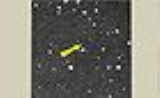
28978 Ixion

Encyclopedia
28978 Ixion is a Kuiper belt
object discovered on May 22, 2001. Ixion is a plutino
(an object that has a 2:3 orbital resonance
with Neptune
) and a very likely dwarf planet
; its diameter
of 650 km estimated by Spitzer
makes it about the fifth largest plutino. It is named after Ixion
, a figure from Greek mythology
. Ixion was discovered by the Cerro Tololo Inter-American Observatory
(807). It is a moderately red color in visible light and has a surface made of a mixture of tholin
and water ice. Light-curve-amplitude analysis shows only small deviations, suggesting Ixion is a spheroid with small albedo spots and hence a dwarf planet.
, Ixion was the first TNO discovered that was originally estimated to be larger than asteroid
Ceres, Even in 2002, a year after its discovery, Ixion was still believed to be more than 1000 km in diameter. though the 2002 estimate was a result of a spurious detection at 250 GHz that was not confirmed by later observations. More recent estimates suggest that Ixion has a high albedo and is smaller than Ceres. Observations of Ixion by Spitzer Space Telescope
in the far-infrared part of the spectrum revealed that its size is about 650 km.
Ixion is moderately red (slightly redder than 50000 Quaoar
) in the visible light. It also has a higher albedo
(>0.15) than the mid-sized red cubewano
s. There may be an absorption feature at the wavelength of 0.8 μm in its spectrum, which is commonly attributed to the alteration of surface materials by water. In the near-infrared the spectrum of Ixion is flat and featureless. Water ice absorption band
s at 1.5 and 2 μm are absent. This is in contrast to Varuna
, which has a red spectral slope
in the near-infrared as well as prominent water absorption bands. Both visible and infrared spectroscopic results indicate that Ixion's surface is a mixture of water ice, dark carbon
and tholin
, which is a heteropolymer formed by irradiation of clathrates of water
and organic compound
s. The Very Large Telescope
(VLT) has checked Ixion for cometary activity, but did not detect a coma
. Ixion is currently about 41 AU from the Sun, and it is possible that Ixion could develop a coma or temporary atmosphere when it is closer to perihelion.
11.5 star in the constellation of Ophiuchus
on July 19, 2010. This event may have been visible from North America. The RA
and DE
for this event was in a star-rich region at 16 54 25.8620 −24 24 22.856. The occultation could have lasted up to 45 seconds, but the predicted occultation path was likely to miss the Earth. An occultation detection could help refine the diameter of this dwarf-planet candidate.
whereas Pluto's is above it. Uncharacteristically for bodies locked in resonance with Neptune (such as Orcus
), Ixion approaches Pluto with less than 20 degrees of angular separation. Ixion is currently crossing the ecliptic heading below, and will reach its perihelion in 2070. Pluto has passed its perihelion (1989) and is descending toward the ecliptic. Ixion's orbital period is almost 250 Earth years, about 0.5% larger than Pluto's. Ixion does demonstrate some regular changes in brightness, which are thought to be caused by its rotation. As of 2010, however, the rotation period
of Ixion remains undetermined.
Kuiper belt
The Kuiper belt , sometimes called the Edgeworth–Kuiper belt, is a region of the Solar System beyond the planets extending from the orbit of Neptune to approximately 50 AU from the Sun. It is similar to the asteroid belt, although it is far larger—20 times as wide and 20 to 200 times as massive...
object discovered on May 22, 2001. Ixion is a plutino
Plutino
In astronomy, a plutino is a trans-Neptunian object in 2:3 mean motion resonance with Neptune. For every 2 orbits that a plutino makes, Neptune orbits 3 times. Plutinos are named after Pluto, which follows an orbit trapped in the same resonance, with the Italian diminutive suffix -ino...
(an object that has a 2:3 orbital resonance
Orbital resonance
In celestial mechanics, an orbital resonance occurs when two orbiting bodies exert a regular, periodic gravitational influence on each other, usually due to their orbital periods being related by a ratio of two small integers. Orbital resonances greatly enhance the mutual gravitational influence of...
with Neptune
Neptune
Neptune is the eighth and farthest planet from the Sun in the Solar System. Named for the Roman god of the sea, it is the fourth-largest planet by diameter and the third largest by mass. Neptune is 17 times the mass of Earth and is slightly more massive than its near-twin Uranus, which is 15 times...
) and a very likely dwarf planet
Dwarf planet
A dwarf planet, as defined by the International Astronomical Union , is a celestial body orbiting the Sun that is massive enough to be spherical as a result of its own gravity but has not cleared its neighboring region of planetesimals and is not a satellite...
; its diameter
Diameter
In geometry, a diameter of a circle is any straight line segment that passes through the center of the circle and whose endpoints are on the circle. The diameters are the longest chords of the circle...
of 650 km estimated by Spitzer
Spitzer Space Telescope
The Spitzer Space Telescope , formerly the Space Infrared Telescope Facility is an infrared space observatory launched in 2003...
makes it about the fifth largest plutino. It is named after Ixion
Ixion
In Greek mythology, Ixion was king of the Lapiths, the most ancient tribe of Thessaly, and a son of Ares, or Leonteus, or Antion and Perimele, or the notorious evildoer Phlegyas, whose name connotes "fiery". Peirithoös was his son...
, a figure from Greek mythology
Greek mythology
Greek mythology is the body of myths and legends belonging to the ancient Greeks, concerning their gods and heroes, the nature of the world, and the origins and significance of their own cult and ritual practices. They were a part of religion in ancient Greece...
. Ixion was discovered by the Cerro Tololo Inter-American Observatory
Cerro Tololo Inter-American Observatory
The Cerro Tololo Inter-American Observatory is a complex of astronomical telescopes and instruments located at 30.169 S, 70.804 W, approximately 80 km to the East of La Serena, Chile at an altitude of 2200 metres. The complex is part of the National Optical Astronomy Observatory along with Kitt...
(807). It is a moderately red color in visible light and has a surface made of a mixture of tholin
Tholin
Tholin [after the ancient Greek word meaning "not clear"] is a heteropolymer molecule formed by solar ultraviolet irradiation of simple organic compounds such as methane or ethane. Tholins do not form naturally on modern-day Earth, but are found in great abundance on the surface of icy bodies in...
and water ice. Light-curve-amplitude analysis shows only small deviations, suggesting Ixion is a spheroid with small albedo spots and hence a dwarf planet.
Physical characteristics
Other than PlutoPluto
Pluto, formal designation 134340 Pluto, is the second-most-massive known dwarf planet in the Solar System and the tenth-most-massive body observed directly orbiting the Sun...
, Ixion was the first TNO discovered that was originally estimated to be larger than asteroid
Asteroid
Asteroids are a class of small Solar System bodies in orbit around the Sun. They have also been called planetoids, especially the larger ones...
Ceres, Even in 2002, a year after its discovery, Ixion was still believed to be more than 1000 km in diameter. though the 2002 estimate was a result of a spurious detection at 250 GHz that was not confirmed by later observations. More recent estimates suggest that Ixion has a high albedo and is smaller than Ceres. Observations of Ixion by Spitzer Space Telescope
Spitzer Space Telescope
The Spitzer Space Telescope , formerly the Space Infrared Telescope Facility is an infrared space observatory launched in 2003...
in the far-infrared part of the spectrum revealed that its size is about 650 km.
Ixion is moderately red (slightly redder than 50000 Quaoar
50000 Quaoar
50000 Quaoar is a rocky trans-Neptunian object in the Kuiper belt with one known moon. Discovered on June 4, 2002 by astronomers Chad Trujillo and Michael Brown at the California Institute of Technology from images acquired at the Samuel Oschin Telescope at Palomar Observatory, it is thought by...
) in the visible light. It also has a higher albedo
Albedo
Albedo , or reflection coefficient, is the diffuse reflectivity or reflecting power of a surface. It is defined as the ratio of reflected radiation from the surface to incident radiation upon it...
(>0.15) than the mid-sized red cubewano
Cubewano
A classical Kuiper belt object, also called a cubewano is a low-eccentricity Kuiper belt object that orbits beyond Neptune and is not controlled by an orbital resonance with Neptune. Cubewanos have orbits with semi-major axes in the 40–50 AU range and, unlike Pluto, do not cross Neptune’s orbit...
s. There may be an absorption feature at the wavelength of 0.8 μm in its spectrum, which is commonly attributed to the alteration of surface materials by water. In the near-infrared the spectrum of Ixion is flat and featureless. Water ice absorption band
Absorption band
An absorption band is a range of wavelengths, frequencies or energies in the electromagnetic spectrum which are able to excite a particular transition in a substance...
s at 1.5 and 2 μm are absent. This is in contrast to Varuna
20000 Varuna
20000 Varuna is a large classical Kuiper belt object and a probable dwarf planet. It previously had the provisional designation ' and has been precovered in plates dating back to 1953.-Name:Varuna is named after the Hindu deity,...
, which has a red spectral slope
Spectral slope
In astrophysics and planetary science, spectral slope, also called spectral gradient , is a measure of dependence of the reflectance on the wavelength....
in the near-infrared as well as prominent water absorption bands. Both visible and infrared spectroscopic results indicate that Ixion's surface is a mixture of water ice, dark carbon
Carbon
Carbon is the chemical element with symbol C and atomic number 6. As a member of group 14 on the periodic table, it is nonmetallic and tetravalent—making four electrons available to form covalent chemical bonds...
and tholin
Tholin
Tholin [after the ancient Greek word meaning "not clear"] is a heteropolymer molecule formed by solar ultraviolet irradiation of simple organic compounds such as methane or ethane. Tholins do not form naturally on modern-day Earth, but are found in great abundance on the surface of icy bodies in...
, which is a heteropolymer formed by irradiation of clathrates of water
Water
Water is a chemical substance with the chemical formula H2O. A water molecule contains one oxygen and two hydrogen atoms connected by covalent bonds. Water is a liquid at ambient conditions, but it often co-exists on Earth with its solid state, ice, and gaseous state . Water also exists in a...
and organic compound
Organic compound
An organic compound is any member of a large class of gaseous, liquid, or solid chemical compounds whose molecules contain carbon. For historical reasons discussed below, a few types of carbon-containing compounds such as carbides, carbonates, simple oxides of carbon, and cyanides, as well as the...
s. The Very Large Telescope
Very Large Telescope
The Very Large Telescope is a telescope operated by the European Southern Observatory on Cerro Paranal in the Atacama Desert of northern Chile. The VLT consists of four individual telescopes, each with a primary mirror 8.2m across, which are generally used separately but can be used together to...
(VLT) has checked Ixion for cometary activity, but did not detect a coma
Coma (cometary)
frame|right|The [[153P/Ikeya-Zhang|comet Ikeya-Zhang]] exhibiting a bright, condensed coma In astronomy, a coma is the nebulous envelope around the nucleus of a comet. It is formed when the comet passes close to the Sun on its highly elliptical orbit; as the comet warms, parts of it sublimate...
. Ixion is currently about 41 AU from the Sun, and it is possible that Ixion could develop a coma or temporary atmosphere when it is closer to perihelion.
Occultation
Ixion may have occulted a relatively bright apparent magnitudeApparent magnitude
The apparent magnitude of a celestial body is a measure of its brightness as seen by an observer on Earth, adjusted to the value it would have in the absence of the atmosphere...
11.5 star in the constellation of Ophiuchus
Ophiuchus
Ophiuchus is a large constellation located around the celestial equator. Its name is from the Greek "serpent-bearer", and it is commonly represented as a man grasping the snake that is represented by the constellation Serpens. Ophiuchus was one of the 48 constellations listed by the 2nd-century...
on July 19, 2010. This event may have been visible from North America. The RA
Right ascension
Right ascension is the astronomical term for one of the two coordinates of a point on the celestial sphere when using the equatorial coordinate system. The other coordinate is the declination.-Explanation:...
and DE
Declination
In astronomy, declination is one of the two coordinates of the equatorial coordinate system, the other being either right ascension or hour angle. Declination in astronomy is comparable to geographic latitude, but projected onto the celestial sphere. Declination is measured in degrees north and...
for this event was in a star-rich region at 16 54 25.8620 −24 24 22.856. The occultation could have lasted up to 45 seconds, but the predicted occultation path was likely to miss the Earth. An occultation detection could help refine the diameter of this dwarf-planet candidate.
Orbit and rotation
Ixion and Pluto follow similar but differently oriented orbits: Ixion’s perihelion is below the eclipticEcliptic
The ecliptic is the plane of the earth's orbit around the sun. In more accurate terms, it is the intersection of the celestial sphere with the ecliptic plane, which is the geometric plane containing the mean orbit of the Earth around the Sun...
whereas Pluto's is above it. Uncharacteristically for bodies locked in resonance with Neptune (such as Orcus
90482 Orcus
90482 Orcus is a trans-Neptunian object in the Kuiper belt with a large moon. It was discovered on February 17, 2004 by Michael Brown of Caltech, Chad Trujillo of the Gemini Observatory, and David Rabinowitz of Yale University. Precovery images as early as November 8, 1951 were later identified...
), Ixion approaches Pluto with less than 20 degrees of angular separation. Ixion is currently crossing the ecliptic heading below, and will reach its perihelion in 2070. Pluto has passed its perihelion (1989) and is descending toward the ecliptic. Ixion's orbital period is almost 250 Earth years, about 0.5% larger than Pluto's. Ixion does demonstrate some regular changes in brightness, which are thought to be caused by its rotation. As of 2010, however, the rotation period
Rotation period
The rotation period of an astronomical object is the time it takes to complete one revolution around its axis of rotation relative to the background stars...
of Ixion remains undetermined.
See also
- Comparison of colours of trans-Neptunian objects
External links
- AstDys orbital elements
- Orbital simulation from JPL (Java) / Ephemeris