

Tocharian languages

Encyclopedia
Tocharian or Tokharian is an extinct branch of the Indo-European language family. The name is taken from the people known to the Greeks (Ptolemy
VI, 11, 6) as the Tocharians
. These are sometimes identified with the Yuezhi
and the Kushans. The term Tokharistan usually refers to 1st millennium
Bactria
, which the Kushans ruled. A Turkic text refers to the Turfanian language (Tocharian A) as twqry. Interpretation is difficult, but Friedrich W. K. Müller has associated this with the name of the Bactrian Tokharoi.
Today, mainly two branches of Tocharian are known: Tocharian A (Turfanian, Arsi, or East Tocharian) and Tocharian B (Kuchean or West Tocharian). Documents in these languages exist roughly from the 3rd to 9th centuries AD; before they became extinct, their speakers were either absorbed or exterminated by the expanding Uyghur
tribes. Both languages were once spoken in the Tarim Basin
in Central Asia
, now part of the Xinjiang
Autonomous Region of China
.
" Indo-European language, meaning that it merges the palato-velar consonants of Proto Indo-European
with the plain velars (*k, *g, *gʰ). Centum languages are mostly found in western and southern Europe (Greek
, Italic
, Celtic
, Germanic) and the number of isogloss
es between Tocharian and several Western European languages is stunning, considering the geograhical separation and total lack of cultural contact. In that sense, Tocharian (to some extent like the Greek
and the Anatolian languages
) seems to have been an isolate in the "Satem
" (i.e. palato-velar to sibilant) phonetic regions of Indo-European-speaking populations. The discovery of Tocharian contributed to doubts that Proto-Indo-European had originally split into western and eastern branches.
Note that the above consonantal values are largely based on the writing of Sanskrit/Prakrit loanwords. A retroflex value for /ʂ/ is particularly suspect as it is derived from palatalized /s/; it was probably a low-frequency sibilant /ʃ/ (like German spelling sch), as opposed to the higher-frequency sibilant /ɕ/ (like Mandarin Pinyin
spelling x).
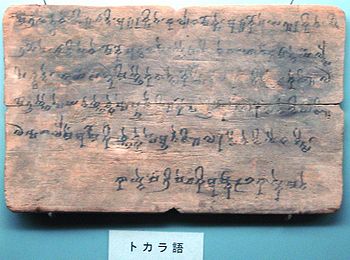 Tocharian is documented in manuscript fragments, mostly from the 8th century (with a few earlier ones) that were written on palm leaves, wooden tablets and Chinese paper
, preserved by the extremely dry climate of the Tarim Basin. Samples of the language have been discovered at sites in Kucha
and Karasahr
, including many mural inscriptions.
Tocharian A and B are not intercomprehensible. Properly speaking, based on the tentative interpretation of twqry as related to Tokharoi, only Tocharian A may be referred to as Tocharian, while Tocharian B could be called Kuchean (its native name may have been kuśiññe), but since their grammars are usually treated together in scholarly works, the terms A and B have proven useful. A common Proto-Tocharian language must precede the attested languages by several centuries, probably dating to the 1st millennium BC
. Given the small geographical range of and the lack of secular texts in Tocharian A, it might alternatively have been a liturgical language, the relationship between the two being similar to that between Classical Chinese
and Mandarin
. However, the lack of a secular corpus in Tocharian A is by no means definite, due to the fragmentary preservation of Tocharian texts in general.
Most of the script in Tocharian was a derivative of the Brahmi
alphabetic syllabary (abugida
) and is referred to as slanting Brahmi, However a smaller amount was written in the Manichaean script
in which Manichaean
texts were recorded. It soon became apparent that a large proportion of the manuscripts were translations of known Buddhist
works in Sanskrit
and some of them were even bilingual, facilitating decipherment of the new language. Besides the Buddhist and Manichaean
religious texts, there were also monastery correspondence and accounts, commercial documents, caravan permits, medical and magical texts, and one love poem.
In 1998, Chinese linguist Ji Xianlin
published a translation and analysis of fragments of a Tocharian Maitreyasamiti-Nataka discovered in 1974 in Yanqi.
declension
system of Proto-Indo-European. The only cases inherited from the proto-language are nominative, genitive, and accusative
; in Tocharian the old accusative is known as the oblique case. In addition to these three cases, however, each Tocharian language has six cases formed by the addition of an invariant suffix to the oblique case. For example, the Tocharian A word "teacher" is declined as follows:
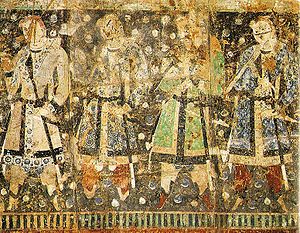 The existence of the Tocharian languages and alphabet was not even suspected until archaeological exploration of the Tarim basin by Aurel Stein in the early 20th century brought to light fragments of manuscripts in an unknown language.
This language, now known as Tocharian, turned out to belong to a hitherto unknown branch of Indo-European. The discovery of Tocharian has upset some theories about the relations of Indo-European languages and revitalized their study.
The Tocharian languages are a major geographic exception to the usual pattern of Centum branches, being the only one that spread directly east from the theoretical Indo-European starting point in the Pontic steppe. One theory, following the "wave" theory of Johannes Schmidt
, suggests that the Satem isogloss represents a linguistic innovation within the heart of the Proto-Indo-European home range, which would thus see the distribution of the Centum languages as simply representing linguistic conservatism along the eastern and western peripheries of the Proto-Indo-European
home range.
Tocharian probably died out after 840, when the Uyghurs
were expelled from Mongolia by the Kyrgyz, retreating to the Tarim Basin. This theory is supported by the discovery of translations of Tocharian texts into Uyghur. During Uyghur rule, the peoples mixed with the Uyghurs to produce much of the modern population of what is now Xinjiang
.
The Afanasevo culture
is a strong candidate for being the earliest attested representative for speakers of the Tocharian languages.
Ptolemy
Claudius Ptolemy , was a Roman citizen of Egypt who wrote in Greek. He was a mathematician, astronomer, geographer, astrologer, and poet of a single epigram in the Greek Anthology. He lived in Egypt under Roman rule, and is believed to have been born in the town of Ptolemais Hermiou in the...
VI, 11, 6) as the Tocharians
Tocharians
The Tocharians were the Tocharian-speaking inhabitants of the Tarim Basin, making them the easternmost speakers of Indo-European languages in antiquity. They were known as, or at least closely related to, the Yuezhi of Chinese sources...
. These are sometimes identified with the Yuezhi
Yuezhi
The Yuezhi, or Rouzhi , also known as the Da Yuezhi or Da Rouzhi , were an ancient Central Asian people....
and the Kushans. The term Tokharistan usually refers to 1st millennium
1st millennium
File:1st millennium montage.png|From left, clockwise: Depiction of Jesus, the central figure in Christianity; The Colosseum, a landmark of the once Roman Empire; Gunpowder is invented during the latter part of the millennium, in China; Chess, a new board game, takes on popularity across the globe;...
Bactria
Bactria
Bactria and also appears in the Zend Avesta as Bukhdi. It is the ancient name of a historical region located between south of the Amu Darya and west of the Indus River...
, which the Kushans ruled. A Turkic text refers to the Turfanian language (Tocharian A) as twqry. Interpretation is difficult, but Friedrich W. K. Müller has associated this with the name of the Bactrian Tokharoi.
Today, mainly two branches of Tocharian are known: Tocharian A (Turfanian, Arsi, or East Tocharian) and Tocharian B (Kuchean or West Tocharian). Documents in these languages exist roughly from the 3rd to 9th centuries AD; before they became extinct, their speakers were either absorbed or exterminated by the expanding Uyghur
Uyghur people
The Uyghur are a Turkic ethnic group living in Eastern and Central Asia. Today, Uyghurs live primarily in the Xinjiang Uyghur Autonomous Region in the People's Republic of China...
tribes. Both languages were once spoken in the Tarim Basin
Tarim Basin
The Tarim Basin is a large endorheic basin occupying an area of about . It is located in the Xinjiang Uyghur Autonomous Region in China's far west. Its northern boundary is the Tian Shan mountain range and its southern is the Kunlun Mountains on the northern edge of the Tibetan Plateau. The...
in Central Asia
Central Asia
Central Asia is a core region of the Asian continent from the Caspian Sea in the west, China in the east, Afghanistan in the south, and Russia in the north...
, now part of the Xinjiang
Xinjiang
Xinjiang is an autonomous region of the People's Republic of China. It is the largest Chinese administrative division and spans over 1.6 million km2...
Autonomous Region of China
China
Chinese civilization may refer to:* China for more general discussion of the country.* Chinese culture* Greater China, the transnational community of ethnic Chinese.* History of China* Sinosphere, the area historically affected by Chinese culture...
.
Phonemes
Phonetically, Tocharian is a "CentumCentum-Satem isogloss
The centum-satem division is an isogloss of the Indo-European language family, related to the different evolution of the three dorsal consonant rows of the mainstream reconstruction of Proto-Indo-European:...
" Indo-European language, meaning that it merges the palato-velar consonants of Proto Indo-European
Proto-Indo-European language
The Proto-Indo-European language is the reconstructed common ancestor of the Indo-European languages, spoken by the Proto-Indo-Europeans...
with the plain velars (*k, *g, *gʰ). Centum languages are mostly found in western and southern Europe (Greek
Greek language
Greek is an independent branch of the Indo-European family of languages. Native to the southern Balkans, it has the longest documented history of any Indo-European language, spanning 34 centuries of written records. Its writing system has been the Greek alphabet for the majority of its history;...
, Italic
Italic languages
The Italic subfamily is a member of the Indo-European language family. It includes the Romance languages derived from Latin , and a number of extinct languages of the Italian Peninsula, including Umbrian, Oscan, Faliscan, and Latin.In the past various definitions of "Italic" have prevailed...
, Celtic
Celtic languages
The Celtic languages are descended from Proto-Celtic, or "Common Celtic"; a branch of the greater Indo-European language family...
, Germanic) and the number of isogloss
Isogloss
An isogloss—also called a heterogloss —is the geographical boundary of a certain linguistic feature, such as the pronunciation of a vowel, the meaning of a word, or use of some syntactic feature...
es between Tocharian and several Western European languages is stunning, considering the geograhical separation and total lack of cultural contact. In that sense, Tocharian (to some extent like the Greek
Greek language
Greek is an independent branch of the Indo-European family of languages. Native to the southern Balkans, it has the longest documented history of any Indo-European language, spanning 34 centuries of written records. Its writing system has been the Greek alphabet for the majority of its history;...
and the Anatolian languages
Anatolian languages
The Anatolian languages comprise a group of extinct Indo-European languages that were spoken in Asia Minor, the best attested of them being the Hittite language.-Origins:...
) seems to have been an isolate in the "Satem
Centum-Satem isogloss
The centum-satem division is an isogloss of the Indo-European language family, related to the different evolution of the three dorsal consonant rows of the mainstream reconstruction of Proto-Indo-European:...
" (i.e. palato-velar to sibilant) phonetic regions of Indo-European-speaking populations. The discovery of Tocharian contributed to doubts that Proto-Indo-European had originally split into western and eastern branches.
Vowels
(transcribed ā) /u/, /o/, /ɨ/ (transcribed ä), /ə/ (transcribed a)- Diphthongs (Tocharian B only): /əi/ (transcribed ai), /oi/ (transcribed oy), /əu/ (transcribed au), /au/ (transcribed āu)
Consonants
- Stops: /p/, /t/, /c/, /k/, /kʷ/ (transcribed ku)
- Affricates: /ts/
- Fricatives: /s/, /ɕ/ (transcribed ś), /ʂ/ (transcribed )
- Approximants: /w/, /j/ (transcribed y)
- Trills: /r/
- Nasals: /m/, /n/ (transcribed word-finally), /ɲ/ (transcribed ñ)
- Lateral approximants: /l/, /ʎ/ (transcribed ly)
Note that the above consonantal values are largely based on the writing of Sanskrit/Prakrit loanwords. A retroflex value for /ʂ/ is particularly suspect as it is derived from palatalized /s/; it was probably a low-frequency sibilant /ʃ/ (like German spelling sch), as opposed to the higher-frequency sibilant /ɕ/ (like Mandarin Pinyin
Pinyin
Pinyin is the official system to transcribe Chinese characters into the Roman alphabet in China, Malaysia, Singapore and Taiwan. It is also often used to teach Mandarin Chinese and spell Chinese names in foreign publications and used as an input method to enter Chinese characters into...
spelling x).
Writing system
Paper
Paper is a thin material mainly used for writing upon, printing upon, drawing or for packaging. It is produced by pressing together moist fibers, typically cellulose pulp derived from wood, rags or grasses, and drying them into flexible sheets....
, preserved by the extremely dry climate of the Tarim Basin. Samples of the language have been discovered at sites in Kucha
Kucha
Kuchaor Kuche Uyghur , Chinese Simplified: 库车; Traditional: 庫車; pinyin Kùchē; also romanized as Qiuzi, Qiuci, Chiu-tzu, Kiu-che, Kuei-tzu from the traditional Chinese forms 屈支 屈茨; 龜玆; 龟兹, 丘玆, also Po ; Sanskrit: Kueina, Standard Tibetan: Kutsahiyui was an ancient Buddhist kingdom...
and Karasahr
Karasahr
Yanqi , or Karasahr , is an ancient town on the Silk Road and capital of Yanqi Hui Autonomous County in the Bayin'gholin Mongol Autonomous Prefecture of Xinjiang, in northwestern China...
, including many mural inscriptions.
Tocharian A and B are not intercomprehensible. Properly speaking, based on the tentative interpretation of twqry as related to Tokharoi, only Tocharian A may be referred to as Tocharian, while Tocharian B could be called Kuchean (its native name may have been kuśiññe), but since their grammars are usually treated together in scholarly works, the terms A and B have proven useful. A common Proto-Tocharian language must precede the attested languages by several centuries, probably dating to the 1st millennium BC
1st millennium BC
The 1st millennium BC encompasses the Iron Age and sees the rise of many successive empires, and spanned from 1000 BC to 1 BC.The Neo-Assyrian Empire, followed by the Achaemenids. In Greece, Classical Antiquity begins with the colonization of Magna Graecia and peaks with the rise of Hellenism. The...
. Given the small geographical range of and the lack of secular texts in Tocharian A, it might alternatively have been a liturgical language, the relationship between the two being similar to that between Classical Chinese
Classical Chinese
Classical Chinese or Literary Chinese is a traditional style of written Chinese based on the grammar and vocabulary of ancient Chinese, making it different from any modern spoken form of Chinese...
and Mandarin
Standard Mandarin
Standard Chinese or Modern Standard Chinese, also known as Mandarin or Putonghua, is the official language of the People's Republic of China and Republic of China , and is one of the four official languages of Singapore....
. However, the lack of a secular corpus in Tocharian A is by no means definite, due to the fragmentary preservation of Tocharian texts in general.
Most of the script in Tocharian was a derivative of the Brahmi
Brāhmī script
Brāhmī is the modern name given to the oldest members of the Brahmic family of scripts. The best-known Brāhmī inscriptions are the rock-cut edicts of Ashoka in north-central India, dated to the 3rd century BCE. These are traditionally considered to be early known examples of Brāhmī writing...
alphabetic syllabary (abugida
Abugida
An abugida , also called an alphasyllabary, is a segmental writing system in which consonant–vowel sequences are written as a unit: each unit is based on a consonant letter, and vowel notation is obligatory but secondary...
) and is referred to as slanting Brahmi, However a smaller amount was written in the Manichaean script
Manichaean script
Manichaean script is a sibling of an early form of Pahlavi script, and like Pahlavi is a development from Imperial Aramaic, the official language and script of the Achaemenid court. Unlike Pahlavi, Manichaean script reveals influences from Sogdian script, which in turn descends from the Syriac...
in which Manichaean
Manichaeism
Manichaeism in Modern Persian Āyin e Māni; ) was one of the major Iranian Gnostic religions, originating in Sassanid Persia.Although most of the original writings of the founding prophet Mani have been lost, numerous translations and fragmentary texts have survived...
texts were recorded. It soon became apparent that a large proportion of the manuscripts were translations of known Buddhist
Buddhism
Buddhism is a religion and philosophy encompassing a variety of traditions, beliefs and practices, largely based on teachings attributed to Siddhartha Gautama, commonly known as the Buddha . The Buddha lived and taught in the northeastern Indian subcontinent some time between the 6th and 4th...
works in Sanskrit
Sanskrit
Sanskrit , is a historical Indo-Aryan language and the primary liturgical language of Hinduism, Jainism and Buddhism.Buddhism: besides Pali, see Buddhist Hybrid Sanskrit Today, it is listed as one of the 22 scheduled languages of India and is an official language of the state of Uttarakhand...
and some of them were even bilingual, facilitating decipherment of the new language. Besides the Buddhist and Manichaean
Manichaeism
Manichaeism in Modern Persian Āyin e Māni; ) was one of the major Iranian Gnostic religions, originating in Sassanid Persia.Although most of the original writings of the founding prophet Mani have been lost, numerous translations and fragmentary texts have survived...
religious texts, there were also monastery correspondence and accounts, commercial documents, caravan permits, medical and magical texts, and one love poem.
In 1998, Chinese linguist Ji Xianlin
Ji Xianlin
Ji Xianlin was a Chinese Indologist, linguist, paleographer, historian, and writer who had been honored by the governments of both India and China. He was born in Qingping County, now Linqing, and died in the No. 301 Hospital, Beijing.-Biography:Ji attended Sanhejie Primary School and the No. 1...
published a translation and analysis of fragments of a Tocharian Maitreyasamiti-Nataka discovered in 1974 in Yanqi.
Morphology
Tocharian has completely re-worked the nominalNoun
In linguistics, a noun is a member of a large, open lexical category whose members can occur as the main word in the subject of a clause, the object of a verb, or the object of a preposition .Lexical categories are defined in terms of how their members combine with other kinds of...
declension
Declension
In linguistics, declension is the inflection of nouns, pronouns, adjectives, and articles to indicate number , case , and gender...
system of Proto-Indo-European. The only cases inherited from the proto-language are nominative, genitive, and accusative
Accusative case
The accusative case of a noun is the grammatical case used to mark the direct object of a transitive verb. The same case is used in many languages for the objects of prepositions...
; in Tocharian the old accusative is known as the oblique case. In addition to these three cases, however, each Tocharian language has six cases formed by the addition of an invariant suffix to the oblique case. For example, the Tocharian A word "teacher" is declined as follows:
| Case Grammatical case In grammar, the case of a noun or pronoun is an inflectional form that indicates its grammatical function in a phrase, clause, or sentence. For example, a pronoun may play the role of subject , of direct object , or of possessor... |
Suffix Suffix In linguistics, a suffix is an affix which is placed after the stem of a word. Common examples are case endings, which indicate the grammatical case of nouns or adjectives, and verb endings, which form the conjugation of verbs... |
Singular Grammatical number In linguistics, grammatical number is a grammatical category of nouns, pronouns, and adjective and verb agreement that expresses count distinctions .... |
Plural Plural In linguistics, plurality or [a] plural is a concept of quantity representing a value of more-than-one. Typically applied to nouns, a plural word or marker is used to distinguish a value other than the default quantity of a noun, which is typically one... |
|---|---|---|---|
| Nominative Nominative case The nominative case is one of the grammatical cases of a noun or other part of speech, which generally marks the subject of a verb or the predicate noun or predicate adjective, as opposed to its object or other verb arguments... |
|||
| Genitive Genitive case In grammar, genitive is the grammatical case that marks a noun as modifying another noun... |
|||
| Oblique Oblique case An oblique case in linguistics is a noun case of synthetic languages that is used generally when a noun is the object of a verb or a preposition... |
|||
| Instrumental Instrumental case The instrumental case is a grammatical case used to indicate that a noun is the instrument or means by or with which the subject achieves or accomplishes an action... |
-yo | ||
| Perlative Perlative case Perlative case "expresses that something moved 'through', 'across', or 'along' the referent of the noun that is marked". The case is found in the West Australian Kuku-Yalanji language, Aymara and in Tocharian.... |
-ā | ||
| Comitative Comitative case The comitative case , also known as the associative case , is a grammatical case that denotes companionship, and is used where English would use "in company with" or "together with"... |
-aśśäl | ||
| Allative Allative case Allative case is a type of the locative cases used in several languages. The term allative is generally used for the lative case in the majority of languages which do not make finer distinctions.-Finnish language:In the Finnish language, the allative is the fifth of the locative cases, with the... |
-ac | ||
| Ablative Ablative case In linguistics, ablative case is a name given to cases in various languages whose common characteristic is that they mark motion away from something, though the details in each language may differ... |
|||
| Locative Locative case Locative is a grammatical case which indicates a location. It corresponds vaguely to the English prepositions "in", "on", "at", and "by"... |
|||
Cultural significance
This language, now known as Tocharian, turned out to belong to a hitherto unknown branch of Indo-European. The discovery of Tocharian has upset some theories about the relations of Indo-European languages and revitalized their study.
The Tocharian languages are a major geographic exception to the usual pattern of Centum branches, being the only one that spread directly east from the theoretical Indo-European starting point in the Pontic steppe. One theory, following the "wave" theory of Johannes Schmidt
Johannes Schmidt (linguist)
Johannes Friedrich Heinrich Schmidt was a German linguist. He developed the Wellentheorie of language development.-Biography:Schmidt was born in Prenzlau, Province of Brandenburg...
, suggests that the Satem isogloss represents a linguistic innovation within the heart of the Proto-Indo-European home range, which would thus see the distribution of the Centum languages as simply representing linguistic conservatism along the eastern and western peripheries of the Proto-Indo-European
Proto-Indo-European language
The Proto-Indo-European language is the reconstructed common ancestor of the Indo-European languages, spoken by the Proto-Indo-Europeans...
home range.
Tocharian probably died out after 840, when the Uyghurs
Uyghur people
The Uyghur are a Turkic ethnic group living in Eastern and Central Asia. Today, Uyghurs live primarily in the Xinjiang Uyghur Autonomous Region in the People's Republic of China...
were expelled from Mongolia by the Kyrgyz, retreating to the Tarim Basin. This theory is supported by the discovery of translations of Tocharian texts into Uyghur. During Uyghur rule, the peoples mixed with the Uyghurs to produce much of the modern population of what is now Xinjiang
Xinjiang
Xinjiang is an autonomous region of the People's Republic of China. It is the largest Chinese administrative division and spans over 1.6 million km2...
.
The Afanasevo culture
Afanasevo culture
The Afanasevo culture, traditionally dated to 2500–2000 BC , is an archaeological culture of the late copper and early Bronze Age of southern Siberia....
is a strong candidate for being the earliest attested representative for speakers of the Tocharian languages.
Comparison to other Indo-European languages
| Tocharian vocabulary (sample) | ||||||||||||
| Tocharian A | Tocharian B | Hittite Hittite language Hittite is the extinct language once spoken by the Hittites, a people who created an empire centred on Hattusa in north-central Anatolia... | Ancient Greek Ancient Greek Ancient Greek is the stage of the Greek language in the periods spanning the times c. 9th–6th centuries BC, , c. 5th–4th centuries BC , and the c. 3rd century BC – 6th century AD of ancient Greece and the ancient world; being predated in the 2nd millennium BC by Mycenaean Greek... | Vedic Sanskrit Vedic Sanskrit Vedic Sanskrit is an old Indo-Aryan language. It is an archaic form of Sanskrit, an early descendant of Proto-Indo-Iranian. It is closely related to Avestan, the oldest preserved Iranian language... | Latin Latin Latin is an Italic language originally spoken in Latium and Ancient Rome. It, along with most European languages, is a descendant of the ancient Proto-Indo-European language. Although it is considered a dead language, a number of scholars and members of the Christian clergy speak it fluently, and... | Gothic Gothic language Gothic is an extinct Germanic language that was spoken by the Goths. It is known primarily from the Codex Argenteus, a 6th-century copy of a 4th-century Bible translation, and is the only East Germanic language with a sizable Text corpus... | Old Irish | Proto-Indo-European Proto-Indo-European language The Proto-Indo-European language is the reconstructed common ancestor of the Indo-European languages, spoken by the Proto-Indo-Europeans... | Modern English English language English is a West Germanic language that arose in the Anglo-Saxon kingdoms of England and spread into what was to become south-east Scotland under the influence of the Anglian medieval kingdom of Northumbria... |
|||
|---|---|---|---|---|---|---|---|---|---|---|---|---|
| sas | heis | eka- | ūnus | áins | oen | one | ||||||
| wu | wi | dān | duo | dva- | duo | twái | dá | *d(u)woh1 | two | |||
| tre | trai | tēries | treis | tri- | trēs | þreis | trí | *treyes | three | |||
| śtwar | śtwer | téssares | catur- | quattuor | fidwōr | cethair | *kʷetwores | four | ||||
| päñ | piś | pente | pañca | quīnque | fimf | cóic | *penkʷe | five | ||||
| héx | sex | saihs | sé | *(s)weḱs | six | |||||||
| heptá | saptá | septem | sibun | secht | *septm | seven | ||||||
| okät | okt | októ | octō | ahtau | ocht | *oḱtoh3 | eight | |||||
| ñu | ñu | ennéa | náva | novem | niun | noí | *newn | nine | ||||
| śäk | śak | deka | dáśa | decem | taihun | deich | *deḱm | ten | ||||
| känt | kante | hekatón | śatám | centum | hund | cét | *ḱmtom | hundred | ||||
| pācar | pācer | patēr | pitár- | pater | fadar | athair | *ph2tēr | father | ||||
| mācar | mācer | mētēr | |mātar- | mater | mōdar | máthair | *meh2tēr | mother | ||||
| pracar | procer | phrátērCognate Cognate In linguistics, cognates are words that have a common etymological origin. This learned term derives from the Latin cognatus . Cognates within the same language are called doublets. Strictly speaking, loanwords from another language are usually not meant by the term, e.g... , with shifted meaning |
bhrātar- | frāter | brōþar | bráthair | *bhreh2tēr | brother | ||||
| éor | soror | swistar | siur | *swesor | sister | |||||||
| yuk | yakwe | híppos | áśva- | equus | aiƕs | ech | *eḱwo- | (horse)English meaning, unrelated word (cf. Old English eoh) | ||||
| ko | keu | boûs | gáus | bosBorrowed cognate, not native. | bó | *gʷow- | cow | |||||
| vak | vek | épos | vāk | vōx | foccul | *wekʷ- | (voice) | |||||
| ñom | ñem | lāman | ónoma | nāman- | nōmen | namō | ainmm | *nomn | name | |||
| malk | mälk | amélgein | marjati | mulgēre | mligim/bligim | *melg- | to milk | |||||
See also
- Language families and languages
- TochariansTochariansThe Tocharians were the Tocharian-speaking inhabitants of the Tarim Basin, making them the easternmost speakers of Indo-European languages in antiquity. They were known as, or at least closely related to, the Yuezhi of Chinese sources...
- Tocharian and Indo-European StudiesTocharian and Indo-European StudiesTocharian and Indo-European Studies is a scholarly journal on Tocharian in the Indo-European context, established in 1987 by the Icelandic linguist Jörundur Hilmarsson...
Sources
- Gerd Carling 2009. Dictionary and Thesaurus of Tocharian A. Volume 1: a-j. (in collaboration with Georges-Jean Pinault and Werner Winter), Wiesbaden, Harrassowitz Verlag, 2009, XXXIX+204 pages.
- "Tokharian Pratimoksa Fragment Sylvain Levi". The Journal of the Royal Asiatic Society of Great Britain and Ireland. 1913, pp. 109–120.
- Mallory, J.P. and Victor H. Mair. The Tarim Mummies. London: Thames & Hudson, 2000. (ISBN 0-500-05101-1)
- Malzahn, Melanie (Ed.). Instrumenta Tocharica. Heidelberg: Carl Winter Universitätsverlag, 2007. (ISBN 978-3-8253-5299-8)
- Pinault, Georges-JeanGeorges-Jean PinaultGeorges-Jean Pinault is professor of linguistics à the Ecole pratique des hautes études. He one of the leading experts on Tocharian languages and has published more than two hundred articles on Indo-European linguistics...
2008. Chrestomathie tokharienne. Textes et grammaire, Leuven-Paris, Peeters (Collection linguistique publiée par la Société de Linguistique de Paris, t. XCV), 2008, 692 pages. - Schmalsteig, William R. "Tokharian and Baltic." Lituanus. v. 20, no. 3, 1974.
- Krause, WolfgangWolfgang KrauseWolfgang Krause was a German linguist. He specialised initially in Celtic studies and the Tokharians, later in Old Norse and especially runology.-Education and career:...
and Werner Thomas. Tocharisches Elemantarbuch. Heidelberg: Carl Winter Universitätsverlag, 1960. - Winter, Werner. 1998. "Tocharian." In Ramat Giacalone Anna and Paolo Ramat (eds). The Indo-European languages, 154-168. London: Routledge.
External links
- Conjugation tables for Tocharian A and B
- Tocharian alphabet (from Omniglot)
- TITUS: Tocharian alphabets& Manuscripts from the Berlin Turfan Collection
- Mark Dickens, 'Everything you always wanted to know about Tocharian'
- A Tocharian-to-English dictionary with nearly 200 words
- Tocharian Online from the University of Texas at AustinUniversity of Texas at AustinThe University of Texas at Austin is a state research university located in Austin, Texas, USA, and is the flagship institution of the The University of Texas System. Founded in 1883, its campus is located approximately from the Texas State Capitol in Austin...
- Online dictionary of Tocharian B with over 4000 entries
- Tocharian B Swadesh list of basic vocabulary words (from Wiktionary's Swadesh-list appendix)