

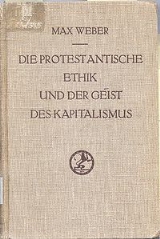
The Protestant Ethic and the Spirit of Capitalism

Encyclopedia
The Protestant Ethic and the Spirit of Capitalism is a book
written by Max Weber
, a German
sociologist, economist
, and politician
. Begun as a series of essay
s, the original German text was composed in 1904 and 1905, and was translated into English for the first time by Talcott Parsons
in 1930. It is considered a founding text in economic sociology
and sociology
in general.
In the book, Weber wrote that capitalism
in northern Europe evolved when the Protestant (particularly Calvinist
) ethic
influenced large numbers of people to engage in work in the secular world, developing their own enterprise
s and engaging in trade
and the accumulation of wealth
for investment. In other words, the Protestant work ethic
was an important force behind the unplanned and uncoordinated mass action
that influenced the development of capitalism
. This idea is also known as the "Protestant Ethic thesis."
but rather an introduction into Weber's later studies of interaction between various religious ideas and economics (The Religion of China: Confucianism and Taoism
, The Religion of India: The Sociology of Hinduism and Buddhism
, and Ancient Judaism
), The Protestant Ethic and the Spirit of Capitalism shows how Puritan
ethics and idea
s influenced the development of capitalism
.
Religious devotion, Weber argues, is usually accompanied by a rejection of worldly affairs, including the pursuit of wealth and possessions. To illustrate his theory, Weber quotes the ethical writings of Benjamin Franklin
:
Weber notes that this is not a philosophy of mere greed, but a statement laden with moral language. Indeed, Franklin claims that God revealed the usefulness of virtue to him .
The Reformation profoundly affected the view of work, dignifying even the most mundane professions as adding to the common good and thus blessed by God, as much as any "sacred" calling. A common illustration is that of a cobbler, hunched over his work, who devotes his entire effort to the praise of God.
To emphasize the work ethic
in Protestantism relative to Catholics, he notes a common problem that industrialists face when employing precapitalist laborers: Agricultural entrepreneurs will try to encourage time spent harvesting by offering a higher wage, with the expectation that laborers will see time spent working as more valuable and so engage it longer. However, in precapitalist societies this often results in laborers spending less time harvesting. Laborers judge that they can earn the same, while spending less time working and having more leisure. He also notes that societies having more Protestants are those that have a more developed capitalist economy.
It is particularly advantageous in technical occupations for workers to be extremely devoted to their craft. To view the craft as an end in itself, or as a "calling" would serve this need well. This attitude is well-noted in certain classes which have endured religious education, especially of a Pietist background.
He defines spirit of capitalism as the ideas and esprit that favour the rational
pursuit of economic gain
: "We shall nevertheless provisionally use the expression 'spirit of capitalism' for that attitude which, in the pursuit of a calling [berufsmaßig], strives systematically for profit for its own sake in the manner exemplified by Benjamin Franklin."
Weber points out that such a spirit
is not limited to Western culture
if one considers it as the attitude of individual
s, but that such individuals — heroic entrepreneurs, as he calls them — could not by themselves establish a new economic order (capitalism
). He further noted that the spirit of capitalism could be divorced from religion, and that those passionate capitalists of his era were either passionate against the Church or at least indifferent to it. Desire for profit with minimum effort and seeing work as a burden to be avoided, and doing no more than what was enough for modest life, were common attitudes. As he wrote in his essays:
After defining the "spirit of capitalism," Weber argues that there are many reasons to find its origins in the religious ideas of the Reformation
. Many others like William Petty
, Montesquieu
, Henry Thomas Buckle
, John Keats
have noted the affinity
between Protestantism and the development of commercialism.
Weber shows that certain branches of Protestantism had supported worldly activities dedicated to economic gain, seeing them as endowed with moral and spiritual significance. This recognition was not a goal in itself; rather they were a byproduct of other doctrines of faith that encouraged planning, hard work and self-denial in the pursuit of worldly riches.
, though he acknowledged some respect for secular everyday labor as early as the Middle Ages. The Roman Catholic Church
assured salvation to individuals who accepted the church's sacraments and submitted to the clerical authority. However, the Reformation had effectively removed such assurances. From a psychological viewpoint, the average person had difficulty adjusting to this new worldview, and only the most devout believers or "religious geniuses" within Protestantism, such as Martin Luther
, were able to make this adjustment, according to Weber.
In the absence of such assurances from religious authority, Weber argued that Protestants began to look for other "signs" that they were saved. Calvin and his followers taught a doctrine of double predestination, in which from the beginning God chose some people for salvation and others for damnation. The inability to influence one's own salvation presented a very difficult problem for Calvin's followers. It became an absolute duty to believe that one was chosen for salvation, and to dispel any doubt about that: lack of self-confidence was evidence of insufficient faith and a sign of damnation. So, self-confidence took the place of priestly assurance of God's grace.
Worldly success became one measure of that self-confidence. Luther made an early endorsement of Europe's emerging labor divisions. Weber identifies the applicability of Luther's conclusions, noting that a "vocation" from God was no longer limited to the clergy or church, but applied to any occupation or trade.
However, Weber saw the fulfillment of the Protestant ethic not in Lutheranism
, which was too concerned with the reception of divine spirit in the soul, but in Calvinistic
forms of Christianity. The trend was carried further still in Pietism. The Baptists diluted the concept of the calling relative to Calvinists, but other aspects made its congregants fertile soil for the development of capitalism—namely, a lack of paralyzing ascetism, the refusal to accept state office and thereby develop unpolitically, and the doctrine of control by conscience which caused rigorous honesty.
What Weber found, in simple terms:
The manner in which this paradox was resolved, Weber argued, was the investment
of this money, which gave an extreme boost to nascent capitalism.
, which emphasized frugality, hard work and thrift, but were mostly free of spiritual content. Weber also attributed the success of mass production partly to the Protestant ethic. Only after expensive luxuries were disdained, could individuals accept the uniform products, such as clothes and furniture, that industrialization offered.
In his remarkably prescient conclusion to the book, Weber lamented that the loss of religious underpinning to capitalism's spirit has led to a kind of involuntary servitude to mechanized industry.
Weber maintained that while Puritan religious ideas had significantly impacted the development of economic system in Europe and United States, there were other factors in play, as well. They included the rationalism in scientific pursuit, growing connections between observation
and mathematics
, development of scholarship
and jurisprudence
, rational systematisation of government administration
(development of bureaucracy
) and advances in entrepreneurship. In the end, the study of Protestant ethic, according to Weber, investigated a part of the detachment from magic
, that disenchantment of the world that could be seen as a unique characteristic of Western culture
.
, a professional theologian
, had begun work on The Social Teachings of the Christian Churches and Sects. Another reason for Weber's decision was that Troeltsch's work already achieved what he desired in that area, which is laying groundwork for comparative analysis of religion and society. Weber moved beyond Protestantism with his research but would continue research into sociology of religion
within his later works (the study of Judaism
and the religions of China
and India).
This book is also Weber's first brush with the concept of rationalization
. His idea of modern capitalism as growing out of the religious pursuit of wealth meant a change to a rational means of existence, wealth. That is to say, at some point the Calvinist rationale informing the "spirit" of capitalism became unreliant on the underlying religious movement behind it, leaving only rational capitalism. In essence then, Weber's "Spirit of Capitalism" is effectively and more broadly a Spirit of Rationalization.
and his theories. While Marx's historical materialism
held that all human institutions - including religion - were based on economic foundations, The Protestant Ethic turns this theory on its head by implying that a religious movement fostered capitalism, not the other way around.
Other scholars have taken a more nuanced view of Weber's argument. Weber states in the closing of this essay, "it is, of course, not my aim to substitute for a one-sided materialistic an equally one-sided spiritualistic causal interpretation of culture and history. Each is equally possible, but each if it does not serve as the preparation, but as the conclusion of an investigation, accomplishes equally little in the interest of historical truth." Weber's argument can be understood as an attempt to deepen the understanding of the cultural origins of capitalism, which does not exclude the historical materialist origins described by Marx.
Part 2. The Practical Ethics of the Ascetic Branches of Protestantism.
criticises Weber's analysis on two fronts. Firstly with reference to Marx's extensive work which showed that the stringent legal measures taken against poverty and vagabondage was a reaction to the massive population shifts caused by the enclosure
of the commons in England. And, secondly, in Grossman's own work showing how this "bloody legislation" against those that had been put off their land was effected across Europe and especially in France. For Grossman this legislation, the outlawing of idleness and the poorhouses they instituted physically forced people from serfdom
into wage-labor. For him, this general fact was not related to protestantism and so capitalism came largely by force and not by any vocational training regarding an inner-worldliness of protestanism. Thus Grossman solves the central crux of Weber's analysis: his puzzlement over how enough people were recruited into early capitalist manufacturing. Grossman shows how people were in fact forced to obey capitalist principles not on any religious grounds but rather from legalistic grounds of force made by those who held power and wanted more production for their own benefit but also, often in their own view, for their nation's benefit. However, it is possible that the Protestant "work ethic" reinforced or legitimized these legal measures within a larger cultural context.
In a paper published on November 10, 2009, Harvard economist Davide Cantoni tested Weber's Protestant hypothesis using population and economic growth in second-millennium Germany as the data set, with negative results. Cantoni writes:
Looking at the history of the development of economic thought, Robertson shows that Adam Smith and David Ricardo did not found economic science de novo. In fact, liberal economic theory was developed by French and Italian Catholics, who were influenced by the Scholastics. The British economic thought was rather a step backwards since it espoused the Labor Theory of Value
, which had already been proved incorrect by the School of Salamanca
.
has indeed influenced positively the capitalist development of respective social systems not so much through the "Protestant ethics" but rather through the promotion of literacy.
Indeed, the ability to read was essential for Protestants (unlike Catholics) to perform their religious duty − to read the Bible
. The reading of Holy Scripture was not just unnecessary for Catholic laymen, for a long time it was even prohibited for them. The edict of the Toulouse Synod
(1229) prohibited the Catholic laymen from possessing copies of the Bible. Soon after that, a decision by the Tarragon Synod spread this prohibition to ecclesiastic people as well. In 1408, the Oxford Synod absolutely prohibited translations of the Holy Scripture. From the very beginning, Protestant groups did not accept this prohibition. Thus, Luther
translated in 1522–1534 first the New Testament
, and then the Old Testament
, into German, so that any German-speaking person could read the Holy Scripture in his or her native language. Moreover, the Protestants viewed reading the Holy Scripture as a religious duty of any Christian. As a result, the level of literacy and education was, in general, higher for Protestants than it was for Catholics and for followers of other confessions that did not provide religious stimuli for learning literacy. It has been shown that literate populations have many more opportunities to obtain and utilize the achievements of modernization than illiterate ones. On the other hand, literate people could be characterized by a greater innovative-activity level, which provides opportunities for modernization, development, and economic growth. Empirical tests have confirmed the presence of a rather strong and highly significant correlation between the early introduction of mass literacy and subsequent high rates of capitalist economic development.
Becker and Wossmann at the University of Munich showed that literacy levels differing in religious areas can sufficiently explain the economic gaps cited by Weber. The results were supported even under a concentric diffusion model of Protestantism using distance from Wittenberg as a model.
Book
A book is a set or collection of written, printed, illustrated, or blank sheets, made of hot lava, paper, parchment, or other materials, usually fastened together to hinge at one side. A single sheet within a book is called a leaf or leaflet, and each side of a leaf is called a page...
written by Max Weber
Max Weber
Karl Emil Maximilian "Max" Weber was a German sociologist and political economist who profoundly influenced social theory, social research, and the discipline of sociology itself...
, a German
Germany
Germany , officially the Federal Republic of Germany , is a federal parliamentary republic in Europe. The country consists of 16 states while the capital and largest city is Berlin. Germany covers an area of 357,021 km2 and has a largely temperate seasonal climate...
sociologist, economist
Economist
An economist is a professional in the social science discipline of economics. The individual may also study, develop, and apply theories and concepts from economics and write about economic policy...
, and politician
Politician
A politician, political leader, or political figure is an individual who is involved in influencing public policy and decision making...
. Begun as a series of essay
Essay
An essay is a piece of writing which is often written from an author's personal point of view. Essays can consist of a number of elements, including: literary criticism, political manifestos, learned arguments, observations of daily life, recollections, and reflections of the author. The definition...
s, the original German text was composed in 1904 and 1905, and was translated into English for the first time by Talcott Parsons
Talcott Parsons
Talcott Parsons was an American sociologist who served on the faculty of Harvard University from 1927 to 1973....
in 1930. It is considered a founding text in economic sociology
Economic sociology
Economic sociology studies both the social effects and the social causes of various economic phenomena. The field can be broadly divided into a classical period and a contemporary one. The classical period was concerned particularly with modernity and its constituent aspects...
and sociology
Sociology
Sociology is the study of society. It is a social science—a term with which it is sometimes synonymous—which uses various methods of empirical investigation and critical analysis to develop a body of knowledge about human social activity...
in general.
In the book, Weber wrote that capitalism
Capitalism
Capitalism is an economic system that became dominant in the Western world following the demise of feudalism. There is no consensus on the precise definition nor on how the term should be used as a historical category...
in northern Europe evolved when the Protestant (particularly Calvinist
Calvinism
Calvinism is a Protestant theological system and an approach to the Christian life...
) ethic
Protestant work ethic
The Protestant work ethic is a concept in sociology, economics and history, attributable to the work of Max Weber...
influenced large numbers of people to engage in work in the secular world, developing their own enterprise
Organization
An organization is a social group which distributes tasks for a collective goal. The word itself is derived from the Greek word organon, itself derived from the better-known word ergon - as we know `organ` - and it means a compartment for a particular job.There are a variety of legal types of...
s and engaging in trade
Trade
Trade is the transfer of ownership of goods and services from one person or entity to another. Trade is sometimes loosely called commerce or financial transaction or barter. A network that allows trade is called a market. The original form of trade was barter, the direct exchange of goods and...
and the accumulation of wealth
Wealth
Wealth is the abundance of valuable resources or material possessions. The word wealth is derived from the old English wela, which is from an Indo-European word stem...
for investment. In other words, the Protestant work ethic
Protestant work ethic
The Protestant work ethic is a concept in sociology, economics and history, attributable to the work of Max Weber...
was an important force behind the unplanned and uncoordinated mass action
Mass action (sociology)
Mass action in sociology refers to the situations where a large number of people behave simultaneously in a similar way but individually and without coordination....
that influenced the development of capitalism
Capitalism
Capitalism is an economic system that became dominant in the Western world following the demise of feudalism. There is no consensus on the precise definition nor on how the term should be used as a historical category...
. This idea is also known as the "Protestant Ethic thesis."
Basic concepts
Though not a detailed study of ProtestantismProtestantism
Protestantism is one of the three major groupings within Christianity. It is a movement that began in Germany in the early 16th century as a reaction against medieval Roman Catholic doctrines and practices, especially in regards to salvation, justification, and ecclesiology.The doctrines of the...
but rather an introduction into Weber's later studies of interaction between various religious ideas and economics (The Religion of China: Confucianism and Taoism
The Religion of China: Confucianism and Taoism
The Religion of China: Confucianism and Taoism is a book written by Max Weber, a German economist and sociologist. It was first published in German under the title Konfuzianismus und Taoismus in 1915 and an adapted version appeared in 1920...
, The Religion of India: The Sociology of Hinduism and Buddhism
The Religion of India: The Sociology of Hinduism and Buddhism
The Religion of India: The Sociology of Hinduism and Butthism, also known as just The Religion of India, is a book on the sociology of religion written by Maximilian Weber, a German economist and sociologist of the early twentieth century. The original edition was in German...
, and Ancient Judaism
Ancient Judaism (book)
Ancient Judaism, also known as Ancient Palestine: Society and Religion, is a book written by Max Weber, a German economist and sociologist, in early the 20th century. The original edition was in German - the essays on Ancient Judaism appeared originally in the 1917–1919 issues of the Archiv fur...
), The Protestant Ethic and the Spirit of Capitalism shows how Puritan
Puritan
The Puritans were a significant grouping of English Protestants in the 16th and 17th centuries. Puritanism in this sense was founded by some Marian exiles from the clergy shortly after the accession of Elizabeth I of England in 1558, as an activist movement within the Church of England...
ethics and idea
Idea
In the most narrow sense, an idea is just whatever is before the mind when one thinks. Very often, ideas are construed as representational images; i.e. images of some object. In other contexts, ideas are taken to be concepts, although abstract concepts do not necessarily appear as images...
s influenced the development of capitalism
Capitalism
Capitalism is an economic system that became dominant in the Western world following the demise of feudalism. There is no consensus on the precise definition nor on how the term should be used as a historical category...
.
Religious devotion, Weber argues, is usually accompanied by a rejection of worldly affairs, including the pursuit of wealth and possessions. To illustrate his theory, Weber quotes the ethical writings of Benjamin Franklin
Benjamin Franklin
Dr. Benjamin Franklin was one of the Founding Fathers of the United States. A noted polymath, Franklin was a leading author, printer, political theorist, politician, postmaster, scientist, musician, inventor, satirist, civic activist, statesman, and diplomat...
:
Weber notes that this is not a philosophy of mere greed, but a statement laden with moral language. Indeed, Franklin claims that God revealed the usefulness of virtue to him .
The Reformation profoundly affected the view of work, dignifying even the most mundane professions as adding to the common good and thus blessed by God, as much as any "sacred" calling. A common illustration is that of a cobbler, hunched over his work, who devotes his entire effort to the praise of God.
To emphasize the work ethic
Work ethic
Work ethic is a set of values based on hard work and diligence. It is also a belief in the moral benefit of work and its ability to enhance character. An example would be the Protestant work ethic...
in Protestantism relative to Catholics, he notes a common problem that industrialists face when employing precapitalist laborers: Agricultural entrepreneurs will try to encourage time spent harvesting by offering a higher wage, with the expectation that laborers will see time spent working as more valuable and so engage it longer. However, in precapitalist societies this often results in laborers spending less time harvesting. Laborers judge that they can earn the same, while spending less time working and having more leisure. He also notes that societies having more Protestants are those that have a more developed capitalist economy.
It is particularly advantageous in technical occupations for workers to be extremely devoted to their craft. To view the craft as an end in itself, or as a "calling" would serve this need well. This attitude is well-noted in certain classes which have endured religious education, especially of a Pietist background.
He defines spirit of capitalism as the ideas and esprit that favour the rational
Rationalization (sociology)
Rationalization is a term used in sociology to refer to a process in which an increasing number of social actions become based on considerations of teleological efficiency or calculation rather than on motivations derived from morality, emotion, custom, or tradition...
pursuit of economic gain
Wealth
Wealth is the abundance of valuable resources or material possessions. The word wealth is derived from the old English wela, which is from an Indo-European word stem...
: "We shall nevertheless provisionally use the expression 'spirit of capitalism' for that attitude which, in the pursuit of a calling [berufsmaßig], strives systematically for profit for its own sake in the manner exemplified by Benjamin Franklin."
Weber points out that such a spirit
Spirit
The English word spirit has many differing meanings and connotations, most of them relating to a non-corporeal substance contrasted with the material body.The spirit of a living thing usually refers to or explains its consciousness.The notions of a person's "spirit" and "soul" often also overlap,...
is not limited to Western culture
Western culture
Western culture, sometimes equated with Western civilization or European civilization, refers to cultures of European origin and is used very broadly to refer to a heritage of social norms, ethical values, traditional customs, religious beliefs, political systems, and specific artifacts and...
if one considers it as the attitude of individual
Person
A person is a human being, or an entity that has certain capacities or attributes strongly associated with being human , for example in a particular moral or legal context...
s, but that such individuals — heroic entrepreneurs, as he calls them — could not by themselves establish a new economic order (capitalism
Capitalism
Capitalism is an economic system that became dominant in the Western world following the demise of feudalism. There is no consensus on the precise definition nor on how the term should be used as a historical category...
). He further noted that the spirit of capitalism could be divorced from religion, and that those passionate capitalists of his era were either passionate against the Church or at least indifferent to it. Desire for profit with minimum effort and seeing work as a burden to be avoided, and doing no more than what was enough for modest life, were common attitudes. As he wrote in his essays:
After defining the "spirit of capitalism," Weber argues that there are many reasons to find its origins in the religious ideas of the Reformation
Protestant Reformation
The Protestant Reformation was a 16th-century split within Western Christianity initiated by Martin Luther, John Calvin and other early Protestants. The efforts of the self-described "reformers", who objected to the doctrines, rituals and ecclesiastical structure of the Roman Catholic Church, led...
. Many others like William Petty
William Petty
Sir William Petty FRS was an English economist, scientist and philosopher. He first became prominent serving Oliver Cromwell and Commonwealth in Ireland. He developed efficient methods to survey the land that was to be confiscated and given to Cromwell's soldiers...
, Montesquieu
Charles de Secondat, baron de Montesquieu
Charles-Louis de Secondat, baron de La Brède et de Montesquieu , generally referred to as simply Montesquieu, was a French social commentator and political thinker who lived during the Enlightenment...
, Henry Thomas Buckle
Henry Thomas Buckle
Henry Thomas Buckle was an English historian, author of an unfinished History of Civilization.- Biography :...
, John Keats
John Keats
John Keats was an English Romantic poet. Along with Lord Byron and Percy Bysshe Shelley, he was one of the key figures in the second generation of the Romantic movement, despite the fact that his work had been in publication for only four years before his death.Although his poems were not...
have noted the affinity
Affinity (sociology)
Affinity in terms of sociology, refers to "kinship of spirit", interest and other interpersonal commonalities. Affinity is characterized by high levels of intimacy and sharing, usually in close groups, also known as affinity groups. It differs from affinity in law and canon law which generally...
between Protestantism and the development of commercialism.
Weber shows that certain branches of Protestantism had supported worldly activities dedicated to economic gain, seeing them as endowed with moral and spiritual significance. This recognition was not a goal in itself; rather they were a byproduct of other doctrines of faith that encouraged planning, hard work and self-denial in the pursuit of worldly riches.
Origins of the Protestant work ethic
Weber traced the origins of the Protestant ethic to the ReformationProtestant Reformation
The Protestant Reformation was a 16th-century split within Western Christianity initiated by Martin Luther, John Calvin and other early Protestants. The efforts of the self-described "reformers", who objected to the doctrines, rituals and ecclesiastical structure of the Roman Catholic Church, led...
, though he acknowledged some respect for secular everyday labor as early as the Middle Ages. The Roman Catholic Church
Roman Catholic Church
The Catholic Church, also known as the Roman Catholic Church, is the world's largest Christian church, with over a billion members. Led by the Pope, it defines its mission as spreading the gospel of Jesus Christ, administering the sacraments and exercising charity...
assured salvation to individuals who accepted the church's sacraments and submitted to the clerical authority. However, the Reformation had effectively removed such assurances. From a psychological viewpoint, the average person had difficulty adjusting to this new worldview, and only the most devout believers or "religious geniuses" within Protestantism, such as Martin Luther
Martin Luther
Martin Luther was a German priest, professor of theology and iconic figure of the Protestant Reformation. He strongly disputed the claim that freedom from God's punishment for sin could be purchased with money. He confronted indulgence salesman Johann Tetzel with his Ninety-Five Theses in 1517...
, were able to make this adjustment, according to Weber.
In the absence of such assurances from religious authority, Weber argued that Protestants began to look for other "signs" that they were saved. Calvin and his followers taught a doctrine of double predestination, in which from the beginning God chose some people for salvation and others for damnation. The inability to influence one's own salvation presented a very difficult problem for Calvin's followers. It became an absolute duty to believe that one was chosen for salvation, and to dispel any doubt about that: lack of self-confidence was evidence of insufficient faith and a sign of damnation. So, self-confidence took the place of priestly assurance of God's grace.
Worldly success became one measure of that self-confidence. Luther made an early endorsement of Europe's emerging labor divisions. Weber identifies the applicability of Luther's conclusions, noting that a "vocation" from God was no longer limited to the clergy or church, but applied to any occupation or trade.
However, Weber saw the fulfillment of the Protestant ethic not in Lutheranism
Lutheranism
Lutheranism is a major branch of Western Christianity that identifies with the theology of Martin Luther, a German reformer. Luther's efforts to reform the theology and practice of the church launched the Protestant Reformation...
, which was too concerned with the reception of divine spirit in the soul, but in Calvinistic
Calvinism
Calvinism is a Protestant theological system and an approach to the Christian life...
forms of Christianity. The trend was carried further still in Pietism. The Baptists diluted the concept of the calling relative to Calvinists, but other aspects made its congregants fertile soil for the development of capitalism—namely, a lack of paralyzing ascetism, the refusal to accept state office and thereby develop unpolitically, and the doctrine of control by conscience which caused rigorous honesty.
What Weber found, in simple terms:
- According to the new Protestant religions, an individual was religiously compelled to follow a secular vocation with as much zeal as possible. A person living according to this world view was more likely to accumulate money.
- The new religions (in particular, Calvinism and other more austere Protestant sects) effectively forbade wastefully using hard earned money and identified the purchase of luxuries as a sinSinIn religion, sin is the violation or deviation of an eternal divine law or standard. The term sin may also refer to the state of having committed such a violation. Christians believe the moral code of conduct is decreed by God In religion, sin (also called peccancy) is the violation or deviation...
. Donations to an individual's church or congregation was limited due to the rejection by certain Protestant sects of iconIconAn icon is a religious work of art, most commonly a painting, from Eastern Christianity and in certain Eastern Catholic churches...
s. Finally, donation of money to the poor or to charityCharity (virtue)In Christian theology charity, or love , means an unlimited loving-kindness toward all others.The term should not be confused with the more restricted modern use of the word charity to mean benevolent giving.- Caritas: altruistic love :...
was generally frowned on as it was seen as furthering beggary. This social condition was perceived as laziness, burdening their fellow man, and an affront to God; by not working, one failed to glorify God.
The manner in which this paradox was resolved, Weber argued, was the investment
Investment
Investment has different meanings in finance and economics. Finance investment is putting money into something with the expectation of gain, that upon thorough analysis, has a high degree of security for the principal amount, as well as security of return, within an expected period of time...
of this money, which gave an extreme boost to nascent capitalism.
The Protestant work ethic in Weber's time
By the time Weber wrote his essay, he believed that the religious underpinnings of the Protestant ethic had largely gone from society. He cited the writings of Benjamin FranklinBenjamin Franklin
Dr. Benjamin Franklin was one of the Founding Fathers of the United States. A noted polymath, Franklin was a leading author, printer, political theorist, politician, postmaster, scientist, musician, inventor, satirist, civic activist, statesman, and diplomat...
, which emphasized frugality, hard work and thrift, but were mostly free of spiritual content. Weber also attributed the success of mass production partly to the Protestant ethic. Only after expensive luxuries were disdained, could individuals accept the uniform products, such as clothes and furniture, that industrialization offered.
In his remarkably prescient conclusion to the book, Weber lamented that the loss of religious underpinning to capitalism's spirit has led to a kind of involuntary servitude to mechanized industry.
Weber maintained that while Puritan religious ideas had significantly impacted the development of economic system in Europe and United States, there were other factors in play, as well. They included the rationalism in scientific pursuit, growing connections between observation
Observation
Observation is either an activity of a living being, such as a human, consisting of receiving knowledge of the outside world through the senses, or the recording of data using scientific instruments. The term may also refer to any data collected during this activity...
and mathematics
Mathematics
Mathematics is the study of quantity, space, structure, and change. Mathematicians seek out patterns and formulate new conjectures. Mathematicians resolve the truth or falsity of conjectures by mathematical proofs, which are arguments sufficient to convince other mathematicians of their validity...
, development of scholarship
Scholarship
A scholarship is an award of financial aid for a student to further education. Scholarships are awarded on various criteria usually reflecting the values and purposes of the donor or founder of the award.-Types:...
and jurisprudence
Jurisprudence
Jurisprudence is the theory and philosophy of law. Scholars of jurisprudence, or legal theorists , hope to obtain a deeper understanding of the nature of law, of legal reasoning, legal systems and of legal institutions...
, rational systematisation of government administration
Governance
Governance is the act of governing. It relates to decisions that define expectations, grant power, or verify performance. It consists of either a separate process or part of management or leadership processes...
(development of bureaucracy
Bureaucracy
A bureaucracy is an organization of non-elected officials of a governmental or organization who implement the rules, laws, and functions of their institution, and are occasionally characterized by officialism and red tape.-Weberian bureaucracy:...
) and advances in entrepreneurship. In the end, the study of Protestant ethic, according to Weber, investigated a part of the detachment from magic
Magic (paranormal)
Magic is the claimed art of manipulating aspects of reality either by supernatural means or through knowledge of occult laws unknown to science. It is in contrast to science, in that science does not accept anything not subject to either direct or indirect observation, and subject to logical...
, that disenchantment of the world that could be seen as a unique characteristic of Western culture
Western culture
Western culture, sometimes equated with Western civilization or European civilization, refers to cultures of European origin and is used very broadly to refer to a heritage of social norms, ethical values, traditional customs, religious beliefs, political systems, and specific artifacts and...
.
Conclusions
In the final endnotes Weber states that he abandoned research into Protestantism because his colleague Ernst TroeltschErnst Troeltsch
Ernst Troeltsch was a German Protestant theologian and writer on philosophy of religion and philosophy of history, and an influential figure in German thought before 1914...
, a professional theologian
Theology
Theology is the systematic and rational study of religion and its influences and of the nature of religious truths, or the learned profession acquired by completing specialized training in religious studies, usually at a university or school of divinity or seminary.-Definition:Augustine of Hippo...
, had begun work on The Social Teachings of the Christian Churches and Sects. Another reason for Weber's decision was that Troeltsch's work already achieved what he desired in that area, which is laying groundwork for comparative analysis of religion and society. Weber moved beyond Protestantism with his research but would continue research into sociology of religion
Sociology of religion
The sociology of religion concerns the role of religion in society: practices, historical backgrounds, developments and universal themes. There is particular emphasis on the recurring role of religion in all societies and throughout recorded history...
within his later works (the study of Judaism
Ancient Judaism (book)
Ancient Judaism, also known as Ancient Palestine: Society and Religion, is a book written by Max Weber, a German economist and sociologist, in early the 20th century. The original edition was in German - the essays on Ancient Judaism appeared originally in the 1917–1919 issues of the Archiv fur...
and the religions of China
The Religion of China: Confucianism and Taoism
The Religion of China: Confucianism and Taoism is a book written by Max Weber, a German economist and sociologist. It was first published in German under the title Konfuzianismus und Taoismus in 1915 and an adapted version appeared in 1920...
and India).
This book is also Weber's first brush with the concept of rationalization
Rationalization (sociology)
Rationalization is a term used in sociology to refer to a process in which an increasing number of social actions become based on considerations of teleological efficiency or calculation rather than on motivations derived from morality, emotion, custom, or tradition...
. His idea of modern capitalism as growing out of the religious pursuit of wealth meant a change to a rational means of existence, wealth. That is to say, at some point the Calvinist rationale informing the "spirit" of capitalism became unreliant on the underlying religious movement behind it, leaving only rational capitalism. In essence then, Weber's "Spirit of Capitalism" is effectively and more broadly a Spirit of Rationalization.
Reception
The essay can also be interpreted as one of Weber's criticisms of Karl MarxKarl Marx
Karl Heinrich Marx was a German philosopher, economist, sociologist, historian, journalist, and revolutionary socialist. His ideas played a significant role in the development of social science and the socialist political movement...
and his theories. While Marx's historical materialism
Historical materialism
Historical materialism is a methodological approach to the study of society, economics, and history, first articulated by Karl Marx as "the materialist conception of history". Historical materialism looks for the causes of developments and changes in human society in the means by which humans...
held that all human institutions - including religion - were based on economic foundations, The Protestant Ethic turns this theory on its head by implying that a religious movement fostered capitalism, not the other way around.
Other scholars have taken a more nuanced view of Weber's argument. Weber states in the closing of this essay, "it is, of course, not my aim to substitute for a one-sided materialistic an equally one-sided spiritualistic causal interpretation of culture and history. Each is equally possible, but each if it does not serve as the preparation, but as the conclusion of an investigation, accomplishes equally little in the interest of historical truth." Weber's argument can be understood as an attempt to deepen the understanding of the cultural origins of capitalism, which does not exclude the historical materialist origins described by Marx.
Table of contents (from the 1958 Scribner's edition, translated by Talcott Parsons)
Part 1. The Problem- I. Religious Affiliation and Social Stratification
- II. The Spirit of Capitalism
- III. Luther's Conception of the Calling. Task of the Investigation.
Part 2. The Practical Ethics of the Ascetic Branches of Protestantism.
- IV. The Religious Foundations of Worldly Asceticism
-
- A. Calvinism
-
-
- Predestination; Elimination of Magic; Rationalization of the World; Certainty of Salvation; Lutheranism vs. Calvinism; Catholicism vs. Calvinism; Monasticism vs. Puritanism; Methodical Ethic; Idea of Proof.
-
-
- B. Pietism
-
-
- Emotionalism; Spener; Francke; Zinzendorf; German Pietism.
-
-
- C. Methodism
- D. The Baptism Sects
-
-
- Baptist and Quaker; Sect Principle; Inner Worldly Asceticism; Transformation of the World.
-
- V. Asceticism and the Spirit of Capitalism
-
- Richard Baxter; Meaning of Work; Justification of Profit; Jewish vs. Puritan Capitalism; Puritanism and Culture; Saving and Capital; Paradox of Asceticism and Rich; Serving Both Worlds; Citizenry Capitalistic Ethic; Iron Cage of Capitalism.
Economic criticism
The economist and historian Henryk GrossmanHenryk Grossman
Henryk Grossmanalternative spelling: Henryk Grossmann , was a Polish-German economist and historian of Jewish descent....
criticises Weber's analysis on two fronts. Firstly with reference to Marx's extensive work which showed that the stringent legal measures taken against poverty and vagabondage was a reaction to the massive population shifts caused by the enclosure
Enclosure
Enclosure or inclosure is the process which ends traditional rights such as mowing meadows for hay, or grazing livestock on common land. Once enclosed, these uses of the land become restricted to the owner, and it ceases to be common land. In England and Wales the term is also used for the...
of the commons in England. And, secondly, in Grossman's own work showing how this "bloody legislation" against those that had been put off their land was effected across Europe and especially in France. For Grossman this legislation, the outlawing of idleness and the poorhouses they instituted physically forced people from serfdom
Serfdom
Serfdom is the status of peasants under feudalism, specifically relating to Manorialism. It was a condition of bondage or modified slavery which developed primarily during the High Middle Ages in Europe and lasted to the mid-19th century...
into wage-labor. For him, this general fact was not related to protestantism and so capitalism came largely by force and not by any vocational training regarding an inner-worldliness of protestanism. Thus Grossman solves the central crux of Weber's analysis: his puzzlement over how enough people were recruited into early capitalist manufacturing. Grossman shows how people were in fact forced to obey capitalist principles not on any religious grounds but rather from legalistic grounds of force made by those who held power and wanted more production for their own benefit but also, often in their own view, for their nation's benefit. However, it is possible that the Protestant "work ethic" reinforced or legitimized these legal measures within a larger cultural context.
In a paper published on November 10, 2009, Harvard economist Davide Cantoni tested Weber's Protestant hypothesis using population and economic growth in second-millennium Germany as the data set, with negative results. Cantoni writes:
Revisionist criticim
H.M. Robertson, in his book Aspects of Economic Individualism, argued against the historical and religious claims of Weber. Robertson points out that capitalism began to flourish not in Britain, but in 14th century Italy, a decidedly different epoch. Since this is true, then the rise of capitalism cannot be attributed to Adam Smith, the Protestant Revolution, etc. In fact, Robertson goes further, and states that what happened in Britain was rather a retrogression from what was achieved in Italy centuries earlier.Looking at the history of the development of economic thought, Robertson shows that Adam Smith and David Ricardo did not found economic science de novo. In fact, liberal economic theory was developed by French and Italian Catholics, who were influenced by the Scholastics. The British economic thought was rather a step backwards since it espoused the Labor Theory of Value
Labor theory of value
The labor theories of value are heterodox economic theories of value which argue that the value of a commodity is related to the labor needed to produce or obtain that commodity. The concept is most often associated with Marxian economics...
, which had already been proved incorrect by the School of Salamanca
School of Salamanca
The School of Salamanca is the renaissance of thought in diverse intellectual areas by Spanish and Portuguese theologians, rooted in the intellectual and pedagogical work of Francisco de Vitoria...
.
Other criticism
It has recently been suggested that ProtestantismProtestantism
Protestantism is one of the three major groupings within Christianity. It is a movement that began in Germany in the early 16th century as a reaction against medieval Roman Catholic doctrines and practices, especially in regards to salvation, justification, and ecclesiology.The doctrines of the...
has indeed influenced positively the capitalist development of respective social systems not so much through the "Protestant ethics" but rather through the promotion of literacy.
Indeed, the ability to read was essential for Protestants (unlike Catholics) to perform their religious duty − to read the Bible
Bible
The Bible refers to any one of the collections of the primary religious texts of Judaism and Christianity. There is no common version of the Bible, as the individual books , their contents and their order vary among denominations...
. The reading of Holy Scripture was not just unnecessary for Catholic laymen, for a long time it was even prohibited for them. The edict of the Toulouse Synod
Synod
A synod historically is a council of a church, usually convened to decide an issue of doctrine, administration or application. In modern usage, the word often refers to the governing body of a particular church, whether its members are meeting or not...
(1229) prohibited the Catholic laymen from possessing copies of the Bible. Soon after that, a decision by the Tarragon Synod spread this prohibition to ecclesiastic people as well. In 1408, the Oxford Synod absolutely prohibited translations of the Holy Scripture. From the very beginning, Protestant groups did not accept this prohibition. Thus, Luther
Martin Luther
Martin Luther was a German priest, professor of theology and iconic figure of the Protestant Reformation. He strongly disputed the claim that freedom from God's punishment for sin could be purchased with money. He confronted indulgence salesman Johann Tetzel with his Ninety-Five Theses in 1517...
translated in 1522–1534 first the New Testament
New Testament
The New Testament is the second major division of the Christian biblical canon, the first such division being the much longer Old Testament....
, and then the Old Testament
Old Testament
The Old Testament, of which Christians hold different views, is a Christian term for the religious writings of ancient Israel held sacred and inspired by Christians which overlaps with the 24-book canon of the Masoretic Text of Judaism...
, into German, so that any German-speaking person could read the Holy Scripture in his or her native language. Moreover, the Protestants viewed reading the Holy Scripture as a religious duty of any Christian. As a result, the level of literacy and education was, in general, higher for Protestants than it was for Catholics and for followers of other confessions that did not provide religious stimuli for learning literacy. It has been shown that literate populations have many more opportunities to obtain and utilize the achievements of modernization than illiterate ones. On the other hand, literate people could be characterized by a greater innovative-activity level, which provides opportunities for modernization, development, and economic growth. Empirical tests have confirmed the presence of a rather strong and highly significant correlation between the early introduction of mass literacy and subsequent high rates of capitalist economic development.
Becker and Wossmann at the University of Munich showed that literacy levels differing in religious areas can sufficiently explain the economic gaps cited by Weber. The results were supported even under a concentric diffusion model of Protestantism using distance from Wittenberg as a model.
See also
- Iron cageIron cageIron cage, a sociological concept introduced by Max Weber, refers to the increased rationalization inherent in social life, particularly in Western capitalist societies. The "iron cage" thus traps individuals in systems based purely on teleological efficiency, rational calculation and control...
- RationalizationRationalization (sociology)Rationalization is a term used in sociology to refer to a process in which an increasing number of social actions become based on considerations of teleological efficiency or calculation rather than on motivations derived from morality, emotion, custom, or tradition...
- DisenchantmentDisenchantmentDisenchantment is a term in the social sciences used to describe the cultural rationalization and devaluation of mysticism apparent in modern society...
- Protestant work ethicProtestant work ethicThe Protestant work ethic is a concept in sociology, economics and history, attributable to the work of Max Weber...
- Social evolutionism
- Merton thesisMerton ThesisThe Merton Thesis is an argument about the nature of early experimental science proposed by Robert K. Merton. Similar to Max Weber's famous claim on the link between Protestant ethic and the capitalist economy, Merton argued for a similar positive correlation between the rise of Protestant pietism...
- Anglo-Saxon economyAnglo-Saxon economyAn Anglo-Saxon economy or Anglo-Saxon capitalism is a capitalist macroeconomic model in which levels of regulation and taxes are low, and government provides relatively fewer services.-Origins of the...
External links
- Online ebook of The Protestant Ethic and the Spirit of Capitalism
- Online web version of the text
- Complete German text
- Complete text archive of The Protestant Ethic and the Spirit of Capitalism
- 'Protestant Ethic Thesis' at the Swatos' Encyclopedia of Religion and Society
- Max Weber, The Protestant Ethic and the Spirit of Capitalism, (Norton Critical Editions, 2009), Introduction by Richard SwedbergRichard SwedbergRichard Swedberg is a Swedish sociologist at Cornell University. Swedberg has been a contributor to developing a sociological approach to the analysis of the economy....