

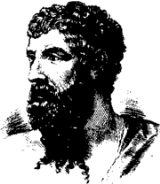
The Frogs

Encyclopedia
The Frogs is a comedy written by the Ancient Greek playwright Aristophanes
. It was performed at the Lenaia
, one of the Festivals of Dionysus
, in 405 BC
, and received first place.
, despairing of the state of Athens' tragedians
, and allegedly recovering from the disastrous Battle of Arginusae
. He travels to Hades
to bring Euripides
back from the dead. He brings along his slave Xanthias
, who is smarter, stronger, more rational, more prudent, and braver than Dionysus. The play opens as Xanthias and Dionysus argue over what kind of complaints Xanthias can use to open the play comically.
To find a reliable path to Tartarus, Dionysus seeks advice from his half-brother Heracles
who had been there before in order to retrieve the hell hound Cerberus
. Dionysus shows up at his doorstep dressed in a lion-hide and carrying a club. Heracles, upon seeing the effeminate Dionysus dressed up like himself, can't help laughing. At the question of which road is quickest to get to Hades, Heracles replies with the options of hanging yourself, drinking poison, or jumping off a tower. Dionysus opts for the longer journey across a lake (possibly Lake Acheron
); the one which Heracles took himself.
When Dionysus arrives at the river, Charon
ferries him across. Xanthias, being a slave, is not allowed in the boat, because he was unable to take part in the Battle of Arginusae
, and has to walk around it. He answers "I'll await you on yon side," a cheeky reference to how long he thinks it will take Dionysus to make it. The chorus starts here.
As Dionysus helps row, he hears a chorus of croaking frogs (the only scene in the play featuring frogs). Their chant — (Greek
: )— constantly repeat, and Dionysus chants with them until they fall silent, as Charon makes him row. When he arrives at the shore, Dionysus meets up with Xanthias, who teases him by claiming to see the frightening monster Empusa
. A second chorus composed of spirits of Dionysian Mystics
soon appear.
The next encounter is with Aeacus
, who mistakes Dionysus for Heracles due to his attire. Still angry over Heracles' theft of Cerberus, Aeacus threatens to unleash several monsters on him in revenge. Scared, Dionysus trades clothes with Xanthias. A maid then arrives and is happy to see Heracles. She invites him to a feast with virgin dancing girls, and Xanthias is more than happy to oblige. But Dionysus quickly wants to trade back the clothes. Dionysus, back in the Heracles lion-skin, encounters more people angry at Heracles, and so he makes Xanthias trade a third time.
When Aeacus returns, Xanthias tells him he should torture Dionysus to obtain the truth as to whether or not he is really a thief, and he offers several brutal options in which to do it. The terrified Dionysus tells the truth that he is a god. After each is whipped, Dionysus is brought before Aeacus' masters, and the truth is verified. Xanthius then chats up a maid, interrupted by preparations for the contest scene.
The maid describes the Euripides-Aeschylus conflict. Euripides, who had only just recently died, is challenging the great Aeschylus
to the seat of 'Best Tragic Poet' at the dinner table of Pluto
, the ruler of the underworld. A contest is held with Dionysus as judge. The two playwrights take turns quoting verses from their plays and making fun of the other. Euripides argues the characters in his plays are better because they are more true to life and logical, whereas Aeschylus believes his idealized characters are better as they are heroic and models for virtue. Aeschylus gets the upper hand in the argument, and begins making a fool of Euripides. He shows that Euripides' verse is predictable and formulaic by having Euripides quote lines from many of his prologue
s, each time interjecting with "... lost his little flask of oil". Euripides counters by setting Aeschylus' lyric verse to flute music, showing that it easily conforms to iambic tetrameter, expressed by the segment "oho what a stroke come you not to the rescue" (Lattimore translation) from Aeschylus' lost play Myrmidons
. Aeschylus retorts to this by mocking Euripides' choral meters and lyric monodies with castanets.
To end the debate, a balance is brought in and each are told to tell a few lines into it. Whoever's lines have the most "weight" will cause the balance to tip in their favor. Euripides produces verses of his that mention, in turn, the ship Argo
, Persuasion, and a mace. Aeschylus responds with the river Spercheios, Death, and two crashed chariots and two dead charioteers! Since the latter verses refer to "heavier" objects, Aeschylus wins, but Dionysus is still unable to decide whom he will revive. He finally decides to take the poet who gives the best advice about how to save the city. Euripides gives cleverly worded but essentially meaningless answers while Aeschylus provides more practical advice, and Dionysus decides to take Aeschylus back instead of Euripides. Pluto allows Aeschylus to return to life so that Athens may be succoured in her hour of need, and invites everyone to a round of farewell drinks. Before leaving, Aeschylus proclaims that Sophocles
should have his chair while he is gone, not Euripides.
for proof of this: “The antepirrhema of the parabasis (718-37) urges the citizen-body to reject the leadership of those whom it now follows, upstarts of foreign parentage (730-2), and turn back to men of known integrity who were brought up in the style of noble and wealthy families” (Dover 33). Kleophon is mentioned in the ode of the parabasis (674-85), and is both “vilified as a foreigner” (680-2) and maligned at the end of the play (1504, 1532).
The Frogs deviates from the pattern of political standpoint offered in Aristophanes’ earlier works, such as The Acharnians
(425 BC), Peace
(421 BC), and Lysistrata
(411 BC), which have all been termed 'peace' plays. The Frogs is not often thus labeled, however – Dover points out that though Kleophon was adamantly opposed to any peace which did not come of victory, and the last lines of the play suggest Athens
ought to look for a less stubborn end to the war, Aeschylus’ advice (1463-5) lays out a plan to win and not a proposition of capitulation. Also, The Frogs contains solid, serious messages which represent significant differences from general critiques of policy and idealistic thoughts of good peace terms. During the parabasis Aristophanes presents advice to give the rights of citizens back to people who had participated in the oligarchic
revolution in 411 BC, arguing they were misled by Phrynichus
' 'tricks' (literally 'wrestlings'). Phrynichos was a leader of the oligarchic revolution who was assassinated, to general satisfaction, in 411. This proposal was simple enough to be instated by a single act of the assembly, and was actually put into effect by Patrokleides’ decree after the loss of the fleet at Aegospotami
. The anonymous Life states that this advice was the basis of Aristophanes’ receipt of the olive wreath, and the author of the ancient Hypothesis says admiration of the parabasis was the major factor that led to the play's second production.
J.T. Sheppard contends that the exiled general Alcibiades
is a main focus of The Frogs. At the time the play was written and produced, Athens was in dire straits in the war with the Peloponnesian League
, and the people, Sheppard claims, would logically have Alcibiades on their minds. Sheppard quotes a segment of text from near the beginning of the parabasis:
He states that though this text ostensibly refers to citizens dispossessed of their rights, it will actually evoke memories of Alcibiades, the Athenians' exiled hero. Further support includes the presentation of the chorus, who recites these lines, as initiates
of the mysteries
. This, Sheppard says, will also prompt recollection of Alcibiades, whose initial exile was largely based on impiety regarding these religious institutions. Continuing this thought, the audience is provoked into remembering Alcibiades' return in 408 BC, when he made his peace with the goddesses. The reason Aristophanes hints so subtly at these points, according to Sheppard, is because Alcibiades still had many rivals in Athens, such as Kleophon and Adeimantus
, who are both blasted in the play. Sheppard also cites Aeschylus during the prologue debate, when the poet quotes from The Oresteia
:
This choice of excerpt again relates to Alcibiades, still stirring his memory in the audience. Sheppard concludes by referencing the direct mention of Alcibiades' name, which occurs in the course of Dionysus' final test of the poets, seeking advice about Alcibiades himself and a strategy for victory. Though Euripides first blasts Alcibiades, Aeschylus responds with the advice to bring him back, bringing the subtle allusions to a clearly stated head and concluding Aristophanes' point.
's palace, and he does so by line 673. The parabasis follows, (lines 674-737) and in the dialogue between the slaves a power struggle between Euripides and Aeschylus is revealed. Euripides is jealous of the other's place as the greatest tragic poet. Dionysus is asked by Pluto to mediate the contest or agon.
Charles Paul Segal argues that The Frogs is unique in its structure, because it combines two forms of comic motifs, a journey motif and a contest motif or agon
motif, with each motif being given equal weight in the play.
Segal contends that Aristophanes transformed the Greek comedy structure when he downgraded the contest or agon which usually preceded the parabasis and expanded the parabasis into the agon. In Aristophanes' earlier plays, i.e., The Acharnians and The Birds
, the protagonist is victorious prior to the parabasis and after the parabasis is usually shown implementing his reforms. Segal suggests this deviation gave a tone of seriousness to the play. For more detail see Old Comedy
.
Aristophanes
Aristophanes , son of Philippus, of the deme Cydathenaus, was a comic playwright of ancient Athens. Eleven of his forty plays survive virtually complete...
. It was performed at the Lenaia
Lenaia
The Lenaia was an annual festival with a dramatic competition. It was one of the lesser festivals of Athens and Ionia in ancient Greece. The Lenaia took place in Athens in the month of Gamelion, roughly corresponding to January. The festival was in honour of Dionysos Lenaios...
, one of the Festivals of Dionysus
Dionysia
The Dionysia[p] was a large festival in ancient Athens in honor of the god Dionysus, the central events of which were the theatrical performances of dramatic tragedies and, from 487 BC, comedies. It was the second-most important festival after the Panathenaia...
, in 405 BC
405 BC
Year 405 BC was a year of the pre-Julian Roman calendar. At the time, it was known as the Year of the Tribunate of Barbatus, Capitolinus, Cincinnatus, Medullinus, Iullus and Mamercinus...
, and received first place.
Plot
The Frogs tells the story of the god DionysusDionysus
Dionysus was the god of the grape harvest, winemaking and wine, of ritual madness and ecstasy in Greek mythology. His name in Linear B tablets shows he was worshipped from c. 1500—1100 BC by Mycenean Greeks: other traces of Dionysian-type cult have been found in ancient Minoan Crete...
, despairing of the state of Athens' tragedians
Tragedy
Tragedy is a form of art based on human suffering that offers its audience pleasure. While most cultures have developed forms that provoke this paradoxical response, tragedy refers to a specific tradition of drama that has played a unique and important role historically in the self-definition of...
, and allegedly recovering from the disastrous Battle of Arginusae
Battle of Arginusae
The naval Battle of Arginusae took place in 406 BC during the Peloponnesian War near the Arginusae islands east of the island of Lesbos. In the battle, an Athenian fleet commanded by eight strategoi defeated a Spartan fleet under Callicratidas...
. He travels to Hades
Hades
Hades , Hadēs, originally , Haidēs or , Aidēs , meaning "the unseen") was the ancient Greek god of the underworld. The genitive , Haidou, was an elision to denote locality: "[the house/dominion] of Hades". Eventually, the nominative came to designate the abode of the dead.In Greek mythology, Hades...
to bring Euripides
Euripides
Euripides was one of the three great tragedians of classical Athens, the other two being Aeschylus and Sophocles. Some ancient scholars attributed ninety-five plays to him but according to the Suda it was ninety-two at most...
back from the dead. He brings along his slave Xanthias
Xanthias
Xanthias refers to several characters, notably all slaves, who appear in plays by the Ancient Greek playwright Aristophanes.In The Frogs, Xanthias is the slave of Dionysus. He delivers the opening line of the play, riding on Dionysus' donkey and debating with Dionysus about what jokes Xanthias can...
, who is smarter, stronger, more rational, more prudent, and braver than Dionysus. The play opens as Xanthias and Dionysus argue over what kind of complaints Xanthias can use to open the play comically.
To find a reliable path to Tartarus, Dionysus seeks advice from his half-brother Heracles
Heracles
Heracles ,born Alcaeus or Alcides , was a divine hero in Greek mythology, the son of Zeus and Alcmene, foster son of Amphitryon and great-grandson of Perseus...
who had been there before in order to retrieve the hell hound Cerberus
Cerberus
Cerberus , or Kerberos, in Greek and Roman mythology, is a multi-headed hound which guards the gates of the Underworld, to prevent those who have crossed the river Styx from ever escaping...
. Dionysus shows up at his doorstep dressed in a lion-hide and carrying a club. Heracles, upon seeing the effeminate Dionysus dressed up like himself, can't help laughing. At the question of which road is quickest to get to Hades, Heracles replies with the options of hanging yourself, drinking poison, or jumping off a tower. Dionysus opts for the longer journey across a lake (possibly Lake Acheron
Acheron
The Acheron is a river located in the Epirus region of northwest Greece. It flows into the Ionian Sea in Ammoudia, near Parga.-In mythology:...
); the one which Heracles took himself.
When Dionysus arrives at the river, Charon
Charon (mythology)
In Greek mythology, Charon or Kharon is the ferryman of Hades who carries souls of the newly deceased across the rivers Styx and Acheron that divided the world of the living from the world of the dead. A coin to pay Charon for passage, usually an obolus or danake, was sometimes placed in or on...
ferries him across. Xanthias, being a slave, is not allowed in the boat, because he was unable to take part in the Battle of Arginusae
Battle of Arginusae
The naval Battle of Arginusae took place in 406 BC during the Peloponnesian War near the Arginusae islands east of the island of Lesbos. In the battle, an Athenian fleet commanded by eight strategoi defeated a Spartan fleet under Callicratidas...
, and has to walk around it. He answers "I'll await you on yon side," a cheeky reference to how long he thinks it will take Dionysus to make it. The chorus starts here.
As Dionysus helps row, he hears a chorus of croaking frogs (the only scene in the play featuring frogs). Their chant — (Greek
Greek language
Greek is an independent branch of the Indo-European family of languages. Native to the southern Balkans, it has the longest documented history of any Indo-European language, spanning 34 centuries of written records. Its writing system has been the Greek alphabet for the majority of its history;...
: )— constantly repeat, and Dionysus chants with them until they fall silent, as Charon makes him row. When he arrives at the shore, Dionysus meets up with Xanthias, who teases him by claiming to see the frightening monster Empusa
Empusa
Empusa is a demigoddess of Greek mythology. In later incarnations she appeared as a species of monsters commanded by Hecate ....
. A second chorus composed of spirits of Dionysian Mystics
Dionysian Mysteries
The Dionysian Mysteries were a ritual of ancient Greece and Rome which used intoxicants and other trance-inducing techniques to remove inhibitions and social constraints, liberating the individual to return to a natural state. It also provided some liberation for those marginalized by Greek...
soon appear.
The next encounter is with Aeacus
Aeacus
Aeacus was a mythological king of the island of Aegina in the Saronic Gulf.He was son of Zeus and Aegina, a daughter of the river-god Asopus. He was born on the island of Oenone or Oenopia, to which Aegina had been carried by Zeus to secure her from the anger of her parents, and whence this...
, who mistakes Dionysus for Heracles due to his attire. Still angry over Heracles' theft of Cerberus, Aeacus threatens to unleash several monsters on him in revenge. Scared, Dionysus trades clothes with Xanthias. A maid then arrives and is happy to see Heracles. She invites him to a feast with virgin dancing girls, and Xanthias is more than happy to oblige. But Dionysus quickly wants to trade back the clothes. Dionysus, back in the Heracles lion-skin, encounters more people angry at Heracles, and so he makes Xanthias trade a third time.
When Aeacus returns, Xanthias tells him he should torture Dionysus to obtain the truth as to whether or not he is really a thief, and he offers several brutal options in which to do it. The terrified Dionysus tells the truth that he is a god. After each is whipped, Dionysus is brought before Aeacus' masters, and the truth is verified. Xanthius then chats up a maid, interrupted by preparations for the contest scene.
The maid describes the Euripides-Aeschylus conflict. Euripides, who had only just recently died, is challenging the great Aeschylus
Aeschylus
Aeschylus was the first of the three ancient Greek tragedians whose work has survived, the others being Sophocles and Euripides, and is often described as the father of tragedy. His name derives from the Greek word aiskhos , meaning "shame"...
to the seat of 'Best Tragic Poet' at the dinner table of Pluto
Pluto (mythology)
In ancient Greek religion and myth, Pluto was a name for the ruler of the underworld; the god was also known as Hades, a name for the underworld itself...
, the ruler of the underworld. A contest is held with Dionysus as judge. The two playwrights take turns quoting verses from their plays and making fun of the other. Euripides argues the characters in his plays are better because they are more true to life and logical, whereas Aeschylus believes his idealized characters are better as they are heroic and models for virtue. Aeschylus gets the upper hand in the argument, and begins making a fool of Euripides. He shows that Euripides' verse is predictable and formulaic by having Euripides quote lines from many of his prologue
Prologue
A prologue is an opening to a story that establishes the setting and gives background details, often some earlier story that ties into the main one, and other miscellaneous information. The Greek prologos included the modern meaning of prologue, but was of wider significance...
s, each time interjecting with "... lost his little flask of oil". Euripides counters by setting Aeschylus' lyric verse to flute music, showing that it easily conforms to iambic tetrameter, expressed by the segment "oho what a stroke come you not to the rescue" (Lattimore translation) from Aeschylus' lost play Myrmidons
Myrmidons
The Myrmidons or Myrmidones were legendary people of Greek history. They were very brave and skilled warriors commanded by Achilles, as described in Homer's Iliad. Their eponymous ancestor was Myrmidon, a king of Thessalian Phthia, who was the son of Zeus and "wide-ruling" Eurymedousa, a...
. Aeschylus retorts to this by mocking Euripides' choral meters and lyric monodies with castanets.
To end the debate, a balance is brought in and each are told to tell a few lines into it. Whoever's lines have the most "weight" will cause the balance to tip in their favor. Euripides produces verses of his that mention, in turn, the ship Argo
Argo
In Greek mythology, the Argo was the ship on which Jason and the Argonauts sailed from Iolcos to retrieve the Golden Fleece. It was named after its builder, Argus.-Legend:...
, Persuasion, and a mace. Aeschylus responds with the river Spercheios, Death, and two crashed chariots and two dead charioteers! Since the latter verses refer to "heavier" objects, Aeschylus wins, but Dionysus is still unable to decide whom he will revive. He finally decides to take the poet who gives the best advice about how to save the city. Euripides gives cleverly worded but essentially meaningless answers while Aeschylus provides more practical advice, and Dionysus decides to take Aeschylus back instead of Euripides. Pluto allows Aeschylus to return to life so that Athens may be succoured in her hour of need, and invites everyone to a round of farewell drinks. Before leaving, Aeschylus proclaims that Sophocles
Sophocles
Sophocles is one of three ancient Greek tragedians whose plays have survived. His first plays were written later than those of Aeschylus, and earlier than or contemporary with those of Euripides...
should have his chair while he is gone, not Euripides.
Politics
Kenneth Dover claims that the underlying political theme of The Frogs is essentially “old ways good, new ways bad”. He points to the parabasisParabasis
In Greek comedy, the parabasis is a point in the play when all of the actors leave the stage and the chorus is left to address the audience directly...
for proof of this: “The antepirrhema of the parabasis (718-37) urges the citizen-body to reject the leadership of those whom it now follows, upstarts of foreign parentage (730-2), and turn back to men of known integrity who were brought up in the style of noble and wealthy families” (Dover 33). Kleophon is mentioned in the ode of the parabasis (674-85), and is both “vilified as a foreigner” (680-2) and maligned at the end of the play (1504, 1532).
The Frogs deviates from the pattern of political standpoint offered in Aristophanes’ earlier works, such as The Acharnians
The Acharnians
The Acharnians is the third play - and the earliest of the eleven surviving plays - by the great Athenian playwright Aristophanes. It was produced in 425 BCE on behalf of the young dramatist by an associate, Callistratus, and it won first place at the Lenaia festival...
(425 BC), Peace
Peace (play)
Peace is an Athenian Old Comedy written and produced by the Greek playwright Aristophanes. It won second prize at the City Dionysia where it was staged just a few days before the ratification of the Peace of Nicias , which promised to end the ten year old Peloponnesian War...
(421 BC), and Lysistrata
Lysistrata
Lysistrata is one of eleven surviving plays written by Aristophanes. Originally performed in classical Athens in 411 BC, it is a comic account of one woman's extraordinary mission to end The Peloponnesian War...
(411 BC), which have all been termed 'peace' plays. The Frogs is not often thus labeled, however – Dover points out that though Kleophon was adamantly opposed to any peace which did not come of victory, and the last lines of the play suggest Athens
Athens
Athens , is the capital and largest city of Greece. Athens dominates the Attica region and is one of the world's oldest cities, as its recorded history spans around 3,400 years. Classical Athens was a powerful city-state...
ought to look for a less stubborn end to the war, Aeschylus’ advice (1463-5) lays out a plan to win and not a proposition of capitulation. Also, The Frogs contains solid, serious messages which represent significant differences from general critiques of policy and idealistic thoughts of good peace terms. During the parabasis Aristophanes presents advice to give the rights of citizens back to people who had participated in the oligarchic
Oligarchy
Oligarchy is a form of power structure in which power effectively rests with an elite class distinguished by royalty, wealth, family ties, commercial, and/or military legitimacy...
revolution in 411 BC, arguing they were misled by Phrynichus
Phrynichus
Phrynichus may refer to:*Phrynichus, a genus in the Amblypygi, an order of arachnids-People:*There are two dramatic poets named Phrynicus whose plays only survive in fragments:...
' 'tricks' (literally 'wrestlings'). Phrynichos was a leader of the oligarchic revolution who was assassinated, to general satisfaction, in 411. This proposal was simple enough to be instated by a single act of the assembly, and was actually put into effect by Patrokleides’ decree after the loss of the fleet at Aegospotami
Battle of Aegospotami
The naval Battle of Aegospotami took place in 405 BC and was the last major battle of the Peloponnesian War. In the battle, a Spartan fleet under Lysander completely destroyed the Athenian navy...
. The anonymous Life states that this advice was the basis of Aristophanes’ receipt of the olive wreath, and the author of the ancient Hypothesis says admiration of the parabasis was the major factor that led to the play's second production.
J.T. Sheppard contends that the exiled general Alcibiades
Alcibiades
Alcibiades, son of Clinias, from the deme of Scambonidae , was a prominent Athenian statesman, orator, and general. He was the last famous member of his mother's aristocratic family, the Alcmaeonidae, which fell from prominence after the Peloponnesian War...
is a main focus of The Frogs. At the time the play was written and produced, Athens was in dire straits in the war with the Peloponnesian League
Peloponnesian League
The Peloponnesian League was an alliance in the Peloponnesus from the 6th to the 4th centuries BC.- Early history:By the end of the 6th century, Sparta had become the most powerful state in the Peloponnese, and was the political and military hegemon over Argos, the next most powerful state...
, and the people, Sheppard claims, would logically have Alcibiades on their minds. Sheppard quotes a segment of text from near the beginning of the parabasis:
He states that though this text ostensibly refers to citizens dispossessed of their rights, it will actually evoke memories of Alcibiades, the Athenians' exiled hero. Further support includes the presentation of the chorus, who recites these lines, as initiates
Initiation
Initiation is a rite of passage ceremony marking entrance or acceptance into a group or society. It could also be a formal admission to adulthood in a community or one of its formal components...
of the mysteries
Eleusinian Mysteries
The Eleusinian Mysteries were initiation ceremonies held every year for the cult of Demeter and Persephone based at Eleusis in ancient Greece. Of all the mysteries celebrated in ancient times, these were held to be the ones of greatest importance...
. This, Sheppard says, will also prompt recollection of Alcibiades, whose initial exile was largely based on impiety regarding these religious institutions. Continuing this thought, the audience is provoked into remembering Alcibiades' return in 408 BC, when he made his peace with the goddesses. The reason Aristophanes hints so subtly at these points, according to Sheppard, is because Alcibiades still had many rivals in Athens, such as Kleophon and Adeimantus
Adeimantus, son of Leucolophides
Adeimantus , son of Leucolophides, an Athenian, was one of the commanders with Alcibiades in the expedition against Andros in 407 BC. He was again appointed one of the Athenian generals after the Battle of Arginusae in 406 BC, and continued in office till the Battle of Aegospotami in 404 BC, where...
, who are both blasted in the play. Sheppard also cites Aeschylus during the prologue debate, when the poet quotes from The Oresteia
The Oresteia
The Oresteia is a trilogy of Greek tragedies written by Aeschylus which concerns the end of the curse on the House of Atreus. When originally performed it was accompanied by Proteus, a satyr play that would have been performed following the trilogy; it has not survived...
:
This choice of excerpt again relates to Alcibiades, still stirring his memory in the audience. Sheppard concludes by referencing the direct mention of Alcibiades' name, which occurs in the course of Dionysus' final test of the poets, seeking advice about Alcibiades himself and a strategy for victory. Though Euripides first blasts Alcibiades, Aeschylus responds with the advice to bring him back, bringing the subtle allusions to a clearly stated head and concluding Aristophanes' point.
Structure of The Frogs
According to Kenneth Dover the structure of The Frogs is as follows: In the first section Dionysus' has the goal of gaining admission to PlutoPluto
Pluto, formal designation 134340 Pluto, is the second-most-massive known dwarf planet in the Solar System and the tenth-most-massive body observed directly orbiting the Sun...
's palace, and he does so by line 673. The parabasis follows, (lines 674-737) and in the dialogue between the slaves a power struggle between Euripides and Aeschylus is revealed. Euripides is jealous of the other's place as the greatest tragic poet. Dionysus is asked by Pluto to mediate the contest or agon.
Charles Paul Segal argues that The Frogs is unique in its structure, because it combines two forms of comic motifs, a journey motif and a contest motif or agon
Agon
Agon is an ancient Greek word with several meanings:*In one sense, it meant a contest, competition, especially the Olympic Games , or challenge that was held in connection with religious festivals....
motif, with each motif being given equal weight in the play.
Segal contends that Aristophanes transformed the Greek comedy structure when he downgraded the contest or agon which usually preceded the parabasis and expanded the parabasis into the agon. In Aristophanes' earlier plays, i.e., The Acharnians and The Birds
The Birds (play)
The Birds is a comedy by the Ancient Greek playwright Aristophanes. It was performed in 414 BCE at the City Dionysia where it won second prize. It has been acclaimed by modern critics as a perfectly realized fantasy remarkable for its mimicry of birds and for the gaiety of its songs...
, the protagonist is victorious prior to the parabasis and after the parabasis is usually shown implementing his reforms. Segal suggests this deviation gave a tone of seriousness to the play. For more detail see Old Comedy
Ancient Greek comedy
Ancient Greek comedy was one of the final three principal dramatic forms in the theatre of classical Greece . Athenian comedy is conventionally divided into three periods, Old Comedy, Middle Comedy, and New Comedy...
.
Sophocles
Sophocles, a tragic playwright similar to Aeschylus, and who had died recently is referenced several times as a worthy playwright. He is told to guard Aeschylus' chair while he is away.Additional resources
- The Frogs in Greek (from Perseus)