

The Oresteia

Encyclopedia
The Oresteia is a trilogy
of Greek
tragedies
written by Aeschylus
which concerns the end of the curse
on the House of Atreus. When originally performed it was accompanied by Proteus
, a satyr play
that would have been performed following the trilogy; it has not survived. The term "Oresteia" originally probably referred to all four plays, but today is generally used to designate only the surviving trilogy. "The individual plays probably did not originally have titles of their own" The only surviving example of a trilogy of ancient Greek
plays, the Oresteia was originally performed at the Dionysia
festival in Athens
in 458 BC
, where it won first prize. A principal theme of the trilogy is the shift from the practice of personal vendetta
to a system of litigation. The name derives from the character Orestes
, who sets out to avenge his father after his mother's affair with Aegisthus
, King of Argos, from the Trojan War
. Waiting at home for him is his wife, Clytemnestra
, who has been planning his murder, partly as revenge for the sacrifice of their daughter, Iphigenia, and partly because in the ten years of Agamemnon's absence Clytemnestra has entered into an adulterous relationship with Aegisthus
, Agamemnon's cousin and the sole survivor of a dispossessed branch of the family, who is determined to regain the throne he believes should rightfully belong to him.
has fallen). He laments the fortunes of the house, but promises to keep silent: "A huge ox has stepped onto my tongue." However, when Agamemnon returns, he brings with him Cassandra
, the enslaved daughter of the Trojan king, Priam
, and a priestess of Apollo, as his concubine, further angering Clytemnestra.
The central action of the play is the agon
between Clytemnestra and Agamemnon. She plays the loving, waiting wife and attempts to persuade Agamemnon to step on a purple (sometimes red) tapestry or carpet to walk into "his" palace as a true returning conqueror. The problem is that this would indicate hubris
on Agamemnon's part, and he is reluctant. Eventually, for reasons that are still heavily debated, Clytemnestra does persuade Agamemnon to cross the purple tapestry to enter the oikos
, the home.
While Clytemnestra and Agamemnon are offstage, Cassandra, who had heretofore been silent, is suddenly possessed by the god Apollo
and enters a tumultuous trance. Gradually her incoherent delirium starts making some sense and she engages in anguished discussion with the chorus
whether she should enter the palace, knowing that she too will be murdered. Cassandra has been cursed by Apollo
for rejecting his advances. He has given her clairvoyance
so that she can foresee future events, but he has cursed her so that no one who hears her prophesies will believe them until it's too late. In Cassandra's soliloquy, she runs through many gruesome images of the history of the House of Atreus as if she had been a witness of them, and she eventually enters the palace, knowing that her fate is preordained and unavoidable. The chorus, in this play a group of the elders of Argos, are left bewildered and fearful, until they hear the death screams of Agamemnon and frantically debate on a course of action.
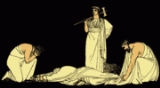
A platform is then rolled out displaying the butchered corpses of Agamemnon and Cassandra, along with Clytemnestra brandishing the bloodied axe, and defiantly explaining her action. Agamemnon was murdered in much the same way an animal is killed for sacrifice: with three blows, the last strike accompanied by a prayer to a god. She is soon joined by Aegisthus
, Agamemnon's dispossessed cousin and her lover, now the king, strutting out and delivering an arrogant speech to the chorus, who nearly enter into a brawl with him and his guard. However, Clytemnestra halts the dispute, saying that "There is pain enough already. Let us not be bloody now." The play closes with the chorus reminding the usurper
s that Orestes
, the son of Agamemnon, will surely return to exact vengeance
.
and Orestes
, and their revenge. Orestes
kills Clytemnestra to avenge the death of Agamemnon, Orestes' father.
, the son of the king of Phocis, where he has grown up in exile; he places two locks of his hair on the tomb. Orestes and Pylades hide as Electra
, Orestes' sister, arrives at the grave accompanied by a chorus of elderly slave women (the libation bearers of the title) to pour libations on Agamemnon's grave; they have been sent by Clytemnestra in an effort "to ward off harm" (l.42). Just as the ritual ends, Electra spots a lock of hair on the tomb which she recognizes as similar to her own; subsequently she sees two sets of footprints, one of which has proportions similar to hers. At this point Orestes and Pylades emerge from their hiding place and Orestes gradually convinces her of his identity.
Now, in the longest and most structurally complex lyric passage in extant Greek tragedy, the chorus, Orestes, and Electra, conjure the departed spirit of Agamemnon to aid them in revenging his murder. Orestes then asks "why she sent libations, what calculation led her to offer too late atonement for a hurt past cure"(l.515-516). The chorus responds that in the palace of Argos Clytemnestra was roused from slumber by a nightmare: she dreamt that she gave birth to a snake, and the snake now feeds from her breast and draws blood along with milk. Alarmed by this, a possible sign of the gods' wrath, she "sent these funeral libations"(l.538). Orestes believes that he is the snake in his mother's dream, so together with Electra they plan to avenge their father by killing their mother Clytemnestra and her new husband, Aegisthus
.
Orestes and Pylades pretend to be ordinary travelers from Phocis, and ask for hospitality at the palace. They even tell the Queen that Orestes is dead. Delighted by the news, Clytemnestra sends a servant to summon Aegisthus. When Aegisthus arrives, Orestes reveals himself and kills the usurper. Clytemnestra hears the shouting of a servant and appears on the scene. She sees Orestes standing over the body of Aegisthus. Orestes is then presented with a difficult situation: in order to avenge his father, he must kill his mother. Clytemnestra bares her breast and pleads, "Hold, oh child, and have shame" to which he responds by saying to his close friend Pylades, the son of the king of Phocis: "Shall I be ashamed to kill [my] mother ?"(l.896-899). Some interpreters have suggested that Orestes' question may be connected to a greater theme in the Oresteia: that sometimes we are faced with impossible decisions; in this case, Orestes' familial duty to his father is fundamentally opposed to his familial duty to his mother. On the other hand, it appears straightforwardly as not much more than a pro forma rhetorical question because he readily accepts Pylades advice that it is the correct course of action. Pylades implores Orestes not to forget his duty to Apollo "and our sworn pact" (900). Orestes proceeds immediately with the murder and wraps the bodies of Clytemnestra and Aegisthus in the cloak that Agamemnon was wearing when he was slain.
As soon as he exits the palace, the Erinyes
, or Furies as they are known in Roman mythology, begin to haunt and torture him in his flight. Orestes flees in agonized panic. The chorus complains that the cycle of violence did not stop with Clytemnestra’s murder, but continues.
go before Athena and eleven other judges chosen by her from the Athenian citizenry at the Areopagus
(Rock of Ares, a flat rocky hill by the Athenian agora
where the homicide court of Athens later held its sessions), to decide whether Orestes' killing of his mother, Clytemnestra, makes him guilty of the crime of murder.
deities that avenge patricide
and matricide
. He, at the instigation of his sister Electra and the god Apollo, has killed their mother Clytemnestra, who had killed their father, King Agamemnon, who had killed his daughter and Orestes's sister, Iphigenia. Orestes finds a refuge and a solace at the new temple of Apollo in Delphi
, and the god, unable to deliver him from the Erinyes' unappeasable wrath, sends him along to Athens under the protection of Hermes
, while he casts a drowsy spell upon the pursuing Erinyes in order to delay them.
Clytemnestra's ghost appears "exactly how or from where is uncertain . . . noteworthy is the poet's bold inventiveness in presenting her as a dream to a collection rather than to a single individual", to the sleeping Erinyes, urging them to continue hunting Orestes. "As the first of them begins to awake the ghost departs". The Erinyes' first appearance on stage is haunting: they hum in unison as they slowly wake up, and seek to find the scent of blood that will lead them to Orestes' tracks. Ancient tradition says that on the play's premiere this struck so much fear and anguish in the audience, that a pregnant woman named Neaira suffered a miscarriage
and died on the spot.
The Erinyes' tracking down of Orestes in Athens is equally haunting: Orestes has clasped Athena
's small statue in supplication
, and the Erinyes close in on him by smelling the blood of his slain mother in the air. Once they do see him, they can also see rivulets of blood soaking the earth beneath his footsteps.
As they surround him, Athena intervenes and brings in eleven Athenians to join her in forming a jury to judge her supplicant. Apollo acts as attorney for Orestes, while the Erinyes act as advocates for the dead Clytemnestra. During the trial, Apollo convinces Athena that, in a marriage, the man is more important than the woman, by pointing out that Athena was born only of Zeus
and without a mother. Athena votes last and casts her vote for acquittal; after being counted, the votes on each side are equal, thus acquitting Orestes as Athena had earlier announced that this would be the result of a tie. She then persuades the Erinyes to accept the verdict, and they eventually submit. Athena then leads a procession accompanying them to their new abode and the escort now addresses them as "Semnai" (Venerable Ones), as they will now be honored by the citizens of Athens and ensure the city's prosperity. Athena also declares that henceforth tied juries will result in the defendant being acquitted, as mercy
should always take precedence over harshness.
, it is widely believed to have been based on the story told in Book IV of Homer
's Odyssey
, where Menelaus, Agamemnon's brother, attempts to return home from Troy and finds himself on an island off Egypt, "whither he seems to have been carried by the storm described in Agam.674. The title character, "the deathless Egyptian Proteus
", the Old Man of the Sea, is described in Homer as having been visited by Menelaus seeking to learn his future. In the process, Proteus tells Menelaus of the death of Agamemnon at the hands of Aegisthus as well as the fates of Ajax the Lesser
and Odysseus
at sea; and is compelled to tell Menelaus how to reach home from the island of Pharos. "The satyrs who may have found themselves on the island as a result of shipwreck . . . perhaps gave assistance to Menelaus and escaped with him, though he may have had difficulty in ensuring that they keep their hands off Helen" The only extant fragment that has been definitively attributed to Proteus was translated by Herbert Weir Smyth
as "A wretched piteous dove, in quest of food, dashed amid the winnowing-fans, its breast broken in twain." In 2002, Theatre Kingston
mounted a production of The Oresteia and included a new reconstruction of Proteus based on the episode in The Odyssey and loosely arranged according to the structure of extant satyr plays.
ending in misfortune. The word did not carry this meaning in ancient Athens, and many of the extant Greek tragedies end happily.
Since Apollo has thrown his weight behind the path of vengeance, Orestes chooses to comply with his commands. In fulfilling his duty towards Apollo and his father, Orestes condemns himself to suffering. He chooses to make this sacrifice, however, in order to preserve the laws of society. In the end of Eumenides, Orestes is tried in court by the Furies, with the goddess Athena and the Athenian elders acting as the jury. In this case, Orestes is not killed in turn for his crimes as would have been the retributive law at the time, but he is given the opportunity to defend himself, and is ultimately declared not guilty. The Erinyes are angered by this decision as they belong to the old gods, and for decades uncounted blood had to be repaid in blood. Yet Athena calms them with great effort, making it clear to them that a society cannot possibly work and grow under such circumstances, and grants them seats of great power in Athens. Justice
is decided by a jury, representing the citizen body and its values and the gods themselves, who sanction this transition by taking part in the judgment, arguing and voting on an equal footing with the mortals. This theme of the polis
self-governed by consent through lawful institutions, as opposed to tribalism
and superstition
, recurs in Greek art and thought. Athena, the goddess of Reason and Protection, calms the Erinyes, the goddesses of revenge and remorse, thereby establishing a legal system centered in Athens, relieving the Greeks of their responsibility to avenge violence with violence. Now the state is the institution to administer justice, employing reason, but also holding the power to punish, violently if need be. Athens has left its barbaric system of blood for blood behind and has embraced civiliation where people deserve a fair trial.
is Clytaemestra’s accomplice in the murder of his cousin Agamemnon
, and Agamemnon had killed his daughter Iphigeneia
, even as a required sacrifice.
“A part of the self” can also be interpreted more figuratively as a significant other, such as a spouse; thus, Clytaemestra’s feelings for Agamemnon
are characterized as ‘philos-aphilos’ as well. As Richmond Lattimore
defined it thus, “the hate gains intensity from the strength of the original love when that love has been stopped or rejected.” Clytaemestra’s love for Agamemnon
has been quashed by his sacrifice of Iphigeneia
and his return with Cassandra
as a concubine. Likewise, Orestes
’ sentiments toward his mother are intensified by anger at her murder of his father and resentment at the fact that she chose her lover over her children – essentially, they are “the price for which she bought herself this man.” These conflicting feelings are embodied in Clytaemestra’s dream about nursing the snake.
Lattimore also draws a parallel between the Oresteia and Hamlet
, suggesting that the sensation of ‘philos-aphilos’ engendered by Prince Hamlet
’s emotional connections to his mother, Queen Gertrude
, and to Ophelia, who are both on the side of King Claudius
– himself a close blood relative who might have held Hamlet’s affection and regard before usurping the throne – are what make the play a tragedy.
Trilogy
A trilogy is a set of three works of art that are connected, and that can be seen either as a single work or as three individual works. They are commonly found in literature, film, or video games...
of Greek
Theatre of Ancient Greece
The theatre of Ancient Greece, or ancient Greek drama, is a theatrical culture that flourished in ancient Greece between c. 550 and c. 220 BC. The city-state of Athens, which became a significant cultural, political and military power during this period, was its centre, where it was...
tragedies
Tragedy
Tragedy is a form of art based on human suffering that offers its audience pleasure. While most cultures have developed forms that provoke this paradoxical response, tragedy refers to a specific tradition of drama that has played a unique and important role historically in the self-definition of...
written by Aeschylus
Aeschylus
Aeschylus was the first of the three ancient Greek tragedians whose work has survived, the others being Sophocles and Euripides, and is often described as the father of tragedy. His name derives from the Greek word aiskhos , meaning "shame"...
which concerns the end of the curse
Curse
A curse is any expressed wish that some form of adversity or misfortune will befall or attach to some other entity—one or more persons, a place, or an object...
on the House of Atreus. When originally performed it was accompanied by Proteus
Proteus
In Greek mythology, Proteus is an early sea-god, one of several deities whom Homer calls the "Old Man of the Sea", whose name suggests the "first" , as protogonos is the "primordial" or the "firstborn". He became the son of Poseidon in the Olympian theogony In Greek mythology, Proteus (Πρωτεύς)...
, a satyr play
Satyr play
Satyr plays were an ancient Greek form of tragicomedy, similar in spirit to burlesque. They featured choruses of satyrs, were based on Greek mythology, and were rife with mock drunkenness, brazen sexuality , pranks, sight gags, and general merriment.Satyric drama was one of the three varieties of...
that would have been performed following the trilogy; it has not survived. The term "Oresteia" originally probably referred to all four plays, but today is generally used to designate only the surviving trilogy. "The individual plays probably did not originally have titles of their own" The only surviving example of a trilogy of ancient Greek
Ancient Greece
Ancient Greece is a civilization belonging to a period of Greek history that lasted from the Archaic period of the 8th to 6th centuries BC to the end of antiquity. Immediately following this period was the beginning of the Early Middle Ages and the Byzantine era. Included in Ancient Greece is the...
plays, the Oresteia was originally performed at the Dionysia
Dionysia
The Dionysia[p] was a large festival in ancient Athens in honor of the god Dionysus, the central events of which were the theatrical performances of dramatic tragedies and, from 487 BC, comedies. It was the second-most important festival after the Panathenaia...
festival in Athens
Athens
Athens , is the capital and largest city of Greece. Athens dominates the Attica region and is one of the world's oldest cities, as its recorded history spans around 3,400 years. Classical Athens was a powerful city-state...
in 458 BC
458 BC
Year 458 BC was a year of the pre-Julian Roman calendar. At the time, it was known as the Year of the Consulship of Rutilus and Carvetus...
, where it won first prize. A principal theme of the trilogy is the shift from the practice of personal vendetta
Feud
A feud , referred to in more extreme cases as a blood feud, vendetta, faida, or private war, is a long-running argument or fight between parties—often groups of people, especially families or clans. Feuds begin because one party perceives itself to have been attacked, insulted or wronged by another...
to a system of litigation. The name derives from the character Orestes
Orestes
Orestes was the son of Agamemnon in Greek mythology; Orestes may also refer to:Drama*Orestes , by Euripides*Orestes, the character in Sophocles' tragedy Electra*Orestes, the character in Aeschylus' trilogy of tragedies, Oresteia...
, who sets out to avenge his father after his mother's affair with Aegisthus
Aegisthus
In Greek mythology, Aegisthus was the son of Thyestes and of Thyestes' daughter, Pelopia....
Introduction
The play Agamemnon details the homecoming of AgamemnonAgamemnon
In Greek mythology, Agamemnon was the son of King Atreus and Queen Aerope of Mycenae, the brother of Menelaus, the husband of Clytemnestra, and the father of Electra and Orestes. Mythical legends make him the king of Mycenae or Argos, thought to be different names for the same area...
, King of Argos, from the Trojan War
Trojan War
In Greek mythology, the Trojan War was waged against the city of Troy by the Achaeans after Paris of Troy took Helen from her husband Menelaus, the king of Sparta. The war is among the most important events in Greek mythology and was narrated in many works of Greek literature, including the Iliad...
. Waiting at home for him is his wife, Clytemnestra
Clytemnestra
Clytemnestra or Clytaemnestra , in ancient Greek legend, was the wife of Agamemnon, king of the Ancient Greek kingdom of Mycenae or Argos. In the Oresteia by Aeschylus, she was a femme fatale who murdered her husband, Agamemnon – said by Euripides to be her second husband – and the Trojan princess...
, who has been planning his murder, partly as revenge for the sacrifice of their daughter, Iphigenia, and partly because in the ten years of Agamemnon's absence Clytemnestra has entered into an adulterous relationship with Aegisthus
Aegisthus
In Greek mythology, Aegisthus was the son of Thyestes and of Thyestes' daughter, Pelopia....
, Agamemnon's cousin and the sole survivor of a dispossessed branch of the family, who is determined to regain the throne he believes should rightfully belong to him.
Storyline
The play opens to a watchman on top of the house, reporting that he has been lying restless there "like a dog" (kunos diken) for a year, "for so rules the manly-willed heart of a woman" (that woman being Clytemnestra awaiting the return of her husband, who has arranged that mountaintop beacons give the signal when TroyTroy
Troy was a city, both factual and legendary, located in northwest Anatolia in what is now Turkey, southeast of the Dardanelles and beside Mount Ida...
has fallen). He laments the fortunes of the house, but promises to keep silent: "A huge ox has stepped onto my tongue." However, when Agamemnon returns, he brings with him Cassandra
Cassandra
In Greek mythology, Cassandra was the daughter of King Priam and Queen Hecuba of Troy. Her beauty caused Apollo to grant her the gift of prophecy...
, the enslaved daughter of the Trojan king, Priam
Priam
Priam was the king of Troy during the Trojan War and youngest son of Laomedon. Modern scholars derive his name from the Luwian compound Priimuua, which means "exceptionally courageous".- Marriage and issue :...
, and a priestess of Apollo, as his concubine, further angering Clytemnestra.
From the silence of the watchman the chorus begin with the great parodos, which as Kitto expressed it ['It lays down the intellectual foundation of the whole trilogy'], bears the weight of the trilogy . . . Through descriptions of the past, hopes and fears for the future, and statements of the present (which together constitute the narrative) this song develops a series of tensions . . .[it] opens with the narrative of events leading towards the Trojan expedition
The central action of the play is the agon
Agon
Agon is an ancient Greek word with several meanings:*In one sense, it meant a contest, competition, especially the Olympic Games , or challenge that was held in connection with religious festivals....
between Clytemnestra and Agamemnon. She plays the loving, waiting wife and attempts to persuade Agamemnon to step on a purple (sometimes red) tapestry or carpet to walk into "his" palace as a true returning conqueror. The problem is that this would indicate hubris
Hubris
Hubris , also hybris, means extreme haughtiness, pride or arrogance. Hubris often indicates a loss of contact with reality and an overestimation of one's own competence or capabilities, especially when the person exhibiting it is in a position of power....
on Agamemnon's part, and he is reluctant. Eventually, for reasons that are still heavily debated, Clytemnestra does persuade Agamemnon to cross the purple tapestry to enter the oikos
Oikos
An oikos is the ancient Greek equivalent of a household, house, or family....
, the home.
While Clytemnestra and Agamemnon are offstage, Cassandra, who had heretofore been silent, is suddenly possessed by the god Apollo
Apollo
Apollo is one of the most important and complex of the Olympian deities in Greek and Roman mythology...
and enters a tumultuous trance. Gradually her incoherent delirium starts making some sense and she engages in anguished discussion with the chorus
Greek chorus
A Greek chorus is a homogenous, non-individualised group of performers in the plays of classical Greece, who comment with a collective voice on the dramatic action....
whether she should enter the palace, knowing that she too will be murdered. Cassandra has been cursed by Apollo
Apollo
Apollo is one of the most important and complex of the Olympian deities in Greek and Roman mythology...
for rejecting his advances. He has given her clairvoyance
Clairvoyance
The term clairvoyance is used to refer to the ability to gain information about an object, person, location or physical event through means other than the known human senses, a form of extra-sensory perception...
so that she can foresee future events, but he has cursed her so that no one who hears her prophesies will believe them until it's too late. In Cassandra's soliloquy, she runs through many gruesome images of the history of the House of Atreus as if she had been a witness of them, and she eventually enters the palace, knowing that her fate is preordained and unavoidable. The chorus, in this play a group of the elders of Argos, are left bewildered and fearful, until they hear the death screams of Agamemnon and frantically debate on a course of action.
A platform is then rolled out displaying the butchered corpses of Agamemnon and Cassandra, along with Clytemnestra brandishing the bloodied axe, and defiantly explaining her action. Agamemnon was murdered in much the same way an animal is killed for sacrifice: with three blows, the last strike accompanied by a prayer to a god. She is soon joined by Aegisthus
Aegisthus
In Greek mythology, Aegisthus was the son of Thyestes and of Thyestes' daughter, Pelopia....
, Agamemnon's dispossessed cousin and her lover, now the king, strutting out and delivering an arrogant speech to the chorus, who nearly enter into a brawl with him and his guard. However, Clytemnestra halts the dispute, saying that "There is pain enough already. Let us not be bloody now." The play closes with the chorus reminding the usurper
Usurper
Usurper is a derogatory term used to describe either an illegitimate or controversial claimant to the power; often, but not always in a monarchy, or a person who succeeds in establishing himself as a monarch without inheriting the throne, or any other person exercising authority unconstitutionally...
s that Orestes
Orestes (mythology)
In Greek mythology, Orestes was the son of Clytemnestra and Agamemnon. He is the subject of several Ancient Greek plays and of various myths connected with his madness and purification, which retain obscure threads of much older ones....
, the son of Agamemnon, will surely return to exact vengeance
Revenge
Revenge is a harmful action against a person or group in response to a grievance, be it real or perceived. It is also called payback, retribution, retaliation or vengeance; it may be characterized, justly or unjustly, as a form of justice.-Function in society:Some societies believe that the...
.
Introduction
The Libation Bearers is the second play of the Oresteia. It deals with the reunion of Agamemnon's children, ElectraElectra
In Greek mythology, Electra was an Argive princess and daughter of King Agamemnon and Queen Clytemnestra. She and her brother Orestes plotted revenge against their mother Clytemnestra and stepfather Aegisthus for the murder of their father Agamemnon...
and Orestes
Orestes (mythology)
In Greek mythology, Orestes was the son of Clytemnestra and Agamemnon. He is the subject of several Ancient Greek plays and of various myths connected with his madness and purification, which retain obscure threads of much older ones....
, and their revenge. Orestes
Orestes
Orestes was the son of Agamemnon in Greek mythology; Orestes may also refer to:Drama*Orestes , by Euripides*Orestes, the character in Sophocles' tragedy Electra*Orestes, the character in Aeschylus' trilogy of tragedies, Oresteia...
kills Clytemnestra to avenge the death of Agamemnon, Orestes' father.
Storyline
Orestes arrives at the grave of his father, accompanied by his friend PyladesPylades
In Greek mythology, Pylades is the son of King Strophius of Phocis and of Anaxibia, daughter of Atreus and sister of Agamemnon and Menelaus. He is mostly known for his strong friendship with his cousin Orestes, son of Agamemnon.-Orestes and Pylades:...
, the son of the king of Phocis, where he has grown up in exile; he places two locks of his hair on the tomb. Orestes and Pylades hide as Electra
Electra
In Greek mythology, Electra was an Argive princess and daughter of King Agamemnon and Queen Clytemnestra. She and her brother Orestes plotted revenge against their mother Clytemnestra and stepfather Aegisthus for the murder of their father Agamemnon...
, Orestes' sister, arrives at the grave accompanied by a chorus of elderly slave women (the libation bearers of the title) to pour libations on Agamemnon's grave; they have been sent by Clytemnestra in an effort "to ward off harm" (l.42). Just as the ritual ends, Electra spots a lock of hair on the tomb which she recognizes as similar to her own; subsequently she sees two sets of footprints, one of which has proportions similar to hers. At this point Orestes and Pylades emerge from their hiding place and Orestes gradually convinces her of his identity.
Now, in the longest and most structurally complex lyric passage in extant Greek tragedy, the chorus, Orestes, and Electra, conjure the departed spirit of Agamemnon to aid them in revenging his murder. Orestes then asks "why she sent libations, what calculation led her to offer too late atonement for a hurt past cure"(l.515-516). The chorus responds that in the palace of Argos Clytemnestra was roused from slumber by a nightmare: she dreamt that she gave birth to a snake, and the snake now feeds from her breast and draws blood along with milk. Alarmed by this, a possible sign of the gods' wrath, she "sent these funeral libations"(l.538). Orestes believes that he is the snake in his mother's dream, so together with Electra they plan to avenge their father by killing their mother Clytemnestra and her new husband, Aegisthus
Aegisthus
In Greek mythology, Aegisthus was the son of Thyestes and of Thyestes' daughter, Pelopia....
.
Orestes and Pylades pretend to be ordinary travelers from Phocis, and ask for hospitality at the palace. They even tell the Queen that Orestes is dead. Delighted by the news, Clytemnestra sends a servant to summon Aegisthus. When Aegisthus arrives, Orestes reveals himself and kills the usurper. Clytemnestra hears the shouting of a servant and appears on the scene. She sees Orestes standing over the body of Aegisthus. Orestes is then presented with a difficult situation: in order to avenge his father, he must kill his mother. Clytemnestra bares her breast and pleads, "Hold, oh child, and have shame" to which he responds by saying to his close friend Pylades, the son of the king of Phocis: "Shall I be ashamed to kill [my] mother ?"(l.896-899). Some interpreters have suggested that Orestes' question may be connected to a greater theme in the Oresteia: that sometimes we are faced with impossible decisions; in this case, Orestes' familial duty to his father is fundamentally opposed to his familial duty to his mother. On the other hand, it appears straightforwardly as not much more than a pro forma rhetorical question because he readily accepts Pylades advice that it is the correct course of action. Pylades implores Orestes not to forget his duty to Apollo "and our sworn pact" (900). Orestes proceeds immediately with the murder and wraps the bodies of Clytemnestra and Aegisthus in the cloak that Agamemnon was wearing when he was slain.
As soon as he exits the palace, the Erinyes
Erinyes
In Greek mythology the Erinyes from Greek ἐρίνειν " pursue, persecute"--sometimes referred to as "infernal goddesses" -- were female chthonic deities of vengeance. A formulaic oath in the Iliad invokes them as "those who beneath the earth punish whosoever has sworn a false oath"...
, or Furies as they are known in Roman mythology, begin to haunt and torture him in his flight. Orestes flees in agonized panic. The chorus complains that the cycle of violence did not stop with Clytemnestra’s murder, but continues.
Introduction
The Eumenides is the final play of the Oresteia, in which Orestes, Apollo, and the ErinyesErinyes
In Greek mythology the Erinyes from Greek ἐρίνειν " pursue, persecute"--sometimes referred to as "infernal goddesses" -- were female chthonic deities of vengeance. A formulaic oath in the Iliad invokes them as "those who beneath the earth punish whosoever has sworn a false oath"...
go before Athena and eleven other judges chosen by her from the Athenian citizenry at the Areopagus
Areopagus
The Areopagus or Areios Pagos is the "Rock of Ares", north-west of the Acropolis, which in classical times functioned as the high Court of Appeal for criminal and civil cases in Athens. Ares was supposed to have been tried here by the gods for the murder of Poseidon's son Alirrothios .The origin...
(Rock of Ares, a flat rocky hill by the Athenian agora
Agora
The Agora was an open "place of assembly" in ancient Greek city-states. Early in Greek history , free-born male land-owners who were citizens would gather in the Agora for military duty or to hear statements of the ruling king or council. Later, the Agora also served as a marketplace where...
where the homicide court of Athens later held its sessions), to decide whether Orestes' killing of his mother, Clytemnestra, makes him guilty of the crime of murder.
Storyline
Orestes is tormented by the Erinyes, or Furies, chthonicChthonic
Chthonic designates, or pertains to, deities or spirits of the underworld, especially in relation to Greek religion. The Greek word khthon is one of several for "earth"; it typically refers to the interior of the soil, rather than the living surface of the land or the land as territory...
deities that avenge patricide
Patricide
Patricide is the act of killing one's father, or a person who kills his or her father. The word patricide derives from the Latin word pater and the Latin suffix -cida...
and matricide
Matricide
Matricide is the act of killing one's mother. As for any type of killing, motives can vary significantly.- Known or suspected matricides :* Amastris, queen of Heraclea, was drowned by her two sons in 284 BC....
. He, at the instigation of his sister Electra and the god Apollo, has killed their mother Clytemnestra, who had killed their father, King Agamemnon, who had killed his daughter and Orestes's sister, Iphigenia. Orestes finds a refuge and a solace at the new temple of Apollo in Delphi
Delphi
Delphi is both an archaeological site and a modern town in Greece on the south-western spur of Mount Parnassus in the valley of Phocis.In Greek mythology, Delphi was the site of the Delphic oracle, the most important oracle in the classical Greek world, and a major site for the worship of the god...
, and the god, unable to deliver him from the Erinyes' unappeasable wrath, sends him along to Athens under the protection of Hermes
Hermes
Hermes is the great messenger of the gods in Greek mythology and a guide to the Underworld. Hermes was born on Mount Kyllini in Arcadia. An Olympian god, he is also the patron of boundaries and of the travelers who cross them, of shepherds and cowherds, of the cunning of thieves, of orators and...
, while he casts a drowsy spell upon the pursuing Erinyes in order to delay them.
Clytemnestra's ghost appears "exactly how or from where is uncertain . . . noteworthy is the poet's bold inventiveness in presenting her as a dream to a collection rather than to a single individual", to the sleeping Erinyes, urging them to continue hunting Orestes. "As the first of them begins to awake the ghost departs". The Erinyes' first appearance on stage is haunting: they hum in unison as they slowly wake up, and seek to find the scent of blood that will lead them to Orestes' tracks. Ancient tradition says that on the play's premiere this struck so much fear and anguish in the audience, that a pregnant woman named Neaira suffered a miscarriage
Miscarriage
Miscarriage or spontaneous abortion is the spontaneous end of a pregnancy at a stage where the embryo or fetus is incapable of surviving independently, generally defined in humans at prior to 20 weeks of gestation...
and died on the spot.
The Erinyes' tracking down of Orestes in Athens is equally haunting: Orestes has clasped Athena
Athena
In Greek mythology, Athena, Athenê, or Athene , also referred to as Pallas Athena/Athene , is the goddess of wisdom, courage, inspiration, civilization, warfare, strength, strategy, the arts, crafts, justice, and skill. Minerva, Athena's Roman incarnation, embodies similar attributes. Athena is...
's small statue in supplication
Supplication
Supplication is the most common form of prayer, wherein a person asks God to provide something, either for the person or who is doing the praying or for someone else on whose behalf a prayer. This because of a supplication is being made, also known as intercession.The concept of supplication is...
, and the Erinyes close in on him by smelling the blood of his slain mother in the air. Once they do see him, they can also see rivulets of blood soaking the earth beneath his footsteps.
As they surround him, Athena intervenes and brings in eleven Athenians to join her in forming a jury to judge her supplicant. Apollo acts as attorney for Orestes, while the Erinyes act as advocates for the dead Clytemnestra. During the trial, Apollo convinces Athena that, in a marriage, the man is more important than the woman, by pointing out that Athena was born only of Zeus
Zeus
In the ancient Greek religion, Zeus was the "Father of Gods and men" who ruled the Olympians of Mount Olympus as a father ruled the family. He was the god of sky and thunder in Greek mythology. His Roman counterpart is Jupiter and his Etruscan counterpart is Tinia.Zeus was the child of Cronus...
and without a mother. Athena votes last and casts her vote for acquittal; after being counted, the votes on each side are equal, thus acquitting Orestes as Athena had earlier announced that this would be the result of a tie. She then persuades the Erinyes to accept the verdict, and they eventually submit. Athena then leads a procession accompanying them to their new abode and the escort now addresses them as "Semnai" (Venerable Ones), as they will now be honored by the citizens of Athens and ensure the city's prosperity. Athena also declares that henceforth tied juries will result in the defendant being acquitted, as mercy
Mercy
Mercy is broad term that refers to benevolence, forgiveness and kindness in a variety of ethical, religious, social and legal contexts.The concept of a "Merciful God" appears in various religions from Christianity to...
should always take precedence over harshness.
Proteus
Although Proteus, the satyr play which originally followed the first three plays of The Oresteia, is lost, except for a two-line fragment preserved by AthenaeusAthenaeus
Athenaeus , of Naucratis in Egypt, Greek rhetorician and grammarian, flourished about the end of the 2nd and beginning of the 3rd century AD...
, it is widely believed to have been based on the story told in Book IV of Homer
Homer
In the Western classical tradition Homer , is the author of the Iliad and the Odyssey, and is revered as the greatest ancient Greek epic poet. These epics lie at the beginning of the Western canon of literature, and have had an enormous influence on the history of literature.When he lived is...
's Odyssey
Odyssey
The Odyssey is one of two major ancient Greek epic poems attributed to Homer. It is, in part, a sequel to the Iliad, the other work ascribed to Homer. The poem is fundamental to the modern Western canon, and is the second—the Iliad being the first—extant work of Western literature...
, where Menelaus, Agamemnon's brother, attempts to return home from Troy and finds himself on an island off Egypt, "whither he seems to have been carried by the storm described in Agam.674. The title character, "the deathless Egyptian Proteus
Proteus
In Greek mythology, Proteus is an early sea-god, one of several deities whom Homer calls the "Old Man of the Sea", whose name suggests the "first" , as protogonos is the "primordial" or the "firstborn". He became the son of Poseidon in the Olympian theogony In Greek mythology, Proteus (Πρωτεύς)...
", the Old Man of the Sea, is described in Homer as having been visited by Menelaus seeking to learn his future. In the process, Proteus tells Menelaus of the death of Agamemnon at the hands of Aegisthus as well as the fates of Ajax the Lesser
Ajax the Lesser
Ajax was a Greek mythological hero, son of Oileus, the king of Locris. He was called the "lesser" or "Locrian" Ajax, to distinguish him from Ajax the Great, son of Telamon. He was the leader of the Locrian contingent during the Trojan War. He is a significant figure in Homer's Iliad and is also...
and Odysseus
Odysseus
Odysseus or Ulysses was a legendary Greek king of Ithaca and the hero of Homer's epic poem the Odyssey. Odysseus also plays a key role in Homer's Iliad and other works in the Epic Cycle....
at sea; and is compelled to tell Menelaus how to reach home from the island of Pharos. "The satyrs who may have found themselves on the island as a result of shipwreck . . . perhaps gave assistance to Menelaus and escaped with him, though he may have had difficulty in ensuring that they keep their hands off Helen" The only extant fragment that has been definitively attributed to Proteus was translated by Herbert Weir Smyth
Herbert Weir Smyth
Herbert Weir Smyth was an American classical scholar. His comprehensive grammar of ancient Greek has become a standard reference on the subject in English, comparable to William Watson Goodwin's, whom he succeeded as Eliott Professor of Greek Literature at Harvard University.He was educated at...
as "A wretched piteous dove, in quest of food, dashed amid the winnowing-fans, its breast broken in twain." In 2002, Theatre Kingston
Theatre Kingston
Theatre Kingston is a theatre company located in Kingston, Ontario, Canada.Founded in 1990 as Theatre Beyond by Paul Gelineau, the company became The People's Theatre Kingston in 1992 and had two more Artistic Directors under that name—Kathryn MacKay and Kathleen LeRoux...
mounted a production of The Oresteia and included a new reconstruction of Proteus based on the episode in The Odyssey and loosely arranged according to the structure of extant satyr plays.
Analysis and themes
That the play ends on a happy note may surprise modern readers, to whom the word tragedy denotes a dramaDrama
Drama is the specific mode of fiction represented in performance. The term comes from a Greek word meaning "action" , which is derived from "to do","to act" . The enactment of drama in theatre, performed by actors on a stage before an audience, presupposes collaborative modes of production and a...
ending in misfortune. The word did not carry this meaning in ancient Athens, and many of the extant Greek tragedies end happily.
Social progress and justice
The ancient law of the Erinyes mandates that blood must be paid for with blood in an unending cycle of doom. The chorus states this fact several times throughout the play, most clearly in the first section of the kommos. Vengeance is just, they say, and it has been the law of the house for generations. Nothing else can wash away a bloodstain but more blood, which in turn requires more blood in order to be cleansed. The chorus offers no solution to this dire situation of violence breeding more violence. They merely state it as the natural law and do what is in their power to help Orestes fulfill his role in the divine plan. However, over the course of The Libation Bearers, one get the sense that this time, things will be different. Apollo has promised Orestes that he will not suffer for his crime, and we know that a god is unlikely to go back on his word. Man cannot hope to build a progressive civilization if he is steeped in a perpetual bloodbath.Since Apollo has thrown his weight behind the path of vengeance, Orestes chooses to comply with his commands. In fulfilling his duty towards Apollo and his father, Orestes condemns himself to suffering. He chooses to make this sacrifice, however, in order to preserve the laws of society. In the end of Eumenides, Orestes is tried in court by the Furies, with the goddess Athena and the Athenian elders acting as the jury. In this case, Orestes is not killed in turn for his crimes as would have been the retributive law at the time, but he is given the opportunity to defend himself, and is ultimately declared not guilty. The Erinyes are angered by this decision as they belong to the old gods, and for decades uncounted blood had to be repaid in blood. Yet Athena calms them with great effort, making it clear to them that a society cannot possibly work and grow under such circumstances, and grants them seats of great power in Athens. Justice
Justice
Justice is a concept of moral rightness based on ethics, rationality, law, natural law, religion, or equity, along with the punishment of the breach of said ethics; justice is the act of being just and/or fair.-Concept of justice:...
is decided by a jury, representing the citizen body and its values and the gods themselves, who sanction this transition by taking part in the judgment, arguing and voting on an equal footing with the mortals. This theme of the polis
Polis
Polis , plural poleis , literally means city in Greek. It could also mean citizenship and body of citizens. In modern historiography "polis" is normally used to indicate the ancient Greek city-states, like Classical Athens and its contemporaries, so polis is often translated as "city-state."The...
self-governed by consent through lawful institutions, as opposed to tribalism
Tribalism
The social structure of a tribe can vary greatly from case to case, but, due to the small size of tribes, it is always a relatively simple role structure, with few significant social distinctions between individuals....
and superstition
Superstition
Superstition is a belief in supernatural causality: that one event leads to the cause of another without any process in the physical world linking the two events....
, recurs in Greek art and thought. Athena, the goddess of Reason and Protection, calms the Erinyes, the goddesses of revenge and remorse, thereby establishing a legal system centered in Athens, relieving the Greeks of their responsibility to avenge violence with violence. Now the state is the institution to administer justice, employing reason, but also holding the power to punish, violently if need be. Athens has left its barbaric system of blood for blood behind and has embraced civiliation where people deserve a fair trial.
Philos-aphilos
"Philos-aphilos" is a vigorous force throughout the trilogy. All of the bloodshed throughout the play is “murder committed not against an external enemy but against a part of the self.” This can be interpreted literally: Orestes slays his mother, his own flesh and blood; AegisthusAegisthus
In Greek mythology, Aegisthus was the son of Thyestes and of Thyestes' daughter, Pelopia....
is Clytaemestra’s accomplice in the murder of his cousin Agamemnon
Agamemnon
In Greek mythology, Agamemnon was the son of King Atreus and Queen Aerope of Mycenae, the brother of Menelaus, the husband of Clytemnestra, and the father of Electra and Orestes. Mythical legends make him the king of Mycenae or Argos, thought to be different names for the same area...
, and Agamemnon had killed his daughter Iphigeneia
Iphigeneia
Iphigenia is a daughter of Agamemnon and Clytemnestra in Greek mythology. In Attic accounts, her name means "strong-born", "born to strength", or "she who causes the birth of strong offspring."-Post-Homeric Greek myth:...
, even as a required sacrifice.
“A part of the self” can also be interpreted more figuratively as a significant other, such as a spouse; thus, Clytaemestra’s feelings for Agamemnon
Agamemnon
In Greek mythology, Agamemnon was the son of King Atreus and Queen Aerope of Mycenae, the brother of Menelaus, the husband of Clytemnestra, and the father of Electra and Orestes. Mythical legends make him the king of Mycenae or Argos, thought to be different names for the same area...
are characterized as ‘philos-aphilos’ as well. As Richmond Lattimore
Richmond Lattimore
Richmond Alexander Lattimore was an American poet and translator known for his translations of the Greek classics, especially his versions of the Iliad and Odyssey, which are generally considered as among the best English translations available.Born to David and Margaret Barnes Lattimore in...
defined it thus, “the hate gains intensity from the strength of the original love when that love has been stopped or rejected.” Clytaemestra’s love for Agamemnon
Agamemnon
In Greek mythology, Agamemnon was the son of King Atreus and Queen Aerope of Mycenae, the brother of Menelaus, the husband of Clytemnestra, and the father of Electra and Orestes. Mythical legends make him the king of Mycenae or Argos, thought to be different names for the same area...
has been quashed by his sacrifice of Iphigeneia
Iphigeneia
Iphigenia is a daughter of Agamemnon and Clytemnestra in Greek mythology. In Attic accounts, her name means "strong-born", "born to strength", or "she who causes the birth of strong offspring."-Post-Homeric Greek myth:...
and his return with Cassandra
Cassandra
In Greek mythology, Cassandra was the daughter of King Priam and Queen Hecuba of Troy. Her beauty caused Apollo to grant her the gift of prophecy...
as a concubine. Likewise, Orestes
Orestes
Orestes was the son of Agamemnon in Greek mythology; Orestes may also refer to:Drama*Orestes , by Euripides*Orestes, the character in Sophocles' tragedy Electra*Orestes, the character in Aeschylus' trilogy of tragedies, Oresteia...
’ sentiments toward his mother are intensified by anger at her murder of his father and resentment at the fact that she chose her lover over her children – essentially, they are “the price for which she bought herself this man.” These conflicting feelings are embodied in Clytaemestra’s dream about nursing the snake.
Lattimore also draws a parallel between the Oresteia and Hamlet
Hamlet
The Tragical History of Hamlet, Prince of Denmark, or more simply Hamlet, is a tragedy by William Shakespeare, believed to have been written between 1599 and 1601...
, suggesting that the sensation of ‘philos-aphilos’ engendered by Prince Hamlet
Prince Hamlet
Prince Hamlet is a fictional character, the protagonist in Shakespeare's tragedy Hamlet. He is the Prince of Denmark, nephew to the usurping Claudius and son of the previous King of Denmark, Old Hamlet. Throughout the play he struggles with whether, and how, to avenge the murder of his father, and...
’s emotional connections to his mother, Queen Gertrude
Gertrude (Hamlet)
In William Shakespeare's play Hamlet, Gertrude is Hamlet's mother and Queen of Denmark. Her relationship with Hamlet is somewhat turbulent, since he resents her for marrying her husband's brother Claudius after he murdered the King...
, and to Ophelia, who are both on the side of King Claudius
King Claudius
King Claudius is a character and the antagonist from William Shakespeare's play Hamlet. He is the brother to King Hamlet, second husband to Gertrude and uncle to Hamlet. He obtained the throne of Denmark by murdering his own brother with poison and then marrying the late king's widow...
– himself a close blood relative who might have held Hamlet’s affection and regard before usurping the throne – are what make the play a tragedy.
Translations
- Thomas MedwinThomas MedwinThomas Medwin was an early 19th century English poet and translator, who is chiefly known for his biographies of his cousin Percy Bysshe Shelley and his recollections of his close friend Lord Byron.-Early life:...
and Percy Bysshe ShelleyPercy Bysshe ShelleyPercy Bysshe Shelley was one of the major English Romantic poets and is critically regarded as among the finest lyric poets in the English language. Shelley was famous for his association with John Keats and Lord Byron...
, 1832-1834 – verse (Pagan Press reprint 2011) - Robert BrowningRobert BrowningRobert Browning was an English poet and playwright whose mastery of dramatic verse, especially dramatic monologues, made him one of the foremost Victorian poets.-Early years:...
, 1889 – verse: Agamemnon - Arthur S. Way, 1906 – verse
- John Stuart BlackieJohn Stuart BlackieJohn Stuart Blackie was a Scottish scholar and man of letters. He was born in Glasgow, and educated at the New Academy and afterwards at the Marischal College, in Aberdeen, where his father was manager of the Commercial Bank.After attending classes at Edinburgh University , Blackie spent three...
, 1906 - verse - Edmund Doidge Anderson Morshead, 1909 – verse: full text
- Herbert Weir SmythHerbert Weir SmythHerbert Weir Smyth was an American classical scholar. His comprehensive grammar of ancient Greek has become a standard reference on the subject in English, comparable to William Watson Goodwin's, whom he succeeded as Eliott Professor of Greek Literature at Harvard University.He was educated at...
, Aeschylus, Loeb Classical Library, 2 vols. Greek text with facing translations, 1922 – prose Agamemnon Libation Bearers Eumenides - Gilbert MurrayGilbert MurrayGeorge Gilbert Aimé Murray, OM was an Australian born British classical scholar and public intellectual, with connections in many spheres. He was an outstanding scholar of the language and culture of Ancient Greece, perhaps the leading authority in the first half of the twentieth century...
, 1925 – verse Agamemnon - Louis MacNeiceLouis MacNeiceFrederick Louis MacNeice CBE was an Irish poet and playwright. He was part of the generation of "thirties poets" which included W. H. Auden, Stephen Spender and Cecil Day-Lewis; nicknamed "MacSpaunday" as a group — a name invented by Roy Campbell, in his Talking Bronco...
, 1936 – verse AgamemnonAgamemnonIn Greek mythology, Agamemnon was the son of King Atreus and Queen Aerope of Mycenae, the brother of Menelaus, the husband of Clytemnestra, and the father of Electra and Orestes. Mythical legends make him the king of Mycenae or Argos, thought to be different names for the same area... - Richmond LattimoreRichmond LattimoreRichmond Alexander Lattimore was an American poet and translator known for his translations of the Greek classics, especially his versions of the Iliad and Odyssey, which are generally considered as among the best English translations available.Born to David and Margaret Barnes Lattimore in...
, 1953 – verse - Philip Vellacott, 1956 – verse
- Paul RochePaul RocheDonald Robert Paul Roche was a British poet, novelist, and professor of English, a critically acclaimed translator of Greek and Latin classics, notably the works of Aeschylus, Sophocles, Euripides, Sappho, and Plautus...
, 1963 – verse - Peter Arnott, 1964 – verse
- George ThomsonGeorge Derwent ThomsonGeorge Derwent Thomson was an English classical scholar, Marxist philosopher, and scholar of the Irish language.-Classical scholar:...
, 1965 - verse - Howard RubensteinHoward Rubenstein (physician)Howard Rubenstein is an American physician, playwright and translator of classical Greek drama.- Life and works :Rubenstein was born in Chicago and attended Lake View High School. He was a magna cum laude graduate of Carleton College, where he was elected to Phi Beta Kappa and Sigma Xi and won the...
, 1965 - verse AgamemnonAgamemnonIn Greek mythology, Agamemnon was the son of King Atreus and Queen Aerope of Mycenae, the brother of Menelaus, the husband of Clytemnestra, and the father of Electra and Orestes. Mythical legends make him the king of Mycenae or Argos, thought to be different names for the same area... - Hugh Lloyd-JonesHugh Lloyd-JonesSir Peter Hugh Jefferd Lloyd-Jones FBA was a British classical scholar and Regius Professor of Greek at Oxford....
, 1970 – verse - Rush RehmRush RehmRush Rehm is an Associate Professor of Drama and Classics at Stanford University, California, in the United States. He also works professionally as an actor and director. He has published many works on classical theatre.- Bibliography :...
, 1978 - verse, for the stage - Robert FaglesRobert FaglesRobert Fagles was an American professor, poet, and academic, best known for his many translations of ancient Greek classics, especially his acclaimed translations of the epic poems of Homer...
, 1975 – verse - Robert LowellRobert LowellRobert Traill Spence Lowell IV was an American poet, considered the founder of the confessional poetry movement. He was appointed the sixth Poet Laureate Consultant in Poetry to the Library of Congress where he served from 1947 until 1948...
, 1977 – verse - Tony HarrisonTony HarrisonTony Harrison is an English poet and playwright. He is noted for controversial works such as the poem V and Fram, as well as his versions of ancient Greek tragedies, including the Oresteia and Hecuba...
, 1981 – verse - David GreneDavid GreneDavid Grene was a professor of classics at the University of Chicago from 1937 until his death. He was a co-founder of the Committee on Social Thought and is best known for his translations of ancient Greek literature.-Life:...
and Wendy Doniger O'Flaherty, 1989 – verse - Peter MeineckPeter MeineckPeter Meineck is the Artistic Director and founder of Aquila Theatre. Peter is also a clinical professor of Classics at New York University...
, 1998 – verse - Ted HughesTed HughesEdward James Hughes OM , more commonly known as Ted Hughes, was an English poet and children's writer. Critics routinely rank him as one of the best poets of his generation. Hughes was British Poet Laureate from 1984 until his death.Hughes was married to American poet Sylvia Plath, from 1956 until...
, 1999 – verse - Ian C. Johnston, 2002 – verse: full text
- George Theodoridis, Agamemnon, Choephori, Eumenides 2003-2007 – prose: http://bacchicstage.wordpress.com/
- Ethan Sinnott Director/Set Designer/Translator, 2008 Spring Production Gallaudet University Theatre arts Department
- Alan Sommerstein, Aeschylus, Loeb Classical Library, 3 vols. Greek text with facing translations,2008
- Dominic J AllenDominic Allen (British playwright)Dominic Allen is a British theatre actor and playwright, and one of four company directors of the theatre collective Belt Up Theatre....
& James WilkesJames Wilkes (theatre)James Wilkes is a British theatre practitioner and one of four company directors of theatre collective Belt Up Theatre....
, 2009 for Belt Up Theatre Company http://www.yorktheatreroyal.co.uk/cgi/events/events.cgi?t=template&a=440 - Anne CarsonAnne CarsonAnne Carson is a Canadian poet, essayist, translator and professor of Classics. Carson lived in Montreal for several years and taught at McGill University, the University of Michigan, and at Princeton University from 1980-1987....
, 2009, An Oresteia - A translation featuring episodes from the Oresteia from three different playwrights; Aeschylus' Agamemnon Sophocles' ElectraElectra (Sophocles)Electra or Elektra is a Greek tragedy by Sophocles. Its date is not known, but various stylistic similarities with the Philoctetes and the Oedipus at Colonus lead scholars to suppose that it was written towards the end of Sophocles' career.Set in the city of Argos a few years after the Trojan...
, and Euripides' OrestesOrestes (play)Orestes is an Ancient Greek play by Euripides that follows the events of Orestes after he had murdered his mother.-Background:... - Peter Arcese, 2010 - AgamemnonAgamemnonIn Greek mythology, Agamemnon was the son of King Atreus and Queen Aerope of Mycenae, the brother of Menelaus, the husband of Clytemnestra, and the father of Electra and Orestes. Mythical legends make him the king of Mycenae or Argos, thought to be different names for the same area...
, in syllabic verse - Alexandra Spencer-Jones, 2010 - AgamemnonAgamemnonIn Greek mythology, Agamemnon was the son of King Atreus and Queen Aerope of Mycenae, the brother of Menelaus, the husband of Clytemnestra, and the father of Electra and Orestes. Mythical legends make him the king of Mycenae or Argos, thought to be different names for the same area...
, 1945 context for Action To The Word Theatre - Alexandra Spencer-Jones, 2011 - Choephori, 1953 context for Action To The Word Theatre
External links
- BBC audio file. The Oresteia discussion in In our time Radio 4 programme. 45 minutes.