


The Clash

Encyclopedia
The Clash were an English punk rock
band that formed in 1976 as part of the original wave of British punk. Along with punk, their music incorporated elements of reggae
, ska
, dub
, funk
, rap
, dance
, and rockabilly
. For most of their recording career, the Clash consisted of Joe Strummer
(lead vocals, rhythm guitar), Mick Jones
(lead guitar, vocals), Paul Simonon
(bass guitar, vocals) and Nicky "Topper" Headon
(drums, percussion). Headon left the group in 1982, and internal friction led to Jones's departure the following year. The group continued with new members, but finally disbanded in early 1986.
The Clash achieved commercial success in the United Kingdom with the release of their debut album, The Clash
, in 1977. Their third album, London Calling
, released in the UK in December 1979, brought them popularity in the United States when it came out there the following month. Critically acclaimed, it was declared the best album of the 1980s a decade later by Rolling Stone magazine.
The Clash's politicized lyrics, musical experimentation and rebellious attitude had a far-reaching influence on rock, alternative rock
in particular. They became widely referred to as "The Only Band That Matters", originally a promotional slogan introduced by the group's record label, CBS
. In January 2003, the band—including original drummer Terry Chimes
—were inducted into the Rock and Roll Hall of Fame
. In 2004, Rolling Stone ranked the Clash number 28 on their list of the 100 greatest artists of all time.
sang and played rhythm guitar in the pub rock
act The 101'ers
, which formed in 1974. By the time the Clash came together two years later, he had already abandoned his original stage name, "Woody" Mellor, in favour of "Joe Strummer", a reference to his rudimentary strumming skills on the ukulele as a busker
in the London Underground
. Mick Jones
played guitar in protopunk
band London SS
, which rehearsed for much of 1975 without ever playing a live show and recording only a single demo. London SS was managed by Bernard Rhodes, a sometime associate of impresario Malcolm McLaren
and a friend of the band McLaren managed, the Sex Pistols
. Jones and his bandmates became friendly with Sex Pistols Glen Matlock
and Steve Jones
, who would assist them as they tried out potential new members. Among those who auditioned for London SS without making the cut were Paul Simonon
, who tried out as a vocalist, and drummer Terry Chimes
. Nicky Headon
drummed with the band for a week, then quit.
After London SS broke up in early 1976, Rhodes continued as Jones's manager. In February, Jones saw the Sex Pistols perform for the first time: "You knew straight away that was it, and this was what it was going to be like from now on. It was a new scene, new values—so different from what had happened before. A bit dangerous." At the instigation of Rhodes, Jones contacted Simonon in March, suggesting he learn an instrument so he could join the new band Jones was organising. Soon Jones, Simonon on bass, Keith Levene
on guitar and "whoever we could find really to play the drums" were rehearsing. Chimes was asked to audition for the new band and got the job, although he soon quit.
The act was still searching for a lead singer. Chimes recalls one Billy Watts (who "seemed to be, like, nineteen or eighteen then, as we all were") handling the duties for a time. Rhodes had his eye on Strummer, with whom he made exploratory contact. Jones and Levene had both seen him perform and were impressed as well. Strummer, for his part, was primed to make the switch. In April, he had taken in the opening act for one of his band's gigs. That act was the Sex Pistols. "I knew something was up," Strummer later explained,
On 30 May, Rhodes and Levene met surreptitiously with Strummer after a 101'ers gig. Rhodes gave him 48 hours to decide whether he wanted to join the new band that would "rival the Pistols". Within 24 hours, Strummer agreed. Simonon later remarked, "Once we had Joe on board it all started to come together." Strummer introduced the band to his old school friend Pablo LaBritain, who sat in on drums during Strummer's first few rehearsals with the group. LaBritain's stint with the band didn't last long (he subsequently joined 999
), and Terry Chimes—whom Jones later referred to as "one of the best drummers" in their circle—became the band's regular drummer. Chimes did not take to Strummer at first: "He was like twenty-two or twenty-three or something that seemed 'old' to me then. And he had these retro clothes and this croaky voice". Simonon came up with the band's name after they had briefly dubbed themselves the Weak Heartdrops and the Psychotic Negatives. He later explained the name's origin: "It really came to my head when I started reading the newspapers and a word that kept recurring was the word 'clash', so I thought 'The Clash, what about that,' to the others. And they and Bernard, they went for it."
. The band apparently wanted to make it on-stage before their rivals in The Damned—another London SS spinoff—made their own scheduled debut two days later. The Clash would not play in front of an audience again for another five weeks. Levene was becoming disaffected with his position in the group. At the Black Swan, he approached the Sex Pistols' lead singer, John Lydon
(then going by Johnny Rotten), and suggested they get a band together if the Pistols ever broke up.
The night after their debut, the band members along with most of the Sex Pistols and much of the rest of London's "inner circle" of punks showed up at Dingwalls club to attend a concert by New York's leading punk rock band, the Ramones
. Afterward "came the first example of the rivalry-induced squabbling that was to dog the punk scene and undermine any attempts to promote a spirit of unity among the bands involved." Simonon got into a scuffle with J.J. Burnel
, the bass player of The Stranglers
. A slightly older band, The Stranglers were publicly identified with the punk scene, but were not part of the "inner circle" centred on the Sex Pistols.
With Rhodes insisting that the band not perform live again until they were much tighter, the Clash rehearsed intensely over the following month. Strummer later described how seriously the band devoted itself to forging a distinct identity: "We were almost Stalinist in the way that you had to shed all your friends, or everything that you'd known, or every way that you'd played before." Strummer and Jones shared most of the writing duties—"Joe would give me the words and I would make a song out of them", Jones later said. Sometimes they would meet in the office over their Camden
rehearsal studio to collaborate directly. According to a later description of Strummer's, "Bernie [Rhodes] would say, 'An issue, an issue. Don't write about love, write about what's affecting you, what's important." Strummer took the lead vocals on the majority of songs; in some cases he and Jones shared the lead. Once the band began recording, Jones would rarely have a solo lead on more than one song per album, though he would be responsible for two of the group's biggest hits. On 13 August, the Clash—sporting a paint-spattered "Jackson Pollock
" look—played before a small, invitation-only audience in their Camden studio. Among those in attendance was Sounds
critic Giovanni Dadamo. His review described the band as a "runaway train...so powerful, they're the first new group to come along who can really scare the Sex Pistols shitless".
On 29 August, the Clash and Manchester's Buzzcocks
opened for the Sex Pistols at the Screen on the Green—the Clash's first public performance since 4 July. The triple bill is seen as pivotal to the British punk scene's crystallisation into a movement, though NME reviewer Charles Shaar Murray wrote, "The Clash are the sort of garage band that should be speedily returned to the garage, preferably with the motor still running". Strummer later credited Murray's comments with inspiring the band's composition "Garageland"
.
In early September, Levene was fired from the Clash. Strummer would claim that Levene's dwindling interest in the band owed to his supposedly abundant use of speed, a charge Levene has denied. (Levene and Lydon would form Public Image Ltd.
in 1978.) On 21 September, the Clash performed publicly for the first time without Levene at another seminal concert: the 100 Club Punk Special, sharing the bill with the Sex Pistols, Siouxsie and the Banshees and Subway Sect
. Chimes left in late November; he was briefly replaced by Rob Harper
as the Clash toured in support of the Sex Pistols during December's Anarchy Tour.
for £100,000, a remarkable amount for a band that had played a total of about thirty gigs and almost none as a headliner. As Clash historian Marcus Gray describes, the "band members found themselves having to justify [the deal] to both the music press and to fans who picked up on the critics' muttered asides about the Clash having 'sold out' to the establishment." Mark Perry
, founder of the leading London punk periodical, Sniffin' Glue
, let loose with what he would later call his "big quote": "Punk died the day The Clash signed to CBS." As one band associate described it, the deal "was later used as a classic example of the kind of contract that no group should ever sign—the group had to pay for their own tours, recordings, remixes, artwork, expenses...."
Mickey Foote, who worked as a technician at their concerts, was hired to produce the Clash's debut album, and Terry Chimes was drafted back for the recording. The band's first single, "White Riot
", was released in March 1977 and reached number 34. The album, The Clash
, came out the following month. Filled with fiery punk tracks, it also presaged the many eclectic turns the band would take with its cover of the reggae song "Police and Thieves
". "[A]midst the Sex Pistols' inertia in the first half of 1977, the Clash found themselves as the flag-wavers of the punk rock consciousness", according to music journalist and former punk musician John Robb. Though the album charted well in the UK, climbing to number 12, CBS refused to give it a US release, believing that its raw, barely produced sound would make it unsalable in that market. A North American version of the album with a modified track listing was released in 1979, after the UK original became the best-selling import album of all time in the United States.
Chimes, whose career aspirations owed little to the punk ethos, had left the band again soon after the recording sessions. He later said, "The point was I wanted one kind of life and they wanted another and, like, why are we working together, if we want completely different things?" As a result, only Simonon, Jones and Strummer were featured on the album's cover, and Chimes was credited as "Tory
Crimes". Strummer later described what followed: "We must have tried every drummer that then had a kit. I mean every drummer in London. I think we counted 205. And that's why we were lost until we found Topper Headon." Headon, who had played briefly with Jones's London SS, was nicknamed "Topper" by Simonon, who felt he resembled the Topper comic book
character Mickey the Monkey
. An excellent musician, Headon could also play piano, bass and guitar. The day after he signed up, he declared, "I really wanted to join the Clash. I want to give them even more energy than they've got—if that's possible"; interviewed over two decades later, he said his original plan was to stay briefly, gain a name for himself, and then move on to a better gig. In any event, Strummer later observed, "Finding someone who not only had the chops, but the strength and the stamina to do it was just the breakthrough for us".
In May, the band set out on the White Riot Tour, headlining a punk package that included the Buzzcocks, Subway Sect, The Slits
and The Prefects
. The day after a Newcastle gig, Strummer and Headon were arrested for stealing pillowcases from their hotel room. That same month, CBS released "Remote Control" as the debut LP's second single, defying the wishes of the band, who saw it as one of the album's weakest tracks. Headon's first recording with the band was the single "Complete Control
", which addressed the band's anger at their record label's behaviour. It was co-produced by famed reggae artist Lee "Scratch" Perry, though Foote was summoned to "ground things" a bit and the result was pure punk rock. Released in September 1977—NME
noted how CBS allowed the group to "bait their masters"—it rose to number 28 on the British chart and has gone on to be cited as one of punk's greatest singles. In February 1978, the band came out with the single "Clash City Rockers
". June saw the release of "(White Man) In Hammersmith Palais
", which surprised fans with its ska rhythm and arrangement.
Before the Clash began recording their second album, CBS requested that they adopt a cleaner sound than its predecessor in order to reach American audiences. Sandy Pearlman
, known for his work with Blue Öyster Cult
, was hired to produce the record. Simonon later recalled, "[R]ecording that album was just the most boring situation ever. It was just so nitpicking, such a contrast to the first album...it ruined any spontaneity." Although some listeners complained about its relatively mainstream production style, Give 'Em Enough Rope
received largely positive reviews upon its November release. It hit number 2 in the UK, but it was not the American breakthrough CBS had hoped for, reaching only number 128 on the Billboard chart
. The album's first UK single, the hard rocking "Tommy Gun
", rose to number 19, the highest chart position for a Clash single to date. In support of the album, the band toured the UK supported by The Slits and The Innocents
. The series of concerts—there were more than thirty, from Edinburgh to Portsmouth—was promoted as the Sort It Out Tour. The band subsequently undertook its first, largely successful tour of North America in February 1979.
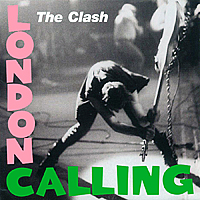 In August and September 1979, the Clash recorded London Calling
. Produced by Guy Stevens
, a former A&R
executive who had worked with Mott the Hoople
and Traffic
, the double album was a mix of punk rock, reggae, ska, rockabilly, traditional rock and roll and other elements possessed of an energy that had hardly flagged since the band's early days and more polished production. It is regarded as one of the greatest rock albums ever recorded. Its final track, a relatively straightforward rock and roll number sung by Mick Jones called "Train in Vain
", was included at the last minute and thus did not appear in the track listing on the cover. It became their first US Top 40 hit, peaking at number 23 on the Billboard chart. In the UK, where "Train in Vain" was not released as a single, London Callings title track
, stately in beat but unmistakably punk in message and tone, rose to number 11—the highest position any Clash single reached in the UK before the band's break-up.
Released in December, London Calling hit number 9 on the British chart; in the United States, where it was issued in January 1980, it reached number 27. The cover of the album, based on the cover of Elvis Presley
's self-titled 1956 debut LP
, became one of the best known in the history of rock. Its image, by photographer Pennie Smith
, of Simonon smashing his bass guitar was later cited as the "best rock 'n roll photograph of all time" by Q
magazine. During this period, the Clash began to be regularly billed as "The Only Band That Matters". Musician Gary Lucas
, then employed by CBS Records' creative services department, claims to have coined the tagline. The epithet was soon widely adopted by fans and music journalists.
Around the turn of the year, the band members attended a special private screening of a new film, Rude Boy
; part fiction, part rockumentary
, it tells the story of a Clash fan who leaves his job in a Soho
sex shop to become a roadie for the group. The movie—named after the rude boy
subculture—includes footage of the band on tour, at a London Rock Against Racism
concert, and in the studio recording Give 'Em Enough Rope. The band was so disenchanted with it that they had Better Badges
make buttons that declared "I don't want RUDE BOY Clash Film". On 27 February 1980, it premiered at the 30th Berlin International Film Festival
, where it won an honourable mention.
The Clash had planned to record and release a single every month in 1980. CBS balked at this idea, and the band came out with only one single—an original reggae tune, "Bankrobber
", in August—before the December release of the 3-LP, 36-song Sandinista!
The album again reflected a broad range of musical styles, including extended dubs
and the first forays into rap
by a major rock band. Produced by the band members with the participation of Jamaican reggae artist Mikey Dread
, Sandinista! was their most controversial album to date, both politically and musically. Critical opinion was divided, often within individual reviews. Trouser Press
s Ira Robbins described half the album as "great", half as "nonsense" and worse. In the New Rolling Stone Record Guide
, Dave Marsh
argued, "Sandinista! is nonsensically cluttered. Or rather seems nonsensically cluttered. One of the Clash's principal concerns...is to avoid being stereotyped." The album fared well in America, charting at number 24.
In 1981, the band came out with a single, "This Is Radio Clash
", that further demonstrated their ability to mix diverse influences such as dub and hip hop. They set to work on their fifth album in September, originally planning it as a 2-LP set with the title Rat Patrol from Fort Bragg. Jones produced one cut, but the other members were dissatisfied. Production duties were handed to Glyn Johns
, and the album was reconceived as a single LP. Though Combat Rock
was filled with offbeat songs, experiments with sound collage
, and a spoken word vocal by Beat
poet Allen Ginsberg
, it contained two "radio friendly" tracks. The leadoff single in the US was "Should I Stay or Should I Go
", released in June 1982. Another Jones feature in a rock and roll style similar to "Train in Vain", it received heavy airplay on AOR stations. The follow-up, "Rock the Casbah
", put lyrics addressing the Iranian clampdown on imports of Western music to a bouncy dance rhythm. (The singles were released in the opposite order in the UK, where they were both preceded by "Know Your Rights
".) The music for "Rock the Casbah" was composed by Headon, who performed not only the percussion but also the piano and bass heard on the recorded version. It was the band's biggest US hit ever, charting at number 8, and the video was put into heavy rotation by MTV. The album itself was the band's most successful, hitting number 2 in the UK and number 7 in the US.
on a leg of their final tour in the US, including a show at New York's Shea Stadium
. Though the Clash continued to tour, the personal tensions were increasing. In early 1983, Chimes left the band after the end of the Combat Rock Tour, due to the in-fighting and turmoil. He was replaced by Pete Howard for the US Festival
in San Bernardino, California
, which the Clash co-headlined, along with David Bowie
and Van Halen
. The band argued with the event's promoters over inflated ticket prices, threatening to pull out unless a large donation was made to a local charity. The group ultimately performed on 28 May, the festival's New Music Day, which drew a crowd of 140,000. After the show, members of the band brawled with security staff. This was Jones's last appearance with the group. In September 1983, he was fired. Shortly thereafter, he became a founding member of General Public
, but left that band as they were recording their first album. Jones then founded the long-lasting project Big Audio Dynamite
.
Nick Sheppard
, formerly of the Bristol
-based band The Cortinas
, and Vince White
were recruited as the Clash's new guitarists. Howard continued as the drummer. The reconstituted band played its first shows in January 1984 with a batch of new material and launched into the self-financed Out of Control Tour, travelling widely over the winter and into early summer. At a striking miners' benefit show ("Scargill's Christmas Party") in December 1984, they announced that a new album would be released early in the new year.
The recording sessions for Cut the Crap
were chaotic, with manager Bernard Rhodes and Strummer working in Munich. Most of the music was played by studio musicians, with Sheppard and later White flying in to provide guitar parts. Struggling with Rhodes for control of the band, Strummer returned home. The band went on a busking tour of public spaces in cities throughout the UK, playing acoustic versions of their hits and popular cover tunes.
After a concert in Athens, Strummer went to Spain to clear his mind. While he was abroad, the first single from Cut the Crap, the mournful "This Is England
", was released to mostly negative reviews. "CBS had paid an advance for it so they had to put it out", Strummer later explained. "I just went, 'Well fuck this', and fucked off to the mountains of Spain to sit sobbing under a palm tree, while Bernie had to deliver a record." However, critic Dave Marsh later championed "This Is England" as one of the top 1001 rock singles of all time. The single has also received retroactive praise from Q magazine
and others.
"This Is England", much like the rest of the album that came out later that year, had been drastically re-engineered by Rhodes, with synths and football-style chants added to Strummer's incomplete recordings. Although Howard was an adept drummer, drum machines were used for virtually all of the percussion tracks. For the remainder of his life, Strummer largely disowned the album, although he did profess that "I really like 'This Is England' [and album track] 'North and South' is a vibe." Other songs played on the tour remain unreleased to this day, including "Jericho" and "Glue Zombie". The Clash effectively disbanded in early 1986.
(B.A.D.), that had released its debut late in 1985. The two did work together on their respective 1986 projects. Jones helped out with the two songs Strummer wrote and performed for the Sid and Nancy
soundtrack. Strummer, in turn, cowrote a number of the tracks on the second B.A.D. album, No. 10, Upping St.
, which he also co-produced. With Jones committed to B.A.D., Strummer moved on to various solo projects and screen acting work. Simonon formed a band called Havana 3am
. Headon recorded a solo album, before once again spiraling into drug abuse. Chimes drummed with a succession of different acts.
On 2 March 1991, a reissue of “Should I Stay or Should I Go” gave the Clash its first and only number 1 UK single. That same year, Strummer reportedly cried when he learned that "Rock the Casbah" had been adopted as a slogan by US bomber pilots in the Gulf War
.
In 1999, Strummer, Jones and Simonon cooperated in the compiling of the live album From Here to Eternity
and video documentary Westway to the World. On 7 November 2002, the Rock and Roll Hall of Fame
announced that the Clash would be inducted the following March. On 15 November, Jones and Strummer shared the stage, performing three Clash songs during a London benefit show by Joe Strummer and the Mescaleros
. Strummer, Jones and Headon wanted to play a reunion show to coincide with their induction into the Hall of Fame. Simonon did not want to participate because he believed that playing at the high-priced event would not have been in the spirit of the Clash. Strummer's sudden death from a congenital heart defect on 22 December 2002 ended any possibility of a full reunion. In March 2003, the Hall of Fame induction took place; the band members inducted were Strummer, Jones, Simonon, Chimes and Headon.
In early 2008, Carbon/Silicon
, a new band founded by Mick Jones and his former London SS bandmate Tony James
, entered into a six-week residency at London's Inn on the Green. On opening night, 11 January, Headon joined the band for the Clash's "Train in Vain". An encore followed with Headon playing drums on "Should I Stay or Should I Go". This was the first time since 1982 that Headon and Jones had performed together on stage.
Jones and Headon reunited in September 2009 to record the 1970s Clash B-side "Jail Guitar Doors" with Billy Bragg
. The song is the namesake of a charity founded by Bragg which gives musical instruments and lessons to prison inmates. Jones, Headon, and Bragg were backed by former inmates during the session, which was filmed for a documentary about the charity, "Breaking Rocks." Simonon and Jones were featured on the title track of the Gorillaz
album Plastic Beach
in 2010. This reunion marked the first time the two performers had worked together in over twenty years. They later joined the Gorillaz on their world tour
for the remainder of 2010.
. On 30 April 1978, the Clash played the Rock Against Racism
concert in London's Victoria Park
for a crowd of 50–100,000 people; Strummer wore a T-shirt identifying two violent left-wing groups: the words "Brigade Rosse"—Italy's Red Brigades—appeared alongside the insignia of the Red Army Faction
—West Germany's Baader-Meinhof Group.
Their politics were made explicit in the lyrics of such early recordings as "White Riot", which encouraged disaffected white youths to riot like their black counterparts; "Career Opportunities", which addressed the alienation of low-paid, routinized jobs and discontent over the lack of alternatives; and "London's Burning", about the bleakness and boredom of life in the inner city. Artist Caroline Coon
, who was associated with the punk scene, argued that "[t]hose tough, militaristic songs were what we needed as we went into Thatcherism
". The scope of the band's political interests widened on later recordings. The title of Sandinista! celebrated the left-wing rebels
who had recently overthrown Nicaraguan despot Anastasio Somoza Debayle
, and the album was filled with songs driven by other political issues extending far beyond British shores: "Washington Bullets
" addressed covert military operations around the globe, while "The Call-Up" was a meditation on US draft policies. Combat Rocks "Straight to Hell
" is described by scholars Simon Reynolds
and Joy Press as an "around-the-world-at-war-in-five-verses guided tour of hell-zones where boy-soldiers had languished."
The band's political sentiments were reflected in their resistance to the music industry's usual profit motivations; even at their peak, tickets to shows and souvenirs were reasonably priced. The group insisted that CBS sell their double and triple album sets London Calling and Sandinista! for the price of a single album each (then £5), succeeding with the former and compromising with the latter by agreeing to sell it for £5.99 and forfeit all their performance royalties on its first 200,000 sales. These "VFM" (value for money) principles meant that they were constantly in debt to CBS, and only started to break even around 1982.
, the Clash's debut, alongside Never Mind the Bollocks, Here's the Sex Pistols
, is "punk's definitive statement" and London Calling "remains one of the most influential rock albums". In Rolling Stones 2003 list of the 500 greatest albums of all time, London Calling ranked number 8, the highest entry by a punk band. The Clash was number 77 and Sandinista! was number 404. In the magazine's 2004 list of the 500 greatest songs of all time, "London Calling" ranked number 15, again the highest for any song by a punk band. Four other Clash songs made the list: "Should I Stay Or Should I Go" (228), "Train In Vain" (292), "Complete Control" (361), and "White Man In Hammersmith Palais" (430). "London Calling" ranked number 48 in the magazine's 2008 list of the 100 greatest guitar songs of all time.
In John Robb's description, the Clash's debut established the "blueprint for the sound and the soul of what punk rock would be about.... The Clash were utterly inspirational, utterly positive, and they offered a million possibilities." Jake Burns
of Stiff Little Fingers
, the first major punk band from Northern Ireland, explained the record's impact:
The Clash also inspired many musicians who were only loosely associated, if at all, with punk. The band's embrace of ska, reggae and England's Jamaican subculture helped provide the impetus for the 2 Tone
movement that emerged amid the fallout of the punk explosion. Other musicians who began performing while the Clash were active and acknowledged their debt to the band include Billy Bragg
and Aztec Camera
. U2
's The Edge
has compared the Clash's inspirational effect to that of the Ramones
—both gave young rock musicians at large the "sense that the door of possibility had swung open." He wrote, "The Clash, more than any other group, kick-started a thousand garage bands across Ireland and the UK... [S]eeing them perform was a life-changing experience." Bono
has described the Clash as "the greatest rock band. They wrote the rule book for U2."
In later years, the Clash's influence can be heard in American political punk bands such as Rancid
, Anti-Flag
, Bad Religion
, NOFX
, Green Day
, and Rise Against
as well as in the political hard rock of early Manic Street Preachers
. California's Rancid, in particular, are known as "incurable Clash zealots". The title track of the band's album Indestructible proclaims, "I'll keep listening to that great Joe Strummer!" The Clash's involvement with Jamaican musical and production styles has inspired similar cross-cultural efforts by bands such as Bad Brains
, Massive Attack
, 311
, Sublime
and No Doubt
. They are credited with laying the groundwork for LCD Soundsystem
's "punk-funk". Jakob Dylan
of The Wallflowers
ranked London Calling above the work of his father, Bob Dylan
, as the record that “changed his life”. Bands identified with the garage rock revival of the late 1990s and 2000s such as Sweden's The Hives
, Australia's The Vines
and America's The White Stripes
and The Strokes
evidence the Clash's influence. Among the many latter-day British acts identified as having been inspired by the Clash are Babyshambles
, The Futureheads
, The Charlatans and The Arctic Monkeys. Before M.I.A.
had an international hit in 2008 with "Paper Planes
", which is built around a sample from "Straight to Hell", she referenced "London Calling" on 2003's "Galang". A cover of "The Guns of Brixton
" by German punk band Die Toten Hosen
was released as a single in 2006. A version by reggae legend Jimmy Cliff
was scheduled for release in November 2011.
The band has also had a notable impact on music in the Spanish-speaking world. In 1997, a Clash tribute album featuring performances by Buenos Aires
punk bands was released. Many rock en español
bands such as Todos Tus Muertos
, Café Tacuba, Maldita Vecindad
, Los Prisioneros
, Tijuana No, and Attaque 77
are indebted to the Clash. Argentina's Los Fabulosos Cadillacs
covered London Callings "Revolution Rock" and "The Guns of Brixton" and invited Mick Jones to sing on their song "Mal Bicho". The Clash's influence is similarly reflected in Paris-founded Mano Negra
's politicized lyrics and fusion of musical styles.
Punk rock
Punk rock is a rock music genre that developed between 1974 and 1976 in the United States, the United Kingdom, and Australia. Rooted in garage rock and other forms of what is now known as protopunk music, punk rock bands eschewed perceived excesses of mainstream 1970s rock...
band that formed in 1976 as part of the original wave of British punk. Along with punk, their music incorporated elements of reggae
Reggae
Reggae is a music genre first developed in Jamaica in the late 1960s. While sometimes used in a broader sense to refer to most types of Jamaican music, the term reggae more properly denotes a particular music style that originated following on the development of ska and rocksteady.Reggae is based...
, ska
Ska
Ska |Jamaican]] ) is a music genre that originated in Jamaica in the late 1950s, and was the precursor to rocksteady and reggae. Ska combined elements of Caribbean mento and calypso with American jazz and rhythm and blues...
, dub
Dub music
Dub is a genre of music which grew out of reggae music in the 1960s, and is commonly considered a subgenre, though it has developed to extend beyond the scope of reggae...
, funk
Funk
Funk is a music genre that originated in the mid-late 1960s when African American musicians blended soul music, jazz and R&B into a rhythmic, danceable new form of music. Funk de-emphasizes melody and harmony and brings a strong rhythmic groove of electric bass and drums to the foreground...
, rap
Hip hop music
Hip hop music, also called hip-hop, rap music or hip-hop music, is a musical genre consisting of a stylized rhythmic music that commonly accompanies rapping, a rhythmic and rhyming speech that is chanted...
, dance
Dance music
Dance music is music composed specifically to facilitate or accompany dancing. It can be either a whole musical piece or part of a larger musical arrangement...
, and rockabilly
Rockabilly
Rockabilly is one of the earliest styles of rock and roll music, dating to the early 1950s.The term rockabilly is a portmanteau of rock and hillbilly, the latter a reference to the country music that contributed strongly to the style's development...
. For most of their recording career, the Clash consisted of Joe Strummer
Joe Strummer
John Graham Mellor , best remembered by his stage name Joe Strummer, was the co-founder, lyricist, rhythm guitarist and lead vocalist of the British punk rock band The Clash. His musical experience included his membership in The 101ers, Latino Rockabilly War, The Mescaleros and The Pogues, in...
(lead vocals, rhythm guitar), Mick Jones
Mick Jones (The Clash)
Michael Geoffrey "Mick" Jones is the former lead guitarist, secondary vocalist and co-founder for the British punk rock band The Clash until his dismissal in 1983. He went on to form the band Big Audio Dynamite with Don Letts before line-up changes led to the formation of Big Audio Dynamite II and...
(lead guitar, vocals), Paul Simonon
Paul Simonon
Paul Gustave Simonon is an English musician and artist best known as the bass guitarist for punk rock band The Clash. Recent work includes his involvement in the album The Good, the Bad & the Queen with Damon Albarn, Simon Tong and Tony Allen, released in January 2007...
(bass guitar, vocals) and Nicky "Topper" Headon
Topper Headon
Headon was extensively interviewed for the Joe Strummer: The Future Is Unwritten documentary film about the late Clash frontman. He related his experiences during this period, how he became addicted to heroin and how there were problems before his dismissal...
(drums, percussion). Headon left the group in 1982, and internal friction led to Jones's departure the following year. The group continued with new members, but finally disbanded in early 1986.
The Clash achieved commercial success in the United Kingdom with the release of their debut album, The Clash
The Clash (album)
The album received positive reviews from critics and peaked at number 12 in the UK charts. In December 1979, critic Robert Christgau named it his favorite album of the 1970s....
, in 1977. Their third album, London Calling
London Calling
London Calling is the third studio album by the English punk rock band The Clash. It was released in the United Kingdom on 14 December 1979 through CBS Records, and in the United States in January 1980 through Epic Records...
, released in the UK in December 1979, brought them popularity in the United States when it came out there the following month. Critically acclaimed, it was declared the best album of the 1980s a decade later by Rolling Stone magazine.
The Clash's politicized lyrics, musical experimentation and rebellious attitude had a far-reaching influence on rock, alternative rock
Alternative rock
Alternative rock is a genre of rock music and a term used to describe a diverse musical movement that emerged from the independent music underground of the 1980s and became widely popular by the 1990s...
in particular. They became widely referred to as "The Only Band That Matters", originally a promotional slogan introduced by the group's record label, CBS
Columbia Records
Columbia Records is an American record label, owned by Japan's Sony Music Entertainment, operating under the Columbia Music Group with Aware Records. It was founded in 1888, evolving from an earlier enterprise, the American Graphophone Company — successor to the Volta Graphophone Company...
. In January 2003, the band—including original drummer Terry Chimes
Terry Chimes
Terry Chimes was the original drummer of punk rock group The Clash. He originally played with them from July 1976 to November 1976, January 1977 to April 1977, and again from May 1982 to February 1983. He was the drummer for Hanoi Rocks in 1985, before the band broke-up that same year...
—were inducted into the Rock and Roll Hall of Fame
Rock and Roll Hall of Fame
The Rock and Roll Hall of Fame and Museum is a museum located on the shore of Lake Erie in downtown Cleveland, Ohio, United States. It is dedicated to archiving the history of some of the best-known and most influential artists, producers, engineers and others who have, in some major way,...
. In 2004, Rolling Stone ranked the Clash number 28 on their list of the 100 greatest artists of all time.
Origins: 1974–1976
Before the Clash's founding, the band's future members were active in different parts of the London music scene. John Graham MellorJoe Strummer
John Graham Mellor , best remembered by his stage name Joe Strummer, was the co-founder, lyricist, rhythm guitarist and lead vocalist of the British punk rock band The Clash. His musical experience included his membership in The 101ers, Latino Rockabilly War, The Mescaleros and The Pogues, in...
sang and played rhythm guitar in the pub rock
Pub rock (UK)
Pub rock was a rock music genre that developed in the mid 1970s in the United Kingdom. A back-to-basics movement, pub rock was a reaction against progressive and glam rock. Although short-lived, pub rock was notable for rejecting stadium venues and for returning live rock to the small pubs and...
act The 101'ers
The 101ers
The 101ers were a pub rock band from the 1970s, notable as being the band that Joe Strummer left to join The Clash. Formed in London in May 1974, the 101ers made their performing debut on 7 September at the Telegraph pub in Brixton, under the name El Huaso and the 101 All Stars. The name would...
, which formed in 1974. By the time the Clash came together two years later, he had already abandoned his original stage name, "Woody" Mellor, in favour of "Joe Strummer", a reference to his rudimentary strumming skills on the ukulele as a busker
Busking
Street performance or busking is the practice of performing in public places, for gratuities, which are generally in the form of money and edibles...
in the London Underground
London Underground
The London Underground is a rapid transit system serving a large part of Greater London and some parts of Buckinghamshire, Hertfordshire and Essex in England...
. Mick Jones
Mick Jones (The Clash)
Michael Geoffrey "Mick" Jones is the former lead guitarist, secondary vocalist and co-founder for the British punk rock band The Clash until his dismissal in 1983. He went on to form the band Big Audio Dynamite with Don Letts before line-up changes led to the formation of Big Audio Dynamite II and...
played guitar in protopunk
Protopunk
Protopunk is a term used retrospectively to describe a number of musicians who were important precursors of punk rock in the late 1960s to mid-1970s, or who have been cited by early punk musicians as influential...
band London SS
London SS
London SS were an early British punk rock group founded in March 1975 by guitarist Mick Jones and bassist Tony James.The band spent most of their short history auditioning potential members. Besides Jones and James, however, guitarist Brian James was the only other semi-permanent member...
, which rehearsed for much of 1975 without ever playing a live show and recording only a single demo. London SS was managed by Bernard Rhodes, a sometime associate of impresario Malcolm McLaren
Malcolm McLaren
Malcolm Robert Andrew McLaren was an English performer, impresario, self-publicist and manager of the Sex Pistols and the New York Dolls...
and a friend of the band McLaren managed, the Sex Pistols
Sex Pistols
The Sex Pistols were an English punk rock band that formed in London in 1975. They were responsible for initiating the punk movement in the United Kingdom and inspiring many later punk and alternative rock musicians...
. Jones and his bandmates became friendly with Sex Pistols Glen Matlock
Glen Matlock
Glen Matlock is an English bass guitarist most famous for being in the original line-up of the punk rock band the Sex Pistols. Drummer Paul Cook has said that Matlock came up with much of the music for the band's songs and most of the lyrics, while lead singer Johnny Rotten made some adjustments...
and Steve Jones
Steve Jones (musician)
Stephen Philip "Steve" Jones is an English rock guitarist, singer and actor, best known as guitarist and founding member of the punk rock band the Sex Pistols.-Childhood:...
, who would assist them as they tried out potential new members. Among those who auditioned for London SS without making the cut were Paul Simonon
Paul Simonon
Paul Gustave Simonon is an English musician and artist best known as the bass guitarist for punk rock band The Clash. Recent work includes his involvement in the album The Good, the Bad & the Queen with Damon Albarn, Simon Tong and Tony Allen, released in January 2007...
, who tried out as a vocalist, and drummer Terry Chimes
Terry Chimes
Terry Chimes was the original drummer of punk rock group The Clash. He originally played with them from July 1976 to November 1976, January 1977 to April 1977, and again from May 1982 to February 1983. He was the drummer for Hanoi Rocks in 1985, before the band broke-up that same year...
. Nicky Headon
Topper Headon
Headon was extensively interviewed for the Joe Strummer: The Future Is Unwritten documentary film about the late Clash frontman. He related his experiences during this period, how he became addicted to heroin and how there were problems before his dismissal...
drummed with the band for a week, then quit.
After London SS broke up in early 1976, Rhodes continued as Jones's manager. In February, Jones saw the Sex Pistols perform for the first time: "You knew straight away that was it, and this was what it was going to be like from now on. It was a new scene, new values—so different from what had happened before. A bit dangerous." At the instigation of Rhodes, Jones contacted Simonon in March, suggesting he learn an instrument so he could join the new band Jones was organising. Soon Jones, Simonon on bass, Keith Levene
Keith Levene
Keith Levene is an English songwriter and multi-instrumentalist. He was an early member of The Clash, but is best known as being a founding member of Public Image Limited, along with John Lydon....
on guitar and "whoever we could find really to play the drums" were rehearsing. Chimes was asked to audition for the new band and got the job, although he soon quit.
The act was still searching for a lead singer. Chimes recalls one Billy Watts (who "seemed to be, like, nineteen or eighteen then, as we all were") handling the duties for a time. Rhodes had his eye on Strummer, with whom he made exploratory contact. Jones and Levene had both seen him perform and were impressed as well. Strummer, for his part, was primed to make the switch. In April, he had taken in the opening act for one of his band's gigs. That act was the Sex Pistols. "I knew something was up," Strummer later explained,
so I went out in the crowd which was fairly sparse. And I saw the future—with a snotty handkerchief—right in front of me. It was immediately clear. Pub rock was, "Hello, you bunch of drunks, I'm gonna play these boogies and I hope you like them." The Pistols came out that Tuesday evening and their attitude was "Here's our tunes, and we couldn't give a flying fuck whether you like them or not. In fact, we're gonna play them even if you fucking hate them."
On 30 May, Rhodes and Levene met surreptitiously with Strummer after a 101'ers gig. Rhodes gave him 48 hours to decide whether he wanted to join the new band that would "rival the Pistols". Within 24 hours, Strummer agreed. Simonon later remarked, "Once we had Joe on board it all started to come together." Strummer introduced the band to his old school friend Pablo LaBritain, who sat in on drums during Strummer's first few rehearsals with the group. LaBritain's stint with the band didn't last long (he subsequently joined 999
999 (band)
999 are an English rock band who formed in London in 1977. They are often cited as one of the first punk rock bands. Between 1978 and 1981, they had five Top 75 singles in the UK Singles Chart, and one Top 40 single. After extensive touring across the Atlantic Ocean, the band's third and fourth...
), and Terry Chimes—whom Jones later referred to as "one of the best drummers" in their circle—became the band's regular drummer. Chimes did not take to Strummer at first: "He was like twenty-two or twenty-three or something that seemed 'old' to me then. And he had these retro clothes and this croaky voice". Simonon came up with the band's name after they had briefly dubbed themselves the Weak Heartdrops and the Psychotic Negatives. He later explained the name's origin: "It really came to my head when I started reading the newspapers and a word that kept recurring was the word 'clash', so I thought 'The Clash, what about that,' to the others. And they and Bernard, they went for it."
First gigs and the growing scene: 1976
After rehearsing with Strummer for less than a month, the Clash made their debut on 4 July 1976, supporting the Sex Pistols at the Black Swan in SheffieldSheffield
Sheffield is a city and metropolitan borough of South Yorkshire, England. Its name derives from the River Sheaf, which runs through the city. Historically a part of the West Riding of Yorkshire, and with some of its southern suburbs annexed from Derbyshire, the city has grown from its largely...
. The band apparently wanted to make it on-stage before their rivals in The Damned—another London SS spinoff—made their own scheduled debut two days later. The Clash would not play in front of an audience again for another five weeks. Levene was becoming disaffected with his position in the group. At the Black Swan, he approached the Sex Pistols' lead singer, John Lydon
John Lydon
John Joseph Lydon , also known by the former stage name Johnny Rotten, is a singer-songwriter and television presenter, best known as the lead singer of punk rock band the Sex Pistols from 1975 until 1978, and again for various revivals during the 1990s and 2000s...
(then going by Johnny Rotten), and suggested they get a band together if the Pistols ever broke up.
The night after their debut, the band members along with most of the Sex Pistols and much of the rest of London's "inner circle" of punks showed up at Dingwalls club to attend a concert by New York's leading punk rock band, the Ramones
Ramones
The Ramones were an American rock band that formed in the New York City neighborhood of Forest Hills, Queens, in 1974. They are often cited as the first punk rock group...
. Afterward "came the first example of the rivalry-induced squabbling that was to dog the punk scene and undermine any attempts to promote a spirit of unity among the bands involved." Simonon got into a scuffle with J.J. Burnel
Jean-Jacques Burnel
J. J. Burnel , is a Franco-English musician producer and songwriter, best known as the bass guitarist with the British rock band The Stranglers.-Life and career:...
, the bass player of The Stranglers
The Stranglers
The Stranglers are an English punk/rock music group.Scoring some 23 UK top 40 singles and 17 UK top 40 albums to date in a career spanning five decades, the Stranglers are the longest-surviving and most "continuously successful" band to have originated in the UK punk scene of the mid to late 1970s...
. A slightly older band, The Stranglers were publicly identified with the punk scene, but were not part of the "inner circle" centred on the Sex Pistols.
With Rhodes insisting that the band not perform live again until they were much tighter, the Clash rehearsed intensely over the following month. Strummer later described how seriously the band devoted itself to forging a distinct identity: "We were almost Stalinist in the way that you had to shed all your friends, or everything that you'd known, or every way that you'd played before." Strummer and Jones shared most of the writing duties—"Joe would give me the words and I would make a song out of them", Jones later said. Sometimes they would meet in the office over their Camden
Camden Town
-Economy:In recent years, entertainment-related businesses and a Holiday Inn have moved into the area. A number of retail and food chain outlets have replaced independent shops driven out by high rents and redevelopment. Restaurants have thrived, with the variety of culinary traditions found in...
rehearsal studio to collaborate directly. According to a later description of Strummer's, "Bernie [Rhodes] would say, 'An issue, an issue. Don't write about love, write about what's affecting you, what's important." Strummer took the lead vocals on the majority of songs; in some cases he and Jones shared the lead. Once the band began recording, Jones would rarely have a solo lead on more than one song per album, though he would be responsible for two of the group's biggest hits. On 13 August, the Clash—sporting a paint-spattered "Jackson Pollock
Jackson Pollock
Paul Jackson Pollock , known as Jackson Pollock, was an influential American painter and a major figure in the abstract expressionist movement. During his lifetime, Pollock enjoyed considerable fame and notoriety. He was regarded as a mostly reclusive artist. He had a volatile personality, and...
" look—played before a small, invitation-only audience in their Camden studio. Among those in attendance was Sounds
Sounds (magazine)
Sounds was a long-term British music paper, published weekly from 10 October 1970 – 6 April 1991. It was produced by Spotlight Publications , which was set up by Jack Hutton and Peter Wilkinson, who left "Melody Maker" to start their own company...
critic Giovanni Dadamo. His review described the band as a "runaway train...so powerful, they're the first new group to come along who can really scare the Sex Pistols shitless".
On 29 August, the Clash and Manchester's Buzzcocks
Buzzcocks
Buzzcocks are an English punk rock band formed in Bolton in 1976, led by singer–songwriter–guitarist Pete Shelley.They are regarded as an important influence on the Manchester music scene, the independent record label movement, punk rock, power pop, pop punk and indie rock. They achieved commercial...
opened for the Sex Pistols at the Screen on the Green—the Clash's first public performance since 4 July. The triple bill is seen as pivotal to the British punk scene's crystallisation into a movement, though NME reviewer Charles Shaar Murray wrote, "The Clash are the sort of garage band that should be speedily returned to the garage, preferably with the motor still running". Strummer later credited Murray's comments with inspiring the band's composition "Garageland"
Garageland (song)
"Garageland" is a song by English punk rock band The Clash featured as the final track for their 1977 debut album The Clash.The song was penned by Joe Strummer as a response to music journalist Charles Shaar Murray, who, after a gig in 1976, wrote a review saying that they were "the kind of garage...
.
In early September, Levene was fired from the Clash. Strummer would claim that Levene's dwindling interest in the band owed to his supposedly abundant use of speed, a charge Levene has denied. (Levene and Lydon would form Public Image Ltd.
Public Image Ltd.
Public Image Ltd are an English post-punk band formed by vocalist John Lydon , guitarist Keith Levene and bassist Jah Wobble, with frequent subsequent personnel changes. Lydon is the sole constant member of the band....
in 1978.) On 21 September, the Clash performed publicly for the first time without Levene at another seminal concert: the 100 Club Punk Special, sharing the bill with the Sex Pistols, Siouxsie and the Banshees and Subway Sect
Subway Sect
Subway Sect were one of the original British punk bands. Their influence was limited by the very small amount of recorded material they released.-The early days:...
. Chimes left in late November; he was briefly replaced by Rob Harper
Rob Harper
Rob Harper is a British musician noted for being an early drummer for The Clash from December 1976-January 1977.- Biography :Rob Harper started out playing guitar in a college band and when the singer invited a guitarist called Mark Knopfler to join, Rob switched to the bass so Mark could join on...
as the Clash toured in support of the Sex Pistols during December's Anarchy Tour.
Debut album and Give 'Em Enough Rope: 1977–1979
By the turn of the year, punk had become a major media phenomenon in the UK. On 25 January 1977, the Clash signed to CBS RecordsColumbia Records
Columbia Records is an American record label, owned by Japan's Sony Music Entertainment, operating under the Columbia Music Group with Aware Records. It was founded in 1888, evolving from an earlier enterprise, the American Graphophone Company — successor to the Volta Graphophone Company...
for £100,000, a remarkable amount for a band that had played a total of about thirty gigs and almost none as a headliner. As Clash historian Marcus Gray describes, the "band members found themselves having to justify [the deal] to both the music press and to fans who picked up on the critics' muttered asides about the Clash having 'sold out' to the establishment." Mark Perry
Mark Perry (musician)
Mark Perry, also known as Mark P, was a British fanzine publisher and is a writer and musician.Perry was a bank clerk when, inspired by The Ramones, he founded the punk fanzine Sniffin' Glue in 1976...
, founder of the leading London punk periodical, Sniffin' Glue
Sniffin' Glue
Sniffin' Glue is the name of a monthly punk zine started by Mark Perry in July 1976 and released for about a year. The name is derived from a Ramones song "Now I Wanna Sniff Some Glue." Others that wrote for the magazine that later became well known journalists include Danny Baker.Although initial...
, let loose with what he would later call his "big quote": "Punk died the day The Clash signed to CBS." As one band associate described it, the deal "was later used as a classic example of the kind of contract that no group should ever sign—the group had to pay for their own tours, recordings, remixes, artwork, expenses...."
Mickey Foote, who worked as a technician at their concerts, was hired to produce the Clash's debut album, and Terry Chimes was drafted back for the recording. The band's first single, "White Riot
White Riot
"White Riot" is a song by English punk rock band The Clash, released as the band's first single in 1977 and also featured on their debut album. There are two versions: the single version , and a different version on the UK album...
", was released in March 1977 and reached number 34. The album, The Clash
The Clash (album)
The album received positive reviews from critics and peaked at number 12 in the UK charts. In December 1979, critic Robert Christgau named it his favorite album of the 1970s....
, came out the following month. Filled with fiery punk tracks, it also presaged the many eclectic turns the band would take with its cover of the reggae song "Police and Thieves
Police and Thieves
"Police and Thieves" is a well-known reggae song, first recorded in the Jamaican reggae style by the falsetto singer Junior Murvin in 1976 , and one year later in a punk-reggae version by The Clash. Murvin's first commentary was "They have destroyed Jah work!".The song was written by Murvin and the...
". "[A]midst the Sex Pistols' inertia in the first half of 1977, the Clash found themselves as the flag-wavers of the punk rock consciousness", according to music journalist and former punk musician John Robb. Though the album charted well in the UK, climbing to number 12, CBS refused to give it a US release, believing that its raw, barely produced sound would make it unsalable in that market. A North American version of the album with a modified track listing was released in 1979, after the UK original became the best-selling import album of all time in the United States.
Chimes, whose career aspirations owed little to the punk ethos, had left the band again soon after the recording sessions. He later said, "The point was I wanted one kind of life and they wanted another and, like, why are we working together, if we want completely different things?" As a result, only Simonon, Jones and Strummer were featured on the album's cover, and Chimes was credited as "Tory
Tory
Toryism is a traditionalist and conservative political philosophy which grew out of the Cavalier faction in the Wars of the Three Kingdoms. It is a prominent ideology in the politics of the United Kingdom, but also features in parts of The Commonwealth, particularly in Canada...
Crimes". Strummer later described what followed: "We must have tried every drummer that then had a kit. I mean every drummer in London. I think we counted 205. And that's why we were lost until we found Topper Headon." Headon, who had played briefly with Jones's London SS, was nicknamed "Topper" by Simonon, who felt he resembled the Topper comic book
Topper (comic book)
The Topper was a UK comic published by D. C. Thomson & Co. Ltd that ran from 7 February 1953 to 15 September 1990, when it merged with The Beezer....
character Mickey the Monkey
Mickey the Monkey
Mickey the Monkey was a comic strip which featured the eponymous fictional monkey, Mickey. The character was the cover star of British comic The Topper from its launch in 1953 until the 1970s. The strip appeared throughout the comic's run, until its merger with The Beezer. The final story was in...
. An excellent musician, Headon could also play piano, bass and guitar. The day after he signed up, he declared, "I really wanted to join the Clash. I want to give them even more energy than they've got—if that's possible"; interviewed over two decades later, he said his original plan was to stay briefly, gain a name for himself, and then move on to a better gig. In any event, Strummer later observed, "Finding someone who not only had the chops, but the strength and the stamina to do it was just the breakthrough for us".
In May, the band set out on the White Riot Tour, headlining a punk package that included the Buzzcocks, Subway Sect, The Slits
The Slits
The Slits were a British punk rock band. The quartet was formed in 1976 by members of the bands The Flowers of Romance and The Castrators. The members were Ari Up , who died of cancer in October 2010, and Palmolive , with Viv Albertine and Tessa Pollitt replacing founding members, Kate Korus and...
and The Prefects
The Prefects
The Prefects were a punk band from Birmingham, United Kingdom, with members that would later form The Nightingales.-History:In 1976 singer Robert Lloyd, with guitarist/drummer brothers Alan and Paul Apperley formed after an advert was placed by the Apperley brothers in the Birmingham Evening Mail....
. The day after a Newcastle gig, Strummer and Headon were arrested for stealing pillowcases from their hotel room. That same month, CBS released "Remote Control" as the debut LP's second single, defying the wishes of the band, who saw it as one of the album's weakest tracks. Headon's first recording with the band was the single "Complete Control
Complete Control
"Complete Control" is a song by The Clash, released as a 7" single and featured on the U.S. release of their debut album.The song is often cited as one of punk's greatest singles, and is a fiery polemic on record companies, managers and the state of punk music itself, the motivation for the song...
", which addressed the band's anger at their record label's behaviour. It was co-produced by famed reggae artist Lee "Scratch" Perry, though Foote was summoned to "ground things" a bit and the result was pure punk rock. Released in September 1977—NME
NME
The New Musical Express is a popular music publication in the United Kingdom, published weekly since March 1952. It started as a music newspaper, and gradually moved toward a magazine format during the 1980s, changing from newsprint in 1998. It was the first British paper to include a singles...
noted how CBS allowed the group to "bait their masters"—it rose to number 28 on the British chart and has gone on to be cited as one of punk's greatest singles. In February 1978, the band came out with the single "Clash City Rockers
Clash City Rockers
"Clash City Rockers" is a song and single by The Clash. First released in February 1978 with the b-side "Jail Guitar Doors," a re-worked version of a song from Joe Strummer's pub rock days, it was later included as the opening track of the belated US version of the band's eponymous debut album.The...
". June saw the release of "(White Man) In Hammersmith Palais
(White Man) In Hammersmith Palais
" In Hammersmith Palais" is a song by The Clash, self produced and first released as a 7" single, backed with the track "The Prisoner", in June 1978....
", which surprised fans with its ska rhythm and arrangement.
Before the Clash began recording their second album, CBS requested that they adopt a cleaner sound than its predecessor in order to reach American audiences. Sandy Pearlman
Sandy Pearlman
Sandy Pearlman is an American music producer, artist manager, professor, poet, songwriter, and once was a record company executive...
, known for his work with Blue Öyster Cult
Blue Öyster Cult
Blue Öyster Cult, often abbreviated BÖC, is an American rock band, most of whose members first came together in Long Island, NY in 1967 as the band Soft White Underbelly...
, was hired to produce the record. Simonon later recalled, "[R]ecording that album was just the most boring situation ever. It was just so nitpicking, such a contrast to the first album...it ruined any spontaneity." Although some listeners complained about its relatively mainstream production style, Give 'Em Enough Rope
Give 'Em Enough Rope
Give 'Em Enough Rope is the second studio album by the English punk rock band The Clash. It was released on 10 November 1978 through CBS Records. It was their first album released in the United States, preceding the US version of The Clash...
received largely positive reviews upon its November release. It hit number 2 in the UK, but it was not the American breakthrough CBS had hoped for, reaching only number 128 on the Billboard chart
Billboard charts
The Billboard charts tabulate the relative weekly popularity of songs or albums in the United States. The results are published in Billboard magazine...
. The album's first UK single, the hard rocking "Tommy Gun
Tommy Gun (song)
"Tommy Gun" is a song by the British punk rock band The Clash, released as the first single from their second album Give 'Em Enough Rope ....
", rose to number 19, the highest chart position for a Clash single to date. In support of the album, the band toured the UK supported by The Slits and The Innocents
The Innocents (UK punk band)
The Innocents formed in the spring of 1978 and played frequently with The Clash and The Slits. The original lineup was predominantly female with four women and one male....
. The series of concerts—there were more than thirty, from Edinburgh to Portsmouth—was promoted as the Sort It Out Tour. The band subsequently undertook its first, largely successful tour of North America in February 1979.
London Calling, Sandinista! and Combat Rock: 1979–1982
London Calling
London Calling is the third studio album by the English punk rock band The Clash. It was released in the United Kingdom on 14 December 1979 through CBS Records, and in the United States in January 1980 through Epic Records...
. Produced by Guy Stevens
Guy Stevens
Guy Stevens worked in a number of different roles in the British music industry including producer and manager. He gave the rock bands Procol Harum and Mott the Hoople their distinctive names....
, a former A&R
A&R
Artists and repertoire is the division of a record label that is responsible for talent scouting and overseeing the artistic development of recording artists. It also acts as a liaison between artists and the record label.- Finding talent :...
executive who had worked with Mott the Hoople
Mott the Hoople
Mott the Hoople were a British rock band with strong R&B roots, popular in the glam rock era of the early to mid 1970s. They are popularly known for the song "All the Young Dudes", written for them by David Bowie and appearing on their 1972 album of the same name.-The early years:Mott The Hoople...
and Traffic
Traffic (band)
Traffic were an English rock band whose members came from the West Midlands. The group formed in April 1967 by Steve Winwood, Jim Capaldi, Chris Wood and Dave Mason...
, the double album was a mix of punk rock, reggae, ska, rockabilly, traditional rock and roll and other elements possessed of an energy that had hardly flagged since the band's early days and more polished production. It is regarded as one of the greatest rock albums ever recorded. Its final track, a relatively straightforward rock and roll number sung by Mick Jones called "Train in Vain
Train in Vain
"Train in Vain" is a song by the British punk rock band The Clash. It was released as the third and final single from their third album, London Calling...
", was included at the last minute and thus did not appear in the track listing on the cover. It became their first US Top 40 hit, peaking at number 23 on the Billboard chart. In the UK, where "Train in Vain" was not released as a single, London Callings title track
London Calling (song)
"London Calling" is a song by the British punk rock band The Clash. It was released as a single from the band's 1979 double album London Calling...
, stately in beat but unmistakably punk in message and tone, rose to number 11—the highest position any Clash single reached in the UK before the band's break-up.
Released in December, London Calling hit number 9 on the British chart; in the United States, where it was issued in January 1980, it reached number 27. The cover of the album, based on the cover of Elvis Presley
Elvis Presley
Elvis Aaron Presley was one of the most popular American singers of the 20th century. A cultural icon, he is widely known by the single name Elvis. He is often referred to as the "King of Rock and Roll" or simply "the King"....
's self-titled 1956 debut LP
Elvis Presley (album)
-1999 Reissue with Bonus Tracks:Catalogue data reflects simultaneous release of all tracks from LPM 1254 as singles in August, 1956; chart positions from Billboard Pop Singles chart.-2006 FTD Reissue:Disc OneDisc Two-Personnel:...
, became one of the best known in the history of rock. Its image, by photographer Pennie Smith
Pennie Smith
Pennie Smith is an English photographer, known for having photographed several rock musicians. She specialises in black-and-white photography.Smith attended Twickenham Art school in the late 1960s, studying graphics and fine art...
, of Simonon smashing his bass guitar was later cited as the "best rock 'n roll photograph of all time" by Q
Q (magazine)
Q is a popular music magazine published monthly in the United Kingdom.Founders Mark Ellen and David Hepworth were dismayed by the music press of the time, which they felt was ignoring a generation of older music buyers who were buying CDs — then still a new technology...
magazine. During this period, the Clash began to be regularly billed as "The Only Band That Matters". Musician Gary Lucas
Gary Lucas
Gary Lucas is an American guitarist, a Grammy-nominated songwriter, a soundtrack composer for film and television, and an international recording artist with over a dozen solo albums to date. He has been described as "one of the best and most original guitarists in America" ; a "legendary leftfield...
, then employed by CBS Records' creative services department, claims to have coined the tagline. The epithet was soon widely adopted by fans and music journalists.
Around the turn of the year, the band members attended a special private screening of a new film, Rude Boy
Rude Boy (film)
Rude Boy is a 1980 British film directed by Jack Hazan and David Mingay and filmed in 1978 and early 1979.The film, part fiction, part rockumentary, tells the story of Ray Gange, a Clash fan who leaves his job in a Soho sex shop to become a roadie for the band...
; part fiction, part rockumentary
Rockumentary
The term rockumentary is a neologism denoting a documentary about rock music or its musicians. The term was used by Bill Drake in the 1969 History of Rock & Roll radio broadcast, and by Rob Reiner in the 1984 mockumentary film This Is Spinal Tap....
, it tells the story of a Clash fan who leaves his job in a Soho
Soho
Soho is an area of the City of Westminster and part of the West End of London. Long established as an entertainment district, for much of the 20th century Soho had a reputation for sex shops as well as night life and film industry. Since the early 1980s, the area has undergone considerable...
sex shop to become a roadie for the group. The movie—named after the rude boy
Rude boy
Rude boy, rudeboy, rudie, rudi or rudy are common terms used in Jamaica. In the 1960s it was also used for juvenile delinquents and criminals in Jamaica, and has since been used in other contexts...
subculture—includes footage of the band on tour, at a London Rock Against Racism
Rock Against Racism
Rock Against Racism was a campaign set up in the United Kingdom in 1976 as a response to an increase in racial conflict and the growth of white nationalist groups such as the National Front. The campaign involved pop, rock and reggae musicians staging concerts with an anti-racist theme, in order...
concert, and in the studio recording Give 'Em Enough Rope. The band was so disenchanted with it that they had Better Badges
Better Badges
Better Badges was a London button-badge manufacturer, started in 1976 by Joly MacFie. During the years 1977-1984 it became the leading publisher and merchandiser of 'punk badges' - exporting millions worldwide from their offices at 286 Portobello Road...
make buttons that declared "I don't want RUDE BOY Clash Film". On 27 February 1980, it premiered at the 30th Berlin International Film Festival
30th Berlin International Film Festival
The 30th annual Berlin International Film Festival was held from February 18 to February 29, 1980.-Jury:* Ingrid Thulin * Betsy Blair* Mathieu Carrière* Alberto Isaac* Peter Kern* Károly Makk* Alexander Mitta* Alexandre Trauner...
, where it won an honourable mention.
The Clash had planned to record and release a single every month in 1980. CBS balked at this idea, and the band came out with only one single—an original reggae tune, "Bankrobber
Bankrobber
"Bankrobber" is a song, and single by The Clash. The song was not released on any of their studio albums, instead appearing on their compilation Black Market Clash...
", in August—before the December release of the 3-LP, 36-song Sandinista!
Sandinista!
Sandinista! is the fourth studio album by the English punk rock band the Clash. It was released on 12 December 1980 as a triple album containing 36 tracks, with 6 songs on each side...
The album again reflected a broad range of musical styles, including extended dubs
Dub music
Dub is a genre of music which grew out of reggae music in the 1960s, and is commonly considered a subgenre, though it has developed to extend beyond the scope of reggae...
and the first forays into rap
Hip hop music
Hip hop music, also called hip-hop, rap music or hip-hop music, is a musical genre consisting of a stylized rhythmic music that commonly accompanies rapping, a rhythmic and rhyming speech that is chanted...
by a major rock band. Produced by the band members with the participation of Jamaican reggae artist Mikey Dread
Mikey Dread
Michael George Campbell , better known as Mikey Dread, was a Jamaican singer, producer, and broadcaster. He was one of the most influential performers and innovators in reggae music...
, Sandinista! was their most controversial album to date, both politically and musically. Critical opinion was divided, often within individual reviews. Trouser Press
Trouser Press
Trouser Press was a rock and roll magazine started in New York in 1974 as a mimeographed fanzine by editor/publisher Ira Robbins, fellow Who fan Dave Schulps and Karen Rose under the name "Trans-Oceanic Trouser Press" ...
s Ira Robbins described half the album as "great", half as "nonsense" and worse. In the New Rolling Stone Record Guide
Rolling Stone Album Guide
The Rolling Stone Album Guide, previously known as The Rolling Stone Record Guide, is a book that, along with its sister publication Rolling Stone magazine, contains professional reviews of popular music...
, Dave Marsh
Dave Marsh
Dave Marsh is an American music critic, author, editor and radio talk show host. He was a formative editor of Creem magazine, has written for various publications such as Newsday, The Village Voice, and Rolling Stone, and has published numerous books about music and musicians, mostly focused on...
argued, "Sandinista! is nonsensically cluttered. Or rather seems nonsensically cluttered. One of the Clash's principal concerns...is to avoid being stereotyped." The album fared well in America, charting at number 24.
In 1981, the band came out with a single, "This Is Radio Clash
This Is Radio Clash
"This Is Radio Clash" is a song by the English punk rock band The Clash. The single was released in 1981 and was never released on any of their studio albums, though it was included in the track listing of their compilations: The Singles, The Story of the Clash, Volume 1, Singles Box, The Singles ...
", that further demonstrated their ability to mix diverse influences such as dub and hip hop. They set to work on their fifth album in September, originally planning it as a 2-LP set with the title Rat Patrol from Fort Bragg. Jones produced one cut, but the other members were dissatisfied. Production duties were handed to Glyn Johns
Glyn Johns
Glyn Johns is a musician, recording engineer and record producer.-Career:He has worked with such artists as Bob Dylan, The Beatles, The Easybeats, The Band, The Rolling Stones, The Who, Led Zeppelin, Eagles, Eric Clapton, The Clash, The Steve Miller Band, Small Faces, Spooky Tooth, The Ozark...
, and the album was reconceived as a single LP. Though Combat Rock
Combat Rock
The album received positive reviews from critics, and reached the number two on the UK Albums Chart, the number seven on the Billboard Pop albums, and the top ten on many charts in other countries...
was filled with offbeat songs, experiments with sound collage
Sound collage
In music, montage or sound collage is a technique where sound objects or compositions, including songs, are created from collage, also known as montage, the use of portions of previous recordings or scores...
, and a spoken word vocal by Beat
Beat generation
The Beat Generation refers to a group of American post-WWII writers who came to prominence in the 1950s, as well as the cultural phenomena that they both documented and inspired...
poet Allen Ginsberg
Allen Ginsberg
Irwin Allen Ginsberg was an American poet and one of the leading figures of the Beat Generation in the 1950s. He vigorously opposed militarism, materialism and sexual repression...
, it contained two "radio friendly" tracks. The leadoff single in the US was "Should I Stay or Should I Go
Should I Stay or Should I Go
"Should I Stay or Should I Go" is a song by the English punk rock band The Clash, from their album Combat Rock. It was written in 1981 and featured Mick Jones on lead vocals. It became the band's only number-one single on the UK Singles Chart, a decade after it was originally released. In November...
", released in June 1982. Another Jones feature in a rock and roll style similar to "Train in Vain", it received heavy airplay on AOR stations. The follow-up, "Rock the Casbah
Rock the Casbah
"Rock the Casbah" is a song by the English punk rock band The Clash in 1982. It was released as the third single from their fifth album, Combat Rock. The song reached number eight on the Billboard Hot 100 chart in the U.S. and, along with the track "Mustapha Dance," it also reached number eight on...
", put lyrics addressing the Iranian clampdown on imports of Western music to a bouncy dance rhythm. (The singles were released in the opposite order in the UK, where they were both preceded by "Know Your Rights
Know Your Rights
"Know Your Rights" is a song by The Clash. It was released as a single prior to the release of the album, Combat Rock, on which it appears. The song was the first single from the album....
".) The music for "Rock the Casbah" was composed by Headon, who performed not only the percussion but also the piano and bass heard on the recorded version. It was the band's biggest US hit ever, charting at number 8, and the video was put into heavy rotation by MTV. The album itself was the band's most successful, hitting number 2 in the UK and number 7 in the US.
Disintegration and break up: 1982–1986
After Combat Rock, the Clash began to disintegrate. Headon was asked to leave the band just prior to the release of the album, due to his heroin addiction which was damaging his health and drumming. Chimes was brought back to drum for the next few months. The loss of Headon, well liked by the others, exposed the growing frictions within the band. Jones and Strummer began to feud. The band opened for The WhoThe Who
The Who are an English rock band formed in 1964 by Roger Daltrey , Pete Townshend , John Entwistle and Keith Moon . They became known for energetic live performances which often included instrument destruction...
on a leg of their final tour in the US, including a show at New York's Shea Stadium
Shea Stadium
William A. Shea Municipal Stadium, usually shortened to Shea Stadium or just Shea , was a stadium in the New York City borough of Queens, in Flushing Meadows–Corona Park. It was the home baseball park of Major League Baseball's New York Mets from 1964 to 2008...
. Though the Clash continued to tour, the personal tensions were increasing. In early 1983, Chimes left the band after the end of the Combat Rock Tour, due to the in-fighting and turmoil. He was replaced by Pete Howard for the US Festival
US Festival
The US Festivals were two early 1980s music and culture festivals sponsored by Steve Wozniak, formerly of Apple Computer. The first was held Labor Day weekend in September 1982 and the second was Memorial Day weekend in May 1983...
in San Bernardino, California
San Bernardino, California
San Bernardino is a city located in the Riverside-San Bernardino metropolitan area , and serves as the county seat of San Bernardino County, California, United States...
, which the Clash co-headlined, along with David Bowie
David Bowie
David Bowie is an English musician, actor, record producer and arranger. A major figure for over four decades in the world of popular music, Bowie is widely regarded as an innovator, particularly for his work in the 1970s...
and Van Halen
Van Halen
Van Halen is an American hard rock band formed in Pasadena, California, in 1972. The band has enjoyed success since the release of its debut album, Van Halen, . As of 2007 Van Halen has sold 80 million albums worldwide and has had the most #1 hits on the Billboard Mainstream Rock chart...
. The band argued with the event's promoters over inflated ticket prices, threatening to pull out unless a large donation was made to a local charity. The group ultimately performed on 28 May, the festival's New Music Day, which drew a crowd of 140,000. After the show, members of the band brawled with security staff. This was Jones's last appearance with the group. In September 1983, he was fired. Shortly thereafter, he became a founding member of General Public
General Public
General Public were a band formed by The Beat vocalists, Dave Wakeling and Ranking Roger, and which included former members of Dexy's Midnight Runners, The Specials and The Clash...
, but left that band as they were recording their first album. Jones then founded the long-lasting project Big Audio Dynamite
Big Audio Dynamite
Big Audio Dynamite are a British musical group formed in 1984 by the ex-guitarist and singer of the Clash, Mick Jones. The group are noted for their effective mixture of varied musical styles, incorporating elements of punk rock, dance music, hip hop, reggae, and funk...
.
Nick Sheppard
Nick Sheppard
Nick Sheppard is a Bristol-born guitarist best known for being in the well-known punk band The Clash for a short time.-Biography:Nick Sheppard was educated at Bristol Grammar School, one of Bristol's leading public schools, and was in the same year as fellow musician Mark Stewart of The Pop Group...
, formerly of the Bristol
Bristol
Bristol is a city, unitary authority area and ceremonial county in South West England, with an estimated population of 433,100 for the unitary authority in 2009, and a surrounding Larger Urban Zone with an estimated 1,070,000 residents in 2007...
-based band The Cortinas
The Cortinas (punk band)
The Cortinas were a 1970s Bristol-based punk rock band. Guitarist Nick Sheppard went on to play with The Clash. In 2001, the band’s debut single, "Fascist Dictator" , was included in a leading British music magazine’s list of the best punk-rock singles of all-time.-Biography:Named after a car, the...
, and Vince White
Vince White
Gregory Stuart Lee White , better known as Vince White, was one of the guitarists recruited by The Clash to replace Mick Jones after he was fired from the band in 1983.-Biography:...
were recruited as the Clash's new guitarists. Howard continued as the drummer. The reconstituted band played its first shows in January 1984 with a batch of new material and launched into the self-financed Out of Control Tour, travelling widely over the winter and into early summer. At a striking miners' benefit show ("Scargill's Christmas Party") in December 1984, they announced that a new album would be released early in the new year.
The recording sessions for Cut the Crap
Cut the Crap
Cut the Crap is the sixth and final album by the English punk rock band The Clash, released on 4 November 1985 by Epic Records.Following the ejection of founding member Mick Jones from the group, The Clash hired guitarists Nick Sheppard and Vince White to replace him...
were chaotic, with manager Bernard Rhodes and Strummer working in Munich. Most of the music was played by studio musicians, with Sheppard and later White flying in to provide guitar parts. Struggling with Rhodes for control of the band, Strummer returned home. The band went on a busking tour of public spaces in cities throughout the UK, playing acoustic versions of their hits and popular cover tunes.
After a concert in Athens, Strummer went to Spain to clear his mind. While he was abroad, the first single from Cut the Crap, the mournful "This Is England
This Is England (song)
"This Is England" is a song by English punk rock band The Clash, released in September 1985 as the only single from their sixth and final critically maligned studio album Cut the Crap...
", was released to mostly negative reviews. "CBS had paid an advance for it so they had to put it out", Strummer later explained. "I just went, 'Well fuck this', and fucked off to the mountains of Spain to sit sobbing under a palm tree, while Bernie had to deliver a record." However, critic Dave Marsh later championed "This Is England" as one of the top 1001 rock singles of all time. The single has also received retroactive praise from Q magazine
Q (magazine)
Q is a popular music magazine published monthly in the United Kingdom.Founders Mark Ellen and David Hepworth were dismayed by the music press of the time, which they felt was ignoring a generation of older music buyers who were buying CDs — then still a new technology...
and others.
"This Is England", much like the rest of the album that came out later that year, had been drastically re-engineered by Rhodes, with synths and football-style chants added to Strummer's incomplete recordings. Although Howard was an adept drummer, drum machines were used for virtually all of the percussion tracks. For the remainder of his life, Strummer largely disowned the album, although he did profess that "I really like 'This Is England' [and album track] 'North and South' is a vibe." Other songs played on the tour remain unreleased to this day, including "Jericho" and "Glue Zombie". The Clash effectively disbanded in early 1986.
Collaborations and reunions 1986–present
After the break-up, Strummer contacted Jones in an effort to reform the Clash. Jones, however, had already formed a new band, Big Audio DynamiteBig Audio Dynamite
Big Audio Dynamite are a British musical group formed in 1984 by the ex-guitarist and singer of the Clash, Mick Jones. The group are noted for their effective mixture of varied musical styles, incorporating elements of punk rock, dance music, hip hop, reggae, and funk...
(B.A.D.), that had released its debut late in 1985. The two did work together on their respective 1986 projects. Jones helped out with the two songs Strummer wrote and performed for the Sid and Nancy
Sid and Nancy
Sid and Nancy is a 1986 British biopic directed by Alex Cox. The film portrays the life of Sid Vicious , bassist of the seminal punk rock band the Sex Pistols, and his relationship with girlfriend Nancy Spungen .-Plot:The film opens with several police officers dragging Sid Vicious out of the Hotel...
soundtrack. Strummer, in turn, cowrote a number of the tracks on the second B.A.D. album, No. 10, Upping St.
No. 10, Upping St.
- Notes :* "Dial A Hitman" contains a spoken-word outro featuring Matt Dillon and Laurence Fishburne* "C'mon Every Beatbox" was remixed and released in the USA as "Badrock City"* "C'mon Every Beatbox", "V...
, which he also co-produced. With Jones committed to B.A.D., Strummer moved on to various solo projects and screen acting work. Simonon formed a band called Havana 3am
Havana 3am
Havana 3am was the band of bassist Paul Simonon formed shortly after his previous band, The Clash, officially broke up in 1986.The band consisted of Simonon on bass, American musician Gary Myrick on guitar, Nigel Dixon from the British band Whirlwind on lead vocals, and Travis Williams, a drummer...
. Headon recorded a solo album, before once again spiraling into drug abuse. Chimes drummed with a succession of different acts.
On 2 March 1991, a reissue of “Should I Stay or Should I Go” gave the Clash its first and only number 1 UK single. That same year, Strummer reportedly cried when he learned that "Rock the Casbah" had been adopted as a slogan by US bomber pilots in the Gulf War
Gulf War
The Persian Gulf War , commonly referred to as simply the Gulf War, was a war waged by a U.N.-authorized coalition force from 34 nations led by the United States, against Iraq in response to Iraq's invasion and annexation of Kuwait.The war is also known under other names, such as the First Gulf...
.
In 1999, Strummer, Jones and Simonon cooperated in the compiling of the live album From Here to Eternity
From Here to Eternity: Live
From Here to Eternity: Live is a live album by English punk rock band The Clash. It was released on 4 October 1999. The songs were recorded at different shows. Some of the recordings featured also appear in the movie Rude Boy...
and video documentary Westway to the World. On 7 November 2002, the Rock and Roll Hall of Fame
Rock and Roll Hall of Fame
The Rock and Roll Hall of Fame and Museum is a museum located on the shore of Lake Erie in downtown Cleveland, Ohio, United States. It is dedicated to archiving the history of some of the best-known and most influential artists, producers, engineers and others who have, in some major way,...
announced that the Clash would be inducted the following March. On 15 November, Jones and Strummer shared the stage, performing three Clash songs during a London benefit show by Joe Strummer and the Mescaleros
The Mescaleros
The Mescaleros were the backing band for Joe Strummer, formed in 1999, which went on to make three albums prior to Strummer's death in 2002. Many of the band members were gifted multi-instrumentalists...
. Strummer, Jones and Headon wanted to play a reunion show to coincide with their induction into the Hall of Fame. Simonon did not want to participate because he believed that playing at the high-priced event would not have been in the spirit of the Clash. Strummer's sudden death from a congenital heart defect on 22 December 2002 ended any possibility of a full reunion. In March 2003, the Hall of Fame induction took place; the band members inducted were Strummer, Jones, Simonon, Chimes and Headon.
In early 2008, Carbon/Silicon
Carbon/Silicon
Carbon/Silicon is a punk rock duo consisting of two experienced punk rock musicians: Mick Jones formerly of The Clash and former Generation X and Sigue Sigue Sputnik member Tony James. The band formed around 2002.-Career:...
, a new band founded by Mick Jones and his former London SS bandmate Tony James
Tony James
Tony James is a British musician, best known as a bassist of Generation X and Sigue Sigue Sputnik.- Career :He was originally a member of the punk band London SS, along with Brian James, , and Mick Jones plus Terry Chimes .Later, James joined the early punk band Chelsea...
, entered into a six-week residency at London's Inn on the Green. On opening night, 11 January, Headon joined the band for the Clash's "Train in Vain". An encore followed with Headon playing drums on "Should I Stay or Should I Go". This was the first time since 1982 that Headon and Jones had performed together on stage.
Jones and Headon reunited in September 2009 to record the 1970s Clash B-side "Jail Guitar Doors" with Billy Bragg
Billy Bragg
Stephen William Bragg , better known as Billy Bragg, is an English alternative rock musician and left-wing activist. His music blends elements of folk music, punk rock and protest songs, and his lyrics mostly deal with political or romantic themes...
. The song is the namesake of a charity founded by Bragg which gives musical instruments and lessons to prison inmates. Jones, Headon, and Bragg were backed by former inmates during the session, which was filmed for a documentary about the charity, "Breaking Rocks." Simonon and Jones were featured on the title track of the Gorillaz
Gorillaz
Gorillaz is an English musical project created in 1998 by Damon Albarn and Jamie Hewlett. This project consists of Gorillaz music itself and an extensive fictional universe depicting a "virtual band" of cartoon characters...
album Plastic Beach
Plastic Beach
Plastic Beach is the third studio album by British virtual band and alternative hip hop supergroup Gorillaz, released 3 March 2010 on Parlophone and Virgin Records. Conceived from an unfinished Gorillaz project called Carousel, the album was recorded during June 2008 to November 2009 and produced...
in 2010. This reunion marked the first time the two performers had worked together in over twenty years. They later joined the Gorillaz on their world tour
Escape to Plastic Beach World Tour
The Escape to Plastic Beach World Tour is a concert tour by the British virtual band Gorillaz. The tour is in support of their third studio album Plastic Beach. It is notably the band's first world tour in its decade-spanning history...
for the remainder of 2010.
Politics
The band's music was often charged by a leftist political ideology. Strummer, in particular, was a committed leftist. The Clash are credited with pioneering the advocacy of radical politics in punk rock, and were dubbed the "Thinking Man's Yobs" by NME. Like many early punk bands, the Clash protested against monarchy and aristocracy; however, unlike many of their peers, they rejected nihilism. Instead, they found solidarity with a number of contemporary liberation movements and were involved with such groups as the Anti-Nazi LeagueAnti-Nazi League
The Anti-Nazi League was an organisation set up in 1977 on the initiative of the Socialist Workers Party with sponsorship from some trade unions and the endorsement of a list of prominent people to oppose the rise of far-right groups in the United Kingdom. It was wound down in 1981...
. On 30 April 1978, the Clash played the Rock Against Racism
Rock Against Racism
Rock Against Racism was a campaign set up in the United Kingdom in 1976 as a response to an increase in racial conflict and the growth of white nationalist groups such as the National Front. The campaign involved pop, rock and reggae musicians staging concerts with an anti-racist theme, in order...
concert in London's Victoria Park
Victoria Park, East London
Victoria Park is 86.18 hectares of open space that stretches out across part of the East End of London, England bordering parts of Bethnal Green, Hackney, and Bow, such as along Old Ford Road, London E3 and Victoria Park Road E9. The park is entirely within the London Borough of Tower Hamlets...
for a crowd of 50–100,000 people; Strummer wore a T-shirt identifying two violent left-wing groups: the words "Brigade Rosse"—Italy's Red Brigades—appeared alongside the insignia of the Red Army Faction
Red Army Faction
The radicalized were, like many in the New Left, influenced by:* Sociological developments, pressure within the educational system in and outside Europe and the U.S...
—West Germany's Baader-Meinhof Group.
Their politics were made explicit in the lyrics of such early recordings as "White Riot", which encouraged disaffected white youths to riot like their black counterparts; "Career Opportunities", which addressed the alienation of low-paid, routinized jobs and discontent over the lack of alternatives; and "London's Burning", about the bleakness and boredom of life in the inner city. Artist Caroline Coon
Caroline Coon
Caroline Coon is an English artist, journalist and political activist. Her artwork, which often explores sexual themes from a feminist standpoint , has been exhibited at many major London galleries, including the Saatchi Gallery and the Tate.Coon was born to a family of Kent landowners and had...
, who was associated with the punk scene, argued that "[t]hose tough, militaristic songs were what we needed as we went into Thatcherism
Thatcherism
Thatcherism describes the conviction politics, economic and social policy, and political style of the British Conservative politician Margaret Thatcher, who was leader of her party from 1975 to 1990...
". The scope of the band's political interests widened on later recordings. The title of Sandinista! celebrated the left-wing rebels
Sandinista National Liberation Front
The Sandinista National Liberation Front is a socialist political party in Nicaragua. Its members are called Sandinistas in both English and Spanish...
who had recently overthrown Nicaraguan despot Anastasio Somoza Debayle
Anastasio Somoza Debayle
Anastasio Somoza Debayle was a Nicaraguan leader and officially the 73rd and 76th President of Nicaragua from 1 May 1967 to 1 May 1972 and from 1 December 1974 to 17 July 1979. As head of the National Guard, he was de facto ruler of the country from 1967 to 1979...
, and the album was filled with songs driven by other political issues extending far beyond British shores: "Washington Bullets
Washington Bullets (song)
"Washington Bullets" is a song from The Clash's 1980 album Sandinista!. A politically charged song, it is a simplified version of Latin American history from the 1959 Cuban Revolution to the Nicaraguan Sandinistas of the 1980s, with mention of the Bay of Pigs Invasion, the Soviet-Afghan War, the...
" addressed covert military operations around the globe, while "The Call-Up" was a meditation on US draft policies. Combat Rocks "Straight to Hell
Straight to Hell (song)
"Straight to Hell" is a song by The Clash, from their album Combat Rock. It was released as a double A-side single with "Should I Stay or Should I Go" on 17 September 1982 in 12" and 7" vinyl format format. A slow, mournful ballad, it is one of the most popular songs in the Clash canon due to its...
" is described by scholars Simon Reynolds
Simon Reynolds
Simon Reynolds is an English music critic who is well-known for his writings on electronic dance music and for coining the term "post-rock". Besides electronic dance music, Reynolds has written about a wide range of artists and musical genres, and has written books on post-punk and rock...
and Joy Press as an "around-the-world-at-war-in-five-verses guided tour of hell-zones where boy-soldiers had languished."
The band's political sentiments were reflected in their resistance to the music industry's usual profit motivations; even at their peak, tickets to shows and souvenirs were reasonably priced. The group insisted that CBS sell their double and triple album sets London Calling and Sandinista! for the price of a single album each (then £5), succeeding with the former and compromising with the latter by agreeing to sell it for £5.99 and forfeit all their performance royalties on its first 200,000 sales. These "VFM" (value for money) principles meant that they were constantly in debt to CBS, and only started to break even around 1982.
Legacy and influence
In 2004, Rolling Stone ranked the Clash number 28 on their list of the 100 Greatest Artists of All Time According to The TimesThe Times
The Times is a British daily national newspaper, first published in London in 1785 under the title The Daily Universal Register . The Times and its sister paper The Sunday Times are published by Times Newspapers Limited, a subsidiary since 1981 of News International...
, the Clash's debut, alongside Never Mind the Bollocks, Here's the Sex Pistols
Never Mind the Bollocks, Here's the Sex Pistols
Never Mind The Bollocks Here's The Sex Pistols is the only studio album by the highly influential and controversial English punk rock band The Sex Pistols...
, is "punk's definitive statement" and London Calling "remains one of the most influential rock albums". In Rolling Stones 2003 list of the 500 greatest albums of all time, London Calling ranked number 8, the highest entry by a punk band. The Clash was number 77 and Sandinista! was number 404. In the magazine's 2004 list of the 500 greatest songs of all time, "London Calling" ranked number 15, again the highest for any song by a punk band. Four other Clash songs made the list: "Should I Stay Or Should I Go" (228), "Train In Vain" (292), "Complete Control" (361), and "White Man In Hammersmith Palais" (430). "London Calling" ranked number 48 in the magazine's 2008 list of the 100 greatest guitar songs of all time.
In John Robb's description, the Clash's debut established the "blueprint for the sound and the soul of what punk rock would be about.... The Clash were utterly inspirational, utterly positive, and they offered a million possibilities." Jake Burns
Jake Burns
Jake Burns is a singer and guitarist, and is best known as the frontman of Stiff Little Fingers.-Career:...
of Stiff Little Fingers
Stiff Little Fingers
Stiff Little Fingers are a punk rock band from Belfast, Northern Ireland. They formed in 1977, at the height of the Troubles. They started out as a schoolboy band called Highway Star , doing rock covers, until they discovered punk. They split up after six years and four albums, although they...
, the first major punk band from Northern Ireland, explained the record's impact:
[T]he big watershed was The Clash album—that was go out, cut your hair, stop mucking about time, y'know. Up to that point we'd still been singing about bowling down California highways. I mean, it meant nothing to me. Although The Damned and the Pistols were great, they were only exciting musically; lyrically, I couldn't really make out a lot if it.... [T]o realise that [The Clash] were actually singing about their own lives in West London was like a bolt out of the blue.
The Clash also inspired many musicians who were only loosely associated, if at all, with punk. The band's embrace of ska, reggae and England's Jamaican subculture helped provide the impetus for the 2 Tone
2 Tone
2 Tone is a music genre created in the United Kingdom in the late 1970s by fusing elements of ska, punk rock, rocksteady, reggae, and New Wave. It was called 2 Tone because most of the bands were signed to 2 Tone Records at some point. Other labels associated with the 2 Tone sound were Stiff...
movement that emerged amid the fallout of the punk explosion. Other musicians who began performing while the Clash were active and acknowledged their debt to the band include Billy Bragg
Billy Bragg
Stephen William Bragg , better known as Billy Bragg, is an English alternative rock musician and left-wing activist. His music blends elements of folk music, punk rock and protest songs, and his lyrics mostly deal with political or romantic themes...
and Aztec Camera
Aztec Camera
Aztec Camera were a Scottish New Wave band from the Glasgow suburb of East Kilbride, formed in 1980 and centered around teenage singer-songwriter, Roddy Frame. Their album Love was among the nominations for Best British Album at the 1989 BRIT Awards....
. U2
U2
U2 are an Irish rock band from Dublin. Formed in 1976, the group consists of Bono , The Edge , Adam Clayton , and Larry Mullen, Jr. . U2's early sound was rooted in post-punk but eventually grew to incorporate influences from many genres of popular music...
's The Edge
The Edge
David Howell Evans , more widely known by his stage name The Edge , is a musician best known as the guitarist, backing vocalist, and keyboardist of the Irish rock band U2. A member of the group since its inception, he has recorded 12 studio albums with the band and has released one solo record...
has compared the Clash's inspirational effect to that of the Ramones
Ramones
The Ramones were an American rock band that formed in the New York City neighborhood of Forest Hills, Queens, in 1974. They are often cited as the first punk rock group...
—both gave young rock musicians at large the "sense that the door of possibility had swung open." He wrote, "The Clash, more than any other group, kick-started a thousand garage bands across Ireland and the UK... [S]eeing them perform was a life-changing experience." Bono
Bono
Paul David Hewson , most commonly known by his stage name Bono , is an Irish singer, musician, and humanitarian best known for being the main vocalist of the Dublin-based rock band U2. Bono was born and raised in Dublin, Ireland, and attended Mount Temple Comprehensive School where he met his...
has described the Clash as "the greatest rock band. They wrote the rule book for U2."
In later years, the Clash's influence can be heard in American political punk bands such as Rancid
Rancid (band)
Rancid is an American punk rock band formed in Berkeley, California in 1991. Founded by Tim Armstrong and Matt Freeman, both of whom previously played in the ska punk band Operation Ivy, Rancid is credited—along with Green Day and The Offspring—for reviving mainstream interest in punk rock in the...
, Anti-Flag
Anti-Flag
Anti-Flag is a punk rock band from Pittsburgh, Pennsylvania in the United States, formed in 1988. The band is well known for its outspoken political views. Much of the band's lyrics have focused on fervent anti-war activism, criticism of United States foreign policy, corporatism, U.S. wealth...
, Bad Religion
Bad Religion
Bad Religion is a punk rock band that formed in Los Angeles in 1979. Their current line-up consists of Greg Graffin , Brett Gurewitz , Jay Bentley , Greg Hetson , Brian Baker and Brooks Wackerman . Gurewitz is also the founder of the label Epitaph Records, which has released almost all of the...
, NOFX
NOFX
NOFX is an American punk rock band from Los Angeles, California .The band was formed in 1983 by vocalist/bassist Fat Mike and guitarist Eric Melvin. Drummer Erik Sandin joined NOFX shortly after. In 1991 El Hefe joined to play lead guitar and trumpet, rounding out the current line-up...
, Green Day
Green Day
Green Day is an American punk rock band formed in 1987. The band consists of lead vocalist and guitarist Billie Joe Armstrong, bassist and backing vocalist Mike Dirnt, and drummer Tre Cool...
, and Rise Against
Rise Against
Rise Against is an American punk rock band from Chicago, Illinois, formed in 1999. The band currently consists of Tim McIlrath , Zach Blair , Joe Principe and Brandon Barnes .Rise Against spent its first five years signed to the independent record label Fat Wreck Chords, on which it...
as well as in the political hard rock of early Manic Street Preachers
Manic Street Preachers
Manic Street Preachers are a Welsh alternative rock band, formed in 1986. They are James Dean Bradfield, Nicky Wire, Richey Edwards and Sean Moore. The band are part of the Cardiff music scene, and were at their most prominent during the 1990s...
. California's Rancid, in particular, are known as "incurable Clash zealots". The title track of the band's album Indestructible proclaims, "I'll keep listening to that great Joe Strummer!" The Clash's involvement with Jamaican musical and production styles has inspired similar cross-cultural efforts by bands such as Bad Brains
Bad Brains
Bad Brains is an American hardcore punk band formed in Washington, D.C., in 1977. They are widely regarded as among the pioneers of hardcore punk, though the band's members objected to this term to describe their music. They are also an adept reggae band, while later recordings featured elements of...
, Massive Attack
Massive Attack
Massive Attack are an English DJ and trip hop duo from Bristol, England consisting of Robert "3D" Del Naja and Grant "Daddy G" Marshall. Working with co-producers, as well as various session musicians and guest vocalists, they make records and tour live. The duo are considered to be of the trip...
, 311
311 (band)
311 is an American rock band from Omaha, Nebraska. The band was formed in 1988 by vocalist/rhythm guitarist Nick Hexum, lead guitarist Jim Watson , bassist Aaron "P-Nut" Wills and drummer Chad Sexton...
, Sublime
Sublime (band)
Sublime was an American ska punk band from Long Beach, California, formed in 1988. The band's line-up, unchanged until their breakup, consisted of Bradley Nowell , Eric Wilson and Bud Gaugh . Michael "Miguel" Happoldt also contributed on a few Sublime songs, such as "New Thrash." Lou Dog, Nowell's...
and No Doubt
No Doubt
No Doubt is an American rock band from Anaheim, California that formed in 1986. The ska-pop sound of their first album No Doubt , failed to make an impact...
. They are credited with laying the groundwork for LCD Soundsystem
LCD Soundsystem
LCD Soundsystem was a prominent American dance-punk band from New York City. It was fronted by American singer-songwriter and producer James Murphy, co-founder of record label DFA Records...
's "punk-funk". Jakob Dylan
Jakob Dylan
Jakob Luke Dylan is the lead singer and songwriter of the rock band The Wallflowers and is a son of singer-songwriter Bob Dylan and Sara Dylan. He has also recorded two solo albums.-Personal life:...
of The Wallflowers
The Wallflowers
The Wallflowers is a rock band from Los Angeles, California, fronted by Jakob Dylan. Formed in 1989 and originally known as The Apples, the ensemble has gone through numerous personnel changes with Dylan the only constant....
ranked London Calling above the work of his father, Bob Dylan
Bob Dylan
Bob Dylan is an American singer-songwriter, musician, poet, film director and painter. He has been a major and profoundly influential figure in popular music and culture for five decades. Much of his most celebrated work dates from the 1960s when he was an informal chronicler and a seemingly...
, as the record that “changed his life”. Bands identified with the garage rock revival of the late 1990s and 2000s such as Sweden's The Hives
The Hives
The Hives are a Swedish garage rock band that first garnered attention in the early 2000s as a prominent group of the garage rock revival. Their mainstream success came with the release of the "greatest hits" album Your New Favourite Band, featuring their most well-known song "Hate to Say I Told...
, Australia's The Vines
The Vines
https://wikimediafoundation.org/wiki/Special:LandingCheck?landing_page=L11_1121_WMUK_Jimmy_DDOptimised&utm_medium=sitenotice&utm_campaign=C11_1121_WMUK_DDvOneOff&utm_source=B11_1121_WMUK_Jimmy&language=en&country=GB...
and America's The White Stripes
The White Stripes
The White Stripes was an American rock band, formed in 1997 in Detroit, Michigan. The group consisted of the songwriter Jack White and drummer Meg White . Jack and Meg White were previously married to each other, but are now divorced...
and The Strokes
The Strokes
The Strokes are an American indie rock band formed in 1999 in New York City. Consisting of Julian Casablancas , Nick Valensi , Albert Hammond, Jr. , Nikolai Fraiture and Fabrizio Moretti ....
evidence the Clash's influence. Among the many latter-day British acts identified as having been inspired by the Clash are Babyshambles
Babyshambles
Babyshambles are an English indie rock band established in London. The band was formed by Pete Doherty during a hiatus from his former band The Libertines, but Babyshambles has since become his main project . Babyshambles has released two albums, three EPs and a number of singles...
, The Futureheads
The Futureheads
The Futureheads are an English post-punk band from Sunderland. consisting of Ross Millard , Barry Hyde and David "Jaff" Craig...
, The Charlatans and The Arctic Monkeys. Before M.I.A.
M.I.A. (artist)
Mathangi "Maya" Arulpragasam , better known by her stage name M.I.A. , is an English singer-songwriter, rapper, record producer, painter and director of Sri Lankan Tamil descent. Her compositions combine elements of hip hop, electronica, dance, alternative and world music. M.I.A...
had an international hit in 2008 with "Paper Planes
Paper Planes
"Paper Planes" is a song recorded by musician M.I.A. for her second studio album Kala released in 2007. The song was written by Maya "M.I.A." Arulpragasam, Topper Headon, Mick Jones, Wesley "Diplo" Pentz, Paul Simonon, Joe Strummer and produced by Diplo with additional production by Switch...
", which is built around a sample from "Straight to Hell", she referenced "London Calling" on 2003's "Galang". A cover of "The Guns of Brixton
The Guns of Brixton
"The Guns of Brixton" is a song by the English punk rock band The Clash. It was written and sung by bassist Paul Simonon, who grew up in Brixton, south London...
" by German punk band Die Toten Hosen
Die Toten Hosen
Die Toten Hosen is a German punk band from Düsseldorf. They have enjoyed decades-long mass appeal in Germany.The band's name literally means "The Dead Pants" in English, although the phrase "tote Hose" is a German expression meaning "nothing going on" or "boring"...
was released as a single in 2006. A version by reggae legend Jimmy Cliff
Jimmy Cliff
Jimmy Cliff, OM is a Jamaican musician, singer and actor. He is the only currently living musician to hold the Order of Merit, the highest honour that can be granted by the Jamaican government for achievement in the arts and sciences...
was scheduled for release in November 2011.
The band has also had a notable impact on music in the Spanish-speaking world. In 1997, a Clash tribute album featuring performances by Buenos Aires
Buenos Aires
Buenos Aires is the capital and largest city of Argentina, and the second-largest metropolitan area in South America, after São Paulo. It is located on the western shore of the estuary of the Río de la Plata, on the southeastern coast of the South American continent...
punk bands was released. Many rock en español
Rock en Español
Rock en español is the Spanish-language rock music. While the term is used widely in English, it is used in Spanish mainly to distinguish such music from "Anglo rock." It is a style of rock music that developed in Latin American countries and Latino communities, along with other genres like...
bands such as Todos Tus Muertos
Todos Tus Muertos
Todos Tus Muertos is a punk and reggae band from Argentina created in 1985.-Members:* Felix Gutiérrez - bass and backing vocals * Pablo Molina - vocals, percussion * Christian Fabrizio - drums...
, Café Tacuba, Maldita Vecindad
Maldita Vecindad
La Maldita Vecindad y los Hijos del Quinto Patio are a band formed in Mexico City in 1985. They are pioneers in rock en Español and are one of the most influential rock bands in Latin America....
, Los Prisioneros
Los Prisioneros
Los Prisioneros was a chilean rock band formed in San Miguel, Santiago, Chile in 1982. They began as a local band during the early 1980s, playing small shows in their neighborhood and high school...
, Tijuana No, and Attaque 77
Attaque 77
Attaque 77 is an Argentine rock group formed in 1987.-History:Formed in 1987 as a group of friends who got together to play their favorite songs, most of them by The Ramones, their favorite band and the one that influenced them the most...
are indebted to the Clash. Argentina's Los Fabulosos Cadillacs
Los Fabulosos Cadillacs
Los Fabulosos Cadillacs is an Argentine ska band from Buenos Aires. Formed in 1985, they released their first album, Bares y Fondas in 1986...
covered London Callings "Revolution Rock" and "The Guns of Brixton" and invited Mick Jones to sing on their song "Mal Bicho". The Clash's influence is similarly reflected in Paris-founded Mano Negra
Mano Negra
Mano Negra was a music band in France, during 1987–1995, fronted by Manu Chao.The band, founded in 1987 by Chao, his brother Antoine, and his cousin Santiago Casariego in Paris, France, was very influential in Europe during the early 1990s. Although it reached mainstream success in countries...
's politicized lyrics and fusion of musical styles.
Members
| 1977–1982 | Classic line-up
|
|---|
Discography
Studio albums- The ClashThe Clash (album)The album received positive reviews from critics and peaked at number 12 in the UK charts. In December 1979, critic Robert Christgau named it his favorite album of the 1970s....
(1977) - Give 'Em Enough RopeGive 'Em Enough RopeGive 'Em Enough Rope is the second studio album by the English punk rock band The Clash. It was released on 10 November 1978 through CBS Records. It was their first album released in the United States, preceding the US version of The Clash...
(1978) - London CallingLondon CallingLondon Calling is the third studio album by the English punk rock band The Clash. It was released in the United Kingdom on 14 December 1979 through CBS Records, and in the United States in January 1980 through Epic Records...
(1979) - Sandinista!Sandinista!Sandinista! is the fourth studio album by the English punk rock band the Clash. It was released on 12 December 1980 as a triple album containing 36 tracks, with 6 songs on each side...
(1980) - Combat RockCombat RockThe album received positive reviews from critics, and reached the number two on the UK Albums Chart, the number seven on the Billboard Pop albums, and the top ten on many charts in other countries...
(1982) - Cut the CrapCut the CrapCut the Crap is the sixth and final album by the English punk rock band The Clash, released on 4 November 1985 by Epic Records.Following the ejection of founding member Mick Jones from the group, The Clash hired guitarists Nick Sheppard and Vince White to replace him...
(1985)