


Paul Simonon

Encyclopedia
Paul Gustave Simonon is an English musician and artist best known as the bass guitarist for punk rock
band The Clash
. Recent work includes his involvement in the album The Good, the Bad & the Queen with Damon Albarn
, Simon Tong
and Tony Allen
, released in January 2007. In 2010, he reunited with Mick Jones
, Damon Albarn
and friends for the Gorillaz
album, Plastic Beach
.
, London, England. His father, Gustave, was a clerk in the civil service and his mother, Elaine, was a librarian. He grew up in the South London area of Brixton
, spending around a year in Siena
, Italy with his mother and stepfather. Before joining The Clash, he had planned to become an artist and attended the Byam Shaw School of Art, then based in Campden St, Kensington (now part of Central Saint Martins College of Art and Design
) relocated in Archway, London.
He was asked to join The Clash in 1976 by lead guitarist Mick Jones
, who planned to teach Simonon guitar. However, the instrument proved difficult for Simonon, so Jones decided to teach him bass instead. Simonon would learn his bass parts by rote from Jones in the early days of The Clash and still did not know how to play the bass when the group first recorded. He is credited with coming up with the name of the band and was mainly responsible for the visual aspects such as clothing & stage backdrops.Related news articles: He was also immortalised on the front cover of the band's double album London Calling
; Pennie Smith
's image of him smashing his bass has become one of the iconic pictures of the punk era.
Paul Simonon wrote three of the Clash's songs: "The Guns of Brixton
" on London Calling
, "The Crooked Beat" on Sandinista!
, and the B-side "Long Time Jerk". He sang "Red Angel Dragnet" from Combat Rock
but this song was written by Joe Strummer
.
Simonon played bass on almost all of the Clash's songs. Recordings that he did not play on include: "The Magnificent Seven" and "Lightning Strikes (Not Once but Twice)" on Sandinista!
(played by Norman Watt-Roy
), "Rock the Casbah
" on Combat Rock
(played by Topper Headon
), and 10 of the 12 tracks on Cut the Crap
(played by Norman Watt-Roy). Many of the tracks on Combat Rock
are thought to have bass tracks laid down by Mick Jones or engineer Eddie Garcia and early recordings on Sandinista!
featured bass played by Jones or Strummer, some but possibly not all of which Simonon later re-recorded once he rejoined the sessions after filming Ladies and Gentlemen, The Fabulous Stains
.
Simonon's contrapuntal reggae
/ska
-influenced lines set him apart from the bulk of other punk rock bassists of the era in terms of complexity and the role of the bass guitar within the band. He usually played with a pick
as opposed to plucking the strings with his fingers.
After the Clash dissolved in 1986, Simonon started a band called Havana 3am
. They recorded one album in Japan before breaking up. He also participated in a Bob Dylan
session along with the Sex Pistols
' Steve Jones
that became part of the Dylan album Down in the Groove
. Currently, Simonon works as an artist – his first passion before joining the Clash. He has had several gallery shows, and designed the cover for Big Audio Dynamite
's album, Tighten Up, Vol. 88
, as well as the cover for "Herculean
" from the album The Good, the Bad and the Queen
, a project with Damon Albarn
on which Simonon plays bass. In 2008, after a seven year gap, Simonon began exhibiting paintings again with an exhibition at Thomas Williams Fine Art, London. One of his paintings was bought by British singer Lily Allen
for £23,500, according to the Telegraph newspaper. Paul reunited with Damon Albarn
and Mick Jones
on the new Gorillaz
album Plastic Beach
, and is also the bassist of the Gorillaz live band supporting Plastic Beach, along with Mick Jones on guitar. The band headlined the 2010 Coachella Festival, and took up residence at the Camden roundhouse for two nights in late April 2010.
In 2011, Simonon spent time aboard the Greenpeace
vessel Esperanza incognito under the guise of "Paul the assistant cook" in response to Arctic oil drilling in Greenland
by Cairn
oil. He joined other Greenpeace activists in illegally boarding one of Cairn's oil rigs; an action which earned him two weeks in a Greenland jail. His identity was revealed to other crew members after the voyage, and he joined Damon Albarn and the other members of The Good, the Bad, and the Queen for a performance in London celebrating Greenpeace's 40th anniversary.
Simonon and Mick Jones
are now working as executive producers for a new film based on the recording of The Clash
classic 1979 album London Calling
.
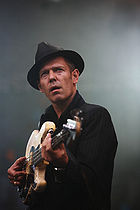 Paul is known for using white Fender Precision basses
and Ampeg
amplification although he has also used Sunn amps. He is also known for decorating his own basses with paint and stickers, and his basses often had a text on the upper horn of the body.
Paul started off playing through a small unknown head-amplifier and a pink 4x10 cab, but in 1978 he began using Ampeg
cabinets and amps and has since used Ampegs. His first bass was a "cheap knock-off", as he called it himself, that he used through 1976 and early 1977, which he splattered in paint. In 1977, during the recording of The Clash
, he received a black Rickenbacker
from Patti Smith
, which he also decorated in paint, but he didn't quite like the sound of it as it sounded too thin, and he also thought it was too lightweight (he's stated that he prefers heavy basses, as they seem more resonant and robust). After that he got hold of a white Fender Precision Bass in 1978, and since has only played white Fenders live.
Later he received a new Fender from CBS
which he has used for many years. CBS used to give him a new bass every now and then. It was another P-Bass, and this one is known for having "Paul" scratched into the body. The pick-ups were black on all of his Fenders, but he changed the ones on this bass to white. This bass was used mainly throughout 1978 and used as a backup in 1979. He played a Wal
JG Custom Bass during the recording session for Give 'Em Enough Rope
in 1978, because the producer Sandy Pearlman
suggested it, but Paul disliked it because it had too many switches.
In 1979 he got a new Fender, which was the one he smashed on the cover of London Calling
. He strongly regretted that move, because it was his best sounding bass. This bass now resides in the Rock and Roll Hall of Fame
. After it was smashed, it was back to the old Fender, which he used until he got a new bass in 1980 (there is a small possibility that this is the same bass as Bass, before it eventually got modified). All of his Fenders up to then had maple necks.
However, in 1981 he got a Fender Fretless Precision with a rosewood fingerboard. He played this through 1981, but went back to using fretted Fenders in 1982. He then got hold of a Fender Precision with a black headstock, rosewood fingerboard, and white pick-ups. He then also changed the neck on his PAUL-bass to a neck with black headstock and rosewood fretboard.
The last two electric bass guitars were mainly used as backup basses, and still are to this day, and the Fender Precision Bass, showed on the picture of him at the top of this section, is still his main bass, heavily worn and beaten up. He had a sunburst Precision in the last years of The Clash
, but this one was only used as a backup and by Joe Strummer
during the song "The Guns of Brixton
".
He had a sunburst Epiphone
Rivoli, which can be seen in the videos for "The Call Up
" and "London Calling
", but he was also seen with it in the earliest days of The Clash. It had probably belonged to Joe Strummer, Mick Jones
or someone in their former bands: The 101'ers (Strummer) or London SS
(Mick Jones). He used an Ovation acoustic bass during the recording of The Good, the Bad and the Queen
.
Cheap Brand Bass: Black w. paint-mess, (also had "POSITIVE" on its upper horn for a short while), Rosewood fretboard (used during the early days and during the recording of "The Clash")
Rickenbacker Bass: Black w. paint-mess and "POSITIVE" on upper horn, Rosewood fretboard (used during the recording of "The Clash" and for touring in support of "The Clash" album)
Fender Precision Bass: White w. paint-mess and "POSITIVE" on upper horn, Black pickguard, Maple neck (rarely seen, but used on the first concerts in 1978 and BBC TV Something Else Live 1978)
Fender Precision Bass: White w. "PAUL" carved on body (which was once covered up by stickers, which are now removed), Black pickguard (formerly with paint-mess), Rosewood fretboard (formerly maple neck) (used all the way from touring in support of the "Give'Em Enough Rope" album, both as main bass and backup bass, both live and recording, still used as main bass)
Wal JG Custom Bass (Serial No. JG1126): Cherry Red, Black pickguard, Rosewood fretboard (used for recording the "Give'Em Enough Rope" album). Now owned by Leigh Gorman of Bow Wow Wow.
Fender Precision Bass: White w. "PRESSURE" on upper horn, Black pickguard w. paint-mess, Maple neck (used for both recording and touring in support of the "London Calling" album. Smashed on the cover for "London Calling")
Fender Precision Bass: White, Black pickguard, Maple neck (used as both backup and main bass during tours between "London Calling" and "Sandinista")
Fender Fretless Precision Bass: White, Black pickguard, Rosewood fretboard (used as main bass for both recording and touring in support of the "Sandinista" album, "Combat Rock" album and "Cut The Crap" album, still used as backup)
Fender Precision Bass: White, Black pickguard, Rosewood fretboard (used as both main and backup bass for touring in support of the "Sandinista" album, "Combat Rock" album, and "Cut The Crap" album, still used as backup)
Fender Precision Bass: Sunburst, Tortoise pickguard, Rosewood fretboard (used as backup during the "Cut The Crap" album and tour)
Epiphone Rivoli bass: Sunburst w. Black duct tape, Rosewood fretboard (used during the early days and the recording of "London Calling" and "Sandinista")
Ovation Acoustic Bass: White, Ebony fretboard (used for recording "The Good, The Bad and The Queen" album)
Amplification, effects, and strings
Ampeg Bass Amps: Ampeg Classic Series SVT-CL Head and Classic Cabinet.
Punk rock
Punk rock is a rock music genre that developed between 1974 and 1976 in the United States, the United Kingdom, and Australia. Rooted in garage rock and other forms of what is now known as protopunk music, punk rock bands eschewed perceived excesses of mainstream 1970s rock...
band The Clash
The Clash
The Clash were an English punk rock band that formed in 1976 as part of the original wave of British punk. Along with punk, their music incorporated elements of reggae, ska, dub, funk, rap, dance, and rockabilly...
. Recent work includes his involvement in the album The Good, the Bad & the Queen with Damon Albarn
Damon Albarn
Damon Albarn is an English singer-songwriter and record producer who has been involved in many high profile projects, coming to prominence as the frontman and primary songwriter of Britpop band Blur...
, Simon Tong
Simon Tong
Simon Tong is a guitarist and keyboardist who was a member of The Verve between 1996 and 1999 and is currently a member of Erland and the Carnival and Transmission. He has also played on tour with Blur, Gorillaz and the unnamed supergroup responsible for The Good, the Bad & the Queen...
and Tony Allen
Tony Allen (musician)
Tony Oladipo Allen is aNigerian drummer, composer, and songwriter who currently lives and works in Paris. He is currently writing his autobiography "Tony Allen: Master Drummer of Afrobeat" with author/musician Michael E...
, released in January 2007. In 2010, he reunited with Mick Jones
Mick Jones (The Clash)
Michael Geoffrey "Mick" Jones is the former lead guitarist, secondary vocalist and co-founder for the British punk rock band The Clash until his dismissal in 1983. He went on to form the band Big Audio Dynamite with Don Letts before line-up changes led to the formation of Big Audio Dynamite II and...
, Damon Albarn
Damon Albarn
Damon Albarn is an English singer-songwriter and record producer who has been involved in many high profile projects, coming to prominence as the frontman and primary songwriter of Britpop band Blur...
and friends for the Gorillaz
Gorillaz
Gorillaz is an English musical project created in 1998 by Damon Albarn and Jamie Hewlett. This project consists of Gorillaz music itself and an extensive fictional universe depicting a "virtual band" of cartoon characters...
album, Plastic Beach
Plastic Beach
Plastic Beach is the third studio album by British virtual band and alternative hip hop supergroup Gorillaz, released 3 March 2010 on Parlophone and Virgin Records. Conceived from an unfinished Gorillaz project called Carousel, the album was recorded during June 2008 to November 2009 and produced...
.
Biography
Simonon was born in BrixtonBrixton
Brixton is a district in the London Borough of Lambeth in south London, England. It is south south-east of Charing Cross. The area is identified in the London Plan as one of 35 major centres in Greater London....
, London, England. His father, Gustave, was a clerk in the civil service and his mother, Elaine, was a librarian. He grew up in the South London area of Brixton
Brixton
Brixton is a district in the London Borough of Lambeth in south London, England. It is south south-east of Charing Cross. The area is identified in the London Plan as one of 35 major centres in Greater London....
, spending around a year in Siena
Siena
Siena is a city in Tuscany, Italy. It is the capital of the province of Siena.The historic centre of Siena has been declared by UNESCO a World Heritage Site. It is one of the nation's most visited tourist attractions, with over 163,000 international arrivals in 2008...
, Italy with his mother and stepfather. Before joining The Clash, he had planned to become an artist and attended the Byam Shaw School of Art, then based in Campden St, Kensington (now part of Central Saint Martins College of Art and Design
Central Saint Martins College of Art and Design
Central Saint Martins College of Art and Design is a constituent college of the University of the Arts London. The school has an outstanding international reputation, and is considered one of the world's leading art and design institutions...
) relocated in Archway, London.
He was asked to join The Clash in 1976 by lead guitarist Mick Jones
Mick Jones (The Clash)
Michael Geoffrey "Mick" Jones is the former lead guitarist, secondary vocalist and co-founder for the British punk rock band The Clash until his dismissal in 1983. He went on to form the band Big Audio Dynamite with Don Letts before line-up changes led to the formation of Big Audio Dynamite II and...
, who planned to teach Simonon guitar. However, the instrument proved difficult for Simonon, so Jones decided to teach him bass instead. Simonon would learn his bass parts by rote from Jones in the early days of The Clash and still did not know how to play the bass when the group first recorded. He is credited with coming up with the name of the band and was mainly responsible for the visual aspects such as clothing & stage backdrops.Related news articles: He was also immortalised on the front cover of the band's double album London Calling
London Calling
London Calling is the third studio album by the English punk rock band The Clash. It was released in the United Kingdom on 14 December 1979 through CBS Records, and in the United States in January 1980 through Epic Records...
; Pennie Smith
Pennie Smith
Pennie Smith is an English photographer, known for having photographed several rock musicians. She specialises in black-and-white photography.Smith attended Twickenham Art school in the late 1960s, studying graphics and fine art...
's image of him smashing his bass has become one of the iconic pictures of the punk era.
Paul Simonon wrote three of the Clash's songs: "The Guns of Brixton
The Guns of Brixton
"The Guns of Brixton" is a song by the English punk rock band The Clash. It was written and sung by bassist Paul Simonon, who grew up in Brixton, south London...
" on London Calling
London Calling
London Calling is the third studio album by the English punk rock band The Clash. It was released in the United Kingdom on 14 December 1979 through CBS Records, and in the United States in January 1980 through Epic Records...
, "The Crooked Beat" on Sandinista!
Sandinista!
Sandinista! is the fourth studio album by the English punk rock band the Clash. It was released on 12 December 1980 as a triple album containing 36 tracks, with 6 songs on each side...
, and the B-side "Long Time Jerk". He sang "Red Angel Dragnet" from Combat Rock
Combat Rock
The album received positive reviews from critics, and reached the number two on the UK Albums Chart, the number seven on the Billboard Pop albums, and the top ten on many charts in other countries...
but this song was written by Joe Strummer
Joe Strummer
John Graham Mellor , best remembered by his stage name Joe Strummer, was the co-founder, lyricist, rhythm guitarist and lead vocalist of the British punk rock band The Clash. His musical experience included his membership in The 101ers, Latino Rockabilly War, The Mescaleros and The Pogues, in...
.
Simonon played bass on almost all of the Clash's songs. Recordings that he did not play on include: "The Magnificent Seven" and "Lightning Strikes (Not Once but Twice)" on Sandinista!
Sandinista!
Sandinista! is the fourth studio album by the English punk rock band the Clash. It was released on 12 December 1980 as a triple album containing 36 tracks, with 6 songs on each side...
(played by Norman Watt-Roy
Norman Watt-Roy
Norman Watt-Roy is the bassist for The Blockheads, previously known as Ian Dury & the Blockheads.In November 1954 the Watt-Roy family, including Norman, his older brother Garth and his sister, moved to England...
), "Rock the Casbah
Rock the Casbah
"Rock the Casbah" is a song by the English punk rock band The Clash in 1982. It was released as the third single from their fifth album, Combat Rock. The song reached number eight on the Billboard Hot 100 chart in the U.S. and, along with the track "Mustapha Dance," it also reached number eight on...
" on Combat Rock
Combat Rock
The album received positive reviews from critics, and reached the number two on the UK Albums Chart, the number seven on the Billboard Pop albums, and the top ten on many charts in other countries...
(played by Topper Headon
Topper Headon
Headon was extensively interviewed for the Joe Strummer: The Future Is Unwritten documentary film about the late Clash frontman. He related his experiences during this period, how he became addicted to heroin and how there were problems before his dismissal...
), and 10 of the 12 tracks on Cut the Crap
Cut the Crap
Cut the Crap is the sixth and final album by the English punk rock band The Clash, released on 4 November 1985 by Epic Records.Following the ejection of founding member Mick Jones from the group, The Clash hired guitarists Nick Sheppard and Vince White to replace him...
(played by Norman Watt-Roy). Many of the tracks on Combat Rock
Combat Rock
The album received positive reviews from critics, and reached the number two on the UK Albums Chart, the number seven on the Billboard Pop albums, and the top ten on many charts in other countries...
are thought to have bass tracks laid down by Mick Jones or engineer Eddie Garcia and early recordings on Sandinista!
Sandinista!
Sandinista! is the fourth studio album by the English punk rock band the Clash. It was released on 12 December 1980 as a triple album containing 36 tracks, with 6 songs on each side...
featured bass played by Jones or Strummer, some but possibly not all of which Simonon later re-recorded once he rejoined the sessions after filming Ladies and Gentlemen, The Fabulous Stains
Ladies and Gentlemen, The Fabulous Stains
Ladies and Gentlemen, The Fabulous Stains is a 1981 film about three teenage girls, played by Diane Lane, Laura Dern and Marin Kanter, who start a punk band. Shot in British Columbia, Canada, the film also featured Ray Winstone, Christine Lahti, ex-Sex Pistols Steve Jones and Paul Cook, along with...
.
Simonon's contrapuntal reggae
Reggae
Reggae is a music genre first developed in Jamaica in the late 1960s. While sometimes used in a broader sense to refer to most types of Jamaican music, the term reggae more properly denotes a particular music style that originated following on the development of ska and rocksteady.Reggae is based...
/ska
Ska
Ska |Jamaican]] ) is a music genre that originated in Jamaica in the late 1950s, and was the precursor to rocksteady and reggae. Ska combined elements of Caribbean mento and calypso with American jazz and rhythm and blues...
-influenced lines set him apart from the bulk of other punk rock bassists of the era in terms of complexity and the role of the bass guitar within the band. He usually played with a pick
Plectrum
A plectrum is a small flat tool used to pluck or strum a stringed instrument. For hand-held instruments such as guitars and mandolins, the plectrum is often called a pick, and is a separate tool held in the player's hand...
as opposed to plucking the strings with his fingers.
After the Clash dissolved in 1986, Simonon started a band called Havana 3am
Havana 3am
Havana 3am was the band of bassist Paul Simonon formed shortly after his previous band, The Clash, officially broke up in 1986.The band consisted of Simonon on bass, American musician Gary Myrick on guitar, Nigel Dixon from the British band Whirlwind on lead vocals, and Travis Williams, a drummer...
. They recorded one album in Japan before breaking up. He also participated in a Bob Dylan
Bob Dylan
Bob Dylan is an American singer-songwriter, musician, poet, film director and painter. He has been a major and profoundly influential figure in popular music and culture for five decades. Much of his most celebrated work dates from the 1960s when he was an informal chronicler and a seemingly...
session along with the Sex Pistols
Sex Pistols
The Sex Pistols were an English punk rock band that formed in London in 1975. They were responsible for initiating the punk movement in the United Kingdom and inspiring many later punk and alternative rock musicians...
' Steve Jones
Steve Jones (musician)
Stephen Philip "Steve" Jones is an English rock guitarist, singer and actor, best known as guitarist and founding member of the punk rock band the Sex Pistols.-Childhood:...
that became part of the Dylan album Down in the Groove
Down in the Groove
Down in the Groove is singer-songwriter Bob Dylan's 25th studio album, released by Columbia Records in May 1988.A highly collaborative effort, it was Dylan's second consecutive album to receive almost unanimous negative reviews...
. Currently, Simonon works as an artist – his first passion before joining the Clash. He has had several gallery shows, and designed the cover for Big Audio Dynamite
Big Audio Dynamite
Big Audio Dynamite are a British musical group formed in 1984 by the ex-guitarist and singer of the Clash, Mick Jones. The group are noted for their effective mixture of varied musical styles, incorporating elements of punk rock, dance music, hip hop, reggae, and funk...
's album, Tighten Up, Vol. 88
Tighten Up, Vol. 88
-Personnel:* Mick Jones - vocals, guitar, producer* Don Letts - sound effects, vocals* Greg Roberts - drums, vocals* Dan Donovan - keyboards, vocals* Leo 'E-Zee-Kill' Williams - bass, vocals* Flea - Dynamite* Adele - Crew* Josh - Grand Poo-Bah...
, as well as the cover for "Herculean
Herculean (song)
"Herculean" is the first single by The Good, the Bad and the Queen, an alternative rock band fronted by Damon Albarn. Though Albarn later claimed that the band was unnamed, and that "The Good, The Bad & The Queen" was merely the name of band's first album, this single clearly credits the artist as...
" from the album The Good, the Bad and the Queen
The Good, the Bad and the Queen
The Good, the Bad & the Queen is the album by an ostensibly unnamed British alternative rock supergroup also commonly referred to as The Good, The Bad & The Queen, and made up of Damon Albarn, Paul Simonon, Simon Tong and Tony Allen. The album was released in January 2007...
, a project with Damon Albarn
Damon Albarn
Damon Albarn is an English singer-songwriter and record producer who has been involved in many high profile projects, coming to prominence as the frontman and primary songwriter of Britpop band Blur...
on which Simonon plays bass. In 2008, after a seven year gap, Simonon began exhibiting paintings again with an exhibition at Thomas Williams Fine Art, London. One of his paintings was bought by British singer Lily Allen
Lily Allen
Lily Rose Beatrice Cooper , better known as Lily Allen, is an English recording artist and fashion designer. She is the daughter of actor and musician Keith Allen and film producer Alison Owen. In her teenage years, her musical tastes evolved from glam rock to alternative...
for £23,500, according to the Telegraph newspaper. Paul reunited with Damon Albarn
Damon Albarn
Damon Albarn is an English singer-songwriter and record producer who has been involved in many high profile projects, coming to prominence as the frontman and primary songwriter of Britpop band Blur...
and Mick Jones
Mick Jones (The Clash)
Michael Geoffrey "Mick" Jones is the former lead guitarist, secondary vocalist and co-founder for the British punk rock band The Clash until his dismissal in 1983. He went on to form the band Big Audio Dynamite with Don Letts before line-up changes led to the formation of Big Audio Dynamite II and...
on the new Gorillaz
Gorillaz
Gorillaz is an English musical project created in 1998 by Damon Albarn and Jamie Hewlett. This project consists of Gorillaz music itself and an extensive fictional universe depicting a "virtual band" of cartoon characters...
album Plastic Beach
Plastic Beach
Plastic Beach is the third studio album by British virtual band and alternative hip hop supergroup Gorillaz, released 3 March 2010 on Parlophone and Virgin Records. Conceived from an unfinished Gorillaz project called Carousel, the album was recorded during June 2008 to November 2009 and produced...
, and is also the bassist of the Gorillaz live band supporting Plastic Beach, along with Mick Jones on guitar. The band headlined the 2010 Coachella Festival, and took up residence at the Camden roundhouse for two nights in late April 2010.
In 2011, Simonon spent time aboard the Greenpeace
Greenpeace
Greenpeace is a non-governmental environmental organization with offices in over forty countries and with an international coordinating body in Amsterdam, The Netherlands...
vessel Esperanza incognito under the guise of "Paul the assistant cook" in response to Arctic oil drilling in Greenland
Greenland
Greenland is an autonomous country within the Kingdom of Denmark, located between the Arctic and Atlantic Oceans, east of the Canadian Arctic Archipelago. Though physiographically a part of the continent of North America, Greenland has been politically and culturally associated with Europe for...
by Cairn
Cairn
Cairn is a term used mainly in the English-speaking world for a man-made pile of stones. It comes from the or . Cairns are found all over the world in uplands, on moorland, on mountaintops, near waterways and on sea cliffs, and also in barren desert and tundra areas...
oil. He joined other Greenpeace activists in illegally boarding one of Cairn's oil rigs; an action which earned him two weeks in a Greenland jail. His identity was revealed to other crew members after the voyage, and he joined Damon Albarn and the other members of The Good, the Bad, and the Queen for a performance in London celebrating Greenpeace's 40th anniversary.
Simonon and Mick Jones
Mick Jones (The Clash)
Michael Geoffrey "Mick" Jones is the former lead guitarist, secondary vocalist and co-founder for the British punk rock band The Clash until his dismissal in 1983. He went on to form the band Big Audio Dynamite with Don Letts before line-up changes led to the formation of Big Audio Dynamite II and...
are now working as executive producers for a new film based on the recording of The Clash
The Clash
The Clash were an English punk rock band that formed in 1976 as part of the original wave of British punk. Along with punk, their music incorporated elements of reggae, ska, dub, funk, rap, dance, and rockabilly...
classic 1979 album London Calling
London Calling
London Calling is the third studio album by the English punk rock band The Clash. It was released in the United Kingdom on 14 December 1979 through CBS Records, and in the United States in January 1980 through Epic Records...
.
Musical equipment
Fender Precision Bass
The Fender Precision Bass is an electric bass.Designed by Leo Fender as a prototype in 1950 and brought to market in 1951, the Precision was the first electric bass to earn widespread attention and use. A revolutionary instrument for the time, the Precision Bass has made an immeasurable impact on...
and Ampeg
Ampeg
Ampeg is primarily a musical instrument amplifier manufacturer headquartered in Woodinville, Washington, though they also manufacture guitars to a small extent...
amplification although he has also used Sunn amps. He is also known for decorating his own basses with paint and stickers, and his basses often had a text on the upper horn of the body.
Paul started off playing through a small unknown head-amplifier and a pink 4x10 cab, but in 1978 he began using Ampeg
Ampeg
Ampeg is primarily a musical instrument amplifier manufacturer headquartered in Woodinville, Washington, though they also manufacture guitars to a small extent...
cabinets and amps and has since used Ampegs. His first bass was a "cheap knock-off", as he called it himself, that he used through 1976 and early 1977, which he splattered in paint. In 1977, during the recording of The Clash
The Clash (album)
The album received positive reviews from critics and peaked at number 12 in the UK charts. In December 1979, critic Robert Christgau named it his favorite album of the 1970s....
, he received a black Rickenbacker
Rickenbacker
Rickenbacker International Corporation, also known as Rickenbacker, is an electric and bass guitar manufacturer based in Santa Ana, California...
from Patti Smith
Patti Smith
Patricia Lee "Patti" Smith is an American singer-songwriter, poet and visual artist, who became a highly influential component of the New York City punk rock movement with her 1975 debut album Horses....
, which he also decorated in paint, but he didn't quite like the sound of it as it sounded too thin, and he also thought it was too lightweight (he's stated that he prefers heavy basses, as they seem more resonant and robust). After that he got hold of a white Fender Precision Bass in 1978, and since has only played white Fenders live.
Later he received a new Fender from CBS
CBS
CBS Broadcasting Inc. is a major US commercial broadcasting television network, which started as a radio network. The name is derived from the initials of the network's former name, Columbia Broadcasting System. The network is sometimes referred to as the "Eye Network" in reference to the shape of...
which he has used for many years. CBS used to give him a new bass every now and then. It was another P-Bass, and this one is known for having "Paul" scratched into the body. The pick-ups were black on all of his Fenders, but he changed the ones on this bass to white. This bass was used mainly throughout 1978 and used as a backup in 1979. He played a Wal
Wal (bass)
Wal is a brand of electric bass manufactured by Electric Wood Ltd. in High Wycombe, England. It was started in 1974 by electronics expert Ian Waller and luthier Pete Stevens...
JG Custom Bass during the recording session for Give 'Em Enough Rope
Give 'Em Enough Rope
Give 'Em Enough Rope is the second studio album by the English punk rock band The Clash. It was released on 10 November 1978 through CBS Records. It was their first album released in the United States, preceding the US version of The Clash...
in 1978, because the producer Sandy Pearlman
Sandy Pearlman
Sandy Pearlman is an American music producer, artist manager, professor, poet, songwriter, and once was a record company executive...
suggested it, but Paul disliked it because it had too many switches.
In 1979 he got a new Fender, which was the one he smashed on the cover of London Calling
London Calling
London Calling is the third studio album by the English punk rock band The Clash. It was released in the United Kingdom on 14 December 1979 through CBS Records, and in the United States in January 1980 through Epic Records...
. He strongly regretted that move, because it was his best sounding bass. This bass now resides in the Rock and Roll Hall of Fame
Rock and Roll Hall of Fame
The Rock and Roll Hall of Fame and Museum is a museum located on the shore of Lake Erie in downtown Cleveland, Ohio, United States. It is dedicated to archiving the history of some of the best-known and most influential artists, producers, engineers and others who have, in some major way,...
. After it was smashed, it was back to the old Fender, which he used until he got a new bass in 1980 (there is a small possibility that this is the same bass as Bass, before it eventually got modified). All of his Fenders up to then had maple necks.
However, in 1981 he got a Fender Fretless Precision with a rosewood fingerboard. He played this through 1981, but went back to using fretted Fenders in 1982. He then got hold of a Fender Precision with a black headstock, rosewood fingerboard, and white pick-ups. He then also changed the neck on his PAUL-bass to a neck with black headstock and rosewood fretboard.
The last two electric bass guitars were mainly used as backup basses, and still are to this day, and the Fender Precision Bass, showed on the picture of him at the top of this section, is still his main bass, heavily worn and beaten up. He had a sunburst Precision in the last years of The Clash
The Clash
The Clash were an English punk rock band that formed in 1976 as part of the original wave of British punk. Along with punk, their music incorporated elements of reggae, ska, dub, funk, rap, dance, and rockabilly...
, but this one was only used as a backup and by Joe Strummer
Joe Strummer
John Graham Mellor , best remembered by his stage name Joe Strummer, was the co-founder, lyricist, rhythm guitarist and lead vocalist of the British punk rock band The Clash. His musical experience included his membership in The 101ers, Latino Rockabilly War, The Mescaleros and The Pogues, in...
during the song "The Guns of Brixton
The Guns of Brixton
"The Guns of Brixton" is a song by the English punk rock band The Clash. It was written and sung by bassist Paul Simonon, who grew up in Brixton, south London...
".
He had a sunburst Epiphone
Epiphone
The Epiphone Company is a musical instrument manufacturer founded in 1873 by Anastasios Stathopoulos. Epiphone was bought by Chicago Musical Instrument Company, which also owned Gibson Guitar Corporation, in 1957. Epiphone was Gibson's main rival in the archtop market...
Rivoli, which can be seen in the videos for "The Call Up
The Call Up
"The Call Up" is a song by English punk rock group The Clash. It was released as the first single from the band's fourth album, Sandinista!...
" and "London Calling
London Calling (song)
"London Calling" is a song by the British punk rock band The Clash. It was released as a single from the band's 1979 double album London Calling...
", but he was also seen with it in the earliest days of The Clash. It had probably belonged to Joe Strummer, Mick Jones
Mick Jones (The Clash)
Michael Geoffrey "Mick" Jones is the former lead guitarist, secondary vocalist and co-founder for the British punk rock band The Clash until his dismissal in 1983. He went on to form the band Big Audio Dynamite with Don Letts before line-up changes led to the formation of Big Audio Dynamite II and...
or someone in their former bands: The 101'ers (Strummer) or London SS
London SS
London SS were an early British punk rock group founded in March 1975 by guitarist Mick Jones and bassist Tony James.The band spent most of their short history auditioning potential members. Besides Jones and James, however, guitarist Brian James was the only other semi-permanent member...
(Mick Jones). He used an Ovation acoustic bass during the recording of The Good, the Bad and the Queen
The Good, the Bad and the Queen
The Good, the Bad & the Queen is the album by an ostensibly unnamed British alternative rock supergroup also commonly referred to as The Good, The Bad & The Queen, and made up of Damon Albarn, Paul Simonon, Simon Tong and Tony Allen. The album was released in January 2007...
.
Lists of Paul Simonon musical equipment
BassesCheap Brand Bass: Black w. paint-mess, (also had "POSITIVE" on its upper horn for a short while), Rosewood fretboard (used during the early days and during the recording of "The Clash")
Rickenbacker Bass: Black w. paint-mess and "POSITIVE" on upper horn, Rosewood fretboard (used during the recording of "The Clash" and for touring in support of "The Clash" album)
Fender Precision Bass: White w. paint-mess and "POSITIVE" on upper horn, Black pickguard, Maple neck (rarely seen, but used on the first concerts in 1978 and BBC TV Something Else Live 1978)
Fender Precision Bass: White w. "PAUL" carved on body (which was once covered up by stickers, which are now removed), Black pickguard (formerly with paint-mess), Rosewood fretboard (formerly maple neck) (used all the way from touring in support of the "Give'Em Enough Rope" album, both as main bass and backup bass, both live and recording, still used as main bass)
Wal JG Custom Bass (Serial No. JG1126): Cherry Red, Black pickguard, Rosewood fretboard (used for recording the "Give'Em Enough Rope" album). Now owned by Leigh Gorman of Bow Wow Wow.
Fender Precision Bass: White w. "PRESSURE" on upper horn, Black pickguard w. paint-mess, Maple neck (used for both recording and touring in support of the "London Calling" album. Smashed on the cover for "London Calling")
Fender Precision Bass: White, Black pickguard, Maple neck (used as both backup and main bass during tours between "London Calling" and "Sandinista")
Fender Fretless Precision Bass: White, Black pickguard, Rosewood fretboard (used as main bass for both recording and touring in support of the "Sandinista" album, "Combat Rock" album and "Cut The Crap" album, still used as backup)
Fender Precision Bass: White, Black pickguard, Rosewood fretboard (used as both main and backup bass for touring in support of the "Sandinista" album, "Combat Rock" album, and "Cut The Crap" album, still used as backup)
Fender Precision Bass: Sunburst, Tortoise pickguard, Rosewood fretboard (used as backup during the "Cut The Crap" album and tour)
Epiphone Rivoli bass: Sunburst w. Black duct tape, Rosewood fretboard (used during the early days and the recording of "London Calling" and "Sandinista")
Ovation Acoustic Bass: White, Ebony fretboard (used for recording "The Good, The Bad and The Queen" album)
Amplification, effects, and strings
Ampeg Bass Amps: Ampeg Classic Series SVT-CL Head and Classic Cabinet.
With The Clash
- The ClashThe Clash (album)The album received positive reviews from critics and peaked at number 12 in the UK charts. In December 1979, critic Robert Christgau named it his favorite album of the 1970s....
(1977) - Give 'Em Enough RopeGive 'Em Enough RopeGive 'Em Enough Rope is the second studio album by the English punk rock band The Clash. It was released on 10 November 1978 through CBS Records. It was their first album released in the United States, preceding the US version of The Clash...
(1978) - London CallingLondon CallingLondon Calling is the third studio album by the English punk rock band The Clash. It was released in the United Kingdom on 14 December 1979 through CBS Records, and in the United States in January 1980 through Epic Records...
(1979) - Sandinista!Sandinista!Sandinista! is the fourth studio album by the English punk rock band the Clash. It was released on 12 December 1980 as a triple album containing 36 tracks, with 6 songs on each side...
(1980) - Combat RockCombat RockThe album received positive reviews from critics, and reached the number two on the UK Albums Chart, the number seven on the Billboard Pop albums, and the top ten on many charts in other countries...
(1982) - Cut the CrapCut the CrapCut the Crap is the sixth and final album by the English punk rock band The Clash, released on 4 November 1985 by Epic Records.Following the ejection of founding member Mick Jones from the group, The Clash hired guitarists Nick Sheppard and Vince White to replace him...
(1985)
With Gorillaz
- Plastic BeachPlastic BeachPlastic Beach is the third studio album by British virtual band and alternative hip hop supergroup Gorillaz, released 3 March 2010 on Parlophone and Virgin Records. Conceived from an unfinished Gorillaz project called Carousel, the album was recorded during June 2008 to November 2009 and produced...
(2010)
Simonon reunites with Clash guitarist Mick JonesMick Jones (The Clash)Michael Geoffrey "Mick" Jones is the former lead guitarist, secondary vocalist and co-founder for the British punk rock band The Clash until his dismissal in 1983. He went on to form the band Big Audio Dynamite with Don Letts before line-up changes led to the formation of Big Audio Dynamite II and...
on the album's title track. - The FallThe Fall (Gorillaz album)-Additional personnel:* Guitar on track 3 by Mick Jones* Additional keyboards on track 6 by Jesse Hackett* Bass on track 12 by Paul Simonon* Qanun on track 12 by James R Grippo* Vocals, guitar and additional songwriting on track 13 by Bobby Womack...
(2010)
(in Aspen Forest)