

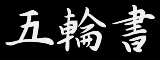
The Book of Five Rings

Encyclopedia
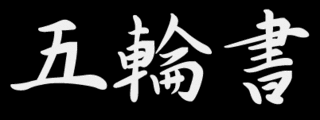
Kenjutsu
, meaning "the method, or technique, of the sword." This is opposed to kendo, which means the way of the sword. Kenjutsu is the umbrella term for all traditional schools of Japanese swordsmanship, in particular those that predate the Meiji Restoration...
and the martial arts in general, written by the samurai
Samurai
is the term for the military nobility of pre-industrial Japan. According to translator William Scott Wilson: "In Chinese, the character 侍 was originally a verb meaning to wait upon or accompany a person in the upper ranks of society, and this is also true of the original term in Japanese, saburau...
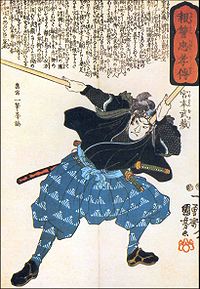
warrior Miyamoto Musashi
Miyamoto Musashi
, also known as Shinmen Takezō, Miyamoto Bennosuke or, by his Buddhist name, Niten Dōraku, was a Japanese swordsman and rōnin. Musashi, as he was often simply known, became renowned through stories of his excellent swordsmanship in numerous duels, even from a very young age...
circa 1645. There have been various translations made over the years, and it enjoys an audience considerably broader than only that of martial artists: for instance, some business leaders find its discussion of conflict and taking the advantage to be relevant to their work. The modern-day Hyōhō Niten Ichi-ryū
Hyoho Niten Ichi-ryu
, which can be loosely translated as "the school of the strategy of two heavens as one", is a koryū , transmitting a style of classical Japanese swordsmanship conceived by the warrior Miyamoto Musashi...
employs it as a manual of technique and philosophy.
Musashi establishes a "no-nonsense" theme throughout the text. For instance, he repeatedly remarks that technical flourishes are excessive, and contrasts worrying about such things with the principle that all technique is simply a method of cutting down one's opponent. He also continually makes the point that the understandings expressed in the book are important for combat on any scale, whether a one-on-one duel
Duel
A duel is an arranged engagement in combat between two individuals, with matched weapons in accordance with agreed-upon rules.Duels in this form were chiefly practised in Early Modern Europe, with precedents in the medieval code of chivalry, and continued into the modern period especially among...
or a massive battle
Battle
Generally, a battle is a conceptual component in the hierarchy of combat in warfare between two or more armed forces, or combatants. In a battle, each combatant will seek to defeat the others, with defeat determined by the conditions of a military campaign...
. Descriptions of principles are often followed by admonitions to "investigate this thoroughly" through practice rather than trying to learn them by merely reading.
Katana
A Japanese sword, or , is one of the traditional bladed weapons of Japan. There are several types of Japanese swords, according to size, field of application and method of manufacture.-Description:...
and wakizashi
Wakizashi
The is one of the traditional Japanese swords worn by the samurai class in feudal Japan.-Description:...
, contrary to the more traditional method of wielding the katana two-handed. However, he only explicitly describes wielding two swords in a section on fighting against many adversaries. The stories of his many duels rarely reference Musashi himself wielding two swords, although, since they are mostly oral traditions, their details may be rather inaccurate. Some suggest that Musashi's meaning was not so much wielding two swords "simultaneously", but rather acquiring the proficiency to (singly) wield either sword in either hand as the need arose. However, Musashi states within the volume that one should train with a long sword in each hand, thereby training the body and improving one's ability to use two blades simultaneously, though the aim of this was only for training purposes and wasn't meant to be a viable fighting style.
The five books

Although it is difficult to grasp it from the book, Go Rin No Sho, these books are actually the teachings which Musashi preached to his students in his own dōjō
Dojo
A is a Japanese term which literally means "place of the way". Initially, dōjōs were adjunct to temples. The term can refer to a formal training place for any of the Japanese do arts but typically it is considered the formal gathering place for students of any Japanese martial arts style to...
. Despite taking some ideas from others, the books are not based on any other school of teaching.
The five "books" refer to the idea that there are different elements of battle, just as there are different physical elements in life, as described by Buddhism
Buddhism
Buddhism is a religion and philosophy encompassing a variety of traditions, beliefs and practices, largely based on teachings attributed to Siddhartha Gautama, commonly known as the Buddha . The Buddha lived and taught in the northeastern Indian subcontinent some time between the 6th and 4th...
, Shinto
Shinto
or Shintoism, also kami-no-michi, is the indigenous spirituality of Japan and the Japanese people. It is a set of practices, to be carried out diligently, to establish a connection between present day Japan and its ancient past. Shinto practices were first recorded and codified in the written...
, and other Eastern religions. The five books below are Musashi's descriptions of the exact methods or techniques which are described by such elements.
The term "Ichi School" is referred to in the book, Go Rin No Sho. When referring to such books, it refers to "Niten No Ichi Ryu" or "Ni Ten Ichi Ryu", which means, when literally translated, "Two heaven, one school", although many could see the translation as "Two Swords, One spirit", or "Two Swords, One Entity". However, the translation of "Two Swords, one Dragon" was thought to be a transliteral misinterpretation of the Kanji word Ryu.
- The Book of Earth chapter serves as an introduction, and metaphorically discusses martial arts, leadership, and training as building a house.
- The Book of Water chapter describes Musashi's style, Ni-ten ichi-ryu, or "Two Heavens, One Style". It describes some basic technique and fundamental principles.
- The Book of Fire chapter refers to the heat of battle, and discusses matters such as different types of timing.
- The Book of Wind chapter is something of a pun, since the Japanese character can mean both "wind" and "style" (e.g., of martial arts). It discusses what Musashi considers to be the failings of various contemporary schools of swordfighting.
- The Book of the Void chapter is a short epilogue, describing, in more esoteric terms, Musashi's probably ZenZenZen is a school of Mahāyāna Buddhism founded by the Buddhist monk Bodhidharma. The word Zen is from the Japanese pronunciation of the Chinese word Chán , which in turn is derived from the Sanskrit word dhyāna, which can be approximately translated as "meditation" or "meditative state."Zen...
-influenced thoughts on consciousness and the correct mindset.
The Book of Ground
The ground book, according to Go Rin No Sho, is mentioned as the book which refers expressly to the strategy taught by Musashi at the Ichi School, and it is said to be how to distinguish the way through "Sword-Fencing", or "Swordsmanship". The idea of strategy mentioned in this book is that of situational strategy, such as techniques and tricks to use when fighting indoors, outdoors, on a horse, or in various other conditions. The book or discipline is that of strategies taught to Ichi school students who would be encouraged to be very astute in their study and strategy:Know the smallest things and the biggest things, the shallowest things and the deepest things. As if it were a straight road mapped out on the ground ... These things cannot be explained in detail. From one thing, know ten thousand things. When you attain the Way of strategy there will not be one thing you cannot see. You must study hard.
Upon their mastery of the strategy and timing listed in the five books, Musashi states that you will be able to defeat ten men as easy as you could defeat one, and asks: "When you have reached this point, will it not mean that you are invincible?"
The strategies listed in this discipline or book relate to situations requiring different weapons and tactics, such as indoor weapons. Musashi states that the use of halberd
Halberd
A halberd is a two-handed pole weapon that came to prominent use during the 14th and 15th centuries. Possibly the word halberd comes from the German words Halm , and Barte - in modern-day German, the weapon is called Hellebarde. The halberd consists of an axe blade topped with a spike mounted on...
-like naginata
Naginata
The naginata is one of several varieties of traditionally made Japanese blades in the form of a pole weapon. Naginata were originally used by the samurai class in feudal Japan, and naginata were also used by ashigaru and sōhei .-Description:A naginata consists of a wooden shaft with a curved...
and spear
Spear
A spear is a pole weapon consisting of a shaft, usually of wood, with a pointed head.The head may be simply the sharpened end of the shaft itself, as is the case with bamboo spears, or it may be made of a more durable material fastened to the shaft, such as flint, obsidian, iron, steel or...
s are purely for on the field, whereas the longsword and accompanying short-sword can be used in most environments, such as on horseback or in fierce battle.
Musashi also mentions the gun
Gun
A gun is a muzzle or breech-loaded projectile-firing weapon. There are various definitions depending on the nation and branch of service. A "gun" may be distinguished from other firearms in being a crew-served weapon such as a howitzer or mortar, as opposed to a small arm like a rifle or pistol,...
as having no equal on the battlefield. It is the supreme weapon on the battlefield, until swords clash—then it becomes useless. He also notes that the gun is somewhat lesser than the bow
Bow (weapon)
The bow and arrow is a projectile weapon system that predates recorded history and is common to most cultures.-Description:A bow is a flexible arc that shoots aerodynamic projectiles by means of elastic energy. Essentially, the bow is a form of spring powered by a string or cord...
, since at that time guns were not very accurate at ranges any longer than point-blank in addition to the disadvantage of being unable to see the bullet and adjust your aim as you would with a bow. Not to mention, in the 17th century, the gap in reloading speeds between skilled archers and skilled gunmen was rather large.
One of the principles of the Niten Ichi-ryū is that one should be versed in many weaponry skills. Musashi indicates that during battle you should not overuse one weapon—this is as bad as using the weapon poorly since it becomes easy for an enemy to find a weakness in your style after countless uses of the same weapon.
Timing, as explained by Musashi, is the core principle in strategy which is listed in the Ground Book. The idea of timing as explained within the ground book is that you must be able to adapt your strategy to timing with your skill, in that you must know when to attack and when not to attack.
In The Book of Five Rings he writes on timing:
"Timing is important in dancing and pipe or string music, for they are in rhythm only if timing is good. Timing and rhythm are also involved in the military arts, shooting bows and guns, and riding horses. In all skills and abilities there is timing.... There is timing in the whole life of the warrior, in his thriving and declining, in his harmony and discord. Similarly, there is timing in the Way of the merchant, in the rise and fall of capital. All things entail rising and falling timing. You must be able to discern this. In strategy there are various timing considerations. From the outset you must know the applicable timing and the inapplicable timing, and from among the large and small things and the fast and slow timings find the relevant timing, first seeing the distance timing and the background timing. This is the main thing in strategy. It is especially important to know the background timing, otherwise your strategy will become uncertain."
The Book of Water
The water book concerns strategyStrategy
Strategy, a word of military origin, refers to a plan of action designed to achieve a particular goal. In military usage strategy is distinct from tactics, which are concerned with the conduct of an engagement, while strategy is concerned with how different engagements are linked...
, but it also includes various other factors which perhaps a warrior reading the book should take into consideration, such as spirituality
Spirituality
Spirituality can refer to an ultimate or an alleged immaterial reality; an inner path enabling a person to discover the essence of his/her being; or the “deepest values and meanings by which people live.” Spiritual practices, including meditation, prayer and contemplation, are intended to develop...
, religion, and one's outlook on life. The meaning of water in relation to life is flexibility. Water demonstrates natural flexibility as it changes to conform with the boundaries which contain it, seeking the most efficient and productive path. So also should one possess the ability to change in accordance with one’s own situation to easily shift between disciplines, methods, and options when presented with new information. A person should master many aspects of life allowing them to possess both balance and flexibility.
The spiritual bearing in strategy, which Musashi writes about concerns your temperament and spirituality whilst in the midst of, or in formulation of a battle. Being a buddhist, most of what is written in the section concerning spirituality refers to principles of calmness, tranquility and spiritual balance;
In strategy your spiritual bearing must not be any different from normal. Both in fighting and in everyday life you should be determined though calm.
This balance refers to what could be thought of as yin and yang
Yin and yang
In Asian philosophy, the concept of yin yang , which is often referred to in the West as "yin and yang", is used to describe how polar opposites or seemingly contrary forces are interconnected and interdependent in the natural world, and how they give rise to each other in turn. Opposites thus only...
within yourself. The over-familiarity or over-use of one weapon is discouraged by Musashi, as it would be seen to reveal your spirituality to your enemy. The idea is that a perfectly balanced spirit is also a perfectly balanced physical presence, and neither creates weakness nor reveals it to your enemy.
During battle, the spirituality and balance is something of which Musashi notes that you should take advantage. Since small people know the spirituality of big people, they can thus note differences and weaknesses between each other. This is something which seems easy, but it is said to change when you are on the battlefield, as then you must know to both adjust your spiritual balance according to what is around you, and to perceive the balance of those around you to take advantage accordingly.
Just as your spirit should be balanced, your various techniques be honed to a perfectly balanced demeanour. In terms of stance, much like balance within the trooper, Musashi notes that stance is an important part of strategy, or battle: Adopt a stance with the head erect, neither hanging down, nor looking up, nor twisted. This is part of what Musashi notes as wedging in.
In regards to the gaze of someone, he notes that a person must be able to perceive that which is all around him without moving their eyeballs noticeably, which is said to be a skill which takes an enormous amount of practice to perfect. He notes that this is again one of the most important parts of strategy, as well as being able to see things which are close to you, such as the technique of an enemy. It is also used to perceive things far away, such as arriving troops or enemies, as that is the precursor to battle. You can then change your actions according to what you see.
Attitudes of swordsmanship
- Upper
- Middle
- Lower
- Right Side
- Left Side
The five attitudes of swordsmanship
Swordsmanship
Swordsmanship refers to the skills of a swordsman, a person versed in the art of the sword. The term is modern, and as such was mainly used to refer to smallsword fencing, but by extension it can also be applied to any martial art involving the use of a sword...
are referred to as the five classifications of areas for attack on the human body. These are areas which are noted for their advantages when striking at an enemy, and the strategist is said to think of them when in situations where, for any reason, you should not be able to strike them. Then his mind should adjust accordingly.
Your attitude should be large or small according to the situation. Upper, Lower and Middle attitudes are decisive. Left Side and Right Side attitudes are fluid. Left and Right attitudes should be used if there is an obstruction overhead or to one side. The decision to use Left or Right depends on the place.
As each is thought of as an attitude, it could be thought of that Musashi means to practice with each "attitude" so that you do not become over-reliant upon one, something which Musashi repeatedly notes as being worse than bad technique.
"No Attitude" refers to those strategists who do not go with the use of the "Five Attitudes" and prefer to simply go without the attitudes of the long sword to focus entirely on technique, as opposed to focusing on both technique and the five attitudes. This is similar to taking chances as opposed to making chances.
The attitude of "Existing - Non Existing", mixes the Five Attitudes with the Attitude of "No Attitude", meaning that the user of the longsword uses the techniques and principles of both at whichever moment he or she finds most opportune.
"In-One Timing" refers to the technique of biding your time until you can find a suitable gap in the enemies' defense, to which you will deliver one fatal blow to the enemy. Although this is said to be difficult, Musashi notes that masters of this technique are usually masters of the five attitudes because they must be perceptive of weaknesses. It is rumoured that Musashi disgraced a former sword master by using such a technique with a Bokken
Bokken
A bokken , "wood", and ken, "sword") , is a Japanese wooden sword used for training. It is usually the size and shape of a katana, but is sometimes shaped like other swords, such as the wakizashi and tantō...
, but there are no descriptions mentioning "In one" timing.
"Abdomen Timing of Two" refers to feint
Feint
Feint is a French term that entered English from the discipline of fencing. Feints are maneuvers designed to distract or mislead, done by giving the impression that a certain maneuver will take place, while in fact another, or even none, will...
ing an attack, then striking an enemy as they are retreating from the attack, hitting them in the abdomen with the correct timing of either two moves or two seconds. Although the technique seems relatively simple, Musashi lists this as one of the hardest techniques to time correctly.
"No Design, No Conception" refers to When word and actions are spontaneously the same. Aside from this philosophical approach to the meaning, the technique is relatively simple to explain: if you are in a deadlock with the enemy, using the force from the cut, you push with your body and use the disciplines outlined in the Void Book to knock the enemy over.
This is the most important method of hitting. It is often used. You must train hard to understand it.
"Flowing Water Cut" technique refers to if you come into a fight with an enemy of a similar level to you in swordsmanship. When attacking fast, Musashi notes that you will always be at stalemate, so like Stagnant water, you must cut as slowly as possible with your long sword. At the beginning of this technique you and your opponent will be searching for an opening within each other's defense. When your opponent either tries to push off your sword, or to hasten back as to disengage it, you must first expand your whole body and your mind. By moving your body first and then that of your sword, you will be able to strike powerfully and broadly with a movement that seems to reflect the natural flow of water. Ease and confidence will be attained when this technique is continuously practiced upon.
"Continuous Cut" refers to when you are again faced with stalemate within a duel, where your swords are clasped together. In one motion, when your sword springs away from theirs, Musashi says to use a continuous motion to slash their head, body, and legs.
"Fire and Stone's Cut" refers to when your swords clash together. Without raising your sword, you cut as strongly as possible. This means cutting quickly with hands, body, and legs.
"Red Leafs Cut" refers to knocking down the enemy's long sword in the spirit of the "No Design, No Conception" cut.
The Book of Fire
The Fire Book refers to fighting methods unlike the specific fighting techniques listed in the Water Book. It goes into a broader scope in terms of hints as to assess a situation, as well as specific situational instructions.He notes obvious advantages of armor and preparedness before a duel or battle as it applies to one man or a whole group of men:
As one man can defeat ten men, so can one thousand men defeat ten thousand. However, you can become a master of strategy by training alone with a sword, so that you can understand the enemy's stratagems, his strength and resources, and come to appreciate how to apply strategy to beat ten thousand enemies.
The dependence of location according to the Go Rin No Sho is crucial. You must be in a place where man-made objects such as buildings, towers, castles, and such do not obstruct your view, as well as facing or standing in a position where the sun or moon does not affect your vision. This is purely so that your vision is focused on nothing but the enemy, and thus there is more concentration upon the enemy's stratagems. Musashi also seems to note the age old strategy of the High Ground
High ground
High ground is a spot of elevated terrain which can be useful in military tactics. Fighting from an elevated position is easier for a number of reasons. Soldiers will tire more quickly when fighting uphill, will move more slowly, and if fighting in formation will have little ability to see beyond...
:
You must look down on the enemy, and take up your attitude on slightly higher places.
Other kinds of tactics which of Musashi tells are way of ensuring that the enemy is at a disadvantage. Forcing yourself on the non-dominant side of a trooper is one way because the left side is difficult for a right-handed soldier. Other disadvantages, such as forcing enemies into footholds, swamps, ditches, and other difficult terrain, force the enemy to be uncertain of his situation.
These things cannot be clearly explained in words. You must research what is written here. In these three ways of forestalling, you must judge the situation. This does not mean that you always attack first; but if the enemy attacks first you can lead him around. In strategy, you have effectively won when you forestall the enemy, so you must train well to attain this.
Ken No Sen (Attacking) is the most obvious method of forestalling an enemy because a head on collision forces both parties to a standstill. Although it is not mentioned, Musashi must have been well aware that this method would also be the most likely to have a higher death count than the others due to the sheer mass of enemies because more than one enemy could then attack a single soldier or trooper.
As the name suggests, Tai No Sen (Waiting for the Initiative) is invented for very opportunistic and decided battles between parties. The main idea being to feign weakness as to open a weak spot, or Achilles' heel
Achilles' heel
An Achilles’ heel is a deadly weakness in spite of overall strength, that can actually or potentially lead to downfall. While the mythological origin refers to a physical vulnerability, metaphorical references to other attributes or qualities that can lead to downfall are common.- Origin :In Greek...
, in the opposing force, and then regrouping to exploit such a hole by attacking deep within the enemy's party. Although it is not mentioned, this would most likely be to kill the officer of the highest rank as an attempt to remove the tactical centre of a group of soldiers. A method particularly useful for Musashi or others, if attacking a general directly, would signal the end of the battle upon his defeat.
Only a small amount of text is written about Tai Tai No Sen (Accompanying and Forestalling). Albeit very confusing, the idea of Tai Tai No Sen is circumventing an ambush or quick attack from the enemy by taking the initiative and attacking in full force. Musashi admits himself that this is a difficult thing to explain.
Although there are other methods, they are mostly situational methods relating to the crossing of rough terrain, and battling within such rough terrain. Although it spreads over two or more paragraphs, most information is common sense, relating to caution and avoidance of such situations.
The idea of timing, as with singular battles, is known as the most important part of attacking next to the skill of participants. However, the type of timing in this instance is somewhat different from the timing noted in The Ground Book since this variety of timing requires looking at the various physical factors which affect an enemy during battle, such as determining if strength is waning or rising within a group of troopers.
The idea of treading down the sword is a very simple technique. Squashing an enemy's attack before it starts by using a form of charging and then attacking under the veil of gunpowder
Gunpowder
Gunpowder, also known since in the late 19th century as black powder, was the first chemical explosive and the only one known until the mid 1800s. It is a mixture of sulfur, charcoal, and potassium nitrate - with the sulfur and charcoal acting as fuels, while the saltpeter works as an oxidizer...
smoke, and arrow fire, the initial attacks used when starting battles can be highly effective. Individually, it refers to attacking the enemy's sword, breaking it, removing it from play, and a technique of controlling it through direct blade on blade contact.
Like Musashi mentions in his philosophical style, there is a cause for a collapse. As there is collapse within an enemy, such as waning in his numbers, Musashi notes that one must observe such events and use them to his advantage.
Interestingly, he notes that an enemy's formation can fall if they lose rhythm. It was known that in such battles, drummers drummed a tune for their other fellow soldiers to march to; and, if the rhythm was lost, it led to a "collapse when their rhythm becomes deranged".
The Book of Wind
Whereas most of the information given in the previous books is useful in such a way that it could still be applicable today, this book is primarily concerned with the specific details about other strategies that existed at the time. The broader lesson from this book is that an important part of understanding your own way is to understand the way of your opponent as precisely as possible.Musashi notes that although most schools have secret and ancient strategies, most forms are derivative of other martial arts. Their similarities and differences evolved through situational factors, such as indoor or outdoor duelling, and the style adapted to the school. He indicates that his appraisal may be one sided because the only school he had interest for was his own, and, in a way, he does not see parallels to his own creation and work. However, he still admits that without basic understanding of these alternate techniques, you will not be able to learn Ni Ten Ichi Ryu, probably for reasons of finding the wrongs in other techniques, and righting them within yourself in Ni Ten Ichi Ryu.
The main difference that Musashi notes between the Ichi School and other strategists and schools is that other schools do not teach the "broader" meaning of strategy. There is a strategy above sword-fencing: "Some of the world's strategists are concerned only with sword-fencing, and limit their training to flourishing the long sword and carriage of the body." The book has many paragraphs on the subject of other schools' techniques, and much of the text lists the ways that other schools do not conform to the ideals which he himself writes about in the Book of Five Rings, such as footwork, sight, and over-reliance or over-familiarity with a weapon.
The Book of Void
Although short, the void book lists, philosophically, the nature of both human knowledge and other things. The void book expressly deals with "That which cannot be seen"."By knowing things that exist, you can know that which does not exist."
The Book of Nothing, according to Musashi, is the true meaning of the strategy of Ni Ten Ichi Ryu. It seems very esoteric in nature because he seems to note that you must learn to perceive that which you cannot understand or comprehend. He notes that in this Void, what can be comprehended are things which we do and see, such as the way of the warrior, martial arts, and Ni Ten Ichi Ryu. At the same time, in the Void, things we do not do or see (which he calls Spirit), are part of the information which we perceive on a conscious level, but with which we have no physical relationship. It is arguable whether Musashi is referring to religious spirituality or if he is actually explaining a way to live a life and process thoughts.
"In the void is virtue, and no evil. Wisdom has existence, principle has existence, the Way has existence, spirit is nothingness."
In the above quote, Musashi speaks of "virtue and no evil". This may mean "goodness and banishment of evil" or "purpose and non-existence of good and evil", and the exact meaning is open to debate.
Crimson-Leaves Strike
With this method, you will cause your adversary's sword to drop through a strike from your sword, then bring yourself immediately back to a readiness to strike. This method is combined with The Strike of Nonthought, in which you will always strike with true force by swinging your sword toward the ground when your opponent's sword is about to drop.Autumn Monkey's Body
With this method, you are to start off by assuming a posture in which you are not to use your hands. You are to think of getting your body close to your opponent before striking him. However, if you think of reaching out both of your hands, your body will remain distant. This is to why you must always think of quickly getting your body close to the enemy. When you are distant, you will exchange blows of the sword, and it will be rather easy to move closer to your opponent.Thomas Cleary
Thomas Cleary
Thomas Cleary is a prolific author and translator of Buddhist, Taoist, Confucian and Muslim classics, and of the Chinese Art of War tradition of strategy and statecraft. He lives in Oakland, California in the United States.-Life and work:...
translates this technique as "Body of the Short-Armed Monkey".
Blow Like a Spark from a Stone
If you are currently within a situation in which you and your opponent's swordSword
A sword is a bladed weapon used primarily for cutting or thrusting. The precise definition of the term varies with the historical epoch or the geographical region under consideration...
s are to clash, you must strike extremely hard without raising your sword to any extent. This is The Blow Like a Spark from a Stone technique. If you are to perform this technique, you must first strike quickly with the three combined forces of your legs, your hands, and your body. This blow will be rather difficult to perform if you do not train it at frequent times. If you diligently train yourself, you will be able to increase the overall force of the technique's impact.