


Temple of Zeus

Encyclopedia
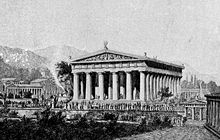
Greek temple
Greek temples were structures built to house deity statues within Greek sanctuaries in Greek paganism. The temples themselves did usually not directly serve a cult purpose, since the sacrifices and rituals dedicated to the respective deity took place outside them...
in Olympia, Greece
Olympia, Greece
Olympia , a sanctuary of ancient Greece in Elis, is known for having been the site of the Olympic Games in classical times, comparable in importance to the Pythian Games held in Delphi. Both games were held every Olympiad , the Olympic Games dating back possibly further than 776 BC...
, dedicated to the chief of the gods, Zeus
Zeus
In the ancient Greek religion, Zeus was the "Father of Gods and men" who ruled the Olympians of Mount Olympus as a father ruled the family. He was the god of sky and thunder in Greek mythology. His Roman counterpart is Jupiter and his Etruscan counterpart is Tinia.Zeus was the child of Cronus...
. It was the very model of the fully developed classical Greek temple of the Doric order
Doric order
The Doric order was one of the three orders or organizational systems of ancient Greek or classical architecture; the other two canonical orders were the Ionic and the Corinthian.-History:...
. The temple, built between 472 and 456 BCE, stood in the most famous sanctuary of Greece, which had been dedicated to local and Pan-Hellenic deities and had probably been established towards the end of the Mycenaean period
Mycenaean Greece
Mycenaean Greece was a cultural period of Bronze Age Greece taking its name from the archaeological site of Mycenae in northeastern Argolis, in the Peloponnese of southern Greece. Athens, Pylos, Thebes, and Tiryns are also important Mycenaean sites...
. The Altis, the enclosure with its sacred grove
Sacred grove
A sacred grove is a grove of trees of special religious importance to a particular culture. Sacred groves were most prominent in the Ancient Near East and prehistoric Europe, but feature in various cultures throughout the world...
, open-air altars and the tumulus
Tumulus
A tumulus is a mound of earth and stones raised over a grave or graves. Tumuli are also known as barrows, burial mounds, Hügelgrab or kurgans, and can be found throughout much of the world. A tumulus composed largely or entirely of stones is usually referred to as a cairn...
of Pelops
Pelops
In Greek mythology, Pelops , was king of Pisa in the Peloponnesus. He was the founder of the House of Atreus through his son of that name....
, was first formed during the tenth and ninth centuries BCE Greece's "Dark Age"
Greek Dark Ages
The Greek Dark Age or Ages also known as Geometric or Homeric Age are terms which have regularly been used to refer to the period of Greek history from the presumed Dorian invasion and end of the Mycenaean Palatial civilization around 1200 BC, to the first signs of the Greek city-states in the 9th...
, when the cult of Zeus was joined to the already establish cult here of Hera.
It housed the renowned statue of Zeus
Statue of Zeus at Olympia
The Statue of Zeus at Olympia was made by the Greek sculptor Phidias, circa 432 BC on the site where it was erected in the Temple of Zeus, Olympia, Greece. It was one of the Seven Wonders of the Ancient World.-Description:...
, which was one of the Seven Wonders of the Ancient World
Seven Wonders of the Ancient World
The Seven Wonders of the World refers to remarkable constructions of classical antiquity listed by various authors in guidebooks popular among the ancient Hellenic tourists, particularly in the 1st and 2nd centuries BC...
. The Chryselephantine
Chryselephantine
Chryselephantine is a term that refers to the sculptural medium of gold and ivory...
statue was approximately 13 m (43 ft) high and was made by the sculptor Phidias
Phidias
Phidias or the great Pheidias , was a Greek sculptor, painter and architect, who lived in the 5th century BC, and is commonly regarded as one of the greatest of all sculptors of Classical Greece: Phidias' Statue of Zeus at Olympia was one of the Seven Wonders of the Ancient World...
in his workshop on the site at Olympia. He took about twelve years to complete it. On his head was a sculpted wreath of olive sprays. In his right hand he held a figure of Nike
Nike (mythology)
In Greek mythology, Nike was a goddess who personified victory, also known as the Winged Goddess of Victory. The Roman equivalent was Victoria. Depending upon the time of various myths, she was described as the daughter of Pallas and Styx and the sister of Kratos , Bia , and Zelus...
, the goddess of victory, also made from ivory and gold, and in his left hand, a scepter made with many kinds of metal, with an eagle perched on the top. His sandals were made of gold and so was his robe. His garments were carved with animals and with lilies. The throne was decorated with gold, precious stones, ebony, and ivory. The statue was the most famous artistic work in Greece.
The temple was constructed by the architect Libon
Libon
Libon was a 5th century BC Greek architect. Born in Elis, he built the Doric temple to Zeus at Olympia in about 460 BC. Libon, through his work on the Temple of Zeus at Olympia, is said to have inspired the technique and design of the Parthenon on the Athenian Acropolis - though this was obviously...
, with carved metopes
Metope (architecture)
In classical architecture, a metope is a rectangular architectural element that fills the space between two triglyphs in a Doric frieze, which is a decorative band of alternating triglyphs and metopes above the architrave of a building of the Doric order...
and triglyph
Triglyph
Triglyph is an architectural term for the vertically channeled tablets of the Doric frieze, so called because of the angular channels in them, two perfect and one divided, the two chamfered angles or hemiglyphs being reckoned as one. The square recessed spaces between the triglyphs on a Doric...
friezes, topped by pediment
Pediment
A pediment is a classical architectural element consisting of the triangular section found above the horizontal structure , typically supported by columns. The gable end of the pediment is surrounded by the cornice moulding...
s filled with sculptures in the Severe Style
Severe style
The severe style, or Early Classic style, was the dominant idiom of Greek sculpture in the period ca. 490 to 450 BCE. It marks the breakdown of the canonical forms of archaic art and the transition to the greatly expanded vocabulary and expression of the classical moment of the late 5th century...
, now attributed to the "Olympia Master
Olympia Master
The Olympia Master is the name given to the anonymous sculptor responsible for the external sculpture of the Temple of Zeus, Olympia. From what Pausanias tells us of the dates of the Temple, the Master and his workshop were active between 470 and 457 BCE The two pediments and the series of metopes...
" and his studio.
The main structure of the building was of a local limestone that was unattractive and of poor quality, and so it was coated with a thin layer of stucco
Stucco
Stucco or render is a material made of an aggregate, a binder, and water. Stucco is applied wet and hardens to a very dense solid. It is used as decorative coating for walls and ceilings and as a sculptural and artistic material in architecture...
to give it an appearance of marble. All the sculptural decoration on the temple was made of Parian marble
Parian marble
Parian marble is a fine-grained semitranslucent pure-white and entirely flawless marble quarried during the classical era on the Greek island of Paros in the Aegean Sea.It was highly prized by ancient Greeks for making sculptures...
, and the roof tiles were of the same Pentelic marble used to build the Parthenon
Parthenon
The Parthenon is a temple on the Athenian Acropolis, Greece, dedicated to the Greek goddess Athena, whom the people of Athens considered their virgin patron. Its construction began in 447 BC when the Athenian Empire was at the height of its power. It was completed in 438 BC, although...
at Athens
Athens
Athens , is the capital and largest city of Greece. Athens dominates the Attica region and is one of the world's oldest cities, as its recorded history spans around 3,400 years. Classical Athens was a powerful city-state...
.
Iconography
Iconography is the branch of art history which studies the identification, description, and the interpretation of the content of images. The word iconography literally means "image writing", and comes from the Greek "image" and "to write". A secondary meaning is the painting of icons in the...
of the temple is the dike or justice based on custom, as represented by Zeus, its upholder.
The east pediment, erroneously attributed to Paeonius
Paeonius
Paeonius of Mende in Macedonia was a Greek sculptor of the late 5th century BC. The only work that can be definitely attributed to him is the statue of Nike discovered at Olympia...
by Pausanias
Pausanias (geographer)
Pausanias was a Greek traveler and geographer of the 2nd century AD, who lived in the times of Hadrian, Antoninus Pius and Marcus Aurelius. He is famous for his Description of Greece , a lengthy work that describes ancient Greece from firsthand observations, and is a crucial link between classical...
, who gave a detailed account of its sculptures in the late second century CE, depicted the myth of the chariot race between Pelops
Pelops
In Greek mythology, Pelops , was king of Pisa in the Peloponnesus. He was the founder of the House of Atreus through his son of that name....
and Oenomaus
Oenomaus
In Greek mythology, King Oenomaus of Pisa, the father of Hippodamia, was the son of Ares, either by the naiad Harpina or by Sterope, one of the Pleiades, whom some identify as his consort instead...
, with Zeus standing in the centre, flanked by standing pairs of heroes and heroines, and the two chariot groups, with recumbent figures in the corners. Hippodameia and her maid stand to Zeus' left (north), and Pelops
Pelops
In Greek mythology, Pelops , was king of Pisa in the Peloponnesus. He was the founder of the House of Atreus through his son of that name....
to Zeus' right. A great part of all fifteen figures has been recovered, in carefully documented excavations; scholars still discuss the placement and interrelationships of six seated or kneeling figures in the composition, and their specific identifications.
The west pediment depicted the Centauromachy, the fight at the wedding of Peirithoos between the Lapiths and the centaur
Centaur
In Greek mythology, a centaur or hippocentaur is a member of a composite race of creatures, part human and part horse...
s, who had violated xenia
Xenia (Greek)
Xenia is the Greek concept of hospitality, or generosity and courtesy shown to those who are far from home. It is often translated as "guest-friendship" because the rituals of hospitality created and expressed a reciprocal relationship between guest and host.The Greek god Zeus sometimes referred...
, the sacred rules of hospitality that support the social norms. Apollo
Apollo
Apollo is one of the most important and complex of the Olympian deities in Greek and Roman mythology...
stood in the centre, flanked by Peirithoos and Theseus
Theseus
For other uses, see Theseus Theseus was the mythical founder-king of Athens, son of Aethra, and fathered by Aegeus and Poseidon, both of whom Aethra had slept with in one night. Theseus was a founder-hero, like Perseus, Cadmus, or Heracles, all of whom battled and overcame foes that were...
. Peirithoos, king of the Lapiths has invited the centaurs to a wedding celebration. The centaurs get drunk and kidnap the women. Perithoos succeeds in defeating them. The Lapiths have been taken to represent the civilised Olympian order of the Greeks themselves, while the Centaurs represent primitive nature of chthonic
Chthonic
Chthonic designates, or pertains to, deities or spirits of the underworld, especially in relation to Greek religion. The Greek word khthon is one of several for "earth"; it typically refers to the interior of the soil, rather than the living surface of the land or the land as territory...
beings; the frieze also reminded fifth-century Greeks of their victory over the Persians
Greco-Persian Wars
The Greco-Persian Wars were a series of conflicts between the Achaemenid Empire of Persia and city-states of the Hellenic world that started in 499 BC and lasted until 449 BC. The collision between the fractious political world of the Greeks and the enormous empire of the Persians began when Cyrus...
, "outsider" threateners of the Hellenic order. The statue of Apollo (currently in the Archaeological Museum of Olympia) was depicted on the obverse
Obverse and reverse
Obverse and its opposite, reverse, refer to the two flat faces of coins and some other two-sided objects, including paper money, flags , seals, medals, drawings, old master prints and other works of art, and printed fabrics. In this usage, obverse means the front face of the object and reverse...
of the Greek 1000 drachmas
Greek drachma
Drachma, pl. drachmas or drachmae was the currency used in Greece during several periods in its history:...
banknote of 1987-2001.
Opisthodomos
An opisthodomos can refer to either the rear room of an ancient Greek temple or to the inner shrine, also called the adyton ; the confusion arises from the lack of agreement in ancient inscriptions. In modern scholarship, it usually refers to the rear porch of a temple...
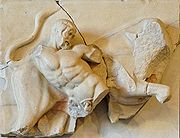
, the entrance portico and the balancing false portico at the rear, were constructed in antis, with six metopes at either end, carved with the 12 labours of Heracles, in which Heracles successfully defeats a series of creatures and monsters that threaten righteous order.
The Roman general Mummius dedicated twenty-one gilded shields after he sacked Corinth in 146 BCE; they were hung upon the columns. In 426 CE, Theodosius II
Theodosius II
Theodosius II , commonly surnamed Theodosius the Younger, or Theodosius the Calligrapher, was Byzantine Emperor from 408 to 450. He is mostly known for promulgating the Theodosian law code, and for the construction of the Theodosian Walls of Constantinople...
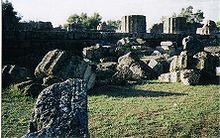
ordered the destruction of the sanctuary, and earthquakes in 522 and 551 devastated the ruins and left the Temple of Zeus partially buried.
The site of the ancient sanctuary, long forgotten under landslips and flood siltation, was identified in 1766. In 1829 a French team partially excavated the Temple of Zeus, taking several fragments of the pediments to the Musée du Louvre. Systematic excavation began in 1875, under the direction the German Archaeological Institute, and has continued, with some interruptions, to the present time.
In Film
The 1997 Disney animated film Hercules depicts the Temple of Zeus as the only communication Hercules has with his father while he is a mortal. Zeus communicates by possessing the statue within the temple. In an episode of the animated seriesHercules: The Animated Series
Hercules is an animated series based on the 1997 film of the same name and the Greek myth. The series follows teenage Hercules training as a hero as well as trying to adjust to life. With his free-spirited friend Icarus, his future-seeing friend Cassandra and his teacher Philoctetes , he battles...
, Zeus further uses this ability to address an issue on Earth by using the statue to visit other cities near Athens.
See also
- ElisElisElis, or Eleia is an ancient district that corresponds with the modern Elis peripheral unit...
- Architecture of Ancient GreeceArchitecture of Ancient GreeceThe architecture of Ancient Greece is the architecture produced by the Greek-speaking people whose culture flourished on the Greek mainland and Peloponnesus, the Aegean Islands, and in colonies in Asia Minor and Italy for a period from about 900 BC until the 1st century AD, with the earliest...
- Greek templeGreek templeGreek temples were structures built to house deity statues within Greek sanctuaries in Greek paganism. The temples themselves did usually not directly serve a cult purpose, since the sacrifices and rituals dedicated to the respective deity took place outside them...
- List of Greco-Roman roofs
- Apollon of OlympiaApollon of OlympiaThe Apollon of Olympia was part of the group of sculptures found in the west pediment of the Temple of Zeus at Olympia. Its original location also provides it with another name: the Apollon from the west pediment. It is one of the most important statues of the Severe style or early Classical...