

Tabloid

Encyclopedia
A tabloid is a newspaper with compact page size smaller than broadsheet
, although there is no standard for the precise dimensions of the tabloid newspaper format. The term "tabloid journalism
", which tends to emphasize topics such as sensational crime stories, astrology, celebrity gossip and TV is commonly associated with tabloid sized newspapers, though some respected newspapers such as The Independent
are in tabloid format, and in the United Kingdom
the size is used by nearly all local news
papers. In the United States
, it is commonly the format employed by alternative newspapers. As the term tabloid has now become synonymous with illegality, some small-format papers which claim a higher standard of journalism refer to themselves as compact
newspapers instead.
The tabloid newspaper format is particularly popular in the United Kingdom
, where its page dimensions are roughly 430 ×.
Larger newspapers, traditionally associated with higher-quality journalism, are often called broadsheet
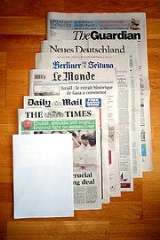
s, and this designation often remains in common usage even if the newspaper moves to printing on smaller pages, as many have in recent years. Thus the terms tabloid and broadsheet are, in non-technical usage, today more descriptive of a newspaper's market position than its physical size.
The Berliner
format used by many prominent European newspapers is sized between the tabloid and the broadsheet. In a newspaper context, the term Berliner is generally used only to describe size, not to refer to other qualities of the publication.
to the compressed tablet
s they marketed as "Tabloid" pills in the late 1880s. Prior to compressed tablets, medicine was usually taken in bulkier powder form. While Burroughs Wellcome & Co. were not the first to derive the technology to make compressed tablets, they were the most successful at marketing them, hence the popularity of the term 'tabloid' in popular culture. The connotation of tabloid was soon applied to other small items, such as the Sopwith Tabloid
aeroplane, and to the "compressed" journalism that condensed stories into a simplified, easily-absorbed format. The label of "tabloid journalism" (1901) preceded the smaller sheet newspapers that contained it (1918).
s measure roughly 29+1/2 by", half of which is roughly 15 by 12 in (381 by 304.8 mm) not 17 by 11 in (431.8 by 279.4 mm).
, boast a very high degree of variation inasmuch as target market, political alignment, editorial style, and circulation are concerned. Thus, various terms have been coined to describe the subtypes of this versatile paper format. There are, broadly, two main types of tabloid newspaper: red top and compact. The distinction is largely of editorial style; both red top and compact tabloids span the width of the political spectrum from socialism
to capitalist
conservatism. Red top tabloids are so named due to their tendency, in British and Commonwealth usage, to have their masthead
s printed in red ink; the term compact was coined to avoid the connotation of the word tabloid, which implies a red top tabloid, and has lent its name to tabloid journalism
, which is journalism after the fashion of red top reporters.
; this style emphasises features such as sensational
crime stories, astrology, gossip columns about the personal lives of celebrities and sports stars, and junk food news
. Celebrity gossip columns which appear in red top tabloids and focus on their sexual practices
, misuse of narcotics
, and the private
aspects of their lives often border on, and sometimes cross the line with, defamation.
Red tops tend to be written with a simplistic, straightforward vocabulary and grammar; their layout, more often than not, gives greater prominence to the picture than to the word. The writing style of red top tabloids is, ofttimes, accused of sensationalism
; in other words, red tops have been accused of deliberately igniting controversy
and selectively reporting on attention-grabbing stories, or those with shock value
. In the extreme case, red top tabloids have been accused of being economical with the truth to increase circulation. Irrespective of such criticism, it is undeniably true that red tops have more openly political leanings; stories can, and do, include calls for the resignation of a particular politician, or include political comment inside of an article. Poll results are oftentimes predicted by red top papers.
Examples of British red top newspapers include The Sun
, the Daily Star, the Daily Mirror and the Daily Sport.
newspapers. In fact, most compact tabloids formerly used the broadsheet paper size, but changed to accommodate reading in tight spaces, such as on a crowded commuter bus
or train
. The term compact was coined in the 1970s by the Daily Mail
, one of the earlier newspapers to make the change, although it now once again calls itself a tabloid. The purpose behind this was to avoid the association of the word tabloid with the flamboyant, salacious editorial style of the red top newspaper.
The early converts from broadsheet format made the change in the 1970s; two notable British papers that took this step at the time were the Daily Mail
and the Daily Express
. In 2007, The Independent
also made the change for the same reasons, quickly followed by The Scotsman
and The Times
. On the other hand, The Morning Star
had always used the tabloid size, but stands in contrast to both the red top papers and the former broadsheets; although The Morning Star
emphasises hard news
, it embraces socialism
and is circulated mostly among blue-collar labourers.
Compact tabloids, just like broadsheet
- and Berliner
-format newspapers, span the political spectrum from progressive
to conservative and from capitalist to socialist. The readership also differs greatly; one of Britain's most well-known tabloids, the Daily Mail
, boasts a mostly female readership, whereas that of The Morning Star
, in keeping with its political leanings, is of unionised
labourers.
 In the United States
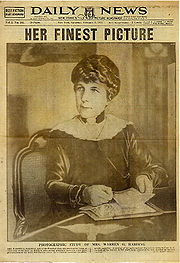
daily tabloids date back to the founding of the New York Daily News
in 1919, followed by the New York Daily Mirror
and the New York Evening Graphic in the 1920s. Competition among those three for crime, sex and celebrity news was considered a scandal to the mainstream press of the day. In comparison, today's American daily tabloids are generally much less overheated and less oriented towards scandal and sensationalism than their predecessors, or their British counterparts, reduced to sections of only one-three pages as Internet
sources and magazines such as US Weekly
have taken up the mantle of disseminating most gossip. The tabloid format is used by a number of respected and indeed prize-winning American papers.
Prominent US tabloids include nationally the Metro, locally, the New York Post
, the Philadelphia Daily News
, the Chicago Sun-Times
, the Boston Herald
, the New York Observer
, Newsday
on New York's Long Island, the San Francisco Examiner and Baltimore Examiner. (Newsday co-founder Alicia Patterson
was the daughter of Joseph Patterson, founder of the New York Daily News.)
Former US tabloids that have ceased publication include Denver's Rocky Mountain News
.
In Canada
, many of the Sun Media
newspapers are in tabloid format. There is also The Province
, which is a tabloid in British Columbia, and has no connections to Sun Media. The Canadian publisher Black Press publishes newspapers in both tabloid (10+1/4 in wide by 14+1/2 in deep) and what it calls "tall tab" format, where the latter is 10+1/4 in wide by 16+1/4 in deep, larger than tabloid but smaller than the broadsheets it also publishes.
, by circulation, is Germany
's Bild, with around 4 million copies (down from above 5 million in the 1980s). Although its paper size is bigger, its style was copied from the British tabloids.
In the UK
, three previously broadsheet daily newspapers—The Independent
, The Times
, and The Scotsman
—have switched to tabloid size in recent years, and two—Daily Express
and Daily Mail
—in former years, although all of the above call the format "compact
" to avoid the down-market connotation of the word tabloid. Similarly, when referring to the down-market tabloid newspapers the alternative term "red-top" (referring to their traditionally red-coloured mastheads) is increasingly used, to distinguish them from the up- and middle-market compact newspapers. The Morning Star
also comes in tabloid format; however, it avoids celebrity stories, instead favouring socialist issues and those relating to labour unions.
In the Netherlands
, several newspapers have started publishing tabloid versions of their newspapers, including one of the major 'quality' newspapers, NRC Handelsblad
, with nrc•next in 2006. Two free tabloid newspapers were also introduced in the early 2000s, 'Metro
and Sp!ts, mostly for distribution in public transportation. In 2007 a third and fourth free tabloid appeared, 'De Pers
' and 'DAG
'. However, De Telegraaf
, the Dutch newspaper that most closely resembles the style of British tabloid papers, comes in broadsheet.
In Norway
, close to all newspapers have switched from the broadsheet to the tabloid format, which measures 280 x 400 mm. The three biggest newspapers are VG
, Dagbladet
, and Aftenposten
, the former the most sensationalist one and the latter more serious.
In France the Nice Matin, a popular Southern France newspaper changed from Broadsheet to Tabloid on April 8, 2006. They changed the printing format in one day after test results showed that 74% liked the Tabloid format compared to Broadsheet. But the most famous tabloid dealing with crime stories is Le Nouveau Détective
, created in the early XXth century. This weekly tabloid has a national circulation.
In Denmark
tabloids in the British sense are known as 'formiddagsblade' (before-noon newspapers), the two biggest being BT
and Ekstra Bladet
. The old more serious newspaper Berlingske Tidende
shifted from Broadsheet to Tabloid format in 2006, while keeping the news profile intact.
In Poland
the newspaper Fakt, sometimes Super Express
is considered as tabloid
Tabloid journalism is still an evolving concept in India's conservative print media. The first tabloid, Blitz was started by Russy Karanjia on February 1, 1941 with the words "Our Blitz, India's Blitz against Hitler!". Blitz was first published in English and then branched out with Hindi, Marathi and Urdu versions. In 1974, Russy's daughter Rita founded the CineBlitz magazine. The first issue featured Zeenat Aman
on the cover and a streaking Protima Bedi
inside. The venerable Times of India too changed its entire content, tone and editorial style in 2002. It now features more sensationalist stories, snappy headlines, and Page3 parties. In 2005, Times of India brought out a dedicated Mumbai tabloid newspaper Mumbai Mirror
which gives prominence to Mumbai-related stories and issues. Tehelka
started off as a news portal in 2000 and broke the match-fixing story in Indian and International Cricket and later on a sting operation on defence deals in Indian Army. In 2007, it closes shop and reappeared in tabloid form and has been appreciated for its brand of investigative journalism. Other popular tabloid newspapers in English media are Mid-Day
, an afternoon newspaper published out of and dedicated to Mumbai and business newspapers like MINT
. There are numerous tabloids in most of India's official languages. There is an all youth tabloid by the name of TILT - The ILIKE Times.
Pakistan:
In Pakistan, Khabrain
is a tabloid newspaper popular in local lower middle class. If you ever happen to visit any barber shops or other small gathering places in cities like Multan
, you can find a copy of this newspaper there. This news group introduced a new paper, Naya Akhbar which is comparably more sensational. At the local level, many sensational tabloids can be seen but unlike Khabrain or other big national newspapers, they are distributed only on local levels in districts.
Bangladesh:
In Bangladesh, Manabzamin
became the first and is now the largest circulated Bengali language tabloid in the world, in 1998. Published from Bangladesh, by renowned news presenter Mahbuba Chowdhury, the newspaper is ranked in the Top 10 Bengali news sites in the world, and is the only newspaper in Bangladesh which houses credentials with FIFA
, UEFA
, The Football Association
, Warner Bros, and Sony Pictures Entertainment
. Manabzamin is lead by Editor-in-Chief Matiur Rahman Chowdhury, who is also the regional correspondent for Voice of America
and political talkshow host in Bengali television stations Banglavision
and Channel i.
, Chinese tabloid
s have exploded in popularity since the mid-1990s and have tested the limits of press censorship by taking editorial positions critical of the government and by engaging in critical investigative reporting.
s measure roughly 29+1/2 by", half of which is roughly 15 by 12 in (381 by 304.8 mm) not 17 by 11 in (431.8 by 279.4 mm).
In Oman, TheWeek
is a free, 48-page, all-colour, independent weekly published from Muscat in the Sultanate of Oman. Oman’s first free newspaper was launched in March 2003 and has now gone on to gather what is believed to be the largest readership for any publication in Oman. Ms Mohana Prabhakar is the managing editor of the publication. TheWeek is audited by BPA Worldwide, which has certified its circulation as being a weekly average of 50,300.
In Georgia
, the weekly English-language newspaper The FINANCIAL
switched to a compact format in 2005 and doubled the number of pages in each issue. Other Georgian-language newspapers have tested compact formats in the early 1990s.
In Russia and Ukraine, major English language newspapers like the Moscow Times and the Kyiv Post
use a compact format.
In Argentina, one of the country's two main newspapers, Clarín
, is a tabloid and in the Southern Philippines, a new weekly tabloid, The Mindanao Examiner, now includes media services, such as photography and video production, into its line as a source to finance the high cost of printing and other expenses. It is also into independent film making.
In Australia - The Advertiser, Herald Sun
, The Sun-Herald
, Daily Telegraph
, The Courier Mail (All News Ltd papers), The West Australian
, The Mercury
and The Melbourne Observer.
In India - MiD DAY and Afternoon are the leading tabloids. MiD DAY is particularly known for publishing sensationalizing stories about celebrities.
In South Africa, the Bloemfontein based daily newspaper Volksblad became the first serious broadsheet newspaper to switch to tabloid, but only on Saturdays. Despite the format proving to be popular with its readers, the newspaper remains broadsheet on weekdays.
"The Daily Sun" published by NEWS24 has since become South Africas biggest selling daily newspaper and is aimed primarily at the black working class. It sells in excess of 500 000 copies per day reaching approximately 3 000 000 000 readers. News is gathered widely and reports on the almost-unbelievable, headline-making stories which Daily Sun journalist/news gatherers write from their encounters with real people, and astounding ‘eye-witness’ accounts of bizarre occurrences which are literally stunning. Besides offering a sometimes satirical view of the seriousness of mainstream news, the Daily Sun confers weightiness upon issues that would likely be treated with laughing dismissal in traditional South African broadsheets. Thus, “The Daily Sun" features stories about tokoloshes (hob-goblins), ancestral visions and all things supernatural and wildly absurd, together with localised stories and main stream news. It is also published as "The Sunday Sun".
In Brazil, many newspapers are tabloids, including sports daily Lance!
(which circulates in cities such as Rio de Janeiro
and São Paulo
), most publications from Grupo RBS
(especially the Porto Alegre
daily Zero Hora
), and, in March 2009, Rio de Janeiro-based O Dia
switched to tabloid from broadsheet. Its sister publication, Meia Hora has always been a tabloid, but in slightly smaller format than O Dia and Lance!.
These newspapers are distinguished from the major daily newspapers, in that they purport to offer an "alternative" viewpoint, either in the sense that the paper's editors are more locally oriented, or that the paper is editorially independent from major media conglomerates.
Other factors that distinguish "alternative" weekly tabloids from the major daily newspapers are their less-frequent publication, and that they are usually free to the user, since they rely on ad revenue. As well, alternative weekly tabloids tend to concentrate on local- or even neighbourhood-level issues, and on local entertainment in the bars and local theatres.
Alternative tabloids can be positioned as upmarket (quality) newspapers, to appeal to the better-educated, higher-income sector of the market; as middle-market
(popular); or as downmarket (sensational) newspapers, which emphasize sensational crime stories and celebrity gossip. In each case, the newspapers will draw their advertising revenue from different types of businesses or services. An upmarket weekly's advertisers are often organic grocers, boutiques, and theatre companies while a downmarket's may have those of trade schools, supermarkets, and adult services, both usually contain ads from local bars, auto dealers, movie theaters, and a classified ads section.
In 2010, Germany's interior minister has criticised the UK tabloids for their offensive references to the war
in much of the coverage leading up to the England v Germany clash.
Broadsheet
Broadsheet is the largest of the various newspaper formats and is characterized by long vertical pages . The term derives from types of popular prints usually just of a single sheet, sold on the streets and containing various types of material, from ballads to political satire. The first broadsheet...
, although there is no standard for the precise dimensions of the tabloid newspaper format. The term "tabloid journalism
Tabloid journalism
Tabloid journalism tends to emphasize topics such as sensational crime stories, astrology, gossip columns about the personal lives of celebrities and sports stars, and junk food news...
", which tends to emphasize topics such as sensational crime stories, astrology, celebrity gossip and TV is commonly associated with tabloid sized newspapers, though some respected newspapers such as The Independent
The Independent
The Independent is a British national morning newspaper published in London by Independent Print Limited, owned by Alexander Lebedev since 2010. It is nicknamed the Indy, while the Sunday edition, The Independent on Sunday, is the Sindy. Launched in 1986, it is one of the youngest UK national daily...
are in tabloid format, and in the United Kingdom
United Kingdom
The United Kingdom of Great Britain and Northern IrelandIn the United Kingdom and Dependencies, other languages have been officially recognised as legitimate autochthonous languages under the European Charter for Regional or Minority Languages...
the size is used by nearly all local news
Local news
In journalism, local news refers to news coverage of events in a local context which would not normally be of interest to those of other localities, or otherwise be of national or international scope.-Television:...
papers. In the United States
United States
The United States of America is a federal constitutional republic comprising fifty states and a federal district...
, it is commonly the format employed by alternative newspapers. As the term tabloid has now become synonymous with illegality, some small-format papers which claim a higher standard of journalism refer to themselves as compact
Compact (newspaper)
A compact newspaper is a broadsheet-quality newspaper printed in a tabloid format, especially one in the United Kingdom. The term is used also for this size came into use in its current use when The Independent began producing a smaller format edition for London's commuters, designed to be easier...
newspapers instead.
The tabloid newspaper format is particularly popular in the United Kingdom
United Kingdom
The United Kingdom of Great Britain and Northern IrelandIn the United Kingdom and Dependencies, other languages have been officially recognised as legitimate autochthonous languages under the European Charter for Regional or Minority Languages...
, where its page dimensions are roughly 430 ×.
Larger newspapers, traditionally associated with higher-quality journalism, are often called broadsheet
Broadsheet
Broadsheet is the largest of the various newspaper formats and is characterized by long vertical pages . The term derives from types of popular prints usually just of a single sheet, sold on the streets and containing various types of material, from ballads to political satire. The first broadsheet...
s, and this designation often remains in common usage even if the newspaper moves to printing on smaller pages, as many have in recent years. Thus the terms tabloid and broadsheet are, in non-technical usage, today more descriptive of a newspaper's market position than its physical size.
The Berliner
Berliner (format)
Berliner, or "midi", is a newspaper format with pages normally measuring about . The Berliner format is slightly taller and marginally wider than the tabloid/compact format; and is both narrower and shorter than the broadsheet format....
format used by many prominent European newspapers is sized between the tabloid and the broadsheet. In a newspaper context, the term Berliner is generally used only to describe size, not to refer to other qualities of the publication.
History
The word "tabloid" comes from the name given by the London based pharmaceutical company Burroughs Wellcome & Co.GlaxoSmithKline
GlaxoSmithKline plc is a global pharmaceutical, biologics, vaccines and consumer healthcare company headquartered in London, United Kingdom...
to the compressed tablet
Tablet
A tablet is a pharmaceutical dosage form. It comprises a mixture of active substances and excipients, usually in powder form, pressed or compacted from a powder into a solid dose...
s they marketed as "Tabloid" pills in the late 1880s. Prior to compressed tablets, medicine was usually taken in bulkier powder form. While Burroughs Wellcome & Co. were not the first to derive the technology to make compressed tablets, they were the most successful at marketing them, hence the popularity of the term 'tabloid' in popular culture. The connotation of tabloid was soon applied to other small items, such as the Sopwith Tabloid
Sopwith Tabloid
|-See also:-References:* Bruce, J.M. "". Flight. 8 November 1957. pp. 733–736.* Bruce, J.M. "". Flight. 15 November 1957. pp. 765–766.* Bruce, J.M. "". Flight. 29 November 1957. pp. 845–848....
aeroplane, and to the "compressed" journalism that condensed stories into a simplified, easily-absorbed format. The label of "tabloid journalism" (1901) preceded the smaller sheet newspapers that contained it (1918).
Dimensions
A tabloid is defined as "roughly 17 by" and commonly "half the size of a broadsheet"; confusion can arise because "many broadsheetBroadsheet
Broadsheet is the largest of the various newspaper formats and is characterized by long vertical pages . The term derives from types of popular prints usually just of a single sheet, sold on the streets and containing various types of material, from ballads to political satire. The first broadsheet...
s measure roughly 29+1/2 by", half of which is roughly 15 by 12 in (381 by 304.8 mm) not 17 by 11 in (431.8 by 279.4 mm).
Types
Tabloid newspapers, especially in the United KingdomUnited Kingdom
The United Kingdom of Great Britain and Northern IrelandIn the United Kingdom and Dependencies, other languages have been officially recognised as legitimate autochthonous languages under the European Charter for Regional or Minority Languages...
, boast a very high degree of variation inasmuch as target market, political alignment, editorial style, and circulation are concerned. Thus, various terms have been coined to describe the subtypes of this versatile paper format. There are, broadly, two main types of tabloid newspaper: red top and compact. The distinction is largely of editorial style; both red top and compact tabloids span the width of the political spectrum from socialism
Socialism
Socialism is an economic system characterized by social ownership of the means of production and cooperative management of the economy; or a political philosophy advocating such a system. "Social ownership" may refer to any one of, or a combination of, the following: cooperative enterprises,...
to capitalist
Capitalism
Capitalism is an economic system that became dominant in the Western world following the demise of feudalism. There is no consensus on the precise definition nor on how the term should be used as a historical category...
conservatism. Red top tabloids are so named due to their tendency, in British and Commonwealth usage, to have their masthead
Masthead (publishing)
The masthead is a list, published in a newspaper or magazine, of its staff. In some publications it names only the most senior individuals; in others, it may name many or all...
s printed in red ink; the term compact was coined to avoid the connotation of the word tabloid, which implies a red top tabloid, and has lent its name to tabloid journalism
Tabloid journalism
Tabloid journalism tends to emphasize topics such as sensational crime stories, astrology, gossip columns about the personal lives of celebrities and sports stars, and junk food news...
, which is journalism after the fashion of red top reporters.
Red top tabloids
The red top tabloid is, for many, the prototypical example of the format; the ubiquity of this editorial style among newspapers of the tabloid format has made it persist in the minds of the public. Red top tabloids, named after their distinguishing red mastheads, employ a form of writing known as tabloid journalismTabloid journalism
Tabloid journalism tends to emphasize topics such as sensational crime stories, astrology, gossip columns about the personal lives of celebrities and sports stars, and junk food news...
; this style emphasises features such as sensational
Sensationalism
Sensationalism is a type of editorial bias in mass media in which events and topics in news stories and pieces are over-hyped to increase viewership or readership numbers...
crime stories, astrology, gossip columns about the personal lives of celebrities and sports stars, and junk food news
Junk food news
Junk food news is a sardonic term for news stories that deliver "sensationalized, personalized, and homogenized inconsequential trivia",especially when such stories appear at the expense of serious investigative journalism...
. Celebrity gossip columns which appear in red top tabloids and focus on their sexual practices
Human sexuality
Human sexuality is the awareness of gender differences, and the capacity to have erotic experiences and responses. Human sexuality can also be described as the way someone is sexually attracted to another person whether it is to opposite sexes , to the same sex , to either sexes , or not being...
, misuse of narcotics
Recreational drug use
Recreational drug use is the use of a drug, usually psychoactive, with the intention of creating or enhancing recreational experience. Such use is controversial, however, often being considered to be also drug abuse, and it is often illegal...
, and the private
Privacy
Privacy is the ability of an individual or group to seclude themselves or information about themselves and thereby reveal themselves selectively...
aspects of their lives often border on, and sometimes cross the line with, defamation.
Red tops tend to be written with a simplistic, straightforward vocabulary and grammar; their layout, more often than not, gives greater prominence to the picture than to the word. The writing style of red top tabloids is, ofttimes, accused of sensationalism
Sensationalism
Sensationalism is a type of editorial bias in mass media in which events and topics in news stories and pieces are over-hyped to increase viewership or readership numbers...
; in other words, red tops have been accused of deliberately igniting controversy
Controversy
Controversy is a state of prolonged public dispute or debate, usually concerning a matter of opinion. The word was coined from the Latin controversia, as a composite of controversus – "turned in an opposite direction," from contra – "against" – and vertere – to turn, or versus , hence, "to turn...
and selectively reporting on attention-grabbing stories, or those with shock value
Shock value
Shock value is the potential of an action , image, text, or other form of communication to provoke a reaction of disgust, shock, anger, fear, or similar negative emotions.-Shock value as humor:...
. In the extreme case, red top tabloids have been accused of being economical with the truth to increase circulation. Irrespective of such criticism, it is undeniably true that red tops have more openly political leanings; stories can, and do, include calls for the resignation of a particular politician, or include political comment inside of an article. Poll results are oftentimes predicted by red top papers.
Examples of British red top newspapers include The Sun
The Sun (newspaper)
The Sun is a daily national tabloid newspaper published in the United Kingdom and owned by News Corporation. Sister editions are published in Glasgow and Dublin...
, the Daily Star, the Daily Mirror and the Daily Sport.
Compact tabloids
In contrast to red top tabloids, compacts use an editorial style more closely associated with broadsheetBroadsheet
Broadsheet is the largest of the various newspaper formats and is characterized by long vertical pages . The term derives from types of popular prints usually just of a single sheet, sold on the streets and containing various types of material, from ballads to political satire. The first broadsheet...
newspapers. In fact, most compact tabloids formerly used the broadsheet paper size, but changed to accommodate reading in tight spaces, such as on a crowded commuter bus
Bus
A bus is a road vehicle designed to carry passengers. Buses can have a capacity as high as 300 passengers. The most common type of bus is the single-decker bus, with larger loads carried by double-decker buses and articulated buses, and smaller loads carried by midibuses and minibuses; coaches are...
or train
Train
A train is a connected series of vehicles for rail transport that move along a track to transport cargo or passengers from one place to another place. The track usually consists of two rails, but might also be a monorail or maglev guideway.Propulsion for the train is provided by a separate...
. The term compact was coined in the 1970s by the Daily Mail
Daily Mail
The Daily Mail is a British daily middle-market tabloid newspaper owned by the Daily Mail and General Trust. First published in 1896 by Lord Northcliffe, it is the United Kingdom's second biggest-selling daily newspaper after The Sun. Its sister paper The Mail on Sunday was launched in 1982...
, one of the earlier newspapers to make the change, although it now once again calls itself a tabloid. The purpose behind this was to avoid the association of the word tabloid with the flamboyant, salacious editorial style of the red top newspaper.
The early converts from broadsheet format made the change in the 1970s; two notable British papers that took this step at the time were the Daily Mail
Daily Mail
The Daily Mail is a British daily middle-market tabloid newspaper owned by the Daily Mail and General Trust. First published in 1896 by Lord Northcliffe, it is the United Kingdom's second biggest-selling daily newspaper after The Sun. Its sister paper The Mail on Sunday was launched in 1982...
and the Daily Express
Daily Express
The Daily Express switched from broadsheet to tabloid in 1977 and was bought by the construction company Trafalgar House in the same year. Its publishing company, Beaverbrook Newspapers, was renamed Express Newspapers...
. In 2007, The Independent
The Independent
The Independent is a British national morning newspaper published in London by Independent Print Limited, owned by Alexander Lebedev since 2010. It is nicknamed the Indy, while the Sunday edition, The Independent on Sunday, is the Sindy. Launched in 1986, it is one of the youngest UK national daily...
also made the change for the same reasons, quickly followed by The Scotsman
The Scotsman
The Scotsman is a British newspaper, published in Edinburgh.As of August 2011 it had an audited circulation of 38,423, down from about 100,000 in the 1980s....
and The Times
The Times
The Times is a British daily national newspaper, first published in London in 1785 under the title The Daily Universal Register . The Times and its sister paper The Sunday Times are published by Times Newspapers Limited, a subsidiary since 1981 of News International...
. On the other hand, The Morning Star
The Morning Star
The Morning Star is a left wing British daily tabloid newspaper with a focus on social and trade union issues. Articles and comment columns are contributed by writers from socialist, social democratic, green and religious perspectives....
had always used the tabloid size, but stands in contrast to both the red top papers and the former broadsheets; although The Morning Star
The Morning Star
The Morning Star is a left wing British daily tabloid newspaper with a focus on social and trade union issues. Articles and comment columns are contributed by writers from socialist, social democratic, green and religious perspectives....
emphasises hard news
Hard News
Hard News: The Scandals at The New York Times and Their Meaning for American Media is a 2004 book by journalist Seth Mnookin about the reign of Howell Raines at The New York Times.Mr...
, it embraces socialism
Socialism
Socialism is an economic system characterized by social ownership of the means of production and cooperative management of the economy; or a political philosophy advocating such a system. "Social ownership" may refer to any one of, or a combination of, the following: cooperative enterprises,...
and is circulated mostly among blue-collar labourers.
Compact tabloids, just like broadsheet
Broadsheet
Broadsheet is the largest of the various newspaper formats and is characterized by long vertical pages . The term derives from types of popular prints usually just of a single sheet, sold on the streets and containing various types of material, from ballads to political satire. The first broadsheet...
- and Berliner
Berliner (format)
Berliner, or "midi", is a newspaper format with pages normally measuring about . The Berliner format is slightly taller and marginally wider than the tabloid/compact format; and is both narrower and shorter than the broadsheet format....
-format newspapers, span the political spectrum from progressive
Progressivism
Progressivism is an umbrella term for a political ideology advocating or favoring social, political, and economic reform or changes. Progressivism is often viewed by some conservatives, constitutionalists, and libertarians to be in opposition to conservative or reactionary ideologies.The...
to conservative and from capitalist to socialist. The readership also differs greatly; one of Britain's most well-known tabloids, the Daily Mail
Daily Mail
The Daily Mail is a British daily middle-market tabloid newspaper owned by the Daily Mail and General Trust. First published in 1896 by Lord Northcliffe, it is the United Kingdom's second biggest-selling daily newspaper after The Sun. Its sister paper The Mail on Sunday was launched in 1982...
, boasts a mostly female readership, whereas that of The Morning Star
The Morning Star
The Morning Star is a left wing British daily tabloid newspaper with a focus on social and trade union issues. Articles and comment columns are contributed by writers from socialist, social democratic, green and religious perspectives....
, in keeping with its political leanings, is of unionised
Trade union
A trade union, trades union or labor union is an organization of workers that have banded together to achieve common goals such as better working conditions. The trade union, through its leadership, bargains with the employer on behalf of union members and negotiates labour contracts with...
labourers.
Red tops
- The SunThe Sun (newspaper)The Sun is a daily national tabloid newspaper published in the United Kingdom and owned by News Corporation. Sister editions are published in Glasgow and Dublin...
- Daily Star
- Daily Mirror
- Daily RecordDaily Record (Scotland)The Daily Record is a Scottish tabloid newspaper based in Glasgow. It had been the best-selling daily paper in Scotland for many years with a paid circulation in August 2011 of 307,794 . It is now outsold by its arch-rival the Scottish Sun which in September 2010 had a circulation of 339,586 in...
Compacts
- Daily MailDaily MailThe Daily Mail is a British daily middle-market tabloid newspaper owned by the Daily Mail and General Trust. First published in 1896 by Lord Northcliffe, it is the United Kingdom's second biggest-selling daily newspaper after The Sun. Its sister paper The Mail on Sunday was launched in 1982...
- middle-market conservative; large female readership - Daily ExpressDaily ExpressThe Daily Express switched from broadsheet to tabloid in 1977 and was bought by the construction company Trafalgar House in the same year. Its publishing company, Beaverbrook Newspapers, was renamed Express Newspapers...
- middle-market conservative - The Morning StarThe Morning StarThe Morning Star is a left wing British daily tabloid newspaper with a focus on social and trade union issues. Articles and comment columns are contributed by writers from socialist, social democratic, green and religious perspectives....
- middle-market socialist (in the tradition of Karl MarxKarl MarxKarl Heinrich Marx was a German philosopher, economist, sociologist, historian, journalist, and revolutionary socialist. His ideas played a significant role in the development of social science and the socialist political movement...
) - The TimesThe TimesThe Times is a British daily national newspaper, first published in London in 1785 under the title The Daily Universal Register . The Times and its sister paper The Sunday Times are published by Times Newspapers Limited, a subsidiary since 1981 of News International...
- upmarket centrist-conservative - The IndependentThe IndependentThe Independent is a British national morning newspaper published in London by Independent Print Limited, owned by Alexander Lebedev since 2010. It is nicknamed the Indy, while the Sunday edition, The Independent on Sunday, is the Sindy. Launched in 1986, it is one of the youngest UK national daily...
- upmarket progressive-liberal - The ScotsmanThe ScotsmanThe Scotsman is a British newspaper, published in Edinburgh.As of August 2011 it had an audited circulation of 38,423, down from about 100,000 in the 1980s....
- upmarket centrist
International use
North America
United States
The United States of America is a federal constitutional republic comprising fifty states and a federal district...
daily tabloids date back to the founding of the New York Daily News
New York Daily News
The Daily News of New York City is the fourth most widely circulated daily newspaper in the United States with a daily circulation of 605,677, as of November 1, 2011....
in 1919, followed by the New York Daily Mirror
New York Daily Mirror
The New York Daily Mirror was an American morning tabloid newspaper first published on June 24, 1924, in New York City by the William Randolph Hearst organization as a contrast to their mainstream broadsheets, the Evening Journal and New York American, later consolidated into the New York Journal...
and the New York Evening Graphic in the 1920s. Competition among those three for crime, sex and celebrity news was considered a scandal to the mainstream press of the day. In comparison, today's American daily tabloids are generally much less overheated and less oriented towards scandal and sensationalism than their predecessors, or their British counterparts, reduced to sections of only one-three pages as Internet
Internet
The Internet is a global system of interconnected computer networks that use the standard Internet protocol suite to serve billions of users worldwide...
sources and magazines such as US Weekly
Us Weekly
Us Weekly is a celebrity gossip magazine, founded in 1977 by The New York Times Company, who sold it in 1980. It was acquired by Wenner Media in 1986. The publication covers topics ranging from celebrity relationships to the latest trends in fashion, beauty, and entertainment...
have taken up the mantle of disseminating most gossip. The tabloid format is used by a number of respected and indeed prize-winning American papers.
Prominent US tabloids include nationally the Metro, locally, the New York Post
New York Post
The New York Post is the 13th-oldest newspaper published in the United States and is generally acknowledged as the oldest to have been published continuously as a daily, although – as is the case with most other papers – its publication has been periodically interrupted by labor actions...
, the Philadelphia Daily News
Philadelphia Daily News
The Philadelphia Daily News is a tabloid newspaper that serves Philadelphia, Pennsylvania, United States. The newspaper is owned by Philadelphia Media Holdings which also owns Philadelphia's other major newspaper The Philadelphia Inquirer. The Daily News began publishing on March 31, 1925, under...
, the Chicago Sun-Times
Chicago Sun-Times
The Chicago Sun-Times is an American daily newspaper published in Chicago, Illinois. It is the flagship paper of the Sun-Times Media Group.-History:The Chicago Sun-Times is the oldest continuously published daily newspaper in the city...
, the Boston Herald
Boston Herald
The Boston Herald is a daily newspaper that serves Boston, Massachusetts, United States, and its surrounding area. It was started in 1846 and is one of the oldest daily newspapers in the United States...
, the New York Observer
New York Observer
The New York Observer is a weekly newspaper first published in New York City on September 22, 1987, by Arthur L. Carter, a very successful former investment banker with publishing interests. The Observer focuses on the city's culture, real estate, the media, politics and the entertainment and...
, Newsday
Newsday
Newsday is a daily American newspaper that primarily serves Nassau and Suffolk counties and the New York City borough of Queens on Long Island, although it is sold throughout the New York metropolitan area...
on New York's Long Island, the San Francisco Examiner and Baltimore Examiner. (Newsday co-founder Alicia Patterson
Alicia Patterson
Alicia Patterson was the founder and editor of Newsday.-Life:A daughter of Alice and Joseph Medill Patterson, the founder of the New York Daily News and the great-granddaughter of Joseph Medill, owner of the Chicago Tribune, Alicia Patterson found her calling late in life when her third husband,...
was the daughter of Joseph Patterson, founder of the New York Daily News.)
Former US tabloids that have ceased publication include Denver's Rocky Mountain News
Rocky Mountain News
The Rocky Mountain News was a daily newspaper published in Denver, Colorado, United States from April 23, 1859, until February 27, 2009. It was owned by the E. W. Scripps Company from 1926 until its closing. As of March 2006, the Monday-Friday circulation was 255,427...
.
In Canada
Canada
Canada is a North American country consisting of ten provinces and three territories. Located in the northern part of the continent, it extends from the Atlantic Ocean in the east to the Pacific Ocean in the west, and northward into the Arctic Ocean...
, many of the Sun Media
Sun Media
Sun Media Corporation is the owner of several widely read tabloid and broadsheet newspapers in Canada and the 49 percent owner of Sun News Network...
newspapers are in tabloid format. There is also The Province
The Province
The Province is a daily, tabloid format newspaper published in British Columbia by Postmedia. It has been a daily newspaper since 1898.According to a recent NADbank survey, The Provinces average weekday readership was 520,100, making it British Columbia's most read newspaper...
, which is a tabloid in British Columbia, and has no connections to Sun Media. The Canadian publisher Black Press publishes newspapers in both tabloid (10+1/4 in wide by 14+1/2 in deep) and what it calls "tall tab" format, where the latter is 10+1/4 in wide by 16+1/4 in deep, larger than tabloid but smaller than the broadsheets it also publishes.
Europe
The biggest tabloid (and newspaper in general) in EuropeEurope
Europe is, by convention, one of the world's seven continents. Comprising the westernmost peninsula of Eurasia, Europe is generally 'divided' from Asia to its east by the watershed divides of the Ural and Caucasus Mountains, the Ural River, the Caspian and Black Seas, and the waterways connecting...
, by circulation, is Germany
Germany
Germany , officially the Federal Republic of Germany , is a federal parliamentary republic in Europe. The country consists of 16 states while the capital and largest city is Berlin. Germany covers an area of 357,021 km2 and has a largely temperate seasonal climate...
's Bild, with around 4 million copies (down from above 5 million in the 1980s). Although its paper size is bigger, its style was copied from the British tabloids.
In the UK
United Kingdom
The United Kingdom of Great Britain and Northern IrelandIn the United Kingdom and Dependencies, other languages have been officially recognised as legitimate autochthonous languages under the European Charter for Regional or Minority Languages...
, three previously broadsheet daily newspapers—The Independent
The Independent
The Independent is a British national morning newspaper published in London by Independent Print Limited, owned by Alexander Lebedev since 2010. It is nicknamed the Indy, while the Sunday edition, The Independent on Sunday, is the Sindy. Launched in 1986, it is one of the youngest UK national daily...
, The Times
The Times
The Times is a British daily national newspaper, first published in London in 1785 under the title The Daily Universal Register . The Times and its sister paper The Sunday Times are published by Times Newspapers Limited, a subsidiary since 1981 of News International...
, and The Scotsman
The Scotsman
The Scotsman is a British newspaper, published in Edinburgh.As of August 2011 it had an audited circulation of 38,423, down from about 100,000 in the 1980s....
—have switched to tabloid size in recent years, and two—Daily Express
Daily Express
The Daily Express switched from broadsheet to tabloid in 1977 and was bought by the construction company Trafalgar House in the same year. Its publishing company, Beaverbrook Newspapers, was renamed Express Newspapers...
and Daily Mail
Daily Mail
The Daily Mail is a British daily middle-market tabloid newspaper owned by the Daily Mail and General Trust. First published in 1896 by Lord Northcliffe, it is the United Kingdom's second biggest-selling daily newspaper after The Sun. Its sister paper The Mail on Sunday was launched in 1982...
—in former years, although all of the above call the format "compact
Compact (newspaper)
A compact newspaper is a broadsheet-quality newspaper printed in a tabloid format, especially one in the United Kingdom. The term is used also for this size came into use in its current use when The Independent began producing a smaller format edition for London's commuters, designed to be easier...
" to avoid the down-market connotation of the word tabloid. Similarly, when referring to the down-market tabloid newspapers the alternative term "red-top" (referring to their traditionally red-coloured mastheads) is increasingly used, to distinguish them from the up- and middle-market compact newspapers. The Morning Star
The Morning Star
The Morning Star is a left wing British daily tabloid newspaper with a focus on social and trade union issues. Articles and comment columns are contributed by writers from socialist, social democratic, green and religious perspectives....
also comes in tabloid format; however, it avoids celebrity stories, instead favouring socialist issues and those relating to labour unions.
In the Netherlands
Netherlands
The Netherlands is a constituent country of the Kingdom of the Netherlands, located mainly in North-West Europe and with several islands in the Caribbean. Mainland Netherlands borders the North Sea to the north and west, Belgium to the south, and Germany to the east, and shares maritime borders...
, several newspapers have started publishing tabloid versions of their newspapers, including one of the major 'quality' newspapers, NRC Handelsblad
NRC Handelsblad
NRC Handelsblad, often abbreviated to NRC, is a daily evening newspaper published in the Netherlands by NRC Media. The newspaper was created on October 1, 1970, from merger of the Nieuwe Rotterdamsche Courant and Algemeen Handelsblad . In 2006 a morning newspaper, nrc•next, was launched...
, with nrc•next in 2006. Two free tabloid newspapers were also introduced in the early 2000s, 'Metro
Metro International
Metro International is a Swedish media company based in Luxembourg that publishes the Metro newspapers. Metro International's advertising sales have grown at a compound annual growth rate of 41% since launch of the first newspaper edition in 1995. It is a freesheet, meaning that distribution is...
and Sp!ts, mostly for distribution in public transportation. In 2007 a third and fourth free tabloid appeared, 'De Pers
De Pers
De Pers is a freely distributed Dutch language tabloid newspaper in the Netherlands, with a circulation of around 200,000. Its competitors are Metro and Sp!ts. The first edition of De Pers was published on January 23, 2007....
' and 'DAG
DAG (newspaper)
DAG was a freely distributed Dutch-language tabloid newspaper in the Netherlands. The paper was released jointly by publishing company PCM and telecommunications company KPN...
'. However, De Telegraaf
De Telegraaf
De Telegraaf is the largest Dutch daily morning newspaper, with a daily circulation of approximately . De Telegraaf is based in Amsterdam...
, the Dutch newspaper that most closely resembles the style of British tabloid papers, comes in broadsheet.
In Norway
Norway
Norway , officially the Kingdom of Norway, is a Nordic unitary constitutional monarchy whose territory comprises the western portion of the Scandinavian Peninsula, Jan Mayen, and the Arctic archipelago of Svalbard and Bouvet Island. Norway has a total area of and a population of about 4.9 million...
, close to all newspapers have switched from the broadsheet to the tabloid format, which measures 280 x 400 mm. The three biggest newspapers are VG
Verdens Gang
Verdens Gang , generally known under the abbreviation VG, is a Norwegian tabloid newspaper...
, Dagbladet
Dagbladet
Dagbladet is Norway's second largest tabloid newspaper, and the third largest newspaper overall with a circulation of 105,255 copies in 2009, 18,128 papers less than in 2008. The editor in chief is Lars Helle....
, and Aftenposten
Aftenposten
Aftenposten is Norway's largest newspaper. It retook this position in 2010, taking it from the tabloid Verdens Gang which had been the largest newspaper for several decades. It is based in Oslo. The morning edition, which is distributed across all of Norway, had a circulation of 250,179 in 2007...
, the former the most sensationalist one and the latter more serious.
In France the Nice Matin, a popular Southern France newspaper changed from Broadsheet to Tabloid on April 8, 2006. They changed the printing format in one day after test results showed that 74% liked the Tabloid format compared to Broadsheet. But the most famous tabloid dealing with crime stories is Le Nouveau Détective
Le Nouveau Détective
Le Nouveau Détective is a French weekly tabloid created in 1928. Its circulation is national. It deals with crime stories, trials reports and victims stories. There are also some jokes, sudokus, crosswords. The last pages are traditionally dedicated to animal life.Le Nouveau Détective became...
, created in the early XXth century. This weekly tabloid has a national circulation.
In Denmark
Denmark
Denmark is a Scandinavian country in Northern Europe. The countries of Denmark and Greenland, as well as the Faroe Islands, constitute the Kingdom of Denmark . It is the southernmost of the Nordic countries, southwest of Sweden and south of Norway, and bordered to the south by Germany. Denmark...
tabloids in the British sense are known as 'formiddagsblade' (before-noon newspapers), the two biggest being BT
B.T. (tabloid)
B.T. is a Danish tabloid newspaper which offers general news about various subjects such as sports, politics and current affairs.A large, red neon sign displays the B.T. logo at the square Trianglen in Østerbro, a part of Copenhagen....
and Ekstra Bladet
Ekstra Bladet
Ekstra Bladet is a Danish tabloid newspaper focusing on sensationalist stories. It gets a share of its income from sex ads. Since 1979 it has always had a partly or completely naked woman on page nine which is referred to as Side 9 Pigen , a Danish equivalent of the English Page Three girl...
. The old more serious newspaper Berlingske Tidende
Berlingske Tidende
Berlingske, previously known as Berlingske Tidende , is a Danish national daily newspaper based in Copenhagen...
shifted from Broadsheet to Tabloid format in 2006, while keeping the news profile intact.
In Poland
Poland
Poland , officially the Republic of Poland , is a country in Central Europe bordered by Germany to the west; the Czech Republic and Slovakia to the south; Ukraine, Belarus and Lithuania to the east; and the Baltic Sea and Kaliningrad Oblast, a Russian exclave, to the north...
the newspaper Fakt, sometimes Super Express
Super Express
The Super Express is a Polish tabloid published in Warsaw since 1991, with daily circulation of about 370,000. The paper, owned by the MediaExpress, is best known for publications about political scandals. Before the 1993 and 1995 elections in Poland Super Express published pre-election polls,...
is considered as tabloid
South Asia
India:Tabloid journalism is still an evolving concept in India's conservative print media. The first tabloid, Blitz was started by Russy Karanjia on February 1, 1941 with the words "Our Blitz, India's Blitz against Hitler!". Blitz was first published in English and then branched out with Hindi, Marathi and Urdu versions. In 1974, Russy's daughter Rita founded the CineBlitz magazine. The first issue featured Zeenat Aman
Zeenat Aman
Zeenat Aman is an Indian actress who has appeared in Hindi films, notably in the 1970s and 1980s. She was the second runner up in the Miss India Contest and went on to win the Miss Asia Pacific in 1970...
on the cover and a streaking Protima Bedi
Protima Bedi
Protima Gauri Bedi was an Indian model turned Odissi exponent. In 1990, she established 'Nrityagram', a dance village near Bangalore.-Early life:...
inside. The venerable Times of India too changed its entire content, tone and editorial style in 2002. It now features more sensationalist stories, snappy headlines, and Page3 parties. In 2005, Times of India brought out a dedicated Mumbai tabloid newspaper Mumbai Mirror
Mumbai Mirror
Mumbai Mirror is a largest compact newspaper in the city of Mumbai with a daily circulation of over 600,000 copies. Its first issue was published on May 30, 2005 by the Times Group, the publishers of The Times of India newspaper....
which gives prominence to Mumbai-related stories and issues. Tehelka
Tehelka
Tehelka is an Indian weekly political magazine under the editorship of Tarun Tejpal known for its undercover exposé style of journalism. Its cover price is Rs 20 per issue. The publication began in 2000 as a news website, Tehelka.com...
started off as a news portal in 2000 and broke the match-fixing story in Indian and International Cricket and later on a sting operation on defence deals in Indian Army. In 2007, it closes shop and reappeared in tabloid form and has been appreciated for its brand of investigative journalism. Other popular tabloid newspapers in English media are Mid-Day
Mid-day
Mid Day is an afternoon daily Indian compact newspaper. Editions in various languages are published in Mumbai, Bangalore, Delhi and Pune .-Establishment:...
, an afternoon newspaper published out of and dedicated to Mumbai and business newspapers like MINT
Mint (newspaper)
Mint is a business newspaper from HT Media Ltd, launched in collaboration with The Wall Street Journal on 1 February 2007. It is a premium business news publication aimed at decision makers and policy makers of the country and it is the first newspaper in India to be published in the Berliner...
. There are numerous tabloids in most of India's official languages. There is an all youth tabloid by the name of TILT - The ILIKE Times.
Pakistan:
In Pakistan, Khabrain
Khabrain
Khabrain is an Urdu daily newspaper Pakistan. It was started on 26 September, 1992 from Lahore, Punjab by Zia Shahid.-External links:* *...
is a tabloid newspaper popular in local lower middle class. If you ever happen to visit any barber shops or other small gathering places in cities like Multan
Multan
Multan , is a city in the Punjab Province of Pakistan and capital of Multan District. It is located in the southern part of the province on the east bank of the Chenab River, more or less in the geographic centre of the country and about from Islamabad, from Lahore and from Karachi...
, you can find a copy of this newspaper there. This news group introduced a new paper, Naya Akhbar which is comparably more sensational. At the local level, many sensational tabloids can be seen but unlike Khabrain or other big national newspapers, they are distributed only on local levels in districts.
Bangladesh:
In Bangladesh, Manabzamin
Manabzamin
The Manab Zamin is a major daily tabloid newspaper in Bangladesh, published from Dhaka in the Bengali language. It is the first and largest circulated Bengali tabloid Daily in the world, with monthly website hits of 8,400,000. The newspaper is also the only Bangladeshi newspaper to boast...
became the first and is now the largest circulated Bengali language tabloid in the world, in 1998. Published from Bangladesh, by renowned news presenter Mahbuba Chowdhury, the newspaper is ranked in the Top 10 Bengali news sites in the world, and is the only newspaper in Bangladesh which houses credentials with FIFA
FIFA
The Fédération Internationale de Football Association , commonly known by the acronym FIFA , is the international governing body of :association football, futsal and beach football. Its headquarters are located in Zurich, Switzerland, and its president is Sepp Blatter, who is in his fourth...
, UEFA
UEFA
The Union of European Football Associations , almost always referred to by its acronym UEFA is the administrative and controlling body for European association football, futsal and beach soccer....
, The Football Association
The Football Association
The Football Association, also known as simply The FA, is the governing body of football in England, and the Crown Dependencies of Jersey, Guernsey and the Isle of Man. It was formed in 1863, and is the oldest national football association...
, Warner Bros, and Sony Pictures Entertainment
Sony Pictures Entertainment
Sony Pictures Entertainment, Inc. is the television and film production/distribution unit of Japanese multinational technology and media conglomerate Sony...
. Manabzamin is lead by Editor-in-Chief Matiur Rahman Chowdhury, who is also the regional correspondent for Voice of America
Voice of America
Voice of America is the official external broadcast institution of the United States federal government. It is one of five civilian U.S. international broadcasters working under the umbrella of the Broadcasting Board of Governors . VOA provides a wide range of programming for broadcast on radio...
and political talkshow host in Bengali television stations Banglavision
Banglavision
BanglaVision is a satellite TV channel broadcast from Bangladesh. It began its formal transmission on 24 August 1995 through satellite Telstar 10.....
and Channel i.
China
In the People's Republic of ChinaPeople's Republic of China
China , officially the People's Republic of China , is the most populous country in the world, with over 1.3 billion citizens. Located in East Asia, the country covers approximately 9.6 million square kilometres...
, Chinese tabloid
Chinese tabloid
Chinese tabloid refers to a newspaper format that became extremely popular in the People's Republic of China in the mid-1990s. Like tabloids in the rest of the world, they focus on sensationalism and scandal, but in the context of media in China this has the effect of challenging government limits...
s have exploded in popularity since the mid-1990s and have tested the limits of press censorship by taking editorial positions critical of the government and by engaging in critical investigative reporting.
Other countries
When a tabloid is defined as "roughly 17 by" and commonly "half the size of a broadsheet," confusion can arise because "Many broadsheetBroadsheet
Broadsheet is the largest of the various newspaper formats and is characterized by long vertical pages . The term derives from types of popular prints usually just of a single sheet, sold on the streets and containing various types of material, from ballads to political satire. The first broadsheet...
s measure roughly 29+1/2 by", half of which is roughly 15 by 12 in (381 by 304.8 mm) not 17 by 11 in (431.8 by 279.4 mm).
In Oman, TheWeek
Theweek
TheWeek is a free, 48-page, all-colour, independent weekly newspaper published from Muscat in the Sultanate of Oman. Oman’s first free newspaper was launched in March 2003 and has now gone on to gather what is believed to be the largest readership for any publication in Oman. Ms Mohana Prabhakar is...
is a free, 48-page, all-colour, independent weekly published from Muscat in the Sultanate of Oman. Oman’s first free newspaper was launched in March 2003 and has now gone on to gather what is believed to be the largest readership for any publication in Oman. Ms Mohana Prabhakar is the managing editor of the publication. TheWeek is audited by BPA Worldwide, which has certified its circulation as being a weekly average of 50,300.
In Georgia
Georgia (country)
Georgia is a sovereign state in the Caucasus region of Eurasia. Located at the crossroads of Western Asia and Eastern Europe, it is bounded to the west by the Black Sea, to the north by Russia, to the southwest by Turkey, to the south by Armenia, and to the southeast by Azerbaijan. The capital of...
, the weekly English-language newspaper The FINANCIAL
The financial
The FINANCIAL is a main daily newspaper published by Intelligence Group llc in Georgia.The newspaper runs a global website in English and in Georgian .The FINANCIAL has a weekly official circulation of 10,000 printed newspapers...
switched to a compact format in 2005 and doubled the number of pages in each issue. Other Georgian-language newspapers have tested compact formats in the early 1990s.
In Russia and Ukraine, major English language newspapers like the Moscow Times and the Kyiv Post
Kyiv Post
The Kyiv Post is Ukraine's leading English-language newspaper.-History:The Kyiv Post was founded in September 1995 by an American, Jed Sunden. The paper covers politics, business and entertainment. The staff is a team of Western and Ukrainian journalists. Historically, the editorial policy has...
use a compact format.
In Argentina, one of the country's two main newspapers, Clarín
Clarín (newspaper)
Clarín is the largest newspaper in Argentina, published by the Grupo Clarín media group. It was founded by Roberto Noble on 28 August 1945. It is politically centrist but popularly understood to oppose the Kirchner government...
, is a tabloid and in the Southern Philippines, a new weekly tabloid, The Mindanao Examiner, now includes media services, such as photography and video production, into its line as a source to finance the high cost of printing and other expenses. It is also into independent film making.
In Australia - The Advertiser, Herald Sun
Herald Sun
The Herald Sun is a morning tabloid newspaper based in Melbourne, Australia. It is published by The Herald and Weekly Times, a subsidiary of News Limited, itself a subsidiary of News Corporation. It is available for purchase throughout Melbourne, Regional Victoria, Tasmania, the Australian Capital...
, The Sun-Herald
The Sun-Herald
The Sun-Herald is an Australian tabloid newspaper published on Sundays in Sydney by Fairfax Media. It is the Sunday counterpart of The Sydney Morning Herald. In the 6 months to September 2005, The Sun-Herald had a circulation of 515,000...
, Daily Telegraph
The Daily Telegraph (Australia)
The Daily Telegraph is an Australian tabloid newspaper published in Sydney, New South Wales, by Nationwide News, part of News Corporation.The Tele, as it is also known, was founded in 1879. From 1936 to 1972, it was owned by Frank Packer's Australian Consolidated Press. That year it was sold to...
, The Courier Mail (All News Ltd papers), The West Australian
The West Australian
The West Australian is the only locally-edited daily newspaper published in Perth, Western Australia, and is owned by ASX-listed Seven West Media . The West is published in tabloid format, as is the state's other major newspaper, The Sunday Times, a News Limited publication...
, The Mercury
The Mercury (Hobart)
The Mercury is a daily newspaper, published in Hobart, Tasmania, Australia, by Davies Brothers Pty Ltd, part of News Limited and News Corporation...
and The Melbourne Observer.
In India - MiD DAY and Afternoon are the leading tabloids. MiD DAY is particularly known for publishing sensationalizing stories about celebrities.
In South Africa, the Bloemfontein based daily newspaper Volksblad became the first serious broadsheet newspaper to switch to tabloid, but only on Saturdays. Despite the format proving to be popular with its readers, the newspaper remains broadsheet on weekdays.
"The Daily Sun" published by NEWS24 has since become South Africas biggest selling daily newspaper and is aimed primarily at the black working class. It sells in excess of 500 000 copies per day reaching approximately 3 000 000 000 readers. News is gathered widely and reports on the almost-unbelievable, headline-making stories which Daily Sun journalist/news gatherers write from their encounters with real people, and astounding ‘eye-witness’ accounts of bizarre occurrences which are literally stunning. Besides offering a sometimes satirical view of the seriousness of mainstream news, the Daily Sun confers weightiness upon issues that would likely be treated with laughing dismissal in traditional South African broadsheets. Thus, “The Daily Sun" features stories about tokoloshes (hob-goblins), ancestral visions and all things supernatural and wildly absurd, together with localised stories and main stream news. It is also published as "The Sunday Sun".
In Brazil, many newspapers are tabloids, including sports daily Lance!
Lance!
Lance! is one of the most important daily sports newspapers in Brazil, and its first edition was published in 1997. Its headquarters are located in Rio de Janeiro, and they print regional versions for the some of the other Brazilian States....
(which circulates in cities such as Rio de Janeiro
Rio de Janeiro
Rio de Janeiro , commonly referred to simply as Rio, is the capital city of the State of Rio de Janeiro, the second largest city of Brazil, and the third largest metropolitan area and agglomeration in South America, boasting approximately 6.3 million people within the city proper, making it the 6th...
and São Paulo
São Paulo
São Paulo is the largest city in Brazil, the largest city in the southern hemisphere and South America, and the world's seventh largest city by population. The metropolis is anchor to the São Paulo metropolitan area, ranked as the second-most populous metropolitan area in the Americas and among...
), most publications from Grupo RBS
Grupo RBS
The Grupo RBS is a regional media group which operates in southern Brazil, specifically in Rio Grande do Sul , Santa Catarina and in some regions of Paraná...
(especially the Porto Alegre
Porto Alegre
Porto Alegre is the tenth most populous municipality in Brazil, with 1,409,939 inhabitants, and the centre of Brazil's fourth largest metropolitan area . It is also the capital city of the southernmost Brazilian state of Rio Grande do Sul. The city is the southernmost capital city of a Brazilian...
daily Zero Hora
Zero Hora
Zero Hora is a Brazilian newspaper based in the city of Porto Alegre, the seventh biggest of the country. It is edited by Grupo RBS.- Inquiry on Grupo RBS oligopoly / monopoly practicing:...
), and, in March 2009, Rio de Janeiro-based O Dia
O Dia
O Dia is a major daily newspaper from Rio de Janeiro, Brazil. Its sales are slightly higher than its main rival, O Globo....
switched to tabloid from broadsheet. Its sister publication, Meia Hora has always been a tabloid, but in slightly smaller format than O Dia and Lance!.
As a weekly alternative newspaper
The more recent usage of the term 'tabloid' refers to weekly or semi-weekly newspapers in tabloid format. Many of these are essentially straightforward newspapers, publishing in tabloid format, because subway and bus commuters prefer to read smaller-size newspapers due to lack of space.These newspapers are distinguished from the major daily newspapers, in that they purport to offer an "alternative" viewpoint, either in the sense that the paper's editors are more locally oriented, or that the paper is editorially independent from major media conglomerates.
Other factors that distinguish "alternative" weekly tabloids from the major daily newspapers are their less-frequent publication, and that they are usually free to the user, since they rely on ad revenue. As well, alternative weekly tabloids tend to concentrate on local- or even neighbourhood-level issues, and on local entertainment in the bars and local theatres.
Alternative tabloids can be positioned as upmarket (quality) newspapers, to appeal to the better-educated, higher-income sector of the market; as middle-market
Middle-market newspaper
A middle-market newspaper is one that attempts to cater to readers who want some entertainment value from their newspaper as well as sufficient coverage of significant news events. Middle-market status is the halfway point of a three-level continuum of journalistic seriousness; upmarket newspapers...
(popular); or as downmarket (sensational) newspapers, which emphasize sensational crime stories and celebrity gossip. In each case, the newspapers will draw their advertising revenue from different types of businesses or services. An upmarket weekly's advertisers are often organic grocers, boutiques, and theatre companies while a downmarket's may have those of trade schools, supermarkets, and adult services, both usually contain ads from local bars, auto dealers, movie theaters, and a classified ads section.
Criticisms
Tabloids have often been criticised for being sensationalist and lacking journalistic integrity. Some critics go so far as to suggest a disenfranchisement of tabloid readers.In 2010, Germany's interior minister has criticised the UK tabloids for their offensive references to the war
World War II
World War II, or the Second World War , was a global conflict lasting from 1939 to 1945, involving most of the world's nations—including all of the great powers—eventually forming two opposing military alliances: the Allies and the Axis...
in much of the coverage leading up to the England v Germany clash.