


Szabla

Encyclopedia
Szabla (ˈʂabla; plural: szable) is the Polish word for sabre
. It specifically refers to an Eastern Europe
an one-edged sabre-like mêlée weapon
with a curved blade
and, in most cases, a two-bladed tip called a feather (pióro). Initially used by light cavalry, with time it also evolved into a variety of arms used both for martial and ceremonial purposes. Until the 19th century, it also served as one of the symbols of the nobility (szlachta
) in the Polish-Lithuanian Commonwealth
, who considered it to be one of the most important pieces of men's traditional attire.
word szablya "saber", literally "tool to cut with", from szabni "to cut."
and Kievan Rus were but local copies of their eastern predecessors used by the Turkic and Arabic peoples: the kilij
, pulwar
, talwar
, saif, shamshir
or scimitar
. It is often assumed that all of these were in turn descendants of the ubiquitous parent sword, the Turko-Mongol saber
used by the nomadic tribes of Asia and then brought to the Middle East
during their migration out of Central Asia
.
Although by early 16th century such weapons were used both in the Polish-Lithuanian Commonwealth
and Hungary, in most cases these were but examples of captured weapons issued to peasants and serfs in case of a dire need. As such, they were considered plebeian weapons unworthy of the nobility. The higher classes and the knights at that time still preferred straight-bladed sword
s, much like their western European counterparts. However, with time the advent of firearms and artillery, as well as constant pressure from the Ottoman Empire
and the Tatars, who used light cavalry
in large numbers, prompted a movement away from the old paradigm of heavily-armored medieval men-at-arms—a movement that also manifested itself in a changing preference for sword blade types.. It was in the 15th century that curved swords were adopted in Polish–Lithuanian Commonwealth and Hungary, both countries being having had the most extensive contacts (largely hostile) with the Mongols, Turks and Tatars.
The following century, after the election of Transylvanian-Hungarian noble Stefan Batory
as king of Poland, the entire Polish army was reformed to suit the new needs. The series of Polish-Lithuanian Union
, as well as extensive contacts with Hungary and Transylvania, made the sabre one of the basic arms used by the nobility, formerly using the swords. With time the sabre evolved in the Polish-Lithuanian Commonwealth
and gave birth to a variety of sabre-like weapons, fit for various tasks. In the following centuries, the ideas of Sarmatism
as well as the Polish fascination with Eastern attire, customs, cuisine and warfare resulted in the szabla becoming an indispensable part of attire of the szlachta, as well as one of the symbols of nobility—and its alleged ancient roots.
The greatest diversity is found in various types of the hilt, which define the purpose of the sabre. The Polish sabres could usually be divided onto:
in the late 16th century. It featured a large, open hilt with a cross-shaped cross-guard and a heavy blade, either uncurved at all or curved only slightly. To protect the hand, at times a chain was attached to the cross-guard and the pommel. Since a number of such weapons were made by order of the king himself during his reform of the army and were engraved with his portrait, this kind of sabre is also referred to as batorówka - after Batory's name.
n sabre, possibly after Armenian merchants and master swordsmiths who formed a large part of arms makers of the Commonwealth at those times. In fact the Armenian sabre developed into three almost completely distinct types of swords, each used for a different purpose. Their popularity and efficiency made the Polish nobles abandon the broadsword
s used in Western Europe.
sabre was perhaps the best-known type of szabla of its times and became a precursor to many other such European weapons. Introduced around 1630, it served as a Polish cavalry
mêlée weapon, mostly used by heavy cavalry, or Polish Hussars
. Much less curved than its Armenian predecessors, it was ideal for horseback fighting and allowed for much faster and stronger strikes. The heavier, almost fully closed hilt offered both good protection of the hand and much better control over the sabre during a skirmish. Two feather-shaped pieces of metal on both sides of the blade called moustache (wąsy) offered greater durability of the weapon by strengthening its weakest point: the joint between the blade and the hilt. The soldier fighting with such sabre could use it with his thumb extended along the back-strap of the grip for even greater control when 'fencing' either on foot or with other experienced horsemen, or by using the thumb-ring, a small ring of steel or brass at the junction of the grip and the cross-guard through which the thumb is placed, could give forceful downward swinging cuts from the shoulder and elbow with a 'locked' wrist against infantry and less experienced horsemen. This thumb ring also facilitated faster 'recovery' of the weapon for the next cut. A typical hussar szabla was relatively long, with the average blade of 85 centimetres in total. The tip of the blade, usually some 15 to 18 centimetres long, was in most cases double-edged. Such sabres were extremely durable yet stable, and were used in combat well into 19th century.
The Polish and Hungarian szabla's design influenced a number of other designs in other parts of Europe and led to the introduction of the sabre in Western Europe. An example that bears a considerable resemblance is the famous British 1796 pattern Light Cavalry Sabre which was designed by Captain John Gaspard le Marchant after his visits "East" to Central and Eastern Europe and research into these and other nations' cavalry tactics
and weapons. Poland had ceased to exist as a separate nation by this time but their other co-nation from previous centuries, Hungary, was still an existing nation, and as this was the source of all things "Hussar", it was the Polish-Hungarian szable of 150 years earlier rather than the oft quoted Indian tulwar that were the main source of inspiration for the first "mainly cutting" sabre in the British Army. This same "1796" sabre was taken up by the King's Hanoverian troops and also by the Prussians under General Gebhard Leberecht von Blücher
who attempted to give his name to the weapon, almost universally known as "the 1796 Light Cavalry Sabre" in the rest of Europe. This weapon also found its way into the cavalry of the newly formed United States of America in the war of 1812.
Polish Hussar szabla is believed to be one of the finest cold weapons ever made.
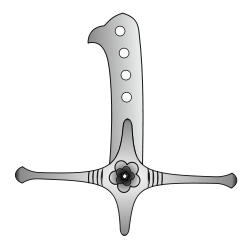 Perhaps one of the most famous types of a Polish sabre was the classical karabela, which entered service around 1670. Most likely the name was coined after the Turkish terms Kara (dark) and bela (curse). The type of the sabre was modelled after the swords of the Turkish footmen formations of Janissaries and Spahis, which used it in close quarters. Much lighter than the hussar szabla, the karabela had an open hilt with the pommel modelled after eagle's head. Such an anatomic grip allowed for easier handling of circular cuts while fighting on foot and for swinging cuts from horseback.
Initially the karabela sabres were used mostly for decoration or as a ceremonial weapon worn on special occasions. Popularized during the reign of King Jan III Sobieski, the sabre became one of the most popular Polish cold steel weapons. Though in theory the type could be subdivided into an ornamented ceremonial type and a simple battle weapon, in reality both were more expensive, and the cheaper designs were often used in combat. Most of the szlachta could afford only one expensive karabela and, in case of a dire need, simply replaced the ebony or ivory scabbard
with a leather version and removed some of the precious stones from the hilt in order to convert it into a reliable weapon.
Sabre
The sabre or saber is a kind of backsword that usually has a curved, single-edged blade and a rather large hand guard, covering the knuckles of the hand as well as the thumb and forefinger...
. It specifically refers to an Eastern Europe
Eastern Europe
Eastern Europe is the eastern part of Europe. The term has widely disparate geopolitical, geographical, cultural and socioeconomic readings, which makes it highly context-dependent and even volatile, and there are "almost as many definitions of Eastern Europe as there are scholars of the region"...
an one-edged sabre-like mêlée weapon
Mêlée weapon
A melee weapon is any weapon that does not involve a projectile — that is, both the user and target of the weapon are in contact with it simultaneously in normal use...
with a curved blade
Blade
A blade is that portion of a tool, weapon, or machine with a cutting edge and/or a pointed tip that is designed to cut and/or puncture, stab, slash, chop, slice, thrust, or scrape animate or inanimate surfaces or materials...
and, in most cases, a two-bladed tip called a feather (pióro). Initially used by light cavalry, with time it also evolved into a variety of arms used both for martial and ceremonial purposes. Until the 19th century, it also served as one of the symbols of the nobility (szlachta
Szlachta
The szlachta was a legally privileged noble class with origins in the Kingdom of Poland. It gained considerable institutional privileges during the 1333-1370 reign of Casimir the Great. In 1413, following a series of tentative personal unions between the Grand Duchy of Lithuania and the Kingdom of...
) in the Polish-Lithuanian Commonwealth
Polish-Lithuanian Commonwealth
The Polish–Lithuanian Commonwealth was a dualistic state of Poland and Lithuania ruled by a common monarch. It was the largest and one of the most populous countries of 16th- and 17th‑century Europe with some and a multi-ethnic population of 11 million at its peak in the early 17th century...
, who considered it to be one of the most important pieces of men's traditional attire.
Etymology
The Polish word szabla "sword, saber", may derive from the HungarianHungarian language
Hungarian is a Uralic language, part of the Ugric group. With some 14 million speakers, it is one of the most widely spoken non-Indo-European languages in Europe....
word szablya "saber", literally "tool to cut with", from szabni "to cut."
History
Various types of sabre-like arms were first brought to Eastern Europe by the nomads as early as the 6th century. However, it was not until the 14th and 15th centuries that a curved sword was adopted in European warfare. Initially the sabres used in HungaryHungary
Hungary , officially the Republic of Hungary , is a landlocked country in Central Europe. It is situated in the Carpathian Basin and is bordered by Slovakia to the north, Ukraine and Romania to the east, Serbia and Croatia to the south, Slovenia to the southwest and Austria to the west. The...
and Kievan Rus were but local copies of their eastern predecessors used by the Turkic and Arabic peoples: the kilij
Kilij
A kilij is a type of saber used by the Turks throughout history starting from late Hsiung-nu period to Avar Empire and Göktürk Khaganate, Uyghur Khaganate, Seljuk Empire, Timurid Empire, Mamluk Empire, Ottoman Empire, and later Turkic Khanates of Central Asia...
, pulwar
Pulwar
A pulwar is a single handed curved sword from Afghanistan and neighbouring regions of Pakistan and Northwestern India.-Characteristics:...
, talwar
Talwar
The talwar is a type of curved sword or sabre from India and modern-day Pakistan...
, saif, shamshir
Shamshir
A Shamshir also Shamsheer and Chimchir, is a type of sabre with a curve that is considered radical for a sword: 5 to 15 degrees from tip to tip. The name is derived from Persian شمشیر shamshīr, which means "sword"...
or scimitar
Scimitar
A scimitar is a backsword or sabre with a curved blade, originating in Southwest Asia .The Arabic term saif translates to "sword" in general, but is normally taken to refer to the scimitar type of curved backsword in particular.The curved sword or "scimitar" was widespread throughout the Muslim...
. It is often assumed that all of these were in turn descendants of the ubiquitous parent sword, the Turko-Mongol saber
Dao (sword)
Daois a category of single-edge Chinese swords primarily used for slashing and chopping , often called a broadsword in English translation because some varieties have wide blades. In China, the dao is known as one of the four major weapons, along with the gun , qiang , and the jian , and referred...
used by the nomadic tribes of Asia and then brought to the Middle East
Middle East
The Middle East is a region that encompasses Western Asia and Northern Africa. It is often used as a synonym for Near East, in opposition to Far East...
during their migration out of Central Asia
Central Asia
Central Asia is a core region of the Asian continent from the Caspian Sea in the west, China in the east, Afghanistan in the south, and Russia in the north...
.
Although by early 16th century such weapons were used both in the Polish-Lithuanian Commonwealth
Polish-Lithuanian Commonwealth
The Polish–Lithuanian Commonwealth was a dualistic state of Poland and Lithuania ruled by a common monarch. It was the largest and one of the most populous countries of 16th- and 17th‑century Europe with some and a multi-ethnic population of 11 million at its peak in the early 17th century...
and Hungary, in most cases these were but examples of captured weapons issued to peasants and serfs in case of a dire need. As such, they were considered plebeian weapons unworthy of the nobility. The higher classes and the knights at that time still preferred straight-bladed sword
Sword
A sword is a bladed weapon used primarily for cutting or thrusting. The precise definition of the term varies with the historical epoch or the geographical region under consideration...
s, much like their western European counterparts. However, with time the advent of firearms and artillery, as well as constant pressure from the Ottoman Empire
Ottoman Empire
The Ottoman EmpireIt was usually referred to as the "Ottoman Empire", the "Turkish Empire", the "Ottoman Caliphate" or more commonly "Turkey" by its contemporaries...
and the Tatars, who used light cavalry
Light cavalry
Light cavalry refers to lightly armed and lightly armored troops mounted on horses, as opposed to heavy cavalry, where the riders are heavily armored...
in large numbers, prompted a movement away from the old paradigm of heavily-armored medieval men-at-arms—a movement that also manifested itself in a changing preference for sword blade types.. It was in the 15th century that curved swords were adopted in Polish–Lithuanian Commonwealth and Hungary, both countries being having had the most extensive contacts (largely hostile) with the Mongols, Turks and Tatars.
The following century, after the election of Transylvanian-Hungarian noble Stefan Batory
Stefan Batory
Stephen Báthory was a Hungarian noble Prince of Transylvania , then King of Poland and Grand Duke of Lithuania . He was a member of the Somlyó branch of the noble Hungarian Báthory family...
as king of Poland, the entire Polish army was reformed to suit the new needs. The series of Polish-Lithuanian Union
Polish-Lithuanian Union
The term Polish–Lithuanian Union sometimes called as United Kingdom of Poland and Lithuania refers to a series of acts and alliances between the Kingdom of Poland and the Grand Duchy of Lithuania that lasted for prolonged periods of time and led to the creation of the Polish–Lithuanian...
, as well as extensive contacts with Hungary and Transylvania, made the sabre one of the basic arms used by the nobility, formerly using the swords. With time the sabre evolved in the Polish-Lithuanian Commonwealth
Polish-Lithuanian Commonwealth
The Polish–Lithuanian Commonwealth was a dualistic state of Poland and Lithuania ruled by a common monarch. It was the largest and one of the most populous countries of 16th- and 17th‑century Europe with some and a multi-ethnic population of 11 million at its peak in the early 17th century...
and gave birth to a variety of sabre-like weapons, fit for various tasks. In the following centuries, the ideas of Sarmatism
Sarmatism
"Sarmatism" is a term designating the dominant lifestyle, culture and ideology of the szlachta of the Polish-Lithuanian Commonwealth from the 16th to the 19th centuries. Together with "Golden Liberty," it formed a central aspect of the Commonwealth's culture...
as well as the Polish fascination with Eastern attire, customs, cuisine and warfare resulted in the szabla becoming an indispensable part of attire of the szlachta, as well as one of the symbols of nobility—and its alleged ancient roots.
Construction
As has been said, the main feature of a szabla is a curved one-edged blade, often with a yelmen (called feather in Poland).As in most swords, Polish sabres were composed of a variety of parts, each bearing a different name (Polish terms in parentheses):
The forte and foible could be visually separated by two claws on the non-sharp side of the blade, the threshold (próg) and the martle (młotek). Both sides of the blade could be shaped in a variety of ways and were often decorated with ornaments or inscriptions. Other signs featured on the flats include producer's marks and coats of arms. Elements:
|
The greatest diversity is found in various types of the hilt, which define the purpose of the sabre. The Polish sabres could usually be divided onto:
- open hilt - a classical sabre with cross-guards
- half-open hilt - with a knuckle-guard bent vertically and not joined to the pommel
- closed hilt - with one or more knuckle-guards forming a guard around bearer's palm
Types
Hungarian-Polish szabla
The first type of szabla, the Hungarian-Polish (węgiersko-polska), was popularized among the szlachta during the reign of the Transylvanian-Hungarian King of Poland Stefan BatoryStefan Batory
Stephen Báthory was a Hungarian noble Prince of Transylvania , then King of Poland and Grand Duke of Lithuania . He was a member of the Somlyó branch of the noble Hungarian Báthory family...
in the late 16th century. It featured a large, open hilt with a cross-shaped cross-guard and a heavy blade, either uncurved at all or curved only slightly. To protect the hand, at times a chain was attached to the cross-guard and the pommel. Since a number of such weapons were made by order of the king himself during his reform of the army and were engraved with his portrait, this kind of sabre is also referred to as batorówka - after Batory's name.
Armenian-style szabla
In late 17th century the first notable modification of the sabre appeared. Unlike the early "Hungarian-Polish" type, it featured a protected hilt and resembled the curved sabres of the East. It was hence called the ArmeniaArmenia
Armenia , officially the Republic of Armenia , is a landlocked mountainous country in the Caucasus region of Eurasia...
n sabre, possibly after Armenian merchants and master swordsmiths who formed a large part of arms makers of the Commonwealth at those times. In fact the Armenian sabre developed into three almost completely distinct types of swords, each used for a different purpose. Their popularity and efficiency made the Polish nobles abandon the broadsword
Broadsword
Broadsword may refer to:*Broadsword , a military sword used by heavy cavalry during the 17th to early 19th centuriesIn more modern times, it has also been used to refer to:...
s used in Western Europe.
- Czeczuga was a curved sabre with a small cross-guard with an ornamented open hilt and a hood offering partial protection to the hand.
- Ordynka was a heavier weapon used by the cavalry. It resembled a mixture of all the features of the Czeczuga with a heavier and more durable hilt and blade of the short sword.
- Armenian karabelaKarabelaA karabela was a type of Polish sabre . Perhaps one of the most famous types of that type of weapons, it became highly popular in the Polish-Lithuanian Commonwealth in the 1670s...
was the first example of a ceremonial sword used by the szlachta. It had both its blade and cross-guard curved, and had a short grip. It was engraved and decorated with precious stones and ivory. Used throughout the ages, in 18th century it evolved into a standard karabela, used both as a part of attire and in combat (see below).
Hussar szabla
The hussarHussar
Hussar refers to a number of types of light cavalry which originated in Hungary in the 14th century, tracing its roots from Serbian medieval cavalry tradition, brought to Hungary in the course of the Serb migrations, which began in the late 14th century....
sabre was perhaps the best-known type of szabla of its times and became a precursor to many other such European weapons. Introduced around 1630, it served as a Polish cavalry
Polish cavalry
The Polish cavalry can trace its origins back to the days of Medieval mounted knights. Poland had always been a country of flatlands and fields and mounted forces operate well in this environment...
mêlée weapon, mostly used by heavy cavalry, or Polish Hussars
Polish Hussars
The Polish Hussars were the main type of cavalry of the first Polish Army, later also introduced into the Army of the Grand Duchy of Lithuania, between the 16th and 18th centuries...
. Much less curved than its Armenian predecessors, it was ideal for horseback fighting and allowed for much faster and stronger strikes. The heavier, almost fully closed hilt offered both good protection of the hand and much better control over the sabre during a skirmish. Two feather-shaped pieces of metal on both sides of the blade called moustache (wąsy) offered greater durability of the weapon by strengthening its weakest point: the joint between the blade and the hilt. The soldier fighting with such sabre could use it with his thumb extended along the back-strap of the grip for even greater control when 'fencing' either on foot or with other experienced horsemen, or by using the thumb-ring, a small ring of steel or brass at the junction of the grip and the cross-guard through which the thumb is placed, could give forceful downward swinging cuts from the shoulder and elbow with a 'locked' wrist against infantry and less experienced horsemen. This thumb ring also facilitated faster 'recovery' of the weapon for the next cut. A typical hussar szabla was relatively long, with the average blade of 85 centimetres in total. The tip of the blade, usually some 15 to 18 centimetres long, was in most cases double-edged. Such sabres were extremely durable yet stable, and were used in combat well into 19th century.
The Polish and Hungarian szabla's design influenced a number of other designs in other parts of Europe and led to the introduction of the sabre in Western Europe. An example that bears a considerable resemblance is the famous British 1796 pattern Light Cavalry Sabre which was designed by Captain John Gaspard le Marchant after his visits "East" to Central and Eastern Europe and research into these and other nations' cavalry tactics
Cavalry tactics
For much of history , humans have used some form of cavalry for war. Cavalry tactics have evolved over time...
and weapons. Poland had ceased to exist as a separate nation by this time but their other co-nation from previous centuries, Hungary, was still an existing nation, and as this was the source of all things "Hussar", it was the Polish-Hungarian szable of 150 years earlier rather than the oft quoted Indian tulwar that were the main source of inspiration for the first "mainly cutting" sabre in the British Army. This same "1796" sabre was taken up by the King's Hanoverian troops and also by the Prussians under General Gebhard Leberecht von Blücher
Gebhard Leberecht von Blücher
Gebhard Leberecht von Blücher, Fürst von Wahlstatt , Graf , later elevated to Fürst von Wahlstatt, was a Prussian Generalfeldmarschall who led his army against Napoleon I at the Battle of the Nations at Leipzig in 1813 and at the Battle of Waterloo in 1815 with the Duke of Wellington.He is...
who attempted to give his name to the weapon, almost universally known as "the 1796 Light Cavalry Sabre" in the rest of Europe. This weapon also found its way into the cavalry of the newly formed United States of America in the war of 1812.
Polish Hussar szabla is believed to be one of the finest cold weapons ever made.
Karabela
Initially the karabela sabres were used mostly for decoration or as a ceremonial weapon worn on special occasions. Popularized during the reign of King Jan III Sobieski, the sabre became one of the most popular Polish cold steel weapons. Though in theory the type could be subdivided into an ornamented ceremonial type and a simple battle weapon, in reality both were more expensive, and the cheaper designs were often used in combat. Most of the szlachta could afford only one expensive karabela and, in case of a dire need, simply replaced the ebony or ivory scabbard
Scabbard
A scabbard is a sheath for holding a sword, knife, or other large blade. Scabbards have been made of many materials over the millennia, including leather, wood, and metals such as brass or steel.-Types of scabbards:...
with a leather version and removed some of the precious stones from the hilt in order to convert it into a reliable weapon.
Other types
- Kosciuszkowska, a variant popularized during the Kościuszko UprisingKosciuszko UprisingThe Kościuszko Uprising was an uprising against Imperial Russia and the Kingdom of Prussia led by Tadeusz Kościuszko in Poland, Belarus and Lithuania in 1794...
; - Szabla wz.34 ("model 34 szabla"), a 20th-century variant produced from 1934 in the Second Polish RepublicSecond Polish RepublicThe Second Polish Republic, Second Commonwealth of Poland or interwar Poland refers to Poland between the two world wars; a period in Polish history in which Poland was restored as an independent state. Officially known as the Republic of Poland or the Commonwealth of Poland , the Polish state was...
for Polish cavalry; just about 10,000 were made.