


Theognis of Megara

Encyclopedia
Theognis of Megara was an ancient Greek
poet active sometime in the sixth century BC. The work attributed to him consists of gnomic poetry
quite typical of the time, featuring ethical maxims and practical advice about life. He was the first Greek poet known to express concern over the eventual fate and survival of his own work and, along with Homer
, Hesiod
and the authors of the Homeric Hymns
, he is among the earliest poets whose work has been preserved in a continuous manuscript tradition (the work of other archaic poets is preserved as scattered fragments). In fact more than half of the extant elegiac
poetry of Greece before the Alexandrian period is included in the approximately 1,400 verses attributed to him. Some of these verses inspired ancient commentators to value him as a moralist yet the entire corpus is valued today for its "warts and all" portrayal of aristocratic life in archaic Greece.
The verses preserved under Theognis' name are written from the viewpoint of an aristocrat confronted by social and political revolution typical of Greek cities in the archaic period. Part of his work is addressed to Cyrnus, who is presented as his erōmenos. The author of the poems celebrated him in his verse and educated him in the aristocratic values of the time, yet Cyrnus came to symbolize much about his imperfect world that the poet bitterly resented:
Here paraphrased to retain the form of the Elegiac couplet
:
In spite of such self-disclosures, almost nothing is known about Theognis the man: little is recorded by ancient sources and modern scholars question the authorship of most of the poems preserved under his name.
in the second quarter of the sixth century, and lines 773-82 seem to refer to the Persian invasion of mainland Greece in the reign of Xerxes
, at the end of the first quarter of the fifth century. Ancient sources record dates in the mid-sixth centuryEusebius dates Theognis in the 58th Olympiad
(548-45 BC), Suda
the 59th Olympiad (544-41 BC) and Chronicon Paschale
the 57th Olympiad (552-49 BC)yet it is not clear for example whether Suda in this case means a date of birth or some other significant event in the poet's life and, moreover, all three sources could have derived their dates from lines 773-82 under the assumption that these refer to Harpagus's attack on Ionia
in the reign of Cyrus The Great
. Even some modern scholars have interpreted those lines in that time-frame, deducing a birth date on or just before 600 BC, while others place his birth around 550 BC to fit in with the Persian invasion under either Darius
or Xerxes. There is confusion also about his place of birth, "Megara", which Plato
for example understood to be Megara Hyblaea
in Sicily, while a scholiast on Plato cites Didymus
for the rival theory that the poet was born in a Megara in Attica
, and ventures the opinion that Theognis might have later migrated to the Sicilian Megara (a similar theory had assigned an Attic birthplace to the Spartan poet Tyrtaeus
). Modern scholars in general opt for a birth place in mainland Greek Megara
though a suitable context for the poems could be found just about anywhere in archaic Greece and there are options for mix-and-match, such as a birth in mainland Megara and then migration to Sicilian Megara (lines 1197-1201 mention dispossession/exile and lines 783-88 journeys to Sicily, Euboea and Sparta).
The elegiac verses attributed to Theognis present him as a complex character and an exponent of traditional Greek morality. Thus for example Isocrates
includes him among "the best advisers for human life", even able to be ignored as a wowser,"...although all consider words of advice both in poetry and in prose to be most useful, they certainly do not derive the greatest pleasure from listening to them, but their attitude towards them is the same as their attitude towards those who admonish: for although they praise the latter, they prefer to associate with those who share in their follies and not with those who seek to dissuade them. As proof once could cite the poetry of Hesiod
, Theognis and Phocylides
; for people say that they have been the best advisers for human life, but while saying this they prefer to occupy themselves with one another's follies than with the precepts of those poets."Isocrates, To Nicocles 42-4, cited and translated by Douglas E. Gerber, Greek Elegiac Poetry, Loeb Classical Library (1999), page 171-3 yet Plato's Socrates cites some Theognidean verses to dismiss the poet as a confused and self-contradictory sophist whose teachings are not to be trusted, while a modern scholar excuses self-contradictions as typical of a life-long poet writing over many years and at the whim of inspiration. The Theognidea might in fact be a collection of elegiac poems by different authors (see Modern scholarship below) and the 'life' that emerges from them depends on which poems editors consider authentic. Two modern authorities have drawn these portraits of Theognis, based on their own selections of his work:
, for example, mentions 2 800 lines of elegiacs, twice the number preserved in medieval manuscripts. Different scholars have different theories about the transmission of the text to account for the discrepancy yet it is generally agreed that the present collection actually contains too many verses under the name of Theognis: the collection appears in fact to be an anthology that includes verses by him. The collection is preserved in more than forty manuscripts, comprising a continuous series of elegiac couplets that modern editors now separate into some 300 to 400 'poems', according to personal preferences. The best of these manuscripts, dated to the early 10th century, includes an end section titled Book 2 (sometimes referred to as Musa Paedica), which features some hundred additional couplets and which "harps on the same theme throughoutboy love." The quality of the verse in the end section is radically diverse, ranging from "exquisite and simple beauty" to "the worst specimens of the bungler's art", and many scholars have rejected it as a spurious addition, including the philosopher Friedrich Nietzsche (see Nietzsche and Theognis below). The rest of the work also raises issues about authenticity, since some couplets look like lines attributed by ancient sources to other poets (Solon
, Euenus
, Mimnermus
and Tyrtaeus).Solon (lines 315-18, 585-90), Euenus (lines 467-96, 667-82, 1341-50), Mimnermus (lines 795-56, 1020-22) and Tyrtaeus (lines 1003-6), and other couplets are repeated with few or no changes elsewhere in the text.Repeated lines: 87-90≈1082cf, 116≈644, 39-42≈1081-82b, 209-10≈332ab, 509-10≈211-12, 853-54≈1038ab, 877-78≈1070ab, 415-18≈1164eh, and including Book Two 1151-52≈1238ab. Ironically, Theognis mentions to his friend Cyrnus precautions that he has taken to ensure the fidelity of his legacy:
The nature of this seal and its effectiveness in preserving his work is much disputed by scholars (see Modern scholarship below).
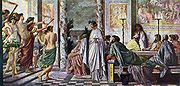
drinking parties that had symbolic and practical significance for the participants:
Sympotic topics covered by Theognis include for example wine,Example of a wine-theme: "Two demons of drink beset wretched mortals, enfeebling thirst and harsh drunkeness. I'll steer a middle course between them and you won't persuade me either not to drink or to drink too much."lines 837-40, translated by Douglas Gerber, Loeb, page 295 politics,Example of political theme:"Cyrnus, this city is pregnant and I am afraid she will give birth to a man who will set right our wicked insolence. The townsmen are still of sound mind but their leaders have changed and fallen into the depths of depravity."lines 39-42, translated by Douglas Gerber, Loeb, page 181 friendship,Example of friendship theme: "Many in truth are your comrades when there's food and drink, but not so many when the enterprise is serious."lines 115-16, translated by Douglas Gerber, Loeb page 189 war,Example of war theme: "This is excellence, this the best human prize and the fairest for a man to win. This is a common benefit for the state and all the people, whenever a man with firm stance holds his ground among the front ranks."lines 1003-6 (also attributed to Tyrtaeus
), translated by Douglas Gerber, Loeb page 319 life's brevity,Example of carpe diem
theme: "Enjoy your youth, my dear heart: soon it will be the turn of other men, and I'll be dead and become dark earth."lines 877-78, translated by Douglas Gerber, Loeb, page 301 human nature,Example of human nature theme: "It is easer to beget and rear a man than to put good sense in him. No one has yet devised a means whereby one has made the fool wise and a noble man out of one who is base."lines 429-31, translated by Douglas Gerber, Loeb page 237 wealth,Example of Wealth theme: "O wretched poverty, why do you delay to leave me and go to another man? Don't be attached to me against my will, but go, visit another house, and don't always share this miserable life with me.lines 351-54, translated by Douglas Gerber, Loeb page 225 loveExample of a love theme: "Don't show affection for me in your words but keep your mind and heart elsewhere, if you love me and the mind within you is loyal. Either love me sincerely or renounce me, hate me and quarrel openly,"lines 87-90, translated by Douglas Gerber, Loeb page 187 and so on. Distinctions are frequently made between 'good' and 'bad' , a dichotomy based on a class distinction between aristocrats and 'others', typical of the period but usually implicit in the works of earlier poets such as Homer"In Theognis it amounts to an obsession". The verses are addressed to Cyrnus and other individuals of unknown identity, such as Scythes, Simonides, Clearistus, Onomacritus, Democles, Academus, Timagoras, Demonax and Argyris and 'Boy'. Poems are also addressed to his own heart or spirit, and deities such as Zeus
, Apollo
, Artemis
, Castor
and Pollux
, Eros
, Ploutos, the Muses and Graces
.
style. An 'elegy' in English is associated with lamentation. In ancient Greece it was a much more flexible medium, suitable for performance at drinking parties and public festivals, urging courage in war and surrender in love. It gave the hexameter
line of epic verse a lyrical impulse by the addition of a shorter 'pentameter' line, in a series of couplets accompanied by the music of the aulos
or pipe. Theognis was conservative and unadventurous in his use of language, frequently imitating the epic phrasing of Homer
, even using his Ionian dialect rather than the Dorian spoken in Megara, and possibly borrowing inspiration and entire lines from other elegiac poets, such as Tyrtaeus, Mimnermus and Solon. His verses are not always melodious or carefully constructed but he often places key words for good effect and he employs linguistic devices such as asyndeton
, familiar in common speech. He was capable of arresting imagery and memorable statements in the form of terse epigrams. Some of these qualities are evident in the following lines, considered to be "the classic formulation of Greek pessimism":
The lines were much quoted in antiquity, as for example by Stobaeus
and Sextus Empiricus
, and it was imitated by later poets, such as Sophocles
and Bacchylides
.Stobaeus 4.52, Sextus Empiricus Pyrrh. hypot. 3.231, Sophocles O.C 1225 and Bacchylides 5.160-2cited by David Campbell, Greek Lyric Poetry page 366 Theognis himself might be imitating others: each of the longer hexameter lines is loosely paraphrased in the shorter pentameter lines, as if he borrowed the longer lines from some unknown source(s) and added the shorter lines to create an elegiac version. Moreover the last line could be imitating an image from Homer's Odyssey
(5.482), where Odysseus covers himself with leaves though some scholars think the key word might be corrupted
Odyssey 5.476-83 The smothering accumulation of eta sounds in the last line of the Greek is imitated here in the English by mound round.
, sometime known as 'the father of Theognidean criticism', was the first modern scholar to edit the collection with a view to separating authentic verses from spurious additions (1826), Ernest Harrison (Studies in Theognis 1902) subsequently defended the authenticity of the collection, and thus the scholarly world divided into two camps, which one recent scholar half-jokingly referred to as 'separatists' and 'unitarians' There have also been divisions within the camps. Separatists have agreed with Theodor Bergk
(1843) that the collection was originally assembled as the work of Theognis, into which a large admixture of foreign matter has somehow found its way, or they have believed it was compiled originally as a textbook for use in schools or else as a set of aristocratic drinking
songs, in which some verses of Theognis happen to be strongly represented. Quite recently Martin Litchfield West identified 306 lines as a core sequence of verses that can be reliably attributed to Theognis since they contain mention of Cyrnus and are attested by 4th century authorities such as Plato and Aristotle, though the rest of the corpus could still contain some authentic verses. West however acknowledges that the whole collection is valuable since it represents a cross-section of elegiac poetry composed in the sixth and early fifth centuries. According to another view, the quest for authentically Theognidean elegies is rather beside the pointthe collection owes its survival to the political motivations of Athenian intellectuals in the 5th and 4th century, disappointed with democracy and sympathetic to old aristocratic values: "The persona of the poet is traditionally based, ideologically conditioned and generically expressed." According to this view, the verses were drinking songs in so far as the symposium was understood to be a microcosm of society, where multiple views were an aspect of adaptive behaviour by the embattled aristocracy, and where even eroticism had political symbolism: "As the polis envisaged by Theognis is degenerate, erotic relationships are filled with pain..."
In lines 19-22, the poet announces his intention of placing a 'seal' on the verses to protect them from theft and corruption. The lines are among the most controversial in Theognidean scholarship and there is a large body of literature dedicated to their explanation. The 'seal' has been theorized to be the name of Theognis or of Cyrnus or, more generally, the distinct poetic style or else the political or ethical content of the 'poems', or even a literal seal on a copy entrusted to some temple, just as Heraclitus of Ephesus was said once to have sealed and stored a copy of his work at the Artemisium
.
studied the work of Theognis during his university days at Leipzig. His first published article (in an influential classical journal, Rheinisches Museum) concerned the historical transmission of the collected verses. Nietzsche was an ardent exponent of 'catchword theory', which explains the arrangement of the Theognidean verses as pairs of poems, each pair linked by a shared word or catchword that could be placed anywhere in either poem, as for example in these pairs:
However a later scholar has observed that the catchword principle can be made to work for just about any anthology as a matter of coincidence due to thematic association.
Nietsche valued Theognis as an archetype of the embattled aristocrat, describing him as "...a finely formed nobleman who has fallen on bad times", and "a distorted Janus
-head" at the crossroads of social change."Theognis appears as a finely formed nobleman who has fallen on bad times...full of fatal hatred toward the upward striving masses, tossed about by a sad fate that wore him down and made him milder in many respects. He is a characteristic image of that old, ingenious somewhat spoiled and no longer firmly rooted blood nobility, placed at the boundary of an old and a new era, a distorted Janus
-head, since what is past seems so beautiful and enviable, that which is comingsomething that basically has an equal entitlementseems disgusting and repulsive; a typical head for all those noble figures who represent the aristocracy prior to a popular revolution and who struggle for the existence of the class of nobles as for their individual existence."from a biography of Nietzsche by Curt Paul Zanz, quoted and translated by Maudemarie Clark and Alan Swensen in their edition, On the Genealogy of Morality: a polemic, Hackett Publishing Company (1998), page 133 Not all the verses in the collection however fitted Nietzsche's notion of Theognis, the man, and he rejected Musa Paedica or Book 2 as the interpolation of a malicious editor out to discredit him. In one of his seminal works, On the Genealogy of Morals, he describes the poet as a 'mouthpiece' of the Greek nobility: Theognis represents superior virtues as traits of the aristocracy and thus distinguishes (in Nietzsche's own words) the "truthful" aristocrat from the "lying common man". Nietzsche in the same passage (Part I, section 5) makes some of his most controversial pronouncements, wondering for instance if "...the conqueror and master race, the Aryan, is not succumbing physiologically," to a "dark, black-haired aboriginal" race of pre-Aryans It is a matter of scholarly debate whether or not Nietzsche intended such statements to be understood literally or figuratively and similarly there may be doubts about whether or not Theognis advocated eugenics
or social selection when making such statements as this:
Charles Darwin represented a widespread preference for a biological interpretation of such statements when he commented on the above lines thus: "The Grecian poet, Theognis...saw how important selection, if carefully applied, would be for the improvement of mankind. He saw likewise that wealth often checks the proper action of sexual selection."Charles Darwin
Ancient Greece
Ancient Greece is a civilization belonging to a period of Greek history that lasted from the Archaic period of the 8th to 6th centuries BC to the end of antiquity. Immediately following this period was the beginning of the Early Middle Ages and the Byzantine era. Included in Ancient Greece is the...
poet active sometime in the sixth century BC. The work attributed to him consists of gnomic poetry
Gnomic poetry
Gnomic poetry consists of sententious maxims put into verse to aid the memory. They were known by the Greeks as gnomes, from the Greek word for "an opinion".A gnome was defined by the Elizabethan critic Henry Peacham as...
quite typical of the time, featuring ethical maxims and practical advice about life. He was the first Greek poet known to express concern over the eventual fate and survival of his own work and, along with Homer
Homer
In the Western classical tradition Homer , is the author of the Iliad and the Odyssey, and is revered as the greatest ancient Greek epic poet. These epics lie at the beginning of the Western canon of literature, and have had an enormous influence on the history of literature.When he lived is...
, Hesiod
Hesiod
Hesiod was a Greek oral poet generally thought by scholars to have been active between 750 and 650 BC, around the same time as Homer. His is the first European poetry in which the poet regards himself as a topic, an individual with a distinctive role to play. Ancient authors credited him and...
and the authors of the Homeric Hymns
Homeric Hymns
The Homeric Hymns are a collection of thirty-three anonymous Ancient Greek hymns celebrating individual gods. The hymns are "Homeric" in the sense that they employ the same epic meter—dactylic hexameter—as the Iliad and Odyssey, use many similar formulas and are couched in the same dialect...
, he is among the earliest poets whose work has been preserved in a continuous manuscript tradition (the work of other archaic poets is preserved as scattered fragments). In fact more than half of the extant elegiac
Elegiac
Elegiac refers either to those compositions that are like elegies or to a specific poetic meter used in Classical elegies. The Classical elegiac meter has two lines, making it a couplet: a line of dactylic hexameter, followed by a line of dactylic pentameter...
poetry of Greece before the Alexandrian period is included in the approximately 1,400 verses attributed to him. Some of these verses inspired ancient commentators to value him as a moralist yet the entire corpus is valued today for its "warts and all" portrayal of aristocratic life in archaic Greece.
The verses preserved under Theognis' name are written from the viewpoint of an aristocrat confronted by social and political revolution typical of Greek cities in the archaic period. Part of his work is addressed to Cyrnus, who is presented as his erōmenos. The author of the poems celebrated him in his verse and educated him in the aristocratic values of the time, yet Cyrnus came to symbolize much about his imperfect world that the poet bitterly resented:
Here paraphrased to retain the form of the Elegiac couplet
Elegiac couplet
The elegiac couplet is a poetic form used by Greek lyric poets for a variety of themes usually of smaller scale than the epic. Roman poets, particularly Ovid, adopted the same form in Latin many years later...
:
-
- To all to whom there is pleasure in song and to people yet unborn
- You also will be a song, while the earth and sun remain,
- Yet I am treated by you without even the least mark of respect
- And, as if I were a child, you have deceived me with words.
- To all to whom there is pleasure in song and to people yet unborn
In spite of such self-disclosures, almost nothing is known about Theognis the man: little is recorded by ancient sources and modern scholars question the authorship of most of the poems preserved under his name.
Life
Ancient commentators, the poems themselves and even modern scholars offer us mixed signals about the poet's life. Some of the poems respond in a personal and immediate way to events widely dispersed in time. Lines 29-52 seem to portray the political situation in Megara before the rise of the tyrant Theagenes, about the latter half of the seventh century, but lines 891-95 describe a war in EuboeaEuboea
Euboea is the second largest Greek island in area and population, after Crete. The narrow Euripus Strait separates it from Boeotia in mainland Greece. In general outline it is a long and narrow, seahorse-shaped island; it is about long, and varies in breadth from to...
in the second quarter of the sixth century, and lines 773-82 seem to refer to the Persian invasion of mainland Greece in the reign of Xerxes
Xerxes I of Persia
Xerxes I of Persia , Ḫšayāršā, ), also known as Xerxes the Great, was the fifth king of kings of the Achaemenid Empire.-Youth and rise to power:...
, at the end of the first quarter of the fifth century. Ancient sources record dates in the mid-sixth centuryEusebius dates Theognis in the 58th Olympiad
Olympiad
An Olympiad is a period of four years, associated with the Olympic Games of Classical Greece. In the Hellenistic period, beginning with Ephorus, Olympiads were used as calendar epoch....
(548-45 BC), Suda
Suda
The Suda or Souda is a massive 10th century Byzantine encyclopedia of the ancient Mediterranean world, formerly attributed to an author called Suidas. It is an encyclopedic lexicon, written in Greek, with 30,000 entries, many drawing from ancient sources that have since been lost, and often...
the 59th Olympiad (544-41 BC) and Chronicon Paschale
Chronicon Paschale
Chronicon Paschale is the conventional name of a 7th-century Greek Christian chronicle of the world...
the 57th Olympiad (552-49 BC)yet it is not clear for example whether Suda in this case means a date of birth or some other significant event in the poet's life and, moreover, all three sources could have derived their dates from lines 773-82 under the assumption that these refer to Harpagus's attack on Ionia
Ionia
Ionia is an ancient region of central coastal Anatolia in present-day Turkey, the region nearest İzmir, which was historically Smyrna. It consisted of the northernmost territories of the Ionian League of Greek settlements...
in the reign of Cyrus The Great
Cyrus the Great
Cyrus II of Persia , commonly known as Cyrus the Great, also known as Cyrus the Elder, was the founder of the Achaemenid Empire. Under his rule, the empire embraced all the previous civilized states of the ancient Near East, expanded vastly and eventually conquered most of Southwest Asia and much...
. Even some modern scholars have interpreted those lines in that time-frame, deducing a birth date on or just before 600 BC, while others place his birth around 550 BC to fit in with the Persian invasion under either Darius
Darius I of Persia
Darius I , also known as Darius the Great, was the third king of kings of the Achaemenid Empire...
or Xerxes. There is confusion also about his place of birth, "Megara", which Plato
Plato
Plato , was a Classical Greek philosopher, mathematician, student of Socrates, writer of philosophical dialogues, and founder of the Academy in Athens, the first institution of higher learning in the Western world. Along with his mentor, Socrates, and his student, Aristotle, Plato helped to lay the...
for example understood to be Megara Hyblaea
Megara Hyblaea
Megara Hyblaea – perhaps identical with Hybla Major – is the name of an ancient Greek colony in Sicily, situated near Augusta on the east coast, north-northwest of Syracuse, Italy, on the deep bay formed by the Xiphonian promontory...
in Sicily, while a scholiast on Plato cites Didymus
Didymus
Didymus may refer to:* Thomas the Apostle or "Didymus", both names meaning "twin" in Aramaic and Greek respectively, is the most well-known Didymus due to his role in early Christian history* Didymus Chalcenterus Didymus may refer to:* Thomas the Apostle or "Didymus", both names meaning "twin" in...
for the rival theory that the poet was born in a Megara in Attica
Attica
Attica is a historical region of Greece, containing Athens, the current capital of Greece. The historical region is centered on the Attic peninsula, which projects into the Aegean Sea...
, and ventures the opinion that Theognis might have later migrated to the Sicilian Megara (a similar theory had assigned an Attic birthplace to the Spartan poet Tyrtaeus
Tyrtaeus
Tyrtaeus was a Greek poet who composed verses in Sparta around the time of the Second Messenian War, the date of which isn't clearly establishedsometime in the latter part of the seventh century BC...
). Modern scholars in general opt for a birth place in mainland Greek Megara
Megara
Megara is an ancient city in Attica, Greece. It lies in the northern section of the Isthmus of Corinth opposite the island of Salamis, which belonged to Megara in archaic times, before being taken by Athens. Megara was one of the four districts of Attica, embodied in the four mythic sons of King...
though a suitable context for the poems could be found just about anywhere in archaic Greece and there are options for mix-and-match, such as a birth in mainland Megara and then migration to Sicilian Megara (lines 1197-1201 mention dispossession/exile and lines 783-88 journeys to Sicily, Euboea and Sparta).
The elegiac verses attributed to Theognis present him as a complex character and an exponent of traditional Greek morality. Thus for example Isocrates
Isocrates
Isocrates , an ancient Greek rhetorician, was one of the ten Attic orators. In his time, he was probably the most influential rhetorician in Greece and made many contributions to rhetoric and education through his teaching and written works....
includes him among "the best advisers for human life", even able to be ignored as a wowser,"...although all consider words of advice both in poetry and in prose to be most useful, they certainly do not derive the greatest pleasure from listening to them, but their attitude towards them is the same as their attitude towards those who admonish: for although they praise the latter, they prefer to associate with those who share in their follies and not with those who seek to dissuade them. As proof once could cite the poetry of Hesiod
Hesiod
Hesiod was a Greek oral poet generally thought by scholars to have been active between 750 and 650 BC, around the same time as Homer. His is the first European poetry in which the poet regards himself as a topic, an individual with a distinctive role to play. Ancient authors credited him and...
, Theognis and Phocylides
Phocylides
Phocylides , Greek gnomic poet of Miletus, contemporary of Theognis of Megara, was born about 560 BC.A few fragments of his "maxims" have survived , in which he expresses his contempt for the pomps and vanities of rank and wealth, and sets forth in simple language his ideas of honour, justice and...
; for people say that they have been the best advisers for human life, but while saying this they prefer to occupy themselves with one another's follies than with the precepts of those poets."Isocrates, To Nicocles 42-4, cited and translated by Douglas E. Gerber, Greek Elegiac Poetry, Loeb Classical Library (1999), page 171-3 yet Plato's Socrates cites some Theognidean verses to dismiss the poet as a confused and self-contradictory sophist whose teachings are not to be trusted, while a modern scholar excuses self-contradictions as typical of a life-long poet writing over many years and at the whim of inspiration. The Theognidea might in fact be a collection of elegiac poems by different authors (see Modern scholarship below) and the 'life' that emerges from them depends on which poems editors consider authentic. Two modern authorities have drawn these portraits of Theognis, based on their own selections of his work:
Transmission
It was probably his reputation as a moralist, significant enough to deserve comment by Aristotle and Plato, that guaranteed the survival of his work through the Byzantine period. However, it is clear that we don't possess his total output. The Byzantine SudaSuda
The Suda or Souda is a massive 10th century Byzantine encyclopedia of the ancient Mediterranean world, formerly attributed to an author called Suidas. It is an encyclopedic lexicon, written in Greek, with 30,000 entries, many drawing from ancient sources that have since been lost, and often...
, for example, mentions 2 800 lines of elegiacs, twice the number preserved in medieval manuscripts. Different scholars have different theories about the transmission of the text to account for the discrepancy yet it is generally agreed that the present collection actually contains too many verses under the name of Theognis: the collection appears in fact to be an anthology that includes verses by him. The collection is preserved in more than forty manuscripts, comprising a continuous series of elegiac couplets that modern editors now separate into some 300 to 400 'poems', according to personal preferences. The best of these manuscripts, dated to the early 10th century, includes an end section titled Book 2 (sometimes referred to as Musa Paedica), which features some hundred additional couplets and which "harps on the same theme throughoutboy love." The quality of the verse in the end section is radically diverse, ranging from "exquisite and simple beauty" to "the worst specimens of the bungler's art", and many scholars have rejected it as a spurious addition, including the philosopher Friedrich Nietzsche (see Nietzsche and Theognis below). The rest of the work also raises issues about authenticity, since some couplets look like lines attributed by ancient sources to other poets (Solon
Solon
Solon was an Athenian statesman, lawmaker, and poet. He is remembered particularly for his efforts to legislate against political, economic and moral decline in archaic Athens...
, Euenus
Euenus
Euenus of Paros, , was a 5th century BC philosopher and poet who was roughly contemporary with Socrates. Several fragments of his poetry exist in the Palatine Anthology and Euenus is mentioned several times in Plato's Phaedo, Phaedrus , and Apology of Socrates. He is quoted in the Nicomachean...
, Mimnermus
Mimnermus
Mimnermus was a Greek elegiac poet from either Colophon or Smyrna in Ionia, who flourished about 630-600 BC. He was strongly influenced by the example of Homer yet he wrote short poems suitable for performance at drinking parties and was remembered by ancient authorities chiefly as a love poet...
and Tyrtaeus).Solon (lines 315-18, 585-90), Euenus (lines 467-96, 667-82, 1341-50), Mimnermus (lines 795-56, 1020-22) and Tyrtaeus (lines 1003-6), and other couplets are repeated with few or no changes elsewhere in the text.Repeated lines: 87-90≈1082cf, 116≈644, 39-42≈1081-82b, 209-10≈332ab, 509-10≈211-12, 853-54≈1038ab, 877-78≈1070ab, 415-18≈1164eh, and including Book Two 1151-52≈1238ab. Ironically, Theognis mentions to his friend Cyrnus precautions that he has taken to ensure the fidelity of his legacy:
The nature of this seal and its effectiveness in preserving his work is much disputed by scholars (see Modern scholarship below).
Subject matter
All the poetry attributed to Theognis deals with subjects typically discussed at aristocratic symposiaSymposium
In ancient Greece, the symposium was a drinking party. Literary works that describe or take place at a symposium include two Socratic dialogues, Plato's Symposium and Xenophon's Symposium, as well as a number of Greek poems such as the elegies of Theognis of Megara...
drinking parties that had symbolic and practical significance for the participants:
Sympotic topics covered by Theognis include for example wine,Example of a wine-theme: "Two demons of drink beset wretched mortals, enfeebling thirst and harsh drunkeness. I'll steer a middle course between them and you won't persuade me either not to drink or to drink too much."lines 837-40, translated by Douglas Gerber, Loeb, page 295 politics,Example of political theme:"Cyrnus, this city is pregnant and I am afraid she will give birth to a man who will set right our wicked insolence. The townsmen are still of sound mind but their leaders have changed and fallen into the depths of depravity."lines 39-42, translated by Douglas Gerber, Loeb, page 181 friendship,Example of friendship theme: "Many in truth are your comrades when there's food and drink, but not so many when the enterprise is serious."lines 115-16, translated by Douglas Gerber, Loeb page 189 war,Example of war theme: "This is excellence, this the best human prize and the fairest for a man to win. This is a common benefit for the state and all the people, whenever a man with firm stance holds his ground among the front ranks."lines 1003-6 (also attributed to Tyrtaeus
Tyrtaeus
Tyrtaeus was a Greek poet who composed verses in Sparta around the time of the Second Messenian War, the date of which isn't clearly establishedsometime in the latter part of the seventh century BC...
), translated by Douglas Gerber, Loeb page 319 life's brevity,Example of carpe diem
Carpe diem
Carpe diem is a phrase from a Latin poem by Horace that has become an aphorism. It is popularly translated as "seize the day"...
theme: "Enjoy your youth, my dear heart: soon it will be the turn of other men, and I'll be dead and become dark earth."lines 877-78, translated by Douglas Gerber, Loeb, page 301 human nature,Example of human nature theme: "It is easer to beget and rear a man than to put good sense in him. No one has yet devised a means whereby one has made the fool wise and a noble man out of one who is base."lines 429-31, translated by Douglas Gerber, Loeb page 237 wealth,Example of Wealth theme: "O wretched poverty, why do you delay to leave me and go to another man? Don't be attached to me against my will, but go, visit another house, and don't always share this miserable life with me.lines 351-54, translated by Douglas Gerber, Loeb page 225 loveExample of a love theme: "Don't show affection for me in your words but keep your mind and heart elsewhere, if you love me and the mind within you is loyal. Either love me sincerely or renounce me, hate me and quarrel openly,"lines 87-90, translated by Douglas Gerber, Loeb page 187 and so on. Distinctions are frequently made between 'good' and 'bad' , a dichotomy based on a class distinction between aristocrats and 'others', typical of the period but usually implicit in the works of earlier poets such as Homer"In Theognis it amounts to an obsession". The verses are addressed to Cyrnus and other individuals of unknown identity, such as Scythes, Simonides, Clearistus, Onomacritus, Democles, Academus, Timagoras, Demonax and Argyris and 'Boy'. Poems are also addressed to his own heart or spirit, and deities such as Zeus
Zeus
In the ancient Greek religion, Zeus was the "Father of Gods and men" who ruled the Olympians of Mount Olympus as a father ruled the family. He was the god of sky and thunder in Greek mythology. His Roman counterpart is Jupiter and his Etruscan counterpart is Tinia.Zeus was the child of Cronus...
, Apollo
Apollo
Apollo is one of the most important and complex of the Olympian deities in Greek and Roman mythology...
, Artemis
Artemis
Artemis was one of the most widely venerated of the Ancient Greek deities. Her Roman equivalent is Diana. Some scholars believe that the name and indeed the goddess herself was originally pre-Greek. Homer refers to her as Artemis Agrotera, Potnia Theron: "Artemis of the wildland, Mistress of Animals"...
, Castor
Castor
Castor derives from the , meaning "beaver", or "he who excels". It originally referred to Castor, one of the Dioscuri/Gemini twins of Graeco-Roman mythology.Castor or CASTOR may also refer to:-Science and technology:...
and Pollux
Pollux
Pollux may refer to:Astronomy*Pollux , *Pollux, a crater on the Saturnian moon EpimetheusFictional characters*Pollux Black, a pureblood wizard, grandfather of Sirius Black in the Harry Potter universeGames...
, Eros
Eros
Eros , in Greek mythology, was the Greek god of love. His Roman counterpart was Cupid . Some myths make him a primordial god, while in other myths, he is the son of Aphrodite....
, Ploutos, the Muses and Graces
Grâces
Grâces is a commune in the Côtes-d'Armor department in Bretagne in northwestern France.-Population:Inhabitants of Grâces are called gracieux.-External links:*...
.
Poetic style
Theognis wrote in the archaic elegiacElegy
In literature, an elegy is a mournful, melancholic or plaintive poem, especially a funeral song or a lament for the dead.-History:The Greek term elegeia originally referred to any verse written in elegiac couplets and covering a wide range of subject matter, including epitaphs for tombs...
style. An 'elegy' in English is associated with lamentation. In ancient Greece it was a much more flexible medium, suitable for performance at drinking parties and public festivals, urging courage in war and surrender in love. It gave the hexameter
Hexameter
Hexameter is a metrical line of verse consisting of six feet. It was the standard epic metre in classical Greek and Latin literature, such as in the Iliad and Aeneid. Its use in other genres of composition include Horace's satires, and Ovid's Metamorphoses. According to Greek mythology, hexameter...
line of epic verse a lyrical impulse by the addition of a shorter 'pentameter' line, in a series of couplets accompanied by the music of the aulos
Aulos
An aulos or tibia was an ancient Greek wind instrument, depicted often in art and also attested by archaeology.An aulete was the musician who performed on an aulos...
or pipe. Theognis was conservative and unadventurous in his use of language, frequently imitating the epic phrasing of Homer
Homer
In the Western classical tradition Homer , is the author of the Iliad and the Odyssey, and is revered as the greatest ancient Greek epic poet. These epics lie at the beginning of the Western canon of literature, and have had an enormous influence on the history of literature.When he lived is...
, even using his Ionian dialect rather than the Dorian spoken in Megara, and possibly borrowing inspiration and entire lines from other elegiac poets, such as Tyrtaeus, Mimnermus and Solon. His verses are not always melodious or carefully constructed but he often places key words for good effect and he employs linguistic devices such as asyndeton
Asyndeton
Asyndeton is a stylistic scheme in which conjunctions are deliberately omitted from a series of related clauses. Examples are veni, vidi, vici and its English translation "I came, I saw, I conquered." Its use can have the effect of speeding up the rhythm of a passage and making a single idea more...
, familiar in common speech. He was capable of arresting imagery and memorable statements in the form of terse epigrams. Some of these qualities are evident in the following lines, considered to be "the classic formulation of Greek pessimism":
-
- Best of all for mortal beings is never to have been born at all
- Nor ever to have set eyes on the bright light of the sun
- But, since he is born, a man should make utmost haste through the gates of Death
- And then repose, the earth piled into a mound round himself.
- Best of all for mortal beings is never to have been born at all
The lines were much quoted in antiquity, as for example by Stobaeus
Stobaeus
Joannes Stobaeus , from Stobi in Macedonia, was the compiler of a valuable series of extracts from Greek authors. The work was originally divided into two volumes containing two books each...
and Sextus Empiricus
Sextus Empiricus
Sextus Empiricus , was a physician and philosopher, and has been variously reported to have lived in Alexandria, Rome, or Athens. His philosophical work is the most complete surviving account of ancient Greek and Roman skepticism....
, and it was imitated by later poets, such as Sophocles
Sophocles
Sophocles is one of three ancient Greek tragedians whose plays have survived. His first plays were written later than those of Aeschylus, and earlier than or contemporary with those of Euripides...
and Bacchylides
Bacchylides
Bacchylides was an Ancient Greek lyric poet. Later Greeks included him in the canonical list of nine lyric poets which included his uncle Simonides. The elegance and polished style of his lyrics have been a commonplace of Bacchylidean scholarship since at least Longinus...
.Stobaeus 4.52, Sextus Empiricus Pyrrh. hypot. 3.231, Sophocles O.C 1225 and Bacchylides 5.160-2cited by David Campbell, Greek Lyric Poetry page 366 Theognis himself might be imitating others: each of the longer hexameter lines is loosely paraphrased in the shorter pentameter lines, as if he borrowed the longer lines from some unknown source(s) and added the shorter lines to create an elegiac version. Moreover the last line could be imitating an image from Homer's Odyssey
Odyssey
The Odyssey is one of two major ancient Greek epic poems attributed to Homer. It is, in part, a sequel to the Iliad, the other work ascribed to Homer. The poem is fundamental to the modern Western canon, and is the second—the Iliad being the first—extant work of Western literature...
(5.482), where Odysseus covers himself with leaves though some scholars think the key word might be corrupted
Odyssey 5.476-83 The smothering accumulation of eta sounds in the last line of the Greek is imitated here in the English by mound round.
Modern scholarship
The collection of verses attributed to Theognis has no overall structure, being a continuous series of elegiac couplets featuring frequent, sudden changes in subject and theme, in which different people are addressed and even the speaker seems to change persona, voicing contradictory statements and, on a couple of occasions, even changing sex.A woman's voice for example here: "My friends betray me and refuse to give me anything when men appear. Well, of my own accord I'll go out at evening and return at dawn, when the roosters awake and crow"lines 861-64 translated by Douglas Gerber, Loeb page 299 It looks like a miscellaneous collection by different authors (some verses are in fact attributed elsewhere to other poets) but it is not known when or how the collection was finalized. Friedrich Gottlieb WelckerFriedrich Gottlieb Welcker
Friedrich Gottlieb Welcker was a German classical philologist and archaeologist.-Biography:Welcker was born at Grünberg, Hesse-Darmstadt. Having studied classical philology at the University of Giessen, in 1803 he was appointed master in the high school, an office which he combined with that of...
, sometime known as 'the father of Theognidean criticism', was the first modern scholar to edit the collection with a view to separating authentic verses from spurious additions (1826), Ernest Harrison (Studies in Theognis 1902) subsequently defended the authenticity of the collection, and thus the scholarly world divided into two camps, which one recent scholar half-jokingly referred to as 'separatists' and 'unitarians' There have also been divisions within the camps. Separatists have agreed with Theodor Bergk
Theodor Bergk
Theodor Bergk was a German philologist, an authority on classical Greek poetry.-Biography:He was born in Leipzig. After studying at the University of Leipzig, where he profited by the instruction of G. Hermann, he was appointed in 1835 to the lectureship in Latin at the orphan school at Halle...
(1843) that the collection was originally assembled as the work of Theognis, into which a large admixture of foreign matter has somehow found its way, or they have believed it was compiled originally as a textbook for use in schools or else as a set of aristocratic drinking
Symposium
In ancient Greece, the symposium was a drinking party. Literary works that describe or take place at a symposium include two Socratic dialogues, Plato's Symposium and Xenophon's Symposium, as well as a number of Greek poems such as the elegies of Theognis of Megara...
songs, in which some verses of Theognis happen to be strongly represented. Quite recently Martin Litchfield West identified 306 lines as a core sequence of verses that can be reliably attributed to Theognis since they contain mention of Cyrnus and are attested by 4th century authorities such as Plato and Aristotle, though the rest of the corpus could still contain some authentic verses. West however acknowledges that the whole collection is valuable since it represents a cross-section of elegiac poetry composed in the sixth and early fifth centuries. According to another view, the quest for authentically Theognidean elegies is rather beside the pointthe collection owes its survival to the political motivations of Athenian intellectuals in the 5th and 4th century, disappointed with democracy and sympathetic to old aristocratic values: "The persona of the poet is traditionally based, ideologically conditioned and generically expressed." According to this view, the verses were drinking songs in so far as the symposium was understood to be a microcosm of society, where multiple views were an aspect of adaptive behaviour by the embattled aristocracy, and where even eroticism had political symbolism: "As the polis envisaged by Theognis is degenerate, erotic relationships are filled with pain..."
In lines 19-22, the poet announces his intention of placing a 'seal' on the verses to protect them from theft and corruption. The lines are among the most controversial in Theognidean scholarship and there is a large body of literature dedicated to their explanation. The 'seal' has been theorized to be the name of Theognis or of Cyrnus or, more generally, the distinct poetic style or else the political or ethical content of the 'poems', or even a literal seal on a copy entrusted to some temple, just as Heraclitus of Ephesus was said once to have sealed and stored a copy of his work at the Artemisium
Artemisium
Artemisium is a cape north of Euboea, Greece. The legendary hollow cast bronze statue of a debatable Zeus or Poseidon was found off this cape in a sunken ship.-See also:* Temple of Artemis...
.
Nietzsche and Theognis
Friedrich NietzscheFriedrich Nietzsche
Friedrich Wilhelm Nietzsche was a 19th-century German philosopher, poet, composer and classical philologist...
studied the work of Theognis during his university days at Leipzig. His first published article (in an influential classical journal, Rheinisches Museum) concerned the historical transmission of the collected verses. Nietzsche was an ardent exponent of 'catchword theory', which explains the arrangement of the Theognidean verses as pairs of poems, each pair linked by a shared word or catchword that could be placed anywhere in either poem, as for example in these pairs:
- lines 1-10 ("child of God") and lines 11-14 ("daughter of God");
- lines 11-14 ("daughter of God) and lines 15-18 ("daughters of God");
- lines 15-18 ("word") and lines 19-26 ("words") etc.
However a later scholar has observed that the catchword principle can be made to work for just about any anthology as a matter of coincidence due to thematic association.
Nietsche valued Theognis as an archetype of the embattled aristocrat, describing him as "...a finely formed nobleman who has fallen on bad times", and "a distorted Janus
Janus
-General:*Janus , the two-faced Roman god of gates, doors, doorways, beginnings, and endings*Janus , a moon of Saturn*Janus Patera, a shallow volcanic crater on Io, a moon of Jupiter...
-head" at the crossroads of social change."Theognis appears as a finely formed nobleman who has fallen on bad times...full of fatal hatred toward the upward striving masses, tossed about by a sad fate that wore him down and made him milder in many respects. He is a characteristic image of that old, ingenious somewhat spoiled and no longer firmly rooted blood nobility, placed at the boundary of an old and a new era, a distorted Janus
Janus
-General:*Janus , the two-faced Roman god of gates, doors, doorways, beginnings, and endings*Janus , a moon of Saturn*Janus Patera, a shallow volcanic crater on Io, a moon of Jupiter...
-head, since what is past seems so beautiful and enviable, that which is comingsomething that basically has an equal entitlementseems disgusting and repulsive; a typical head for all those noble figures who represent the aristocracy prior to a popular revolution and who struggle for the existence of the class of nobles as for their individual existence."from a biography of Nietzsche by Curt Paul Zanz, quoted and translated by Maudemarie Clark and Alan Swensen in their edition, On the Genealogy of Morality: a polemic, Hackett Publishing Company (1998), page 133 Not all the verses in the collection however fitted Nietzsche's notion of Theognis, the man, and he rejected Musa Paedica or Book 2 as the interpolation of a malicious editor out to discredit him. In one of his seminal works, On the Genealogy of Morals, he describes the poet as a 'mouthpiece' of the Greek nobility: Theognis represents superior virtues as traits of the aristocracy and thus distinguishes (in Nietzsche's own words) the "truthful" aristocrat from the "lying common man". Nietzsche in the same passage (Part I, section 5) makes some of his most controversial pronouncements, wondering for instance if "...the conqueror and master race, the Aryan, is not succumbing physiologically," to a "dark, black-haired aboriginal" race of pre-Aryans It is a matter of scholarly debate whether or not Nietzsche intended such statements to be understood literally or figuratively and similarly there may be doubts about whether or not Theognis advocated eugenics
Eugenics
Eugenics is the "applied science or the bio-social movement which advocates the use of practices aimed at improving the genetic composition of a population", usually referring to human populations. The origins of the concept of eugenics began with certain interpretations of Mendelian inheritance,...
or social selection when making such statements as this:
Charles Darwin represented a widespread preference for a biological interpretation of such statements when he commented on the above lines thus: "The Grecian poet, Theognis...saw how important selection, if carefully applied, would be for the improvement of mankind. He saw likewise that wealth often checks the proper action of sexual selection."Charles Darwin
Charles Darwin
Charles Robert Darwin FRS was an English naturalist. He established that all species of life have descended over time from common ancestry, and proposed the scientific theory that this branching pattern of evolution resulted from a process that he called natural selection.He published his theory...
Further reading
- Easterling, P.E.P. E. EasterlingPatricia Elizabeth Easterling FBA is an English classical scholar, recognised as a particular expert on the work of Sophocles.-Life and career:...
(Series Editor), Bernard M.W. Knox (Editor), Cambridge History of Classical Literature, v.I, Greek Literature, 1985. ISBN 0-521-21042-9, cf. Chapter 5, pp. 136–146 on Theognis. - Highbarger, Ernest L., "A New Approach to the Theognis Question", Transactions and Proceedings of the American Philological AssociationAmerican Philological AssociationThe American Philological Association , founded in 1869, is a non-profit North American scholarly organization devoted to all aspects of Greek and Roman civilization...
, Vol. 58, (1927), pp. 170–198, The Johns Hopkins University PressJohns Hopkins University PressThe Johns Hopkins University Press is the publishing division of the Johns Hopkins University. It was founded in 1878 and holds the distinction of being the oldest continuously running university press in the United States. The Press publishes books, journals, and electronic databases... - Murray, GilbertGilbert MurrayGeorge Gilbert Aimé Murray, OM was an Australian born British classical scholar and public intellectual, with connections in many spheres. He was an outstanding scholar of the language and culture of Ancient Greece, perhaps the leading authority in the first half of the twentieth century...
, A History of Ancient Greek Literature, 1897. Cf. Chapter III, The Descendants of HomerHomerIn the Western classical tradition Homer , is the author of the Iliad and the Odyssey, and is revered as the greatest ancient Greek epic poet. These epics lie at the beginning of the Western canon of literature, and have had an enormous influence on the history of literature.When he lived is...
, HesiodHesiodHesiod was a Greek oral poet generally thought by scholars to have been active between 750 and 650 BC, around the same time as Homer. His is the first European poetry in which the poet regards himself as a topic, an individual with a distinctive role to play. Ancient authors credited him and...
, OrpheusOrpheusOrpheus was a legendary musician, poet, and prophet in ancient Greek religion and myth. The major stories about him are centered on his ability to charm all living things and even stones with his music; his attempt to retrieve his wife from the underworld; and his death at the hands of those who...
, p. 83 and on. - Selle, Hendrik, Theognis und die Theognidea (Berlin; New York: Walter de Gruyter, 2008) (Untersuchungen zur antiken Literatur und Geschichte, 95).
Editions
- Theognidis Megarensis Poetae Vetvstiss, Ex officina. Chrisopori Plantini, Antwerp. 1572 (MDLXXXII) translation into LatinLatinLatin is an Italic language originally spoken in Latium and Ancient Rome. It, along with most European languages, is a descendant of the ancient Proto-Indo-European language. Although it is considered a dead language, a number of scholars and members of the Christian clergy speak it fluently, and...
by Iacobo Schegkio - August Immanuel BekkerAugust Immanuel BekkerAugust Immanuel Bekker was a German philologist and critic.-Biography:Born in Berlin, Bekker completed his classical education at the University of Halle under Friedrich August Wolf, who considered him as his most promising pupil. In 1810 he was appointed professor of philosophy in the University...
(1815, 2nd ed. 1827) - Friedrich Gottlieb WelckerFriedrich Gottlieb WelckerFriedrich Gottlieb Welcker was a German classical philologist and archaeologist.-Biography:Welcker was born at Grünberg, Hesse-Darmstadt. Having studied classical philology at the University of Giessen, in 1803 he was appointed master in the high school, an office which he combined with that of...
(1826); both these are epoch-making books which no serious student can ignore - Theodor BergkTheodor BergkTheodor Bergk was a German philologist, an authority on classical Greek poetry.-Biography:He was born in Leipzig. After studying at the University of Leipzig, where he profited by the instruction of G. Hermann, he was appointed in 1835 to the lectureship in Latin at the orphan school at Halle...
(1843, 4th ed. 1882; re-edited by E. Hiller, 1890, and Otto CrusiusOtto CrusiusOtto Crusius may refer to:* Ludwig Friedrich Otto Baumgarten-Crusius, , German Protestant divine* Otto Crusius , German classical scholar...
, 1897); - Jakob Sitzler (1880)
- Ernest Harrison, Studies in Theognis (1902)
- Thomas Hudson-Williams, The elegies of Theognis and other elegies included in the Theognidean sylloge (1910)
- Martin Litchfield WestMartin Litchfield WestMartin Litchfield West is an internationally recognised scholar in classics, classical antiquity and philology...
, Iambi et elegi graeci, vol. 1 (1971, revised edition 1989) - Douglas Young (after Ernest Diehl), Teubner edition (1998) - ISBN 3-519-01036-4
- David HayesDavid HayesDavid Hayes is the name of:*David Hayes , American sculptor*David J. Hayes , U.S. Deputy Secretary of the Interior*David A. Hayes , Australian Thoroughbred racehorse trainer*David Hayes , Canadian writer...
New Translations of Theognis in The Utopian http://www.the-utopian.org/post/2136338182/those-wings-of-yours
External links
- J.M.Edmonds (ed.)'Elegiac Poems of Theognis', Elegy and Iambus' Vol.1, Greek with English translations, via Perseus Digital Library
- Poems by Theognis of Megara English translations